Trump's Iran Offer: Olive Branch or Tactical Cover for Escalation?
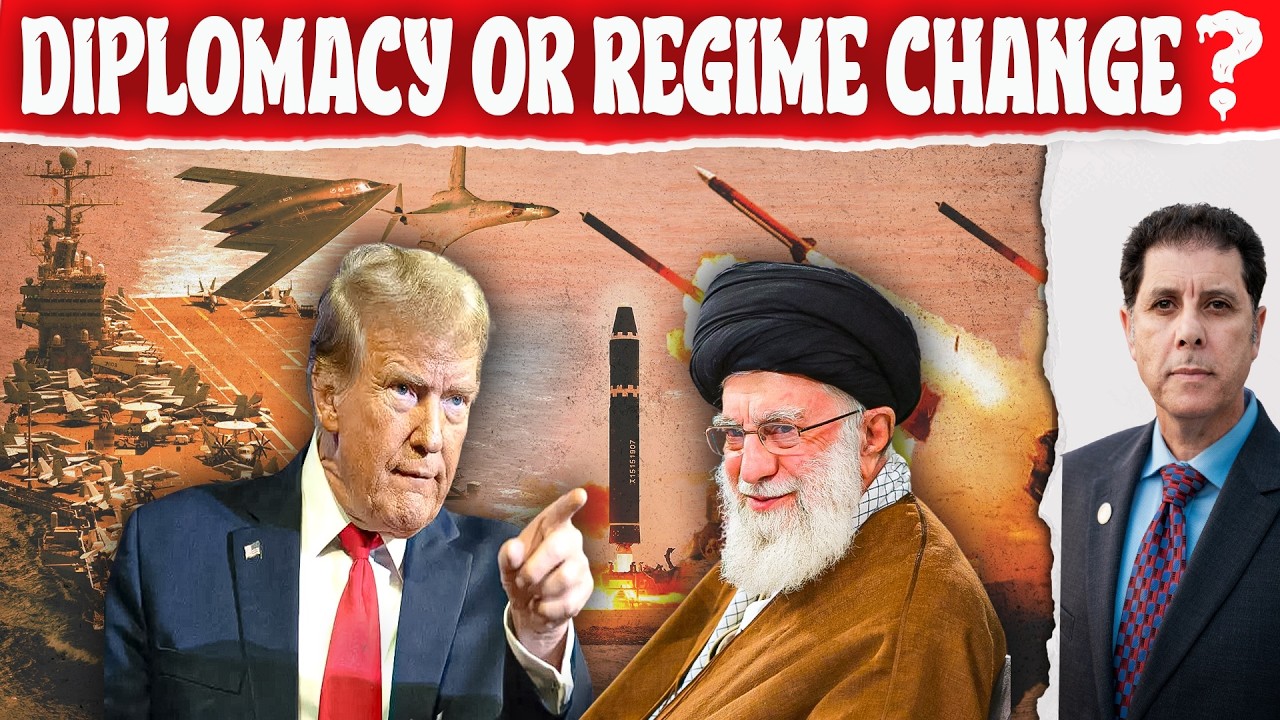
Trump says he'll meet Iran's Supreme Leader while pushing regime change. A military strategist breaks down why talks likely fail, and examines Russian and Chinese weapons flowing to Iran: S-400 air defenses, Su-35 fighters, and long-range radars that could shift the balance in the Gulf.
Chapters
Hello everyone and welcome to Geopolitical Trends, where truth matters. Mr. Trump wants to meet Ali Khamenei while simultaneously backing regime change in Iran and calling him, meaning Ali Khamenei, a "sick man," in quote. You can't negotiate your way out of someone planning your overthrow. That's just common sense. And this is why Mr. Trump is saying, you know what, I would like to meet with the Iranian Supreme Leader Ali Khamenei. But at the same time, this is the same Trump who tore up the nuclear deal Iran spent years honoring. So the logical question becomes is, why will Khamenei fall for it? Twice. And this is what I'm going to be providing you in this analysis, talking about, uh, whether diplomacy or regime change. This is exactly where the dilemma is going to be for Ali Khamenei. I will also share a clip with you from a military strategist, Colonel Fateh al-Falahi. Very, very insightful, uh, uh, assessments of him that I'm gonna be sharing with you as we move forward into this. Just as a background to those who do not know, Donald Trump has announced that he's willing to meet with Iranian Supreme Leader Ali Khamenei. And the question is, will it be possible given the current tensions that exist? And of course, we are— know sort of where things are. If you are to think about the willingness of Mr. Trump that he is open to meeting with Iran's president, Iran's Supreme Leader Ali Khamenei, he is like, sure, I would like to do that. And that's, by the way, confirmed also by Marco Rubio, Secretary of State. And he's confirming that Donald Trump prefers diplomatic solution into meeting with, with Ali Khamenei. The logical question that's gonna come into, can you trust the Americans? What if they want, they want just to withdraw Ali Khamenei from hiding, from his plan, not hiding, but his place, whatever he's at. And this is where you think about the major barriers, in my opinion, that will prevent this meeting, at least in a short term. Some. So you think about the military, uh, uh, uh, escalation or tensions that is. And if we go back to June 2025 when Israel, uh, struck multiple targets across Iran back then, which started back in June 13, 2025, and that in itself damaged some key nuclear facilities and of course killing, uh, several of Iran's top military leaders. Then you think about the deep mistrust that exists. Ali Khamenei himself has rejected Trump's offer to resume nuclear negotiations. Well, I'll say, Mr. Khamenei, if you are doing this, why don't you move forward with the nuclear program and be done with it? So you can't have it both ways either because you're putting yourself in a really, really bad situation. Because at least to Khamenei's thinking, there will be no negotiations if there is a deal that's gonna be accompanied by coercion or predetermined outcome, which what the US already put in as far as the Iran's missile technology. Because to Khamenei, and I agree with him in this assessment, when he stated that this is not sort of a deal, but rather an imposition and bullying, in quotes. And that was quoted inside the Time of Israel newspaper. Then you have the third element, which is the contradictory signals Donald Trump is sending. Because they are confusing. While Mr. Trump is open to meeting with Ali Khamenei, Trump has simultaneously backed regime change in Iran, of course deploying additional warships to the region. As a matter of fact, uh, the, uh, the, uh, USS, uh, airstrike group Gerald Ford, it's on its way, uh, to the region. And we're going to be talking about this in the clip that I'm going to be sharing with you. And that in itself raising tensions despite the ongoing talks, indirect talks between the US and Iran. Then the third element will be the harsh rhetoric of Donald Trump himself. Well, when you describe— this is Trump describing Ali Khamenei as a sick man who should run his country properly and stop killing people, in quote. This is Donald Trump's quote. He also added that it's time, in quote, "It's time to look for a new leadership in Iran," end of quote. And yet you still want to sit down with Ali Khamenei? The bottom line, the way I see it, is that while Trump expressed this willingness, maybe just for show, you know, the combination of these military preparations the mutual suspicion from each side, the, this Trump mixed messaging and so forth about regime change. I mean, we all know how these demonstrations erupted suddenly in Iran. Yes, there are economic conditions that needs to be addressed in Iran, but those demonstrations were sort of funded by outside elements. So this is why I'm seeing this face-to-face, uh, meaning it's a— it will require a lot of work. This, the escalations, the, the tone down of the rhetoric from Trump, you know, technically it's feasible, but I just don't see it unless Iran, uh, Ali Khamenei makes that decision, which will be, in my opinion, it will be a strategic mistake. What do you think? As a matter of fact, when— and thank you to those who participated in the vote when I did ask you a question. Truly appreciate you for that. We had about 1,600 or 1,700 voters that took place or took part of that vote. 12% of you said yes, meaning Khamenei should meet with Trump. 85% of you said no, heck no, and 4% of you said we don't know, which, which is logical answer as well, because you, you, you have to consider all the aspects that is going on. Now with this comes the question, at least for me on my end, Should Ali Khamenei consider this? I think he will be making a strategic mistake because how can he trust to sit down with Trump who was the one who pulled Iran, who pulled the US out of JCPOA in 2019? So the credibility, it's not there at all. So why would you wanna waste your time? Because how can you trust? Others are saying the opposite, the case for engaging. So why Mr. Khamenei might consider this? And again, I want to present you with both sides of the arguments and let you reach your own decision on that or conclusion. From purely strategic standpoint of view, If you are to think about this logically, not emotionally, there are arguments for at least exploring the dialogue. Because why? A meeting could allow Iran to directly communicate its red lines. It could also allow Iran to test Trump's actual intentions versus his rhetoric. And of course, there is a third element, in my opinion, that will be potentially negotiate from a position where the US administration has explicitly signaled openness. So if Trump, and we're gonna go with the argument that if Trump is genuinely interested in negotiated settlement, engagement might be the only way to find a diplomatic off-ramp from the current military escalation. But I am left to wonder, hypothetically, we go with that, then the next administration, let's say the Democrats come back to power or another Republican, which by the way, Americans have no choices anyway. They're stuck between two evil parties anyway. They don't have two, two coins, two faces of the same coin. So what if the next president will say, "Oh, I'm pulling out of that agreement with Iran." Because that's exactly what Donald Trump did in 2019. And this leads me to talk about the case against meeting with Donald Trump. That's why I said I wanna provide you with both sides of the argument. The first thing that's gonna come to mind, at least from those who argue in this position, is Khamenei's skepticism is deeply rooted in recent history and Trump's current posture, which is logical. And again, I find myself going back to the JCPOA 2019, the withdrawal of the US from that, because that is the elephant in the room. It was Trump, unilaterally, who withdrew the US from the JCPOA in 2018 and it entered into effect 2019. And calling it— this is what Trump said, it's on the record— "worst deal ever made," in quote. And what did Trump end up doing? He went ahead and reimposed hard sanctions on Iran. When you look at this from Iran's perspective, at least Iran upheld its end of the bargain. Regarding the agreement for years, submitted to inspections with the IAEA. And with all this, the US simply walked away when a new administration took office. This is again my concern looking down the road. If Ali Khamenei decided to sit down with Trump and let's say reach an agreement, whatever, there are no guarantees. Because our system doesn't, doesn't work on honor aspects of it. We don't honor agreements. And that in itself, this argument demonstrates the fragility of any US-Iran agreement not deeply embedded into international law or multilateral frameworks. But even if you go with that argument of international law, You know, look what we've been doing in Venezuela. Look what we've been doing elsewhere. Where is international law? So beyond the GCPUA precedent, there are current signals that should really, in my opinion, concern Ali Khamenei prior to making this decision, because it will be, it will be a major, major undertaking should he decide to go that route. So some of the signals, for example, you think about the Trump mixed and contradictory messaging. While publicly open for meetings with Ali Khamenei, it's Trump himself that is simultaneously backing a regime change. As a matter of fact, the Shah, the son of Reza, the Shah who was the one who is pushing for regime change in Iran, just met with Zelensky in Munich during the Munich Security Summit, which is laughable anyway. And when you have Donald Trump deploying additional warships to the region, raising tensions despite ongoing talk, to me, this is not the posture of someone who wants to negotiate in good faith. This is the posture of someone who is pursuing confrontation and negotiations at the same time, which is very odd, to say the least. Then when you get into the personal insults of a head of state, when Trump described Khamenei as, and I put this in quote, "sick man who should run his country properly and stop killing people." In quote. Yeah. How can you call for foreign regime change while simultaneously proposing meeting with the head of that country? Which is contradictory. And that in itself signaled to the Iranians that Trump may be using negotiations as a cover for other objective. Khamenei will have to be thinking in these terms. And the third point in this is Khamenei's own assessment, which I want to share with you, thinking outside the box. So this is why most likely Khamenei will reject— he may already reject Donald Trump's offer, saying that if a deal is accompanied by coercion and predetermined outcome, then that's not a deal. And this suggests that Ali Khamenei viewed the current dynamics that's taking place as one where the United States will impose terms rather than negotiate them. And that's to me where the big issue is. Is Ali Khamenei make— is— will Ali Khamenei be making a strategic mistake if he goes forward with this? Of course, there are those who are saying, well, yeah, you are absolutely correct about the strategic mistake aspects of it, but we're going to have to look at another aspect. And that other aspect is what? To avoid military escalation that could lead to war. To preserve Iran's nuclear program, to refuse all engagements that could be costly. Because if escalation spiral out of control, it is going to take its own course, its own momentum. I'm here to tell you that's going to also lead to complete diplomatic isolation, and that in itself will remove any possibility for negotiated de-escalation. But on the other hand, there are those who saying, then what does Iran have to lose? This is not at all. Another word, we have to understand the history of the Persian Empire. You go back in history, you won't be able to defeat them. Just look at history. The same argument I made back in 2002, my first time I landed in Afghanistan. And the argument was, what are we trying to accomplish here? Defeating the group? There is no way. No major power was able to conquer Afghanistan. Look at history. Ask the UK, ask the Soviet Union, and now ask the Americans. Ask Alexander the Great. Himself couldn't conquer Afghanistan. Only, of course, a lot of people did not know that our presence in Afghanistan wasn't about Afghanistan. It was about the Caucasus, exactly what is happening now in Armenia and Azerbaijan and so forth. That was the whole objective for why we went there to begin with. But that's a conversation for another day. And this is where you're going to have to think in terms of If the goal is, if the objective is to avoid being drawn into an agreement that Trump can unilaterally abandon, as he did back in 2019 with the GCPOA, or avoid legitimizing the regime change discussions by appearing some sort of, oh, I'm willing to negotiate under coercion, Benjamin Netanyahu's caution makes more strategic sense. And knowing what I know, because I wrote a book about Iran, I had to dig into the sensitive information, shall we say, not the classified one. I can't disclose all that, but the idea of understanding that Iran's thinking is pragmatic They don't think emotionally. They are very rational. Ali Khamenei is. Now, do I agree with him on everything? No, of course I don't. But again, that's his prerogative, not mine. Suffice it to understand in this argument that he has some common sense as to why moving this direction by agreeing to meet with Donald Trump will not be a good way. A good one. Because here's the thing: a weakened negotiating position from which you can only accept unfavorable terms is often worse than negotiations at all. This is exactly what Ali Khamenei is thinking about, strategically saying. And you add to this is the trust question. And this worth addressing once again, the JCPOA precedent is genuinely damaging to any Trump-Iran deal prospects. I've argued this the moment United States withdrew from the JCPOA. As a matter of fact, when I wrote my book, the, uh, the Iran book I made an argument for, does Iran have any Plan B in case the US pull out of the JCPOA? Knowing how the administration operates, I said to myself, no, I'm not going to rule that option. So I'm going to write it. I know some disagree with me. Oh, no, now Iran has reached a deal with everything is going to be No, no. And here we are. And this is why Khamenei learned that the US administrations, not the Donald Trump administration, the US administrations, meaning the subsequent governments, can simply disregard agreements. And that is going to leave Iran with the cost of compliance but none of the benefits. And that, that is what's at the heart of negotiations to begin with. If you can't benefit from the negotiations, then what's the point? Because it's already creating credibility issue for Donald Trump's proposal, this new proposal. How can you do that when you don't have your lack credibility? And that in itself transcends Donald Trump himself. So even if Donald Trump personally honored an agreement, like I said at the beginning, a future president could withdraw. That is one of the downfall of our system. So the only way around this is to have the deal embedded within the UN Security Council resolution. Or backed by other major powers in a way that makes the United States withdrawal costlier. But at the same time, are you going to trust the UN? Are you going to count on the UN Security Council? No. When you have 5 permanent members that control everything. So suffice it to say for this, Trump's track record And current rhetoric suggests that Ali Khamenei will not be interested in that kind of constrained agreement. And I can see the logic of it. And my own assessment is that if Ali Khamenei is thinking in this term, then his skepticism is rational, is logic, given the history and the current signals. What I am questioning is whether a complete refusal or even meet foreclosure's information may be strategically limiting if Iran genuinely wants to avoid further escalations, unless Iran is ready for that, militarily speaking. And I'm gonna get into the military aspects of this conversation. So the middle ground where we are, The low-level exploratory talks that's going on right now through intermediaries, that means the OMAN, rather than high-stakes summit, might be sort of a cautious and prudent way, sort of until clear signals emerge about really Trump's actual intentions. That's to me where the hard question is, and we ought to think in these terms. Now, one of the aspects I want to bring into this conversation has to do with the two other countries, Russia and China. Yes, I am, I'm bringing this into the conversation here because it's worth your time understanding and knowing what is going on. So So the question I'm asking is, how do Russia and China assess these developments? Will they assist Iran militarily? This is, in my opinion, a very, very crucial question. I know, don't— we don't, we don't jump to conclusions right away. Why? Russia is not doing anything, China is not doing anything. No, no, no, no. That's the reason I'm talking to you, because I found out. I have my ways of finding things out. I found out that there is delivery of military hardware to Iran, and I'm going to share pictures with you. So make sure you stay with me here. And once again, this is a very, very crucial aspect into understanding this. Let me play this clip quickly here, and I'll resume my talks. Liking this video so far? Don't just be a watcher. Go ahead and hit the like, share, and subscribe button, and don't forget to tap the bell so you will not miss any of my videos or live streams. This way, you will be supporting a channel that stands for the truth and objective reporting. The choice is yours. Thanks for your support. All right, let's talk about this. As I said, it's crucial question. Why? Because this question is related to the broader understanding, the broader geopolitical picture. Because what we are witnessing right now is the change of the geopolitical landscape in the region. This is not about just Iran. You have Russia and China, you know, they've shown some sort of support, but at the same time, cautiously. About direct military assistance to Iran. And when I say direct military, I am talking about openly, publicly. That is what I'm referring to here because there are two things you need to understand. Iran-Russia 20-year comprehensive strategic partnership, which was signed in January 2025 and entered into force in October 2025. And that in itself focus on 3 aspects. One is economic, as a matter of fact, 4. One is economic, the other one is defense, third one is political, and the fourth is sanctions evasion ties. This is on the Russia side. On the Chinese side, the Iran-China 25-year Comprehensive Cooperation Agreement, which was signed in 2021. That one in itself emphasized trade, infrastructure, energy, and the Belt and Road Initiative projects. There is no mention of a military. Okay, but just remember this as I move forward. No military dimension mentioned in the agreement. So I'm going to do one by one. I'm going to do Russia first, then I do China first, and I'll play the clip for you after I show you certain military hardware to put it in perspective. Russia's assessment and possession as of now. The idea is what we need to understand is that both Russia and China are providing, as a matter of fact, military assistance to Iran. So, so I'm going to start with Russia. Russia— there are reports, and I'm going to provide you the links— there are reports this year, earlier of this year, that Russia has provided Iran with certain type of advanced military equipment that include the S-400 long-range air defense systems. And as a matter of fact, Iran went ahead and put these systems near Asfahan, to my knowledge. I think they're still testing some others, but they already did that. So the S-400 systems has already been stationed, as I said, near Esfahan and have been operational for tests. That's one. Second one is you have the electronic warfare systems, and this not new. This was in August after Iran was attacked. So what did Russia do? It confirmed— as a matter of fact, Iran confirmed this as well— that Russia provided Iran with advanced Kashchurska. Let me share a picture with you here of the— right here, this is a type of the Kashchurska, the Russian system. This is an electronic warfare. I was in the second in my unit in, in the MI. So those are very highly advanced, and the systems are to combat radar and satellite signals. There's another one here. So Iran is already in possession of this from Russia. Okay, then there are aircraft. The aircraft that I am familiar with is the Su-35, where the, the difference is regarding this is that the Su— the Sukhoi Su-35 jet, of course, the objective of it was to modernize Iran's Air Force. However, the deliveries have been delayed, are on— as a matter of fact, some of those planes are still in production, while some other types have been already delivered. But this type of aircraft are advanced systems. This is from the Russia side of aspect. There are other types that I came into finding out. One of them is the Mi-28NE attack helicopters. I'll show you pictures here. I confirmed it. Iran has received and is confirmed as early as this year. Then you have the MiG-29s. I don't have it. I'm sorry, I forgot to put a picture for you. I only put the S-400 systems. No, those are Chinese, and I'm going to get into that. The MiG-29. And of course, Russia sent a large number of military transport flights to Iran. No reports was disclosed to all of this. This is why I want to just put this in perspective for you. If we go on the Chinese side, how do we see it? The first thing to come to mind is that the Chinese are very cautious because China's primary concern— what is, what is China's primary concern? Is the security of the oil supplies. Because remember, China imports about 40% of oil that goes through the Persian Gulf. Let me put this in a map for you. For China, 40%, that's substantive. If that is interrupted, it's going to create some— not major issues, I'm sure the Chinese have reserve stocks, but still it's going to create a problem. Because think of it this way, should this escalate to a war, every strike either from the US or Israel on the Iranian infrastructure, it's going to harm the Chinese oil imports or even Chinese economic interests. And that in itself, because China has access to discounted oil Already they're getting some from Russia, but also from Iran. So disrupting any of that, either overland trade routes or the sea, is going to be a problem because anything overland is going to be tied to the BRI also. That will be a problem. However, the Chinese didn't stop here. Yeah, they said we recognize and we are cautious about this. But we're gonna do something militarily. Here is what happened, and it's not reported openly. You have to know where to look, and I have the link for you. At least 16, 16 Chinese military cargo planes have landed in Iran. I'm going to show you the plane. Uh, this is the military transport. This is for heavy cargo stuff. So 16 reported in Iran over roughly 56-hour period in late January. Usually this large, this large, you know, unusual for a large airlift that coincided with de-escalating tensions between Tehran and Washington. So to those who say, you know, you have to remember those countries, Russia and China, because all those three, Russia, China, and Iran, that's considered the sort of the pillars of this new multipolar order. Believe it or not, Iran might not play this major role, but it still play enough role to influence the events in the region. And multipolar order, it's based on those three. That's why China is calculating strategically that they're gonna do this particular aspect. The flight themselves have not been widely reported. The interesting aspect is that both— neither Iran nor China confirmed the nature of the cargo. And at the same time, it was during the time when the Iranian Foreign Minister Abbas Eravji was warning of retaliation. It was during the same time those cargo planes were coming, the military hardware, and that's what he meant when Abbas Erakchi stated, and I quote because I remember him in his briefing, when he said, "We have our fingers on the trigger." That's a subtle way for him that we are prepared. That means that's when the Chinese were delivering the hardware. And that's also when Abbas Erakchi added that Iran will respond immediately and powerfully. Those are measured words. Those are measured words. I do believe those statements. I didn't want to make a comment on it at that time because I wasn't sure. You don't say something like this unless you have something in place to counterattack or deal with the US strikes and became now evident to me. That's what it is, the deliveries of the, uh, uh, uh, advanced systems from both China and Russia. So let's look at, uh, uh, as a matter of fact, let me put, uh, the link for you in the chat box for those who wants to check out on this. You can read it, uh, later on if you decide to do so. Now let me share with you what China delivered to Iran already. First of all, China has upgraded Iran's air defense system by supplying the HQ-9B. I'm going to show you a picture, uh, HQ-9B right there. This is the Chinese HQ-9B air defense systems. This is surface-to-air missile systems. Okay, that's, uh, almost, almost similar or compatible— longer range SAMs comparable to Russia's S-300 missile systems. But Russia already delivered 400 missile systems in July 2025. So, and we're staying with the Chinese here. The, the Iranian have the Iranian government officially confirmed the integration to replace the losses from the Israeli strikes with what the Chinese provided. China has also deployed the YLC-8B long-range surveillance radars. Let me show you. If I did this one, I don't know. I didn't. My apologies. This is just the Iran cargo, the Chinese airplanes. Yeah, I didn't. I'm sorry, I forgot. I forgot to put the picture for you. And why is this important, this type of range surveillance radar, long range? Because those have the capability of detecting stealth aircraft like F-35, which usually, should the US move forward with a strike, F-35s will be deployed into this. Iran— uh, I'm sorry, China already sent those to— to send those to Iran. China also sent or shipped missile components. Those are solid fuel propellants in addition to guidance systems. That's why I said last time on my livestream, should this strike happen by the US, this war, it's going to be with planes and missiles. Because first of all, we can't afford to have an invasion, a ground force on the Iranian soil. There is no way. And the reason why China is sending this particular, the two examples of the missile components, the solid fuel propellant and the guidance systems is for Iran to rebuild its ballistic missile production lines. Because remember, Iran already developed or declared or confirmed the Khorramshahr-4, the ICBM, solid fuel. So this is the reason for that. So the Chinese are ensuring that their interests are protected somehow. They are supporting an ally because to them, meaning to Beijing, if Tehran is in a much stronger position militarily today than it was on June 13, 2025, when Israel launched the airstrikes. And this is again the importance of understanding this dynamic. So I'm gonna play a clip for you and I'm gonna do the translation. It's quite long, but I'm gonna cut it short. We just, uh, want you to hear and understand the key aspects of this one. So let me, uh, okay, and I'll be stopping it as I move forward., when we, uh, for me to do the translation for you. All right, let's start here. The military deployment is, uh, sort of, uh, nothing has happened like this before. This is unusual for this massive deployment. In addition to the military bases, you know, his reference here is to this particular right here. Oh, I'm sorry. Yeah, this is the U.S. bases, and that's what he's referring to in this particular talk here. Because you have now the show of force, and you have the missile testing. All of this draws some sort of a picture that something— that means the region is standing on a cliff of a new sort of phase of its existence. This development, we're going to be talking to—
he's a colonel.
His name is Hatem Karimi al-Falahi. I'm aware of him. He's been in military for a while, and he is solid and credible and knowledgeable.
He's a military expert and strategist. Welcome. We are talking about a large theater that reminds us of what happened in June 2025.
It's a great geography. It's a great geography that this confrontation is going to be facing. Indeed, we are talking about a large theater. We're talking about the American deployments. We're talking about the military deployments near the Mediterranean, in the Mediterranean Sea. In addition to the Red Sea, in addition to the Arabian Sea in this particular location. You have the aircraft carrier, you have the destroyers, then you have the home base of the Fifth Fleet in Bahrain. In addition to that, you have another deployment of military assets in Azerbaijan. And Armenia. We're talking approximately up to 40,000 troops in these regions. In addition to aircraft carrier that is already there and the one that is going to be joining them soon. And it's going to be arriving within next half of next month, which means now we're talking about an air and sea deployment, a major deployments in the region. We talk about the aircraft that is already there, which is Abraham Lincoln. This is what you see on the screen, is the aircraft carrier of USS aircraft carrier Gerald Ford, which is on its way to the region, is the largest military piece known to humankind. It's on its way to the Middle East to be added to the deployment in addition to other assets. Uh, by the way, this is where I wanted to wait until I, uh, share as I do the translation, because I want you to pay attention to what has been delivered from the Russians and the Chinese versus what the US have there. That's why I'm saying If this conflict should move into— it's going to be based on planes, missiles, drones, and all that. It's very, very important to understand these aspects here. So let's continue here. You have mentioned Armenia and Azerbaijan. There is the deployment of assets there. All this, it's an indication of what might happen with this American deployment. What are the scenarios? Of course, with the deployment of an additional aircraft carrier, that's going to give some strategic, uh, proof or signals. First is that the Americans are exercising the extreme pressure, extreme pressure in stating that they will use force, military force. Because military force is one of the tools in foreign policy or political scene. So what the US is trying to do is to move as much as it can of military assets into the region. To add to this, there are more than 150 aircraft, aircraft, the transport, and the transport that have arrived to the region, including the C-17, because those planes can carry up to 70 tons of cargo. And more than 120 soldiers. That means there is a massive deployment of US forces to the region. So when we talk about this kind of capabilities, we're talking about some technological advancements. That means it gives the upper hand for the deployment of air assets for the US and massive destruction capabilities. This will not work if it weren't for the calculations of the defense aspects of this. In other words, for Iran to have some defenses of, of sort. What you're looking at right now on the screen is F-15. This aircraft can launch missiles that is laser-guided. And the Americans have tested already this particular missile. In the Red Sea, they tried this one against the Houthis. As we see on the screen, this plane is launching this missile. —and it destroyed the Shahed, that's the drone, Iranian. And he has launched many of these type of aircraft recently. Each missile, each missile cost between $15,000 and $20,000. All this, even for the plane itself, it costs so much. Will this be in the sense of destroying the Iranian drones? If we are to talk about the Iranian plan or the possibility of what it can execute, first, we're going to have to talk about different phases of this particular The first plan or the first phase will be about the containment of the US strikes. And that's when the mursheed, meaning Ali Khamenei, when he said, we will not strike first. That means the first strike, it's not going to come from Iran. It's going to come from the US or Israel. He just— the anchor, he's just saying this is the missile that we talked about earlier that is laser-guided. The second phase will be about the missiles and the drones. You swarm the enemy with missiles and drones, which means it's going to be used mainly from Iran in a greater scale. The third phase will be the use of allies, meaning for Iran. That means there are other fronts that's going to join the fight or getting involved in the fight. Then it becomes the economic choke, which means the shutdown of the Strait of Hormuz. In addition to the closure of Bab el-Mandeb. —which means that could landmine or undersea mine that will be planted in those particular locations—or it will be the use or deployment of missiles that will target those naval assets, especially when we talk about strategic choke points. And he's pointing to That's, by the way, guys, just under the southern part of Yemen. That's where he's pointing at. And what the US will hope is to maintain this passageway open. And this, of course, for the, the, for the, uh, the, uh the goods to be delivered to the rest of the global market. Which means that the Iranian plan, it depends on different phases. And this in itself is going to present a major challenge to the Americans. Despite the US high-tech and all that. Some have said the Americans have found a solution to all this. By deploying, this is what's called al-wash logistic. I forget the word in Arabic. It'll come to me. This is KC-135. It's a recon plane, by the way. Now, this plane has the capability of sort of rendering or sort of impacting the radars. There are radars for communication and the radars for defense. This plane was deployed in Venezuela.
And now it is deployed. It is deployed in the Middle East.
What is the significance of this, and how the Iranians are going to have to deal with this? The US has 2 planes of this type. The evil spy, I think spying evil or something. Al-wash, I forget the word for it in English. This plane has a long radar, the range of it. That's what he meant. This radar has the capability of sort of malfunctioning other radars in the area, especially for the air defense systems. In addition, it has within it the electronic warfare capabilities. This plane consists of some very, very limited specialists that's going to be in— You have officers for the electronic warfare. You have 4 officers that deal with impacting the radars for air defense systems. And you have 6 engineers that deals with impacting the radars as far as jamming and so forth. Because this plane will have the capability of rendering the air defense systems sort of useless without using any weapons whatsoever, except it uses electronic warfare. And that will pave the way for— and I'm gonna stop right here because it's, it's long. And that paved the way for the US aircraft to get in into Iranian airspace. That is the point of why I wanted to share this clip. This is why Iran end up receiving those type of systems, the, the, uh, the HQ-9B surface-to-air missiles from, uh, the, uh, the Chinese, it receives the electronic jamming systems from the Russians. All this was for a reason. And that is exactly how you see this playing out. This is— and it's gonna become— as to how far this is gonna go, nobody knows. Nobody knows at this point. The one thing I know for a fact is that Iran or the Ali Khamenei arguing that because of Islamic duties we cannot have nukes, whatever, that, that's just gonna hinder his ability to protect Iran. After all, a leader, the role is to ensure the safety and security of its people. Once again, I find myself going back to North Korea's For example, there is a picture here of Kim Jong-un with— by the way, that's his daughter. There is now a conversation inside circles here in Washington as to whether he is grooming his daughter for leadership position down the road and not his sister. Will that create a problem or not? That's beside the point. My point in this is that ICBM you're looking at, which is nuclear-tipped. That's when, when North Korea went ahead with this in 19— in 2005, when they declared their nuclear capabilities, the calculations for the Americans have changed. And that is again where I see Iran is making this particular mistake. Yes, the assistance of Russia and China is, is It will make a big difference, but also there is a limit how far Russia and China will go because they are not gonna sort of sacrifice their people on behalf of Iran. It just doesn't work that way. Just doesn't work that way. It's like what we do when you look at Ukraine right now. Are we sending our troops? Yeah, you might send the trainers, whatever. Hypothetically, if there is a war in South China Sea, do you think we're gonna be fighting there? No, you're gonna use the Japanese, the South Koreans, the Filipinos. And even Australians and so forth. And this is again where you have to think into the sort of how Russia and China see Iran, especially from a strategic perspective, because to them, to Russia and China, Iran is a really very useful strategic tool, sort of to complicate the US power projection. Whether we can go as far as saying, well, is Iran can be considered a core strategic ally for them? I don't know. What do you think? Is Iran, in your opinion, a strategic ally for Russia and China that is warranting existential commitment? Another word, to go to war for. And that's why, in my opinion, the way I see it— and I'll conclude with an excerpt from my book about this particular aspect— is that I see Russia and China playing a careful game, providing enough support to maintain their— some sort of protect their economic interests in Iran, but not as much as the trigger, the direct a US confrontation. It's not that they're scared of the US, no. It's just, it's not worth it to them. That's how they're gonna see it. And this means at the same time to Iran, it cannot count on them for the kind of military backing that will deter Israel and the US from military strikes. And that is exactly, to go back to my, the beginning of this livestream here, This is exactly the limitation that is now Ali Khamenei is evaluating as he contemplates the Trump potential offer here. Because Ali Khamenei knows for a fact he cannot expect the Chinese and the Russians to send their soldiers or intervene to back him up. Militarily. That's the way I see it. What do you think? So here is my excerpt from, uh, my last book, and, uh, and I will conclude with this one. Here is what I wrote back then. You know, some argue that North Korea never trusted the IAEA, the International Atomic Energy Agency, viewing it as one of America's tools for executing the West's mainly the United States' hostile policy towards North Korea. This was evident when on February 9th, 2005, the DPRK announced its possession of nuclear weapons. The debate then suggested that after North Korea released the news, the United States would shelve some of its military plans against North Korea, lest the U.S. military forces or interests in the region come under attack. I am convinced that Iran will have followed the North Korean model if negotiations with the P5+1 has failed. Yet I argue the failure of the negotiations was not an option for not only Iran, but also China and Russia, the main beneficiary of Iran's nuclear agreements. And that depends. So let me know what you think. Please make sure to share your comments in the comment section. I would greatly appreciate it. I take this opportunity to say Happy New Year, Happy Chinese New Year, which is the Year of the Horse, to all my Chinese viewers if they are here. Or to those who celebrate. So I want to just, uh, for a tradition, to wish you a happy new year. I take this opportunity also to say thank you and give a shout out to Eric Ko for your PayPal donation, a massive generosity. I am— your generous donation, rather. I'm very, very grateful. And I also want to say thank you to Charles DG for, uh, your buying me a cup of teas in support of my upcoming Asia trip. So to those who wants to support the channel, here is the link should you decide to do this. You all know I don't have sponsors, I have you, the community. I will be grateful if you can support the channel if you decide to do so. And here is the link to my upcoming Asia trip. I do plan on heading out there Uh, we are so far at about, uh, uh, 16%, uh, 17% now. I need to update this one here. I would greatly appreciate it. Uh, to those who might, who might be interested in, uh, reading, uh, my book, uh, Volatile State: Iran in the Nuclear Age, I'm gonna share the link with you, uh, for that one if you wanna Banner. Here's the link. Here's where you can get the, uh, the book if you want to get a copy of it. So you can get it there. All right, hope you all enjoyed it. Make sure to leave me a comment. Please, please don't forget to subscribe and hit the like button. I will greatly appreciate it. Let me remove this picture here. And I look forward to seeing you next time. As always, remember, geopolitics impacts your daily life in more ways than one. Till next time, bye-bye.
More from David


Beyond the Single Actor: Why the Gulf Isn't Choosing Between the US and China


Iran, Iraq's Militias, and the Houthis Are Coordinating! This Changes Everything




Who Controls the Next Decade's Resources? Latin America and Africa's Geopolitical Crossroads

The Chokepoint Trap: How Washington's Stupidity Triggered a Cascade That Now Controls the World

Trump Spooked as IRGC Unveiled dual-use SLV, Deployed Ghadir Mini-Subs & Hinted at Tactical Nukes!
