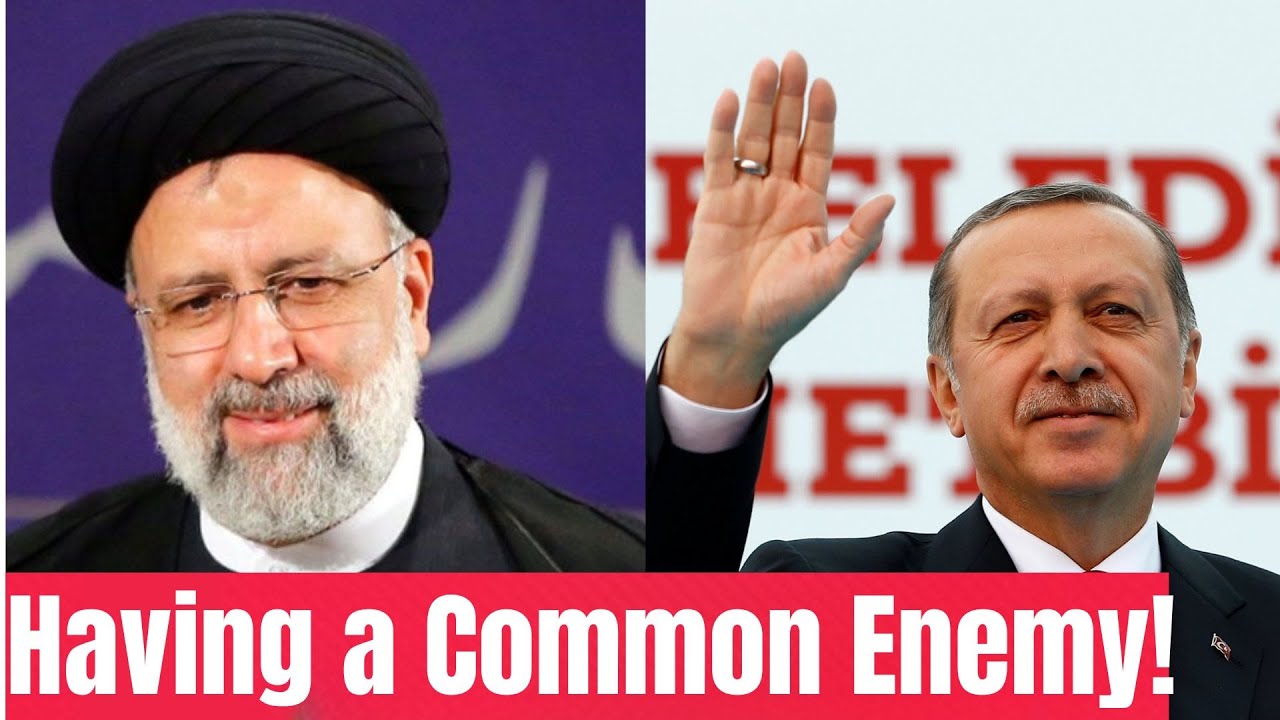
In this live Geopolitical Trends broadcast, host David Oualaalou greets a global chat audience before diving into a detailed analysis of Iranian President Ebrahim Raisi’s official visit to Turkey. He frames the visit as a seismic shift in West Asian geopolitics, occurring just months after Iran‑Saudi diplomatic rapprochement and against a backdrop of the Syrian civil war, the Gaza‑Red Sea crisis, and NATO tensions. The host links the event to broader dynamics: UN Secretary‑General António Guterres’ response to an International Court of Justice (ICJ) ruling, Algeria’s push for a UN Security Council meeting, and the United States’ sudden pivot toward African partners in response to China and Russia’s growing influence. He then provides an extensive geographic and historic overview of Turkey—its trans‑continental position, the strategic Incirlik nuclear‑weapon base, NATO membership, language reforms, Kurdish minority issues, Ottoman legacy, and a series of coups—illustrating why Turkey can act independently of NATO when its national interests dictate. Economic considerations, especially a prospective Iran‑Turkey gas pipeline, are highlighted as another layer of cooperation. Throughout, the host emphasizes a multi‑dimensional analytical framework (economic, financial, social, diplomatic, security) and speculates on how the United States might respond to a Turkey‑Iran alignment that could marginalize U.S. influence in the region. The stream ends with a reminder that geopolitics affects daily life and a promise of further analysis.
Chapters
All right, hello everybody and welcome to Geopolitical Trends, where truth matters. Today is January 27th, so the weekend is here. So hope you are having already a good weekend, time to chill out and relax. For me, it's a working day, that's how I look at it, because of the responsibility and the duty. Let me share something with you from the get-go before I'll get into something. I got a comment from somebody that's saying I take too much time saying hello to everybody. Now, how stupid that is. This person needs to learn how to meditate. Maybe this person needs to learn how to sit still. Maybe this person has a deficit in patience. So whatever there is, so— and I usually don't waver from this kind of stuff. I will push back because It is a responsibility the way I look at it towards the community, you guys. So I will say hello to you, I will say thank you, and if these people don't like it, they can get off. They'll do me a favor because they won't belong here. So that's how I look at it. So I usually don't like to be harsh in my words, but I don't shy away and I don't mince words either. That's my personality. Anyway, good to see you all. I'm very excited to be with you. Let me say thank you to Jennifer Lee. I haven't seen you for a while, but Jennifer Lee, by the way, guys, has been an avid supporter of all channels before, and he was the first to buy me coffee. I remember, I remember the names because I have the record right here. So, so thank you very much, Jennifer Lee, and good to see you as always. Full Tilt Boogie, good to see you joining me here live. Uh, Willie Holman from West Memphis, as always, thank you for being here. Uh, Chanel, good to see you from Washington State, good to see you as always. Phil, good to see you from Ottawa. Cody Leonard, here he is. And Cody, thank you very much for your contribution to the conversation. I've been reading your stuff, so I'm very grateful to you for that. So so. Uh, Karakulak, good to see you as always. Poyang, good to see you from New York City. Uh, Dr. Freeman, uh, I remember first time here. All Muslims must unite. I agree with you. Unfortunately, they don't have that kind of determination to do so. Nasser from Sri Lanka, good to see you. Uh, please talk about— who's saying this one? OM, please talk about Central America and South America. I will. Yeah, I don't talk enough about that, so I'm glad you brought this up. I will dig, take a look next week, see what's going on, something worth your time or reading or hearing about, and I will address that one. So Phil, as always. Daniela, Daniela, good to see you from the UK. Mo Julie, Matt Julie, I'm sorry, from Congo, good to see you. Alan Roy, Roy from Montreal. Francis Tango, good to see you. Juan Kisi, good to see you from Malaysia. Uh, oh, here is one we have. OM from Honduras, good to see you. I've been in Bolivia before. See guys, that one there, this one here, I'll share it with you. This is from Bolivia when I visited Bolivia. I bought one there just as a souvenir to remember, but that was work related. I wasn't like tourism or whatever. So, so I will do Latin America for sure. So Timeline Dunkley, good to see you from New York City. Uh, uh, Stock Static Khalid or, or Zalid, hello dear professor. Hello to you as well. So, uh, Ahmed City, good evening to you, evening your time. And thank you, by the way, Hamed, for buying me cup of tea, more than one cup. Thank you so much for that. Elizabeth Reyes from Santa Ana in California, good to see you as always. All right guys, let me tell you what I'm going to be talking about today. Of course, the visit of the Iranian president Raisi to Turkey. Now, if you only know the tensions that existed, and, and, and, and listen carefully, I didn't say tensions that exist, tensions that existed in the recent past. We're talking about just few years ago during the height of the tension, the civil war in Syria. Why? Because Turkey is in one end and Iran is on the other. Turkey wanted at that time to, uh, have the Bashar Assad regime removed. Iran saying no way because that is our clients. And now all of a sudden you have the Iranian president visiting officially. I'm going to share a clip with you from another YouTube that I came across, just to share the, the, the clip with you. Is not mine, uh, just for you to see. So this is what I'm going to be talking about, because there are geopolitical, uh, uh, uh, consequences to this visit because it coincided with the shift that is taking place. And speaking of, uh, the shift, I need to let you know where I'm gonna be right after this one here. You guys can join me on this because I'm gonna elaborate more on certain things. You can just see there, the— that's the link. Some of you said the link doesn't work. Well, I tried it, it worked. It depends again. So, and let me, let me put it for you guys in the chat box. So you— this way you have it. All right, chat box right there. And here we go. So you guys have that there, and we will, uh, we will be, uh, addressing this. So, uh, also I need to, uh, share with you the questions as to why is this important, because here you're gonna have to ask a question. Or questions. How significant is this visit to Turkey? Because it came on the timing of it, really, with what's going on in the Red Sea, what's going on in Gaza, what's going on in the, in the whole region. When I say West Asia, Middle East, whatever term you want to use, but also came with what's going on with NATO, for example. It's like what I just discussed this morning on the video that I released this morning. All this ain't happening in vacuum. Add to this something that is not reported yet. I came across— I'm gonna follow up on it— in Africa. Now the US is expanding its support for African nations all of a sudden. Well, Africa, sad to say, and I'll say it, has been the forgotten continent. It was never a priority for the US foreign policy till they saw, they Washington establishment sees now what China and Russia doing in Africa. All of a sudden we wanted now to support African nations. I don't think so. African nations will trust us anyway. We don't have credibility. We can't be trusted. So, and by the way, I had someone made a comment— that's why I read them, guys, to learn from Somebody wrote a comment, my first time here, and if this is an anti-US, anti-West, I am not going to subscribe. How stupid that is. So I answered him back, and I said— I answered him or her, I don't know— and I said, well, it's not anti-US, it's not anti-West, it is about objectivity and truth. Simple as that. So, so anyway, those are questions that you ought to think about. Does the visit hint at a change in dynamics in the region? And again, I'm going to be sharing briefly with you my own analysis that I did in my Iran book right there, because I, I, I— what I'm seeing now, guys, on, on, on the ground is what I addressed few years ago. So you kind of be ahead of the curve, but that's what you do as a geopolitical analyst. This is not about assuming This is not about just, uh, maybe whatever. You— it's your best judgment or assessment that is based on facts, and those facts are tied into the economic setting, financial setting, uh, social setting, diplomacy, international affairs, security, and so forth. And the last question is, what will the US do? Yeah, because you can ignore this one. I am sure we were— wait, when I say we, where I'm referring to the whole government for that, even though I, I don't, I don't buy or believe in what our government is doing anyway. It's, it's, it's going backward. But when, when I said we, that's what I'm referring to, is the idea that we've been watching like hawks this visit because we know this comes at a time in a shifting dynamics in the region, not to our, uh, uh, fortune, if I may use the term. And that's why it's important to ask those questions, because without them we can't just talk in, in, in, in the void, because that, that's not going to work at all. So, so before I'll do this, let me jump into, like we always do, a tour around the world. Few, few headlines here. Some I'm going to just share pictures like I always do. I'll talk about them on the other location soon. So, so let me share a picture with you first. Uh, this is for Mr. Guterres. He is the UN Secretary General, and here is what he's saying. Uh, UN Secretary General. So what he's saying is that he would immediately Listen carefully, guys. He would immediately transmit the notification of the ICG, International Court of Justice, interim measures to the UN Security Council. He's just doing his job. I'm sure he's going to be attacked verbally by the Israeli, uh, ambassadors to the UN because they already did, you know, and that's to me pathetic. The guy to win his job. So we will push for him to do so if it were the other way around. So why now? So it will be very interesting to see, uh, because, uh, Guterres affirms that the decision of the ICG are binding and is confident that all parties will abide by them under the UN Charter and the regime under which the court was established. You all know the history of the UN, how it came to be. So if we start to be cherry-picking, which we already did— you look at what happened, uh, with the US vote last time regarding what's taking place in Gaza. Uh, next one, next one. Uh, I'm gonna just share picture. Uh, maybe I need to give you at least a context with it. Uh, this is, uh, yeah, let's, let's save this one for later because this one is from the, the deputy military spokesman for the HI group. So, so, and I'm gonna detail this later on. And the last one I'm going to share is this picture. This is the ICG, of course. Uh, this one is, uh, has to do with, uh, the reaction, the reaction to the decision, uh, uh, issued by the ICG, which was yesterday, by the way. So here's what's interesting about this, this decision one country in the Muslim world, that's Algeria. So the president of Algeria, Abdelmajid Tebboune, you know, directed— listen carefully— directed his country's permanent mission to the UN to request a convening, to request the convening of a meeting of the UN Security Council as soon as possible. So there are two tracks to this. There's the track that the UN Secretary-General will have by law and the Charter of the UN to present the finding of the ICG, because ICG falls also under UN. He has to present this to the UN Security Council. Now, when you have another member— now, uh, the Algeria is not a permanent member, but it could be within the rotation. Remember, there are 15 or 16 members of the UN Security Council. Only 5 of them are permanent, which even with that, I am in favor of— you need to get rid of that. That's an old setting. The world has changed. Even Russia is calling for this, and I'm sure China will be supporting of that. Get rid of this permanent members, you know, and rotate it. Well, maybe Algeria is part of those, and that's why they calling for— and, uh, uh, sort of as soon as possible for the UN Security Council to vote on this. We all know where it's gonna go, right? So no need to beat that horse, but I will elaborate more on the other location when I get there. So, so for now, let us move into, uh, this conversation about the, uh, the, uh, the visit. So there, a recent official visit of the Iranian president Ibrahim Raisi to Turkey, really, in my opinion, again, as geopolitical analyst, I see it as a, as a, a major shift, a seismic shift, because comes right after only few months when Iran and Saudi Arabia reestablish their diplomatic ties. We've been doing our utmost to prevent that from happening. Now we're seeing where the wind is blowing. Can you imagine Iran and Turkey collaborating? Because they were on the opposite end, and we fomented that tension. So I don't see that happening. What I see is that both countries, Iran and Turkey, will unite against a common enemy. You all know what I'm referring to here. I'm gonna talk about this in more detail later on, but for now, just to provide you an idea that this visit signals a major geopolitical shift that does not bode well for the United States because we're losing— we are losing support in the region. As a matter of fact, the rest of the world, except for the countries that, like Japan, like Philippines, like South Korea, like Australia, uh, Germany, France, UK, uh, Canada. You all know what those countries are. So now Turkey, uh, both of them, both leaders, uh, Recep Tayyip Erdoğan and Ibrahim Raisi, in a joint statements sort of have confirmed the need to sidestep any threats to the region's stability, because it will be problematic. And I see the logic and arguments in their joint statement. That does not mean they see eye to eye on everything. No, no, there's still some disagreements over there. But the fact that the president of Iran received this official Uh, uh, I'm gonna share, uh, one thing quickly here with you before I move into the geography and history, especially when it comes down to Turkey. I did talk about, uh, Iran previously, uh, but I need to share this with you. Uh, let me, let me lock— get it here. And I'm just briefly here, it's nothing. And again, I got this one from another YouTube video that just a clip. Uh, it's not mine. I didn't sort of make the video, whatever. So I, uh, and I do not know if the name appears or not, uh, for that one. So, all right, let me share this screen with you again here, guys. Then we go full screen and I hope you guys can hear, but it won't matter because I just want to show you few pictures here. This is the convoy, uh, the, the, the vehicle here. That's where the, uh, Iranian president is, and he's coming over to the presidential palace to meet Recep Tayyip Erdoğan. So So I'm going to fast forward a little bit here, guys, just because we want to— it is right here entering the presidential location or palace or whatever term you want to use. Uh, the guy standing here is, uh, the Turkish president, Recep Tayyip Erdoğan, and this is where the President Ibrahim Raisi came out and they are meeting this official. So very, very, very crucial to understand this when it comes down to international relations. Those two were on the opposite ends, and here it is together. It, it, it just— it's turning a page on what we were always expecting, that the status quo will always be maintained in the— in West Asia or Middle East, whatever term you want to use. So this is just the national anthems and so forth. Uh, here is another one here, uh, the, the National Guard. This is usually— you do this for an official state visit. You don't do this just for whomever, okay? But also it signifies the, the— it signifies the importance of the visit. Uh, let me see something else here that's honoring, uh, the National Guard their National Guard, uh, the introduction here to the cabinet in Turkey. It's a protocol, guys, uh, but again, it highlights the significance of this. So, and, and, and that's about it. This is— I just wanted to share this with you here, guys, uh, uh, briefly here. So, and again, for us, we are wondering, what the heck? You know, NATO— you— Turkey is a NATO member. How come it's aligning with— all right. Turkey doesn't see it that way. Turkey doesn't care. Turkey has to think about its own strategic interest, whether a NATO member or not. Remember, they clashed with the US over the F-35 training when Turkey decided— why, why did we ban the Turkish pilots from coming to the US to train for F-35? Does anybody know why? Can you guys type in in the chat box why that is. Farhad Razavi, good to see you. By the way, I just say it— Muslim Revert, good to see you. Yeah, why, why that happened, guys? Do you know? It happened a few years ago, not too long ago, but Turkey did something that just shocked the West. You got it on C. Turkey decided to purchase the S-400 missile system from Russia because it goes against whatever. Why? Do you guys know why? Because the S-400 missile systems are far advanced that it will be able to track— something has to do with the radars of the NATO planes. And Turkey said, we don't care. So we retaliated by sanctioning Turkey by by saying we're going to ban your pilots from coming over to train for the F-35s. So that is the reason why. And I need you to understand, for Turkey, it has to think about its own, its own strategic interest. For Iran is different story altogether. So, uh, so this is what happened. Now, while the US may hoped for a different outcome, meaning the tension persists and so forth, It seems that, uh, West Asia is moving towards a path of its own. Gone now when West Asia will have to wait for the US to dictate the path. Not anymore. So, so Turkey and Iran, to me, they are forging now stronger ties despite differences, and not just for their own interest but for the greater, uh, objectives of the regional stability. They're looking at the big picture, and there is something of economic nature to it. And this one has to do with the conversations regarding a pipeline. I was aware of few years ago between Iran and Turkey to deliver gas to Europe. I don't think so now it would be the objective for it for Europe, rather to provide Turkey, or maybe Turkey can sell it on its own. I do not know the outcome to that. So, so let me share, uh, geography with you a little bit because you need to know a little bit about Turkey, and we'll do a little bit of history, uh, then do brief analysis and move on to the next location. So, okay, here is the geography. And Turkey, by the way, very, very interesting country if you ever get a chance to visit. Uh, I used to have a friend of mine uh, who was the commanding officer of the Incirlik base. And if you know what's in, in Incirlik base— does anybody know what kind of assets are in Incirlik base? If you know it, just type it in the chat box. So let me share the screen with you. There we go. That's Turkey. Uh, you got it, Ira Liver, you got it, sir, you got it. It's the US nuclear assets are in Incirlik. Uh, Oliver, yes, you got it. Karakulak, you got it, because of the presence of the nukes there. Francis Tango, you got it. Taiwan, uh, still in addition to the drone, we do have some there, but the main thing is the nukes. We have them in 5 countries. In, in, uh, Turkey, Belgium, Netherlands, uh, Germany— not, uh, Italy, if I'm not mistaken. I drew a blank on two other countries. I'm very familiar with the one in Netherlands, uh, because I used to go to that part of the world there. So, all right, let me talk about a little bit about geography for you. Turkey— interesting how it was introduced in the historical record not as a Middle Eastern, not as a, a Western Asia, but rather as a transcontinental Euro-Asian country. I find it very interesting, very interesting. And strategically, it is in a better position. That's why NATO was really, really after having Turkey be part of— because of the strategic location. Can you just imagine, guys, if Turkey switch and said we don't want to be part of NATO anymore. How that's going to tip the balance? So, so Turkey is transcontinental Euro-Asian country. The major part of the country lies in Anatolia Plateau of Western Asia, as you're looking at the map there, while a small part is located in the— on, on the Southeastern Europe Balkans Peninsula. So the Turkish Strait, which called Bosphorus and Dardanelles and Sea of Marmara, separated the European part of Turkey called East Thrace from Anatolia. Turkey is located in the northern and eastern hemisphere of the Earth, similar to Syria, similar to Iran, similar Saudi Arabia, and so forth. It is bordered by 7 countries. You have, uh, I know on the map you don't see it clearly there because I can't make it any bigger. That's the screen that I got here from, by the way, that's map from Atlas World Atlas. That's what I give credit to. The 7 countries are Greece and Bulgaria to the northwest, Georgia to the northeast, Armenia and Iran to the east, Iraq to the southeast, east and Syria to the south. So, uh, of course you have an area, uh, it's called, uh, uh, Nakhchivan. Nakhchivan is an exclave of Azerbaijan, is also bordering, uh, borders Turkey to the east. Now if you remember a few months ago, and I did a video for you guys about the tensions between Armenia and Azerbaijan, and how Turkey get involved and how Iran get involved is because the border areas. So, so the country has a coastline, meaning Turkey has a coastline on the Black Sea to the North Aegean Sea to the west and to the Mediterranean Sea to the south. Interesting. So this is why it's important to understand The, the— because you can't, you can't— geography, I mean, there is a discipline in political science called political geography. That is the reason for it. Oh, let me say thank you to Sikh AED. Thank you so much for, uh, your Super Sticker. Truly appreciate you for that. Thank you so much. This is the reason why it's important to understand geography, guys, and especially when it comes down to a country like Turkey. And now I'm gonna share some historical aspects for you that you need to know. It's very, very, very long. I am not gonna cover that. I'm gonna only snapshots. I know some put comments, well, you failed to mention this, you failed to mention that. Come on, man, you know, I appreciate the comments, but if you word it nicely, that will be nice. I didn't fail to mention this. It's because the timing of it, it's so long. So, but what you do, you forgive. Forgiveness is— it does good to your soul. It does good. No need for that. But I will not tolerate nonsense. I do push back against that. You all know how I operate. So anyway, let me share a picture with you guys here about, uh, Turkey itself. They do have this mini commercials here, guys, but there's nothing I can do about that, uh, because on the screen when it comes out— and by the way, the picture I'm going to share with you, I found also another article, uh, written by, uh, uh, Kali, uh, Sipinski. Kali is the author of this particular article where I'm going to be sharing this historical fact. By the way, I did fact-check some of this information, not all of it, and I found it to be factual based on the article here. So, so here is the screen I'm going to share with you, and then I'll provide you some, some snapshots about the historical aspects of Turkey. Very fascinating. That's a, that's a picture, I believe, of Uh, is Istanbul— not Istanbul— Nikko de Pascal. That's Istanbul, if I'm not mistaken. And this image was from Getty Images. That's where, that's where it was from. So, all right, let me share, uh, stuff about history with you. So I'm gonna go back first of all by highlighting to you that, uh, at the crossroads between Europe and Asia is Turkey. That's what makes it very strategically located. Of course, when you think about the old Turkey, you think about it was dominated by Greeks, by Persians, and Romans in turn throughout the Classic Era. It's called as Classical Era. I'm sorry, not Classic, Classical Era. So, and of course, that led later on to what is now Turkey because it was once the seat of the Byzantine Empire. So let's go back to 11th century. Uh, in the 11th century, Turkey's nomads, nomads from Central Asia— yeah, that's where they came from— moved into the region, and gradually they were conquering all of Asia Minor. So Who were first? First were the Seljuk, uh, in Arabic term it's al-Saljukiyun. And I remember reading about this in some books in Arabic language about the Seljuk. And then the Ottoman Turkish— of course you all know about the Ottoman Empire, ruled for almost 400 years, uh, or 4 centuries, one of the longest one— came to power, exerting now influence over much of the Eastern Mediterranean world. And bringing Islam to the southeastern part of Europe. So after the Ottoman Empire fell in 19— or before I say this, what year did the Ottoman Empire fail? I would like you guys to type this in the chat box once again, just to have you part of the conversation. What year did the Ottoman Empire fail? Because that's a common historical knowledge. And again, just for us to share the knowledge here. 1922, you went too far, Kara Kulak. You, you have to go back few years, uh, 19th century. That's correct. What year exactly? I'm looking at right after 1918. See, Dosley, Christian, uh, you got it, you guys got it. 1918, that was the whole reason what paved the way for carving out the whole Ottoman Empire, uh, sort of, uh, uh, uh, what's the word I'm looking for, spoils of the war, if I may. And we, and, and the West, mainly Britain and France to a degree, but mainly Britain, end up carving out all the regions without understanding the social setting, the languages, the ethnics, and so So after the fall of the empire, Ottoman Empire, in 1918, Turkey transformed itself into a vibrant, modernizing, secular state it is today. Of course, there are those who questioning, oh, is Turkey a democracy? Well, to me, I wouldn't even ask that question because what is democracy? Yeah, we shouldn't even be asking that question. So, but here is what I found fascinating in my research about this. It has to do with the languages. You know, the official language is Turkey, which is Turkish. You know, if, uh, uh, uh, I, I don't speak it, I don't know it, uh, which is the most widely spoken of languages in the Turkic family. Pay attention to what I'm saying— Turkic family, which means what? There are many languages fall under the same umbrella of the Turkic language. So Turkish is one of those, and because part of the larger Altaic linguistic groups, it is related to Central Asian languages such as Kazakhs, Uzbeks, and Turkmenistan, among others. I remember when I was in, in Uzbekistan for the first time, and I am hearing, wow, this sounds very different. I know it was part of the Soviet Union, but in certain areas I kind of sound— I didn't ask the question, and now it makes sense to me. So Turkish was written, uh, here is interesting thing, Turkish was written using the Arabic alphabet. It was Atatürk's reforms, because he's the one who reformed, Kemal Atatürk. He's the one who reforms the language there. So as part of the secularizing process, he had a new alphabet created that uses the Latin, Latin letters with a few modifications. And I even found an example for you. For example, letter, letter C. You all know how letter C is written, right? You know, except that in Turkish, letter C will have a small tail curving beneath it, beneath it. Yeah, you do see, but you curve a little bit the bottom of it. And that's the equivalency for us in English with CH. That was one of the— I found it very, very interesting. There is another aspect of the language that can tell you the reason why Turkey is sort of taking a hard line against the Kurdish Why? Because Kurdish is the largest minority language in Turkey, and it's spoken by about 18% of the population. Kurdish is an Indo-Iranian language related to Farsi, Baluchi, and Tajik— Tajikistan, that is. So I remember when I was in Kurdistan, I couldn't communicate with them because they don't speak Arabic language. The MS, Modern Standard Arabic, MSA, it's called MSA. So it may be written in the Latin, Arabic, or Cillic alphabets depending upon where it is being used. That's what I found very, very interesting. Uh, one interesting aspect about the history of Turkey is you have to go to Anatolia Anatolia, it's like, uh, Anatolia will tell you the story of what Turkey had to go through because Anatolia had a history before the Turk. Yeah, but the region did not become Turkey until the Seljuk, as I mentioned earlier. The Seljuk Turks moved into the area in the 11th century CE, CE meaning Common Era. So, uh, on August 26th of 1071— yeah, I was surprised to find the exact date for this— the Seljuks under the Elp Arslan prevailed at the Battle of Manzikert, defeating the coalition of Christian armies led by the Byzantine Empire. And this sound defeat of the Byzantine marked the beginning of true Turkish control over Anatolia, that is the Asian portion of modern-day Turkey. So fast forward to 1453, the Ottoman Empire dealt a death blow to the Byzantine Empire when it captured the capital at Constantinople. I can't even pronounce. So the Ottoman Empire reached its apogee in the 16th century under the rule of Suleiman the Magnificent. He conquered much of Hungary in the north and as far west as Algeria in north east, uh, in Northern Africa. Suleiman also enforced religious tolerance of Christians and Jews within his empire. This is why I'm— and I am, you know, I am in favor of— well, it's not in favor, there is no favor or not, you know. Jewish people, you know, they have to live in peace. I'm talking about the Jewish people, I'm not talking about government. And this is why throughout the history Jewish have coexisted with other, uh, religious or other faiths, and they lived, they lived in peace. So fast forward to 18th century, the Ottoman began to lose territory around the edges of the empire, and with weak sultans on the throne and corruption— again, corruption is always at the center of the demise of every empire. We are, we in the United States are in the midst of it. I hope my fellow Americans will wake up and, and at least they can watch at least the video here one time so they can hear the truth. Sadly, uh, you know, you all know how things work on the platform here, right? So, so the corruption in one of the vaunted, uh, Janissary Corps, Ottoman Turkey became known as the sick man of Europe. And by 1913, Greece, the Balkans, Algeria, Libya, and Tunisia had all broken away from the Ottoman Empire. And when World War I broke out along what had been the boundary between the Ottoman Empire and the Austro-Hungarian Empire, Turkey made the fatal decision to ally itself with the Central Powers Germany and Austria-Hungary. Yeah, they turn on them. After the Central Powers lost World War I, the Ottoman Empire ceased to exist, and you all know the history for that. Fast forward to November 1st, 1922, the Ottoman Sultanate was formally abolished. Almost a year later, on October 29th, 1923, the Republic of Turkey was proclaimed with its capital at Ankara. Mustafa Kemal became the first president of the new secular republic. Fast forward to 1945, Turkey became a charter member of the new United Nations, and it had remained there neutral, by the way. It remained neutral, which I didn't know. I did not know that Turkey remained neutral in World War II. I guess they learned from the, the lessons in World War I. So that year, meaning 1945, also marks the end of a single-party rule in Turkey which has lasted for 20 years. Now firmly aligned with the Western powers, Turkey joined NATO in 1952 much to the consternation of the USSR. Very, very interesting. Uh, and with the Republic's roots going back to the secular military leaders such as Mustafa Kemal Atatürk, the Turkish military views itself as the guarantor of the secular democracy in Turkey. As such, it has staged coups in 1960, 1971, 1980 and 1997. So that's, uh, and based on the article here that I, that I, uh, shared, that I'm sharing with you, uh, it was when the article was written. By the way, this information was written in 2018, and I post the link for you for this one because I did, uh, I did, uh, uh, I was invited to a TV station Uh, it's an affiliation of CBS at that time to talk about the failed coup in Turkey that took place in 2017, recently, you know, recently, few years. So, and this is where you see now you have Turkey having a hard time with the PKK, the Kurdish separatist movement. So, which by the way, we do fund and support behind closed doors. So, so this is what I wanted to share with you, part of the history to understand its importance, because it's very, very, very crucial for us to understand. Uh, oh yeah, was it 2016? That's when it was. Yeah, I couldn't remember the year exactly when the coup, the failed coup that took place. So, all right, let me share, uh, briefly, briefly, uh, some ideas with you as to the visit of, uh, Ibrahim Raisi and what it means within the big picture. Of course, uh, both leaders discussed what's going on, uh, with Israel, of course. And I'm not going to be using the terminology, I'm going to save it for the next location. Uh, but beside this, that's not what I'm going to be talking about. I want to talk about how this visit reflects truly the shifting geopolitical dynamics in the region. And Turkey, whether NATO member or not, doesn't care for all that. Turkey is also in it for the convenience. That's just part of reality, uh, because we all heard the statements coming out of Turkey. Well, we're gonna do this, we're gonna do that. Nothing happened. They're, they're self-serving. But again, do you blame them for that? I want— I'll say no. Why? Is because in geopolitics is all about national strategic interests. That's just the bottom line to it. That's how it works. So, all right guys, I'm gonna, I'm gonna sign off here and go, uh, oh, Francis Tango, yeah, I can do that. Let me put the link for you guys because I know sometimes it doesn't work. I do not know why, but this is what I'm gonna be, and I'm gonna detail more stuff for you here. There it is, Francis. Uh, I'm gonna put it in the chat box, guys. That's what it is, and you guys can see. Abil Malcolm, good to see you. I haven't seen you for a while, man. I hope all is well. So, so, okay guys, I will see you in about, uh, what time is it? Yeah, it's almost time. So I'll see you in 5 minutes. As always, remember, geopolitics impact your daily life in more ways than one. See you soon. Bye-bye.
More from David


Beyond the Single Actor: Why the Gulf Isn't Choosing Between the US and China


Iran, Iraq's Militias, and the Houthis Are Coordinating! This Changes Everything




Who Controls the Next Decade's Resources? Latin America and Africa's Geopolitical Crossroads

The Chokepoint Trap: How Washington's Stupidity Triggered a Cascade That Now Controls the World

Trump Spooked as IRGC Unveiled dual-use SLV, Deployed Ghadir Mini-Subs & Hinted at Tactical Nukes!
