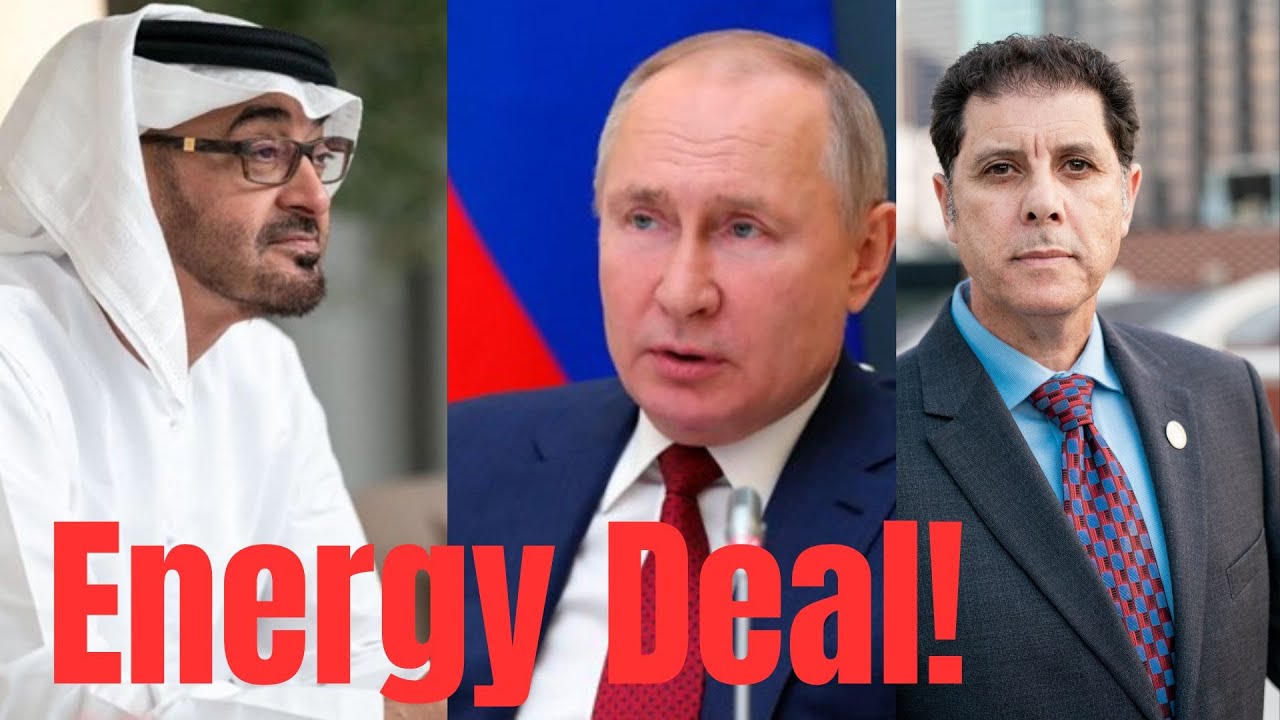
David Oualaalou breaks down UAE President Mohammed bin Zayed's visit to Russia, focusing on growing trade ties, OPEC+ coordination, and what it signals about shifting Middle East allegiances. The visit suggests Russia is expanding influence in the region while the UAE and Saudi Arabia move closer to Moscow.
Chapters
Hello everyone and welcome to Geopolitical Trends. My name is David Oualaalou. In today's video, I am going to decipher for you the meaning of the President of United Arab Emirates' trip to Russia. So as a matter of fact, today, uh, uh, the President Mohammed bin Zayed is in Moscow to talk with the Russian president. And the question that we need to ask from the get-go is the visit of the United Arab Emirates president to Russia is a message to the United States? Because remember, United Arab Emirates is an ally of the United States. You can just see the dynamics, I hope. But before I'll delve deeper into all this issue, Don't forget, please, to subscribe and hit the like and the notification buttons so you will be notified every time I upload a new video. So let's dive in into this issue here. So by the time you see this video, most likely the meeting will have taken place. So Russian President Vladimir Putin, uh, is meeting with, uh, in Saint Petersburg, by the way, in Moscow, with the United Arab Emirates President Mohammed bin Zayed, the talks basically between the two countries is going to focus on the cooperation side of the house, the economic aspects of it. And why is this? Because the developments between the two countries in both in the international system and the regional states of affairs to see how they can help each other. And also one of the key thing that they're gonna be focusing on in their talk, it has to do with global energy and food markets. Because remember, United Arab Emirates is a member of OPEC, Russia is a member of OPEC Plus. And I remember I did video on this one here, check it out if you get a chance to do, to do so. So I'm going to address this topic for you from two angles. One is economics, second is geopolitical. This way you can put it in within the global context. So economically speaking, the volume of trade exchange between the two countries, between Russia and United Arab Emirates, has increased recently despite the pandemic, despite whatever it was for the last 2.5 years. And it almost doubled from 2.5 billion $2.5 billion. That is tremendous. And I'm gonna provide you a link, uh, to where I get these stats from. Um, the Russian president has said that his country, the Russia that is, and United Arab Emirates are actively working within the framework of OPEC+ alliance. There is a hidden message right there that is sent to the West. By these statements. And why the Russian president said this, he said because in order to stabilize the global energy markets, which we all know how it is. I'm sure you've noticed the prices at the gas pump. As a matter of fact, this morning I was driving and I saw the gas prices hit $3.39. In some other states, they're about $5.69. So when the Russian president is saying this within the context of the global energy crisis that's going on, you can just see where the message is. The Russian president also stressed that the group's, which is the OPEC+, moves are not directed against any party. No, I personally see the message right there in that statement, of course, because the visit the United Arab Emirates president to Russia came on the heels of October 5th. What just happened on October 5th? It was the OPEC+ meeting by which it announced the reduction of, or cutting of the oil production by about 2 million barrels a day, which is going to start, by the way, next month. That's what's surprising about this. No. And of course, the decision by the OPEC+ has really angered the United States that is now in consideration of reevaluating its relationship with Saudi Arabia. But I think that train has already left the station. So there is another dimension that I would like you to consider within this discussion here, and it has to do with BRICS. Brazil, Russia, India, China, and South Africa. Why is this important, you may ask? Well, because the BRICS has two main large consumers, India and China. What those two countries have in common? They are both, both major consumers of energy. No, then you have Russia, which is a major producer, and there is the talk about Saudi Arabia possibly accepting the Chinese yuan instead of the petrodollar. You can just see where things are headed. Talk about trends, you know, but also United Arab Emirates visit to Russia is also wanted to ensure that it does not stay behind when that train leaves the station. Because here is the bottom line: global economy has already shifted east towards Asia. The wealth is already shifting from the West to the East. And for a country like a Gulf state like United Arab Emirates, which is like a good ally with the United States, for them to take this step, they are sending a message to the United States. From a geopolitical angle, there are 3 main questions that we need. They are relevant to the current global context, and we need to ask this. One is, will current geopolitical shifts greatly benefit Russia's long-term global objective? Okay, that's one. Second one is, will foreign policy, Russian foreign policy that is, that will pursue in the Middle East and the Baltic region to guarantee the security of its strategic interest. So the question is, it will become what type of foreign policy Russia's gonna pursue in these two locations. And the third one, of course, will major powers confront each other or one another, that is, over resources that could trigger a military conflict? Or will they choose appeasement to maintain peace and stability in this new era, which is the shifting of the global order from unipolar to multipolar. Those are basic relevant questions we need to ask. Similarly, we have to also consider with Russia's new status in the Middle East, Russia is already redrawing the region's geopolitical map militarily, politically and economically. And that said, who would have thought that Russia will have become the deciding factor on which the Middle East political outcome depends? What am I talking about here? I'm talking about the conflict in Syria. Look at who decided on the conflict outcome. Whose decision was it to see that the magnitude of Russia's influence has maintained the Syrian President Bashar al-Assad in power. And if my argument doesn't convince you to grasp the impact of Russia's expansion in the Middle East, consider, for instance, the recent cooperation between Russia and Saudi Arabia, or Iran for that matter. In my opinion, that cooperation in itself demonstrates how the geopolitical balance of power in the Middle East favors Russia, not the United States. I find it, however, very ironic, very, very ironic that Saudi Arabia is cooperating with Russia. You may ask yourself, why is that ironic? Well, Again, I am a student of history. How could we forget the images of the mujahideen in Afghanistan supported and financed by Saudi Arabia and trained by the CIA fighting the Soviet Union, the USSR in Afghanistan back in 1971. I'm sorry, in 1979. However, In the ever-changing and unpredictable Middle East, Saudi Arabia resumed its diplomatic ties with Russia and went beyond just political niceties to include defense and energy discussions. Talk about change. So here's my conclusion for you. We need to accept that while we remain a global force in the 21st century. The absolute supremacy of the United States and the West, for that matter, is fast waning. And let us be realistic here. Europe is very weak and more divided than ever. So the way I see it is that the Western world may be on its last stretch of its hegemonic journey, because pretending otherwise at this late stage of the game is just foolishness. That's how I see it. So here's my question for you for today: do you believe United Arab Emirates president's visit to Russia suggests the Middle East is ditching the United States for Russia or China? Let me repeat that. Do you believe the visit of the United Arab Emirates president to Russia suggests the Middle East is ditching the United States for either Russia or China or both? Make sure to leave me some comments and let me know what you think. As always, remember, geopolitics impacts your daily life in more ways than one. Till next time, bye-bye.