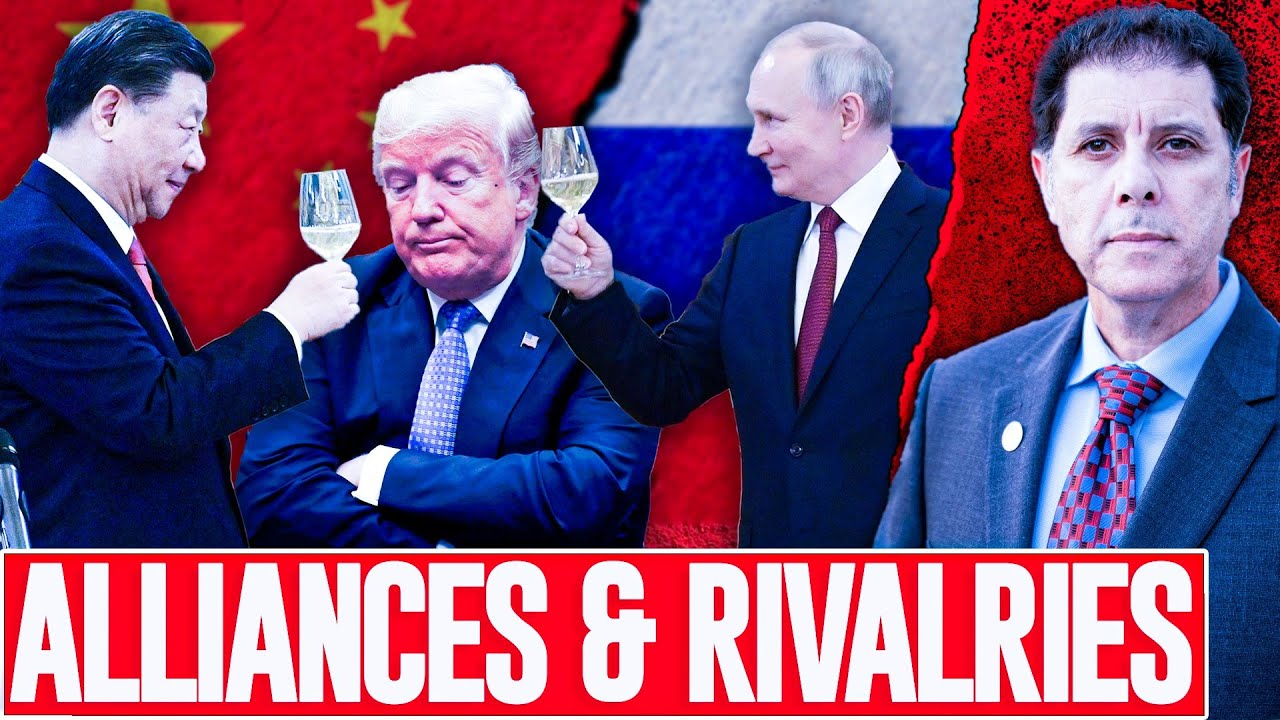
Geopolitics requires psychology, not just territory and resources. The presenter traces five thinkers—Morgenthau, Freud, Jung, Fromm, Arendt—who grounded international relations in collective memory and cultural trauma, then shows how emotions drove the French Revolution, World War II, the Cold War, and the Arab Spring. He warns that AI now enables psychological manipulation at scale.
Chapters
Hello everyone and welcome to Geopolitical Trends, where truth matters. Have you ever wondered what elements influence geopolitical decisions? Why do leaders act the way they do? Why do countries behave the way they do? In this video, I am going to share with you my insights about one of the key elements that has, in my opinion, a major impact on the trajectory of geopolitics. In an increasingly interconnected world, the field of geopolitics has evolved from traditional analysis of territories and resources. Today, it integrates the intricate realm of psychology to offer a more profound understanding of international relations and political behavior. This fusion of geopolitics and psychology seeks to unravel the deep psychological motivations that drive political leaders and populations, and how these motivations shape policy formulation and international relations. Ukraine-Gaza conflicts are a case in point. Now, is there an intersection of psychology and geopolitics? Well, the psychology of geopolitics operates on the premise that political behavior is not merely a result of rational calculations of power and resources, but is also deeply influenced by the psychological undercurrents of history culture, and yes, human behavior. As we delve into the collective unconscious of nations, we find that historical memories, cultural narratives, and psychological traumas play a pivotal role in shaping geopolitical strategies. For instance, the collective memory of past conflicts can influence a nation's foreign policy, for generations to come. This is evident in the way Russia's historical experiences with conflicts have shaped its current geopolitical stance, emphasizing the need for buffer zones and security. Similarly, the psychological impact of the Cold War continues to influence US relations with Russia and China, as old rivalries and mutual suspicions resurface in new forms. Some of the key figures in the psychology of geopolitics. Several influential thinkers have contributed to the understanding of psychology in geopolitics. Number 1, Hans Morgenthau emphasized the role of human nature and psychological factors in international politics, arguing that the desire for power and security is rooted in the psychological makeup of individuals and nations. 2. Sigmund Freud. Sigmund Freud did not write directly about geopolitics, but his theories on the unconscious mind and psychoanalysis have profoundly influenced how we understand human motivations in the political sphere. Carl Jung's concept of the collective unconscious has been instrumental in understanding how shared psychological patterns influence national identity and behavior. Erich Fromm linked psychoanalysis with social analysis, providing deep insights into how social and political phenomena are influenced by underlying psychological factors. And the last person is— or last thinker— Hannah Arendt explored the psychological foundations of power and totalitarianism, offering a philosophical and psychological perspective on the nature of political authority. These thinkers have laid the groundwork for analyzing political leaders and their decisions through a psychological lens, allowing us to better understand the motivations behind geopolitical actions. Then comes the historical application of geopolitical psychology. Historical events provide rich case studies for analyzing the intersection of psychology and geopolitics. Consider the following examples: The French Revolution. The psychological forces that drove the French masses to revolt against the monarchy were deeply influenced by concepts of freedom and equality, which played a decisive role in shaping the revolutionary fervor. World War II. The psychological motivation of Adolf Hitler and his allies, driven by a complex mix of nationalism, revenge, and a desire for domination, can be examined to understand the decisions that led to the war. What about the Cold War? The mutual fears between the United States and the Soviet Union were rooted in psychological insecurities and ideological convictions. The zero-sum mentality of this period, where each superpower saw the other's gains as its loss, was fueled by deep psychological anxieties. Then comes the Arab Spring. The psychological motivation of the Arab people who revolted against their regimes were driven by collective desire for dignity, freedom, and justice, challenging longstanding authoritarian structures in the Arab world. In each of these cases, psychological analysis provides a deeper understanding of the forces at play, revealing how personal and collective emotions beliefs, and traumas can drive geopolitical events. Then comes the ethics of psychological manipulation in geopolitics. As the field of geopolitical psychology advances, it raises important ethical questions. Is it ethical to use psychological knowledge to manipulate the behavior of individuals or groups to achieve political goals? This question becomes particularly relevant when considering the use of psychological tactics in, for example, intelligence operations, political marketing, and even warfare. For example, intelligence agencies often use personality analysis to assess potential security threats While this can be a valuable tool for national security, it also raises concerns about privacy and the ethical implications of manipulating human behavior for political ends. Similarly, political campaigns, mainly in the Western world, increasingly rely on psychological insights to influence voter behavior. Leading to questions about the fairness and transparency of such practices. The debate over the ethical use of psychological knowledge in geopolitics is further complicated by the advance of artificial intelligence. AI, AI technologies are now being used to analyze vast amounts of data, predict human behavior, and influence potential events. While these tools offer powerful capabilities, they also pose significant ethical challenges, particularly regarding privacy, consent, and the potential misuse. Modern application and challenges. In the modern era, the applications of psychology in geopolitics have expanded beyond traditional analysis. To include new tools and techniques. Take, for example, intelligence analysis. Intelligence agencies use psychological profiling to understand the motivation and potential actions of political leaders and adversaries. What about negotiation tactics? Negotiator use psychological insights to better understand the motivation of the opposing party, aiming to achieve more favorable outcomes. Then comes the political marketing. Political candidates employ marketing strategies based on psychological research to sway voter opinions and behavior. And the big one is artificial intelligence. AI is increasingly being used now to analyze data on human behavior and predict its impact on political events, offering new ways to anticipate and respond to geopolitical developments. However, these advancements come with significant challenges. Psychological variables are difficult to measure with precision, and the dynamic nature of human behavior makes it challenging to predict outcomes accurately. Additionally, cultural diversity must be accounted for in psychological analysis, as motivations and behaviors can vary widely across different cultural contexts. It is my conclusion for you. The psychology of geopolitics is a promising field that offers a deeper understanding of international relations and political behavior. By combining the sharpness of political analysis with the accuracy of psychological observations, this approach provides new readings of world events, revealing the underlying motivations and fears that drive global power dynamics. However, the use of psychological knowledge in geopolitics must be approached with caution. The ethical implications of manipulating human behavior, the challenges of accurately measuring psychological variables, and the potential for bias in analysis all underscore the need for careful considerations in the application of this field. As we move forward, the integration of psychological insights into geopolitical analysis will be crucial for navigating the complexities of the 21st century. By understanding the minds behind the actions, we can better anticipate and respond to the challenges and opportunities that lie ahead in the global arena. Please hit the like button if you like this video, and don't forget to subscribe. As always, remember, geopolitics impacts your daily life in more ways than one. Till next time, thank you.