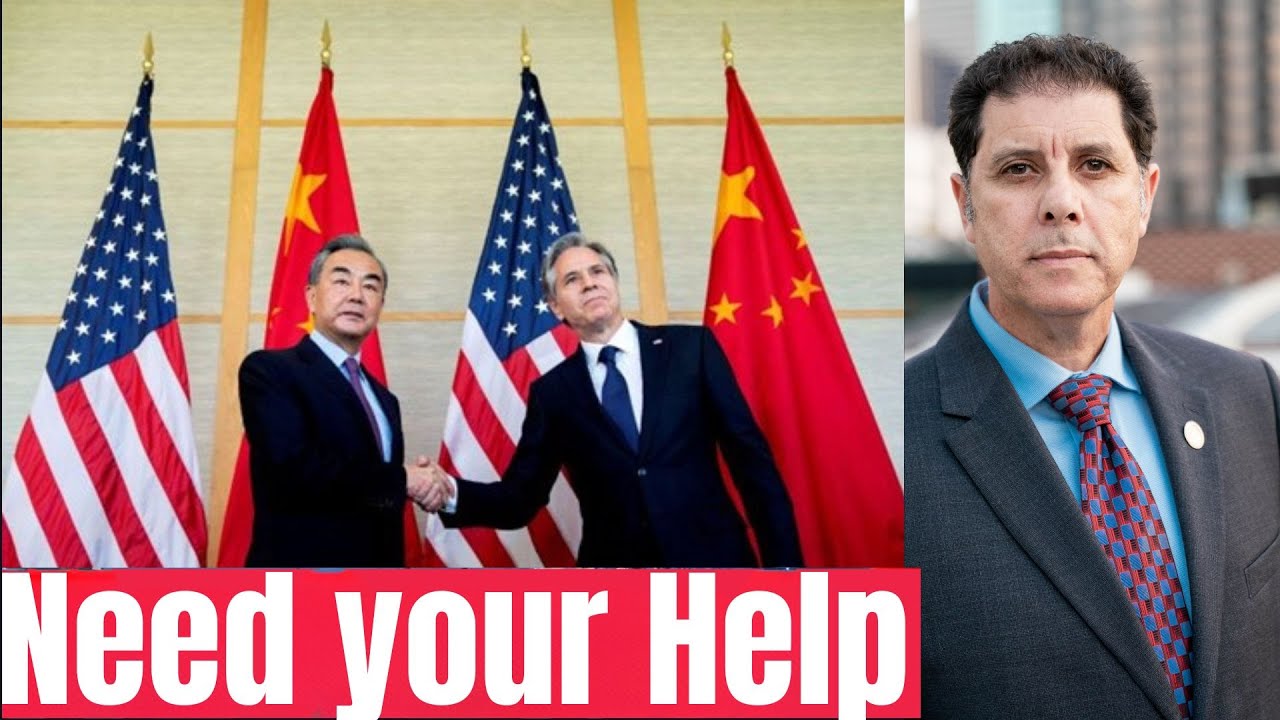
In this live‑stream, host David Oualaalou opens with a thank‑you to his supporters before diving into a deep‑dive on the recent three‑day visit of Chinese Foreign Minister Wang Yi to Washington. He frames the U.S. invitation as a strategic move aimed at improving "communications between superpowers" and possibly paving the way for a Biden‑Xi summit. Throughout the hour‑long discussion he raises three core questions: (1) why the United States extended the invitation, (2) what the U.S. hopes to gain—particularly whether it is seeking Chinese leverage over Iran—and (3) how China is likely to respond. He links the visit to a broader set of geopolitical currents: the presence of Chinese warships in the Pacific, the Asia‑Pacific Economic Cooperation (APEC) summit in San Francisco, the shifting balance of power in the Middle East (Iran’s missile drills, Israel‑Gaza conflict, Gulf states’ growing economic ties with China), and the looming U.S. presidential election. He critiques U.S. rhetoric on human rights, points out perceived hypocrisy in U.S. policy, and argues that any future U.S.–China dialogue will not be on an equal footing unless the U.S. first restores credibility. The host also touches on related topics such as NATO’s expansion into Japan, India’s ambiguous stance toward China, the role of Turkey and Turkey‑Russia‑China dynamics, and the internal cultural‑psychological factors that shape foreign‑policy decision‑making. Audience questions are fielded throughout, covering topics from Taiwan public opinion polls to the possibility of U.S. special‑ops forces in Gaza. The stream ends with the host promising future deep‑dives on India, Taiwan, and a live‑stream from China.
Chapters
Hello everybody and welcome to Geopolitical Trends. So excited to be this with you on this Friday, October 27th. Uh, very interesting topic I'm going to be covering today, and it has to do with the ongoing visit of the chief diplomat, the Chinese chief diplomat, foreign minister, that is Mr. Wang Yi. Who received an invitation from Washington makes you just wonder what is really, uh, the, the objective of the invitation to begin with. And this is what I intend to, uh, provide you with my own assessments about it, tie it to other issues because there are other issues in the background, uh, then, then we'll just— I'll open the floor for you for your questions and we just go from there. So, but first, like I always do, and I always like to do that because I like to express my sincere thanks and show my gratitude to all of you for your continued support. Uh, I also want to give a shout out to a new member by the name Sean Tan. Thank you so much, Sean, for becoming a channel supporter. Truly appreciate it. Speaking of supporters and members, uh, I will be doing some testing, technical stuff this afternoon to find out if I, uh, can launch that, uh, uh, live stream for the channel members and supporters. So if it works out, I'm gonna do it on Sunday. I will let you know. Otherwise, we're gonna push it for next week, but I will give you a heads up on all that because I promised you I will do that. All right, let's, uh, well, let me just say quick while I'm here on the chat box, uh, uh, hello Harry, how are you? Good to see you. Uh, who else here? Reza Mar, good to see you. Good morning to you, or good afternoon, whatever part of the world. Hi Phil! Good to see you, Alan. Good to see you, uh, Masian. Good to see you as well. Das895, greeting to you as well. And Athene Wu, good to see you. Francis, uh, I'm sorry, not Francis, but rather— where did I see the word Francis? Yeah, it was Francis Tango. So my memory still serves me well here. So good to see you all, guys. Now All right, let's get into our conversation, and I'll start for you with these questions like I always do, because we need to think about the big picture. As always, why did the US invite Mr. Wani? I mean, it's, it's logical question to ask given what's going on. And remember, put this within the context of what just happened the last video, last, last, uh, live stream I did for you about China's warships, you know. By the way, those have been there, some before. Yeah, it's nothing new in a sense, but I want— I didn't want to approach it from that. I wanted to approach it from the optics of geopolitical aspects of it, what it means now that China's warships. And yes, one of you made a comment about why don't we just call them naval assets instead of warships? Because when the US or the West sends their Naval assets, we call them naval assets. Good point there. But also you have to differentiate because when we say aircraft carrier, when we, we say aircraft carrier group, which means the group contains destroyers and all of them are warships. So that is the only difference. But anyway, so the question becomes, why did the United States extend the invitation? Second, what is really the US is after? I mean, you're telling me because they want to have a conversation with the Chinese? I don't think so. As one who understand the ins and outs of the workings of our government— I was there, I worked there, I have more over decades working there, so I kind of understand the mindset— then it ain't happening in a vacuum for that. So the third question is, what will be China's response? Yeah, what will be China's response? Because remember China's gonna go with the protocol. You saw how they received, for example, Chuck Schumer, uh, senator from, uh, New York, when he went to China. Even he was granted an audience with President Xi. Once again, if I were advising the Chinese president, I said no, and I'll give my justification. But of course, he's the boss, he can decide whatever he wants. So Just keep this in mind as we further into the discussion here, and I would ask you a few questions here and there, part of this conversation. So here is the background for those who might not know. China's top diplomat, Mr. Wang Yi, is already in Washington for 3 days, and this, it was under— because when you read, and I read enough here, uh, in, in the West, when I said in my country here, as far as the publications regarding this trip they all of them converge on one particular, uh, uh, uh, key point or theme, and that is, is under improving communications between the superpowers. Here is another two things you need to pay attention to here. Improving communications is the same terminology that's been used when Secretary of State, uh, went to China in July The same terminology was used when the, uh, what's in a Treasury Secretary, Janet Yellen, went to China. The same context was discussed when the CIA director went over there. Okay, the second part of this is the key: superpowers. Is this means that now the US recognizing the status of China? Because if you look at the literature And I've been watching this for— that's part of my academic background. We always use the term the emerging power, you know. We never wanted to use the superpower. We use the term power, but in this context, they put it under latest sign of improving communications between the superpowers. So just pay attention to how things are worded, some. So this is, as I said, Mr. Wang Yi is here in US for 3-day visit, and this, according again to what they're saying it's for, it's to pave the way for the unexpected summit between President Biden and President Xi. I don't know if it will happen. My, my, uh, my, my, if I am to put my geopolitical analyst hat on, I will say that most likely it will happen. The question is, how will it happen? Another word, will the meeting between China and the US be done on an equal footing instead of the US still thinking we are up here and China is down here? You all remember, I'll, I'll take you back to the meeting way back in Alaska. Can anybody know if you remember that meeting, how he was approached? Was the first summit between the US and China after the inauguration of, uh, uh, uh, what's his name, President Biden. So this is what I'm saying. Now they're saying because this is to pave the way for the summit. Yes, summit could take place, but the key question we need to ask: will it be on an equal footing? Because that's where the issue is. We are not ready to deal with China talk to China, negotiate with China on an equal footing. That is where I see the, the, the issue to that. And of course, during his trip, meaning Mr. Wang Yi, right now, uh, the, the, uh, the tensions in the Middle East is going to come, uh, to the fore. There is no doubt about it. But that leads us to one other question, and the other question is Is the US— and this is a question for you guys— is the US seeking help of China with Iran? What do you think? Just leave me, uh, the, the answer on the chat box and I'll, I'll get back to it here. But if I am to— let, let me share a map with you guys first while we talking here, uh, for you just to place things in perspective. As to what are we talking about here. Okay, where is the map? All right, here. Yeah, so when you look at, uh, if, as I said, the question if the US is seeking help from China with Iran is because when you look at this area, what I'm pointing out here, uh, already, already things are in motion. Iran just tested some missiles yesterday. They're doing 2-day drills for the— and here is the keyword— readiness. That is the key. The Israelis saying, well, we're gonna hold off on the, uh, uh, incursion into Gaza. Makes you just wonder, is psychologically the Israeli soldiers are so sort of— because psychologically, if you are not ready for, for a fight like this, you, you won't do well. Literally, uh, in, in a military, psychology is very, very important, as you may know, and you have to be ready mentally before you get in, into some, uh, areas like that. So when you look at the Middle East as a whole, you think in terms of, okay, is the US really wanted to help with China? Why? Because China's developing relationships between, uh, Oman, between United Arab Emirates Qatar, uh, Iraq, then you got of course, uh, Iran and Saudi Arabia. And speaking of what I'm thinking about, it's of Qatar. I'm sure you've, uh, saw what I just posted for you guys about Qatar is going to execute 8 Indian former Indian officers, naval officers, for spying for Israel. And I think it's To me, I'm, I'm being fair, you know. Corruption, you, you have to be in jail. There is no ifs and buts. You look at our own Senator, uh, uh, Menendez. Nah, still walking around. What— why isn't he, uh, in on trial? You give him fair, fair trial. Same thing what the judicial in Qatar did. They had to give those guys a fair trial. And they found— the judiciary found that they were spying on behalf of Israel. They're gonna be put to death because that's the law in that land. It becomes the question is, uh, what were 8 retired officers, uh, from Indian Navy doing in Qatar to begin with? But that's a conversation for another day. So here's the thing, there is another aspect that is very, very important to understand. And this one has to do with an upcoming summit, and this one is the Asia-Pacific Economic Cooperation Summit, which is going to be held in San Francisco. And I will cover that one for you. And this is where the hope— this is my thinking why the State Department went ahead, ahead of time and extended the invitation to pave the path, but also test the waters to see whether there is willingness of the Chinese to meet with President Biden, you know. And then, you know why? Because the concern from two fronts in, and for us in the United States. One is that it will look so bad if President Xi does not attend. You all remember G20 when President Xi say, I'm not attending, thank you very much, there's nothing there for me, why will I waste my time? But China sent the delegation, so we all know it was nothing but hypes in India, no more, no less. I mean, I, I hope Indians start to realize how much they are being used. It's no different than Australia being used. So this is one. Second one has to— or second aspect of it has to do with our presidential elections, the upcoming one. Because here's the thing, if things smooth out between now and then, the Biden administration can claim— or the Democrats for that matter, because I don't see Biden running again. You know, the guy shouldn't even be in politics now. He should retire. And I'll say it straightforward to his face if I had a chance to meet him personally, which I don't see any reason why I need to meet with him anyway. Uh, this way they will say, look, we worked out differences with the Chinese, we're doing good because of the trade and all that, when in reality we're not. You look no further to where China is right now technologically, given what the United States just did as far as the, uh, sanctions on chips. And if, if this is not an evidence for you, uh, just look what just happened with the docking of the space station for the Chinese, uh, uh, in, in, in space, how it was perfectly, uh, executed. I mean, it just shows how far they've come. So now we are finding out that the sanctions we try to apply on China regarding the trade is backfiring on us, and we wanted to smooth things out. This is the reason personally, for what I see, why they wanted to have this meeting ahead of time. And I'll go back to my fundamental question: will any summit or meeting between the US and China be on an equal footing? In other words, a superpower to superpower. So let me see your answers, guys, if, if you put something here. Hi, uh, Coach Hoy Hoy, good to see you. Uh, I'm just trying to see the answer. If you think, in your opinion, absolutely, okay. So that means— but we are not seeing that way, we are not approaching it that way. So, and, and let alone our credibility in line. How can we tell the Chinese we want to work out our differences and all that, and we're still doing what's need to be sort of— we're still doing, uh, uh, or, or creating tensions to push for more, uh, tensions in the region or elsewhere. I mean, this, uh, Middle Eastern stuff, it's, it's been prepared in my opinion. This is not— nothing happened in a vacuum here. So, and as I said, you go back to when President— oh, when— I'm sorry, when Secretary of State Blinken went to China over the summer. And what was very interesting about all this, if you recall, and I remember I did a video for you Of course, what the US had to say at that time— and I'll say according to, because I had to dig what was stated here— according to the State Department press release, they arguing that, well, we have to discuss area of cooperation with China along with the US concern about human rights abuses. Here we go again. Reports in the Chinese spy facilities in Cuba and China's unfair and non-market economic practices, in quotes, by the way. That was the State Department word, not mine. So, well, of course we all know the Secretary of State raised the concern about the PRC human rights violations in Xinjiang. We, we all know it turns out to be lie anyway. And if it even the case, how would you call what we are doing right now in the Middle East supporting human rights violations. I mean, it's fair. This is what I'm saying. Will the— will, will they, US and China, be able to negotiate on an equal footing? And I don't see us doing that because we don't want that. We wanted to always maintain that superiority when in reality It's gone. That era is gone. We're dealing with a new reality right now. And what I found very disturbing from that, uh, uh, statements from, uh, uh, the State Department— and that was, by the way, back then— this idea of the human rights in Xinjiang and Tibet and Hong Kong, I know, all were in areas where we created tensions intentionally. Yeah, that's to me— well, how can you expect someone to sit down with you, uh, sort of, uh, uh, what's the word, in good faith, when you are not? You are being a hypocrite. You are being a liar. You are being manipulative. Why should I trust you? And this is what I'm saying. What is really behind why China— why US extended the invitation to China. Yes, of course, the issue of, uh, and, and here is, by the way, one more quote, because this is a quote. He emphasized, meaning the Secretary of State, emphasized that the United States will always stand up for our values, end of quote. Once again, we using the terms so loosely to the point that it became just nothing but a consumption of ink, nothing but a bravado. We don't stand for any value. What do we stand for when we close our eyes on the real atrocities that's taking place at the time of this recording? Because we're allowing it. So this is what I'm saying. It's— and I had to provide this for you, so to provide both sides of the argument, as I always do. I don't side with one another. I provide the facts, I provide the arguments, and you guys reach your own conclusion. So, so, and of course, if you remember during that time in July, what happened at that time in Washington? The, the, uh, the Chinese ambassador to the US was removed abruptly. So, uh, he was removed from his post and subsequently replaced by Mr. Wang Yi. You know, of course Chinese didn't give a reason. It's their own internal— whatever his reasons are. And Mr. Chen, I believe, uh, was 50, I think 56, 57 years old, something like that. Uh, hasn't been publicly, uh, seen since then. So I even read yesterday that somebody just passed away, had a heart attack. I don't know if it's the same person or not. So, and by the way, the same thing just happened now to, uh, the Secretary of Defense in China. Li Changfu has been released of his duties. At the time of this, there is no defense minister yet in China. They are looking to replace that, and I intend to look into that. I do know one of the cases he's involved or was involved in has to do with procurements.. And the question becomes to me is, did he make a decision without the consent of the leadership? And if he did, then he broke protocol. Otherwise, is there is something else? I don't know yet. I'm looking into it. I will report on it in due time. So, because it's only fair to report on something like that as well. So, but to go back to this, and the key fundamental besides paving the way for this so-called— this, uh, the Asia-Pacific, uh, cooperation. What cooperation are we talking about here? Is there any cooperation to begin with? When you look at now, for example, uh, let me bring the map back here, uh, when you look at, for example, uh, like I mentioned earlier about, uh, Malaysia, Malaysia, uh, sort of requesting not requesting, proposing rather, the idea of having free trade with those, the GCC, the Gulf Cooperation Council, which is those countries right here, 6 of them, Qatar, Bahrain, Kuwait, and Saudi Arabia. That is the, the way I see it. So when we talk about, uh, the Asia-Pacific coop— what cooperation are we talking about? We are— when we are undermining aspects of it, and you expect the Chinese to just sit down with you? I, it's— I think it's gonna happen. The meeting between President Xi and President Biden will happen if Xi decided to come to San Francisco. Now, here is the other side of it. If he decided not to attend, that is a big blow for the United States optics. It's a big blow. For the US. It's because it will confirm my own assertion as far as now China is confident enough to come forward and start saying what's on its mind. And what is on its mind is now is the time for us to no longer be in the back seat. Or behind the scenes. We are up front and we will dictate the terms. That's the way I see it. I don't see China doing it that way because also China has to worry about the optics of it, but that will be part of that. But I still go back to the idea of, I think, uh, US needs help with China regarding Iran. Why? Because Iran is a client of China, is, is friend of China, is partner of China. They have a lot of major deals. Remember, China and Iran entered into a $400 billion agreement, economic ventures, that is. So the, the Iranian nuclear, uh, uh, missile technology is developed both with the help of the Russians mainly, but also the Chinese, in addition to their domestic indigenous productions. You know, don't undermine— or underestimate, rather— the ability of the Iranians, because remember, they survived the sanctions from the US since 1979, and they're still standing. So this is how I see it. And the reason why, because the US hopes that China could use its influence with Iran to help ensure that Israel war against Hamas does not spill over into wider area of the Middle East. How, how pathetic— yeah, I'll use the term— how pathetic of our foreign establishment to even be thinking in these terms that, oh, Israel is going to go to Gaza and everything will be contained within that border. That is naive. That is stupid. That's the stupidity of our establishment, foreign, foreign policy establishment. That tells you right there, amateurs. You know, you don't have to be this whatever to, to see the reality of it. If Israel goes into Gaza, that particular conflict is going outside, no matter how you look at it. So this is exactly what the US is hoping for. Then there is another dimension which I believe Western media, uh, the media here that covered this story intentionally did not want to say that. And I'm gonna say it because that's what an analyst does. You brought up the top, the, the key points that no one else has considered before because it's part of the equation. And the one I'm looking at is for us to try to create a wedge between China and Russia. That is also another objective we are trying to figure out how to maneuver to do that. I don't think so we will succeed. There is no way China's gonna turn its back on Russia, unlike what India just did. And I have to confirm that, by the way, guys, I am in the process of confirming if India indeed joined the West with sanctions against Russia, that is big blow. It's big blow to the Indian— oh, you know, in this case, will we be fair to say India has no credibility anyway? They've been using Russian oil for cheap and turning on them. That's— I won't be surprised. No, but that's what I see. The US wanted to create that wedge between China and Russia, and I don't think so. It will succeed. The other aspect, as I mentioned last time, was the idea of that partnership between the three countries— China, Russia, and Iran. So if we can isolate China, you know, we're gonna just have to— which wouldn't work anyway. Chinese are smart enough to know. It became now clear. I'm not saying it became now clear as to how we play the game. It's over. Everybody now knows what the playbook is. That's it. All these tricks and all this stuff, it won't do it anymore because the world has changed and we need to change with it. So the other thing is that the US is concerned about is that the Arab world is leaning more towards China than it is to the United States. That is the key also. So it's coming from different angles, and I don't think so having this meeting with the Chinese gonna cut it. Yes, the, the Chinese decided to maintain protocol, diplomatic protocol, that is according to international norms. They decided to sort of be polite when you accept the invitation. They could have said no, but they said no, we will attend. Or we will send our, uh, foreign minister, Mr. Wang Yi. He's a seasoned diplomat, by the way. He's been, he's been around the block, so he understands the game, how it's played. Uh, but deep down, how will— who's in the right mind will think that China will trust what the Americans are saying? We don't have— we lost that credibility. We lost that credibility, and it's not easy to bring it back. You know, this is like when you, you know, you break a trust, uh, it's not easy to recover from that, you know. So to me, that's why I go back to that point of Marcus Aurelius: if ain't right, don't do it. If it is not true, don't say it. Straightforward. There is no if and but. That's, that's the way I see it. So the idea of, uh, the Arab world leaning to China is concern to the US because leaning not only diplomatically but economically as well. As a matter of fact, I just find out this morning, I think United Arab Emirates is going to go for a purchase of the J-20, which is a Chinese fighter jet. I, I'm, I'm gonna get the link and post it for you guys. I just read it briefly, I didn't, uh, dig deeper into it, but to me it's a sign. It is a sign for all what lies ahead coming. Remember, when any country in the GCC does one action, you'll see the wave. Qatar started with the gas with China for 25-year agreement. Saudi Arabia moved into the petrochemical by building, uh, in joint venture with China, uh, a refinery, an oil refinery. The last, because I disclosed it in my book, was about an $8 to $10 billion project. Uh, uh, Saudi Arabia is also purchasing some type of weapons. And here is what I see also coming. What I see coming is that soon China will allow those countries, once China is, uh, uh, what's the word I'm looking for is, is, uh, convinced, is convinced of this partnership with those countries. Yes, it is the beginning of it to strengthen that, but once China is convinced, guess what China's going to do for those countries? It might even allow them to use China's Beidou navigation system. Forget about the GPS altogether. I do see this coming down the road. I won't be surprised. You already started with Iran, one country at a time. This is one thing the US is very, very concerned about. So then there is the looming— the big elephant in a room. Which one is that, guys? Can anybody tell me what is the big elephant in a room? It might not be discussed this time But I won't be surprised that the US will, uh, sort of, ah, let's not mention that. I just want to see first of all if, if anybody can tell me, and it has to do with Asia, because I like you to be part of this conversation here, guys. The big elephant in a room. And to help you guys out, they have some elections coming up soon. And I know it takes a while for this to show up here. It takes, uh, uh, there, there's this delay. Uh, India. No, no, not India. No, no, no, no, no, no, no, no, no. Oh, oh, oh, right here. You got it, you got it. Taiwan. The US is gonna— if I am to guess the conversation, they're gonna be very sensitive about how to approach it. No, given that, you know why? Because there was a recent poll in Taiwan. I had a chance to read it and I'll share it with you. 87% 87%, which by the way I didn't find the information here in the West. 87% in a recent poll says that they want to maintain the form of the status quo. Meaning what? In a plain simple language, they want to maintain that China stays— is part of China, but they prefer that China will let it be as is now. Two-party systems. In other words, Taiwan, it's almost like a state that can run its own affairs, but it's still under Beijing. This is what 87% of the pollsters, or 87% what the poll found, that the status quo means, and I quote here, maintains de facto independence, but avoiding retaliations from China. This is why they want— they don't want any tensions, you know. And the percentage of Taiwan people who wants to maintain the status quo indefinitely is growing. So I do believe this is something that, uh, the, the US will be very, very— it's gonna trade carefully. Because remember, 2 weeks ago, we sent some official from the government to Taiwan. And the reason we sent that, interesting enough, it was during the same, uh, time around when this poll was conducted. Is that a coincidence? You decide. But to me, it was nothing but to go there and test the waters and see, because polls, public opinion, will give you an idea where things are. This is where I see, uh, the, the other, uh, uh, uh part of the conversation. And like I said earlier, remember, if, if this to be in preparation for President Xi and President Biden— and again, why will President Xi will want to meet with Biden to begin with? And again, he's the president. If I were advising, I'll advise otherwise and provide my justification to why that is. No, on the other hand, China wants to maintain, uh, some sort of, uh, let's not ruffle the feathers per se. They just maintain cool-headed here on the international stage, which shows that, you know, cool heads always prevail. China exemplify this one, and especially when you consider who President Xi just granted the audience to 3 days ago. It was none other but the governor of, uh, uh, California, Newsom. We call him here in the US, uh, it's, it's a nuisance, which means a bad thing. So, uh, anyway, uh, they want, uh, he went to China and he got a tour of the Chinese EVs, electric vehicles, and so forth. And he was impressed what he saw. As a matter of fact, I got a, a tweet, uh, I'm trying to pull it up for you guys. Uh, Taiwan— no, that they are saying, well, The US policy. Yeah, yeah, it's right here. I'm going to share it with you guys so you'll see. And I knew it was in a, in a sense of, uh, let me share the screen. And he met, by the way, he met with Mr. Wang Yi back there in China. So let me expand this one. There it is. You guys can see it, right? That is Mr. Uh, Wanyi meeting with Governor, uh, uh, Newsom, Newsom of California. Uh, President Xi granted him the audience as well. And what was interesting about this one, it was a joke that on, on Twitter it says Wanyi meets with the president of the Republic of California. Ah, it's a joke, but it's not a joke, uh, at least for us in Texas. We kind of don't care for the federal government. We could sustain our own economy. So, and if you ask Americans, if you ask Texans here, we never want to be part of the federal government. We don't need it. And rightly so. So that is what I found very interesting. So, but I think the Chinese looking at it from an economic perspective, because California is a big state, and of course it's going to be very, very important to, uh, uh, uh, take into consideration because of the Chinese market. The other aspect of this picture that you just saw also because the governor of California is thinking about running for president in 2024. So if you are to have this picture with the president of China, that just elevate things to a different level. Like I always say, in international relations, context matters. This is why the optics of it is very, very important to understand. So this is what I wanted to share with you guys, because I want to be, uh, concise and to the point on all this, because you need to understand the really the context of this trip and their, uh, uh, or within the, the geopolitical or global affairs for that matter, the context within it, because all this doesn't happen in a vacuum. And there is a reason why we extended the invitation at this time. And I'm sure Chinese are smart enough to know, you know, if you only look at their culture and history, it, it's been through a lot. They've learned a lot because the best, uh, uh, uh, experiences you gain is usually when you make mistakes and you learn from them. This is what differentiates somebody who learned from history from experiences in, in comparison to someone who pretends to be, you know. There are people that they think, you know, they just something internally that is not working right. Uh, they might think they are so bright, but they are so, uh, what's the word, they have this negative energy. That's what they project, and it has nothing to do with the rest of the world. It has to do with them internally. Why? Because they were they were never willing to look inward. Because when we look inward, we face some things we don't want to deal with. We try to like, oh no, I'm gonna keep myself busy, occupied, because I don't want to hear that inner voice inside me that telling me, hey, you need to work on this and this and that and so forth. We don't want that. So what it becomes, it becomes how we project ourselves outside. No, people don't want to hear the truth because they don't want to deal with their own first. That's why they start rejecting everything else. Oh, if it's outside, I'm fine. No, you're not if you still have internal conflict that you never been willing to deal with. That's why usually I've been, I've been grateful and thankful, uh, that I've gained perception about people, and I can sense the negativity of someone, and I just keep them at bay because it's not for me. And I don't want to pretend to be okay around them. I don't. I remove myself because it's up to me to decide. And the reason why? Because sometimes when I get up at 3 o'clock in the morning, I sit down quietly and just reflect on my shortcomings. To learn from and to fix whatever needs to be fixed. We all are flawed, by the way. I don't care you have a PhD or not, we all are flawed. And if we were perfect, life wouldn't even evolve. What's the point? And I think that is where, where it becomes very crucial to really develop that kind of inner perception to understand. In— to me personally, It's part of what guides my intuitions regarding geopolitical affairs. That's why I was so far spot on on what I talked about 5, 6, 7 years ago, or even 10 years ago. As a matter of fact, I said something back in 1992 or 1994, somewhere around that. That was the reason why I wanted to go learn Chinese, because I just started to see back then where China will be in the next 25, 30 years. And I wanted to prepare myself to be there. So things didn't work out. I don't blame anybody. I blame myself for not really going into that and learn Chinese language. Because I mean, just imagine if I were fluent in Chinese, both Cantonese and Mandarin. Sky's the limit, as we say. So, but that's how it is today. So anyway, I'm gonna take a question or two, guys, because that's all I have to cover if I don't have anything of importance to say. I keep my mouth closed. Uh, hope, by the way, you enjoyed the conversation yesterday with Robbie Barwick. So it was a lot to cover, but it was worth it. So I like Robbie, he's a straight shooter. Once again, I thank you all for your support, truly, truly appreciate it. And I am going to be working on that, uh, uh, exclusive, uh, Q&A for the members and supporters. Just be on the lookout for my post and I'll post it for you. All right, let me go to the top and I start looking at, uh, excuse me, excuse me. Oh, Alan, bonjour à toi, bonjour de Montréal, meaning good morning from Montreal. Good morning to you too as well, sir. Uh, let me see if there is— just put Q, I know it's, it's question., and we just go from there. And by the way, I am working on the story about India because it, it's, it's troubling if it is true. I can't confirm it yet, but it is very troubling if India turned on Russia like that. That will only tell me one thing and one thing only, that the United States told the Indians You either do that or we're gonna turn your life upside down. And easy for us to do it, just impose sanctions, and we will create something to put sanctions on. So that's, that's the only explanation. Because when India used to say, well, the global superpower— what superpower? I mean, there must be— when I say they, not the Indian people, I'm talking the government here. I never, never put the people into this. Because people don't get involved in that. They must be living in la-la land to think that they are an emerging superpower. It's not. You have to have certain conditions to be able to classify yourself as an emerging power. You don't have— India doesn't have the ingredients, the basic ingredients for all that to begin with. Yes, it does have massive populations. So what? Sometimes massive population can become a hindrance. Which looks like that is the case in India, given where its infrastructure is, the level of poverty, and the extensions that is uncontrollable, which the government in New Delhi is keeping a close eye— is, uh, is keeping a blind eye on, and, and allowing certain groups to just conduct whatever they're doing, which is not right. It is not right. Okay, I am looking here to see, guys, if there is a question. Yo, and by the way, some of you put a comment about, uh, uh, wanting me to do an update, uh, or to do an analysis about Taiwan, and I will. Uh, I am putting this, uh, uh, I am putting it in motion. Just it takes me a few days because, as I always tell you guys, not just because I have the information in my hand. I have to confirm it, and I will not waste your time, uh, till I make sure I have the accurate information to share it with you. So there's a question from 1984. Question: How does Washington read Recep Tayyip Erdoğan's address in Turkey Parliament regarding Israeli-Palestine? I listened to it, the, uh, the, the— I listened to, to it, but I read the translation. I don't speak Turkish. It was, it was straight, straightforward, straightforward. Erdoğan is also doing it for domestic consumption. It's what I said last time. Most of the Arab countries, most of the Muslim countries use the Arab-Israeli conflict for, for domestic, uh, uh, audiences to sidestep the shortfalls— economic, education, healthcare, you name it, infrastructure, whatever. Uh, that's usually what they do. I mean, he was sincere in his statements and he meant what he said. Turkey has always been, uh, great supporters of the Arab— of the Palestinians. And I think this scene where the atrocities with the US is closing its eyes, they have to decide. Somebody has to step. Arabs tends to talk a lot. I'll say it. There's a saying in the Arab culture. Once you understand the culture, there's an Arab saying. If anybody speaks Arabic language here, you will know what I'm talking about. The saying goes like this: which means basically, the translation is Arab agree not to agree. That's all it is. They just talk. Because you ask yourself the question, what happened to all these weapons they've been buying all those years? All those decades. Really, I'm not advocating for war, don't get me wrong, guys. War is never a solution. But come on, when will you take step? When will you take stand? You look at now, for example, King of Jordan and his wife did the— did the— an interview with CNN. I'm talking about atrocities. Yeah, yeah, all that is good. But how good is that when you meaning the king in this case, allowing his airspace to be used by US planes carrying weapons for Israel to use in Gaza. To me, it's hypocrisy. You just want to show— because the concern for the monarchy in Jordan is not about the Palestinians, or even for the Queen herself to be talking about the Palestinians. It's not— it's about the survival of the monarchy. So it is, you know, uh, to, to me it was like always the idea, why aren't these strong enough to come forward and be truthful? Yeah, you might not fight, whatever, you don't have to fight, but at least be honest, you know, show some guts in being truthful, honesty, you know. But to say, oh, we care about the Palestinians, and you are opening your airspace for them. That's to me hypocrisy. So Erdoğan, back Erdoğan, I think he meant what he says. This is why he mentioned about the, the training they are conducting in Cyprus, that they're going to be using live fire, which means if the US gets closer and get hit, oh well, it's your problem. The US can't do anything to Turkey anyway. We can threaten sanctions, whatever. Turkey is so crucial that if we push it too far, it's gonna go east towards the Russians, the Chinese, and that's gonna tilt the balance. There is already conversation right now about disbanding NATO. NATO is becoming just this, uh, global security threat. It is a threat to global security. So Turkey will be fine. As a matter of fact, Turkey challenged NATO and went ahead and bought But the Russians, S-400 missile systems, despite, you know, we threaten sanctions and all, what did we do? Nothing, nothing. So, uh, let me see another question if there is one there. Oh, Sophia, thank you so much for your super sticker, truly appreciate it. First time I, I see here, Sophia, thank you so much for being here. I really appreciate it. Okay, let me see another question. Oh, SK Wong, good to see you. SK Wong, I read a lot of his comments on, on the, uh, on, on, on the channel. I've, I've always been putting some interesting— and by the way, guys, I encourage you to read some comment. I scan them. I do spend time reading all that. And yes, uh, if there is something of, of, of the, of, of the cops, I won't allow it. Straightforward. It's like here for us. I do remember last time that person who was, uh, and I think it was a troll anyway, so wonder where it was coming from. So, oh, I want to say thank you, uh, Poen 2, thank you so much again for your Super Sticker. Truly appreciate it, it means a lot. Interesting. So yeah, just to remind you guys, I will be working on the topic of India and I will be working also on the topic of Taiwan and I prepare them. Uh, if you noticed, I don't do as many recorded videos because this I can elaborate more. I still can do the videos but I feel you'll get more out of this than if I do a video, because videos will be more than just— no more than 7, 8, 10 minutes max. So, you know. Oh, Kim Cho, thank you so much, man. Truly appreciate it. I really appreciate your support. Thank you so much. All right, I'm not able to see something. Uh, okay, there's a question here from Das, uh, 895. Question: David, you have thought about visiting China? I think it will be great way to see firsthand why China is as well as, uh, is as, as well as it is and how fast it progressed. I intend to I do plan to. Usually I never disclose where I am going and when I am going, but that's just part of, you know, that's— it's nothing new. That's how I've been moving around the world. But I do have it on— it's on the plan. It's just a matter of pinpointing the dates because I have to coordinate so many other stuff here at home before I'll do that. And, uh, but I do plan on doing that. And, and I'm writing a book about China. It behooves me to be there on the ground to see with my own eyes. You can't, uh, some of the other books that I wrote about, I've been in that part, I've been in some former Soviet enclaves, so I was very familiar with, with— so, so I do intend to do that. And, and of course, we'll do a live stream for you from China. I'm, I'll be happy to do it there, assuming the conditions whatever I'm going to be, uh, will be conducive for that. All right, uh, question here. YT, do you see US troops in Gaza? Not the US, it will be the special ops, and those will be embedded with Israel wearing uniform and insignia from Israel, uh, which will be bad because if— here is the big, big problem, optics again— if Hamas was able to capture one That's all they need. And it shows you right there. First, it will be, what are we doing there to begin with? Because only in our laws, only Congress can declare war. Second, we are not at war with Gaza. Why will it even be there? So then if it's not the case, why are we sending our troops to fight? Uh, that's no different. What Australia is doing now is sending its troops. Germany is sending its troops. France, he said, now they're going to be supporting. It shows you right there. And this is why, to go back to the beginning of my conversation here, why would China trust the Americans? Because hypothetically, if there were to be an issue, conflict, that is in Taiwan, it's going to be the same scenario. You know, you already hear the European Union, we need to stand with Taiwan. Well, stand for what? Even Japan is saying, well, we're gonna have to come to the defense of Taiwan. Defend for what? The land belonged to one country. It's just that country decided to let that land live in its own laws, whatever, but it's still under the mainland. End of story. It's no different than what we have here with Hawaii, with Puerto Rico. You know, they still fall under the US, but they have— as a matter of fact, Hawaii doesn't want to be part of the US. This is what happened with Maui fire, by the way. It wasn't an accident. So it's the same thing. So I don't see, uh, uh, yeah, the US could do that, but if it does, it won't be— it will be under— that's always the practice, will be some entities within special ops. Because remember, in the special ops, we have so many, some of them are not even known. That's why they have their own black budget., and that budget only few, few eyes in the government will know about, and they have to be signed by the president. That's about it. So the rest of government would never know they exist, or even, even their budget. So if they do, they're gonna go wear the Israeli, uh, uh, uniform. And, uh, but if they got caught, is the same thing the British did in Ukraine, you know. That's, that's the way I see it. So I don't see them openly Yes, we did send troops already, and this is one of the reasons why, uh, Israel— part of it, not all, not the whole reason why Israelis didn't go into Gaza, because we told them wait till we deploy our troops. I don't think so either. That's just part of it. I think they are very concerned and nervous about going in because this is not a— it won't be an open conflict in, in a, in, in a sense of fighting. It will be guerrilla. It's street fighting, and Israelis are not that good at it. We are not good at it. Look just what happened in Iraq. And speaking of Iraq, today it was announced that Muqtada al-Sadr, the head of the Shia there, whatever, asked that the US Embassy should be closed in Baghdad. So you can just see, uh, we, we, we are our phone. It's, it's just double standard, and that double standard, it's not gonna be a hold. This is why Turk, uh, the, uh, what's his name, uh, Erdogan, even though he's not an Arab, he's a Turk, you know. Remember, don't confuse— like most of the Western think that the Persians are Arabs and Arabs are Persians, and the Turk are Arabs and Arabs are— no, no, each one of them has a It's just to put them under the same umbrella regarding the religion of Islam, no more, no less. No. Okay, let's see this. This is coming. That's, that's just, uh, you know, have you always been a Chinese or Russian apologist? And how is it living in China if you love it so much? That, that, you know, that just says a lot about your ability to think straight. The question— apologist for what? For speaking the truth? You know, does that make me an apologist? It will be like Nevin back in World War II. I mean, what are you talking about? I mean, I have to disagree with you on that. No, no, I'm not an apologist, and I don't apologize for something that is true, that is right. I apologize when I make a mistake. That's the way I see it. So, but I respect your opinion because that's what this platform is all about, as long as it's respectful. Oh, Abdul, Abdul Jagan, thank you so much for your super sticker. Truly appreciate it. It means a lot, and I want you all guys to know I appreciate it, I appreciate it a lot. Okay, let me— Tony, good to see you, Tony. I read some of your comments, truly appreciate it. Tony puts a lot of comment there as well on the, on the, uh, on the videos and so forth. That's why, guys, I encourage you to read some of those comments, very, very knowledgeable, uh, and I, I learned from it. Okay, question from Francis Tango. Uh, question: is NATO still going to open an office in Japan? Yes, it is, in, in Tokyo. They are. This is part of where this coordination is going on regarding what's going on with AUKUS, Australia trying now to pull New Zealand into this, because remember, New Zealand is also part of the Five Eyes. You have Canada, US, UK, Australia, and New Zealand. But NATO, yeah, because the way it's going to go, you have to fold in New Zealand under that NATO umbrella, then you push it into Japan. Interesting enough, they didn't say that they want to open up an office in Seoul, but rather Japan. But both countries, in my opinion, they have turned over their sovereignty, no different than Australia. So, so it will, it will be opening up there, and we all know why. Maybe when I'll do the, uh, analysis about Taiwan, I will touch on this, on this particular one. Uh, question from Phil. Thank you, Phil. Question: Will India reevaluate the $1 billion EV China investment opportunity proposal? Uh, I don't think— I, I think, I think even Chinese now, in my— I could be wrong again, but to me the signs that I'm seeing is China's growing more convinced that you can't count on India. No, this is why I think the BDY, you know, they turned down. This is why they, uh, China decided to deliver the 500, uh, 500 electric buses to, uh, either Honduras or Nicaragua, one of the other. I, I couldn't remember. If anybody remembers, if you put it on the chat room for chat box for our viewers to— yeah, either Honduras or Nicaragua, one of the other. And they decided not to sell that to, uh, India but give it to a Latin American country. You think about, uh, uh, some multinational corporations leaving India altogether. So yeah, I don't think so China has any appetite now for— because they know if they get involved and invest all that India could flip quickly. All it takes from us to tell them, hey, you need to flip, and they will flip. That's how India is. The government, that is. Remember, not people, the government. Uh, it's not too strong because Modi— Modi was never qualified for the position to begin with. You can come with that mindset of national— of, uh, of, of nationalism, that is and you govern in that. You can't do that when you're a head of a government. You know, people have different values, people have different thinking, different principles, and so forth. You have to be able to manage all different perspectives under the same umbrella, but doesn't mean you impose your will on them. You can't do that. So I don't see that, uh, and India is, is They are coming. They start to realize, I think they start to realize now, maybe we made the mistake by playing both sides, being on both sides of the fence. It's gonna— I, I said this before, I'm not surprised— it's gonna hit them hard when they realize that the world shifts certain directions and they're gonna find themselves holding the end of the stick. That's the way I see it. All right guys, I hope you find this very informative and I look forward to seeing you next time. As always, remember, geopolitics impact your daily life in more ways than one. Till next time, bye-bye.
More from David


Beyond the Single Actor: Why the Gulf Isn't Choosing Between the US and China


Iran, Iraq's Militias, and the Houthis Are Coordinating! This Changes Everything




Who Controls the Next Decade's Resources? Latin America and Africa's Geopolitical Crossroads

The Chokepoint Trap: How Washington's Stupidity Triggered a Cascade That Now Controls the World

Trump Spooked as IRGC Unveiled dual-use SLV, Deployed Ghadir Mini-Subs & Hinted at Tactical Nukes!
