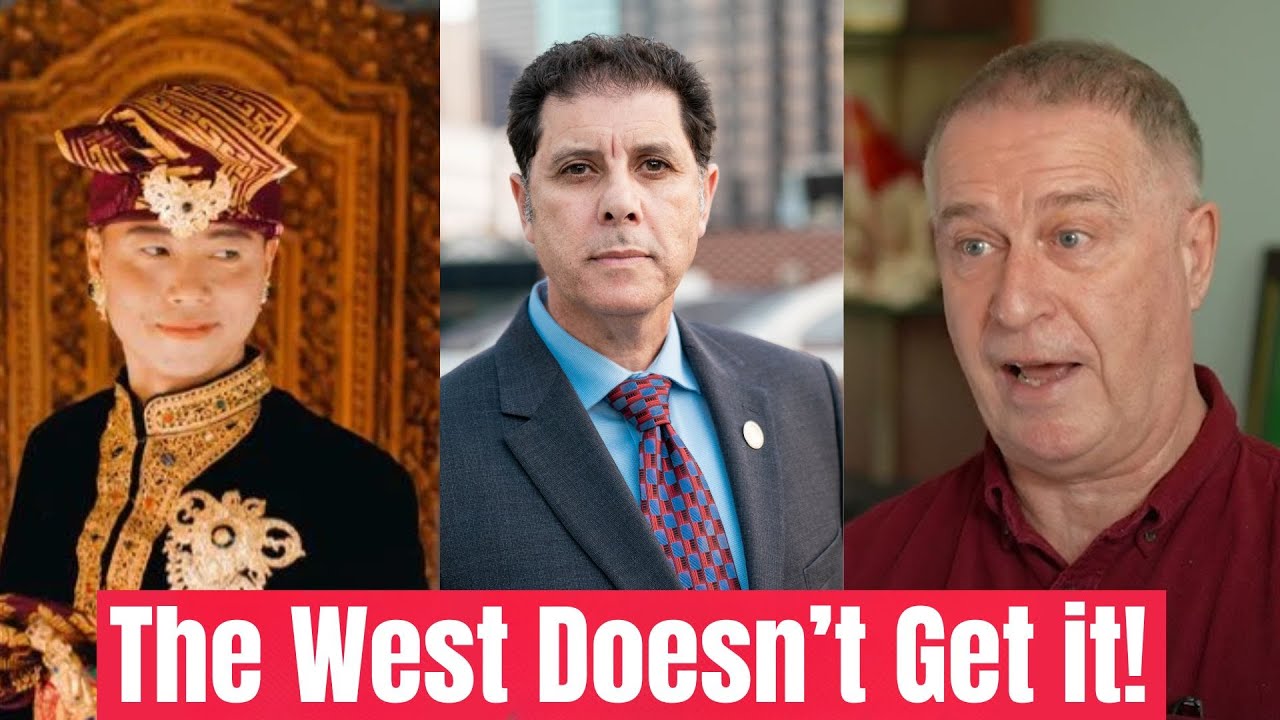
Jerry Gray and Carl Zha argue Western media misreads China through a cultural lens, pointing to grassroots elections within the Communist Party and deep U.S.-China supply-chain ties that make decoupling impossible. They discuss Tibet, Xinjiang, BRICS expansion, and why Trump and Biden policies both fail to account for how China actually works.
Chapters
All right, hello everybody and welcome to Geopolitical Trends, where truth matters. Excited to be with you for the second time in the same day. So I truly enjoyed our conversation earlier at noon, but that's the community conversation, no geopolitics whatsoever. So it's always nice to have that with you guys once a month, and, uh, and, and, and I will, I will, I'll I'll keep that tradition going on. So today we're gonna have a conversation with none other than Jerry Gray and Carl Zhao. Now Jerry is here, so I'm gonna bring him and we'll start the conversation while we're waiting on Carl. Sometimes it's the connection and so forth, but Carl will show up here. So let me go ahead and bring in Jerry. Let me— here he is. Hi Jerry!
Hi, good morning from wet Guangdong.
Members of the community who are familiar with the geography of China, do you know which area you are talking about? Well, good to see you, Jerry. I know you've been traveling and all that, and I know you're tired, but I take this opportunity to say thank you for really, uh, uh, giving up on going to just chill out and be with us here in this conference.
It's my pleasure.
Thank you.
I really look forward to this. So, uh, well, I figured, uh, let me just see where is, where is Carl? Yeah, he's not here yet. Somebody's asking in a chat room. So we waiting on Carl till he come in. At the same time, you and I will start the conversation and just go from there. So, well, I like to get— by the way, guys, I put all the bios and all that in the description. So to those who are not familiar with Jerry Uh, you'll see the, the, uh, the bio there. But also, Jerry has a YouTube channel. You need to guys check it out. I put the links in the description. So usually when I have guests, I like to get into the conversation because it's more— it's, it's worth a lot for me at this time. So anyway, what I wanted to get your take, Jerry, is why some of us in the West, we don't get China. We don't understand China. Why is that?
We don't. I have to be honest, I didn't for a long time too. We are completely misinformed about China. That's one aspect of it. Just about everything you ever read or see or watch about China is wrong. They take a story which has a kind of grain of truth, 2% truth, and then they misinterpret, and then it becomes 'Look what China have done now, they're really bad.' And there's always this headline, 'But at what cost?' And it's because we're culturally very, very different people. Um, we—
there's—
there are two great psychologists in the world. One is called Gerd Hofstadter and the other is called Alphonso Trompinaz. And these two guys— oh, there's Carl. Hi, Carl.
Hi, Carl. Good, good to see you, man.
Good to see you guys.
A lot of people were already asking, it's like, where's Carl? I see he'll be here, man. Just, just give it, give it a time, give it a time, he'll be here. So, so I was asking, uh, and I'll, I'll ask you a question too, uh, Carl, after Jerry finishes his, uh, his answers. I was asking the question, uh, that some, many of us in the West, we don't, we don't get China, we don't understand China. And I wanted to have Jerry's inputs, then I'll, I'll address the same question to you. Yeah, go ahead, Jerry.
So yeah, effectively I was talking about these two psychologists, Gert Hofstad and Alfonso Trompenaars. They are adversaries in, in their fields. They do not cooperate with each other, but they have both come to the same conclusion that there is such a thing as national identities. Culture is different in different countries, and both of them have, have termed these. And, and I like Hofstad, he's much simpler for me to understand because I'm a very simple person. And Hofstede has 6 dimensions of culture. Now, in 2 of those dimensions, Westerners and Chinese people are similar, but in 4 of his dimensions, we are very, very different. And this is something that we don't notice or we don't know about. Everything that a Chinese person will do behaviorally in terms of psychology is based on their experience, their knowledge, their life. It's based on how they grew up, and they grew up with a respect for authority. They grew up with a respect for hard work. They grew up with a desire to be frugal and less individual than we are. We are individuals. The Americans are high, the Australians are higher, the Brits are not quite so high, but basically when you look at these three Anglo-Saxon countries, they're on a scale, they're right up very, very high and China is the opposite. Where America is high, China is low. Where America is low, China is high. And this is the thing that what a Chinese person will do with the same set of stimuli is different to what an American or what a Brit will do. Now, this is why we get it so wrong, because, uh, I, I studied, um, workplace psychology under Western management philosophies. Chinese workplace psychology under Western management philosophy. Basically what this means is managers say, I want you to get this done in the way that most Western managers would, and then the Chinese person will go away and do something entirely different or not do it at all without saying a word. Now what the hell happened there? And this is the psychology, the Western— almost all the books about management are written by Westerners. When you come to work in a factory here, now the same thing applies When a, when a Chinese factory tries to do business in the West, there are these, you know, these conflicts happening all the time because they just do things differently. They react differently to the same set of stimulus. And anybody who really wants to look, delve very deeply into this, if they haven't already, then just go look at, it's called Hofstede Insights online. Hofstede is H-O-F-S-T-E-D-E hyphen Insights and and you'll find you can actually put in, if you live in— doesn't matter what country— if you live in Zimbabwe and you want to compare Zimbabwe to China, if you live in Algeria and you want to compare Algeria to France, there will be differences. So yeah, you can actually put this in and have a look on a graph and then read the description of what each of these dimensions of culture means. That's why Westerners, they look at China's— Western capitalists, if we want to call it that— they look at China's communist state and say it can't work. But Chinese people say, well, it's working. It's working very well for us. Our government is looking after us very well. And the Westerners looking down and saying, yeah, but they're repressing you. No, they're not. They're looking after me. That's the different view.
Interesting. By the way, guys, for those who do not know, Jerry has an MA, Master of Arts, in Cross-Cultural Change Management. So the cultural aspect is very, very important. Now I'm going to turn it over to you, Carl, because I, you know, the community is interested in your perspective. So, and it would be the same sort of same question that I am also very interested in learning. Why, why we don't get China? Why, where is the thing that we are not able to understand about China given now the changes that is happening?
Well, I think there's, uh, one reason, like Jerry point out, there's, there's cultural difference, um, you know, Anglo-Saxon, uh, societies like US, Australia, UK, etc., they prize individualism. And sometimes I would say they prize hyper-individualism. I mean, one example is, you know, given Olympics you know, Olympics opening ceremony is a big talk, uh, talking point nowadays. And a lot of people are reposting the opening ceremony of 2008 Beijing Olympics where you had thousands of people doing synchronized drumming. And invariably you will have people from the West, particularly Anglo West, commenting, oh my God, this is terrifying. And, and, and then they will immediately go into— I have a tweet here. You said the contrast between the synchronized flatness of collective collectivism and the unruliness and dynamism of American individualism. I mean, this is just a very innocent performance of people, uh, you know, Chinese people putting on display, trying to create a spectacle for their guests, for, for the people, you know, they aim to impress. Yet people are reading this into, oh, this is their, their, um, slavish collectivism, whereas we are much better because we are more dynamic, because they're individualism, which is completely bullshit. Uh, but, but that's how people are conditioned, you know. There's, there has been cultural conditioning from very young age. It's not genetic. Culture. Um, and you know, the another example, I think, because it was a, you know, with a recent U.S. election, uh, and people were— there was an internet, uh, Twitter person who tweeted, so why is that the Indian immigrants do so much better in U.S. than the Chinese? And I think, um, it's also culture, cultural, because because United States prize— in U.S., that, you know, if you are extroverted, if you're outspoken, if you're assertive, that's been prized. That's seen as leadership quality. And, and, and in, in this sense, you know, Indian have a very similar— India have very similar cultural disposition. You know, a lot of, uh, from my, my experience in the IT world, you know, my Indian co-workers tend to be big talkers, you know, is that they're very eloquent. And, and so that, that those just happen to be the cultural traits that's being prized in United States. You know, you, you always see when you, when you are big loudmouth talker, like, okay, you're a great politician, right? And that, but that's not how they, you know, in China how the people are brought up, uh, you know, trying to eat the Chinese Confucian culture much more emphasis placed on self-effacing humility, you know, to, to, to be respectful, to be polite, to, uh, you know, you, you, you, you don't need to, you know, always trying to assert your dominance over others, uh, because especially in, uh, in China, uh, uh, where you have so many people, that, that, that could potentially cause a lot of conflict. So you want to, you want to be You want to be as cooperative as possible with other people, but those are not the cultural traits that's been valued in U.S., especially for, for leadership position, you know. So, so this— I observed this in both corporate world and the political politics in, in U.S. U.S., they want, they, they want you to be big talkers, you know. That's, that's what they like. But in China— so this is a, this is the cultural explanation, but there's also a deep ignorance about China, uh, in the West. In, in— I mean, we all accept people are different, there's like different cultures, you know. Why can't we just get along, right? I mean, why can't we just get along, just accept the cultural difference and get along? But, but, um, there has been decades of Cold War propaganda waged in the West against China, in particular after founding of People's Republic 1949. So there was a recent survey, a global opinion survey, that shows in the West, um, a three-quarter of the people in the West now have very negative opinions about China. But in the world outside of the West, 70% of the world population have, have rather positive opinion. It's flipped. Most of the people outside the West have positive opinion about China. And I think this is not— this cannot be attributed to cultural difference, because there's a— other parts of the world have very different cultures from China or United States or the Anglosphere. This is a result of propaganda, because the people in the West have been relentlessly, relentlessly fed disinformation about China. And so they don't know any better. For people who haven't traveled to China, who haven't lived in China for a long time like Jerry has, uh, you know, they just don't know any better. Their only source of information about China often is from their mainstream media or some, uh, posts on Reddit, you know, and those are overwhelmingly negative. And like, now it's not only that mainstream media that's feeding this information about China anymore. Uh, because with proliferation of social media, um, the US three-letter agencies and US government had figured out a way to game social media. There, there's a recent report coming from the Philippines just few month ago, uh, just a month ago. Um, Pentagon— it turns— this is Reuters, uh, investigation. It turns out Pentagon ran an anti-vaccine campaign in the Philippines because they didn't want the people in the Philippines to take Chinese vaccines. This, this started under the Trump administration, um, in the initial, uh, phase of COVID because United States, um, they're hoarding all the vaccines for itself, uh, you know, they're, they're not— they're, uh, whatever's left, they're selling it at very high price to the, the countries, uh, to the rest of the country. Whereas China was making their— the Chinese-made vaccines readily available to all over the globe, including the Philippines. In fact, but then the Philippine President Duterte made a personal appeal to China to make sure Philippines is in the front of the line to get the Chinese vaccines. So what Pentagon— what US government saw this as China is gaining on United States influence, so they felt they need to combat it. So they actually formed a social media campaign. They had— they created a lot of fake accounts to spread, uh, disinformation about Chinese vaccine in the targeting Filipinos. And they will say stuff like, um, you know, all the— everything coming from China is fake. The only COVID is real. Only the COVID virus coming out from China is real. You can't trust anything else. And what happened ended up happening was this— it fostered a whole, um, Philippines became the, the least vaccinated nation in Southeast Asia as a result. And even when the Western vaccine become available, people are hesitant to take it because they're already, they're already against vaccines, any kind of vaccine. And this campaign persisted into the early Trump administration until like Finally, the Facebook— the Facebook and both Facebook and Twitter, they become aware what Pentagon is doing because they can monitor who are the fake accounts. And they went to have a private talk with Pentagon, say like, can you please stop this? You are spreading this information. And the Pentagon resisted. So the Facebook went to the Biden administration, which at the time was pro-vaccine. So Biden administration had to make an executive decision to tell Pentagon to stop doing this. And, and, but the Pentagon also asked Facebook not to ban those fake accounts by claiming those fake accounts were created to combat terrorism. So those fake accounts still exist right now on Facebook spreading other disinformation. So right now, you know, like, this is a— people in the West have been bombarded by relentlessly by propaganda. And, and there— this is why China is adopting a little more proactive approach recently by issuing visa-free policy to the— which extended to a lot of European countries. Not right now— Germany, France, Italy, Spain, Belgium, uh, Portugal, Ireland. Now you can go travel to China 30 days visa-free. Uh, the idea is you come to China see it with your own eyes, a lot of times that will dispel a lot of the media misinformation and propaganda that they have been conditioned with. And I think that's very effective because now on YouTube you see a lot of bloggers are vlogging about their coming to China and say, oh wow, China is totally not what I expected, you know, they didn't tell us about this China. And which is, which is, I think because people-to-people exchange is— I think, I still think that's the best way to bring the world together. But United States government is trying to do the opposite now. They're trying to issue travel— United States put, put a, a, a, a, a Level 3 warning on travel to China. Level 3 warning, which is the same warning that applied to states in the midst of civil war, like Ethiopia, right? And they're saying China is so dangerous You should know, you couldn't further the truth. China is one of the safest countries in the world. They're also tell— trying to tell people not go to Xinjiang, right? Xinjiang is a place where US State Department is accusing China of committing genocide on the Uyghur population. And unlike Tibet, you know, you can actually travel to Xinjiang freely as long as valid Chinese visa. So anybody can go. Now there's a lot of vloggers again on YouTube are not just, uh, not just Anglo vlogger, but also vloggers from Japan, from India, from the Arab world. Many of them are traveling to Xinjiang and vlogging their, their experience there, and which paints a totally different picture from like this genocide narrative that's been pushed by State Department. So United States government now don't want people— what, discourage people from going to Xinjiang? And their rationale is saying you are— by going to Xinjiang, you're supporting the genocide. You're, you're supporting the Chinese narrative. It's like they're telling people, don't trust eyes, do not trust your own eyes, trust us, trust our— our— we're the only official, uh, real news, you know, non-fake news. Like, this is all 1984. I mean, like, uh, it's, it's 1984, War is Peace. And so, so I think that's one major factor contributing to, um, to, you know, now, now, first of all, there was already ignorance, but the compounding that ignorance was disinformation. So this is why there's three-quarters of the people surveyed in the West now have a negative opinion of China when most of them probably never even traveled to China.
Yeah, let me ask, uh, let me ask, uh, Jerry, since you mentioned Tibet. And, uh, Jerry, is that okay if I mention where you were? Yeah, okay. I always like to have permission before, uh, just for you guys to know, Jerry and I, we talked as to when he informed me about his trip. And since, uh, uh, Carl mentioned Tibet, can you, Jerry, please let us know what you saw, how things are? And especially, especially now that I just find out, I found out that now there are some tensions created by India because of what China discovered. They discovered some, uh, discovery in Tibet on the far side of the Chinese land. There's some natural resources discovery or something. India now is making, uh, some sort of, uh, major problem about it. So if you would be kind of just—
historically, there's a problem called the McMahon Line, and this was the British government 100, just over 100 years, I think it was 1916, '17, sometime around there. Carl's nodding, he knows, he's better at history than I am. Um, that McMahon Line was drawn by the British and has created problems ever since, uh, because the, the Chinese government weren't involved in the discussions, and, uh, that, that created a problem. The British government drew a line and said, this is India and that's China. And that's how it— that's how those particular problems existed. And China said, well, no, that's actually not true. The Aksu Chin is part of China, has been part of Tibet forever, and it's been part of China for more than 1,000 years. So it's, it's, it's ours. We're gonna, we're gonna stick with that. And that's where you have this Line of Actual Control, the LAC, where they, where they have the clashes. And nobody carries firearms up there. They all just carry very lethal-looking sticks. I've just come back from Tibet. Now, I have to be honest here, I'm going to make some videos of my own about Tibet, but I'm going to put the cards on the table here and be— I'm trying to be transparent. I was taken there by the Tibetan government. I was invited there by the Tibetan government with about 30 other, uh, vloggers. So there's two very unusual things going on here. One is I was the only foreigner And the other thing is, in terms of numbers, I was— I'm tiny. I've got 38,000 followers on YouTube. Some of these people had 7 million followers on Chinese media. So the Chinese government is really trying to show what it is. But then, of course, you're with the Chinese government, so it's a fairly stage-managed event. You don't get much free time, and you are stage-managed. You're taken from one place to the next place to the next place. Now, Having said that, you have to drive to get there. So you do see the countryside, you do see the villages, you do see the smaller towns as you're driving through them, and you're going to this state-managed farm to have a look at how they're growing record-breaking pumpkins or something like that. And, and you did see stuff like that. But the bottom line is, if there's any oppression going on in Tibet, they're doing a very, very good job of hiding it. It's just not possible to see. Now, I am trained in looking at things like this. I'm a former police officer. I've got years of experience of interview techniques and things like that. And I've traveled extensively through both Xinjiang and most of China. But until a week ago, I hadn't been to Tibet. I spent 8 days there and I only came back— it's Sunday morning now— I came back Friday evening. Yeah, and after 8 days in Tibet, so I've got, um, pages and pages of notes on, on my laptop, and I'm going to be forming them into scripts which are going to become 3 videos. So there'll be a lot more information later, but the fact is, I, I sensed the, the problem is not the Tibetan people. The problem is the Chinese people. They have a sense of insecurity about what they have there, and you can see this. You go to the museum and the museum is run by the Chinese—
not—
I mean, the Tibetans are Chinese, but it's run by the central government rather than the local government. And they have artwork which kind of depicts the liberation of Tibet rather than artwork which depicts Tibetan culture. They've got a mixture of both, but it's definitely there. And you can see this— there is propaganda there, but the fact is it's designed to tell what really did happen. There was a liberation of Tibet rather than an invasion of Tibet. Now, there are people who would argue that. There's certainly a lot of people in Washington who would argue with me about that. But if you go to Tibet and you ask the Tibetans, and I did, they won't argue with you about that. It was liberated. It is much better now. However, as everything happens, there's some form of cultural changes going on. Now, what's happened to the— there are still people who dress very Tibetan style just walking down the street, but most people don't. Most people are wearing jeans and t-shirts and a jacket, you know, Western-style clothing. Now, you could say there's a cultural appropriation there and they're forcing the culture out, but that's not true. They're doing the opposite. The Chinese government are pushing the culture so that it's now becoming more of a tourist thing than anything. And I see the same thing happening if you go to Hawaii, if you go to Fiji, wherever you go, Western culture has changed their local culture. And the same thing is happening in Tibet. It's a natural progression when you move from a traditional cultural— your life, your life was quite poor, your life was short usually. And now they have better education, have better health, they have better wealth. They have better lifestyles and they don't have as much of the original culture. But I went into a private house, a personal visit to a private house, and there's a huge great room. So why is the room so big? It's massive. Oh, this is because this is the room that we have our parties and dances in. And then we went a few doors down the road. It's exactly the same, the same house. We have our dances and parties here. So their culture is still there. It's private. But it is changing. It's a fact of life. It is changing because historically that's what happens when people move from the former life that they had to the new life that they've got now. And I asked a question, I was in a village and I asked a question, how many kids go to university from this village? About 50% of the kids graduate high school, go to university, and about 30% of them come come back. About 20% go elsewhere. And I asked the question, where are they going to university? And oh, anywhere, anywhere where they, they want to go. I mean, if they, if they qualify, they can go to Beijing. And I met in, in this art gallery, actually, I met two internationally educated Tibetan kids, or not kids, one was 30, the other was 25. And they, one was educated in Brighton in the UK, the other one in Lancaster in the UK. And how did you feel when you're in the UK? Oh, it's great. Everybody said they love Tibet, but they hate our government. What do you think about it? Well, the government are okay. Well, there you go. Tibetans telling me that the government are okay. These are Tibetan kids, internationally educated, and they weren't being monitored or anything silly like that. And by the way, I've been through Xinjiang several times, but twice on a bike. I've actually cycled 5,000 kilometers inside the borders of Xinjiang. Anyone can do that. And if you're going to try and hide oppression or genocide, you can't hide it from someone riding a bike wherever they wanted to go. That's what we did. We literally went anywhere we wanted to go, and we rode in and out of Xinjiang twice.
Very, very interesting. Where is Carl? Carl just got disconnected, so he'll come back. We'll come back here. Yeah, sometimes the connection— I've always, once in a while, when, uh, anytime I have a conversation with Carl, it gets disconnected, then he'll come back again. So, so he'll come back again and we'll, uh— here is Carl. Yeah, uh, here you are. I thought I lost you, man. So, all right, let me, let me turn it over to you, Carl, uh, uh, and, and we're gonna get into the sort of the heavy topics. I, I would like the community to learn about. And I'd like to have your input about where do you see, hypothetically, should Trump wins the election, what can we expect the type of foreign relation or the bilateral relations between the US and China moving forward, knowing that— here is the thing— Trump already mentioned he's gonna put about 60% tariffs on China. Where do you see this going?
Before I go there, I just want to add to some comments about Tibet. I think it's great to hear the stories and experience of Tibet from Tibetan themselves. That's why there is one channel I highly recommend on YouTube. It's called Tibet Travel. You go to Tibet Travel. It's actually a channel by a Tibetan tour operator. He, he's a Tibet local Tibetan. He takes people around Tibet and his vlog is done in English and he really presents Tibet from a Tibetan perspective and it is very accessible because it's in English. I highly recommend people go check it out and you can see what life in Tibet is really like for ordinary Tibetans. Um, now for us, for Trump, uh, you know, first of all, the Trump victory is not guaranteed, right? Like, yeah, if they had hold the election on the day of the failed assassination, Trump would have won, no, no, no question. Um, but because Democratic Party forced Biden to give up his nomination, now it's a little bit different because they're, they're now putting Kamala Harris as a candidate. And Kamala Harris, even though she's famous for making vacuous statement and laughing, um, in public But she's— because she hasn't done anything in the last 3 years, she's not as visible as Biden. So she's not as, uh, associated with all the Biden policy, including, you know, the, the full-throated support for Israel. Uh, even though we know Harris policy probably the same as Biden, but at least she wasn't on the forefront. So while not at a hate is aiming toward Biden. You know, Biden was called Genocide Joe, you know. Nobody is calling Harris Genocide Harris yet. So, so, and, and, and I see what the Democrats now, right, right now, what they're trying to do. They're trying to also going on attacking, uh, offensive against Trump, particularly Trump's VP, Trump's, uh, vice presidential candidate J.D. Vance. Because JD Vance, they dug up an audio clip of JD Vance from 3 years ago, from 2021, when he was making disparaging comments about women who didn't have children, which potentially could turn off a huge segment of the voting population. Now, a lot of women are saying they don't agree with Biden. Kamala and all, but because what JD Vance said was so off-putting, you know, he would both vote against JD Vance team. So, so at this point, um, I, I don't think the Trump victory is guaranteed because we still have 4 months, and in the US calendar, in the US calendar, election calendar, 4 months is an eternity. Anything can happen in 4 months, right? I mean, I mean, there could be another Trump assassination, you know, who knows? That's true. And so, but, but let's, let's say, let's say Trump do get elected, uh, from the Chinese perspective, Biden is terrible. You know, Trump was bad, but Biden even worse because Trump started the whole, uh, down spiral of the Sino-American relationship. Argue it even started earlier with under Hillary Clinton as the Secretary of State when she did pivot to Asia. But, um, it— but Biden was— I mean, Trump is when you really took a nosedive, but Biden took it to the next level by, uh, wait, what, by doubling down on Trump's, uh, sanctions and made it worse, and by expanding the sanctions dramatically. So in that case, from Chinese perspective, it's not like Biden or Trump or Harris or Trump, it's like It doesn't make too much difference, but the one big difference is Trump is unpredictable. He's a wild card, and he, in that way, he's a destabilizing factor for the U.S. foreign policy establishment. And, and, and, and Trump, you know, if you remember, he actually went to meet with Kim Jong-un, uh, from North Korea. And, and he actually went to China. And so, so there's still a possibility, you know, Trump being who he is, a businessman, might yield to his businessman instinct, that is, um, have a transactional foreign policy, that he might make a deal with China. And this is what a lot of the foreign policy elite in U.S. were afraid of in the first term. They're afraid that Trump is going to make a deal with China over Taiwan, you know, like over some trade concession or something. And, and, and, and I think that fear still persists among the same foreign policy elite. Many of them will be out of office, will be out of a job. Um, and the problem is, you know, we look at first Trump term, Trump was still surround himself with anti-China hawks and, uh, you know Thankfully, many of them will not be returning, like John Bolton, you know, because they have burned their bridges with Trump so much. Uh, we— I, I will say what have— I think what Chinese government is doing right now, they're adopting a wait-to-see approach, you know. They're not bothering engaging with Biden at this point because, well, Biden is out anyway. And, and, but they're, they are, they're just waiting to see where— when the dust settles in the US election, which is shaping into a shit show. Um, and they're waiting to see who is gonna, uh, come out ahead, and then they'll— they can make some plans on how to, um, how to go forward on repairing the relationship between US and China. But if you see the Chinese foreign policy, yeah, actually there has been dramatic change. Um, you know, one thing is during the Deng Xiaoping era or the Hu Jintao era or the Jiang Zemin era, uh, during that time China was mostly concentrated on its own internal development. Um, you know, it, it tried to have relationship, bilateral, really a good bilateral relationship with everybody including United States and, and its Western allies. And, and, and because, you know, they just want to do business. Um, but given the, the, the environment in the last few years when U.S. has been increasingly more aggressive trying to isolate China, trying to contain China, China's foreign policy lately has been a lot more assertive, you know, they— a lot more proactive. They just— they first, they brokered the Saudi-Iran peace deal that kind of threw the U.S. grand strategy Middle East into shambles, you know, because US strategy was, was trying to wedge Saudi Arabia from Iran and get Saudi Arabia and Israel together. And but after October 7th, that, that's became impossible. No Arab state, no Muslim majority state will, will at this point try to normalize ties with Israel. And, and so, so that's, that's, that's one, uh, you know So US for— and, and, and China just recently hosted the 14 Palestinian factions including Hamas and Fatah in Beijing. They issued the Beijing Declaration, a commitment to form a unity Palestine government with a capital in Jerusalem. So this is pretty big.
This is—
China is going on offensive right now. And, and they, whereas traditionally they usually exer— they really abstain from— in the UN Security Council, you know, they rarely cast veto. But starting from, uh, Syrian War, that's when China start to use its veto power more and more. I mean, China voted with, with Russia to veto like many, many UN, uh, sanctions against Syria. And, and, and, and China continued to be, to be more proactive in the foreign policy arena because they, they see that US is destroying all the international forum, international institutions that US once helped build and dominate. And so China is now quietly building out the replacement. Um, and so, so, so whether Trump wins, uh, you know, Kamala wins, China is doing its own thing. China is already preparing the world for toward the multipolar world in which U.S. is becoming increasingly irrelevant. You know, U.S. is no longer the, the hyperpower. The unipolar moment has, has long gone. So I, you know, I, I think we'll have to wait and see. I mean, what Trump is do— he said he was gonna do— Trump said, promised a lot of things, you know. First of all, Trump says a lot of things at election. Whether they will become realized and implemented is It's another story. But even if Trump plays a lot of, you know, 60% tariffs, people that's going to hurt is American consumers.
Americans. I mean, like, that's true.
When everything is made in China, when China is the world's factory, there's a popular thing to push for decoupling in Washington in the last few years, you know. They first cut— they call it decoupling, they call it de-risking, but the whole idea was to isolate China because they think, okay, US and China economy became so intertwined that if ever a conflict becomes a hot conflict, there will be collateral damage and backlashes on the US economy. So they thought, okay, we'll just be proactive, we cut off the ties right now, you know, right now. The two economy are like Siamese twins. We're just going to take a knife and cut them in the middle, and then that way when the conflict break out, we don't have to worry about collateral damage. But this is very foolish because, um, you know, even the US defense industry rely on component source from China. You have Lockheed Martin CEO coming on and say, well, we can't really decouple 100% from China because we still need components from China. And this is U.S. military-industrial complex speaking. Yeah, it's not, it's not realistic. And it's like, uh, it's— and China is also diversifying its export. Now, now China trade, uh, China trades more with ASEAN, with Southeast Asia, than they trade with United States. The, the China's export of EVs. When they do export, most of the Chinese brand EVs are exporting to the Global South countries, either Southeast Asia or Latin America, you know, to Brazil and Mexico part in particular. And, and they're not coming to U.S. Of course, one reason is because of the tariff, but, but the trade with the Global South will become increasingly more important to China. This is why BRICS now it's shaping up as a major international institution. BRICS started as an acronym by Goldman Sachs, you know, it's an acronym for, for the stock market, but now it's becoming a real counterbalance to the US hegemony. So we're living interesting times indeed.
Uh, speaking of BRICS, guys, uh, be on the lookout tomorrow. I'm going to be releasing a video at, uh, 0800 hours That was a dedicated video. Someone reached out to me and wants me to do an analysis. It's, it's a company that deals with cryptocurrency, so I checked them out on all that stuff and I did the analysis for them, and I'm gonna release it tomorrow. So just be on the lookout for that. Uh, Jerry, I want to turn to you, uh, on, on just to follow into this, but on from a different angle completely. Recently, uh, in a sudden move, which to me I'm still Trying to figure it out. Sudden move by none other than Marcos Jr. Uh, Marcos, yeah, on Philippines. Now Marcos is saying, I prefer diplomacy with China regarding the South China Sea, uh, disputes and so forth. Why the sudden pivot? Why the sudden pivot? How do you make out of that?
I, I don't know what gets into his young head, uh, to be quite honest. Uh, he's, he's pretty much controlled by the United States. They, they control his mother's and his own income. And so it's quite, quite simple. He's been doing a lot of things that for, for selfish reasons. And I think probably he's realized, maybe he's realized that his selfish reasoning is fine for him, but he's got 8 years in the position and he has to run this country for the next 6 years. He's got 2 years behind him now. So they, they only have one term, but it's an 8-year term in the Philippines. And I think possibly he may have been given some advice. We're going down the wrong track here as a country. It's one thing for you to get rich or stay rich because the Americans will allow you control, but it's quite another thing for you to destroy your country. And that's what he was, he was going through. That's— I, I think inside of his own inner circle, he must have some people who can actually see the danger of what was going on. So they've now signed an agreement, and that agreement is the same agreement as they had 12 years ago, and 20 years ago when this Sierra Madre was beached on this thing, they said, okay, we want it. China said, we want it gone. China has never been the aggressor in this. Never. Not at one, not at any stage has China been the aggressor, except that all the media in the West say China is the aggressor. It's not true. China is not the aggressor. China is saying, get that thing off the beach. It's a pristine beach. We want to leave it pristine. That's all China wants. They want to leave it pristine. It's not an island that they're going to fight over or anything like that. Then no one's going to live there. It's just a pristine beach that China says we need to leave it that way. And they had an agreement that the troops that are living there— and there are troops living on that boat. It's a wreck. It's an old World War II landing craft. The troops that are living on there are allowed to have medical, food, water supplies delivered. They cannot have any construction materials to make this more of a a barracks, if you like. I mean, they're trying to turn— the Philippines are trying to militarize this little shoal. It's not even an island, it's a shoal. So the Philippines have been trying to militarize it. China has been trying to prevent that. And now they've agreed that they can militarize it with the troops that are on there. They can rotate the troops on and off. They can deliver supplies that are needed, but they cannot deliver construction equipment because at any stage, China will say you're not going to do it. And that, that is why that's been escalating. There's only one shoal which is useless to anyone. They're still fishing around the region. There's no issues with it. It is in a disputed area. It has nothing to do with the UNCLOS because UNCLOS doesn't cover the land. It only covers the water. It doesn't cover the sovereignty. So it's not an issue there. The people keep shouting about how the United Nations has declared this as Philippine land. That's not true at all. That's just complete misinformation. So I think perhaps he's just been told this is not worth it. Now, whatever you're getting out of this, you're not going to win this because the people will rise up against you. The people at the moment, the Philippine people, do not like China, but that's because there's massive American misinformation, media information. And we've already talked about— Karl's already talked about the psyops about the vaccines, Chinese vaccines being dangerous, being fake, all that sort of stuff. Well, that's, that was all proven now to be fake. And I think maybe the, the people are thinking, we've got a leader here, we've got a president, but he's not leading us, he's, he's managing his own affairs. And I think he may have been told there's going to be an uprising if we don't do it, if we don't compromise on this. So that would— that's my only explanation. I can't think of any reason why he would just suddenly turn around and say, we're going to have this deal, the deal that we already had. He's not a great statesman in creating this deal. All they've done is agreed to what was agreed in the previous administration.
So basically, he's going to refer back to Duterte's approach to China, basically.
I hope that he will. I think it's going to be very, very difficult for him to do a complete about-face because America does control him. But I think he needs to— if he's building up his own wealth, we know the family are corrupt anyway. So if he is building up his own wealth now, he may not need to rely so much on the wealth that his father built up 30 years ago, maybe 40 years ago. I mean, his father, his father was intensely corrupt. And where did the family go when they escaped from the Philippines? They went to Guam, and then they— and the American military moved them to Hawaii. They are an American-controlled family. And where is their money? Their money is controlled by America. This is why he came in. I thought when he came in that maybe we might have some— he had a good relationship with Xi Jinping. He personally knew Xi Jinping before he became president. So when he was young, he had met Xi Jinping. So I thought that might be a good start, but it wasn't. It went completely the opposite way to what I expected. And now I think maybe he's either realized or been told this isn't going to work. You, you might be harvesting and collecting or, or protecting your own funds, but you're not protecting your country, and you're going to drive us to war.
Very interesting. Uh, Carl, I want to get your input on something that is in the works right now. A lot of people— I kind of digged into it, and, and I saw I didn't get a chance to give you a heads up on this one, and this one has to do with Thailand. Now, in your opinion, Carl, and, and you've been around long enough to know, Thailand is trying to sort of hit two birds with one stone. I'm referring to joining both BRICS and the OECD, which is the Organization for Economic Cooperation and Development. Is there any possibility that Thailand can succeed in, succeed in achieving this objective?
Okay, before we go to Thailand, I wanted to add a little bit more to the Philippines.
Certainly, certainly.
Um, certainly. So remember when Blinken went to the Philippines and he said the United States have an ironclad commitment to the Philippine defense that covers the U.S.-Philippine Security Agreement, covers everything, including the South China Sea, which is a dramatic expansion of the U.S.-Philippine, uh, security agreement. Because yeah, that security agreement was signed in 1951, and at that time Philippines did not claim the islands in South China Sea. So, so, so, so, so Blinken say, oh, we will stand behind Philippines everywhere, including South China Sea. And then what happened when, um, under the U.S., uh, uh, you know, support, the Philippines expanded, escalated the tension over Second Thomas Shoal. There was a, there was a standoff, and, and it was a, with the Chinese Coast Guard. And then United States suddenly changed their tune. Now they're saying the U.S.-Philippines, uh, mutual defense treaty only applies to the pre-1951 Philippine border. Which, which is the, the, the agreement was in the first place. But now that they clarified, okay, actually does not— we're not gonna go get ourselves involved in a conflict with China on your behalf. You know, uh, Marcos was actually asked about this on television when he, he was interviewed. The reporter asked him, do you think United States is willing to go to war with China for the Philippines. And Marcos went, uh, like that. In the— that was his response on air. So that was— we know, we know the answer, you know. United States, their, their whole goal was to be able to get inside Philippine bases again. Now they gain 9 access to 9, 9 or 10 Filipino bases.
9. Yeah, 9 bases, but only 5 declared. There are 4 that not declared, and you know why.
Yeah, so, so, so they, they, they got what they wanted. They, they're now able to place missiles in the Philippines. Uh, oh, by, by the way, U.S. also backed away from, uh, the missile place. They, they, they play some missile on Philippines for the, for the joint exercise, but afterwards they say, oh This missiles were just there for the exercise, we're taking them out. So the US is also backing off right now, they're also backing down. So, so with its main sponsor US backing down, Marcos doesn't have much choice left, and he's— and he's doing some face-saving, uh, tactics for peace of public. He's, he's closing down, uh, the POGO, the Philippine Offshore Gambling Operator. Which is mostly operated by, by Chinese. And, and he's kicking out 20,000, uh, uh, Chinese who are involved in, in operating this, uh, the POGO scheme. Now, the POGO thing, the, the Philippine offshore gambling, uh, operator, it was a license that was the, the Philippine government issued for, for people to come in to operate casinos. And, and their target is really Chinese tourists from mainland China because gambling is illegal in mainland. You can only go to Macau to gamble. So, so, you know, in the first place, the gambling was set up to attract some of this, uh, traffic from the mainland, uh, Chinese gamblers come to the Philippines to gamble. And a lot of these, uh, things were controlled by very shady Chinese criminal elements. So first of all, These people, you know, the Chinese government actually do not like these people who are running up the, the, the, the gambling operation in the Philippines, trying to get mainland Chinese to come to the Philippines to gamble their money away. And but from Marcos' perspective, now he's appeasing the anti-Chinese sentiment in his own country. So I'm doing something about the Chinese, see, I'm closing down this, uh, there's a Mogul, the, the, the offshore gambling operator, and sending these illegal Chinese back to their country. Now, now that this move— Chinese government is not opposed to the move because like I said, a lot of these are Chinese criminals who are on the run from mainland China. That's why they have to go offshore to, to set up their gambling business. So, so this is kind of win-win, but, uh, but, but, but Marcos is also able to satisfy his domestic teaching. See, I'm doing something about these Chinese, you know, I'm being tough. And, and, but in effect, like, uh, Jerry said, they're reverting back to the gentleman agreement that was signed in 2014 about the Second Thomas Shoal. It's returning to status quo before all these, uh, all these tension gets stirred up. Um, so I, I, you know, now, now back now to Thailand. Um, now Thailand If Thailand is the only country in Southeast Asia was not colonized by European powers during the colonial period, and they did that successfully because they were able to play off the British against the French. You know, France had control of the French Indochina— Vietnam, Laos, Cambodia— on the, on the eastern border of Thailand. And the British had control of Myanmar on the western border So Thailand proposed like, okay, let us be your buffer state between your zone of influence, so we can be the neutral country. So they, they were able— so even though Thailand's sovereignty was curtailed by both colonial power, but they were able to survive as an independent, uh, entity, uh, by playing off these two big colonial powers. And during World War II, uh, when after Pearl Harbor, when Japan, uh, was rampaging across Southeast Asia, Thailand joined Japan, you know, became an ally of Japan. But then during the end of World War II, when, when Thailand saw that Japan was losing, so Thailand suddenly switched sides to join the United States. So Thailand is very good at kind of playing both sides. Thailand is very good at this game. And, and, you know, you see in the— so, so, and Thailand's own relationship with China was also evolving because during the Cold War, much of the Cold War, Thailand was opposed to China because, you know, they see Mao supporting communism, including communist insurgency movement inside in northern Thailand. But, uh, after, uh, end of Cultural Revolution, when Deng Xiaoping came power. Deng Xiaoping said we're not gonna— we're not even gonna export revolution anymore and cut off funding to the communist movement in Southeast Asia. And at the same time, um, that's when, you know, right after, um, Sino-Vietnamese War in '79. So Vietnam, uh, went into Cambodia and, and that made to overthrow, uh, Khmer Rouge. And but Vietnam Vietnamese Army stayed in Cambodia until 1990. That made Thailand very nervous because Thailand suddenly have saw this Vietnamese Army on its border, and that's when Thailand start to move close to China. So Thailand and China and also United States coordinated to, to contain Vietnam, uh, uh, from, from 1970s to 1980s. And then, then Thailand start to moving closer to China. So, so Thailand now buys their, uh, Thai Navy buys their warships from China. You know, that's a pretty close relationship. You know, Thai, when you buy weapon systems, you are building institutional ties because you have to send people for training, you have to, uh, and, and, and there's continual training, maintenance. Um, so Thailand is— they have traditionally been a U.S. ally, but they also have a very good time, good relationship with China, traditional— I mean, since 1980s, you know, for the last 40 years. Uh, and they, they have no incentive to rock that boat, you know. They, they're not the— they're not the, you know, China— because again, China adopted the non-interference policy towards neighbors, you know, all the other countries in the region. And so for, for Thailand's perspective, it's perfectly happy to continue trade relationship with China. Thailand has a large, uh, they have— they receive a huge amount of investment from China. Um, you know, the, the Chinese investment into Thailand is, is huge compared to the U.S. investment into Thailand. You know, it's totally worth the U.S. investment in Thailand. So, so Thailand, we very much like to see that economic relationship continue. So, so to answer your question, can they do it? If anybody could do— could balance, could play off that balance, I think Thailand will.
Well, that would be interesting if they succeeded. That, that's going to change the dynamics in, in, in my opinion, because when you consider Cambodia, Vietnam in the picture on one end, then you consider Malaysia, Indonesia on the other. So that's to me the dynamics where it would be. Uh, Jerry, I want to, I want to get your take on some cultural aspects, and the cultural aspects that I'd like to have your inputs about has to do with the multipolarity. Now, as the world is shifting to the multipolar, I would like to focus on the Asia region, and by that I would like to know, for example, how do you see culturally countries like Japan and South Korea that usually they are Asian nations, right? But unlike Australia, which never wanted to identify as an Asian nation— and by the way, one of my avid supporters sent me a comment saying, from Australia, saying that if you have— if you happen to mention that, identify yourself as an Asian, you could lose your job. Is there any truth into this?
In Australia?
Yes.
I've never heard of that. I mean, it would be illegal, uh, but I guess they're— of course, yeah, it would be illegal because it was— it's racist if, if someone says I'm not employing you because you come from China or Japan or whatever. That, that would be illegal.
No, no, no, no, no, no, no, Jerry. No, Jerry. If the person is Australian, wanted to identify as an Asian person Oh, I've never heard of that. Okay, I just heard it.
Yeah, it wouldn't surprise me at all. Australia has some very strange laws right now, foreign interference, foreign influence laws. It has— it's pretty much the strongest laws in the world. So if an Australian person says Australia is an Asian nation, I can't see that causing any problem. Australia is geographically part of Asia or Eurasia, not Eurasia, Oceania, Australasia, got different names. But yeah, I don't think that's going to be an issue. If anybody says, well, I think Australia is part of Asia, it should be. Paul Keating's been saying this for 20, 40 years. Paul Keating was the former prime minister and he's 80 years old now and he's come out of retirement basically to say you're mad. The establishment in Australia right now is mad. So Australia is— you're right, Australia doesn't identify. It's an Anglo-Saxon. It's a very insecure country. It's kind of out there, remote. It used to take 6 or 8 weeks to get there by ship. Now it still takes 22 hours. Direct flight into Perth is about 22 hours from London, which— and London is still seen as the parent country, which it is because the King of England is also the King of Australia, the King of Canada, the King of New Zealand. So they have these issues. They had a referendum way, way back about 1990-something where they decided that they were going to see if they were going to keep the monarchy, and the referendum decided they would. But that was partially because the Prime Minister at the time wrote a— the policy was going to be that the politicians would pick the president rather than the people. And so it was a very clever way of him keeping the monarchy by saying, we're going to pick the president, not you. It's not going to be a democracy, or it's going to be democratic because we're elected and we're going to elect the president. And the people said, no, we don't want that. So it was really not that they didn't want the monarchy, it was they didn't want the presidential system or the republican system that was being proposed. So they opted for the lesser of two evils and kept the the monarchy. So I think if they change that now, it might, it might go. I don't think the monarchy are very popular, particularly now the Queen has gone and, and, um, Charles is, is the king. I don't think they're very happy with Charles being their king. So I think that would change. Um, would Japan and Korea are very, very different Asian countries. They are different because they are both occupied by America. They have both been invaded occupied, and nothing has changed since the Second World War for Japan and since the 1950s for South Korea. They are— and South Korea has a terrible situation where its entire military is handled by America. It has signed over its entire military to America to control. So America controls South Korea, and America influences Japan incredibly through— I mean, we know about the Plaza Accords, but even prior to that, Pretty much every major corporation exists at the largesse of America, and they were allowed to grow. They grew incredibly well, incredibly efficiently. Everything that Japan did back in the 1950s, '60s, and '70s, China did in the '80s, '90s, and noughties. So that's the difference. When they were able to, the Americans said, we're not going to have this economy getting as big as ours, so they crushed the Japanese economy. They're trying to do the same thing with the Chinese economy now. So that, that's the history behind that. The reason why Japan and, um, and Korea, South Korea, are so influenced by America and, and so culturally different— they're not culturally different, they're culturally very similar, but they are going to be culturally different because they have control from an outside culture. The control comes from outside. So they may not make the same decisions that a Chinese government would make. Things like the Power Distance Index, the respect for hierarchy, Japan and Korea are actually higher than China on that scale. These are one of the six dimensions I talked about before. So Japan and Korea have a higher respect for authority, and their authority is American. It's as simple as that. And that is why they're different.
Very, very concerning for that. So, guys, by the way, if you will be kind and just prepare your questions for Carl and Jerry, and I'll ask later on as we keep our conversation here. So, Carl, I want to get your take, man, on two main events that are evolving as we speak. One of them is the meeting of the foreign minister of Ukraine with Mr. Wang Yi in China. And second one is the meeting between Tony Blinken and Mr. Wang Yi, which that one I don't foresee anything coming good out of it anyway. So, uh, do you think for the Ukraine representative in, in China, are they reaching to China, uh, sort of in an honest faith that they really want China to broker a deal, or this is just like, uh, what is it, like a window dressing of sort? Or some, some, uh, uh, uh, uh, strategy by the US allowing this to move forward? I can't hear you here.
I think his mic's muted.
Yeah, my, my guess is that you might be hedging themselves for an incoming Trump presidency because, you know, Trump and Pence, they made their stance on Ukraine very clear at the Republican convention. And Ukraine now realized if Trump were to become the president, see, they will be cast out. They might be left hanging the bag. So they have a This might be their hedge, you know, trying to make peace with Russia through Beijing, um, you know, because they, they can't go to Russia directly, you know. Beijing became a, a perfect place for them to make the overture, um. And for— as for Blinken, I mean, yeah, do people even care what he has to say? He might be out of it. He could be— he's probably out of a job, so soon. And there's actually Wall Street Journal report talking about Kamala Harris is going to throw out Biden's foreign policy team, including firing, uh, Blinken and, um, uh, and Jake Sullivan, the national security advisor under Biden. So if that's the case, you know, Jake Sullivan is out. Uh, I mean, uh, Tony's— Tony— Jake Sullivan and Tony Blinken are out anyway, either way, in a few months. I mean, what's the point of talking to him? Uh, yeah, so I don't see that being very fruitful unless, you know, for some reason Tony Blinken is going to offer some concessions. I don't see that likely on the eve of US election. You know, either both sides of the US election now want to appear tough on China, you know. They— so, so I— so in under this kind of circumstances, I don't see any kind of truthful, uh, uh, resolutions coming from that meeting.
So this is nothing but a window dressing, given that how the Chinese proposed a 12-point peace plan back then, and it was rejected immediately by the United States. So, so, and I don't— yeah, I don't see why the Chinese will even bother with this.
Yeah, I, I mean, if you look at what Blinken was saying and what the Ukrainian foreign ministers saying— Blinken and Jake Sullivan, they were still blaming China. And, and together with the NATO, the head of NATO, they're saying China is the, uh, is sponsor of the biggest aggression on Europe since World War II by cooperating with Russia. And, and, and whereas Ukrainian foreign minister says, we appreciate the positive and constructive role of China playing as a peacemaker in this conflict. So if you look, if you contrast the statement from the two, you know, I, I, yeah, yeah, there's nothing— I mean, there's nothing from Blinken that, that China can, can work with, you know.
Indeed, indeed. Very, very, very interesting and fascinating. Uh, guys, if you have a question, I am gonna, uh, start preparing your questions here to address them to Carl and Jerry before I turn the last I'll give each one of you guys the last word here, and I'll start with you, Jerry. Just the last word, if you can just share something about where the world is headed and where the cultural aspect will play, whether it will play a role into this or not.
Well, an interesting thing with the OECD, to add to the earlier discussion, is that Brazil has also applied for a session, and Brazil is already BRICS. So Thailand is applying for both But Brazil is already a founding member of BRICS and has applied for accession. So if, as Carl said, if any country can do it, Thailand's the one. But Brazil are already in and they've applied. They're in the same position now. So China, India, and South Africa are already key partners of the OECD as well. I don't think many people realize that. But I think when it comes to the OECD and whether they should be in BRICS, whether Indonesia or Singapore Malaysia is considering, and Indonesia is saying, well, we, we're not really sure yet. But they're part of RCEP, they're part of ASEAN, they, they, they're not really that bothered about it. It's— what's the benefit? The risk, the, the downside is that inside of BRICS you've now got Iran, which is the kind of number one adversary, military adversary of America and Israel, of course. But that, that's the problem. If if any of these organizations— if these countries join an organization that has someone that America wants to start a war with. And Iran is the country they would want to start a war with. They don't want to start a war with China. They won't win that. They won't win a war with Iran either, but it would be another Iraq, another Iran, another Afghan— sorry, another Afghanistan. So if Iran is invaded, then it's not— it's going to be a long, drawn-out, protracted, many, many deaths. Not necessary. America haven't won anything since Vietnam— no, Korea. They haven't won a war since Korea.
World War II.
Yeah, you're right. They don't have a very good track record. They can start them, but they can't seem to finish them very well. And so, I mean, my hope is that the Ukrainian minister coming to China is a good thing. I believe that he will go back with a plan. And I believe that will bring about— start to bring about the end of that conflict. If that happens, my fear is that the pivot will go straight to Asia because now they don't have a conflict to go there. The military-industrial complex needs its conflict to keep its share prices up. It needs conflict to keep its business operations going. It needs conflict. It's a country that thrives on conflict. So Once they— once China has helped to ease conflict in the Middle East, which it already has, the Yemen war was, was stopped by China. Now the Ukraine, Ukrainian war could be stopped by China, could be. And when that happens, what's the military-industrial complex going to do? They're going to look for the next war, and it would be either Iran or getting the Philippines to— and Australia and Japan and Korea to fight a proxy war inside over Taiwan, which is a ridiculous situation because China's— China's always said, we're not going to invade Taiwan, we're going to defend it, it's ours. And the United Nations and the United States recognize it's China's. They're not going to invade it, they're going to defend it. If someone wants to take it away, they're going to say no, that's not going to happen. You took Hong Kong, you took Macau, you took Chongqing, you took Shanghai, you took parts of Beijing, you took Wuhan from us. You took Shandong, you took parts of Guangdong. We're not going to let you do that again. Taiwan is ours. We're protecting it. And that is the only thing that China has ever threatened to do, protect its own interests. Taiwan is part of China. United Nations says so. They'll protect it. That's how I see the future. I hope, I hope I'm wrong about America's pivot into Asia. I know they've pivoted to Asia once before, but I'm talking militarily as to economically.
Very interesting. Where can my viewers find you, Jerry?
Jerry's Take on China on YouTube.
There it is. Here is the link here. You guys check it out. Subscribe to Jerry's channel. You know, it's very, very interesting. And, uh, who knows, I might show up one day on your channel. I'd be happy to do it, Jerry. Should I be happy?
Can I, can I just point out one thing here? 5 years ago, I was completely unknown. On any social media. And one guy picked up on something I put into Twitter, and it was Carl Azar, and he interviewed me on Silk and Steel podcast. That's where I started. Thank you, Carl.
That's the beauty of—
You're very welcome, Jerry. You're very welcome.
So, Carl, I'll turn it over to you for your last word here. Where do you see the— with the dynamics that's taking place? Of course, we, we consider, for example, The European are ratcheting up this kind of the, the, the, uh, the not the sanction, the tariffs over the Chinese EV. At the same time, you got the Italian Prime Minister begging China for investments. You look at the US aggressive policies moving forward towards Asia. You look at now the trip of Blinken and so forth. Where do you see all this is going when considering that the world has already shifted? To a multipolar setting, whether we like it or not.
So this is— that goes back to say that Trump is going to be a great destabilizing factor, because Trump actually said he welcomed Chinese investment in United States in, uh, in EV, you know, like, like, this is huge departure from, from, uh, from what the Biden administration And because, because Trump's argument is like, why let the Chinese build EV factories in Mexico and then sell it to us when the Chinese can invest in United States and we can build it ourselves? Which is actually makes sense, very logical argument. And that I'm sure BYD will perfectly, uh, happy to, to take up on that offer. But there's also a, a, a The concern about that is, you know, with the way U.S. election goes, you know, it takes more than 4 years to set up a plan, get into operation. Then, then, you know, if another party, another candidate gets into office and throw all that agreement out the window, all your investment goes kapoof. You know, that this, this happened before, you know, like with, uh, with Trump tearing up the, the Iran deal, right? I mean, then, then you then all your investment is gone. So, but anyways, Europe is— have another issue, is another completely another issue, because a lot of the European security elite that's attached to NATO now, they're definitely afraid that Trump is going to come in and that's— it's gonna abandon NATO, and then they were gonna have to hold the bag on the Ukraine conflict. And this is probably why Ukraine is also like making their own future bet. By going to Beijing. So we're gonna have to see how the U.S. election pans out. But I shared concerns of Jerry about the U.S. pivot back to Asia because even J.D. Vance, uh, Trump's VP pick, said that very explicitly. He said China is our primary adversaries, the biggest threat to America. So we gotta— we can't afford to dilly-dally in places like Ukraine. You know, we've got to focus on China. And this is what Mearsheimer has been arguing too. You know, Mearsheimer says, you know, U.S. shouldn't waste its time in Ukraine or Middle East, should all concentrate on containing China. Um, I, I, you know, all these U.S. grand strategists, they, they, they, they think very far ahead. They have all these big plans. But, uh, remember Alan Greenspan, he wrote his memoir about Iraq War. He said US didn't go to Iraq to grab the oil but to dictate the flow of the oil because China at that time was becoming increasingly dependent on the Middle East oil import. This is back in 2003 when China— rise of China was still on the horizon. They're already planning how to contain China, but their execution is piss poor, you know. So yeah, These US strategists might have all these grand strategy, they try to play the, the world like on a risk board, but in the end, you know, I, I trust them fuck it up, you know, like, like they always do. So I'm, I'm, I'm an optimist. I look on the bright side of things.
Well, let's hope that happens. Uh, where can, uh, my viewers find you, Carl?
Uh, I have my own YouTube channel, Carl Zha. And I also run a podcast, Silk and Steel Podcast on Patreon, where I first interviewed Jerry. You know, Jerry is living the life I want, you know, cycling across China.
You have to let those kids grow up first and then retire, then you can do it.
Yeah, very interesting. Can I be 10 years? 20 years.
Yeah, it goes by fast, Jerry. Uh, Carl, it goes by so fast, you know. I, I mean, I'm like 18, the youngest one. I mean, where this time goes, it's just so fast.
Mine, uh, mine is 42.
Wow, it's just where time goes. So yeah, guys, check out, uh, uh, Carl's YouTube channel here. And, uh, so it's very, very fascinating, interesting, of course, for To those of you guys who like history, I know you like me when I talk about history, but Carl, that's his, his wheelhouse there. So, so just check it out, guys, and, and subscribe to both channels. So, so let me take some questions from you guys here. And first of all, I'm gonna recognize, uh, Speaking the Truth for your super sticker. Thank you very much for this, greatly appreciate you for that. Uh, I mean, you did two of them, so So thank you so much for that. Then there is Temputra. Good to see you as always, and thank you very much for your Super Sticker. Question, Jerry, this one for you. Could you please explain how Chinese democracy works and how someone can be a CPC member and official in China?
How long do we have?
Is—
this is a very, very complicated—
I'm going to take a bio break. I'm going to take a bio break.
I'll be right back. This is quite a complicated answer. Basically, it's selection and election. China is an extremely democratic country. People don't realize this. It's very democratic. I didn't realize this for many years. I lived here without even having any knowledge of this. But now I have. I've researched quite deep into it. I've been taken by TV stations into the democratic process. And I'm getting deeper and deeper into it. I've been to several different places. I've been involved in poverty alleviation too. So it's been fantastic for me to learn about this. A person who stands for local election in a local village, this is where it starts, a person has to have a record. You can't just say, "I'm going to do this." You have to have done something. You can't get into the Communist Party of China, you can't get into the CPC, unless you have a track record of being a contributor to your community. So you don't have to be in the CPC or any of the other 8 parties to stand for election for the NPC or the, the, the Provincial People's Congress as well. The National People's Congress and the Provincial People's Congress are all selected from the community, and you, you stand for election. You're elected on the basis of what you have done, not what you say you're going to do. And then you're elected to a maximum of 2 terms of the NPC, or the Provincial People's Congress, and then the National People's Congress. So these are 5-year terms and they are term-limited. Everyone gets 1 or 2 terms. They have to stand for reelection. So there's that. This is the group that actually manages the party. You can be a party member, but you don't have to be. About 60% of them are party members, 40-something percent are not. So it's, it's, it's kind of balanced. They're just people from the community supervising the CPC. So that's what the National People's Congress does. The CPC itself is different. China has no such thing as politicians. There are people who are good at politics, but China has no politicians. It only has bureaucrats. You cannot reach high rank in the CPC, and you cannot reach high rank in governance, and they are separated. But the CPC is usually the form of the governance. But you can't reach high rank without having a record, without being good at your job, without being qualified and experienced. So you must be something special to get into the CPC at a higher level. You have come from grassroots. You— Xi Jinping used to dig ditches in Shanxi, for example. Now you could say, you could argue that, you know, he came from a one of the royal families of China. His father was a high-ranking officer, but during the Cultural Revolution, he went out to the farms. Everybody went out to the farms. They learned how to do what they were going to do. Many of them— and there's a lot of books being written which we don't see in the Western media— a lot of books have been written about these people wanting to do this. They wanted to see how the people lived and how the people work. Now, of course, the books that we do see all say, my family was tormented, my family was And that's all true. But the problem is the academics who did suffer the most are the people who left China and wrote about it. The people, the peasants who didn't suffer so much didn't have the skills or the technology or the education to write about it. Now they do, but they're all very, very old. And Xi Jinping has gone through those ranks. He went through the very, very, very, very low-level ranks. Ranking before he was allowed to go to university. Then he went to university, and then he got a job in Beijing, and then he got a job somewhere else in— I think it was— I think he went somewhere in Heilongjiang or Dongbei anyway, as a local cadre, a local official. And he worked his way all the way through to become a mayor of a city, a party secretary of a province, and then into the Politburo, the central government, and then to the presidency. So it really is— every single one of them at that level has been through a period, a process of selection and election, education and experience. And it's all positive experience. You can't fail in your job and get promoted in China. It doesn't work that way. So it is quite a complicated system. I have done a video about it a long time ago, and I can't even remember the name of it, but you can probably find it. I'll try and find it. And Tommy Putter is one of my drivers too. I'll try and get that to him or her.
That would be great. So, and I take last question for Carl. This is from Manifold 3D. How can China and the US detach when one is largest producer and the other is the largest consumer? Both economies would crash.
Yes.
Yeah, I mean, and this The whole decoupling is coming up by people who have very little grasp of reality. I mean, these people in Washington Beltway bubble, they probably, they probably don't do their own shopping, right? I mean, they don't probably don't know how intimately U.S. economy is tied with, with the Chinese. The problem is a lot of the people, oh, you know, the U.S. pump out so much propaganda about China. The US elite are now— they're consuming their own propaganda. No, they really think that they can just cut off China and China will go back to Stone Ages. That, you know, US is gonna fall first. You know, where people gonna get their stuff? Uh, you know, like, you know, they talk about re-industrializing United States, but the problem is they have, you know, they have de-industrialized so much over the last 30 years. It's not a matter of bringing up a plant in, in like tomorrow or, or, uh, or next day, because you need skilled workers right now. Because they have totally moved the manufacturing supply chain to East Asia, now we don't have the, the relevant and necessary, uh, skills in US anymore. This is one of the problem that was faced by Taiwan Semiconductor, TSMC, when they tried to, uh, set up a plant in Arizona. You know, that's— that was the deal they had with the United States. But they have so much problem getting that plant going. And one of the biggest complaints by the TSMC founder Boris Chan is they can't find enough skilled workers in the United States because all that factory has been offshore so long ago. The whole generations of, of US have been missing that, that necessary, uh, skills. So you, you can't— even if you want to reindustrialize United States, it's a long-term project. China took 40 years to get where it is today. Um, so just to think that you can cut off China and, and, and, and do everything yourself, that's just being unrealistic. Um, and, and, and unfortunately, the, the, these all the touch people are in the position of power. And, well, let's see, let's see what happened with the election, right? Let's see, because, uh, Trump is very— like I say, Trump is very unpredictable. You never know what he will actually do. Uh, so, so let's see how it turns out.
Indeed.
Well, uh, on behalf of the community, I can't say thank you enough. As a matter of fact, somebody put this one here for you. Guys. Thank you, Jerry. Thank you, Carl. Great show. So, uh, I truly appreciate you guys. I look forward to doing this again. Uh, as you all know, guys, usually I told Jerry that Carl and I will always do the monthly conversation here, you know. Do you know, Carl, that by the third week I start getting comments, is Carl coming? I see, yes he is. Don't you worry, man.
Why are you worrying?
The month is not here yet. The end of the month is not here. So, so I look forward to having both of you guys come back here on the channel and further this conversation even along.
Thank you very much, and thank you, Carl.
Of course. Yeah, so you guys, uh, uh, uh, I'm gonna move you out of the studio here. I wish you a good day, and I look forward to catching up with you soon.
So thank you.
All right. Ah, guys, I hope you find this very informative as always, because it is always nice to talk to both guests here, Jerry and, and Carl. And I'll have them again by the end of next month here. So, and, uh, uh, should I end up in China, I probably will meet with them physically and we might do a live stream from there. So we'll figure it out. So we'll work out all the details. Uh, just a reminder, remember tomorrow I will be releasing that video at 0800 hours. Please check it out. And, and, uh, you know, just, just love to read your feedback. As always, I am very thankful to you and grateful for your kind support. And, uh, look forward to seeing you on Monday for the live stream at 12:15. So as always, remember, geopolitics impacts your daily life in more ways than one. Till next time, guys. Bye-bye.
More from David


Beyond the Single Actor: Why the Gulf Isn't Choosing Between the US and China


Iran, Iraq's Militias, and the Houthis Are Coordinating! This Changes Everything




Who Controls the Next Decade's Resources? Latin America and Africa's Geopolitical Crossroads

The Chokepoint Trap: How Washington's Stupidity Triggered a Cascade That Now Controls the World

Trump Spooked as IRGC Unveiled dual-use SLV, Deployed Ghadir Mini-Subs & Hinted at Tactical Nukes!
