What’s behind US Covert Ops in Venezuela? Geopolitical Trends
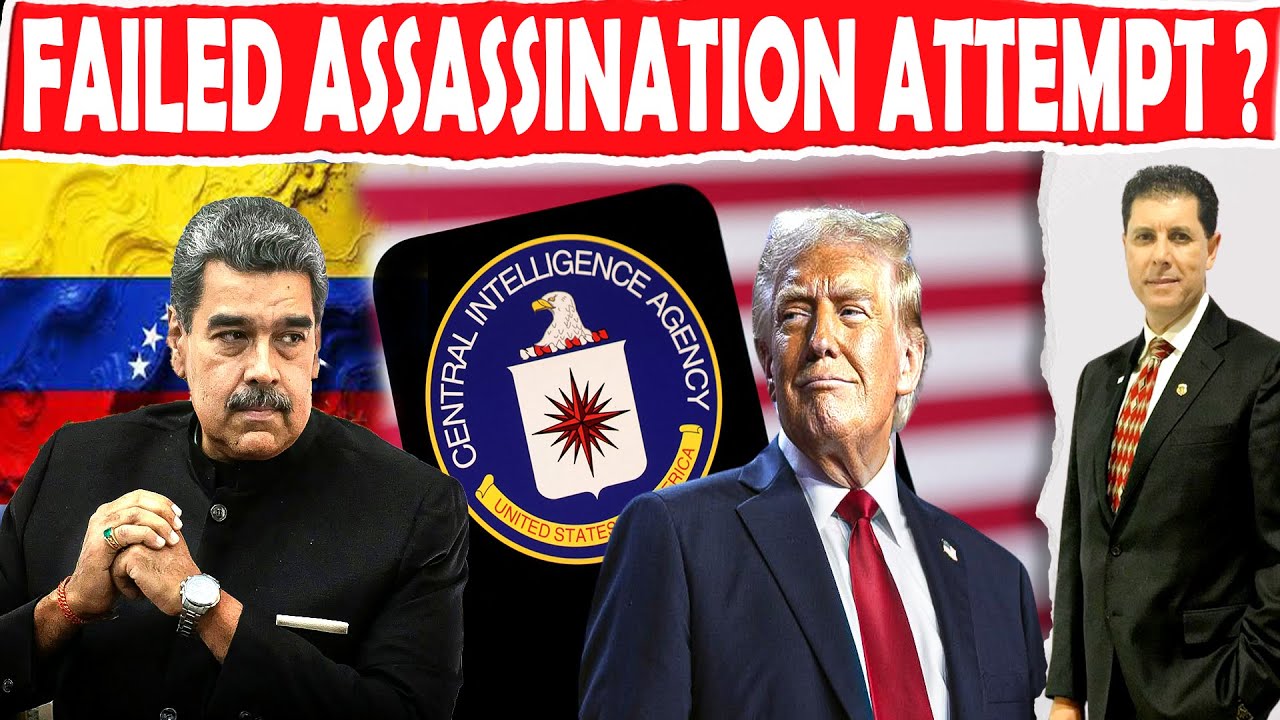
Dr. David Oualaalou examines alleged U.S. and CIA covert operations in Venezuela, tracing the country's OPEC ties and history of American intervention. He responds to clips from Donald Trump and Washington correspondent Vinay Simlot while analyzing Venezuela's geography and political position.
Chapters
Hello everybody and welcome to Geopolitical Trends, where truth matters. I'm your host, Dr. David Oualaalou. Very, very excited to be with you. Uh, I will be addressing for you the, uh, CIA ops, covert ops, that is, in Venezuela, and to why that is. Uh, of course, what Mr. Trump is saying has nothing to do what's with what's really going on. So, and this is what I'm going to be providing you in this, uh, live stream here, uh, my own analysis, uh, given that I wrote, uh, in— I think in my Russia book I wrote something about Latin America pertaining to this aspect here. So, and I'll, uh, I'll answer if there is any questions towards the end. But first, let me say hi to our wonderful community. Before I do this, Liang, Yeah, thank you so much for pointing out I made the mistake when I set it up and I put it at 10 PM. So it was supposed to be 12 PM. So thank you so much, Liang, for pointing that out. We greatly appreciate you for that. Zhaoyang, good to see you. Phil, as always. Catherine, Catherine, good to see you. Landerorfer, is that German name, Catherine? So good to see you here, Myra Page. Good to see you as always. So let's, uh, first of all, I have a housekeeping item that is here quickly for you, which is I'm gonna share a comment by, uh, uh, one of our, uh, community members. His name is Nazari Maryk. So here is what he wrote, and I quote: Hi, Doug. Greetings. I say this with honesty and concern. Your country feels like it's trapped in a cycle of conflict. One war after another, one crisis after another. I am growing older, and before I leave this world, I dream of seeing a planet at peace. I want to travel freely by car or bike, to camp under open skies, without fear. But each year the situation seems to spiral further. I still hold hope that one day a courageous and principled nation will arise, not to conquer, but to help restore sanity and dignity where chaos reigns. End of quote. Thank you so much for that, and I couldn't agree more with your assertion. So, uh, and I, when I put my comments to this particular, uh, my response rather to this comment, I put that some of us Americans feel ashamed of having such a government because that government in Washington doesn't represent me. I just want to put this for the record, and I'm not, you know, it's the truth. I don't feel they are representing me. I will not considering them, meaning all the politicians in Washington, represent me. They are a bunch of corrupted, incompetent, you know, individuals. They don't deserve to be there. But again, it becomes on us citizens to educate ourselves. So I truly, truly appreciate you sharing that with the community. Thank you so much for that, sir. Uh, let's get into our topic, you know, what's behind the US covered up, uh, covert rather, ops in Venezuela. So of course it's a question that we ought to ask when you understand the history of the, uh, of the US involvement, not only in Venezuela but rather Latin America writ large. So, and I'm going to be providing you both the history of Venezuela, which you need to know about, but also the history of COVID ops in that part of the world. And then I share, uh, uh, an excerpt from my book regarding this. So it's been disclosed, uh, that, uh, you are— some US officials usually— here is how it works in Washington. If Washington wants to leak information, they will always have someone in the higher-ups, close within the White House or what have you, send— sort of connect with some news outlets. Because remember, the news outlets and the government, the, the, the administrations are sort of in bed together. That's just the way it works. They feed them the info in return for, for an exclusive interview or what have you. So anyway, this official, who wants to remain anonymous of course, uh, privately said that the, uh, Trump's administration strategy focused on removing President Nicolás Maduro. First of all, Why the heck will we remove someone? Who are we to decide on that? And second, how about, how about not getting involved in internal affairs of other countries? And of course, that's what Trump said, that he's mulling a land attack on Venezuela and sharply escalating tensions after multiple strikes. By the way, it's not one or two. Multiple strikes on boats in the Caribbean Sea. First of all, you're looking at a violation of international law. Second, there is the UN, uh, what we call the UNCLOS, uh, that's the UN, I believe, uh, the Law of the Sea. That's, that's, that's a UN sort of mandate and makes you just wonder, we violate all this an attack. And second, what makes us think that there are drugs in that boat? Usually the protocol is you board the ship, you check, and there've been some incidents— I was aware of some— when the authorities boarded the ship and there were no drugs there. So, and this is again what makes you think twice about what are we doing. So, and, uh, when Trump was asked regarding the regime change, he said, "Yes, I did order the op by the CIA." Well, first of all, CIA does not need the president's authorization. It's a protocol. Usually you have to have the president sign off on certain aspects, but really deep down, the agency doesn't need the— the agency doesn't report to the president. The president is useless when it comes down to the CIA's operations. I'm telling you from one who's been inside the government, so inside the IC, the intelligence community writ large. And here is what Maduro sort of said in response to Donald Trump's announcement. And I quote, "No to regime change, that reminds us." of the failed wars in Afghanistan, Iraq, Libya, no coup d'état carried out by the CIA. Latin America does not want them, does not need them, and reject them, said the Venezuelan president, uh, Nicolás Maduro, end of quote. And that was in response to what Donald Trump when he announced yet another strikes on boats in the Caribbean. So in this case, Trump will have to explain what is the plan, what's next. Are you gonna just be blowing up boats that, you know, you can't just do because there were civilians that been killed. Those strikes are illegal. It's no different than what Obama did when he fired drones or missile fires, whatever you want to call it, in Yemen and end up killing civilians. Because Obama's legacy ain't pretty either. And this is now, you're going to have one question is how Venezuela is going to react and how Latin American countries is going to react to all this given the history of the CIA covert operations in Latin America. And I'm going to be providing you a really historical snapshot about those particular operations. So first, let's start with the geography. So let me share the map with you, and I give credit to World Atlas because that's usually— I use their map for Latin America here, for geography rather. So here's Venezuela. Let me make this bigger. There we go, so you can at least see. So Venezuela, uh, is located in the, uh, northern edge of South America. It is geographically positioned in the northern and the western hemispheres of the Earth. Venezuela is bordered by Brazil to the south Guyana to the east, and by Colombia to the west and southwest. It is also bounded by the North Atlantic Ocean to the northeast and by the Caribbean Sea to the north. Venezuela shares maritime borders with Barbados, the Dominican Republic, Dominica, St. Kitts and Nevis, and Saint Lucia, Trinidad and Tobago, and Puerto Rico. So it is very sort of geographically very, very important location vis-à-vis Venezuela here. Now let's talk a little bit about history of Venezuela because I believe it's important to understand that, that history. So You go back, you have to go back to about 1522. That is sort of when Venezuela was colonized by Spain at that time. 1522, that's how far back. And of course, it has to go before that when Columbus discovered that part. So, and this was the reason for this, the colonization, that is, the reason was because of the resistance from the indigenous people. So, and I'm gonna just be providing brief here. So then we move into 1811. Why 1811? Venezuela became one of the first Spanish-American territories to declare independence from the Spanish, uh, and to form parts of the first Federal Republic of Colombia. Remember, back then in history, it was known as Grand Colombia. That's how it was known, the whole area that includes also part of Bolivia, believe it or not. So back then, so it separated as a full sovereign country in about 1830. And during the 19th century, Venezuela suffered political turmoil. And that's led to some sort of— became some sort of an autocracy and remained dominated by regional military, uh, sort of strongmen. That's what was known for dictatorships that took place all the way until the mid-20th century. This is one of the key aspects that you need to understand. And one of the things, once again, if I am to go back from chronologically back to 1521, that's when the Spanish colonization began and moved all the way. I gotta silence this phone because—
there we go.
Uh, then the first rebellion took place 1749, then 1810, that's when Venezuela takes advantage of Napoleon invasion of Spain to declare independence. Very important to understand this dynamics. And part of that, after that sort of, uh, 1829, 1830, that's when Venezuela secedes from what was known at that time as Gran Colombia. This is what it was known before. Uh, then you move into 1870 to 1888. Why is this important? Because that's when, uh, a ruler— I think I have a picture of Antonio Guzmán. I hope I do. Uh, let me see. Uh, Castillo. No, I don't. Sorry, I don't have the picture. I, I, I don't know where I misplaced it. Anyway, Antonio Guzmán Blanco attracts foreign investments and modernizes the infrastructure, and that's when it developed agriculture and education. Well, once again, why is this important? I'm highlighting this to highlight to you that when you engage in economic ventures, not in conflicts, not in wars, not in creating or fomenting tensions, that's when countries prosper. And Venezuela back then evolved into this direction, both in agriculture and in education. And of course, it was still until 18— 1908 through 1935, and that's when you had a sort of dictator, Juan Vincent Gómez. That was the one of the dictators from the military background, and that's when Venezuela at that time it was discovered that it became one of the world's largest oil exporter. That's how far back. I will talk to you about, uh, Venezuela being the founder of OPEC. A lot of people do not know why. Again, I'm mentioning this to highlight to you why we are there to begin with, why we want to go there. So 1945, that was a coup established the civilian government after so many decades of the military rule. Of course, that was known not just in Venezuela. Colombia also experienced that and other countries in the region. So, and in 1948, uh, that's when you had Romulo, uh, Colegos. That was Venezuela's first so-called democratically elected leader overthrown within 8, 8 months of, uh, in a military coup. And the military coup at that time was led by none other than Marcos Pérez Géminis. 1958 saw also an Admiral Lázaro Aústede. Marcos Pérez— it was basically from 1958 all the way to 1993, all it was a series of coups, one after another. One after another till it came the rise of Hugo Chavez in 1998. And of course Hugo Chavez in 2001, uh, you, uh, enabled to act, pass law aimed at redistributing land and wealth among the people. So concern grows in business and some labor circles that he's trying to concentrate the economic and political power. And of course, that's when an armed rebellion took place in 2002. So, and, uh, Chavez, uh, wanted to take him into military custody. So, and then interim government took place. And in 2005, uh, the former president— the late president passed away— Hugo Chavez signs a decree on a land reform to eliminate Venezuela's large estates and benefit rural poor. So now one of the key things I would need you to understand is 2006. Why is this important? Because that's when the Russians openly— even though Venezuela has been a client of the Soviet Union back then, but in 2006, president, former President Chavez signed the $3 billion deal, arm deals with Russia. So, and that is, uh, sort of when Chavez in 2006 also won the third term election. To that, fast forward to 2007, that's when two leading U.S. oil companies, ExxonMobil and ConocoPhillips, refused to hand over majority control of their operations in the, uh, Orinoco Belt to the Venezuelan government. And that paved the way for what you are seeing today. So, uh, uh, Venezuela's, uh, former President Chavez in 2007 suffered first defeat in the ballot box when a referendum narrowly rejected proposal to increase government control over the central bank. So once you start playing with finance, energy, and so forth, this is where you see the, the, the issues coming up forward. So, so fast forward to 2010, that's when you start to see economic problems in, in Venezuela. And one of the key things that happened, and I remember this vividly, was the devalue of the Bolívar currency, the Venezuelan currency, that is.
Why?
To boost the revenue from oil exports. So, and this is where tensions start to emerge internally. And after, in 2012, after 6 years of wait, Venezuela become a full member of a regional trading bloc, Mercosur. So and, uh, was given about 4 years to comply with the bloc's trading regulations. And of course, 2013, that's when Hugo Chávez passed away, died at age of 58. So, and that's when it became tensions inside the country and so forth, uh, uh, till you had the emergence of Nicolás Maduro. To my knowledge, I was in Washington at that time, but we were aware of the role that Maduro is going to be playing moving forward. And most likely at that time, we were convinced, at least for me, I don't speak for others, I was convinced that Maduro is going to become the next president of Venezuela. And that's exactly what happened. So Maduro, uh, uh, uh, sort of won the elections in 2018 in May. And sort of that's when the 2 million Venezuelans have fled abroad to neighboring countries because you have some tensions become, uh, uh, you know, the country became embroiled into all that. So this is just part of the history that I need you to understand about, uh, Venezuela. One thing I told you I will mention earlier has to do with Venezuela joining OPEC. Now Venezuela, just a lot of people do not know, was a founding member of the OPEC, the Oil Producing Exporting Countries known as OPEC. And this has been since its creation in 1960. That's when it was. So Venezuela was one of the 5 There was only 5 countries at that time, along with Iran, Iraq, Kuwait, Saudi Arabia. So, so, and that was established, the OPEC, to unify the petroleum policies and secure stable price, or prices, that is, for producers. So, so the key that I need you understand, so Venezuela being a founding, a key player and founding member, of the OPEC back in 1960 during Baghdad Conference. That's where OPEC was founded, 1960. And the objective of it was that the Venezuela's participation stems from the organization's goal of coordinating and unifying petroleum policies to secure stable oil markets. So What's interesting about Venezuela, in addition to Saudi Arabia, to my knowledge, is that also Venezuela remain an active member not only in OPEC but also in OPEC+. And OPEC+, and that is the large group of countries that includes non-OPEC members producing countries. There are so many other oil-producing countries did not want to be part of OPEC. So I just want you to understand this reality as to really the role. Then I'll detail exactly more how all of a sudden we are interested in regime change in Venezuela. Liking this video so far? Don't just be a watcher. Go ahead and hit the like, share, and subscribe button. And don't forget to tap the bell so you will not miss any of my videos or live streams. This way, you will be supporting a channel that stands for the truth and objective reporting. The choice is yours. Thanks for your support. Indeed, thank you for your support. So let's talk about what Trump has announced, and I'm going to be playing two clips for you as I move forward. Worst one. So the question becomes, why did Trump authorize CIA to go into Venezuela? Like I said at the beginning, CIA does not need— you know, that's an illusion what the media or the White House is saying. It's nonsense. I'm here to tell you as one who was inside, understand how this dynamics work. CIA does not report to the President of the United States, period. So, and this is basically came through when a journalist asked Donald Trump regarding this. So let me play the clip for you, then we'll, uh, we'll, uh, we'll go from there because I want you to hear this aspect of it. So, all right, let's share the screen. There we go. Donald Trump confirms the CIA is conducting operations inside Venezuela. That statement follows weeks of military strikes against boats accused of carrying drugs near that country. Washington correspondent Vinay Simlot joins us live this morning. So Vinay, what is the White House saying about this?
Yeah, President Trump says he's targeting drug trafficking and says he considers drug cartels, terrorist organizations. And on Wednesday, President Trump confirmed that he authorized CIA covert operations in Venezuela.
I authorized for two reasons, really. Number one, they have emptied their prisons into the United States of America.
And the other thing are drugs.
We have a lot of drugs coming in from Venezuela.
President Donald Trump confirmed in the Oval Office that CIA is conducting conducting covert operations in Venezuela, but the president would not say whether he authorized the agency to kill the Venezuelan president, Nicolás Maduro.
Does the CIA have authority to take out Maduro?
Oh, I don't want to answer a question like that. That's a ridiculous question for me to be given.
The State Department has accused Maduro of leading a global terrorist cartel and offered a $50 million reward for information leading to his arrest. Maduro responded to President Trump on Wednesday.
No war, just peace on the people in United States. Please, please, please, please.
In recent weeks, President Trump has also authorized deadly strikes against 5 boats near Venezuela, killing 27 people. Some lawmakers say they're frustrated the president is essentially committing an act of war without authorization from Congress.
When they load it up with drugs, they're fair game. And every one of those ships were— they're not ships, they're, they're boats.
And President Trump says he's also considering going after Venezuelan drug trafficking by land, not just by sea. And the top Democrat on the Senate Foreign Relations Committee says the American people deserve to know if the administration is leading the U.S. into another conflict.
Ani, the U.S. and several other countries don't even recognize Maduro as the Venezuelan head of state. What's the deal with that?
Yeah, the State Department said back in 2024 during the Venezuelan election, Maduro declared himself the winner even though there's evidence that he may not have actually won that election. And the U.S. State Department says it does not recognize him as the president and says that Maduro has actually negotiated drug shipments and has been part of drug trafficking that has affected the United States.
Vinay Simlot live in Washington, D.C. this morning.
Thanks, Vinay.
Okay, now first of all, I have to disagree with Donald Trump when he said to the journalist, that's a ridiculous question. It is not a ridiculous question, it's legitimate question. So the journalist has the right to ask that question. And for president to answer in that manner, it shows you the lack of a diplomatic finesse that Trump doesn't possess, doesn't understand how the diplomacy and how the protocol works. But it's not— it is legitimate question. Second thing is, first of all, there is a demand for drugs inside the United States. Let's just put things in perspective. So as a matter of fact, the agency has been involved, you know, when you go into the history of the United States, with two locations, one in Southern California back in the '70s, and second in Afghanistan with the trade of, with the opium trade. So who do you think was encouraging all this and who has supported all this? So for Donald Trump to be stating just stuff, you know, just, it doesn't, he doesn't talk based on facts. This is what I found. Very, very frustrating. So, and that is one of the key aspects. Suffice it to say that you need to understand that these operations that's been carried out, it's not new. You know, I'm going to take you back to September 2nd of this year. The US first strikes is reported to have killed 11 people. We don't hear much about it.
No.
September 15th of this year, No, a second strike killed 3 people, and those are civilians, those are not military people. So September 19th, a third strike reported to kill 3 other people. October 3rd, a fourth strike killed 4 people, and this according to U.S. officials. October 14th, another strike killed 6 people according to Trump's statements. October 16th, we're only talking about 4 days ago, U.S. officials confirmed a 6th strike in which some survivors were reported— were reported the vessel was described as engaged in narcotrafficking. Well, first of all, when you engage in this manner, you are breaking all the protocols. First of all, by not declaring that through Congress. And second, there are certain protocols that the U.S., like every other country on Earth, has to observe. That becomes the question of, of why for us we can break all the rules but not other countries. Or when other countries do it, oh, it's wrong, we're gonna have to hold them accountable. Well, who's gonna hold the US accountable? Because what we are doing, it's not right. So I'm gonna share another clip with you here, uh, and I want you to take a listen, please. You bring me to my next question, which is Venezuela. Obviously you've been very focused on this. President Trump has authorized military strikes against suspected drug boats in the Caribbean. As you know, so far more than 20 people, Senator, have been killed in 6 different strikes. Do you believe that these strikes against these suspected drug boats are legal?
No, they go against all of our tradition. You know, when you kill someone, you should know— if you're not in at war, not in a declared war, you really need to know someone's name at least. You have to accuse them of something. You have to present evidence. So all these people have been blown up without us knowing their name, without any evidence of a crime. And for decades, if not centuries, when you stop people at sea in international waters or in your own waters, you announce that you're going to board the ship and you're looking for contraband, smuggling, or drugs. This, this happens every day off of Miami. But we know from Coast Guard statistics that about 25% of the time the Coast Guard boards a ship, there are no drugs. So if our policy now is to blow up every ship we suspect or accuse of drug running, that would be a bizarre world in which 25% of the people might be innocent. The other thing about these speedboats is they're, they're 2,000 miles away from us. If they have drugs, they're probably peddling drugs to one of the islands of Trinidad or Tobago off of Venezuela. Uh, the, the idea that they're coming here is like, it's a huge assumption and really shouldn't you have to present some proof? Um, it is the difference between war and peace. In war though, you don't ask people's name, but if they want all-out war where we kill anybody and everybody that is in the country of Venezuela or coming out. That has to have a declaration of war. It's something that is not pretty, very expensive, and I'm not in favor of declaring war on Venezuela, but the Congress should vote. The president shouldn't do this by himself.
Let's talk about what appears to be an escalation, because in an extraordinary moment, President Trump acknowledged that he has authorized a covert CIA operation inside Venezuela. The Pentagon is scaled-up U.S. forces and military assets in the region. Here is what President Trump said about Nicolás Maduro this week. Take a look.
He has offered everything.
He's offered everything.
You're right. You know why? Because he doesn't want to fuck around with the United States. Thank you, everybody.
You talk about war, Senator. Do you believe that President Trump wants to go to war with Venezuela?
You know, I don't know what his actual intentions are. I can say, though, that not being a master of spycraft, if you announce that you're going to have covert CIA action, it's no longer covert. So if you're going to spy on a country, usually don't announce that you're going to spy on a country. So it's a little bit unusual there. I do think there are members of his administration who have been agitating for war with Venezuela for a long, long period of time. And once again, there's the stick and the carrot. Yes, the president's right, they know that we would defeat them in a matter of days. Uh, but the chaos that ensues, you know, we've had regime change. And President Trump, one of the things I liked about him is that he's, uh, for a long time said that he's not for regime change. He was against regime change in the first Iraq War. He was against regime change in Libya when President Obama promoted it. And out of both of those wars came, you know, trillions of dollars of expenditures but also decades more of violence and instability and chaos. And with regard to Libya, the spread of weapons to terrorists all throughout sub-Saharan Africa. So regime change isn't always what you expect to get.
Okay. Now, the idea of— first of all, two things. When a president use the air force, even though the air force is protected in the Constitution, But as a president, you don't talk in that manner. I understand if the officials between themselves, whatever. I mean, we always used to hear the F-word among us, whatever, when we talk in a normal conversation. But in a setting like that, coming from president, it tells you where the level of this president is. Second thing, who is promoting wanting the war within his administration? There is one particular individual, and that's none other than the Secretary of State. Because that was the first order of business for him. From, you know, as you know, Marco Rubio is of Cuban descent and has always been anti-Maduro because Chavez was closer with, uh, what's his name, uh, uh, now I draw a blank on his name, Fidel Castro. So that's what's always been, been the case. So now pushing for this war, it's, you have to have legitimate reasons, and so far What the administration presenting has nothing to do with the fact. And the third element I want to mention into all this before I move into the history, and I'm going to share examples with you of the CIA's operations in Latin America. There is the UNCLOS, which is the United Nations Convention on the Law of the Seas. And that one, in addition to the 1988 UN Drug Trafficking Conventions, emphasize cooperation. It doesn't emphasize just blowing up boats, boarding and consent mechanisms at the sea. So, uh, sort of not, not some sort of a destruction, if I'm using the term. So any strike, any strike— this is according to the charter— any strikes that kills suspected traffickers, those are suspected, this is why we use the term,— should trigger a prompt, independent, and transparent investigation. So in other words, the US should be investigated under international law. But we all know how it's going to turn out. You look at just what happened with the ICC when it issued the arrest warrant for Netanyahu and what the United States did. It shows you, and more and more, as a matter of fact, A study, another study, I'm sorry, a survey was just released yesterday about the, how the rest of the world perceive Donald Trump. Donald Trump got about 34% around the world at a time when usually US president back then, at least 15, 20 years ago, used to get about above 60. That just shows you where things are. And this is again, where you have now even constitutional lawyers are stepping forward by saying— I had a chance to read one analysis by a constitutional lawyer by the name Bruce Penn. He argued definitely that US maritime operation, any use, and I quote here, any use, that's his quote, any use of military except in self-defense to an actual attack requires express congressional statutory authorization, and the military attack on the alleged Venezuelan drug traffickers was unconstitutional. End of quote. This is, again, if you— we go back in history, we go back to the 1973. What was in 1973? It was the War Powers Resolution, which was a federal law that requires the US president to obtain congressional approval before committing to a war. The wars we went to in Afghanistan, in Iraq, in Libya, and so forth, all those were unconstitutional. So, and it also mandates— this War Power Resolution of 1973 also mandates that the president of the United States notify Congress within 48 hours of any initiating any military action. Let's say you sent a special op to, you know, and I remember we used to be in this, but I also found out that within 40 hours, a letter went from the White House to Congress informing them of some special op somewhere in the world. And this in the powers in the War Powers Act of 1970. So we are breaking every local, domestic, and international protocol for this. And that is now where you're gonna have to see how Venezuela's gonna react to this. And they're gonna have to react, you know, like every other country. It's a sovereign nation. Whether you like Maduro or not, it's beside the point. So Venezuela now accusing, and rightly so, The US of violating international law and the UN Charter, which what I shared with you. So, and that's, that's sort of legitimate, legitimate reasons. Because one thing Trump didn't count on is that by behaving this way is unifying now all Venezuelans. So, and I'm gonna share something with you as I move into this analysis, how they are, how the opposition party inside Venezuela which getting funding through the United States is pushing the other direction. So, and this is again, and I'm just speaking based on historical facts here. So if I am to think about what happened in Venezuela a few years ago, this will be no different, that the Venezuelans will fight the Americans. So that intimidation of we're going to wipe them out in few days, I don't think so. I don't think so. Because you think about it, think about it. Venezuela, you know, they fought the Nazi extremist movements inside. So there is also— Venezuela has been attacked by the Nazis between 1942 and 1944 in the Caribbean. Yeah, that's how far the Nazis went. So there is another historical fact, which is Venezuela has been attacked by none other than British Empire. This is, by the way, FYI, guys, this is why UK is still holding the gold in its, in its bank in, in England that belongs to Venezuela. In other words, they stole the gold, the British did. So British, or Britain, should return the gold to Venezuelans. So that was during this time. So, and what happened? The British sent, sent about 21 ships back then. So, and but the Venezuelans fought back, stood their ground, yeah, with stones, sticks, and knives and machetes, and defeated the Brits. And I'm not talking on the top of my head here. I'm talking about a historical fact. My point is to highlight to you that if we come with this attitude of we're going to look, we couldn't defeat the Houthis in the Red Sea. We couldn't defeat the Taliban in Afghanistan. We couldn't defeat the militias in Iraq. What makes us think again, we're going to defeat in Venezuela or Iran for that matter? Is this because we couldn't defeat Iran, now we moving into Venezuela? Yeah, highlight. So my point is to highlight to you that always what an American president says versus what he does are two opposite things. So that's just, that's just the history of how it is. So then comes the big picture of how Latin American countries is gonna react. Well, you have— I have a picture here of the, uh, Colombian, uh, president This is Gustavo Petro. Petro responded to Trump's announcement on Wednesday, warning of possible consequences for his country. Yeah, but also because, uh, now Donald Trump is accusing Petro as being a drug trafficker. No, he's accusing Petro because Petro was the first one in Latin America to push for an independent state of Palestine and to put Netanyahu in, in the ICC tribunal. Another word, to be tried. Donald Trump didn't like that. This is why this tit-for-tat, it just doesn't make any, any sense whatsoever. So, uh, what, what the president of, uh, uh, Colombia is standing his ground. Here is what he said. And I quote, "Honestly, I am not much of a fan of the policies pursued by the current government of Venezuela. But I do know that what can happen in Colombia is that my responsibility, if missiles start falling over there, or as announced today, if a violent operation began by land carried out by the CIA agents, they say, or by the US Marines, or as we already know, if missiles are launched at an unarmed civilian population, whether or not it is part of the drug trafficker or trafficking chain, end of quote. So in other words, he is advocating for his country, and rightly so. So here is what I'm going to do for you. I'm going to be providing you a historical snapshot of operations that took place by the CIA in Latin America. And I have some pictures. Of course, anytime you mention Latin America and you mention CIA, the dirty wars come to mind. But also there is one major aspect that you need to understand. By having Donald Trump behave in this way, it's kind of put forth now the Monroe Doctrine that is, maybe it's alive again. So we think, at least what Donald Trump is thinking. So, so the U.S. history, or the CIA history in Latin America, is very dirty. So for now, it is unclear as to what the U.S., uh, sort of the espionage operations in Venezuela, how far are they extended. But history offers clues. So offer clues about what? They offer clues about the nature of the operations. Will it go up to the assassination? Possibly, possibly not. But I am sure the Maduro team will take precautions, and I will not be surprised that the Russians will send some entities in support of Maduro. So when you think about the operations of the CIA in Central and South America and the Caribbean, so It's nothing new because you have to go also back all the way to 1800. Throughout the early decades of the 20th century, the US carried out a series of military interventions in Central America and the so-called— I don't know if you remember the, the code name of Banana Wars. And what was it about? Is to protect the US corporations' interest in the region. So let's start from 1934, and under President FDR, Franklin Delano Roosevelt, the U.S. adopted what was known as the Good Neighbor Policy. As a matter of fact, during that time there were some good initiatives by the U.S., not in its entirety. So, and what was one of the efforts with this was that the commitment that the FDR did was not to invade or occupy Latin American nations and not to interfere into their domestic affairs. Yeah. However, that was short-lived. The US didn't honor that in the long term. It sort of flipped. It went from a good neighbor to a bad one. So, and that went through after this time, 1934, because remember, right at that era, right in the '30s, something major happened in Europe. And you all, if you all know, you have to think about Italy. It was the first time the CIA interfered in— indirectly, because back then it was not called CIA— interfered into the Italian elections. That was back in the '30s. That's how it all started. Excuse me. And this went through all the way to the Cold War, and that's where the US funded several operations to unseat elected left-wing leaders in Latin America. So we're gonna do, we're gonna go in historical chronologically here. I'm gonna start in 1950 in Guatemala, and this is where you have The president, Jacobo Árbenz— let me, let me, because I have pictures, so it's black and white, and I'm gonna just share those with you here. 1954, this is where the election of Guatemalan President Jacobo was toppled by local fighter group backed by the CIA under the president, under the presidency of Dwight Eisenhower. You know, Árbenz had sought to nationalize the company stoking fears within the U.S. more socialist policies in the country. This is what happened with at that time. And during this time, under the CIA operation codename PB Success— remember, you can Google it later on— what the, the agency did was it trained fighters led by the military officer at the time. His name was Carlos Castillo Armas. I think I have his picture. Yes, I do. This is Carlos, uh, Carlos Castillo Armas, who was trained by the agency, who took power after a coup. And that's when a civil war raged in Guatemala from the 1960s all the way to 1969 between the Guatemalan government and military on one hand and the leftist rebel group on the other. So once again, it's very crucial to understand these historical facts. Move to 1960s. What is 1960s known for? Cuba, of course. In 1959, that's when leader Fidel Castro— that's 1959— Fidel Castro came to power after overthrowing dictator Fulginesco Batista. And of course, under Eisenhower, the CIA devised a plan to train Cuban exiles to invade the country and overthrow Castro. At that time, when John F. Kennedy came to power in 1960s elections, won the elections, that is, was briefed about the plan during his inauguration. Interesting. What was interesting about all this is that Fidel Castro found out about the training camps through Cuban intelligence. If there is one thing I've learned in my years in the IC in Washington, that the Cuban intelligence are very, very, very shrewd. So savvy. It's not about the satellites, it's not about that. They just their intelligence service is— anyway, they found out. And in 1961, as you all know, Kennedy— what did Kennedy sign off in 1961? It was a major operation. Do you guys know what it was? Can you put the name? Can you name it if you happen to know that history at that time? It was a major— it was, it was, it was botched. It was botched. Uh, does anybody know what operation is that? It's famous historically speaking. It was in Cuba. It was a failed, failed attempt. Oh, Matt Becky, you got it! The Bay of Pigs. The Bay of Pigs, indeed. That was what Kennedy signed off on, the Bay of Pigs, in invasion, a plan for the Cuban exiles to overthrow Castro. As a matter of fact, the ancestors of Marco Rubio, it was during this time. This is why Marco Rubio is pushing— that it's a neocon after all. He's pushing for wars in Venezuela. So however, the invasion failed when the Cuban military overwhelmed them. So move to 1960, also in Brazil, at the same time. What happened in Brazil? You have a president at that time by the name of Jao Goulart. And I, I looked into the— yeah, I have a black and white picture here. It's a color picture. Anyway, 1961, Jao Goulart came into office as president. And what happened with this? Because when he came to power, he came with the mandate to pursue social and economic reform. Once again, those individuals who won power, won the elections, wanted to improve the conditions of their country. Should we blame them for that?
No.
But again, that's again how we tend to not allow any economic development. So Jaume Llull, you know, wanted to pursue this social and economic reform, and he maintained a good relationship with the socialist countries such as Cuba, and a nationalist, or a subsidiary of the US-owned International Telephone and Telegraph. He was known as ITT at that time. The CIA didn't like that. So what did CIA end up doing back then? It went ahead and funded the pro-US politicians and supported anti-communist groups, and this undermined Goulart leadership, culminating in a military coup in 1964. Which established a US-friendly dictatorship. The same time, around this time in Colombia, I'm sorry, in Ecuador in 1960. Ecuador has long been some sort of historical record suggests that it was a basket case for political instability. Till today, you still have certain tensions in Ecuador. I was talking a few months ago to someone who knows the area very well. And I said, how are things in Ecuador? He said, yeah, it's so-so. So back then in the '60s, it was about 27— because here is the history of Ecuador. Ecuador experienced about 27 presidents. Yeah, 27 presidents between 1925 and 1947. That is a lot for such a short time. All this changed in 1950. Why? When the country witnessed a rare period of stability that was at that time. But this did not last.
Why?
Because by the early, uh, of 1960s, the US was worried about the pro-Cuba policies of the President José Valesco Ibarra. I think I have a picture of him. Ibarra, yes. This is the, this guy, former president, and his vice president Carlos Julio Arosema. So who in fact advocated even closer relationship with the Soviet bloc at that time, Soviet bloc nations. So the CIA didn't like this. What they end up doing is using US labor organization as its conduit, finance the spread of anti-communist sentiments in the country. This is exactly how we do it now. We do it through NED and through other organizations, like what happened in Ukraine in 2014. So that's why we're seeing the chaos in, in Ukraine. So, and in the end, the CIA almost owned almost everybody who was anybody in Ecuador. And, uh, because he was a record of a CIA agent who told— it wasn't— who told an analyst at that time. And you know, the analyst was none other than Roger Morris. You have to look him up in, in, in Google. So because this agent was still alive in 2004, told the analyst that the CIA proved appraisal of the agency's activities in Latin America. Aro Zerna, who was at that time the vice president, first staged the coup against the president. So we funded the vice president against the president. So, and initially turned further to the left before trying to moderate his position. And in 1963, the military staged a coup against him banning the Communist Party and severing ties with Cuba, aligning with the US interest. At the same time, all this happened in the same decade of the 1960s. This one in the '60s and the '70s in Bolivia between 1960— and I went to Bolivia apart when I was still in Washington, uh, in 2000, I think 2007. I have some Some artifacts that I brought from Bolivia were very, very interesting. Between 1963 and 1964, the US used covert funding, largely through the CIA, to influence Bolivia's politics. And the funding backed leaders that were sort of, uh, friendly with the US and supported a military coup. And in November of that year, 1964, war, it was a military coup led by none other than, uh, uh, General Roné Barñanos Ortuno. I think I have a picture of him. Yeah, right here. It was against the elected president, Víctor Paz Estanaro Soro. So sort of, that doesn't make any sense to have now a general conducting a military coup against an elected president. This is the elected president of Bolivia at that time, Víctor Paz Estena Sorozo. So the coup was successful and forced Víctor into exile. But the US was not done with interfering in Bolivia. This is why you need to understand, and I'm gonna bring you to today, why still tensions between, what's his name, the head of Bolivia, The indigenous Bolivian and the US, they butting heads. So, uh, I forgot his name, I'm sorry, I couldn't, I couldn't remember. What happened after this? 1970. This is when Washington, in the '70s, it's notorious what the US did in Latin America. The US, Washington had eyes set on another regime change. And this time the target was none other than one José Torres. José Torres had come to power in 1970 and had nationalized multiple US companies in the country. I don't know if I have picture of him. Uh, no, I don't. I'm sorry, I didn't, didn't get this one. 1970, another country that witnessed this is Chile. The CIA provided the funding to help end the presidency of none other than Salvador Allende. I have a picture of him right here. Salvador Allende was an elected leftist leader. Allende has planned to nationalize Chilean copper companies, many of which were owned by US interests. And if you know anything about copper, You understand the importance of this. Speaking of that, I had a, an entity reached out to me to do an analysis for them. It's a, it's a video that I'm gonna release, uh, in the weekend, and they want me to analyze for them the issue of the rare earth elements, you know, because now there is a major concern here in the US. This is no different than what happened back in the '70s. This guy Salvador at that time wanted to nationalize the copper. This is why you see in the US, went ahead and threatened Pakistan to impose sanctions regarding the copper, because some of it, it's used for missiles technologies. So sort of how you, the makeup of a missile. So Salvador Allende wanted to sort of nationalize the Chilean copper. And Chile is known for copper, so many of which were owned by the US interests. And that's when the CIA went ahead and funded, sort of went ahead and funded Allende's opponents and spread anti-communist sentiments. And this, of course, spiraled into 1973 coup led by General Augusto Pinochet. If you know the history of Augusto Pinochet and how brutal Pinochet was, I think I wrote about him in my Russia book. So Allende shot himself dead using an AK-47 rifle before he was captured because he knew what was going to happen. So doubt about the cause of his death lingered because it was nothing confirmed at the time for a decade. Before it was confirmed by an independent autopsy years, years later. So, and of course, the brutal dictatorship of Augusto Pinochet lasted for about 17 years. So this leads me to talk to you about Operation Condor. I don't know if any of you know, but you can look it up later on. This is exactly an operation that took place in 1975, and this is where the CIA supported the right-wing groups at the time, military dictatorship in 6 Latin American countries. And the whole purpose was to set up transitional networks of terror called Operation Condor. And that began during the presidency of none other than Gerald Ford. I don't think so Gerald Ford has a say or had a say into all this. Like I said, CIA does not need the president's authorizations. So what are those countries? And again, I'm going to share the, the excerpt from my book and highlight this. Those 6 countries were Argentina, which we all know now that the US is preparing $20 billion to send to the failed state of Argentina. They were Argentina, Bolivia, Brazil, Chile, Uruguay, and Paraguay. The operation, this Operation Condor, was aimed at one particular aspect, and that aspect is crushing political dissent, leftist and communist sympathizers. So the dictatorships used some sort of You know what they had? The CIA provided them with a shared database to monitor dissents and their families across state borders. And one example that it's not classified, guys, I'm sharing with you what is in a public domain. If you know, I do have access to the Library of Congress, and so sort of I can access information there. But nothing is classified, of course, as you know. Uh, one of the things is that this particular database that was used among these countries, these tactics used, for example, exchanging intelligence, information, prisoners, and torture techniques. So, and under the operation, uh, sort of the operation, Operation Kandor, at least 97 people were assassinated. And this according to historical record. And this was a joint venture initiative by Latin American organizations and the University of Oxford. That's what the research was conducted. This leads me to talk about 1980s. 1980s in El Salvador. In 1981, to be exact, El Salvador military elite. At that time, it was a battalion called Al-Takatal Battalion, and that one conducted a deadly massacre in the village of El Mozouty. It was, it was one known in history. About 1,000 civilian, defenseless civilians, including women and children, were killed. And during this, by the way, This happened during the civil war in 1980 and 1982. Historians can confirm this one. And the battalion was trained and equipped by the United States under its large Cold War policy of suppressing leftist rebellion in Latin America. Of course, the US government increased the military funding, aid, that is, our tax dollars, uh, to El Salvador between 1980 and '82. In the same decade, one major event, it was Grenada. It was a familiar story. If you read history, you will most likely come across this. And what happened, there was at that time none other than a guy by the name Maurice Bishop. I have a picture of him Uh, this is Maurice Bishop. Maurice Bishop was the prime minister of the tiny Caribbean island, and this guy has adopted the Marxist-Leninist policies after seizing power himself in 1979 when the previous premier, Eric Gairy, was out of the country. And of course, by late 1980s, the U.S. was carried out was worried about Cuban influence in the, in the country. So as bloody infighting took place or broke out within Bishop's party over the leadership struggle in 1983, because remember who came to power in America during that era, especially after 1986, was none other than Ronald Reagan. Ronald Reagan funded some of the operations And it's again on the record if you can look it up. So the US swooped in and invading the country, capturing Cuban in Grenada and ensuring that the country future was aligned with US priority. And the bigger one of them all was in Panama, 1980. This is when the US invaded Panama in 1989 during the presidency of none other than George H.W. Bush. Bush Senior, that is. And the invasion was called at that time Operation Just Cause. So as a matter of fact, some of that funding from the sale of weapons into, to Iran, beside the Iran-Contra, some of the funding went through this operation. So the US, of course, underplayed the death toll and justified the invasion, saying it was carried out to remove President Manuel Noriega for allegedly drug trafficking. Do you see the pattern here? That is the reason why I'm bringing this up to you, because we have two that now President Trump is saying Nicolás Maduro is drug trafficker and the Petro, Gustavo Petro of Colombia is drug trafficker. It's no different than what we did back in Panama for Noriega. And as a matter of fact, later on Noriega before that was sort of an agent for the agency, for CIA. So here is what I wrote, just to finalize this part and then move to one other aspect of the analysis regarding this particular— here is what I wrote in my Russia book. And in Latin America, how could we forget the images broadcast on CNN, BBC, and Al Jazeera of the failed coup orchestrated by Juan Guaidó, whom the Trump administration vehemently supports. It is mind-boggling to think about the US support of Guaidó as the legitimate president of Venezuela without the latter winning legitimate elections, let alone a presidential one. Talk about contradictions. While addressing the US involvement in Venezuela and Latin America for for that matter, is a fascinating topic, let history be our guide as to what took place in the 1950s through the 1980s when the United States engaged in a policy of regime change that resulted in a rise— in the rise of dictators of all sorts. The United States did many good things, at least at the beginning, in Latin America, sort of at the same time, it has a bloodstained record of supporting coups and dictators across Latin American region. Somoza in Nicaragua, Pinochet in Chile, Stroessner in Paraguay, Batista in Cuba, Death Squad in Honduras, which is an armed group that conducts extrajudicial killing or forced disappearances of persons, uh, uh, for the purpose of political, uh, uh, repression, assassinations, torture, genocide, ethnic cleansing, or revolutionary terror. And of course, the genocidal military dictators in Guatemala. That's what I wrote back then. So this puts perspective for you as to really where we are going with this. And that compels us to ask the legitimate questions. What are the possible risks of all this? Because there is risks involved. So the consequences not only for Venezuela, but the regional red lines. You think about the investments China has made in Peru and certain other aspects. And all this, it is worth addressing. I read one analysis by a Venezuelan analyst. His name is Piana, you know, and I could see the logic in his argument that Latin American countries now have not far been cautious, have so far rather been cautious in their response to Trump order and threats. So there are certain, except for one guy, one guy is none other than Gustavo Petro. Yeah, right here. That guy is not shy away from criticizing Donald Trump openly. So, and of course, you think about the, the ALBA. ALBA stands for Bolivian Alliance of, for the Peoples of Our America. And this bloc contain Cuba, Nicaragua, Bolivia, Honduras, and some Caribbean islands. So this is where the concerns for the US. So of course you're going to have to think in terms of where this escalation is going to go. What will it lead to? And will it cause a serious friction between Latin American government and the US? Because some countries are hearing on the side of cautious. So because some of the Latin Americas themselves do not see eye to eye with Maduro, it's not a secret. But if the US sending troops on the ground, we're looking at a different ball game. Whether the US will do it, I don't think so. They're going to do that. I don't see the signs for that. It's the same argument that was made about Iran. We're going to send troops into Iran in support of Israel. Nonsense. The same thing we said about Yemen. We're going to be sending troops to Yemen to wipe out the Houthis. Nonsense. And the same argument Donald Trump made about we're gonna take over Bagram from the Taliban. Once again, nonsense. We talk more. So now Maduro did one mistake, and I'm not, uh, you know, sort of— I'll say it— one mistake is that he didn't think over the, over the time since he came to power, you don't burn sort of bridges, diplomatically speaking. You have to know how to— this is why Trump is burning all the bridges, because he's not going to run for president again ever. But again, it's, it's you— once you burn your bridges, it's over. So, and Trump doesn't have the diplomatic finesse to understand how to handle certain, uh, certain situations like this. And this is where you're gonna have to think in terms of moving forward. How it's gonna— how the US is gonna act. And this leads me to the second part of my own analysis about this. I know this is a little bit long, but there's a lot to cover, and this is the most important part. So the idea that the Monroe Doctrine is dead, it's not true. It's alive. It's alive. I'm here to tell you, and Donald Trump is pushing it through the neocon members in his administration. So because Trump's constant aggression, not only in Latin America, but other parts of the world, it tells you where things are headed. We're edging for another war. Can we even afford another war? Can we even fight another war? Another war. So, and this is where the issue of Like he said, well, yeah, I authorized the CIA covert. No, you didn't authorize the squad. If CIA wants to do it, they will do it. They don't need you for that. So, but it raises questions about really why all of a sudden we are moving into Venezuela. And by the way, this is not just America by itself or the US. This is the collective West. Let's be honest about it.
Why?
Because the collective West is puppet. I mean, you look at Europe, Europe now is crumbling both politically and economically. We put him into that spot. So because what the Europeans are saying, the collective West, and I'm gonna add one other country or even two, I'm gonna add Australia to this and I'm gonna add South Korea to David Oualaalou. Because to them, what the emperor does is right. Doesn't matter what. The emperor is always right. Exactly what Donald Trump is doing in Latin America. So because the Europeans and the collective West argument is, well, we're going to have to support Donald Trump. Is the same argument I can make about Ukraine. The Europeans are supporting Donald Trump against their will at the expense of their citizens. Look at the poverty rate in, uh, UK. Look at now the conditions in Germany. Look at what's going on in France, and I was there and I saw. Look at even here in the US with the homeless people, 800 people just sleeping in the streets in San Francisco. If you total all the homeless, about 800,000. No place to sleep except in the streets. And this is where the anti-Venezuela game is played. And I'm not here to support Venezuela. I don't support any. I support what's right. So, but one of the key that I need you to understand, Donald Trump didn't win the Nobel Peace Prize, right? You know, he's okay with it now. You know why? Because it was someone from Venezuela who got it. And I'm gonna share a picture with you. Her name is María Carino Machado. This is the one who won the Nobel Peace Prize. Do you think she is an angel? She is an anti-Maduro, the opposition, been funded by the US. And that's the one, as a matter of fact, Donald Trump got a tip that he's not gonna win the Nobel Peace Prize. It was Machado. She's gonna get it. That's the one. Because now what is expected? It's more funding for her to push, because she is the one— she is the one who told Trump, if I come to power— and I'm paraphrasing here— if I come to power, you have what you need. This is exactly what, you know, Machado already has on several occasions, and again on the record out there if you know where to look, has attempted a coup against Maduro. So, and this you have to go back to 2002, and I recall that because it was during that time right before I left to Afghanistan I had the— I read what was going on in Latin America at the time. So, and this attempt was supported by the CIA to change, uh, at that time against Hugo Chávez. And Machado— let me put a picture again for those who might not know— Machado at that time sort of comes from a wealthy industrialist family and is a conservative neoliberal. And you know what the bigger, even bigger problem is? That she's also a member of the World Economic Forum, Young Global Leader. You get the idea. That's how she won the Nobel Peace Prize, which, by the way, that committee in Nobel Prize in Sweden is as corrupted as it gets. So So she is getting help from the international forum for her attempts to take over Venezuela. Why? Because they want her to privatize the country's riches, oil and hydrocarbon. Recently, she said in an interview, and I'm paraphrasing here with Trump, if I made a president of Venezuela, the benefits for the US will be enormous. So, so in my opinion, she's no peacemaker or peace seeker for that matter. So how come she was given the Nobel Peace Prize? So, and again, just for you to know, this Nobel Peace Prize thing is highly politicized. It's nonsense. It's, it's, it's, it's weaponized anyway. So, so Donald Trump knew about this, and this is why most likely he moved forward with the decision to target those, those boats and, and, and start to conduct the, the COVID ops in, in Venezuela. That is the reason why, because he was given a tip about it and he accepted it. He's okay with it. So, but Trump is no peacemaker. Yeah, I, I don't, I don't believe in that anyway, because the push was against Chavez first, then against Maduro second. So, and here is the thing, the key that I need you to know is that if we succeed in a regime change What's going to happen is that the enormous wealth of Venezuela's hydrocarbons, which is in trillions of dollars worth, you know, as a matter of fact, to those who do not know, Venezuela has the largest reserves in the world for hydrocarbons. So in addition to what I mentioned earlier to you as being as a member of OPEC, now you see why. And this is exactly why we are moving into this direction for this so-called regime change. And this is why you're hearing Trump repeating the sentence, "Oh, Maduro is a drug trafficker. The Colombian president Gustavo Petro is a drug trafficker." We did the same playbook before. This is exactly why I wanted to do this for you, to provide you some insights. Into understanding. And the key aspects to all this is that the reaction now of the entire international community, because the risks, the risks of a conflict is there. So, and where it's going to go from there, I don't know, I can't predict. Suffice it to say that what the Russians did in about 2019 raised a red flag for the US, and I'm referring to the flyover of the Tu-160. Those are nuclear Russian bombers. They call them the White Swan, if you recall. So that's why I'm saying if there is any attempt for that, the Russians will send— they know how to do it. They're very good at that. I will not be surprised that the Russians will do it. For now, We can all agree that the target is Maduro, but I don't think so the US is going to succeed again. So it's just going to be— anyway, that's all I have, and I'm going to end it right here. I know it took a little bit longer here. It's just, it's a lot of fascinating history of Latin America, and I want you to have a full picture of all this. This is the reason why I spend time gathering the sort of the I did the research for you because I want you to be well informed. So no, that's, that's the reason why I do what I do. Should you want to support the channel, you all know, I, as I said, I don't have any official sponsors per se. I have just the community. If you want to support the channel, if you want to buy one of my books, by the way, Uh, this is the link if, if you wanna go ahead and buy, uh, a copy of the book where I address this Latin America aspect of it. Here is the channel if you wanna support it, and I'm very, very grateful to you. Just to remind you, I will be, uh, where I am working on the interviews with some guests for you. And, uh, I'm working on the analysis that I'm gonna do for this entity that reached out to me. Be on the lookout for that on Saturday or Sunday. I'll let you know. And I look forward to seeing you tomorrow. So I'll work on this. And as always, remember, geopolitics impacts your daily life in more ways than one. Till next time, guys. Bye-bye.
More from David


Beyond the Single Actor: Why the Gulf Isn't Choosing Between the US and China


Iran, Iraq's Militias, and the Houthis Are Coordinating! This Changes Everything




Who Controls the Next Decade's Resources? Latin America and Africa's Geopolitical Crossroads

The Chokepoint Trap: How Washington's Stupidity Triggered a Cascade That Now Controls the World

Trump Spooked as IRGC Unveiled dual-use SLV, Deployed Ghadir Mini-Subs & Hinted at Tactical Nukes!
