While the U.S. Watches the Middle East, China & Russia Just Did THIS in Qingdao
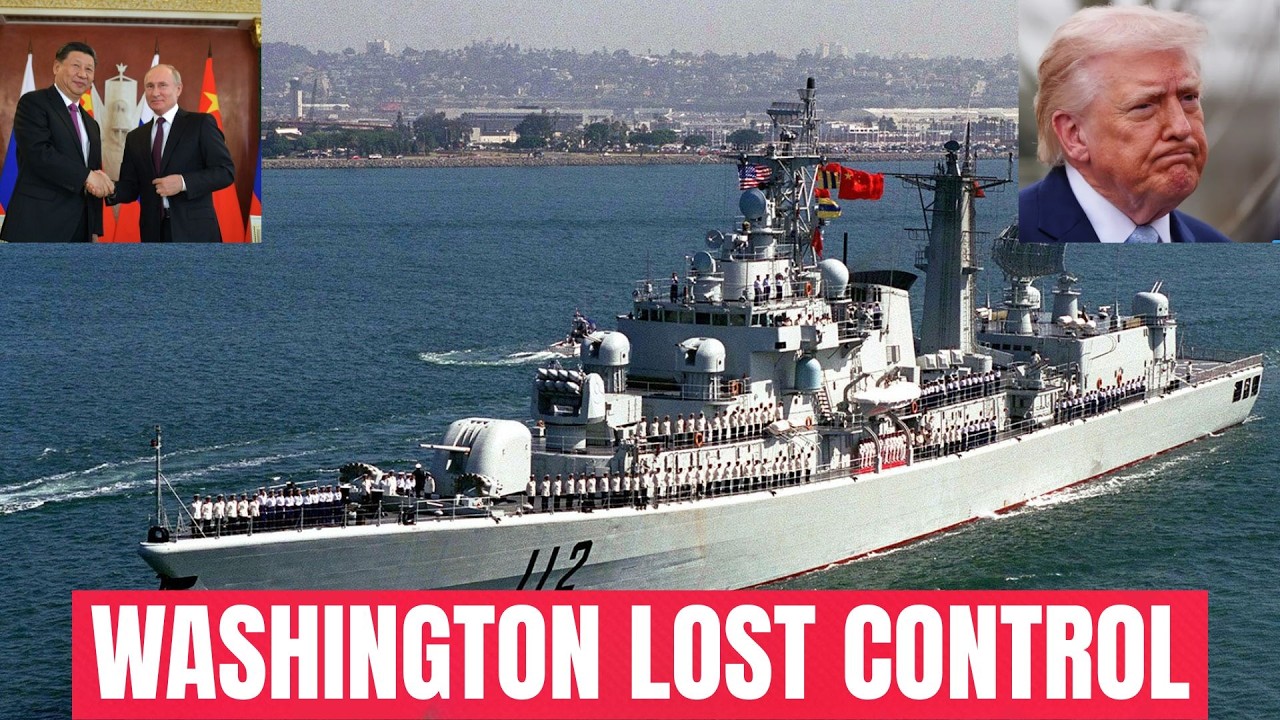
David Oualaalou analyzes Joint Sea 2026, a major Sino-Russian naval exercise off Qingdao featuring destroyers, frigates, and submarines. The timing, during U.S. focus on the Middle East, signals strategic messaging to America and regional allies about energy corridors and military interoperability.
Chapters
Hello everybody and welcome to Geopolitical Trends, where truth matters. Right now there is a terrifying new military reality that is unfolding off the coast of Qingdao in China, as, uh, the latter— and China and Russia, uh, that launched the, uh, massive joint Sea 2026 naval exercises. So, and why is this important? It's important because of the testing of the advanced drone systems, warfare technology, combined their command structure to target Western bases. That's one of the key to that. At the same time, Washington is completely distracted by what's going on in West Asia, and the Pacific trap has just snapped shot by Russia and China combined. So, and here is what's, what's prepping now for, and why the West cannot stop this moving forward. That's the reason why I decided to do this live stream for you. I'm also going to share an excerpt from my Russia book in which I address this specific partnership between Russians and the Chinese which, by the way, at that time when I wrote the book, it was dismissed as, oh, that's too far, it can't happen. And here we are. So, so right now, this is where you are looking, uh, at this developments that's taking place. The launch of the Joint Sea, uh, 2026, uh, drills of the coast of Qingdao. Actually, I have a picture for you to, to show you. I was in that area last time. If you noticed where you have to look here, You're gonna look at the, uh, where it says Beijing right there, go south directly, and that's where you see Qingdao right there on the Jinan or Jinan, uh, uh, uh, side, uh, near Tianjin. So, and you can see the strategic location of this particular, uh, drills taking place here because it's over— overseeing on the other side, the sea, uh, uh, the, uh, the, uh, the Yellow Sea right there, and you have South Korea and of course Japan on the other side. That is, that's why I find the location is also very, very interesting. And that in itself is highly significant because it is the continuation of, and the deepening, if I may add the term here, of the Chinese-Russian military partnership, which I talked about about 8 or 9 years ago. I used to write— I wrote articles about this with the way I saw it going back then. And when I decided to write the Russia book, I kind of highlighted this key aspect. And of course it was dismissed as, oh, that can be given the historical tensions that existed between the Russians and the Chinese, which I am not denying. But at the same time, they want beyond that. They're overlooking that history. That's in the past. And they move in because of the realities of the new geopolitical landscape. So, but of course, the Russians and the Chinese, uh, publicly frame this kind of maneuvers as routine, which is, is, it is the case that the annual cooperation, which is the case, uh, the timing of it, the location, that's to me where I am gonna be focusing my own analysis about, uh, and the tactical focus also. Why? Because those last three, the timing, the location, and the tactical focus, in my opinion, it sends, uh, really a clear strategic signals to the West, not just to the US completely. So, and as you know, the exercises, which by the way, way back, the Chinese Defense Ministry decided, and the Russians in coordination with the Russians, decided to keep the date secret. They wasn't disclosed before. I have seen reports that say— stated right there— the secret upcoming naval drills. Why? Because the dates at that time were not disclosed for strategic reasons, and rightly so. Now I got the confirmation personally, and I speak for myself here, that it is both nations, especially the Chinese, moving forward with disclosing the time frame of it. And the time frame is from July 6th which was about 2 days ago, all the way to the end of this month. Let that sink in. We're not talking about 2 days of naval exercises or 3 days. We're talking about from the 6th, almost, uh, 2 and a half weeks, almost 3 weeks. Can you imagine how much you can achieve in a time frame like this? Can you imagine the testing of new systems that's going to take place? And that is one of the reasons also why I wanted to do this, because I want to highlight to you certain type of systems both the Chinese and the Russians are deploying into these exercises. So as I mentioned before, and I have the map here, the exercises are taking place in the location of Qingdao in China, which is overseeing— overlooking the Yellow River. That's— oh, Yellow Sea, I'm sorry. My apologies, Yellow Sea. That's what it is. And this will be, of course, followed immediately by joint long-range maritime patrol across the Pacific Ocean. There is also another strategic dimension to this. The Russians and the Chinese want to complete the control of the patrolling in the Pacific. No more freedom of navigation for the Americans. And I can see why. I can see why. So now let's talk about, uh, before I'll, I'll, I'll get into the details, a little bit of the, uh, the systems used. I'm going to be providing you my insights from the geopolitical and the strategic significance of this particular development. And within this, I will, uh, share with you the excerpt from my book, and we'll continue with our, uh, analysis. Then I'll do the, uh, conclusion and of course share some clips. I have some good clips for you towards the end of this livestream. So let's start first with the geopolitical and its strategic significance. They both goes hand in hand. The first one, of course, countering balance, uh, the West. It's a counterbalancing act to the West, which is rightly so. You look at what's going on right now in West Asia, especially when it comes down to the Persian Gulf, no? And the Chinese and the Russians are also looking at this from a different perspective altogether. Because they do have strategic interest in these locations. And these exercises between the two is kind of highlighting the importance of this strategic and geopolitical aspect. The exercises themselves serves as a direct— yes, and I use the term carefully— as a direct unified response to the US security framework in the Asia-Pacific. What are we talking about here? We're talking about two main ones, which are, by the way, a failure One is the AUKUS and the second is the Quad. You know, it turns out to be useless anyway. It was nothing but just a window dressing from the security perspective to convince the pathetic allies in Asia that, hey, we stand with you and all that. So we're going to form AUKUS. That's Australia, US, and the UK. And the Quad, of course, that includes India in that part of this, which I have no idea why. The heck will they even allow India into something like that? But at the same time, there's two— the AUKUS and Quad turns out to be useless entities anyway. And this is exactly the, uh, the objective and the message that China and Russia has sent it. By operating jointly, Beijing and Moscow are actively sort of sending the strong message to the West that, yes, we will be willing to challenge you if the time arises, if the needs arises. If you cross the line, you, the West, in this line, in, in, in this case, that is so. And of course, the stronger message coming from Washington, coming from Moscow and Beijing, is that the Western maritime dominance in the region is over. That is one of the key from, again, geopolitical and strategic aspect. The second point to this is the high level of interoperability. That is one of the things when you have too many systems coordinating at the same time. I remember I was in China, thanks to the community who funded that trip to China, and, and I saw the, uh, the military parade. And you're talking about land, sea, and air. The systems that China displayed, they all can work in some sort of a high-level interoperability. That is the point of these exercises as well. This is unlike that superficial diplomatic photo ops when you have— even though some say, oh, that's just a photo op of Mr. Putin shaking hands with Mr. Xi, or President Xi rather. No, this one goes beyond that. So because the drills, in my opinion, the naval drills that is emphasized the deep operational integration between Russia and China. So the navies, both of them in Russia and China, establishes this joint command to coordinate the complex operations including air and missile defense and anti-submarine warfare. In addition, if I may add, the live fire training which is going to take, uh, uh, place soon in the next few days. And I have pictures of what each country deployed as far as the, the naval assets, and I'll share them with you in a second here. So the, the third, the third element of this, because remember the first one we talked about, the counterbalancing the West. The second one, the high-level interoperability. And the third one is the integration of the new warfare technology. This is what I found very, very interesting. And crucially, when you think about the 2026 iteration, introduces now extensive testing of unmanned systems, and at the same time the deployment of the counter-drone operations. And why is this, in your opinion? It is because it's reflecting modern battlefield lessons from— you guessed it right— the ongoing war in Iran and Ukraine, to a degree. And the fourth element to this particular short analysis here on this point here is the normalization This is a key one here for you to understand. Normalizations of what? Of the Pacific patrols between Russia and China. Another word, they are joining hands in ensuring the complete patrolling of the Pacific, because the subsequent joint patrols into, uh, the Pacific Ocean normalize now a combined Sino-Russian naval presence near critical maritime choke points. And that in itself is going to pave the way for both countries to expand their power projection away from their respective home waters— in other words, near their own borders. So, and with this, I'm going to share really brief, just some pictures with you, uh, what's been involved so far in this drill. The major assets from China's Northern Theater Command and from the Russia's Pacific Fleet. So the picture, I don't have them in certain order, but you know, I just, uh, for example, you see the, the Chinese, this, uh, deployed the missile destroyer Qi Feng and the Ansan missile frigate Wohu. And I have pictures of those. Let's start with the, uh, and, and this is the Chinese right here. This is the type of the Type 055 guided missile destroyer Anshan. That's the whole 103. That's the first one the Chinese deployed. The second one is this one right here. This is a Type 054A. This is the guided missile frigate Wuhu, W-U-H-U. Okay, then the other one you have, uh, this one is the, uh Uh, this one is Russians, I believe. I only, I only have 2 or 3 pictures of the— this is the Chinese. Uh, I took a screenshot of this one here. Uh, this is, uh, I forgot the name, my apologies. This is a major, uh, deployments of this. And of course there is the deployments of which, by the way, this is not the exact one, but it was what 2 submarines were deployed and I couldn't find the picture. All I found was this one here. Just wanted to share it with you. But just to let you know, both the Russians and the Chinese— especially the Chinese, I saw because I read the article and I have it for you— the Chinese deployed two types. One is the submarine rescue, then the other one is a submarine. And they didn't disclose the pictures because my guess, and this is just my guess, is probably the type that Chinese just developed, which is able to detect any other submarines in the region, including the US nuclear submarines. Why? Because the radar into this new Chinese submarines are highly developed. That's, that's just my guess here, but so far the only one I saw is this one here I wanted to share with you. So the, the, the Russians, uh, on the other hand they display— they deployed the guided missile cruiser Varyag, and the missile frigate is called Solvoy. And I have a picture of this one. This is the— this is the Russian, uh, uh, Resk, uh, the class multirole corvette. Yeah, I'm sorry, this is a Chinese. My bad, my bad. I got so many pictures here for you, I just want to— and this one, if you notice This one was deployed near Japan back in May, uh, between 9th and 13th, as stated here on the picture. So the Russians is this one right here. This is the Russian Pacific Fleet flagship, the guided missile cruiser Varyag. That is the Russian that the Russians deployed. So then I have two other— I took a screenshot of it. Uh, this is the— I think it's the— this is the Chinese That's the aircraft carrier, and the next one is this one right here. That's— I think is this— I, I don't know, but I think it looks like the same picture. But anyway, suffice it to say, well, you, you take this within the broader context. Why? It's because that the message that they're sending is that both countries, China and Russia, are escalating their defense ties. Escalating, not in a negative way, no, escalating it in a sense of increasing their strength. That's, that's, uh, that's what it means basically, because the naval drills, those ones here, are not happening in a vacuum. As you all know, it occurred just 2 days after the two nations, meaning Russia and China, conducted the joint strategic air patrol over the Sea of Japan and the East China Sea. Look at the map here, and that's where you get the idea. And that's again why I'm saying it's not happening in, in, in a vacuum. So furthermore, you're going to have to think in terms of the, uh, the exercises, uh, follows— or the, the, the naval exercise, that is— follows recent also highly controversial intelligence leaks. Of course, the Western intelligence agencies will have to create something like this because that's usually the role of the intelligence services, is to create doubts, is to create, uh, uh, uh, stuff out of thin air to justify whatever. But anyway, we'll go with the controversial, uh, intelligence leak.— and I have the link, by the way, I'll share it with you— indicating that China has expanded its defense relationship to include secret military training of Russian forces on Chinese soil. You know, well, first of all, let me ask you, if these intelligence agencies are saying, oh, this is a secret military training, why will that be secret if we know that the military cooperation between China and Russia is no secret. So why will the intelligence classify this as a leak and it's secret and it's this and that? To me, I just, uh, it just hypes, no more no less. The Chinese, if they want to do this, they'll do it. They don't care what the, the West or the US or NATO or whatever they think. They don't care for that stuff. But what you can think of is that despite Western sanctions and diplomatic pressure, the partnership between Russia and China is strengthening because that's what we're trying to do. We're trying to break up this partnership. So this partnership between Vladimir Putin and Xi Jinping continues to harden into a functional military alliance. And remember, I did disclose this before to you on many occasions. So far, I don't see any signs yet for this functional military alliance to enter into a form of treaty. I don't see that right now. It might happen, it might not. So let me share the link with you, uh, as to where this particular, uh, uh, uh, uh, intelligence leak that's been disclosed that the Russians are trained on the Chinese soil. So here is the link for you. Oh, I'm sorry, not this one here, uh, not this one here. Oh, pardon me, guys. Yeah, oh, it's this, this second one here, right there. That's the one. Sorry. There we go. Now the next question we have to ask is, how about the timing? Given the changes, uh, on the global geopolitical landscape, mainly in West Asia. Of course, is it a coincidence? Maybe, maybe not. To me, I never ever rule out the timing of an event. Doesn't matter how small it might be. But that's how I've been always doing my own analysis. I look at exactly what's going on in the landscape, and I look at the events that evolve and develop and so forth, and I coordinate this with the timing of it. So because the— those drills, those naval exercises between the Russians and the Chinese are deeply intertwined with the shifting geopolitical dynamics in West Asia, you know, because it's, it's serving— in my opinion, those exercises serve as a calculated message of a strategic distraction and global overextension directed at the United States and its vassal states. Or allies, whatever term you want to use. It's because Washington is finding it now— we just don't want to admit it, but we finding it hard now. Our military resources are heavily fractured by the escalating conflict in West Asia because we were under the impression that we're just gonna walk over Iran. That's, that's a hubris. That's what the arrogance You know, if you're— to those who've read The, uh, The Art of War, you never underestimate your enemy. And when your enemy is making a mistake, you're gonna let him or her keep doing the mistakes or keep committing those mistakes. And that is why Beijing and Moscow, in my opinion, are deliberately intensifying the pressure in the Asia-Pacific or Indo-Pacific, whatever term you want to use. It's all calculating because they are like any other country in that position. You will have to exploit that opportunity to your benefit because we're talking about strategic interests here. So what the Chinese and the Russians are doing is nothing new, nothing different from what we do or we did before. We exploit certain opportunities. The Chinese and the Russians are exploiting the US overextension, because the ongoing volatility in West Asia has now forced the United States to repeatedly surge major military assets. You remember when we took the defense missiles from South Korea? We remember when he had to move an aircraft carrier, aircraft carrier groups, and the strike groups, and advanced air defense systems, we move them out of certain areas, Mediterranean, and move them all the way to the Red Sea and the Persian Gulf. And by launching those large-scale maritime drills between Russia and China, in the Yellow Sea and Pacific right now, Moscow and Beijing are actively exploiting this strategic division of US attentions and resources, by the way. So the timing, in my opinion, it's going to force now the planners to simultaneously manage an active conflict in West Asia, the war in Ukraine, and of course major show of force in East Asia, which I don't see how. We couldn't defeat, well, we won't be able to defeat Iran. We didn't defeat Afghanistan. We didn't win in Iraq. We didn't defeat Ansarullah al-Hadi. What makes us think? But the Russians and the Chinese reading this differently. This is not about one-on-one. No, no, no, no, no. It has to do with the strategic defeat of the Americans. And that because the geopolitical landscape of West Asia or Middle East has already shifted to a tightening— pay attention to this— to a tightening trilateral alignment between three main countries: Russia, China, and Iran. Why is this important? And I'm gonna take you back few months since the beginning of this year, because earlier this year these three main nations held trilateral naval drills in the Gulf of Oman. You remember, I did a video for it. I am gonna look it up later on and put the link for you, uh, in the community tab. So And that in itself was to challenge the presence of the Western, uh, uh, uh, assets there. You remember the Brits said, we will stand with America. The French said, we're not going. The Germans said, we're not going. Canada, I think they sent some of the assets there, but Canada, we all know Canada. But even with all this, the US end up having to move Harry Truman aircraft carrier out of the Red Sea area. You all remember this, uh, and I still have— I kept the picture, uh, for that one to show you right there. When Ansarullah— the US had to move the aircraft carrier way up north. They didn't want to keep it near Bab el-Mandeb because they know what it will mean if they stay there, if the aircraft carrier stay there. And that is why you have to understand the Qingdao drills act now, in my opinion, uh, uh, those drills that now being conducted in Qingdao, uh, act as a Pacific broken— yeah, is Pacific bookend sort of, uh, it's almost like similar to what took place with the maneuvers in West Asia back then. Yeah, it's all about the messages, because this one demonstrates that while Russia supplies Iran with advanced air defense and China provides economic lifeline, the two partners, meaning Russia and China, can sort of seamlessly pivot to project combined power directly on China's doorsteps. In other words, the reason why China picked this location, Qingdao, it's for a reason. Look at the map here and look what you see on your right. It is Seoul, South Korea. There is Japan. So that's all China needed to do is the strategic location for that one. So the second point to this, and before I'll get to the second point, allow me to just play this short clip here. If the truth matters to you, hit like, subscribe, and tap that bell. No spin, no agenda, just the stories they don't want you to know. Don't watch from the sideline, be part of the movement. Your support keeps the truth alive.
Thank you.
The second key point is this, uh, it's securing the energy corridors. Remember, I did a video for you, I released it, about the, the, the Malacca Strait and what China has in plans, has, has, uh, has, uh, uh, the plans that China has for dealing with that location. But I also did one for you for the Persian Gulf. And, uh, this is the one that I talked about earlier, the Strait of Malacca. And this is where you're gonna have to think in terms what this securing alternative energy corridors means. Because when you think about West Asia's maritime trade routes, they are severely compromised by the regional conflicts, as you know. And the security of the, uh, of the alternative energy pathways has become sort of paramount for Beijing. Why is this? Is because Beijing consumes a lot of energy, even though Russia does provide that, but China needs more. It's a bigger— it's big economy, of course. So, and that is where you put the joint Sea 2026 naval exercises. You put it within the proper context, and the proper context is that it focused heavily on a sea lane defense and anti-submarine warfares. This is why both the Chinese and the Russians deployed the submarines as part of this drill. I couldn't find the picture of today, but I just to, uh, share with you a, a, a relevant picture, even though it's not pertaining to this one here, uh, uh, but I just wanted to share that with you. Both countries deployed the submarines, and that tells me something right there about the anti-submarine warfare. So, so this timing, of course, highlights China's urgency to secure its northern and eastern maritime approaches because it wants to ensure, and rightly so, when you have, again, a large economy, you have to ensure and to secure access to energy sources, that is. And China wants to ensure that its massive energy imports from Russia remains completely insulated from Western disruptions or blockade. The fourth element has to do with this signaling. This one also a, a, a, a good point. And it signals the global multi-front challenge. Multi-front to whom? To the Americans. You won't be able to handle it by holding these drills now. Beijing and Moscow are signaling that the global geopolitical landscape is no longer shaped by the isolated regional conflicts. Rather, they are framing it— this is what the, uh, what the Chinese and the Russians drill means— they're framing the current era as an interconnected multi-front challenge to Western hegemony. Yeah, because they are in— they, Russia and China, in possession to do so. So the timing once again sends a clear message that any, any escalation or prolonged Western intervention in West Asia will be met with corresponding highly coordinated hardening of the Sino-Russian military footprint in the Pacific. So, and this is exactly what I argued back then when I wrote my Russia book. And allow me to share this short excerpt with you, even because I had to challenge back then, and I wrote an another article later on challenging those who criticized, uh, what I said. They criticized it in a way that, you know, I don't mind criticism, of course I learn from it, and especially from our community, I welcome your criticism. As long as it is constructive. But that criticism about what I wrote was negative. It was meant to put somebody down, almost saying you don't know what you're talking about. And that I have no tolerance for. And that's why I wrote what I wrote. Here is what I wrote. Let me share it with you. Debates are swirling in the West about how the China-Russia rapprochement may impact the global balance of power. Some are, are concerned about the seriousness of this rapprochement, while others, the critics that is, suggest that it is provisional. Or provisional, I'm sorry, provisional. Yeah. And I wrote for this, whatever the case may be, China-Russia rapprochement indicates a much bigger shift looming in the future one that will inevitably alter the global balance of power if and when Moscow and Beijing play their cards right. That's exactly what's my challenge to that. It's not about the criticism. I welcome criticism as long as it is constructive, but because I saw the signs for that. After all, geopolitics is my main focus academically, so you are full forced to learn and look at the signs and how to read and interpret and analyze the evolving events. And I said it back then, and here we are right now, because those naval drills now are confirming exactly what I talked about a few years ago. And this leads us to the next question before I'll conclude this live stream here. What can the US and its allies— we're talking about the submissive states: Japan, South Korea, and Australia. Philippines to a degree, but I didn't include Philippines because in this case, Philippines will be useless. Let's just say it the way it is. No offense to my Filipino people, the supporters, uh, wonderful people.
It's—
I'm talking about the governments here, as you know. Because what those countries are concluding about these naval exercises? Well, of course they are thinking in terms of from the perspective of the US and its allies in the Asia-Pacific, Japan, South Korea, and Australia, the way they're looking at the joint Sea 2026 exercises and the, uh, what comes with it, and what comes with it is the patrolling of the Pacific. Yeah, the highly, highly troubling conclusions for those countries, because when you think about, ask any security analyst who is in the know an objective. Ask any security analyst and he or she will tell you that in Washington, in Tokyo, in Seoul, in Canberra, they all view these maneuvers not as a routine event but as a coordinated strategy to challenge the rule-based international orders. That's what they're saying, when in reality has nothing to do with the international order, because we are breaking international order right or left. But it is about the challenge. That's how I see it. So I'm going to share with you 3 or 4 key points to put this in perspective from my own, you know. When you think about these conclusions, the way I see how the alliances is seeing it, which I disagree with some, but nonetheless I'm going to share with you how I see it. The dual front, number one, dual front deterrence targets Allied bases. No, no, it's not targeting Allied bases, it's targeting US bases in the region. Exactly what Iran did with Qatar, Kuwait, Bahrain, United Arab Emirates, and Jordan. But Jordan is not— it's, it's, it's not important. And that's where you have the role of Japan and South Korea specifically concluding that the heavy emphasis combined the air and missile defense and joint recon— reconnaissance, that is— is a direct rehearsal for a dual deterrence. Because in their opinion, the drills simulate, rather, how the Chinese and the Russians will cooperatively lock down the Yellow Sea and East China Sea. And to them, they view this as a blueprint to block or threaten key American and allied forward bases in the region, including Okinawa and Yokosuka in Japan. You have Guam and you have Osan in, in South Korea. But that is not the real assessment that this analyst needs to disclose. What they need to disclose is they will be targeting— meaning they, Russia and China, in case of a conflict, they will be targeting US bases on their— on these territories. Big difference. Exactly what Iran did with the Gulf States: Kuwait, Bahrain, Qatar, United Arab Emirates. The second point is the deepening strategic integration via unmanned system. This is one of the reasons also why allies concluding, well, we're going to have to do this because we seeing where the relationship is going between Moscow and Beijing, because has evolved now to something far more stronger. And that's why they are concerned with this. So the establishment of a unified functional joint command base in Qingdao proves that the two military, the Chinese and the Russians, can blend their communications and command pipelines under highly stressed conditions. And of course, the third element will be the testing of the political will of the Allies. But again, what do you expect? Because both countries, the Chinese and the Russians, have the advanced system when you consider what they have deployed, uh, to the region. Okay, just think about it. Those are no small assets naval assets to deploy for naval drills unless you truly have some really specific objective in mind. And that's exactly how you should interpret this one. At least that's how I see it. And that in itself, the, uh, uh, uh, the Chinese submarine-launched ballistic missiles deployed Uh, which by the way, it test-fired into the Pacific. And I know, uh, recently, uh, I don't know if I have, if I have a picture for you. Yes, I do. Uh, yeah, hold on a second, bear a second with me here. Uh, just, just let me copy this and, and post it for you in the, uh I'll show you what the Russian— what the— I'm sorry, what the Chinese just did. So take a look here, I'm uploading the picture here for you. Uh, all right, here we go. Take a look at this and I'm gonna tell you what it is. Take a look. So what you're looking at, you're looking that, uh, Beijing just test a strategic missile in the Pacific, which by the way, I read the article about it in a foreign language and it was a dummy warhead. Of course, the Chinese not going to use, uh, uh, and that's even the US expressed grave concern after the Chinese conducted the test launch of a strategic missile carrying a dummy warhead from a submarine in the Pacific Ocean. And that should send you, uh, the— I mean, to the allies there in the submissive countries like South Korea and Japan and Australia, it should highlight to you the idea of, of, of what it means. And that's what I meant by the allied responses to this. So Uh, and of course they are now saying— they mean in South Korea, Australia, and all that— they're saying all these naval drills are a threat to maritime freedom. Yeah, freedom of navigation. You know how it is, you know. I'm not gonna detail much into this because you all know it's nothing but hypes. We use the word international order and yet we are the one abusing the international order. It's like what happened just with the FIFA I know it's not a— I just find it, uh, how, how easy we corrupted FIFA. FIFA now lost its credibility, you know. It's kind of— that's it. You saw what happened. And I saw the, the game yesterday between Egypt and, and Argentina. I never looked at Argentina as a good team anyway, but we saw how corrupted now the FIFA is. And the same thing I say about this international order. Well, we have to push for international order when we are the one violating that international order. And this is again where I see the concern from the so-called allies is that the idea of wanting to sort of escalate a minilateral defense consolidation among the allies. But we already have the AUKUS, we already have the Quad, which are useless anyway. So that's, that's just not going to work in my opinion. But I am left with one key question before I'll do the conclusion for you, because you can overlook this, is what is North Korea's perspective on these naval drills? Very, very interesting aspects of it. And why is this important is because— and I have a picture of Kim Jong-un, and let me put it up for for you here. Ah, Kim, where are you? Kim Jong-un, right there. And I'll tell you what this is all about in a second here, but I'm gonna share with you first my idea as to how I see North Korea interpreting this one here. So let me share that first, then I'll share the picture with you as I move, because for North Korea is very, very interesting, uh, uh, perspective regarding this joint Sea 2026. North Korea highly welcomed this development.
Why?
Because it validates and strengthens its own, uh, defense posture. And rather than viewing this massive Sino-Russian naval footprint on its doorsteps as a threat, Pyongyang sees the maneuvers as a critical buffer against its adversaries. Once again, look at the map of where the drills are. They are in Qingdao right here. Look at the distance between Qingdao and Korea— no, the, the Korean Peninsula. That is why North Korea is welcoming these specific drills here. That's how they're seeing it. So first of all, there are 2 or 3 key points I want you to know. One is the ideological and strategic validation. Pyongyang, North Korea, that is, view the exercises as a justified, necessary response to what is called US imperialist aggression, in quote, by the way. Because that's coming from North Korea's government. And the expanding of the Asian NATO— you remember last time NATO was talking about, uh, opening an office in Tokyo. Tokyo is willing to host that office on its territory. Japan went ahead and increased its defense budget. And specifically what North Korea highlighted to— they had to do with the three countries US, Japan, and South Korea, what they call the, uh, uh, trilateral, uh, military coordination. So, and you all remember I did a video about 2 years ago or a year and a half ago when the representative of Japan and South Korea flew to Maryland to Camp David and met with back then former President Biden. And I put the title, you come here to kiss the ring. That's what I titled that because that's what it was. So, so to North Korea, the way they see this, the powerful China-Russia military presence in the Yellow Sea directly breaks Western encirclement on both countries, on the Russian, on the Chinese, and which, which you won't be able to encircle China anyway, but that's what the US is thinking, and on a, on the Korean Peninsula because to North Korea, that's how they see this one effectively, because Israel is now acting as a shield that kind of, uh, uh, tie down American military presence in the region. The second one, which I found very interesting, and I have a proof, I have a picture that I'm going to share with you in a second here. This, to North Korea, they found this perfect timing for a cover-up. And there was a cover-up, not in a negative way, but a cover-up on the sense of what is North Korea doing on its own as far as its own naval nuclear modernization. Guess what North Korea just did? It tested a specific types of missile. Here is a picture, and this missile has a specific objective. What you see here is Kim Jong-un ordered officials now to complete The Gangwon Ship trials. What is this? This one here, this particular missile is specifically targeted for destroyers, to sink destroyers. That's exactly what, what, what, uh, uh, John Kim, uh, Kim just did, oversaw the weapon test of a 5,000-ton, uh, uh, uh, payloads. So this is why it's no small matters. That's why North Korean leader ordered the official to complete these trials of the Gang Kong destroyer and puts it into naval service within 2 months, because he wants to affirm that his country's determination to possess what is called absolute power. And that's exactly what this test— that the picture you're looking at That's the 5-ton destroyer Choe Hyon. I'm sorry if I mispronounced. It's H-Y-O-N. Enter into service and announced plan to deploy it, the destroyer Kanggong, a ship of the same class, as part of the broader campaign to modernize its naval fleet. That is exactly what North Korea— why they took an interest into this naval drills between the Russians and the, uh, the, uh, the Russians and the Chinese. So to them, it's, it's the, uh, just as the Qingdao exercises kicks off, Kim went ahead and publicized successful missile and electronic warfare testing abroad Pyongyang brand new, and that's the one, that's the one, the picture you were looking at. So, and the long-term bid for trilateral drills. For years, North Korea's and Russian diplomats have publicly floated the idea that incorporating North Korea into joint military exercises with Russia and China will be appropriate That's it. That's, uh, you know, I'm gonna send you a specific link that I— when I was doing the research for this, I came across, and that's what prompted me to put the North Korea, uh, article into this conversation because it's worth, uh, knowing about it. So while China has historically shown tactical ambiguity and sometimes Chinese hesitated about forming a formal trilateral partnership with North Korea because they were fear about the changes that might happen. Because let's not make a mistake, you know, I'm gonna say it openly here, because China has always have that thinking of unpredictability about North Korea. But now things are changing. So because the joint Sea Drills of 2026 represent now exactly the type of heavy-handed regional alliance bloc that Pyongyang wants to eventually join. Probably we might see them next year for the— for, for, for this one. So I, I believe it could happen. It could happen. So, all right, let me do my conclusion for you here, and I am going to share some clips, and we'll end this live stream here. So one thing I need you to get about this joint Sea 2026 drills is that it proves that the Sino-Russian alliance has evolved from a mere political posturing into a unified, high-tech military machine that now Washington can no longer control. That's the point that I was trying to, uh, uh, uh, uh, uh, highlight in the idea of why is this important to understand. Because US now cannot control this one, and because the US now finding its forces dangerously overextended across the volatile West Asia or Middle East. And that is why you have Beijing and Moscow actively rewriting now the rules of global power right in the Pacific. They're not doing it in West Asia. So that's the way, that's the way I see them playing the strategic game. That's the long game. When I, you know, we're thinking long term here. So here's a question that I would like you to really share your opinion in the comment section if you feel like to do so. With the West now, when I say West, I'm referring to the US. The Western Europe and all that is useless anyway. With the West heavily distracted, do you think the United States still has the power to deter this new global order, or has the balance of power shifted forever? So, so, and I'm gonna pin this comment, uh, in the video section, under the video section for you. So I'd like to have your Uh, uh, to— I'd like you to share your thoughts in the comment below when you can. So, all right, let's, uh, let's do some clips here. Uh, the first one is, uh, I wanna— let me, let me do one thing here. I need to show you— I want to share, uh, the screen with you, uh, of an image. An image has the— what you need to, to— you can read yourself. Let me make this bigger for you here. There we go. You can read this, this yourself, and it's spot on. It's spot on. I have to agree. It's sad that, uh, uh, a lot of voters were misled by a con man. But again, it's their choice. This is the one who voted for, for, uh, for, uh, Donald Trump. So you live with the consequences of your actions. All right, the next one is from Joe Rogan. I usually— I, I usually don't listen, to be honest. America went to Uh, just sometimes, like I always say, when there is a good content— oh, where is it?
War to control Hormuz. Iran handed control of Hormuz to China's currency. Think about that for a second. The petrodollar system ran the world for 50 years. One deal between Kissinger and Saudi Arabia in 1974 made it simple: sell oil in dollars and America protects you. That handshake made the dollar untouchable for half a century. Then America launched 900 strikes on Iran, spent $29 billion, lost dozens of aircraft, all to control the world's most important oil chokepoint. Iran's response was to start collecting Hormuz fees in Chinese yuan, not dollars. India settled Iranian oil in yuan. African banks built yuan channels specifically to avoid the dollar. China's payment system, CIPS, hit a record 1.22 trillion yuan in a single day in March 2026. China absorbs 37% of all crude leaving Hormuz, while America accounts for just 2.5%. Deutsche Bank said it plainly: this war will be remembered as the birth of the petroyuan. BRICS nations now trade 50% in yuan.
Except BRICS nations are undermined by another country, so you all know which one. So let's not beat the dead horse. Next one is from Tucker Carlson. Let's take a listen here. And once again, I just want to repeat this one, I'm not advocating for anyone here, I'm advocating for the content that I found useful for our community to learn about. Take a listen, please. Sick hearing this. There's an effort in the Congress to, in some basic sense, merge the US military with the IDF, with the Israeli military. Same with our intelligence services. It's hard to believe that could be true. Is it true? What do you know about it?
Well, uh, the National Defense Authorization Act of, uh, 2027, Section 219, has a provision that provides for the integration of the IDF and the US military at the topmost sensitive levels of our military operations. And that is a fact. Now, when you have an integration and you say you're going to eliminate duplication, that's a merger. And so they're merging.
And the US military and Israeli military.
Yeah. And in specific areas like artificial intelligence and autonomous functioning of vehicles, you know, that, that will increase the kill efficiency, right? Yes. In quantum sensing. That deals with very sophisticated data and will blur the distinction between offense and defense. Okay. Cyber electronic war is another area they want to merge in, which you can't really— if you take AI and you match it with these sophisticated technologies, you expand the ability to hurt people, really kill people. You know, they want to merge missile defense, space defense, directed energy. It's a whole range of things, and biological technology, including biological potential, biological warfare. What could go wrong, right? See, and I look at it this way, Tucker. The first issue is American sovereignty. I don't care Israel or whoever, we need to maintain our sovereignty. We cannot cause another country to be involved in the decision makings that relate to the national security of the United States of America. Yes. We have to be singular and solitary in that regard. Unfortunately, uh, this provision in this bill, uh, all the safeguards go out the window.
I feel—
yeah, that's disturbing. And that's, by the way, uh, uh, that's Dennis Kucinich. He used to be a former member of Congress, and he runs for president, I think, at some point, but it didn't succeed. But he's somebody— he's, he's in the know. He really, really understands. And Next one is from, uh, I think this lady is a candidate, uh, for, for, uh, either Congress or, uh, yeah, it's a congressional candidate, but she was spot on. And again, Mike, my word, what they're gonna do to her is the Apex gonna do what they did to Thomas Massie. They're gonna do it to her. So, but nonetheless, let's take a listen here to what she has to say. Do you support the United States continuing to send weapons and military funding to Israel?
No.
And I really believe that we need to stop sending our tax dollars to arm a state that is currently enacting a genocide, a word that my opponent has yet to say. It is deeply important that we recognize that it is the taxpayer money of the American people that is contributing to this continued atrocities. And if we want to talk about accountability to be able to actually create peace, there cannot be peace while American taxpayer our dollar is continuing to be used to slaughter civilians. It is abhorrent to me that we continue to invest so much of our money in weapons, in bombs that are slaughtering communities abroad, when so many of our people here are suffering from lack of dignified housing, from lack of access to quality food, from lack of access to the social safety nets that make life dignified for so many.
Yeah, she is spot on. She's right on. And I think there is now this awakening here in America. People start to realize, you know, what are we doing? What have been— what have I been doing for the last few decades? It's about time to take care of the American people and take care of the country first. So, uh, next one is about Iran's missile. It's called Fattah, but I, I just wanted to share this new, uh, discoveries about this particular missile. And that is again why the US has to think twice about this one. Take a listen, please.
This is Iran's Fattah-2. This is Iran's Fattah-2, a hypersonic missile that doesn't just fall on a target, it hunts it down. Instead of a predictable parabolic arc, it can shift its path in midair. It can also carry around 200 kilograms of explosive payload at speeds of Mach 15. That's over 18,500 kilometers per hour. It can strike targets up to 1,500 kilometers away from unexpected directions. Even advanced defense systems can't keep up.
Yeah, I found this very interesting given what the US just did. Did you know, and I am trying to confirm it, there was a recent attack by the US on Iran during the time of the funeral? So, and I am yet to confirm this one, and if I found out that it is true I'm gonna get the details and do a live stream for you about it. Next one is about, uh, which is disturbing— Donald Trump sleeping during a meeting. Take a look. It's, it's very, very embarrassing. I mean, but again, he doesn't represent me. I didn't vote for the guy. So take a listen, please. All right, okay, I'm gonna stop this one here because, you know, we don't understand Turkish, of course. But just to highlight to you that that's— it doesn't matter you like the guy or not, it's It's embarrassing that in a meeting like that you fall asleep on a world stage, you know. Get enough sleep, man. You're representing a country, for Christ's sake. Uh, next one is about FIFA. Yes, I wanted to share this because I'm, I'm seeing that's it, FIFA is over as far as its credibility. So all I'm gonna— I'm not gonna play because, uh, there is a soundtrack there. But you can read what it says right there, what the FIFA did to Russians, for example. Yeah, yeah, it's embarrassing, very, very, very embarrassing. So, uh, uh, yeah, FIFA lost it. That, that guy, Giovanni, whatever his name is, needs to be resigned. He needs to resign immediately. There is no tomorrow. So Next one is about a corruption case, uh, right here in the US. And again, I'm, I'm gonna silence this one because it has a soundtrack, uh, and you remember yesterday when I shared the image with you about the state of Idaho, what they are planning on doing? So I think this guy should be done also, but again, you decide. Take a look. This is a donor, so, and he's going to prison and we're going to have to foot the bill for whatever, how many years going to be there. So I would say do what the Chinese do with this guy. You all know what they do, how they do it with corrupted officials. Time, time. So anyway, want to share that with you. And the last one Uh, this is another representative, an idiot representative. And, and still, but I, I can't for the life of me understand why the voters in South Carolina still voting for this idiot here. Take a look here. Yeah, you can read, uh, this one here, guys. Oh, sorry, right there. I am not surprised because you know what they referring here to, per ex-CIA officer, that's Larry Johnson. And I was aware of this one here way back, way back, as soon as Larry mentioned it, because Larry and I would talk. And, and he did say it way before, he said be on a lookout for something is going to be announced. And here we are. So the guy is getting money, that's why he was pushing for Ukraine war and so forth. So corruption— the system in America is so corrupted. So anyway, that's all I have to share with you. I'll take this opportunity to say thank you to Nash, who sent me, uh, uh, uh, uh, bought me cups of teas in support of my upcoming trip to Asia. I do need to uh, show you an update to where we are because we got, uh, I think 2 or 3 donations since yesterday. So it's only right of me to show you the update, uh, uh, the funding where we are right now. So take a look here, please. There we are. So we're still at 51% now, so we still have a long way to go. I do want to achieve this by the end of July if it's possible, because we need about 3 weeks just to make the traveling arrangements, the locations, the lodging, and all that stuff. So, you know, it's, uh, it's very, very involving. Uh, if you decide to support the trip to Asia, here is the link, and I will be very, very grateful to you. Once again, this is for you, this is for the community. The reason I'm going to certain locations is to report to you. I don't want donations from corporations, whatever, because you know how it is, and I don't like to be under the, uh, authority of someone else dictate to me what to say and not to say. Uh, so far the, uh, the trips that I did, uh, to Asia were because of the community, because of your support, and, uh, I am very grateful to you for that, should you decide to do that one. So that's where we are so far. Uh, to those who wants to support the channel, here is the link for it. If you want to buy me coffee, remember I keep the funding for the channel separate from the funding for the Asia trip. Two separate things. This way I don't overlap, uh, everything else. So for the channel, you know, because of the information that I spend time researching for you and so forth. And for those who wants to get a copy of my books, this is the link for it if you want to. I know some of you just got the latest copy of the Saudi book. This is the Iran book if you are interested—
the—
I'm sorry, the Russian book, Middle East and West Asia, and the Iran book if you decide to get a copy of this. Here is once again the link for, uh, those books if you are interested. So as I said, I'm going to confirm, uh, whether the US did launch a surprise strike inside Iran and get back to you on that one if I confirm the information. So hope you all enjoyed this live stream. Please remember to hit the like and please share this video, subscribe if you have not done so, and encourage others. That's how I'm going to reach the rest of the world. I can't do it alone. You all know, so, but I'm very grateful to you for your continued support. As always, remember, geopolitics impacts your daily life in more ways than one. Till next time, bye-bye.
More from David


Beyond the Single Actor: Why the Gulf Isn't Choosing Between the US and China


Iran, Iraq's Militias, and the Houthis Are Coordinating! This Changes Everything




Who Controls the Next Decade's Resources? Latin America and Africa's Geopolitical Crossroads

The Chokepoint Trap: How Washington's Stupidity Triggered a Cascade That Now Controls the World

Trump Spooked as IRGC Unveiled dual-use SLV, Deployed Ghadir Mini-Subs & Hinted at Tactical Nukes!
