Why World Leaders Are Abandoning Washington and Flying to Beijing!
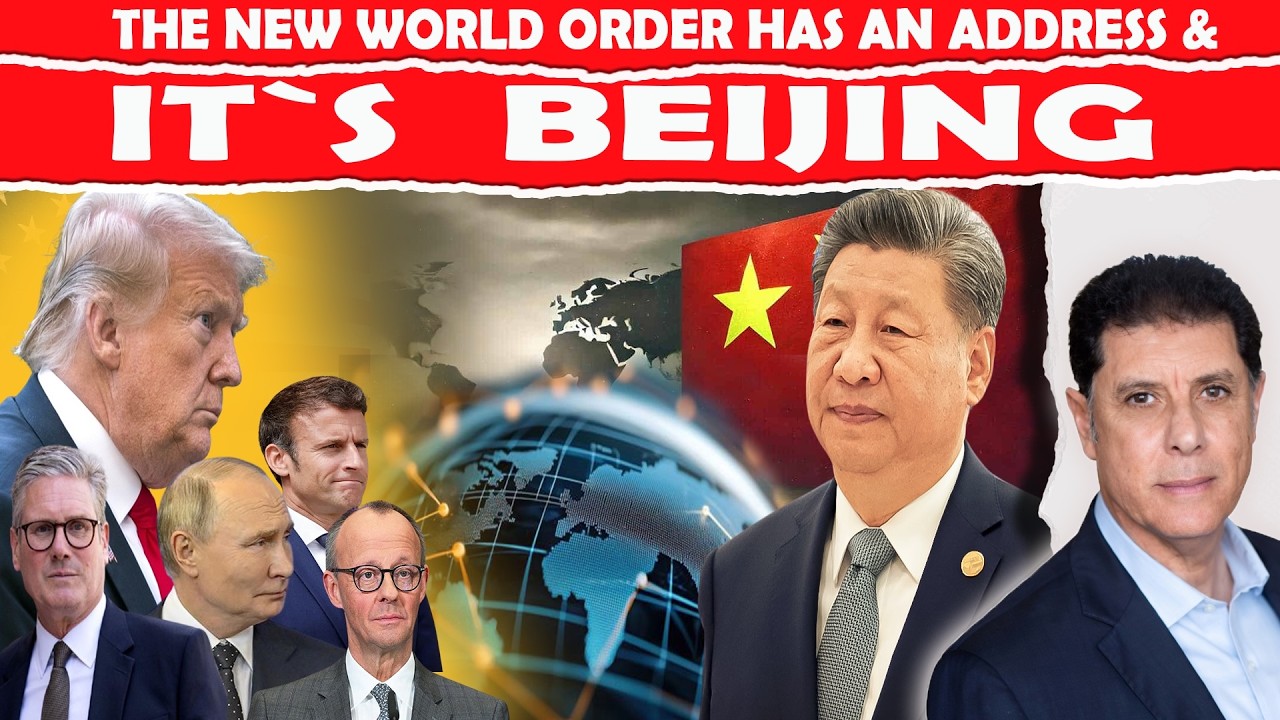
World leaders from Canada to Russia visited Beijing between December 2025 and May 2026, signaling a shift away from Washington as Trump's tariffs and NATO skepticism fracture the traditional Western alliance. The Trump-Xi summit produced limited trade wins and a strategic stability framework, while Russia and China deepened their partnership through a $228 billion annual trade deal outside the dollar system. Beijing is becoming the indispensable mediating power as the post-World War II liberal order reshapes.
Chapters
Hello everyone and welcome to Geopolitical Trends, where truth matters. In just 5 months, from December 2025 to May 2026, something remarkable has unfolded in Beijing. Leaders from every corner of the planet have made what many analysts are now calling a political pilgrimage to the Chinese capital. The prime ministers of Canada, the United Kingdom, Spain, Ireland, the leaders of South Korea, Vietnam, and the United Arab Emirates. And then, in the span of just 4 days this week, the two most powerful leaders on Earth arrived one after another. First was Donald Trump of the United States, then Vladimir Putin of Russia. All 5 permanent members of the United Nations Security Council have now visited President Xi Jinping within 6 months. Think about it. This is not a coincidence. This is not a courtesy. This is the new architecture of global power. And you know what, Benji? Is its address. To understand why Beijing has become the must-visit capital of 2026, you have to understand what broke down everywhere else in the world. The years leading up to 2026 were defined by fracture. You have the Transatlantic Alliance, long the bedrock of Western security, came under extraordinary strain as the United States, under Donald Trump's second term, weaponized, for example, tariffs, threatened to withdraw from NATO commitments, and of course pursued the agenda of America First foreign policy. All these dynamics left traditional allies searching for alternatives. The result: an unprecedented scramble for new strategic partnerships. Canada is a perfect example. Go back to January 2026 when Prime Minister Mark Carney flew to Beijing, the first Canadian leader to do so in nearly a decade. His foreign affairs minister stated bluntly upon arrival, and I quote, "We will double non-US trade over the next 10 years," end of quote. This is a, a seismic statement from a country whose economy has historically been tied almost every, in every aspect entirely to the United States. Carney's trip preceded a new strategic partnership framework a roadmap for economic cooperation, and progress on sensitive trade files, including electric vehicles and, yes, canola. But many analysts noted the real significance went deeper. Corny was signaling fundamental reviving of Canadian foreign policy. Ottawa wasn't just visiting Beijing It was hedging its existential bets, and Canada wasn't alone. In January alone of this year, at least 5 national leaders visited President Xi Jinping. Countries that just had months earlier shined at China over trade disputes, fabricated human rights concerns, or alignment with Washington. Were suddenly booking flights to the Great Hall of the People's Republic of China. The logic was cold and practical. China is the world's second-largest economy. Its consumer market is the second-largest on the planet. And with the US foreign policy becoming increasingly unpredictable, fragmented The calculus for dozens of governments quietly, then openly shifted. Perhaps no visit symbolized this particular geopolitical pivot more starkly than that of the British Prime Minister, uh, Keir Starmer. Keir Starmer arrived in Beijing in late January for the first official UK Prime Minister visit in 8 years. 8 years is a long time in diplomacy. The UK-China relationship had deteriorated sharply over Hong Kong, as you may know, over Huawei, over cyber espionage allegations, and of course the broader alignment of London with Washington's confrontational stance towards Beijing. Of course, the Chinese never forget. Starmer came to reset all of that. The two sides agreed to establish what they called a long-term, consistent, comprehensive strategic partnership. Starmer himself, he articulated the new pragmatism. The UK, he said, could not ignore China as the world's second largest economy. Well, Mr. Steiner is the first. His government would pragmatically seize the opportunities for economic cooperation while at the same time adhering to the bottom line of national security, end quote. That phrase, adhering to the bottom line of national security, end quote, is doing a lot of work in that sense. In that sentence, it reflects the fundamental tensions at the heart of every single visit we are going to discuss today. That is the important thing. So make sure you stay with me here till the end. They are not warm reunion, warm reunion. They are calculated risk management exercises. Every leader arriving in Beijing is performing a delicate balancing act, engaging economically with China while trying not to trigger alarm bells in Washington, within their own security establishments, or among their publics. For Starmer, in this case, the political risk was real. Parts of his own party and the UK defense and intelligence communities remain deeply skeptical of Chinese intentions. Yet the economic pull and the diplomatic logic of operating in a world where US reliability could no longer be assumed proved stronger. This is the central security paradox of 2026, and it plays out in every single one of these visits. That's the irony of all this. But the visit that rewrote the rules, at least in terms of symbolism, was President Trump's state visit to Beijing on May 14th and 15th. By the way, it was the US that requested to go, uh, or to visit China. It was the first visit by an American president to China since 2017, when Trump himself had, uh, last, uh, made a trip 9 years, it seems like an eternity in geopolitics. In that time, the US-China relationship has swung from managed competition to outright economic warfare. Tariffs exceeding 140%, technology restrictions, rare earth mineral slow— uh, showdowns, and of course a global decoupling campaign. And yet here was Donald Trump addressing the steps of— descending the steps of Air Force One in Beijing to a 21-gun salute, an honor guard, and 300 students waving Chinese and American flags. How did we get here? The short answer: both sides needed something. For Washington, The context was the ongoing US-Iran conflict, which had closed the Strait of Hormuz, as you know, disrupting global energy markets and of course threatening economic stability. Trump needed Beijing to hold the line, specifically assurances that China would not transfer weapons to Iran. Defense Secretary Pete Hegseth announced before the summit that Beijing has provided high-level assurances, in quote, that it will not arm Iran. For Beijing, the calculus was different. Facing economic headwinds at home and anxious to prevent new US tariffs and technology exports controls, President Xi Jinping wanted time and strategic space. Some Western analysts described President Xi Jinping's approach as projecting calm confidence, in quote. His objective, not confrontation of course, but control. The results of the summit, as you know, were complicated. Both leaders praised each other lavishly. President Xi called in the milestone visit to, to give Trump safe face. Trump lied as usual and spoke of fantastic trade deals when there were no deals. The headline economic win war was China's agreement to purchase between 150 to 200 Boeing aircraft, though that number disappointed markets, which had expected 500 beyond that. And beyond all that, the two sides agreed on a framework they described as constructive China-US strategic stability, a carefully worded diplomatic formulation designed to stabilize the relationship without resolving any of its underlying tensions. And the way you know it is on Taiwan, for example. The divergence was glaring. The American readout of the summit didn't mention Taiwan at all. The Chinese readout had President Xi warning Trump directly that the Taiwan question was, and I quote, "the most important issue in US-China relations," end of quote. And could lead to conflict. Secretary of State Rubio tried to downplay it, but the warning landed anyway. What Trump-Xi summit ultimately demonstrated is not that the US and China are friends— they are not. What it demonstrated is that even the world's most powerful adversaries now feel compelled to come to Beijing to manage their disagreements. And you know what? On Beijing's term, on Beijing soil, in Beijing's rooms. That's what matter. Optics in international relations matters. Energy was another central to the talks, with the Strait of Hormuz closure disrupting global energy markets, as you know. Both nations had fresh incentives to look into supply arrangements. Russian oil exports to China had already grown 35% in the first quarter of 2026 alone. Think about it. A landmark gas and oil deal appeared imminent. From a security, uh, standpoint, this relationship is deeply alarming to Western capitals. The US has long pressed Beijing to sort of reduce its economic support for Russia, warning that Chinese financial lifeline sustain Moscow's military capacity in Ukraine. But when you ask some objective analysts, they were clear-eyed about the nature of the partnership. Despite the sort of closeness, Russia and China are strategic partners, not military allies, as I've always argued. Putin and Xi are building what they explicitly call a multipolar world, and rightly so, one where no single dominant power dictates terms. As a Kremlin spokesperson noted, Putin's visit will also allow Russia to receive direct updates on what has been discussed during Trump's stay. You know what? It suggests that Beijing has a kind of diplomatic clearinghouse between rival superpowers. Interesting dynamics. Putin— President Putin, rather— himself framed the Russia-China relationship as a crucial balancing force in international relations. And quote, saying, and I quote, interaction between such nations as China and Russia undoubtedly serves as a factor of deterrence and stability, end of quote. That is not the language of a trade partnership. That is the language of a geopolitical counterweight. So let's, let's just zoom out for a moment here. Because there is one fact that crystallizes what has happened in Beijing over the last 6 months better than any other, in my opinion. France's Emmanuel Macron in December 2025, Canada's Mark Carney January 2026. And note, Canada is not P5 member, but G7 member. Britain, Kiss-Timers, January 2026. America, Donald Trump's, May 14th through 15th, 2026. Then Russian, Vladimir Putin, May 19th through 28th, 2026. As I said, the UN Security Council, 5 permanent members, the nations entrusted with primary responsibility for international peace, and security have all made the journey to Beijing. And this is, as a geopolitical analyst, to put it plainly, it's extraordinary. The Security Council was designed as an arena where the world's greatest powers manage their disagreements. However, in 2026, that arena has now a new pregame venue. And that venue is Beijing. This matters enormously for the global security architecture, the UN system, the post-World War II liberal international order, the institutions and alliances built by the West over 8 decades. All of it is being renegotiated as we speak, and it is being renegotiated in part through the economical, uh, ceremonial rather, rooms in the Great Hall of the People's Republic of China. China is not simply a rising power demanding a seat at the table. China is the table. So what does the Beijing pilgrimage of 2026 actually mean for global security? Well, let me break it down for you. In 5 key points. First, China is now the indispensable mediating power. Every major global crisis— the Ukraine war, the Iran conflict, the Taiwan question, global trade fragmentation— runs through Beijing. President Xi has positioned China not as some sort of a provocateur but as a stabilizer, at least in its own telling. And whether that narrative holds up is a separate question, but the optics of hosting both Trump and Putin, both seeking something only China can provide, reinforces it powerfully. Second, the Western-led security order is fragmenting. The visits of Starmer, Kearney, Macron, and others from traditionally Western-aligned democracies signal that the assumption of the United States leadership is no longer automatic. When America weaponizes a trade policy against allies and questions its own treaty commitments, those allies widely began building off-ramp. And you know what? Beijing is one of them. That's why everybody's going to China. Third, the Russia-China axis or partnership, while not a formal alliance, it is hardening. Talks at $228 billion annually conducted outside dollar systems. Energy dependency deepening. Amid Middle Eastern or West Asia instability and a joint declaration describing their partnership as a new type of international relations. This is, ladies and gentlemen, is a structural feature of the 21st century geopolitics that Western security planners cannot afford to dismiss, but they have to accept. Fourth, Taiwan's security environment is deteriorating. Every summit at which Beijing reaffirms that Taiwan is the most important issue and warns of a potential conflict chips away at the ambiguity that has maintained peace across the Taiwan Strait for decades. And the way you know it is Trump's silence on Taiwan in his readout while President Xi's readout rang the alarm bell is, is, is, is as clear as it gets. Fifth, rare earth element or technology and the AI are the new nuclear weapons. China demonstrated in 2025 that it could effectively coerce American trade policy through rare earth mineral restrictions, and Trump backed down. The Council for Foreign Relations noted that President Xi— China breaks a glass tool of rare earth minerals, and the result was an easy détente favoring Beijing. In the 21st century, supply chain dominance is strategic deterrence. None of this, none of this means China has won the great power competition. No, Beijing still faces some domestic challenges: a slowing economy to a degree, property sector in distress, but it's working, a demographic time bomb, but it's managed, the ever-present anxiety of technological dependency on Western semiconductor, but it's being reduced. But in 2026, What you're looking at, you're looking at China is playing a remarkably strong hand, and it is playing it at home. Here is the simple way to understand what just has happened. For most of the post-Cold War era, the defining image of a global diplomacy was a foreign leader arriving at the White House or at NATO headquarters in Brussels or at the UN in New York, and Washington set the agenda. Washington allies shows up, and Washington largely got what it wanted. That image is being replaced. That's the harsh reality. The defining image of diplomacy in 2026 is a, is a foreign leader from East or West, ally or rival, stepping off a plane at Beijing Capital International Airport, being met by an honor guard and making their way to the Great Hall of the People's Republic of China to meet President Xi Jinping. As one analyst put it simply, and I quote, 'Great power politics now must go through Beijing.' End of quote. Whether that is a development to be welcomed, managed, or confronted is a debate that every capital in the world is currently having, quietly by the way, urgently if I may add, and with growing awareness that the answers will define the next chapter of international order. The fact remains is that the pilgrims have come to Beijing. The question now is, what did they bring home? This is the pivotal moment in global history. Stay informed, think critically, and keep watching. If you find this video informative, I will greatly appreciate if you hit the like button and subscribe. As always, remember, geopolitics impacts your daily life in more ways than one. Till next time.
More from David


Beyond the Single Actor: Why the Gulf Isn't Choosing Between the US and China


Iran, Iraq's Militias, and the Houthis Are Coordinating! This Changes Everything




Who Controls the Next Decade's Resources? Latin America and Africa's Geopolitical Crossroads

The Chokepoint Trap: How Washington's Stupidity Triggered a Cascade That Now Controls the World

Trump Spooked as IRGC Unveiled dual-use SLV, Deployed Ghadir Mini-Subs & Hinted at Tactical Nukes!
