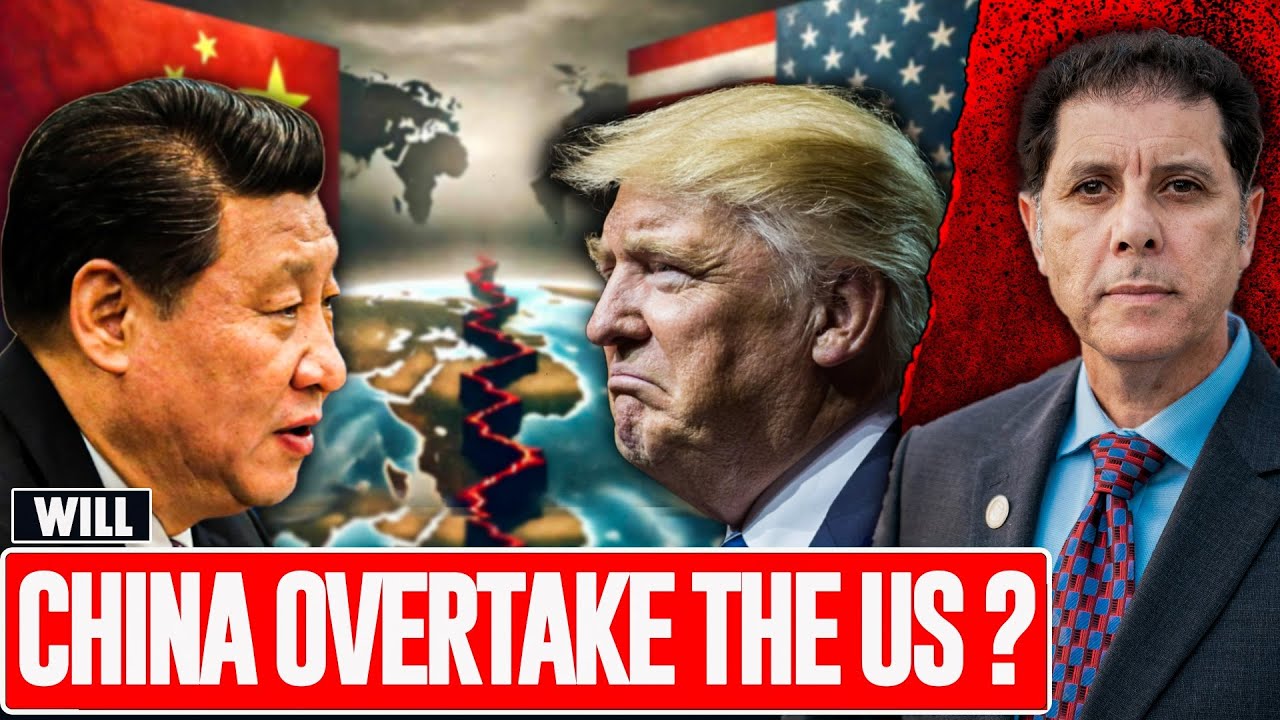
In this 20‑minute monologue, the presenter examines the evolving rivalry between the United States and China and asks whether China will overtake the US as the world’s leading power by 2025. The analysis is organized into seven thematic points: (1) the difficulty of sustaining two superpowers and the shift from US‑led liberal order to a China‑centered vision; (2) economic influence, highlighting China’s status as the top trading partner for over 120 nations and its expanding footprint in Asia‑Pacific, Africa, Latin America and the Middle East; (3) the technological race, covering AI, 5G, quantum computing and green energy, and noting China’s state‑backed industrial policy and the presenter’s recent field observations; (4) military strength and strategic posture, contrasting US global force‑projection with China’s naval buildup and regional ambitions; (5) ideological and cultural competition between liberal democracy and a state‑led development model; (6) shifting alliances and internal US challenges, describing how traditional allies are hedging between the two powers while the US grapples with domestic dysfunction; and (7) future scenarios, using Ray Dalio’s 2024 Great Powers Index to argue that outcomes range from intensified Cold‑War‑like fragmentation to cooperative competition. The speaker concludes that the answer remains uncertain, emphasizing that the manner in which the two powers wield influence will shape global governance. The video ends with a standard YouTube call‑to‑action.
Chapters
Hello everyone and welcome to Geopolitical Trends, where truth matters. Who will lead the world, China or the United States? As the geopolitical landscape evolves at a dizzying pace, one question increasingly resonates across boardrooms, think tanks, and governments alike: who will lead the world? Is it China or is it the United States? For decades, the US sat unchallenged at the pinnacle of global power, exerting its influence not merely through military might and economic clout, but also through cultural reach and the architectural frameworks of international institutions. Now, as China rises rapidly on the world stage, the era of unipolar dominance seems to be drawing to a close. But the transition, when one occurs, is far from smooth. It's a story unfolding in real time, full of ambitions and anxiety, opportunity and danger. There are 7 points I'm going to share with you. Number 1: A world not big enough for two superpowers? The United States once seemed to relish the notion of steering a rising China into a global system, believing that economic modernization would encourage political liberalization. Instead, Washington now views Beijing as a less of a partner and more of a formidable challenger, arguing that China is determined to rewrite the rules of an order the United States helped craft after World War II. This couldn't be far from the truth because China, in my opinion, is not after global dominance or supremacy for that matter. From Washington's perspective, two giants vying for global supremacy spells inevitable tension. What about cooperation, I may ask? Wouldn't that be better? For Beijing, the rise to prominence is not a matter of choice but a destiny, an opportunity to reclaim what it perceives as its rightful place at the center of international affairs. China's leaders often frame their ascent as a restoration of historical grandeur when the Middle Kingdom stood at the apex of cultural and economic influence. To China, US efforts to contain its growth militarily in the Indo-Pacific, economically through trade restrictions, and ideologically by championing a liberal democratic model are not just competitive moves but rather hostile attempts to stifle China's resurgence. Number 2: The Economic Chessboard. One of the most significant battlegrounds for global leadership is economic influence. China's meteoric economic expansion is well documented, but its true significance emerges when viewed against the US in key measures of power. According to Ray Dalio's Great Powers Index 2024, a comparative framework of 8 critical dimensions, from technology and trade to innovation and military strength, Both nations command impressive credentials, yet China's position as the top trading partner for 120 countries worldwide highlights a seismic shift in global commerce. Gone are the days when most nations around the world depended solely on the US market for prosperity. Instead, they now look east for growth, cheap manufacturing, and rising consumer demand. Consider, for example, the Asia-Pacific region. Once comfortably within America's sphere of influence, it is now an arena of intense economic integration with China. Nations in Southeast Asia have carefully balanced their security ties with the US against economic opportunities with China. Trade volumes and investment flows increasingly favor Beijing. Meanwhile, Washington struggles to forge new trade deals or revive the Trans-Pacific Partnership it once championed. Though the United States economy remains functional, at best, China's reach into Africa, Latin America, and West Asia or Middle East indicates that the American era of uncontested economic leadership is waning. Number 3: Technological Race and Innovation. Beyond trade, a technological race is shaping the contours of future power. Who leads in critical fields like artificial intelligence, collisions, quantum computing, and green energy solutions will likely dictate who dominates the global economy of tomorrow. The United States has historically excelled in innovations. Silicon Valley remains a beacon of creativity and venture capital prowess. But China's relentless push in cutting-edge sectors and technologies, from from Huawei 5G infrastructure to massive investments in artificial intelligence startups, suggests it is no longer content to follow the path paved by the American tech titans. Instead, it aims to blaze its own trail, leveraging a vast consumer base, state-backed funding, and strategic industrial policy. My recent trip to China, including Xinjiang, And Guan Zhou confirms the latter assertion. The outcome of the tech race will have deep ramifications. Technological standards set by the leader can shape how the digital world is governed, how data flows, and what norms guide emerging technologies' ethical use. America's allies, looking anxiously at each new Chinese breakthrough, worried that the US is losing ground. And it is. Yet governments in Berlin, Tokyo, while maintaining their allegiance to the US, have already considered aligning with Chinese tech ecosystems as interoperability, supply chains, and cybersecurity become issues of strategic importance. Number 4: Military Might and Strategic Posture. Economic and technological clout is vital, but global leadership has long rested on military strength and strategic positioning. The US retains a robust military advantage. Its Navy patrols global sea lanes, and a network of alliances stretches across Europe in the Pacific. No other nation can match its capacity for force projection. Yet this force projection proved ineffective against lifting the blockade the Houthis put on the Red Sea. On the other hand, China's ambitions are overt. Its naval buildup and advanced missile technologies suggest it aims to defend its interests. Yet China is sending a message to the United States that the latter's days of uncontested access to key maritime regions in the Pacific theater are coming to an end. This setting could one day reshape regional balances. For many countries, particularly in Asia, The question of global leadership is less about who rules the world and more about who ensures stability in their neighborhood. The narrative emerging from London, Washington, Paris, and Berlin already arguing that when the US falters, China will fill the security gap and assure smaller states that it won't impose its will through coercion. While some subservient states, wary of China's growing confidence, quietly hope the US remains strong enough to deter Beijing from rewriting the rules, others see opportunities in playing both sides of each other, securing investments from China while relying on the US security umbrella to keep Beijing's ambitions in check. Japan, South Korea, the Philippines are a case in point. Number 5: Ideological and Cultural Dimensions. Leadership isn't just about commerce or military heft; it's also ideological. The US projects liberal democracy, human rights, and individual freedoms, as a cornerstone of its global vision. More of a bravado, if you know what I mean. China, by contrast, champions a model of strong state-led development, prioritizing collective stability. In a multipolar era, countries have more choices, and Beijing's message resonates with many countries who admire China's economic accomplishments without Western lectures on governance. 6. A World in Flux: Alliances and Alignments. The contest between Washington and Beijing unfolds in a world less willing to pick sides. Traditional and subservient US allies in Europe and Asia find themselves pulled into two directions. Europe resents some aspects of American dominance, yet fears speaking out. Africa and Latin America, long accustomed to Western-led systems of exploitation, embrace China's investments in infrastructure and technology. If the US seeks to preserve its primacy, which is too late for that. It must fix its house first: broken tax system, economic inequality, unemployment, poverty, crumbling infrastructure, and yes, dysfunctional Congress, among others. If China aims to become preeminent leader, it must convince the world that its rise will lift all boats. Not just its own. When considering how the 21st century belongs to China, many are asking serious questions. Has America reached the end of its journey? Is the present democracy gasping its last breath? Consider what the United States has become: a nation divided, a dysfunctional government with a corrupted Congress, fragmented intelligence community, and yes, a tainted law enforcement system. As once argued in one of my writings, the spirit of the American Dream is ceasing to exist. My purpose is not to merely paint a dark image about America, but rather to present facts. As I see them and as they are. Number 7: The Road Ahead—Uncertainty and Opportunity. No single statistic can settle who will lead. The Ray Dalio framework, comparing both nations across 8 key measures of power, paints a complex picture. The US still leads in many areas, but China surges forward in others. The world's future likely rests not on absolute hegemony by one side or the other, but on how the rivalry shapes institutions, norms, and relationships that define global governance. If both countries fail to find a modus vivendi, the world risks fracturing along geopolitical lines. Trade might devolve into regional blocs. Technological ecosystems could become mutually incompatible. And a new Cold War could chill progress on existential issues. Alternatively, competition might spur both giants to innovate, improve governance, and yes, engage constructively. History suggests that leadership contests can be dangerous, but also that great challenges can produce an unanticipated cooperation. Here is my conclusion for you: more questions than answers. Who will lead the world, China or the United States? The answer for now remains uncertain. The US retains some strength and deep global ties, yet its dominance is no longer absolute. China, for its part, has ascended from impoverishment to economic powerhouse in just a few decades, now challenging American influence economically and technologically. Perhaps the more pressing question is not who leads, but rather how they choose to wield their influence. Will leadership be defined by confrontation and zero-sum calculations, or by recognition that no single country can tackle the grand challenges of our age alone? The narrative of American decline or Chinese triumph is far from settled. As the contest plays out, the world watches, waiting to see if competition leads to conflict or if these two powers can chart a path that benefits all humankind. If you like this video, please hit that like button. And don't forget to subscribe. As always, remember, geopolitics impact your daily life in more ways than one. Till next time, bye-bye.