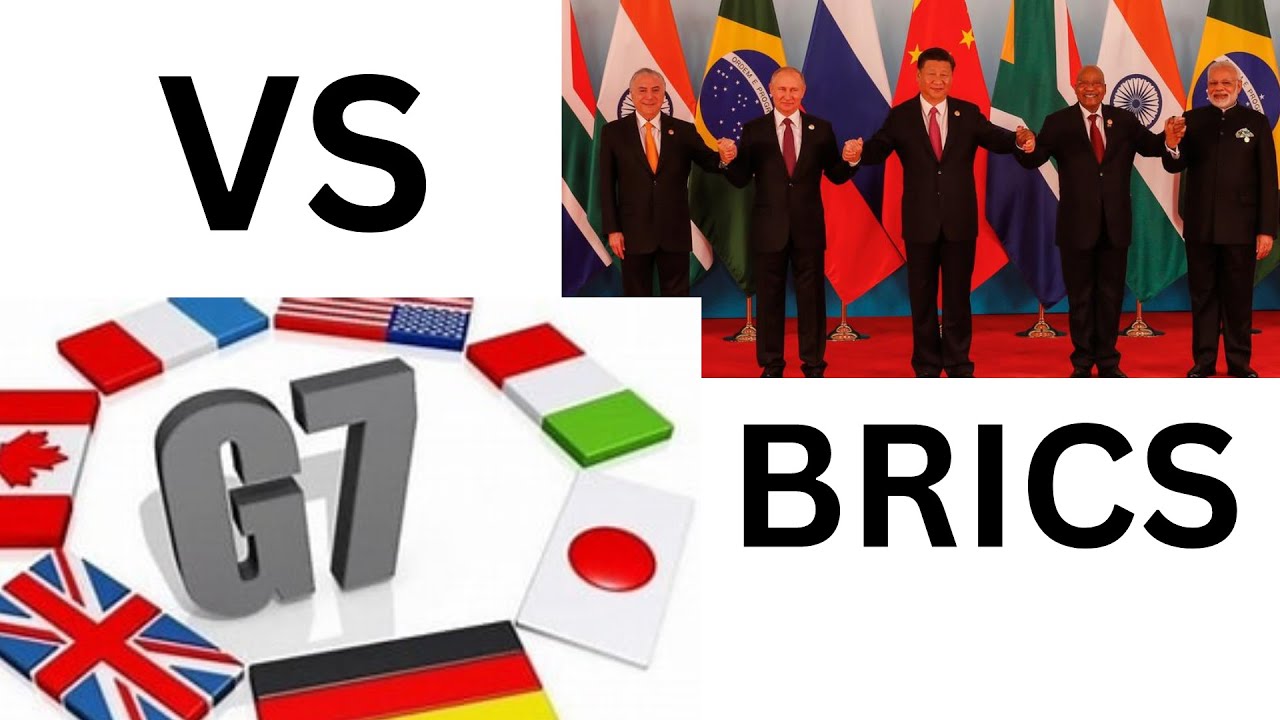
David Oualaalou examines whether BRICS countries could surpass the G7 in economic power and global influence. The video compares the two blocs without identifying specific claims or data points about their relative trajectories.
Chapters
All right, all right. Hello everybody and welcome to Geopolitical Trends. My name is David Oualaalou. So good to be with you as always. I'm so excited to be here, uh, because this is one of the settings where we really get an opportunity to sort of exchange ideas and so forth. So And that is the reason why I sort of like doing this kind of forums or livestreams, just to exchange ideas and we can learn from each other as we always do. So, so before I'll get into any of the discussions, first of all, I just want to let you know what we're going to be talking about. So this way, if you have questions towards the end, if you can prepare them and all that stuff, and I will answer some of this. So So basically the topic we're going to try to cover or exchange ideas about, it has to do with the future of BRICS— Brazil, Russia, India, China, and South Africa. So there's a lot of conversation going on right now as to BRICS Plus, and I will detail all this. So, so what I wanted to do is talk about, for example, the global economic order as we see it. We talk about briefly the roles of, like, for example, ASEAN, the SCO, the RCEP, uh, and some of this. Then we'll address, of course, G7. Then I'll answer some of your questions towards the end. So, uh, but before, before I'll jump into any of this, uh, I'm one who grew up learning one particular thing, that you always have to be grateful, okay, for whatever you have. And you always have to be thankful for whatever you have. So, uh, let me see. Uh, Multipolar, thank you so much for your super sticker. So interesting, Multipolar, because this is what I'm about to express my sincere thanks to all of you. Of course, it goes with no, no, uh, no distinctions here, but I'd like to also to, uh, uh, give a shout out to the channels members, and I'm sure you guys understand because it's the right thing to do. So, so I want to give a shout out first of all to the last, uh, the recent last 3 members, uh, Juniper Lee, uh, also CH10, and Nella. I hope I pronounce it correctly. And while I'm at it, I'm gonna, I'm gonna just give a shout out to all the, the members. So Chi Leong Chia. So thank you so much for your support. Philip H, Johnny's Coffee, Osiris Great, uh, Hedy Lokel, Kevin Thong, William N, and Chua Kok Bang. I hope I pronounce it correctly. Uh, Yokee Tan, uh, Tillman Mickler. Müller, rather, Secret Fountain of Youth, and Ko Choi Hoi. And the last person as the member is Joel Urardi. Joel was the first one to become a member of this channel, so thank you so much to all of you. So, and for all of you, of course, your support. I read your comments on the vid— on the, on the videos that I release. And, and again, I want you to know one thing, guys. Uh, I— if you can tell that the, the production that I have here, it's basic, it's because, you know, I'm doing it by myself here, and Elizabeth's not helping me on this. She's on the other one. But that's not the point. The point is I am more focused on the content that I need you to get and understand, far beyond whatever else. So this is why Sometimes you might notice certain things, but that's, that's okay for me. I care less for that stuff. What I care about the most, like I always said, it's by the time you leave or you turn off, whatever, after watching my videos, you are— you end up with more questions than you were with when you came in. That is my objective for you. So, so anyway, that's, that's, uh, that's my point for you. Uh, first of all, let me know where you are joining me from, please, because I always like to I'm very, very curious about locations. I traveled around the world quite a while when I was working for, uh, for the US government, so I kind of always like to know. Uh, Yoni, yeah, Yonifer Lee, good to see you here as a new member. So, uh, yeah, Ohio. Oh, Prison Memoir of a Modern Anarchist. What a, what a screen name, man. I like it. So from Ohio, good to have you here. So, uh, Jan, Jan Hokor, greeting to you as well, sir. So Steve from UK, good to have you. Alba Beck, always here from Canada, good to see you. Canada, by the way, is going some through major, major changes. So CK Wong from London, great to have you here. Uh, from Belgium we have Rudy Edriensen. I hope I pronounced correctly. Good to have you. Uh, I wonder what part in Belgium are you. I used to go through Brussels and, uh, also what is the city, uh, across the border with Netherlands? Uh, I was used to always drive through there sometimes when I would drive from Paris. So, uh, let me see who is here. Uh, Ko Choi Hoi, hi to you as well. So, uh, let me see who else from joining us. From Uganda, Black Joe. Good to see you, uh, Jack Robert. Good to see you always. And, and once again, Jack, I always appreciate your input and insights and, and sharing your knowledge with, with, with all of us. So I appreciate that. Uh, Michael, Michael Joby from India. Good to see you, Michael. Hope you are enjoying India and eating some Indian food. Uh, Marcos from Singapore, good to have you, Marcos. Sweet Tea from UK. Uh, talk that talk from Indonesia. Speaking of Indonesia, good to have you, by the way. There's some stuff going on in Indonesia I'm gonna need to, uh, address in a video. And by the way, sometimes there are certain topics I don't get on them right away, and the reason— because I want you to know the reason— is I have to fact-check certain things. You know, I have my ways of doing that. You guys got the idea, so no need to beat the dead horse here. So that is the reason why sometimes I come out sort of late, a little bit, because I want to ensure the accuracy of the information, because my credibility is in line here, you know. And I'm— I made it clear, I am not here after the million views and all that. That stuff is nonsense to me because I'm here after the content. I want you guys to get the best, the knowledge that I have. I wanted to share it with you. That is what I'm after. It's because we are all in it. We need to raise awareness among the population. You look at just with what's going on right now with this intensifying of the tensions in Ukraine. So like I always say, and I don't shy away from it, you know, I criticize my government, I criticize my country when it does wrong. Because that is the right thing to do. That's, to me, what a role of a citizen is. If I am to just, uh, you know, wake up, eat breakfast, whatever— even though I don't eat breakfast, you don't need to eat 3 meals a day. I don't know who came up with that. Your body doesn't need that much food anyway. So anyway, you eat, you watch TV, whatever, do you go to bed, then you do it again without even challenging the government when it does wrong. That's to me what the role of a citizen is. You have to step up when it matters. Yeah, will I get a hit for it? So what? But at least when I go to bed, I say to myself, I've done my best. That, that's to me how I look at it. And this is the whole reason for, for why I do what I do. And again, Is it about fame? Is it? I care less for that stuff. I, when I was in the military back there, I used to belong to a unit that was called the Silent Warriors. Why is that? Why we call it Silent Warriors? Because we never cared about the status. We never cared about a photo op with the president. Who cares? Who gives a damn about that? I care less, and I'm not that type. So that is the reason why You know, I'm straightforward. I want you guys to get the knowledge that I have shared with you to the best of my abilities, because we all need to move forward as a unit, because the, the is, is the safety, you know, for the all of us humans. You know, where I see things going is very concerning to me, and I kid you not, and I'm not saying it to sound intelligent, whatever. You guys know this by now. I get up sometimes at 4 o'clock in the morning. I find myself wide awake just thinking, you know, what are the worst scenarios that could happen with what's going on with governments in the West embarking on this kind of failed policies? Those are risky policies that's gonna, you know, put us all, all at risk. And that is the whole idea of, you know, To me, to those who are YouTubers, whatever, please make sure this is not about your, your fame and all that. Make sure you share the knowledge with people that they need to know, because that is the key. Anyway, I have done enough for ranting for today. So all right, let's, let's get on, on our topic here, because I want to talk about this idea of, uh, let me get my notes here just so I can see, uh, everything where it needs to be here. So the idea of, uh, uh, having like bricks. So, okay, so before we getting into all this one here, there is one thing we need to all understand. And again, like I always say, You, I'm a student of history. You learn from history. Trends usually gives you a clear indication where things are headed. And one of the clearest— yes, I use the term clearest— one of the clearest trends of the world that we witnessed just last year, only a few months ago, you know, was the acceleration eastward, which is the shift in global economic power. I've argued this many, many years ago, that the, the shift of wealth is already taking place, or has already taken place, from the West to the East. Because here's the thing, much of the migration was initially achieved through what? A continued strengthening of the— for example, this is where those economic blocks comes in, like the Shanghai Cooperation Organization, the SCO. Okay, with a significant progress being made by the BRICS— Brazil, Russia, India, China, and South Africa— groups, you know, once again, those are trends giving you an idea, uh, because it's gonna be now, uh, the way— what's the word I'm looking for— in terms of the joint policies, which is showing a clear sign, in my opinion, of interest why some countries are now running after joining BRICS, for example. And I did the two videos for you guys about— one about Egypt and the other one about Algeria. You know, the Indonesia, uh, Argentina, Iran, Saudi Arabia, and Turkey. I'm, I'm digging into the information to ensure where things are before I'll come on the air, so So becomes the question, you know, what will this year 2023 look like for BRICS, for example, since it's our topic anyway, you know? Well, the way I see it is that 2023— and once again, I'm basing it on the trends that I'm looking at, you know, the, the applications of Algeria officially, the, uh, Egypt joining BRICS, uh, New Development Bank the Argentina, Iran, Turkey, Saudi Arabia, Indonesia, all of them expressing interests. That's what I see the trends here. So 2023, for me, it looks like to be a sort of a BRICS most important year within the global economic and geopolitical landscape. That's how I see it. And that leads me to ask the question, and this is just a question. You can think about it, you can answer it, you can, uh, whatever. So the question becomes, can BRICS in this case de-dollarize the global financial system? That is the fundamental question, and I will tell you why it's the fundamental question, because that is what's going to determine the impact BRICS will have on the global economy moving forward. And we're gonna detail as to why that is so. So what I'm gonna do, uh, let me just take a look here quickly for see who is— oh, where are my glasses? You know, yeah, you get my age, you gotta have to wear glasses now. So, uh, uh, Josh, Josh Chapman from Philippines, good to see you. Uh, MRJR669 from US East Coast. Yeah, the whole East Coast. So whatever part of the East Coast, good to have you here. Uh, who else, who else, who else, who else? That's about it. That's all I saw here. So, uh, Philippines. Uh, oh, Wanky, Wanky, thank you so much for your Super Sticker. I truly appreciate it. So you guys, your support means a lot. I just want you to know this one. So Uh, Zeus from Mississippi, good to see you. And the DFCON, you said thank you for your videos. You are most welcome. It's for us all. Just, you know, I'm just sharing knowledge with you all because I'm learning from you as well. So, so let's talk about, uh, what I'm gonna do. I figured I know you've heard of BRICS, you know. Believe it or not, some of us here in the US have no clue what BRICS is. So I'm not laughing, it's just the idea of I don't assume. So what I'm gonna do is I'm gonna provide brief, brief background about each entity that I believe it's gonna be playing a major role on the global economy. So we start with BRICS, and let me share the, uh, screen with you about BRICS so you know what I'm talking about here. Right there. So for BRICS Um, BRICS is, uh, of course, uh, uh, Brazil, Russia, India, China, and South Africa. The estimate— the estimated population of it is about 3.2 billion people. Now let's just take a step back and think about that from a consumption perspective. If you are a CEO of a company, you're gonna be thinking about where the market is, okay? That's like the example that I always like to give. Two individuals, okay, two individuals go to Africa, for example, okay? And you all know how Africa is as far as infrastructure. They need a lot of stuff. But the two of them, one of them said, oh, there is no economic opportunity here. The other one says, whoa, there is a huge economic opportunity. You guys, that— you got my point, right? That's what it is. 3.2 billion people for BRICS. You can just see the opportunity there. So, and it's about almost, you know, that's about 41% of the global population. BRICS are also among the, the world's 10 largest countries by population, area, and GDP. So, which is no small matter. So you look at about the emerging powers within BRICS, you know, uh, uh, for example, South Africa, India. Of course, China is the second largest economy in the world, so soon to take over the US. Just to put this within the context, so, and the, the, the, the, uh, sort of some members of those are members of the G20. So with the combined of nominal GDP of about $26.6 trillion, or about 26.2% of the, uh, of the gross, uh, gross rather, world product, or GDP, that is. So, and about $51.9 trillion, or 32% of global GDP, uh, uh, purchasing power parity. That's an estimated of about $4 trillion. So that's just to give you an idea. Let's talk about RCEP, the Regional Comprehensive Economic Partnership, which we all— for us in the US, we had to get into in the middle of it to create some issues, but it didn't work out anyway. So, so what is RCEP? You know, a free trade agreement among Asia-Pacific nations, even though it includes Guess who? Australia. We all know how Australia has surrendered its sovereignty. You know, you're all familiar with what's going on in Australia just last two weeks, that now they agreed— the government agreed to the ambiguous nuclear policy of the United States. Yeah, that's what Australia is doing. So anyway, Australia is part of the RCEP along with Brunei, Cambodia, China, Indonesia, Japan, South Korea, Laos, Malaysia, Myanmar, New Zealand, the Philippines, Singapore, Thailand, and Vietnam. So the 15— there are 15 countries. So the 15 member countries account for about 30%, yeah, 30% of the world population. 2.2 billion people. It also accounts for 30% of the global GDP, or about $29.7 trillion. So that's why you cannot— when you think about the big picture, economically speaking, and we're talking about the global economy here, you cannot ignore the impact of an economic bloc such as the RCEP. And that's what The whole idea of the notion why we decided to address this topic about will BRICS overtake G7. So, and that's a big question mark on that. I can't say yes, definitely, because I'm gonna share with you some information as to why it might be a challenge, and there might be a reason for that. So, so let's move on to ASEAN, the, the Association of Southeast Asian Nations. So And this one has about 10 nations on it, okay, or in it rather. Brunei, Cambodia, Indonesia, Laos, Malaysia, Myanmar, Philippines, Singapore, Thailand, and Vietnam. My big concern with this entity, one particular country, and that country is— let me see if anybody can guess which country. That is big concern. Let me see if you can write it down here, just out of curiosity. Uh, which country do you think there are more question mark over or about than anyone among the ASEAN countries? Uh, Indonesia? No, no, you got it right, Jack, it's Philippines. It is Philippines, and I'm gonna tell you why. I had a conversation a few days ago from individuals from the Philippines, and they came here to the US. You know, actually they flew back, so they still have family over there. And I had a conversation, and the concern about the Philippines, which some— I was informed that the majority inside Philippines are not aware of what's going on. There is a proxy war going on right now as we speak between the United States and China, and it's taking place in Philippines. Now that becomes the question, and this is what I said way back when Marcos Jr., Bongbong, took over. I said he's gonna be in a very, very delicate position. Either he's gonna have to go with the economic welfare of Philippines moving forward, or he's gonna have to sacrifice the economic and go with the security, uh, uh, protection with the US. He can't do both. And this is exactly the, the proxy war that is now emerging in the Philippines quietly. To average Joe, average Jane within Philippines or even outside Philippines might not see it. What you have to look for is just the agreement that was just made 2 and a half weeks ago. And I remember we talked about it, guys, about the 9 military bases there, but only 5 of them that the US requested expansion. Expansion for what? Unless you, you, the United States thinking in terms of allocating more weapons to that. And as a matter of fact, speaking of weapons, the United States has already made a decision to increase the number of troops going to Taiwan. It just happened this morning. I'm, I'm gonna be looking into that. I'm gonna make some phone calls to Washington, D.C., some of my contacts there, just to get the right information, and I might do a video on it for you guys. So here's the thing about ASEAN. In 2021, the estimated total GDP for ASEAN countries stood at about $3.35 trillion. You know, that's, that's a significant increase from the previous years. As a matter of fact, the GDP of ASEAN region has been skyrocketing for a few years now. Which means what? It's reflecting the thriving economy of ASEAN. This is again, that's why I always say, guys, if you can learn one thing, always put things within a global context. It will make more sense to you. This is why I keep saying, this is why ASEAN staying neutral regarding the China-US tensions, except for the Philippines. That is where my big concern, and for two reasons. The location of Philippines as far as access to South China Sea, because that could be very, very choking point for China. And the second, second one is that for Philippines will become the launching pad for the conflict with China, between the US and China. That is where the concern for, for, uh, for ASEAN, but mainly for, for Philippines. But that is why ASEAN countries stay in neutral. G7, and I'll talk about this and move on into addressing some brief analysis for you. G7, this one serves as sort of, uh, what you call it, a platform, a forum of sorts to coordinate policies, you know. But there are voices now, and I've been sort of following, uh, reading through some think tanks here in the US but also overseas. Usually I don't base my faith on the ones here in the US because I know they are the back door of the government. So any, any analysis that comes out will have to be skewed towards what the government want to communicate. That's why I don't take that at face value. I have to fact-check that information through another source. But the experts I'm referring to are not here in the US, by the way. So, so, and I'm one of those individuals who are really putting question mark about G7 as far as its relevancy. Is G7 relevant as of today? Consider who's in it. You know, so you got the United States, France, Italy, Japan, the UK, and West Germany. Those are the 6 countries that formed the G7 back in 1975. You always have to go back a little bit in history to understand. And the objective was then— what was it for? Was it about prosperity? No, it was about providing a venue for the non-communist powers to address pressing economic concerns. Yeah, that's what they say. It's no different than what NATO was saying at the beginning, was supposed to be defensive alliance right here in Europe. All of a sudden now you have NATO is heading out to Asia. What the heck is NATO going to do in Asia for? Why is NATO going to foment tensions in Asia? Because a conflict in Asia will be no small— it's no small matter. It's no small matter. Same thing for G7. And the whole reason G7 was established, remember the year? What year was it? 1975. What happened 4 years prior to that? The oil embargo by the OPEC. So And that is the reason why, because G7 was saying that, well, we have to fight inflation and we have to fight recession, but also we are afraid about another oil embargo. That's what it was. This is no different than, uh, uh, right after the World Economic Forum. If you look at its history, when was it established originally? 1971. What happened in 1971 or just before? Is the oil embargo. So the OPEC, so that is what's important. So, so as of 2020, 2020, yes, 2 years ago, uh, or 3, whatever that is, G7 members accounted for half of the global net worth of about or over $200 trillion, or about 32 to 46% of global gross domestic product. It's no, no small matter. And that is my point to why I wanted to bring this up, to highlight to you how it works. G7 also has about 10% of the world population, 770 million. That's about it. So they don't have much. They don't have much. But one thing that is going on in G7 right now, which you won't hear about in G7, in the EU, and in NATO There is division exists from within. So the internal division that exists within G7, in addition to the external dynamics that's going on— what do I mean by that? Is that the world has already shifted to Asia. Like I give you the example, RCEP, ASEAN, Shanghai, the Shanghai Cooperation Organization. Those what they mean by the dynamics. Interesting enough how analysts usually sometimes word certain things, and this is when you realize whether something is coming from the government or within something, or analysis is conducted by an independent, somebody who's independent. So when a government says external dynamics, they won't want to word it, they won't want to put a word to it because It puts a high— it highlights exactly where the failure of these governments are. This is no different. I'm gonna give you a quick example. It's no different than— you all heard, I'm sure you do, that China has initiated a peace initiative to end the Ukraine-Russia conflict. Guess what was the US and the EU response? We reject it. I just read this morning Antony Blinken's statement. The US reject. Why do you think the US already stating this? Because they don't want a peace initiative coming from another non-Western country such as China, okay? Because it puts the spotlight on China's peaceful initiative moving forward instead of fomenting wars and conflicts and so forth. It also highlights another point, and the other point, it shows that how the West leadership is truly, truly in decline. So the West, the best tactic or policy or approach is to reject And that's exactly what happened. So the same thing with this, uh, what they were talking about, G7 external dynamics. No, no, no, no, no, they cannot say it directly— the rise of ASEAN, the rise of Shanghai, Shanghai Cooperation Organization, the rise of BRICS— but they won't do it. But nonetheless, majority of those analysts, and I read the ones mainly from overseas the analysis that the group G7, it's truly lacking relevance right now. And there is one reason for why it's lacking relevance. It's lacking relevance because China and other emerging powers are not part of it. So that is where the issue is. So I just want you to put it within the big context. So, so now the question becomes for us is, okay, since we are talking only about BRICS, because I want to focus the conversation on one, we can't be all over the place here because it's not, not good. So the question becomes is, now we've seen the, the, uh, what's the— I don't want to use the term demand, but, but the, the approach that countries approaching BRICS want to become a member. BRICS will have now to think very hard this year, not next year, it'll be too late, this year, especially before the meeting or during the meeting that's going to take place in May of this year in South Africa. They have to think hard as to where is the mechanism by which they want to sort of invite other countries? What is the process by which they're gonna evaluate how country is going to be admitted? Because as of today, there is no process. You just submit your application. That's, that's the key aspect. And the key to all this is that all the 5 members— Brazil, Russia, India, China, and South Africa— will have to agree, all of them, on a member. That's all it is for now, but that's not going to be enough when you start inviting other countries, because I do foresee a problem if they don't address it now. And the problem that I see, which I will give you a comparison to, is the EU. Back in the day when the EU started, you know, they used to be just the strong countries economically speaking. Then all of a sudden, EU started admitting countries that have a very, very low economic output, start dragging the EU down. You look at the— and again, I don't pick on any country here, I'm just giving examples. You take the, uh, back then when countries still had their own currencies, you take the, the German mark versus the French franc, okay? They both were up. But as EU starts to grow, you take the, the, the German marks and you compare it to the, the currency in, in Greece, given how the economy in Greece is. I do foresee the same problem for BRICS if they don't resolve it earlier and make sure— this is why Western analysts, some of them getting it wrong— de-dollarizing doesn't mean BRICS is going to create a currency for global trade. That is not the case, and I'll challenge those analysts who say otherwise. The reason being because they wanted to establish the currency for bilateral trades or multilateral trades within the organizations, which makes perfect sense. You look at just now what Iran and Russia just did by establishing the currency, bypassing the SWIFT. So SWIFT became, or becomes now, irrelevant to both Russia and, and Iran transactions because they don't need it. But BRICS cannot move forward without making clear as to how this is going to move forward in this aspect, because it's the financial— it is the financial dimensions that's gonna put really dent into the global economy moving forward. Because you think about it, you just think about it, you take BRICS. Can you just imagine this coordination or joint policies between BRICS, ASEAN, RCEP, and SCO? It's exactly what we are witnessing today with that shift of wealth from the West to the East. The G7, which is the truth of it, how did it become wealthy if it weren't for access to cheap labor in Asia? Let's just say straightforward. For us here in the US, you know, uh, I buy whatever, whatever, if it is produced here, it's gonna cost so much. This is why you hear the hypes about we're gonna sanction China. It's nonsense, doesn't make any sense. And you can't sanction China because all China needs to do is shut down the trade and we're screwed. It's the truth, it's the fact. So, and this is where the idea of how BRICS is going to move forward, uh, we're gonna need to address this this year, not next year, because BRICS has been around now for a while. It's been around. So And yet it's not making that dent economically speaking. Now this could be tied to, for example, uh, how, uh, RCEP countries is, is gonna decide to move forward. Well, but you got countries like Australia there, you know. I personally would not trust Australia government, you know. Never ever confuse people with governments, just FYI, guys. Because I, I know Aussies, I know Australian people, great people, wonderful. It's the damn government. So, so you take that, you take countries like, for example, the, uh, the, uh, ASEAN, and again with the question mark on Philippines because that's where the big concern is. So, you know, and this is why you're gonna have to think about in terms why G7 is, is where it is. It is because the idea of access to, like, cheap labor in the East. But this is coming to an end soon, believe it or not. I am in a process of working on a video for you guys, and this one has to do with information that has not been disclosed openly, and how much now Europeans behind closed doors are saying We're gonna need to travel to China. I know some of them went off, went over a couple of months ago, but this just happened yesterday. And I'll tell you because it's not classified, French President Emmanuel Macron is heading out to China. Germany, just information came out from inside the trade ministry, will be losing about $160 billion if they don't tie lines with China. So European economy is, uh, and I would be releasing a video for you tomorrow about UK. UK is done, despite what you hear, despite what you hear. UK's economy is done with the massive spending that Sunak, the Prime Minister clown Sunak, is pushing. The guy lives in a bubble. You know, he's a millionaire. He doesn't understand the average daily life of an average UK citizen. So just to go back to my conversation about BRICS here, so for BRICS to understand moving forward, for it to become BRICS Plus— because remember, it was only when it was BRICS, only BRICS— Brazil, China, India, uh, BRICS. Brazil Russia, India, and China. They were BRICS. It was till South Africa joined in, that's when it becomes BRICS South Africa. But right after that one, a few years after that, BRICS took off. But it didn't took off the way like you would expect from, for example, G7, the EU, or ASEAN, because there were a lot, a lot of intricacies that needed to be worked out. And the one that always comes to my mind, you know, and if I am to advise BRICS, I will say, especially for the two main countries, the two main populated countries, China and India, they need to sit down and resolve that border issue once for all, because they can't be moving forward with that stuff lingering in the background. That's just not gonna be It doesn't bode well, doesn't look good. It doesn't push the organization to move forward if they are to bring in other countries. So it becomes a question, you know, how can you BRICS bring in Iran and Saudi Arabia? Well, you all know the history of the two, you know, because any observer from outside would be saying, well, wait a minute, you Brazil— you China and India couldn't resolve your issue, And you are inviting Iran and Saudi Arabia knowing their over a thousand-year history? Yeah, that, that, that's to me just common sense, what's pragmatic. So, but anyway, so moving forward, if BRICS to become a BRICS Plus, of course they're going to have to evaluate the countries. The countries that are now in line— Saudi Arabia, Iran, Argentina, Turkey, and of course Algeria applied for that, Egypt. Those will play a very, very crucial rule, or role rather, economically speaking. Why? Because you gotta, for example, Argentina, you know, a big economy, you know, it's not small in Latin America. It will play a role, but also will pave the way for BRICS to even expand larger. BRICS cannot grow too big too quick because it will become problematic. That is one of the reasons why BRICS will have to think in terms, uh, especially China as a key player, in terms of the BRI. You know, when you look at this map like this, you're gonna start to realize, okay, it will make more sense for BRICS to expand. That's just common sense. That's how it's going to be. So, but bringing in Iran and Iran, Saudi Arabia, and Algeria, 3 OPEC members, you know, the numbers do not lie. You know, just between India and China, those OPEC members can support these two, these two economies. And they got enough oil. Now the discovery of natural gas. Algeria, by the way, has a lot of gas. As a matter of fact, Europe has reached out to Algeria, which you won't hear much about. And that was right after the visits of Lavrov to Algeria, because remember, Algeria was a client of Soviet Union back then. But Algeria has a lot of oil and gas. And under its ground. Egypt, on the other hand, with the discovery of natural gas, which I argued this few years ago, makes perfect sense to admit it into BRICS. So the bottom line to all this is that one thing that BRICS needs to do first is to de-dollarize before they do anything as far as policies, as far as, you know, and they have to prepare between now and May, which is only what, 3 months from now, 4, 5 months in South Africa, and they have to move forward. It's because the global order has already shifted, is shifting faster than the West can keep up with. And this is why we see in our policies here in the US, the policies we're embarking on, those are failed policies. And that's usually an indication, you know, Once again, you look at history, you know, what do, uh, what did the empires, uh, uh, do? What was the cause of the fall of the empires? Two main things. One of them is domestic corruption, and second one is its, uh, failed policies, especially foreign policy. You know, you know, you go way back to the Roman Empire. The Roman Empire disintegrated from within not because of a foreign invasion, but because the corruption that was existing within the Senate. You know, the Byzantine before them, the Turks, then the Dutch, the Portuguese, the Spaniard, the British, the French, and now the Americans. Because we are as corrupted as we can be, sad to say, but it's the truth, you know. And when you start to see the foreign policies we are embarking on how ill-conceived they are, how fragmented they are, and how dangerous they are. Because when you got the like of Victoria Nuland pushing on policy, you all see what the outcome is going to be. When you got the like of Antony Blinken as Secretary of State, you're going to see what, you know. And again, I have nothing against those individuals, but as a citizen, it is my duty to speak out. It's because those policies they are pushing for are putting us at risk, all of us, the whole humanity for that matter. And if we think just because we have 10 aircraft carriers and we have whatever, that we could defeat whatever— no. Look at history, look at what happened in Vietnam. Couldn't defeat Vietnam. Vietnamese drove the Americans out. Afghanistan, Iraq, you know, these are real life examples. And you will think any pragmatic politicians with wisdom will learn from these mistakes and said, no, no, no, no, we can't do this. Sadly, what you have in Washington, you have, uh, let me say thank you to Lover of the Russian Team. Thank you so much for your super sticker, truly appreciate it. You got individuals who are yes sir, yes ma'am. They couldn't say no. Why? It's because they are after power, not after serving, not after doing the right thing. You know, there's the saying we used to have in the military: there's a hard right and easy wrong. It is hard to do the right thing, it is easy to do the wrong thing. And you would think those individuals in position of power to truly advocate for what's right. This is not about being afraid of other countries, whatever. This is about ensuring that we all live in peace. What happened to the concept of live and let live? You know, who the heck are we to be dictating to other countries what to do and not to do? You know, I certainly don't want anybody come to my home here and tell me, well, Mr. David, you need to do ABSS. Get the hell out. You don't tell me what to do in my own place, and I won't do it to others either, because it's common sense. And that's why I don't, you know, we don't have leadership anymore anyway in America. You know, American people are lost. They're thinking that both political parties are the two faces of the same coin. Yeah, just straightforward. Let's not sugarcoat it because this didn't happen a decade ago or two. This has happened, been happening since the last 160 years. Yeah, which most Americans do not understand, that the political process in America has been controlled by both political parties. That's why you only see two political parties in America. Well, if we are to talk about democracy, how come you only have two political parties? Isn't it democracy? You're supposed to have choices. But because the system's been controlled that way, you know, it's the system itself. Till you change the system, nothing is going to change. That's like a foundation or a house. If the foundation is shaky from the bottom, you can do all the cosmetics you want, that building is going to collapse one day or another. This is the same thing. So that's what I see. So, so just to go back quickly here, and I'll wrap it up, so I'll open up the floor for you guys for your questions. For BRICS, you know, the signs that now countries willing to join BRICS, because also they are seeing that where things are headed economically, you know, uh, once, once the dollarization takes effect, you know, we are toast here. I'll say it straightforward. Most Americans have no idea of what lies ahead if the dollar becomes weak. And for us, the only left— the only policy left for us is to create more wars, because more wars brings in money. But you know, it's, it's wrong. It's wrong. That is not the right way of how you deal with other countries, or the rest of the world for that matter. So, so for BRICS, they're gonna have to really figure out the mechanisms by which how to move forward. One. Second, they're gonna have to ensure that the country is coming in, have to contribute something. You can bring in a deadweight. That's like when you have in your, uh, you know, military team, whatever, you go on up, whatever, and there is a deadweight. They're gonna drag— he or she is gonna drag the team down. Can't have that. So, because you can't be thinking emotionally here, there's no emotions into this. Oh, I feel bad for this. No, no, no, no, no, no, no, no. You're gonna have to, to see it pragmatically, logically. So, so, and, and that is one of the things that BRICS country needs to do. No. Now here is the answer to the fundamental question, and I'd like to have your input as well. Do you think that BRICS, plus once it grows, would overtake the, the G7? And my answer personally, and this is my personal opinion, I don't see it happening anytime soon. And again, because the data backs up what I'm saying as far as the output. There is a way, however, to change that outlook. But Asia as a whole will have to embark on a very different strategy, and that strategy, in my opinion, it will be, it will be faced with more conflicts from the West. This is why I'm seeing the signs right now about Philippines. I'm seeing the signs about the increased numbers of US troops in Taiwan. I see the signs for the, the nuclear ambiguity that Australia just signed on. I see the signs in South Korea. I see the signs in Japan. And that is where my big concern is. So, so for BRICS, they're gonna have to really, really, like I always say, play their cards, uh, strategic cards, that is the right way. And I am sure they can succeed in achieving whatever they want, and it will become a sort of a force of good. Yeah, I'll say it, a force of good economically that will benefit everybody. You know, I'm not saying they're gonna hand things for free, that's not what I'm saying. It just— the countries will benefit. You know, it was one comment from one of my viewers here way back in one of the videos said, well, how come small countries Uh, how will small countries benefit from this? Small countries will benefit from this one. They don't have to become a BRICS member, but they can enter into ventures with BRICS members. Because remember the New Development Bank? Why do you think Pakistan is sucked into debt? Because IMF is giving it debt while pulling strings attached to it. New Development Bank will not do that because that country, that small country, whatever that is, is not going to ask more loans than he can afford. That's like at your home. Are you gonna buy something that you can't afford? No, you won't. So, all right, I'm gonna stop right here and I'm gonna go answer some of your questions. So, so let's see. Please just put a Q so I know it's a question, uh, and I'll be happy to, uh— I'm gonna go all the way back to the top. Because I, in case I missed something, and we just, uh, and just answer some of your questions. So, uh, okay, all right. One question from S, uh, uh, what kind of BRICS currency do you believe we will see? Will it possible? Oh, let me share your question, I'm sorry. Here's your question. No, uh, will we see— well, would it be possible to be a digital currency next to their current national currencies? And will it, will it be backed by a resource or another currency? Great question, great question. Uh, yes, it will be, it will be backed by hard currency, by, uh, some tangible assets like gold. This is why, for example, China just moved about, I think, 14,000 pounds of gold or something like that. I read it recently. I'm gonna look into that also. Uh, the, the, the concern that I have, if BRICS goes into that direction of a single currency for all, that's what I see the, the problem. They can do that, yes, they can, as long as they maintain their own currencies. So basically, the way I see it If they're going to use trade, use the, the, the agreed-upon currency for bilateral or trilateral trade, trade, or multilateral trades. But for a country like Europe, Europe right now, the EU with the euro, you know, this is where the problem— you get some economies way down, but then you can't do anything about it because the currency of that country is tied to the euro. So BRICS will be better avoiding this kind of mistakes. And yes, he would back it up by tangible asset, not by credit. So that's the way I see it. So, all right, let me see next question. Uh, yeah, you're absolutely correct, lover of the Russian team. Uh, when you put in, uh, your— I agree with you. Yeah, we cannot carry on like this because it's doomed to fail anyway. Yeah, we can't be doing this because at some point— but that's what— when you have amateur politicians, I'll call them that, individuals that have no grasp, they have no depth of what geopolitics is all about, and they have no understanding about the long-term strategic impact of a policy. We're seeing the results we are seeing. So, uh, okay, let me go down, see if there's any question. All right, let's see. Okay, so yeah, I don't see any questions here, guys. I know sometimes there is a delay, there is a delay here with the questions show up, but so I don't see any here. So anyway, I'm gonna just wrap this up here because I don't like to just talk nonsense, you know, just share with you what's important for you guys to know. So And I truly appreciate you, your insight, sharing your knowledge. Also, I know some people get frustrated, you know, that's why, and you're free to express yourself, you know. So anyway, as I said, I'm going to be releasing a video for you guys about the economy of UK. It's very, very bad. And I take this opportunity to thank my editor, by the way, for putting this stuff together. So I truly appreciate it. Then I'll look into Germany, of course. And I have another topic that I, I'm, I'm already, uh, reached out about it to— well, it's the topic is the numbers of the US troops in Taiwan. So I need to see this one. So, well, I, uh, I wish you guys a good weekend. Enjoy your weekend, whatever you are doing, and I look forward to seeing you next time. As always, Remember, geopolitics impacts your daily life in more ways than one. Till next time, guys. Bye-bye.
More from David


Beyond the Single Actor: Why the Gulf Isn't Choosing Between the US and China


Iran, Iraq's Militias, and the Houthis Are Coordinating! This Changes Everything




Who Controls the Next Decade's Resources? Latin America and Africa's Geopolitical Crossroads

The Chokepoint Trap: How Washington's Stupidity Triggered a Cascade That Now Controls the World

Trump Spooked as IRGC Unveiled dual-use SLV, Deployed Ghadir Mini-Subs & Hinted at Tactical Nukes!
