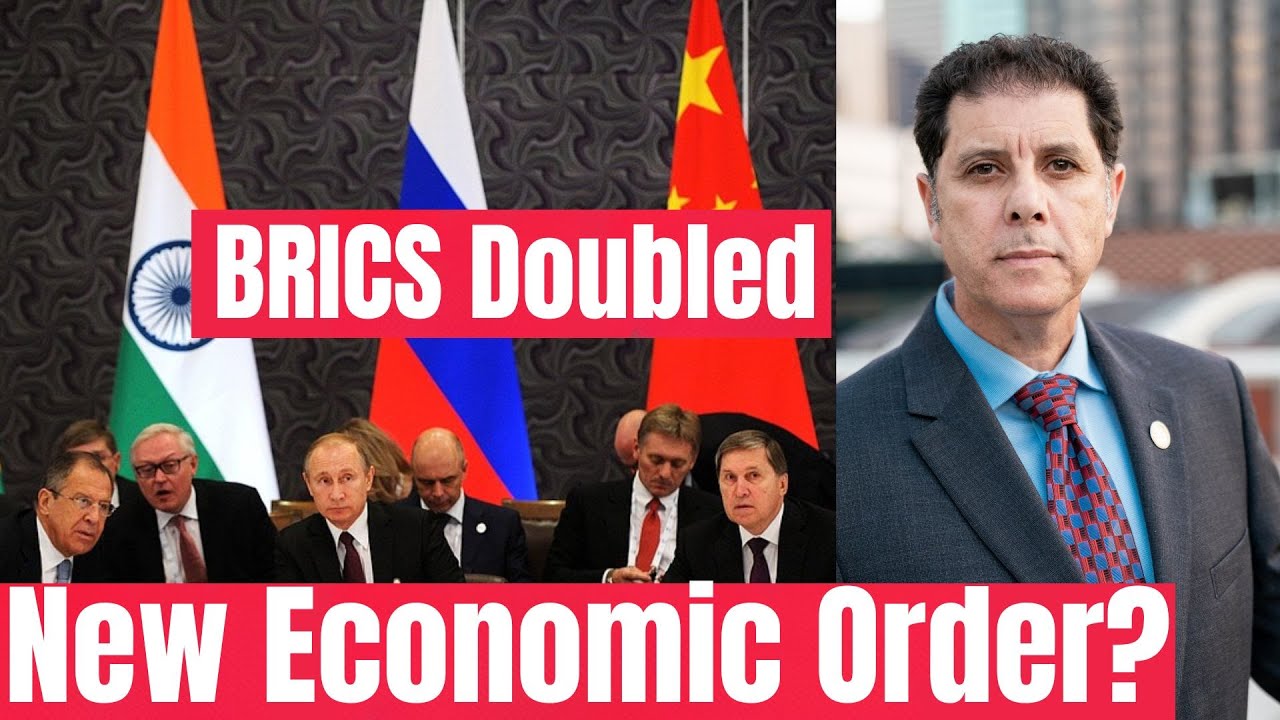
David Oualaalou examines whether BRICS can dethrone the US dollar and emerge as a political counterweight to the West. The bloc is expanding with Egypt, Ethiopia, Iran, Saudi Arabia, and the UAE, while the New Development Bank offers infrastructure to reduce dollar reliance. Internal divisions, especially India's hesitance, could limit BRICS's ability to align on policy.
Chapters
Hello everybody and welcome to Geopolitical Trends. So excited to be with you on this January 13th. So funny how time goes by so fast. Um, I got an interesting topic for you today. It has to do with BRICS, where BRICS is headed. And there's a lot of, lot of, uh, reports coming out of the West suggesting that it's nothing but hype, it's nothing but hoopla. And so forth. Some of them will say there is reason for saying that, others will say not necessarily. Let's get into the facts and we'll find out where this is going to be headed as far as the progress of BRICS. So, so this is what I'm going to be talking to you, uh, about today for a period of time before we head out to Rumble later on. Speaking of Rumble, there is the link for the channel and the live stream that I'm going to be doing there. I put them on the description for this video here on, on, on the YouTube, so you can check it out there. And I'm going to post it for you soon as we move forward here. So, uh, of course there is a sad day today. You all know what just happened, right, uh, about Gonzalo Lera. I intend to address this in detail on the other platform because shame on our government. And I'm gonna detail all this, but, uh, I, I will be talking about all this in detail. So, so here's the topic, as I said, we're gonna talk about today: BRICS. Okay, is— and, and the key question we need to ask, here's the key question, and I put them for you. I usually always have those prepared ahead of time. There are the questions. Those are worth asking, worth asking. Can BRICS— oh, BRICS, I'm sorry. Can BRICS destroy the US dollar? Yeah, straightforward. There is no— there are those, and I even, for me, I use the, the, the term the throne. I wrote an article about this some 6, 7 years ago, or 5 years ago or so, somewhere around that time. Time. And I'll, I'll be happy to look for the link and pull it up for you. And, and, and now I'm moving away from that term of dethroning to using the term destruction. So will BRICS destroy the dollar? That's one of the question. Or can BRICS destroy the dollar? And please just answer on the chat box as we move along. Second question: will BRICS role be limited only to economics? Because of you, of you all know, for the history of BRICS, when it came on in 2009, it was for economic reasons. Many at the time was— were saying where this could be a rivalry to the EU. So this is why I'm asking, will BRICS, in your opinion, will BRICS role be limited only to economics? And the third one, can it be a political force to counter the West? Those are legitimate questions we ought to ask, uh, before I'll delve deeper into all this. And, and, and I'll take, uh, a question or two from you here before we move on to the other platform. So, but before we do this, let me, uh, share with you some headlines from around the world because you need to know what's going on. Uh, one that really caught my attention in Africa, uh, this one happened in Sudan. So as you may know, there are no tensions in Sudan. Of course, we don't hear much about them. Uh, one of our viewers here asked me if I could do an update on Sudan, and I said I will. Uh, I just didn't get to it. There's a lot to cover, there's so much to do, and I'm by myself doing this one here, so Uh, here is what happened. The Sudan war puts about 24 million children at risk, and this came in a report by the, the head of the UN, United Nations Children's Fund, UNICEF, that is in Sudan, confirmed that if the war between the army and the Rapid Support, you know, between those two rivals right now forces continue, the catastrophe of an entire generation will occur in the country. So the first victim of which are 24 million Sudanese children. Uh, the conflict in Sudan, as you know, is putting the health of also 24 million children, uh, and thus the future of the country. Well, this is no different than the same conflict we are witnessing now in between Israel and, uh, in Gaza. So the same thing can be said about that. The second thing, it's, as I said, I am going to be detailing more on this, what I have to say about this guy, the one I'm pointing out on the right, the comedian Z. Uh, I, I decided not to address any of that here except to let you know about the passing of Gonzalo So funny enough that I was truly trying. Somebody was telling me last time to reach out to, if I could, to Gonzalo, uh, when I was in Europe at the— in, in— because you all, you all know I went to Ukraine, uh, uh, myself just to see. I didn't go as far as Kiev, uh, where Gonzalo was, and that's the, the sad part. So here, here is what happened. The, uh, the Chilean-American blogger Gonzalo Lira has died in the Ukrainian prison. He's died in a hospital, but it was because he was under, uh, the, the authority of the prison guards and so forth. Uh, there is a video out there. I'm gonna share it with you if I— I'm gonna put the link for you, uh, because, uh, one of our viewers sent it to me, and I will be, uh, happy to share that with you. But remember, this is also what I'm gonna be, uh, detailing on, on, on Rumble when I go there. Here is the link here, let me share it with you. It's right here, and I'm gonna post it for you in the chat box so you see it. But as I mentioned earlier, it is already on the, uh, description. So for, for the video of today, copy, So I'm gonna put it for you guys on the chat box right here, and make sure to join me at 1 o'clock, about 1 o'clock. So 30 minutes from now, uh, we'll be over there. Once again, the link is on the description, uh, and the whole link to the channel. I don't know what's going on with Rumble, how works that stuff. So let's, let's move on with what we need to do here as far as the topic. May you rest in peace, Gonzalo. It's really sad. What is that? I have two other things I'm not going to talk about here. Is this image here. This is the update from yesterday. And another one, look at this, and I'll let you make the comments. This guy here is representing Israel, so you can just tell. So I'm not judging, but you can— the image is worth a lot. The arrogance, thinking that they are above the law. So I'm gonna be detailing this also, uh, on, on the next, uh, uh, live stream on the other location. So, all right, by the way, uh, let me guys know where you are joining me from, as always, because I always like to know where you are joining me. Good to see you, Francis, as always. Uh, Partha, good to see you. The World Rocks, good to see you. Emirate are responsible for financing with or in Sudan. Uh, you wrote, uh, some told me that Qatar and Emirates are responsible. I, I do see the logic into that. There is some truth into this. There is reason for all this, why the conflicts in Africa. That's for another day. I will cover that conversation because I know a little bit about, given that I spent time in Djibouti. Uh, I was also in Ivory Coast, and I am very familiar what took place, uh, with the, uh, uh, influence of certain, uh, uh, uh, per certain Gulf states that they have. Uh, Kara Kulak from Florida, good to see you. Uh, uh, Hedy Loquel, good to see you. And once again, Hedy, thank you for buying the membership for others. Speaking of memberships, guys, uh, there was someone, uh, uh, by the name of Rabbi Lee who bought 5 memberships yesterday for some members. So I wish you guys, the new member, put a note there when someone does this. I didn't know, I was informed that— I thought you guys got it directly. That's— but I gotta give credit where credit is due to Rabbi Lee, who purchased the 5 memberships for those new members on the channel, uh, on YouTube. So Anyway, and I'll keep my thanks for later on. So, so let's get in into our topic here, guys, because there's a lot. Uh, Caramel Crash from London, good to see you as always. Uh, let's get into this. Here is the thing, the way I see things now moving forward, uh, because this now is a bold move that is now sort of, uh, reverberating across the financial global centers, as I put in the description, for a reason. Why? Because the concern is about what's going to do to the dollar. And this is why I said, or, or I even put in the description where— or I asked you rather, will BRICS succeed in destroying— yeah, that's a keyword— destroying the US dollar? So why is— because now as Russia is going to be hosting the 2024 BRICS Summit, is going to be in, in, uh in a city called, uh, uh, let me see the name of the city. That is called— I have, uh, uh, Gazan. I'm gonna do geography and history about it briefly, but just for now to give you background for those who might not know what this topic is all about. So the idea of, uh, uh, what, what Russia is going to be doing now, well, as you know, on January 1st, because in every year, the baton will have to be passed on to the next country who's going to be hosting the chairmanships of the BRICS, or BRICS chairmanship. That is why on January 1st, Russia was passed on the baton of the BRICS, uh, uh, membership, uh, chairmanship rather, not membership. And as you know, this one took place from what took place in, uh, uh, South Africa, in 2023. But here's the interesting now, that the summit that's going to be taking place in, in, uh, in Kazan in Russia will have about 10 new members. I know when I put the on the community the picture that showed the flag of Argentina, that's the only picture I could found at that time. It was just for us, for the community, and I figured you guys would know Someone— excuse me— someone mentioned that to me, and I just, you know, that's, that's the reason why I put that, that image there. Yes, Argentina is no longer there. So, so, so the 10 countries, uh, in addition to the 5 members of the BRICS, now you have Egypt, Ethiopia, Iran, Saudi Arabia, and the United Arab Emirates. Now there are those who say— and what do you guys think? I want to have your opinion on this— is it better that Argentina is not joining, or Argentina would have added something to BRICS? What do you guys think? So, so the Russian— as I mentioned, the Russian, uh, uh, uh, Federation, or Russia that is uh, will be— has already begun the 2024, uh, BRICS, uh, chairmanship, where Russian President Vladimir Putin, uh— let me share a picture with you guys because you need to see. This is a, an old picture for the BRICS members here. Uh, I don't have any other one for now. We, we just use the old pictures that we have here. So Uh, and what the Russian President Vladimir Putin emphasized under the, the motto, the motto is, and I put in quote, strengthening multilateral— listen carefully, guys— strengthening multilateralism for equitable global developments and security, end of quote. Yeah, strengthening multilateralism for equitable global developments and security. Interesting saying, because this is where BRICS is going to go. And I think one of the things that's going to— one of the theme that's going to emerge from the summit is going to be about unity. So, and this is where, uh, the BRICS will have to act now precisely in this manner to focus on positive and constructive cooperation for all countries concerned. This is what I found very, very interesting. So, so before I'll continue on this, let me remove this link here. Uh, uh, before I move on, let me do a little bit of geography and a little bit of history because we— you need to know about Kazan because Kazan, interesting part, it was in the western part of, of Russia and it has some interesting history to it. Part of, uh, the whole Russia here. So, so let me share the screen with you. Uh, let me close one here. And yeah, by the way, I'm gonna need to look for some moderator to help me out from the community, if anybody is very savvy with this tech stuff, to help me out with all this, if, if anybody wants to help. So All right, let me share the screen with you, then we'll move on. I always like to just come and talk, but I have to do all this because that's just part of it. So, all right, here is the map. Okay, I'm gonna make it bigger here, and I don't know if you guys can see me pointing at Kazan. Here is where Kazan is, right here where you see Moscow. Right on the right of Moscow. So, so little bit of geography, very, very, uh, brief here. So Kazan is considered the capital city for Tatarstan. Now, if you know about Tatarstan, what comes to your mind historically, guys? Let me see, let me test you on the, on the history. What comes to your mind when I mention Tatarstan? Let me see. Uh, Turkish, uh, to a degree. Karakolak, there is something specific. Uh, Tatars, you got it. Caramel Crush, Tatar, because the history that plays a major role into this. So this is why Kazan is considered the capital city for Tatarstan Republic, which is now on western, uh, uh, part of Russia. It lies just north of the Samara Reservoir on the Volga River, as you look at on the map there, where it is joined by the Kazanka River. And the city stretches for about, uh, uh, 25 kilometers, 15 miles or so, along the hills which are much dissected by ravens. So that is what's interesting. Very fascinating location when you look at it over here. So, uh, as to, as to its history, well, briefly here: ancient Kazan, uh, was founded in the late 13th century by the Mongols, Tatars of the Golden Horde, after their overthrow of the Bulgar Kingdom on the Middle Volga. This is why the importance of the Volga River comes in. It was located about 28 miles or 45 kilometers upstream on the Kazanka, uh, and was transferred to the mouth of the river at the end of the 14th century. It goes way back. There's a lot of history. And this is something about Even when I wrote my Russia book, uh, I had to dig into the Russian history or the Soviet Union. You go way back, and, and it was, it was fascinating to read. And I don't consider myself a scholar of Russian history, I don't. But when I dig into the history for my own research, it was very fascinating. And I said to myself, I doubt it, most in the West understand the the long history of, of, of the, the, the Russian Empire back then. So, so after the disintegration of the Golden Horde in the 15th century, Kazan became the capital of an independent Khanate. It developed as an important trading center, and annual fairs were held on the island in the Volga. That's where it was in 19— I'm sorry, in 1469, Ivan III captured Kazan. So if you all know the history of Ivan III, he captured Kazan, but his puppet Khan organized a massacre of all Russians in the town in 1504. This is why history repeats itself. About what happened with the Bolsheviks in 1917 when the Tsar's family— Nicholas, the last Tsar, uh, was, you know, his family was, uh, assassinated there in the, uh, during— in the, in the basement of where they were held. So, but his puppet Khan organized the massacre of all Russians in the town in 1504, and finally in 1950 50— I'm sorry, in 1552, Ivan VI, uh, uh, the Terrible— they call him the Terrible— uh, was captured Kazan after a long siege and subjugated the Khanate. So, so the old Tatar fortress was rebuilt as a Russian Kremlin. Here's what's interesting. So the, the white walls and towers of which survive as a feature of the modern skyline. Kazan. So Kazan was seized in a revolt of 1773 to 1774, and much of the city was burned to the ground. Catherine II, or Catherine II the Great, rebuilt it on a gradient P— pattern. The Cathedral of St. Peter and St. Paul dates from the 18th century. This is what I found very, very, very interesting about all this. And there was a— I don't know what it was. It was an image of, uh, yeah, let me share with you an image, guys, because you need to see this image here quickly. Uh, all right, let me share screen here. What do I see? All right, let me share screen and you see the image of the modern-day Kazan. Very, very interesting. There's an image here, guys. All right, that's the image of it. So, and I don't know if they have other pictures. Yeah, there's another picture here, as you see. And those all are— I see it goes back to 1552 when the troops successfully seized the Kazan. That was the old one. Uh, there's some, uh, historical, uh, during the revolution that took place back then. So that's what's interesting about all this one here that I wanted to share with you. Uh, I don't know if I have another one here, but I doubt it. Let me see one more and I'll move on to my analysis about— oh yeah, I wanted to share this with you guys, uh, the talking about what Catherine II the Great did. Uh, it's, it's this, uh, share screen. Kazan history right there. Yeah, the blue and white, that's the reference to, guys. This is the reference to those images right here. That's what it is. So it's very, very, very interesting here. So let me stop this and bring back, uh, my map because you knew we need to keep the map here briefly here. As I talk about, uh, aspects of, uh— well, we don't need to, we don't have to, guys. Let's just move on to our analysis here. So, so when you think about the interconnected world, you just think about it, the world has already shifted to multipolar. And this is why the— what's going to be coming out of the West, the analysis that indicates, oh, BRICS is nothing but hypes, You know, I can see also the logic to a degree in that argument, especially with what's going on within BRICS. You know, like I always say, and once again, I have nothing against India, but I hold my statements true that India represents the weak link in BRICS. In, in BRICS. So where I see things going, the interconnectedness of the world moving forward So the balance of power is also shifting. As geopolitical analyst, I have to consider this aspect of it while thinking in terms how, for example, BRICS with its new members is going to move as a cohesive entity, which I do not foresee at this point. And that is what concerns me the most. So as Russia prepares now to host the 16th, uh, BRICS summit, uh, in 2024 in Kazan, There is now— will be fair to say— a new chapter is emerging in, in, in, in the BRICS history, because this is why the Russian President Vladimir Putin voiced publicly his support for expanding BRICS members. We talking about additional countries, some of them that I found out here, uh, that could play a role. I'll let you be the judge of that. I'm gonna share with you the countries ranging from, ranging from North Africa to the Middle East, including Pakistan, to Middle East or West Asia, that is Pakistan, Iraq, Turkey, Nigeria. All of them are now positioning themselves as potential new members of BRICS. There is one thing that I know I'm gonna share with you, give you a heads up. Or let me ask you the question, There is one country is going to be given, I believe, the membership during 2024. Can you tell me which country is that, which means officially will be joining, uh, BRICS? Let me just, uh, uh, oh, thank you very much, Dragon 24. Thank you so much. You wrote, Dr. O, uh, all the best to you in 2024. Thank you so much, Dragon Dragon, I appreciate it. Uh, Egypt? No, not Egypt, Phil. Not Indonesia? No, another country. I'll give you one more. Not Iran? No, Iran already been there. Remember, the countries that already been invited, they already there. This country is gonna be asked to join. Algeria? No. Good, good try, good try. You got it, you got it, Harry Smith. It's Venezuela. So I read the report, and I'm gonna see if I can— again, YouTube takes out my links that I put for you sometimes. YouTube, if you are listening, please let the links for people to read so they can have an informed, uh, this sort of, uh, uh, knowledge about the issue. So there's nothing wrong with that. So why Venezuela? It's because he's an oil producer, member of OPEC, but also will play a major role. Now here is another question for you: which one will be better, Argentina or Venezuela? Yeah, because it's worth asking. It is worth asking the question. I know that Javier Milei, uh, said Argentina is not joining because he was pressured to do so. Jafir Meley is not acting on his own. So, so, so you see, you're right, Muslim Revert, Venezuela will be much better than Argentina under this new leadership. It ain't gonna work. So, and that's where I see where things are, uh, moving forward. Uh, Salim, thanks for the truth again. You are most welcome, Salim. Truly appreciate it. So, so this is where I see Venezuela will play a role. Now there are others asking for Indonesia, there are other asking for Malaysia. Nigeria is another oil producer. You only know, you guys know how rich in oil Nigeria is, but there is issues inside the government, corruption mainly. I wish they can fix that issues. So for, uh For the BRICS now, some analysts— I'm one of those, and I can't speak for others. Let me rephrase this: as an analyst, I'll speak for myself. I can't speak on behalf of others because they see it differently. Even though I am from here in the US, I'm in the West, but I think differently than what Western think tanks are thinking when it comes down to BRICS. So the BRICS bloc, the way I see it, as beacon for emerging global influence. Yeah, it's because now it is, uh, sort of, uh, mapping— if I may use the term— mapping a path or some sort of a course to disrupt the current economic status quo. Why? Because we have been dominating the financial aspect of it, but end up sanctioning countries, which means weaponizing the dollar. That's why there will be— BRICS could become a beacon for emerging countries. Later along, based on what I read, about 16 countries have now expressed interest in wanting to join. 16. I cannot advise enough the BRICS not to move too fast. That's like, you guys, think about it this way. If you have a business, all of a sudden you got in so many— are you gonna— or orders, whatever— are you gonna grow so fast without having the infrastructure to sustain that? No, you're gonna have to have infrastructure first before you expand. Same thing I see what's coming with BRICS. No. So the expansion of BRICS alliance, uh, BRICS, as you all know, the, uh, 5 members: Brazil, Russia, China, India, China, and South Africa. And now the perspective or prospective, uh, members, uh, I'm gonna, uh, coin a term used by, uh, uh, uh, Einar Tengen. I listen, I read one of his article, very, very, uh, very insightful guy, and I consider him a friend. He termed the the, the, uh, GT10. That's the term is given for the 10 members, you know. So, because here is the thing, it will mark now a significant shift in global economic order, something the West is not willing to accept. Yanag, we don't see— I don't see much conversation here in the West about it. This is why I wanted to tackle this topic for you, uh, So you're looking at, uh, especially Nigeria expressing a keen interest in joining this alliance. Well, which to me, why? Because it stands now as a statement to the growing discontent with Western, uh, supremacy mainly dominating the financial aspect. And it was an article in the, uh, uh, uh, it was a an analyst by the name Muda Yusuf, uh, from the Nigerian Center for the Promotion of Private Enterprise. He expressed and voices sentiments highlighting the win-win potential BRICS offer for a more balanced global economy. He is spot on, spot on. I couldn't agree more. It's because the world have had it now. With this sanctions here, sanctions there. And this is why I believe the 2024, uh, BRICS summit, its theme that's going to emerge is going to be unity. They might come with— come up with something else, but I don't know. So, so the only thing that I know for a fact is that the last summit in 2023 in South Africa witnessed some major, major surge as far as the membership, the list of countries that they want, and as far as the influence. Despite what you hear, there was some influence coming out of the economics of BRICS. And this because BRICS was considered, or still, the second major player on the world stage economically, and now has become— now sort of, what, what term can we use? A powerful house, a major force, whatever term you want to use. Why? Because he's going to be challenging the establishments and proposing— this is again why I use the term destroying the, the dollar— proposing transformative changes. So, and those changes will center around the pivotal idea. What is that idea, guys? That all this change is going to be centered around? Let me see if you can type it on the chat box. Oh, Michael, thank you, Michael. Uh, David, happy Orthodox New Year. Interesting. Yeah, uh, center around what, guys? There's one key that's going to be center all this change. Multipolarity, that's good. That is true, Michael, but there is another key element, key element on global, global economy, how it's managed. GDP, to a degree. Yeah, let me see. Multipolarity, that is good. I'm looking for key terms, specific. Starts with an F, and I just want you— US dollar, you got it. The finances. And I just want you to be part of the conversation, guys, not to put you on the spot, whatever. So this whole changes is going to be centered around one key aspect, and this one has to do replacing the US dollar with alternative currencies. And not only between them, in global transactions. And that's basically— it's a move that's going to turn the tables, or going to turn things upside down. Most my fellow Americans have no clue what lies ahead as far as on this. And I'm gonna do, uh, on, on, on the other location, on, uh, uh, on Rumble, I'm gonna do a conversation about the debt of the US dollar and what it means. So, so now to answer second question I asked for you before I sign off here, because I need to get on, on the other one. What did I ask you earlier, guys? Is BRICS can be only an economic— let's pull up the questions here, right here, you know, uh, will BRICS role be limited to economics only, you know, or the other one, can it be a political force to counter the West? So, and this is where I see it headed as geopolitical analyst. Once BRICS gets its ducks in a row— and what do I mean by this is to get its house in order— internal matters between India and China, get it fixed between India and Russia regarding the financial transactions. And if India doesn't want to play ball, then they are free to leave. There are plenty of other countries can replace it. Straightforward. India, of course, will have to look after its own strategic interest. I am not arguing against that. Nobody in a right mind will be arguing against that. But at the same time, if you want to have an entity or, or an alliance like BRICS to succeed, cohesiveness will be one of the key elements, and that will be marked through some sort of, uh, uh, everybody seeing eye to eye on policies that can move the alliance forward. Because now you think about the New Development Bank of BRICS, it's a major, a major player in the global financial system. You think about where things are headed with the massive amount of gold that Russia has China has. India, to a degree, it will have more if it gets its stolen gold from, uh, the United Kingdom, from the UK. Venezuela, with its gold that is still, uh, held by the UK. Even Germany, we have their, their gold right here. So, so all I'm saying, guys, is the idea that BRICS, if it does this, works together. And of course, when they invite members, We have to invite members that can contribute, not dead weight. This is something I have always talked about, uh, wrote about, that if countries that's going to be coming to BRICS do not contribute as much as they ought to, that's going to become like— you look at NATO now, what is NATO? Is the US, because the other countries are we using them. Look what we did in Finland. Now we're gonna be opening up 15 bases in Finland because we dictate. Why? Because Finland has nothing to contribute to NATO. Same arguments can be made for BRICS. If countries cannot contribute, they're gonna become a deadweight. That's how I see it. But if they do and have cohesive policies In that case, mark my word that BRICS is going to move from just being an economic, uh, uh, powerhouse or an alliance to becoming sort of, uh, have a political, political force, carries political weight on the global stage. And that in itself means what? Gone the era of unilateralism. In other words, when unipolarity, when one country controls the world, the US in that case, that era is over. We're moving into multipolar system. This is where I see it going. So, so I can't help it by saying that, by saying that the internal dynamics within BRICS, it presents as of today very complex pictures. You look at India, what just said about the currency, Well, we are objecting to it, whatever. So because the diversity, the diversity of its members, each one of them has its own system, each one of them has its own financial, uh, setup or infrastructure, whatever you want to call it. Each one of them has its own economic models, political system, you got the idea, uh, or even strategic interest. You know, they're gonna have to figure out how to work together. I do not mean that every country has to give up its strategic interest. That is not what I'm saying. I'm saying is when you as a team work together, you're going to have to ensure that you are on the same wavelength. That's the way I see it. So, and this is where I see the role of the New Development Bank for— because the New Development Bank, it will be the basin by which, or the infrastructure on which to build this ability to destroy the dollar. That is what is going to be necessary as far as the infrastructure. So, so here is where I see it going. Most likely, when Russia— when officially the summit takes place in 2024, Russia will most likely pay close attention to certain areas that align with the members share the interest. And what is one of the members' shared interest? Is to reduce the reliance on the US dollar. That, that's, that's the— now, I don't know about India in this case. I always have to refer to India because I see India the weak link. The BRICS has to decide before it grows bigger, bigger, because it will become more problematic. If they need to sort out things with India, they better do it now while they are only small. That's the way I see it. So, so of course the transformation of BRICS ain't gonna happen overnight by becoming unified, uh, counterweight to the West. That's what I'm saying. You have to have infrastructure, you have to have strategy, you have to have a plan, and you all have to be on the same sheet of music, as, as the saying goes for us. And this is where I see, uh, that the BRICS decision or directions is aimed at really destroying and diminishing, removing, whatever term you want to use, the dollar's dominance, uh, in more than just economic strategy, because we are weaponizing the dollar. So, and this is where, as a geopolitical analyst, I'm going to say that BRICS can also, with this move, will become a geopolitical maneuver. Yeah, why? It's because it's reflecting the shifting global order that we are witnessing right now. This is how I see it moving forward. But my, my word, the challenge— challenges are there, major one. And if they don't get their act together, meaning BRICS, it's gonna be, uh, It's the structure will be there, but nothing inside. And this is the worst. It's like what happened for us here. We have the— our system, it's the image and, and the frame, but inside is hollow. There is nothing here. So, so this is where I see— oh, I had another picture I wanted to share with you. Where is the picture? Right here. Yeah, as I said, these are all the pictures Uh, now, now that they're going to be growing up, this is during South Africa meeting. Uh, and of course, you take, uh, the understanding of, uh, Russia and Iran— I'm sorry, of Iran and Saudi Arabia being there after China brokered the deal. It's a big, major, major issue. Just a major contribution. I'm sorry, not issue, issue for the West, but, uh, it's a contribution. Uh, just imagine this, guys. Imagine this, if you add Venezuela and Nigeria, now you have Venezuela, Nigeria, Iran, Saudi Arabia. What they all have in common? Major oil producers, major OPEC members. Sky's the limit, as the saying goes. And can you imagine if the US will try to impose sanctions, whatever? OPEC can just decide, okay, Cut production. I mean, I'm not going as far as saying boycotting yet, but there've been some calls for that. So it's just to highlight to you the importance of all this here. So, and, uh, uh, and again, I want to share this image. Uh, just remember, we are not— yes, you see the image of Argentina here, forget about it, it's just an old old image that I had, uh, that I found here that I wanted to use just for our community, uh, posting. And that's all I wanted to do. So, but for now, suffice it to say that what Bricks is gonna be moving forward towards— and I'm gonna be doing an update about its summits and all that— it's gonna be very, very, very interesting. So, all right guys, I'm gonna take a quick question here and we head out to the next location right here. Once again, it is on the, uh, description. I put it there for you so you, you can, you can pick it up right there. And, uh, I'm gonna post it once again in the chat box for those who might be just joining me here recently. Uh, and I'm gonna touch briefly about BRICS, but I'm gonna be talking about what just happened with, uh, a fellow YouTuber, uh, and blogger and journalist, Gonzalo Lira, which is sad, very, very sad. But here is the link for you guys right there. So now I did see someone, uh, Catherine, I believe she knows about technology and so forth. Uh, I don't know if you can access my website for— there's my email there. Uh, if anybody can help her out providing, uh, because I can't post it directly here, but let me just see where. If not, I will look it up later on when I review the, uh, when I review the, the live stream, then I'll, uh, I'll find out. And if you will be kind, whoever this person who knows about technology and media can send me, uh, a comment there and I'll, I'll follow up on it. So, okay guys, all right, let me take one question. I'll save my thanks for later on for on the other channel when I do, uh, the, uh, when I do the thanks over there. So, so if you have a question, just put one, otherwise save it for when we go over to the other location. So I'll do it there. I'm just scrolling quick here to see if there is quickly a quick question I can answer. Before we move on over there. So make sure you guys join me over there. So we got about 612, uh, viewers here, so will be great if you guys can join me over on Rumble. I will greatly appreciate your support over there. All right guys, as always, remember, geopolitics impact your daily life in more ways than one. See you, see you on the other platform, guys. Take care, bye-bye.
More from David


Beyond the Single Actor: Why the Gulf Isn't Choosing Between the US and China


Iran, Iraq's Militias, and the Houthis Are Coordinating! This Changes Everything




Who Controls the Next Decade's Resources? Latin America and Africa's Geopolitical Crossroads

The Chokepoint Trap: How Washington's Stupidity Triggered a Cascade That Now Controls the World

Trump Spooked as IRGC Unveiled dual-use SLV, Deployed Ghadir Mini-Subs & Hinted at Tactical Nukes!
