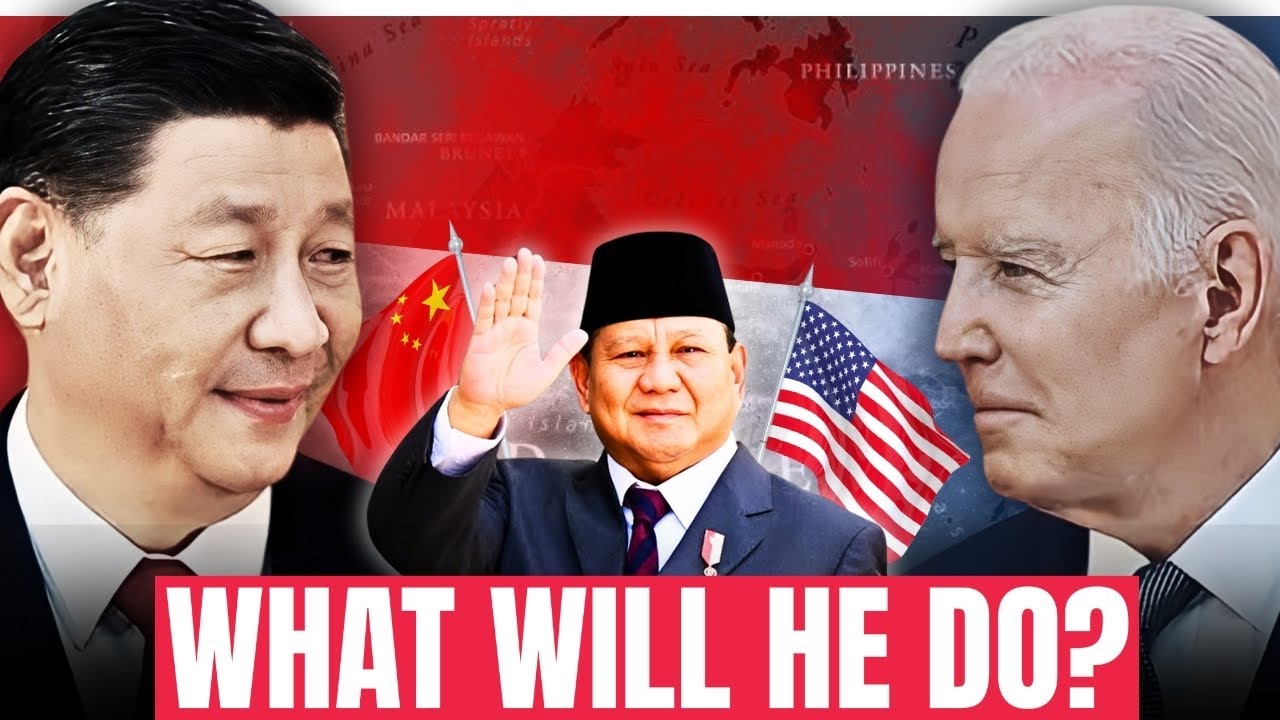
Former general Prabowo Subianto won Indonesia's presidential election in a first round, raising questions about whether the country will tilt toward China or maintain its non-aligned stance. China and Indonesia traded roughly $55 billion in 2022, and the host argues economic pragmatism, not ideology, will shape Prabowo's foreign policy.
Chapters
Hi everybody and welcome to Geopolitical Trends, where truth matters. Very, very excited to be with you. I got an interesting topic for you. It has to do with the, uh, outcome of the elections in, uh, Indonesia, a major country that, believe it or not, that could tilt the balance one way or another vis-à-vis China and the US. Yeah, that's just how it works when it comes down to, uh, something, you know, a country of this size. And this is what I'm gonna be detailing for you today, provide you my own analysis, my own assessments. And I also had— I already had some people, uh, sent in me, uh, some info on my Twitter account, uh, regarding this topic because it's just the interest of it, you know. I've been arguing this for a while, and today we got an opportunity to do this for you guys. Before I'll do this, I want to take a look, see who is here. And by the way, I had a— I, I made a mistake typing that the live stream was supposed to be at 1:15. I made a mistake. It's 12:15 as always. So, uh, boy, so good to see you, John. John, uh, wait Oh, John Smith from New Zealand, good to see you as always. Anna Kiplis, I want to say thank you for your super sticker as always, truly, truly appreciate it. Uh, Bobcock from Philippines, that's very interesting, uh, someone from Philippines watching here. It's because, uh, it's because, guys, the idea of, uh, the question we need to think about also is that will, will Indonesia follow in the footsteps of Philippines? Which will not be good. So, uh, Chaz from Malaysia, good to see you. Uh, Sifami, good to see you. Um, Amando, good to see you as always. John Smithens, good to see you. Lori from Australia, good to see you. I'm very, very excited to have you all here. So, all right, let's, let's, uh, let's get in into what we're gonna be talking about today. And by the way, before I delve deeper Make sure to join me on Friday. I'm gonna be having an interesting conversation. Actually, I can get you the link, uh, to the, uh, where, where, just the link to the live stream, uh, for Friday at 1900 hours. I'm gonna have, I'm gonna be having a conversation with Dr. Wilmer Leon, someone someone I know, by the way, and I trust, of course. Uh, and, uh, it will be an interesting conversation. Let me just put it there. Here is the link to, uh, uh, the, uh, for the live stream, and I will post again for you guys on tomorrow. So just, just FYI for you to know. So, so I'm gonna be having a conversation with Dr. Wilmer Leon on Friday at 1900. So it'll be very, very interesting to address. All right, now today's topic, as I said, I'm going to be talking about, uh, now that Indonesians have voted, the indications suggest that, or the count that is, uh, uh, Prabowo Subianto got about 57, 58% the last, the last, uh, count I checked, uh, that gives him at least a heads up so they don't have to do a runoff because anytime you get above 50, and, and so it is a foregone conclusion that he will become officially, when he swears in, which will be about next month if I'm not mistaken, uh, as the new president. So now that Indonesians voted for, for, for Prabowo, uh, the stakes now are very high. But not about just Indonesia, is vis-à-vis both the US and China. Why? It's because the mounting rivalry that exists in the region. We all know what the US is doing, we all know what we're doing over there, we all know the pushback by China, certain aspect. And now when you have a country like Indonesia, a massive, large-sized country, influential in the region, part of the ASEAN and so forth, It's gonna become very, very important to know the direction. We saw what happened with Philippines after Marcos Jr. took over. You know, it was just a basket case. You know, I was one of those, and I'll admit it, I was one of those that hoping, well, maybe Marcos Jr. will really— bong bong, that is— will really lead the Philippines to an economic sort of development of sort. So I think I was, uh, sort of, uh, quick to, uh, reach that conclusion, and I was wrong because he proved me wrong, especially after he returned. He, uh, Bongbong, or Marcos Jr., returned from his visit to China, which he went there to give lip service and sign the deal with the Americans to expand. So the case for Indonesia will be very interesting, and that's why I put a question in the description for you guys. It's— I said, what will Indonesia do? So, so here are some key questions we need to really consider, because with something like this, you have to think about some key questions. And here are some of them here, as you see on the screen there. So will Prabowo now, or Indonesia for that matter— when I say Prabowo, I'm referring to Indonesia. When I say Indonesia, I'm referring to a problem. That is, what will he— or will Indonesia follow in the footsteps of ASEAN? Now pay attention to this, guys. I didn't say the Philippines, I said ASEAN as a collective entity, because ASEAN made it clear that it stands neutral when it comes down to the rivalry between China and the United States. However, there are two countries there that I raised concern about. One of them is Singapore, the other one is Philippines. Well, Philippines is gone. No, Singapore— I put a question mark on Singapore because Singapore end up joining the United States in sanctioning Russia. So the logical question to ask as an analyst, I'm going to say to myself, what the heck is Singapore government is doing for sanctioning Russia? What for? You know, that, that, that's to me was like one of those, uh, and this is what I'm saying, what will Indonesia do Or will it follow in the footsteps of ASEAN as far as staying, making sure that it stays neutral? Second question is, uh, is the past— and listen carefully, Johan, I'm gonna detail a little bit of biography about Prabowo and what he did when he was in the military— so is now his past with the atrocities that have been committed will undermine his policies? And again, we're not here to judge, guys. You know, we all of us, you and me included, we all did some horrible things in our life at some point, one way or another. It won't matter. All I'm saying is, is because this is what I do, you know, I don't point fingers, I provide the argument objectively. And we're not here to judge, and please refrain from that. Uh, what we're gonna do is, is understand whether his past is gonna come and undermine his policies is because you need to understand what took place in Indonesia in the '70s with the likes of Suharto, with the likes of, uh, the one before him, I— so, Sukarno. I, I have the, I have the descriptions and all that stuff there. So, and that's a logical question for us to ask. Third question is, will President-elect Prabowo confront Beijing or maintain Uh, uh, Joko, whether those economic deals— and this is one of the key questions that we ought to think about it, because if you look at who's the vice president, that makes you think. So, and we will get into all this as I move along. So, but before we do all this, like we always do, let's do some headlines, shall we? You guys want some headlines? Uh, we'll do some headlines around the world because there are a lot of events going on. Then we'll jump into our conversation or analysis that is about Indonesia. So, all right, let me share some pictures as I provide, as I provide you the headline for this. Now, it is a picture. You all know who that guy is. Can anybody type in, in the chat box who that guy is? Right here, I'm pointing at him in the middle. Near the guy who's holding that long stick. You know, not to insult your intelligence here, guys. I, I would never do that, of course. I just want you be part of the conversation, that's all. So, uh, Pol Pot— I'm— I think you're joking, right? Yeah, right. Uh, Darkside say Pol Pot. No, no, you're on a serious note. One KC, you're absolutely correct, is, uh, uh, Anwar Sadat. That's, that's the picture. So what's important about this picture? Well, Egypt, the government now declassified the October War documents of 1973 for the first time. But that's not about the declassification, it is about the timing of it given what's taking place in the border of Rafah which is on the border of Egypt between the— in the Sinai and Egypt and Israel and so forth. You all know Israel is about to conduct an operation there. They said they're gonna get in into Rafah in, in, in Ramadan. Ramadan, the fasting month which starts next month. But, uh, beside the point, is the timing— is Egypt diverting attention or Egypt weak to confront the Israelis? That's, that's what I see. So, so in a historical— in a historic precedent, the Egyptian Ministry of Defense unveiled rare, rare, rare secret military documents dating back to October 6th, 1973 war when Egypt and Syria began a surprise, uh, attack against Israel to recover the occupied territories in a fierce war that lasted about 3 weeks. No. So that's what I found very, very interesting. So it's the timing of it, and, and it's worth noting that. Uh, next one, you're looking at a satellite that is about to hit Earth. It's gonna fall on Earth soon. This one you are looking at, guys, weigh about, uh, more than 2 tons. And this is what the European Agency, the stated that, uh, the European Space Agency, that Europe awaits the fall of, uh, of a dead satellite on Earth because that satellite doesn't work. So, so the European Space Agency announced that the satellite weighing over 2 tons, uh, will collide with Earth on Wednesday, which means today, about— this satellite, by the way, was about 29 years old. After it was launched into space and declared out of service back in 2011. So there's a lot of junk, uh, space debris over there. So it's, uh, it's very interesting to see this one. Next one, this one here, uh, can you tell, can you guys tell which, uh, which country is that? If you look closely at the uniform I just— usually you can always, because in the military when we wear a uniform, there's always the insignia of the country. Can you tell which country is that before I'll talk? And see if you can type that in. Yeah, I know it's not very, very clear, but I just want you guys again just to be part of the conversation here. Oh, Q7E, you got it, you got it! It is Germany indeed. Let me show this one. Yeah, no, no, no, no, no, not Ukraine, not Poland. No, is, uh, right there. Show right there. Yeah, right there is Germany. Yeah, uh, Q7E got it first. So what's important about this, guys? Well, it became now evident. Uh, there are reports, uh, coming out. Uh, those are not classified, by the way. It's just the media reframing, especially in Germany, Because you all know how the media works by now. It shouldn't be a secret to you, but there is a coordination between the US and the European Union regarding the limitation of certain flow of information. You know, uh, I, I experienced that this right here on this platform. Sometimes some of my content gets, uh, uh, blocked, if I may use the term. But anyway, so what you looking at, the German military, having its worn-out weapons and weak experience. The military in Germany is, is like, uh, it's, it's, it's incompetent. So, and this is what happened. Here is what happened, guys, which again I had to look for this info in a foreign language because it wasn't reported here. What happened was an unlicensed Listen carefully, an unlicensed drone that flew over the German military installation and took whatever pictures, okay? And this because you all know the drone could be used for espionage if you want to use that. And this without even Germany or German military finding out about it till later on. And why is this? Is because the overlapping competencies between the German military and the German institutions. This is what's troubling for Germany, that is incompetent. And when you look at their policies, we don't know what it is. As a matter of fact, what's her name, the head of the European, uh, Parliament, uh, or EU, Vanderlaan, or Vanderlaan, Vanderlaan, Ursula von der Leyen, or von der Liar, what I call her. She now wants to run for the second term. Oh no, she's not qualified. So, but again, it's the European people will have to decide on that one. So, uh, one more or two more and we'll jump into our topic. Now this one is very, very interesting. You will recognize it right away. Which country is that? You all know the flag, right? Let me see, guys, what you can type in here. Excuse me. And I found it very, very, uh, uh, disturbing that day in Australia. Ron and Julie Holliday, which are from that part of the world, good to see you as always, Ron and Julie. Good to see you. You're absolutely correct, it's Australia. Well, what's, what's concerning about this? Well, it is concerning, at least in my opinion. I'm an outsider, I'm not an Aussie, but it just raised a flag, a red flag for me in, in the concept of, uh, oh my gosh, Australia doing this. So here is what happens. Australia now wants to build its biggest navy since World War II. Just tell me, since when ever Australia was thinking about its military apparatus? Australia has always existed in peace with its neighbors. It always flourished with the, with the trade with China economically. It was till we pushed Australia over the cliff, and here is the outcome. So Australia yesterday The government in Canberra, uh, outlined a 10-year plan aimed at doubling its fleet of major warships and increasing defense spending by an additional $7 billion in the face of an accelerated arms race in Asia and the Pacific. Well, hold on a second. This is again where you have to be careful when you hear statements emanating from think tanks, uh, uh, uh, or, uh, sort of especially for this one, I would not trust what's coming out of, uh, uh, Canberra or some other institutions, even academia, like Australian National University, which by the way I will talk to you about what they said about Indonesia. Now I did find out, and I confirmed this info by calling my own contact that that Australian National University, one of its departments receives funding from Washington, DC. So the articles and the analysis is worded in a way that push for the narrative, exactly what you are hearing me sharing with you. Listen carefully, I'm going to repeat it. Uh, Australia, its fleet of major warships and increasing defense spending by additional $7 billion in the face of an accelerating arms race in Asia and the Pacific. Well, first of all, if we are to think about arms race, who's creating these problems to begin with? Why are we, for example, for us going and arming Taiwan? That's one. Second, why did we push Australia for the submarine deal, $380 billion? So who's creating the arms? Why is NATO going to establish an office in Tokyo? Why is South Korea and Japan joining with the US in trilateral, uh, uh, simulations of war, whatever, as far as military exercises? And this is again, guys, you pay close attention to the wording. That's what, that's what I meant to say for you. And the last thing I'm going to share with you, because I need to jump into the our topic is this one here. This is the representative of Brazil, ambassador to Israel. According to Brazilian and Israeli media reports, Brazilian President Lula Inácio Lula da Silva, or Luiz Inácio Lula da Silva, uh, summoned on Monday— yeah, 2 days ago, uh, on Monday evening, uh, summoned his, his, uh, his ambassador to Israel. In other words, he told him fly back to Brazil because we need to consult about even maintaining relations with Israel. And this was in response to Tel Aviv rebuke to him, meaning to da Silva, for his statements about what Israel is doing. Yeah, that's— to me, it's, uh, it makes perfect sense. Uh, it's because the voices— look what just we did in, uh, look what we just did at the UN. Security Council. I posted for you guys in the community. I don't know if you guys saw it or not. Uh, we vetoed. Yeah, we, the United States, uh, vetoed now another ceasefire. Britain abstained, which is ridiculous. You abstain, you either vote, you either yes or not. In something like this, it's either black or white. There is, there is nothing in between. You either support or not support. So UK abstained. So the US was the only country that vetoed that. And shame. There are those who saying, well, the person, the representative or the ambassador, she's, she, she was just doing her job. That's true, I agree with that. But at the same time, she can take a stand. I left Washington, DC. I didn't wait for Washington, DC to ask me. When I start to see where things are going, I said, I'm done. I don't want to be part of this. So she could have taken a stand because her legacy, that ambassador, all of them, you know, you all know. This is one of the conversations I'm going to have on Monday with my guest, Dr. Wilmer Leon. He is somebody who is well-read, well-informed regarding the domestic. Of course, we're going to talk about international affairs as well. So shame on my country, and I say it, I don't shy away from it because truth matters. You either stand on this or that, simple as that. So this is where I see things going. It's— we done, we done. The Western liberal order as you and I know it, it's over. It was a comment from someone who mentioned that if only the US could approach this differently, we will stay at the top. Not anymore. So, all right, let's get into our conversation, guys. Well, as you know, let me share a picture with you of, uh, Prabo. Oh, I don't have a picture of him. I should. Anyway, we, we'll move on. Uh, last week, as you know, well, what, what, uh What was noticed in Indonesia, of course the rest of the world was paying attention. I mean, it doesn't make sense if you don't for a country like, uh, uh, uh, Indonesia. What I found also interesting is how the Western media worded the stuff. Listen carefully. Last week, the most populous democracy in Southeast Asia. Why are they throwing the word democracy there? It's to manipulate you. Now we're not talking about whether Indonesia is democratic or not. That's irrelevant to me, and I speak for myself, it's irrelevant. I gotta talk about the, the, the issues and topics that matter. Democracy and all that, it's nothing but a window dressing. But anyway, we'll go with it, uh, for the elections. And, and, uh, when people are choosing now both the president and the legislative, uh, for the next 5 years, where most of the indications suggest that, uh, Indonesia wanted to have Prabowo Subianto to move forward. There was, by the way, a great article out there. Unfortunately, I will not be able to put the link for you, the reason being because I did a link of this particular, uh, platform where I get the info, and YouTube took it down. They sent me an email, they said, Mr. O, we're gonna have to take down that link. Whatever the reason is. But anyway, that is part— but I gotta give credit to the authors of that particular article. Uh, there are 3 of them. The first one is Amy Sud, uh, then Rasti Woro Junior, and Anand Mathi. Those are the 3 authors of the article, and I read that, their analysis on it, and, and, and they were spot on. I agree with some of it, of course, or regarding the outcome. But as far as strategic, uh, no, I don't agree with any till I, uh, compare my own to others and, and go from there. So, so what they argued in their article, and rightly so, is that, uh, Prabowo, uh, most likely he's gonna have to be now very careful as to how he's gonna proceed, uh, moving forward. Because, you know, Prabowo could use— because here is one thing that Prabowo could use. There is one thing about Indonesia. Indonesia has the status of non-aligned position, which means what? In this case, it could benefit Indonesia from both the United States and China because the competing interest Because Indonesia can come and say, we are not aligned, I'll work with you and I'll work with you. Easier said than done when you consider what's taking place right now in that part of the world. So, so, and this is why I said it's foregone conclusion he's gonna be the official president once he's sworn in and go through the protocol, I think in March if I'm not mistaken. So Now it becomes two fundamental questions beside what I asked you earlier. The two fundamental questions is: what will he do? Will he take a hard stand against Beijing, knowing that the trade between Beijing and, and Jakarta, at least the last record that I saw, was about $54.8 billion in 2022, if I'm not mistaken? If you guys come across the new stats, if you will be kind and just share it on the chat box for everybody to know. So the trade is major between the two. So why will— why on earth will he take a hard stance against Benjamin on one end? Second thing, will he be concerned that if he doesn't do that, we will undermine him like what we did back in the 1970s, given his background? And by the way, He had a lot of contacts with the US intelligence community right here in the US. So I'm going to be sharing some stuff with you as I move forward. And of course, uh, the third option that left us to even consider, given who the vice president is, is an indication that, uh, Prabowo Subianto will most likely maintain the same trajectory as, uh, uh, Joko Widodo. Because as you know, Joko Widodo's presidency will end in March officially, because in the Constitution of Indonesia you only allow two terms. So, uh, but when you look at the rapid infrastructure in Indonesia with the investments from China, not from the US, to you the question will become clear as to— not the question, but rather the direction as to what's need to be done becomes very, very clear. So now, before I move forward, let's do a little bit of geography like I always do, and we'll do a little bit of history. And history is as crucial as you can even imagine. So, so let me share a link with you from the World Atlas, to whom I give credit because, uh, uh, that is where, uh can send to this. Okay, I'll give credit to the World Atlas. That's the one, uh, where we're sharing this, uh, uh, map, uh, from screen right here. Indonesia. Let me make this bigger, so full screen. Ah, guys, Indonesia, very interesting. The archipelagic nation of Indonesia. One that is located to the north of Australia and of the, uh, the Southeast Asian mainland between the Pacific and Indian Oceans. Indonesia is placed— interesting, its position— is placed across the equator, and, and as a result is geographically positioned both in the northern and southern hemisphere of the Earth, as well as the eastern hemisphere. That's the only country that I am aware of. Interesting. So it is bordered by Malaysia, PNG, Papua New Guinea, and Timor. It is surrounded also by the Indian Ocean in the south, by the Pacific Ocean, South China Sea in the north, and over a dozen regional seas. Indonesia shares its maritime border with India, Australia, Palau, Singapore, Philippines, Vietnam, and Thailand. So that's what I found very, very interesting. And let me share, uh, same picture here because I can just scroll down for, uh, for where that equator thing right here. This is what's interesting about it, guys. You look at it for Indonesia, where it is located. Very, very interesting. So now, as to its history— now, history is interesting aspects of it. Uh, when you look at the first people in Indonesia arrived to Indonesia about, uh, based on the record that I looked at, and again, some of them differ by about 5 but between 2,000 to 5,000 years. But overall, most of them concur and agree that the first people in Indonesia arrived about 40,000 years. And, and you know what, the way you think about this, guys, is the— think about the slowly, uh, islands, uh, the, the, uh, the, uh, the, the, uh, what's the word I'm looking for, the artifacts that is found on that island, because that's something from way, way, way back. So, so, slowly, island, I, I had to read up on it a little bit to understand. So, so the first people, as I mentioned, for, arrived to Indonesia about 40,000 years ago when the sea level was lower, because if you all know what happened during the, uh, the Younger Dryas, when the flooding came in and cataclysm and so forth. So it was joined to Asia by a land bridge. Then at the end of the last ice age, which was about 10,000 BC, 10,000 BC, a new wave of people came in. At first, how they, they made a living there, whatever, they hunted animals, collected shellfish and gathered plants for food. And by about 2500 BC, they learned to grow crops such as taro, bananas, millet, and rice. The early farmers also made pottery, but all their tools were made of stones because it goes way, way back. There is, by the way, just to share this with you, there is a great book out there if you're ever interested. And I'm not advertising for anybody here. I'm just— because academically speaking, you give credit when somebody writes something academically about a country like this. So his name is Stephen Darkley. He wrote a good book about the history of Indonesia. So, so I'm going to share with you just a paragraph from his book, uh, and I'll put the link for you guys if you're interested. So, so when you think about— in his research, found out that both culturally and politically, Indonesia is one of the most complex— yeah, I use the term and I confirm, or I agree with him— the most complex countries in the world. And here is why. You have about 336 ethnic groups speaking about 583 languages and dialects. It is also recently that these people have been contained within one political framework. So throughout most of the history of Indonesia, Indonesian inhabitants were divided politically in many different ways as sort of a bewildering array of kingdoms and empires rose and fell within the region. And since its independence around By the way, why year did Indonesia gain its independence? Can anybody type in, in the chat box? Let me see if you guys know what year Indonesia gained its independence or started the process for its independence. Hamad, good to see you. Taiwan Steel, good to see you as always. Cam, good to see you. Yeah. What, what year did they gain their independence? Jack Rabbit, good to see you, man. Uh, Muslim Rebirth, good to see you. Uh, Tamputra, good to see you, by the way. Tamputra is from the area there. Thank you very much, and you are absolutely correct, 1945. This is why it's important to understand the dynamics of it. So, and it's one of the challenges Indonesia faces You know what it was? It wasn't about infrastructure, it wasn't about economic, it was about constructing a unified national identity. This is what's important for you to understand why the history of Indonesia— and we didn't even get into yet the era of Suharto and all that, and I'm gonna get into that. But you need to understand, uh, to, to the surprise of many, that Despite his past, people wanted to vote for Subianto. Now, could it be because the vice president is the eldest son of Widodo? I'll let you decide on that. And again, I'm a little familiar with, uh, uh, Subianto's background when he was dealing with the US intelligence agencies. Remember, I used to work in Washington. I was able to find out whatever I need to find out if I need to, but it was for my own understanding. So, and this is what I'm saying, it's just to put this into perspective, to understand. Now, understanding all this is, is very, very important, but also so is the eras, because we're gonna share some pictures. I'm gonna share some, uh pictures with you, uh, uh, like for example the era of Sukarno, 1965. You can't talk about Indonesia without talking about that era. The same thing with Suharto. You can't do that because you'll be missing a big picture. So here's the picture of Sukarno, if I'm not mistaken, here with JFK, uh, Uh, which by the way, JFK was taken down. Why did JFK was taken down? Do you guys know? Does anybody? Why do you think? Let me just see what you type in in the chat box. I know it's not the topic we're talking about, but just, uh, while I'm— while we talking about it and have the picture Good morning, Michael. Yeah, anti— you got it, Cam35, you got it. And this one has to do with wanting to push the MIC aside, and they said, no, you ain't gonna do that, or we're gonna take care of you. And again, this is what I want you to understand, where things are headed within the US. It's because of the same outcome. So, but again, we're not talking about Downsell, but just the picture, because it was during this era where the, the— just listen carefully— it was during this era, especially after 1953, moving forward into this time, that's when it became clear to us what we need to do to other regimes. And what I can tell you, for example, I'm gonna take you back to 1948. What happened in 1948? We got involved. We rigged the elections in Italy. Okay, the CIA got involved. It's nothing classified about it. And at that time, who was the head of the CIA? It was none other than, than Kennan. Kennedy was the father of that, and he even wrote a memo saying, look guys, we interfered into the Italian elections. If we didn't, we will never see another election in Italy. Now that means we're gonna have to create a department of tricks that can overturn elections or do whatever to our regimes we don't like. This is why that picture is important right here to understand. So let's talk about this guy here, Sukarno. And again, we're not pointing fingers, guys, because I don't like doing that. I like to provide the arguments. So, so I'm not talking about his bio, his birth from 1901, when he died in 1970. That's when he died. One thing is sure, that he was the first president of Indonesia. He was a nationalist and a demagogue, if I may use— you know, this might offend some people in Indonesia. I'm sorry, but again, I can't cherry-pick the word in here. I share as is. Then you decide. So he was the founder of the Republic of Indonesia, but also was a dominant figure throughout its history until his death. So, and by the way, I will share with you the link where all this information is. So interesting is that, uh, uh, Sukarno was born in East Java. Those who live in the region, you know an area called Surabaya. That's where he was born on June 6th, 1901, of, of, of a father from Java and a mother from Bali, or Bali, that's what it was. So, and he moved throughout, uh, where his father taught school, of course. So kind of adequate knowledge of Dutch. Why is Dutch? Because Dutch were one of the colonizers of Indonesia. So when he learned a little bit of Dutch, made it possible for him to enter the European elementary school. And it was back in 1916 when he enrolled at a high school in Sobraya. And during this period, he lived with, uh, I can't pronounce this name, guys, uh, some, uh, uh, Jukraminto, which is a prominent Islamic leader and head of the Serkat Islam back then. So he entered into this school and so forth. So Karno spent most of his time in Surabaya, where most important in his future intellectual and political developments came in contact with prominent Indonesian nationalists and with the Dutch socialists. That is what's important too. So, so of course in that time you're going to have to think about how Indonesia society was known for, and it was referred to as the period of authoritarian rules in Indonesia led by Suharto from 1967 to about his resignation in 1998. So that is what's important. Of course, Suharto has been in power for how long? Do you guys know how many years, guys? Suharto has been in power. Suharto, not, not this guy. Suharto, this one right here. How long he's been in power for? Does anybody know? Just give me an estimate, a rough years. And all this, by the way, was coordinated. Oh, you got it, Anna Kiblis, you got it! 32 years. Once again, guys, please, please, please, uh, we mentioning all this not to point fingers but rather to have a civil conversation and discussions, because truth matters. That's one. And second, if we don't understand the past, we won't be able to understand now what Sujandro is going to be doing moving forward, because the fate of a nation depends on what he does. It's the same argument I've made about Marcos Jr. The policies he's going to embark on is what's going to end up influencing the outcome for Philippines. And this is what's important for us to understand. So Suharto's 32-year dictatorship was considered the most brutal and corrupt of the 21st century. But again, he wasn't the only one. There are others in other parts of the world. Let's just, uh, make that clear. So the years after Suharto fall are usually referred to by Indonesians as the era of Reformasi, or Reform Era. And the period— this period is marked by various controversies and contradictions, including violation, human rights violations, corruptions, and inequality. And this is why there are some great articles. I'm going to share them with you guys, uh, and, and put this link for you, like one I read, uh, uh, written by Michael Van, Michael G. Van. Very, very interesting. So I'm going to share, all this video. Because one of the most important thing I want you to understand when we talk about the post-colonial, okay, the most important thing is that, uh, uh, when, when, uh, New Zealand, uh, Indonesia, uh, when it was decolonized, it's because the moment they took the independence Let me get rid of this picture here, put another one here for you, uh, to understand that right after that there was a lot of optimism. Yeah, a lot, because a lot of people were hoping that now that era is gone. There are a lot of optimism and almost like pride that now the young nation— because it was independent— it's gonna sort of embarks on a good journey. And this is why corruption— but again, when you think about corruption, you have to think about what we did in that part of the world in the '70s. So you can't just blame everything Suárez de Walla. I'm not saying— I, I don't know the man. I mean, I know of him, of course, because of my, uh, my academic background. I have to know about it. But, but I'm in no position to, to judge anybody because I also have to consider other facts. And the other facts are our role, what we did in Indonesia in the '70s, and it was all about resources. So this is what I'm saying. So because here is the important thing about Indonesia that I need you to understand historically, is that when Indonesia beat the Dutch between 1945 and 1949. So, and that's what it became independent. I know some record mentioned 1945, but guess what, some others have mentioned that it was 1949. So, because Indonesia was the second postcolonial state after which country, guys? Just think about that time. And think, in that era, which was the second country? So Indonesia was the second largest post-colonial state after which country in that part of the world? Let me see if you guys can type in that in. Ah, you got it! Taiwan still. You got it, you got it. It was India. It was India. Yeah. Al, you got it too. Uh, Francis Tango, you got it too. Yeah, that is correct, that is correct. You guys got it, it was India. It was very important to understand this one here, and this was before the wave of decolonization around 1960s. That's why I'm thinking— that's what I'm saying, think about the historical impact and, and place it within the context of what was taking place. And this is where they really— they, when I say they, the Western colonial powers, they saw Indonesia as the wave of the future. That's why we end up in Indonesia in the '70s and making sure it doesn't go that direction, because Indonesia, based on certain analysis back then, was going to play one of the major roles when it comes down to creating the postcolonial world. That's what's important to understand. And of course, there are— for Indonesia, I have another picture for you guys, some beautiful areas like Bali, of course, where, uh, I had the conversation with Carlza, which I, I, I read the comments, guys. You enjoy the conversation with Carl. And you asking me to bring him back over to the show, I'll be happy to do that in due time. So, uh, someone even asked if, if I could go on his show. I'll be happy to go if he extend an invitation. I'll do it. So, uh, but this is why it's important for you guys to understand. We're gonna go back to the beginning of when it started, why those eras had to move through certain stages. Corruption was part of that history, of the makeup of Indonesia. And this is why we have to ask the question, uh, do Indonesians know why they wanted to vote for Sopianto? And that's only Indonesians can answer that question. So now let's talk about Sopianto himself. Who is he? Let me see if I can find I, I can't believe I forgot a picture. Usually I'm supposed to put a picture for you. I'm gonna just share a screen and leave it for you here. I can't believe I forgot that. Oh well, I'm just a human, I can forget. All right, let's share this one here with you guys. Uh, let me close certain windows here because otherwise my computer will freeze. This is Subianto. And so who is he? Well, he's a wealthy ex-general. He was born into wealth. So, but with major ties to both Indonesia's popular outgoing president and its dictatorial past. We can't ignore that. We can't just say one or the other. So what he promised— he promised Indonesians now that he will, he'll continue the outgoing president's widely popular policies. But his human rights record had activists and some analysts concerned about the future of Indonesia's democracy. Well, first of all, let's take the word democracy out. Because I'm one of— now, I, I don't like to be just using that term so loosely. There is no such thing as democracy. Let me just say this straightforward. Doesn't matter. Even in my own country, we don't have it. We all know what's going on. So, but the question is what— and again, we have to think in terms of the policies because that's how you evaluate the, the good leadership of an individual. Wudodo, the policies were good, at least to a degree, for Indonesians. He established that economic ties with China because he saw where things are going, in addition to being part of ASEAN and wanted to maintain, well, maintain that economic prosperity, or at least the developments of prosperity. Because remember, still there is poverty— pardon me— still there is poverty in Indonesia. Still the outcome of certain income in Indonesia is not where it needs to be. And that is something he's going to have to address, because just because he was born, uh, uh, uh, uh, in wealth, he needs to have an understanding what an average Indonesian person is dealing with. This is the same argument I could make about Philippines when Marcos Jr. all of a sudden talk about face and dumped whatever the hopes of many Filipinos, uh, that they were hoping that now he's gonna embark on, uh, he's gonna embark on a policy that will benefit average Filipino. The same arguments can be made about Subianto. It just— it's very dynamic times, very critical geopolitically now where Indonesia is, and he has to navigate You're looking at two giants, and Indonesia will have to know. Now, I disagree with this white paper or analysis that was coming out, out of, uh, uh, Australian National, uh, University. It's, it's— I won't use the term it's lies, it's manipulating, because it was an article right there. I forget the name of whoever or whomever wrote it, whatever. But I know when it came from that entity, I knew because it is funded by the United States. So any analysis that comes out will have to push for the narrative. And that paper or analysis or article, whatever term you want to use, was saying that, oh, now Indonesia have to decide between the US and, and because they're going to be caught in the middle. No, no, Indonesia have a clear choice. So, Bento now has been given a mandate that people voted for him. Then now it's going to become on him to decide where he wants to take the country. It's not about a choice. Yeah, of course you can either go this direction or that, but a choice is clear. So you don't need alternative to choose from. You know what's clear? That if you go with China economically, the country will prosper. If you join the US, you're going to be sucked in into conflict. Look at the example of Australia. Look at the Philippines. Look at South Korea. Look at the Japan. It was because that, uh, article came out of the, uh, Australian National University was basically manipulating the mind of the people in Indonesia. So to push, oh my gosh, we are so concerned, we're gonna have to do this and do No, no, no, no, no, no, no. Choices are clear, and this is something Subianto will have to decide on how he's going to move. Of course, he's going to have to decide now of how the development of the communities within Indonesia— you know, I'm gonna be in that part of the world. I have not made a decision yet whether I'm gonna go to Indonesia or not. I don't disclose where I'm going, by the way, just FYI. Uh, if, if I get a chance, I'll go. I'm not sure yet, but it will be worth to see with my own eyes as to what's going on. And I'll be talking to people that know a little bit about the global affairs and so forth, and they help me understand exactly where things are. And the problem with that— I don't know what— something came up on my screen. I guess they don't want me to say that, whatever, right? Oh well, life goes on. So it's going to become the question of, okay, uh, uh, if the Indonesian people wanted to say forget about his past, forget about disappearances, forget about human rights, forget about torture, forget about whatever, whatever, you know. And let's, let's say if We're gonna give him a chance to see what he's gonna do. And let's go hypothetically that he's gonna go with increasing trade with China, moving into that direction. What do you think we're gonna do on our end knowing that we were part that created that environment for disappearances, for human rights abuses, for so forth? You know I'm getting at Yeah, so if Subianto is saying I'm gonna do ABC, you're gonna have to think twice about, uh, how this is gonna move forward for a country that is still struggling economically and it's seeing its future economic prosperity lies with the East, not the West. But he's the president now. He's going to have to decide what he wants to do. Of course, the West is going to be screaming bloody loud about, oh, the democracy in jeopardy. And no, no, no, no, no, no, no, no, no. And the reason why you have to think of it that way, because you're going to have to look at on the other part who is on the ticket with him. The vice president, the eldest son of, uh, Joko Widodo. That means there is a leaning towards maybe continuing, uh, continuing the policies of, uh, of Joko. But there is another concern. As an analyst, I'll be thinking, was it a calculated move by Joko Widodo to build a dynasty inside Indonesia? Because that's how it starts when you have your offspring taking power. Look at the Middle East, look at the Muslim world. So I would say, as an analyst, I would say it was a calculated move. Suvyanto is 72. The eldest son of— I don't know his age. If you guys know, if you will be kind and type it on the chat box. You can just see down the road. And even if we are to say, let's put all this aside and think in terms what he's gonna do policy-wise for the country, knowing where ASEAN stands except for Philippines, Laos and Vietnam, Vietnam and Laos on another hand, there's some issues that I'm gonna need to take a look into. So now, like I said, being born in a wealthy family doesn't grant you automatic leadership. What it grants you is the ability to have connections, per se. Indonesian society is no different than us here. It's no different than Australia as far as how these things work. No, because if you all know, if His father was one of the well-known economists, okay, right? One who fled after opposing Sukarno. And where did he go? So, so the family bounced from Britain to Singapore to Switzerland. So most of the time you are being abs— you are being, uh, uh, for him as a kid, learning the Western thinking. And in 1970, Probo came home and joined the army. So, yeah, and he rose till he became— it was in the special forces and all that stuff. So all this, it's good, whatever, but beside that, like I said, it's the policy that matters. And again, I'll bring back Philippines into the conversation. We're always thinking, well, now Marcos Jr. is going to get in and he's going to move forward with the economic, because socioeconomic success is what defines the quality of leadership. You know, look what's going on in Europe right now. Look what's going on for us here in the US. Look what's going on in Australia. Look what's going on in South Korea, Japan. So, uh, let me make sure, guys. I want to make sure. Can you guys hear me? If you hear me, please do give a thumbs up. I would greatly appreciate it because I'm getting a message here that says there's no connection. Okay, thank you, Cam. Appreciate it. Yeah, I don't know why that message came up. So anyway, that is where, where that issue is. So, and it's become, uh, uh, sort of— because if you think about it, yeah, the last part of the last century, we're looking about the last 25 years or so, uh, it gave some sort of, uh, an emergence, if I may use the term, to Asia. Why is that? Why do you think that is? It's because the Asian model proved to be good, working. Of course, the model doesn't have to depend on so-called democracy, doesn't have to depend on whatever. Of course, for us in the West, we're going to be looking at it, oh, those are authoritarian regimes and so forth. But at the same time How about if we sidestep that and look at the economic developments? And this is exactly where that model of Asia is. That's why I've been arguing for the last 15 years that the wealth is shifting from the West to the East because Asia is going to become the economic hub of the world. That's what I said 15 years ago, and here we are. Why? Is because to us we always wanted to keep that term democracy to justify. Look, just what took place in Ukraine, and now you, you all know this by now, it's nothing new for you guys. But at least for the Asian model per se, that setting, dictatorship or not, totalitarian or not, whatever you want to categorize it, at least was some sort of the right ingredients for them to build up a nationalhood that was developing those countries moving forward. That's to me the key to all that. And this is something that I am wondering what Silviano Bravo is going to be doing. So now, whether you agree with or disagree, it's your opinion. Of course I respect it. But again, when we talk about the Asian Tigers, how they emerged, I mean, we all remember the Philippines, we all remember Singapore, we all remember Malaysia. China. You got the idea. So, and this is why it was always known as far as, uh, I don't know where the, uh, let, let me share this one here also because I need to show you where was the idea of the, the tigers and dragons in Asia. It was the turn, the Asian dragon and tigers. So it was always hit, especially when the financial crisis took place in Asia. You all know what happened at that time. So, and why? Because if you all remember, and again, this is where in— this is where history is very important to understand. Because what happened after the financial crisis in Asia? IMF stepped in. And when IMF stepped in, what did Indonesia do? And under whom? Do you remember? It was under Suharto. And what did Suharto do? Or did, rather, he decided to seek help from the IMF. And we all know NATO is the military arm for IMF. This is why you look at the big picture as to how the establishment has to maintain that dominance. So Suharto had no choice. Why? Because he was under our control. One ahead with the IMF with various strengths attached to the Indonesian economy. And once again, I am saying all this to highlight one key, and the key is, given the history of Prabowo— and again, we are not judging— is how he's going to govern moving forward. It's because we do have a lot of stuff about the guy because he was in our establishment We propped him up. And if you think about what we did in the 1970s in Indonesia, it will make perfect sense to you. Uh-oh, I froze. So this is why it's important. So because you look at Sri Lanka, you look at the outcome in Sri Lanka, look at the outcome in Pakistan, look at the outcome in Argentina, some countries in Africa, you don't know the story. And this is where, right after the chaotic situation of the time that now, uh, witnessed Suharto relinquishing power Why did he relinquish power thereafter, after the agreement to IMF? Because he knew what was coming. He knew what was coming. He got assets elsewhere. That's how it works. And right after that, Indonesia started to descend into a painful And I can even use the term— I don't know whether you agree with me, please say yes or no, because I just want to say— will it be fair to use the term violent transition? So, I don't know. But here is what's interesting. I found very interesting at that time. It was none other than neighboring country of Malaysia And who was at the time in charge in Malaysia? Dr. Mahathir Mohamad, who was particularly repelled by the photo of Suharto humbly signing the IMF agreement under the watchful eye of the IMF managing director at that time. So, so basically, to Dr. Mahathir Indonesia surrendered its sovereignty. It's almost like welcoming back colonialism. And he's right. So, and this is once again, it will be interesting to see what Prabowo is going to be doing, the type of policy he's going to embark on, because now the choice is clear. It's not like he's going to have to, well, I got to consult, I got to do this, I got to do that. He's been around long enough to know what the Indonesian people need. He's been long enough to know how the economic conditions— even though he was born into wealth. And again, why not judge him for that? Hey, that's his luck, that's his family, more power to him for that. So, and this is why when the IMF imposed its own reform measures It took Indonesia in a different direction. Why? Because we didn't want Indonesia to stand on its feet. That is the key to all this. Uh, it's, it's, uh, it was one of those arguments that when Dr. Muhammad Mahathir made, and I couldn't agree with him into that. So no. There are another arguments that came out with saying that, uh, if it weren't for the son of Joko Widodo, uh, uh, Prabowo would not be able to garner enough votes. What do you guys think? Any truth to that? Because he would have been forced into runoff. I don't know about that. But it's worth considering because we can't ignore that one. You can't ignore it. So, so as I said, the interesting thing about, uh, Prabowo's background is that his dad, Dr. Subianto, was a reformist, a former economic, economic minister, and the dean of the, ironically Uh, Berkeley. If you know anything about academia here in the US, how we establish so many changes through academia to influence foreign governments, Berkeley was one of them. So, and the Berkeley, uh, it was known as the Berkeley Mafia, by the way. So that's how it was known. The group of Indonesian economic planners trained mainly in the University of California at Berkeley, who ushered in the reform and opening up policies that saw Indonesia transformation into an Asian tiger since the 1960s. So Prabowo was mostly educated in international school during his family many years abroad. That's why I'm saying again, when you are uh, uh, all you have acquired intellectually, that is, is the Western mindset, you will be to a degree blind to really what is going on in some corners inside Indonesia that you probably would never come in contact with. And that's going to make a big, big difference in moving forward regarding his policies. So, so far for me, the way I see it is he's gonna just continue the same policy of woodoo because he was working for Indonesia to a degree. But also he's going to be concerned about how the US will react if he doesn't come forward with declaring officially, like what South Korea did, like what Japan, and now the Philippines, or of course Australia. So he's gonna be walking a fine line that his credibility is going to be always questioned. So, so, and, and, and it's hard to tell because to me I already saw what took place with those four countries— Philippines, Japan, South Korea, and Australia. New Zealand is in, in, in, in, in its way. PNG is in its way. So now it comes the Indonesia. And a large country like that, uh, it will make a dent geopolitically in that part of the world. So it will be interesting to see. I'm going to be looking for some, uh, analysis coming out of, uh, ASEAN countries and see what they think about moving forward, uh, what Indonesia will do. So, all right guys, I am going to take a few questions here. Uh, first of all, I want to share with you a link to, uh, if you want to support the channel right here. Uh, the, uh, at the end of the month, uh, I'm gonna do, uh, a community conversation. Uh, I hope the members for YouTube, they still— if they're still there, otherwise just, uh, you know, transfer everything here to Buy Me a Coffee. Uh, this is for the channel. The top one is for the channel. The second one is for the Asia trip. I also have a PayPal here if you want to support. This one, PayPal, is for the Asia trip. Not— whatever you decide. So I'm, I'm very grateful. Uh, all you know, all I know that I can share with you is that the information you are getting from me is, is it takes me time to collect, to put it together. Once again, I don't talk on the top of my head. I don't do that. If I don't have anything of substance, I won't come on the air. I won't do it. Uh, remember to join me on Friday, uh, and I'm gonna also reach out to some, some of you suggested certain individuals. I'm gonna send an invitation or extend an invitation and just go from there. So, all right, let me see a question or two, and I will greatly appreciate it, uh, your continued support. Please, while I'm thinking about it, please hit that like button right now, you know, before you forget, and, and I greatly appreciate it. Uh, Matty, uh, Matty Becky: Dr. O, one day introduce your library, especially the books behind you. On the next No Geo— oh, okay. Well, there are some— I do have another— a whole other books in the other side. I can't fit everything here, but yeah, I'd be happy to do it one day, you know, because usually when I get in into all this, I, uh, I get sucked in into— because I want to give you as much information as possible. So, all right, let me see a question or two from you guys. Once again, thank you all for being here. It truly means a lot. Franny, good to see you. I'm, I'm going all the way back. Alan Singh, good to see you as always. Uh, Partha P, good to see you as always. And, uh, oh, let me say thank you to, uh, Colonel Klinsky. Thank you so much for your super sticker. You wrote, uh, The World Teacher of All Humanity by Benjamin Crampton. Uh, okay, uh, what are those? Oh, the books. Yeah, I will look them up. You guys take a look. By the way, some of you suggest certain books, certain movies to even watch, and, and I am very grateful for that. I will check it out and take a look at this. So thank you so much for sharing this one here. Okay, let me go all the way back to the top and I'll, uh And I'll, I'll scroll down, and if there is any, just put Q so I know it's a question. Uh, this way I'll, uh, be on the lookout, by the way, for, uh, a recorded video about Malacca Strait. I wrote a short analysis, uh, literally no more than 10 minutes, uh, the stuff that— because in a writing form you are able to sort of have a concise, and here in a live stream, you all know how it goes, so So I be on a lookout for one. Uh, I will be releasing it soon. I'm waiting for my editor to finish up that and send it over. Okay, let me see a question and we just go from there. Hi Phil, good to see you Phil. Uh, okay. Let me see, I'm scrolling all the way down. Jimmy Janga, good to see you. Francis Tango, as always. Okay, uh, I don't see any questions, guys, so that's okay. Maybe you save it for when we do the community conversation, because I always like to do that at the end of the month. But again, for that one, I don't want to do geopolitics. I want just chat with you, because that's time for me and you to just have whatever other topics besides geopolitics. I do remember last time somebody put question about geopolitics And I respectfully decline to answer that one. Oh, John, John Smith from New Zealand, thank you so much for your Super Sticker. Truly appreciate it. And, and nice to have you from New Zealand because you're on the ground. You'll be someone we can bounce ideas with, and you'll tell us exactly how things are because I don't trust the media. So, and I'm sure the community here, uh, will want to hear the truth. So thank you so much for your a super sticker. Truly appreciate it. All right, let me take this question from Y. Uh, is the US now focusing more on countering China with Malaysia now Indonesia being pro-Western? Is the deep state preparing for Trump as president? Well, first of all, uh, I won't say for 100% Indonesia being pro-Western. Yes, Indonesia is pro-Western, And that was the reason why that article came out of the Australian National University, was crafted and written in that way that pushed the narrative towards you better be sided with the West because you will be protected, which to me was misleading, it was manipulating, and I pushed against it and told all of you guys back then, if you go, there is a record there. To the point that they demonetized the video for me, which is fine, because somebody was saying that I, uh, I, uh, I used his article, whatever. Well, I don't even believe in whatever he's saying. I challenged the article, and of course it doesn't matter. It won't matter. It's useless, because I looked at the background of those individuals and I found out who they really are. I mean, how can you go from, uh, uh, being a policeman to talking about geopolitics. No offense to anybody, but in any event, uh, so in this case, you're right, the US will be looking at now, because this is why we're sending now special ops to certain areas, like what we had in, uh, in, uh, I still have a picture right here in Kenman. Yeah, in Kenman County. There are some special ops, US special ops, you know, there. What were US special ops doing in Taiwan? Why are we extending, uh, the, the, the, uh, bases in Philippines? There are 9, even though they're saying only 5. No, there are 9. 4 of them are not disclosed. And if I am to guess, those 4, that's where it's going to be holding some advanced weapons that even Filipinos wouldn't even know. So So the idea of this one here, yeah, the US will want to make sure, and this is what's going to be depending. I'm going to keep an eye on this and I will report back to you in about 3 months or 4 months. We see what he'll do, uh, what Prabowo is going to do. Oh, Osiris, here you are! Osiris, great, good to see you as always. And thank you for your continued support. Osiris buys me coffee every day, and I say it because there is a record for it, every day. So thank you so much, Osiris. I truly appreciate your support. Uh, others of you guys do support the channel, and I am very grateful to you. So it just— I want to, you know, it's the right thing to do. It is the right thing to do. Uh, Francis Tango, Dr. O, when UFO are you going to talk? You seems to be interested in UFO stuff, so, uh, well, we can talk a little bit about that one. It's just maybe we'll do that on that conversation on the— with the community. So what do you guys think? I'll put a, a survey for your question and we go from there. Okay, we'll do that. Uh, Uh, Army with Harmony, uh, question. Yeah, this one I'm not gonna talk about it here because there is a narrative within the IC, the Department of Defense, and the government to really limit the conversation regarding this. But the answer is most likely the case, yes. So, uh, it's sad. It's very, very sad. So, all right guys, I am very grateful to you for being— spending time with me here, and I look forward to seeing you next time. Once again, remember to hit the like button, share this video with others, and I look forward to seeing you on Friday. If not before that, I might do another live for you tomorrow and Friday. Why not? We'll see how it goes. As always, remember, geopolitics impacts your daily life in more ways than one. Till next time, guys. Bye-bye.
More from David


Beyond the Single Actor: Why the Gulf Isn't Choosing Between the US and China


Iran, Iraq's Militias, and the Houthis Are Coordinating! This Changes Everything




Who Controls the Next Decade's Resources? Latin America and Africa's Geopolitical Crossroads

The Chokepoint Trap: How Washington's Stupidity Triggered a Cascade That Now Controls the World

Trump Spooked as IRGC Unveiled dual-use SLV, Deployed Ghadir Mini-Subs & Hinted at Tactical Nukes!
