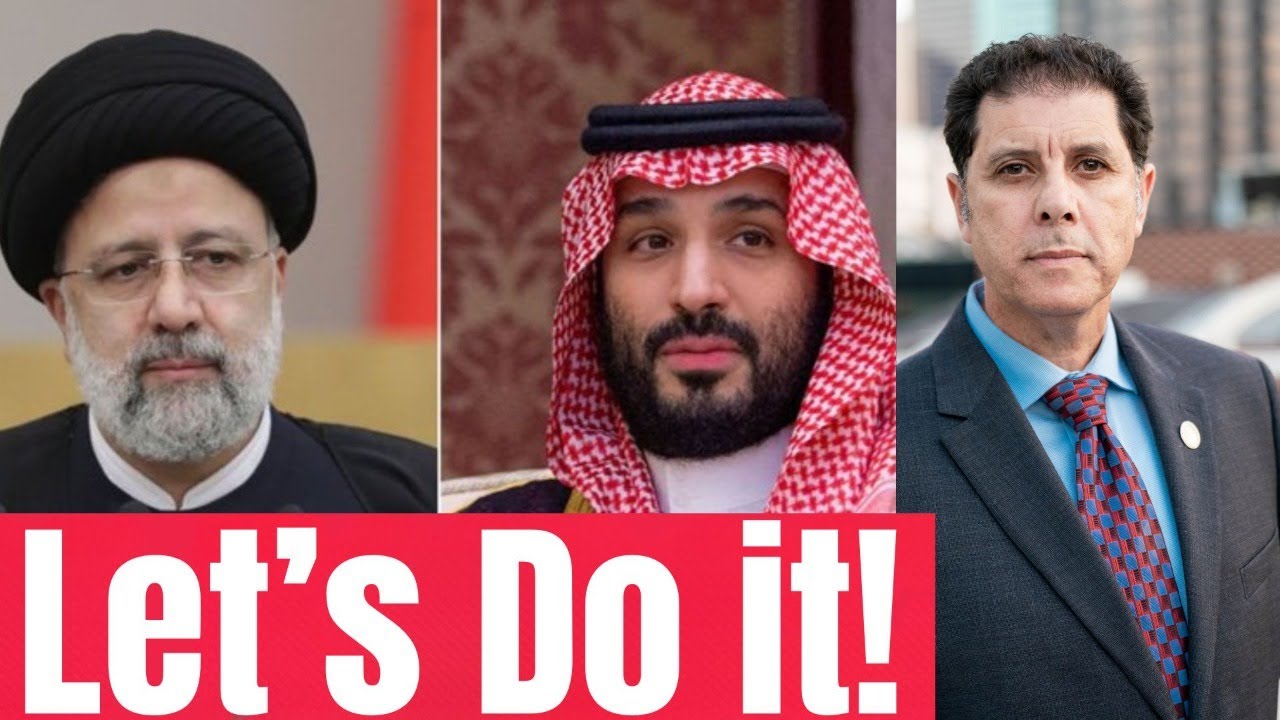
Iran and Saudi Arabia are deepening military cooperation after their 2023 China-brokered rapprochement. The host traces their rivalry from the 1979 Iranian Revolution through their 2016 rupture, arguing Beijing's secret negotiations succeeded where the U.S. failed. The moves signal regional power and pressure Israel while positioning both nations as defenders of the Palestinian cause.
Chapters
Friends or other, very, very excited to be with you on this December 3rd here. So I got an interesting topic, uh, uh, something I am very familiar with on two countries, Iran and Saudi Arabia. And why is this important? It's because I want to put this within the context of the developments that's taking place in the Middle East, as you know, with the Israel and Hamas conflict. So, so this is what I'm gonna be addressing today. Uh, I will answer, of course, uh, a few questions towards the end here. Just type in a question, but please, please type in where you are joining me from. So to all of you, I wanna say thank you. And this is, if you, if this is your first time here, please make sure to subscribe to the channel. I will greatly appreciate it. Thanks to all the, those who bought me coffee, greatly, greatly appreciate it. So, so So let's get in with the key question to all this. What is the significance of the military discussions and the cooperation between Iran and Saudi Arabia? The second question is the timing. Why now? Why they came forward with the announcements? So, and I'm going to provide you insights into this. And the third, uh, question that we ought to ask is to put it within the context of what I said yesterday about NATO. Could we see something as a reaction to that, given also we have to consider Russia, China, and Iran join military exercise, the upcoming one? So, so this is what I'm going to be, uh, addressing in this, uh, uh, conversation. And, uh, like I said, just type in when you are— oh, Calidino Official from Minnesota, good to have you here, man. Humanity First, I'm assuming Connecticut, for sure. Uh, Phil, good to see you as always. All right, let me provide you with the background of this, and the background is this one here. In addition to what China has— what China was able to achieve regarding bringing both the arch enemies of the Middle East— that's known, determined foreign policy has always been Iran and Saudi Arabia— China was able to bring the two together and reestablishing their own diplomatic ties. To me, this conversation about between Iran and Saudi Arabia about the military cooperation It's another sign of détente between the two, uh, uh, regional powers, because they are regional powers. So, so here is what happened. The senior defense Saudi official, uh, discussed— stated that he discussed with Iran military cooperation. And as I said, this is the latest within, uh, signs that the war between Israel and, and, uh, and Hamas sort of is bringing now the two countries, Iran and Saudi Arabia, even closer. What do you guys think? Is it the war that is bringing them to closer, or is it because they are realizing the changes on the geopolitical landscape, not only in a region where they are but around the world, and they want to better preposition themselves for that change? Just let me know what you are thinking, guys. So the Saudi defense minister, his name is Khalid bin Salman, part of the royal family, of course, because one thing I need you to understand about, as one who wrote a book about Saudi Arabia, and I detailed the structure of the, the, the government of Saudi Arabia, but also the royal family with over 2,000 princes together, it, it's the dynamics of it is very, very interesting. So one thing I want you to get about Saudi Arabia's government in general, the key possessions are only held by the key Saudi monarchy, uh, uh, of, uh, sort of, uh, members. So like, for example, the defense minister Khalid bin Salman has told Iran Armed Forces Chief of Staff Mohammad Hossein Bakiri that— and I put this in quote— uh, that he welcomes the increased level of cooperation of the armed forces of the two countries, end of quote. It's very significant. And the reason why— just go back 5 years and, and, and be honest about it. 5 years ago, I mean, I'm sure you learned over, uh, over time about international affairs and so forth. Did you see those two countries coming together, let alone cooperating on a military front, just 5 years ago. So, but again, who do we have to thank for this? Is China. And this is why I'm gonna do a live stream for you later on, uh, about why China will be a better and honest broker than the United States ever was regarding the Arab-Israeli conflict. Or the Israeli-Palestinian conflict. So, so this is where the difference is. And as you know, the relations between Saudi Arabia and Iran sort of have been on the spotlight for the last few months, and specifically in March 2023 of this year, when China, as I mentioned, was able— yes, it succeeded where the United States, uh, failed. As a matter of fact, we shouldn't even been saying that, that the United States failed. The United States never had the intention of brokering a deal between Iran and Saudi Arabia. Why? Because United States has always been ensuring the division between the two, or chin means persist. That's how we influenced the trajectory of the Middle East. Well, so I'm gonna take my word back about the US, where the US failed. The US never attempted for that one. So China brokered the agreement between those two countries, Iran and Saudi Arabia, for them to normalize their relationship, which by the way, as you may know, that the relationship had been cut off of those two countries, Saudi Arabia and Iran, back in 2016. Why 2016, you may ask? Why, why do you think it was cut off in 2016? Can anybody tell me? This one was tied to, uh, very, very developments that took place around 2015. So I'll wait till you see your, your, uh, your answer in the chat box. Now, of course, uh, you're gonna have to think in terms of the whole region, not just the middle, not just Saudi Arabia or Iran, the whole region. Uh, oh, I want to say thank you to, uh, V. Olaf Sideter. I hope I pronounced it correctly. Thank you for becoming a new channel member. Truly appreciate it. The idea, guys, of, uh, the history, because we can move forward without understanding the history of this And you're gonna have to go all the way back to sort of, uh, understand this rivalry that existed for so long. Of course, we contributed to it, uh, between Saudi Arabia and Iran, uh, not only when it comes down to religion or social setting or ideology, but also geopolitics. And that's what makes the, uh, the history Yeah, I will use the term the history of this bilateral relations. I mean, I'll go as far as 1913, all the way from that time to 1979 specifically. Then there was another phase of the relationship after 1979. So, so what I intend to share with you guys here is to look at through the history, but before that we're gonna do a little bit of geography because it's very, very important. Uh, I'm gonna just, uh, show you, uh, uh, about how— I'm gonna share a map with you, rather, uh, this one here about the Middle East. Uh, of course, there are those who say Middle East and there are those who say Western Asia. I'm very familiar with both terms. Most of the time I've been using the term Middle East in all my writings And one of the reasons for that, it's easier for the Western audience to sort of understand the geographical location. You say Western Asia, they're gonna get lost, uh, given that some of us are not, uh, uh, savvy when it comes down to geography. So, uh, so let me share a screen with you here, guys. Here it is. And I want you to— there we go. Let me make this bigger. For you to see. And we're going to talk about, uh, uh, a part of this, uh, uh, what is the Middle East, you know, because you need to understand this. So, uh, the whole Middle East, or western part of Asia, that is geographical and cultural region that is located primarily— here's the keyword— in Western Asia. Yeah, that's normal. Most of the political maps You won't see the term Western Asia, and that's for a reason, okay? You're going to see the Middle East. But, but we, we move beyond that for now because we focus on the content of this. So, but also it is part of North Africa. This is why sometimes you see, for example, Egypt being mentioned in the Middle East and being mentioned in North Africa. But you and I know that Egypt is in North Africa. But also the third part is the southeastern part of Europe. So basically we're looking at three: Western Asia, Northern Africa, and the southeastern part of Europe. So the western border of the Middle East is defined by the Mediterranean Sea, where Israel, as you see on the map, Lebanon, and Syria rest opposite from Greece and Italy in Europe. Egypt, on the other hand, in Africa, also bordered— or borders, rather— the Mediterranean and is sometimes considered as part of the Middle East, while Turkey and Cyprus literally connect Europe to Asia and oscillate between, uh, uh, uh, being called European and Middle Eastern. This is what's interesting about understanding this part of the geography, because without it we won't be able to understand this dynamic. So now let me move to share the map with you, and I know I've did— I've done this before regarding Iran, but I'm going to do one for Iran and one for Saudi Arabia briefly here. Go into history because you need to see that one, and, uh, then we'll move on with our own analysis that I'm going to be sharing with you. So here's the map for Iran. I'll put it in perspective for you here. And again, why is it important to understand? Because geography plays a role. So Iran, as— and again, briefly, guys, here is, is a very rugged terrain. I was closer to the Iranian border from the, from the Iraq side in north, in Kurdistan. So I could just see the mountains, and it was a rugged terrain, the whole mountainous country in Western Asia, which is Iran. That's it. So Iran is situated between, or both, in the northern and eastern hemisphere of the Earth. Very interesting location. Iran is bordered by Armenia and Azerbaijan to the northwest Turkmenistan to the northeast, Afghanistan and Pakistan in the east, Iraq and Turkey in the west. That's a— this is again why it's important for you guys to understand. And Iran is bounded by the Caspian Sea in the north and by the Persian Gulf and Gulf of Oman in the south. And just for the, the sake of, uh, understanding geography around here Uh, I don't know if this map is big enough to— for you guys to see, uh, uh, the borders, the, the bordering countries of Iran. And again, I disclosed this in my Iran book, uh, when I wrote, uh, about Iran, Volatile State Iran in the Nuclear Age. So the countries that border Iran are Iraq, Turkey, Armenia, Azerbaijan, Turkmenistan, Afghanistan, and Pakistan. Very, very interesting. So let me share with you the map for, uh, Saudi Arabia, because it's important to understand that as well, or, or to see that is Saudi Arabia, or they known as the Kingdom of Saudi Arabia, or the Desert Kingdom. Sometimes I, I refer to it as the Desert Kingdom. So All right, here is the map. This is Saudi Arabia. Now Saudi— Saudi Arabia, of course, is in Western Asian nation, is considered a Western Asian nations. Of course, as I said earlier, for the Western audience, when you mention Western Asia, they're gonna get confused. So this is why sometimes I use Middle East and sometimes I use the term, uh, uh, Western Asia. So, but we'll go with the arguments today, or, or the, the, uh, connotations of Saudi Arabia being a Western Asian nation which is occupying the central region of the Arabian Peninsula, as you see on your map there, in Southwest Asia. It is located in the northern and eastern hemisphere of the Earth. Similar position to Iran. This is why Saudi Arabia closer to Iran. Saudi Arabia, as you see on a map, is bordered by 8, 8 nations: Jordan in the northwest, Iraq in the north and northeast, Kuwait, Qatar, Bahrain, United Arab Emirates in the east, Oman in the southeast, and Yemen in the south. The Persian Gulf is in the northeast and the Red Sea to the west of Saudi Arabia. So, and of course, as you know, Saudis are— or Saudi Arabia, rather, not Saudis— often referred to as the land of the two holy mosques in the Muslim faith. Uh, there is the two holy mosques in Mecca and Medina. Uh, those are where the Muslims make pilgrimage, uh, to those countries. And once again, just to highlight to you the bordering countries: Yemen, Iraq, Jordan, Kuwait, the United Arab Emirates, Qatar, and Oman. Iran is further south. So this is, this is the important aspects of understanding geography. And you come to ask yourself, how on earth was China able to broker this deal between these two countries? Well, here is the thing. China didn't achieve this success overnight. The negotiations were kept secret for many years. That is the key. So even the US didn't even know, even though the US came later and said, oh, we were aware of the negotiation. No, you weren't aware. No, you weren't. That's a lie. China was able to succeed, and this is why I decided to do the live, uh, stream for you for tomorrow about the chances of China brokering a deal in the Arab or the Palestinian-Israeli conflict. And, and I'm not going to focus on that, I'm going to focus on the big picture of that. So make sure to tune in tomorrow, uh, uh, to join me for that very interesting conversation. Now we looked at the geography, we're going to have to look at the history. You can't pass it. Then I'll move into my own analysis as far as where, how I, uh, uh, I analyze these developments between Iran and Saudi Arabia regarding the military cooperation. So Saudi Arabia was established, and as I said again, I disclosed all this in my book. This relation— this information, rather, guys, that's based on my academic research. I will provide you some links in addition to mine, uh, where you can read up more if you feel like it, because Middle East is a very, very complicated Even today, guys, after so many, what, 3 decades or so, I'm still learning about the Middle East. You never— I, I, I challenge whomever, any scholar that comes forth and said, oh, I've learned, uh, all it is there to be learned about Middle East. No, there is no such thing. So, so Saudi Arabia was established in 1932. Yeah, this is the official, uh, Saudis existed from before but it wasn't, wasn't just a tribal nomads. That's what Saudi Arabia is, or was, you know. So 1932, with the post-World War II, traditional of a close allies to the United States and the United Kingdom. Why you say this? Because two things: oil, one, and the colonialism of Britain. Straightforward. Now here is the thing, and remember, I am talking about the history here of Saudi Arabia and Iran jointly as far as how they went back and forth throughout time. So because you need to understand this concept, so Iran's government alternated between an absolute monarchy— yeah, that's what it was back then— and increasing parliamentarianism until 1953. Why 1953? Can anybody tell me what happened in 1953 Iran. You guys should, uh, be aware of that. And I'm gonna look for your, uh, your, uh, response for this. A major, major event took place 1953, because you're gonna have to understand how history really provides us insight. The past provides us insight into understanding how events, uh, uh, will, uh, evolve. And it could indicate or predict for us the future. So 1953, what happened in Iran, 1953? Before I move forward, because I need you to, uh, be aware or have an answer to this one here. Oh, Far, I want to say thank you so much for your super sticker. Truly appreciate it. Greatly appreciate it. And I know there's a delay. Oh, you got it right, Magic. Uh, uh, no, I'm sorry, I, I got the wrong one right here. Uh, Magic Works, Dasha, you're absolutely correct, you're absolutely correct. Miss April, CIA, cool. When you say CIA/MI6 You guys got it. You got Mossadegh. You got it. Who answered this one? No, not this one here. It was Ramzi. Ramzi Abdurrahman, you're absolutely correct. That's when we toppled, uh, Muhammad— Dr. Mohammad Mossadegh. So 1953 Iranian coup, uh, increased Mohammad Reza Pahlavi powers as a monarch within the parliamentary system. So basically, what was it? It was that we didn't like what the Iranian voted for. They wanted Dr. Mossadegh. We said no, we want to put our puppets because of the oil at that time. Because remember, what did Mossadegh do? He was calling for— can anybody get it? Why did we topple Mossadegh? Why did we topple Dr. Mohammad Mossadegh? Once again, another question for you guys. And again, I just want to get you part of the conversation, that's all. No more, no less. And no circumstances I want to put you on the spot. No, I don't do that kind of stuff. Uh, uh, was a communist. And no, no, no, no, no, no, no, I, I have to— this— who put this one here? Let me see here. It was a communist. Uh, no, beside that, it was, it was another Oh, oh, David K, you got it, you got it, David K. Why it's not showing up? Show right there. David K, normalization of oil. It was all about oil. Nixon, you got it right too, about oil. Yeah, that's absolutely what it was. So we didn't like it, so what we end up doing? We put a puppet that's gonna serve our interest by ensuring access to oil, and we get the revenue, we get to profit from it. While Iranians didn't. This is no different than what took place in Latin America and what took place in Africa. This is why history is important for you to understand this dynamic. So, so the coup was supported, of course, by the army. But here is the one thing, by the way, I need to share this with you exactly, some historical references. And you know what, I will not use those. I'm gonna share it with you, but I will not use this as the reference for it because there is no citation for it. There is no reference for it. And this, I found it in some historical record. That makes me question, first of all, the source of that historical record. Was it in the West? And if it was in the West, was it justified that way? That's why I never used it in my book, because I found out there is no reference for it. And here is what it says, the— and I put this in quotes because it's not my word— the coup was supported by the army, the bazaar, and the clerics, in addition to the United States and the United Kingdom. Is the first part that matters, guys. Most in the West will say the coup, uh, was, was, uh, supported by the army, bazaar, and clerics, but there is no reference to that. At least I didn't find it. So if I didn't find the, the reference, historic reference, I am not going to disclose this as 100% evidence, which what I did in my book. When I wrote the Iran book, I didn't want to disclose that because there was no reference for it historically speaking. The second part, the CIA and MI6, I do have the record from within the government database that I disclosed, and it was fine. So both states, Iran and Saudi Arabia, were aligned with the West, Western Bloc, in the Cold War against the Soviet Union. It was until the end of the formal Iran-United States relations in 1980, which was a year after 1979, which you all know, 1979, what happened in 1979. So the Iran Revolution. So following the Iranian Revolution, Throughout the Cold War, both, uh, in the Cold War and of course what we embarked on after 9/11, the war on terror, that is, the United States has continued to pursue a strategic relationship with Saudi Arabia. Now, this is one part of history for those two countries. There is the other part of the history of the tension between those two countries, and I'm going to share this with you because it's important to understand. After the revolution, the Iranian Revolution, that is, relations deteriorated considerably. Why? Because Saudi Arabia was very concerned about the survival of the monarchy. So, and this is why also because Iran at that time accused Saudi Arabia of becoming— of, uh, I'm sorry, of, uh, accused rather Saudi Arabia of being an agent of Saudi Arabia in the Persian Gulf region, representing US interest rather than the religion of Islam. This is why the monarchy— I disclosed all this in the Saudi book— this is why the monarchy was very always concerned about the survival. Saudis, it's not— and I don't shy away from saying it— Saudis won't be able to survive without the US. It's no different than Israel. But now things have changed. That's why MBS, Mohammed bin Salman, doesn't see eye to eye with the US. First of all, he's pivoting west, and second, he agreed through his dad, of course, to the rapprochement or the reestablishment of ties between Iran and Saudi Arabia, and that pushed the US out completely. So Saudi Arabia was concerned, and remember, this is after the revolution 1979. So the Arabia was concerned by Iran's consistent desire to export its revolution across the board, to influence or expand its influence within the Persian Gulf region. I don't buy that argument. And again, I disclose this with references. Saudis used these statements to justify and create fear within the Muslim community. Oh my gosh, Iran's going to take over. Iran cannot take over the Muslim world when you consider 1.4 billion, uh, Muslims. Out of the 1.4, there are only 170 million Shiites. So how do you expect a minority Shiites to dominate the entire Muslim world? Just doesn't make any sense. But the Saudis justified this narrative to move forward with this. And of course, until the war between Iraq and Iran emerged, uh, and, and the region, and the, the region after that, post, uh, Saddam Hussein's era, the Levant, and within, uh, sort of further south, in addition to, uh, what took place regarding these tensions between the two countries. And, and I'm not gonna detail more in this. Fast forward to March 2023. Where China was able to succeed, you know. Now there is one particular, uh, historical, uh, uh, uh, time frame you need to know about between 1920 and 1970s, and this during the Bahá'í era. I have a picture with you guys here, uh, this is for later on. It was the Iranian Prime Minister Amir Abbas Hoveyda and the Crown Prince Fadl, who became king, uh, later on. And, and there is a— here is a picture, uh, of him. I need to share this with you. It's an old picture, was taken back in 1979. Yeah, so that's what it was. So the idea of, uh, uh, the whole, the whole, uh, era of this— Saudi Arabia and Iran, as you may know, have established diplomatic ties in 1929. And this was following the signing agreements of friendship treaty. It was a treaty that is called friendship treaty between Iran and Saudi Arabia back then. So this relationship, to your surprise, this surprise, this relationship continues to sort of flourish in 1943 when an Iranian pilgrim, Abu Talib Yazdi, was accused of attempting to throw, uh, his vomit on the Kaaba, which I, I don't buy, and he was executed by the Saudi government. So then fast forward to 1960s, mostly due to the differences, relations were not active, yes, till 1960s because of the religious differences. And that's why, and of course, for Iran's recognition of Israel Yeah, here is what most in the West do not know. They do not know that at some point, few decades ago, Iran and Israel were strategic allies. This might shock you. So, yeah, Saudis didn't like the fact that Iran recognized Israel in— during the '60s. And in 1966, King Faisal of Saudi Arabia visited Iran with the aim of further strengthening relations between both neighboring countries. At that time, used to be the Shah, of course, uh, reciprocated by paying an official visit to Saudi Arabia. This is exactly what we're seeing today. So, and that is why I wanted to share with you this historical snapshot. And what I shared with you is just a snapshot. It's a long If you are interested in, into this aspect of the history, I devoted, uh, chapter on each book on Iran and, uh, Saudi Arabia, if you are, uh, interested in that. So now let's talk about this really coordination military between Iran and Saudi Arabia. And of course Saudi is not going to come forward, Iran's not going to come forward and disclose, which is the normal practice when it comes down to, uh, uh, uh, situations like this. So there was no immediate comments from Saudi Arabia on the matter. And here is the thing, if you only again know, know the history of the Middle East, especially when it comes down to those, uh, regional powers, both Saudi Arabia and Iran have previously clashed over defense issues, including the US presence in the Middle East. Of course, we remember the civil war in Yemen. That those are parts of where things are. But again, they turned the page after both countries reestablished relations thanks to China, because it was able to broker the deal. That's something we couldn't. So, so following that, the contact between those two countries dramatically increased. And this is where, uh, uh, sort of, uh, now they are both Saudi Arabia and Iran converging on one objective. And you know what that objective is? Is to first of all send the signal to the region that we are the key players in this region. There is no other. Some will say Turkey. I think Turkey just talks. Maybe it is not. What do you think? Second thing has to do with both of— both countries, Saudi Arabia and Iran, sending also a message to Israel, because now, uh, tables have turned around. At some point in history, Iran recognized Israel. Saudi Arabia was pissed at that, turned the table around. Isra— Saudi Arabia was in talks about recognizing Israel. As a matter of fact, I was aware of the secret trip that Netanyahu made to Israel at that time. I was still in Washington and all that stuff, and it was to pave the way for the conversation regarding normalization. Of course, after what happened in October 7th, Saudis froze these conversations, and I don't see them going forward anytime. As a matter of fact, it's over for that. To the point, why am I reaching this conclusion? This discussions about military cooperation suggest to me that Saudi Arabia and Iran could be working on something. And again, I'm going to use history as my guide here. You all remember what took place in the War of 1967, the surprise attack by the Arab countries on, uh, Israel. It was Egypt, Jordan, and I think Syria. So could we see the same thing? What do you guys think? Yeah, could Iran and Saudi Arabia surprise Israel? I mean, we just witnessed the shutdown of a missile, Israelis, by the Iranian. Of course, the, the, the technology was provided by, uh, Russia. Even Russia itself has just warned Israel for the last time. So that's one thing to think about. Second thing, could this be in response, meaning this conversation about the military cooperation, could this be in response to what the former Prime Minister of Israel Ehud Olmert said about, we need to use— I put this in quote— we need to use NATO? What do you guys think? Because you can now, as I said last time, you are now in possession to really take step back and think objectively as far as where you see the movements of countries geopolitically speaking. And this is why both of them, Ibrahim Raisi of Saudi Arabia and the Saudi Crown Prince MBS, expressed support for the Palestinians. There are those, and I've seen again videos out there on YouTube, the Saudis have sanctioned Israel. Come on, come on, come on, come on. Yeah, let's, let's take a step back here. This is why you guys need to, before you consume information, make sure it does make sense. To my knowledge, Saudi never, uh, uh, uh, sanctioned Israel. Yeah, they might said we might, but You don't say officially that they have sanctioned them because that's deceiving. I just say it straightforward here, and I understand how YouTube is and all that stuff. On the other hand, you need to think in terms of what's in it for both countries, Saudi Arabia and Iran. If we look at Iran, as geopolitical analyst who wrote a book about Iran, conducted the research on it, analyze it for many, many years Iran is looking at capitalizing on its improved relations with Saudi Arabia to minimize the influence of the United States, while at the same time increasing its cooperation with Russia and China. That is the key to it. Of course, the Saudis also will expand their, uh, influence on the neighboring Gulf states. Because some of the Gulf States have a good relationship with Iran, except one country. One country that is not now stands out odd by itself, and that country is Bahrain. The prince of that country just declared his support for Israel. She is— yeah, it's their country, they can decide support on whomever, but I can tell you as an analyst and knowing what I know, he was pressured to declare that. Because what do we have in Bahrain? Can anybody tell me what assets do we have in Bahrain? Just one again, just include, include you in the conversation. What assets do we have in Bahrain? Once again, at this stage, guys, this, this will become a normal knowledge for you because that's part of the dynamics of the global stage. And I know it takes a while for this to show up, and I'm looking to see where your, your answer is. Uh, military, what type? Hongwan, what type? I want specifics here. Oh, oh, Jesus Aguilar, you got it! But not the Sixth Fleet, is the Fifth Fleet. You got it right, you got it right, both of you. Hongwan, military in general term. Uh, Jesus Aguilar, it's the Fifth Fleet. And that is basically the arguments for why Bahrain, because the survival of— remember guys, All those countries at some point in this history had to depend on the United States for their survival. No other way around it. Even the Shah himself back in the '60s when we put him in was depending on the US. Because what happened when he was deposed? Where did he go? I know about one of his sons lives in, in, in California. There is in San Diego large Iranian communities. So, uh, that— I mean, nothing against— of course nothing against anybody here, but just to highlight to you the idea of how it works. So, so the Gulf monarchs, they are depending on their— they are, uh, worrying more about their survival than— and this is what I question, and again, that's my opinion. I question the Saudi statements. Well, we, we're gonna sanction Israel. Well, Are you, are you in a position, given how many weapons do you have in your storage, even though Saudis did mention that we will be, will, if this doesn't stop, same argument Qatar made, if this doesn't stop, meaning this, it was about the bombardments and so forth, we will arm Hamas. Because here is the thing that I need you to understand. Both countries, Saudi Arabia and, and, and Iran. Yes, they have good relationships, but none of them wants to be seen as the weak, the weak supporters of the Palestinian cause, because Palestinian cause, it justifies for them the push forward as far as their political positions in the Middle East and within the Muslim world, because the Palestinian cause It's not limited just to the Middle East, is the Muslim world. You all heard what took place in Indonesia. You all heard what took place in Indonesia, in Pakistan, you know, with the Muslim communities there. So, and given where Malaysia and Indonesia, with the, uh, uh, numbers of the largest, uh, uh, the most populous Muslim, uh, uh, uh, population in the world there, it makes sense for them now to coordinate their effort— their efforts, meaning they, Iran and Saudi Arabia. The way I see it is that now this will pave the way for a much bigger, uh, uh, outcome. And that outcome will be what I'm going to be talking about tomorrow. I'm not going to say it, I'm going to save it for tomorrow because that's the way I see it moving that direction. Suffice it to say That by standing together jointly on the same issue, the message is loud and clear to both Israel and the United States. Now, are we going to see a repeat of 1967 with the surprise attack? Most likely no, it won't, because both countries understand the ramifications. Things have changed today in comparison to the '60s. But that doesn't mean the other factions will not be armed. And now I know if Qatar said this, they will be able to move forward because Qatar has been known to be a backer of the Hamas group. And since not— it's not a secret, it's nothing new. They've always done that. As a matter of fact, Qatar has always provided funding, not just for the Hamas but also for the rebuilding of Gaza. Because the issue we are looking— we— the conflict we are looking at right now happened before. It's a cycle. This has to end once for all, the two-state solution. So, and this is why I made the decision to talk to you tomorrow about the role of China and how I see it. So now, despite all this, never lose sight of how Saudi Arabia remains the United States' closest security partner. Yeah, even though Saudi Arabia, at least in the research that I conducted and my own contacts Saudi Arabia is trying to diversify its international ties, which explains two things: why Saudi Arabia is pivoting east, and second, why Saudi Arabia went ahead and entered into the swap with the yuan, Chinese yuan, paving the way for what's coming. Because to me, I see it as a, a chain. You know how chain is linked, right? One link to the other and so forth. This is how I see it. You pivot east, you start the swaps, you increase technology, especially from China in Saudi Arabia, you enter into some other arrangements of sort economically, you diversify your military hardware— not all of it entirely all at once because you can't do that and it's not smart thing to do. And that's how you loosen that relationship that you have been dependent too much on, uh, on, on, on the United States. Why you think Saudi Arabia will do this? Because the enemy that once was there, Iran, is no longer. I did a comparison, military to military, between Iran and Saudi Arabia. It's in, in my book. I didn't I wish I would have took that paragraph, but anyway, I still remember what I wrote. It will take Iran about a week to take over Saudis. Yeah, that's how strong Iran is. And that was the fear in Saudi Arabia. No more. And this is where that military cooperation is going to come in. Now, don't get me wrong. Iran is not going to just open up the books for the Saudis. To know about its own technology? Because the element of trust, given the history between the two— no, I don't think so. I don't think so. They cannot— they cannot cooperate. But that doesn't mean you're gonna know about— especially from Iranian side— you're gonna know about what do we have, because Iran has developed some serious missile technologies. This is where I see, uh, the, the, uh, one aspect of it. Second one, from the Saudi side. And again, all this is part of an analysis that if you don't understand it, it won't make sense to you as to, oh gee, why all of a sudden Saudis and Iranians are talking about military cooperation, let alone, as I put in the description, whoever thought Whoever thought that this will happen? And here it is. The other one has to do with the growing tensions between Saudi Arabia and— between Riyadh and Washington. Yeah, it's no secret Washington is pretending, oh, everything is fine with the relationship with the Saudis. And no, yeah, it is on the surface. So no, Because this is why more and more the US is beefing up its presence in the Persian Gulf, and the Saudis looking at it, uh, wait a minute here, you know, first of all, we didn't invite you, we didn't ask you, and second, the US has lost now the edge of ensuring that division that maintained for decades between these two arch enemies is not there anymore. So this is where the challenge for, uh, for Washington is. And if the US justifies its— the deployment of its, uh, aircraft carrier under what I call the, oh, we are, we are sort of doing this in an effort to prevent the spread of the conflict— well, hold on a second. You're the one contributing to the conflict to begin with by giving the green light. What a double standard. That's to me the epic of hypocrisy. But again, why would we be surprised? The United States has no foreign policy, never had for the last at least 4 decades, to my knowledge. No strategy, no, no principled foreign policy. No, because all we have is amateurs. And I've been talking about this I don't like to repeat myself too much here. So the second concern Washington has now is this strengthening ties between Iran and Saudi Arabia. The government doesn't want to see that. Why? Especially, as I said earlier, both countries, Iran and Saudi Arabia, converge over one main objective, one shared objective: the Palestinians. Now, whether they mean it or not, it's beside the point, but at least for now, given the circumstances. So this is how I see it, uh, uh, where now you're seeing, especially in the Middle East, as complicated as it is, because Middle East is complicated, it's history. That is what you are seeing, at least now, for a position like this, for a cooperation at this level What Iran is sending, the message is sending to the Muslim world, not only in the Middle East but around the world, no more that push back against Iran. So because now even Iran is calling for a common, yeah, common position among Muslims regarding the Palestinian case, given the harsh measures that needs to be enacted against Israel. That's what they call in for. And this is why it prompts me to think. And for me, just thinking outside the box, because if you don't think outside the box, you're going to be limited in your vision as far as where do you see events going on. And that's what differentiates an analyst from a good analyst, if I'm used to— is the idea that a surprise attack to the point undermining whatever. I don't see it because I know the consequences of it, but the possibility— what if? So this is what that phone call between the two leaders, uh, talked about. The same approach Iran is doing with other, uh, Gulf states. Like, for example, United Arab Emirates, when the foreign minister of Iran, uh, his name is Hossein Amir-Abdollahian, made the phone call to his counterpart, Sheikh Abdullah bin Zayed Al Nahyan. Same argument stressed, and I put this in quote for you guys because it's worth— this is the quote: Islamic countries must continue their efforts to completely stop the war crimes committed by the Zionist regime and open wide routes, routes for the delivery of humanitarian aid to Gaza. End of quote. This is a quote that's from the foreign minister to his counterpart. So, and this is why I want you to understand those dynamics don't happen in a vacuum. I thought about it, okay? What would you guys need to know about this? That's why I didn't want to come right away till I confirm a few things. And, and by the way, it's, it's confirmed. They did have the phone conversations. They did discuss these issues. What I shared with you was my own analysis and the idea of understanding where this is going to go. But again, not in a vacuum, because you have to put this within the two other contexts. NATO, the, the statements by the former Israeli Prime Minister Ehud Olmert, we need to use NATO. And the second one, with the possibility of China brokering a deal, and I will talk about this one tomorrow. So this is what I wanted to share with you guys because I need you to understand this one here. So, all right, let me see, I'm gonna go all the way back up here. It's fascinating. Middle East is very fascinating. And again, no matter how much you read, no matter— there is always something, uh, new to learn about the Middle East, just because that's how the region is. It's— I enjoyed my time there when I went there. Wonderful people. Doesn't matter what, what country I want to— excuse me. Of course, it helps when you speak the language and understand the culture There are certain things you don't do because culturally it is not accepted. And I, of course, respected their own culture. I went by the laws of their country, whatever country I was in, and respected all that. But I was never looked at— whomever I dealt with, they always looked at me not like as an American, as just a human being, no more, no less. And that's how we ought to be. You know, we shouldn't, you know, I'm an American, I am Chinese, I am Russian, I am Iranian. Put that aside. How about if I just deal with you human to human? That's it. No need for the arrogance of I am mighty, mighty, because we're not. We're not. We're just passing by. Oh, Janita Hong from Philippines. Sorry to hear about what's going on in Philippines. I heard about some, uh,, uh, not a tornado, but, uh, what do you call it, some disaster, natural disaster stuff. I hope, I hope you guys are okay. All right guys, let me see if there is a question here. And once again, two things: remember to join me, uh, uh, make sure to join me tomorrow for the conversation about China being the honest, uh, uh, and reliable broker when it comes down to Arab-Israeli conflict, assuming they play the role for that. Salute to you, Hussein Sadibi. Salute to you. All right, I'm looking. Hi, Atinu, good to see you. Oh, who's this one here? Ali, love you, may I buy you a coffee? Thank you so much, I truly appreciate it, man. And by the way, there are some of you who've been buying me more than 10 cups of coffee, so that will keep me caffeinated. So I can't thank you enough, and, and I really, really appreciate it. Thank you so much for your kind support. It means a lot to me. Uh, please hit that like button, and also please, please subscribe. Uh, I want you to help me here with the spreading the word about the channel. You all know Uh, there are certain tactics being used to undermine the channel. I'm, I'm not blind. I can see. I can— I've been around. So, but it's your support that matters the most, because even if they're trying to suppress the channel, if you spread the word about the channel or share this video with others, the algorithm has no other option but to let it go. I know even some of you have mentioned that they've been unsubscribed even, even though they didn't do it. So we all know what these tactics— and it all stems from one thing, you know what? They don't want the truth out. And I don't waver from that, never, no matter what. So, so I thank you so much, guys, for your support. Oh, uh, uh, Boone, good to see you as always. Abel, Malcolm, good to see you. All right, let me see a question from you guys, if you will be kind. Uh, uh, oh, here is a quick question here that I see it. Uh, Muslim Revert question: Will Netanyahu be arrested after the siege of Gaza is over? No, no, because the system, the ICC, is not credible enough to be partial, to really be independent. You know, we, we've seen this before, it's nothing new. Yeah, they might say, well, we're going to conduct an investigation, and the investigation will take about 5 years, 10 years. Uh, it's not a laughing matter. If the— if, if ICC, like the UN, has any teeth, they would have done it by now. And again, we need to differentiate, guys. I, I can't stress this enough. You need to differentiate. You don't lump all the Jewish people in one. It's not right. It's not right. You know, there are two sides. There are Jewish people, there is Zionism. You know, if you don't know, go educate yourself about that one, because this way you will speak from a position of strength, intellectually speaking. Yeah, this is why I get concerned about YouTube. You seeing those vids that they are, you know, 8, 10 minutes, I'm talking, oh, Saudis sanctions Israel. Well, it's, it's not true. It's not true. Can't be misleading these people like that. That's not right. It's not right. So short answer is not— no, I don't see. But, uh, according to within Israel, he is supposed to be in jail after he leaves office. Whether that's going to happen or not, uh, as a matter of fact, at this moment his son is living in Miami, Florida, enjoying the life there. So he should be fighting there, right? It tells you one set of rules for everybody else and one set of rules for the so-called elites, whatever. Oh, Almseen, good to see you as always, as always. Uh, let me see another question from you guys. Uh, all right, and once again, just to remind you, tomorrow I will be talking about China the, the, the position or the ability of China to broker a deal when it comes down. It's, it's not an easy task. It's not. I have some ideas, uh, how, uh, how China might approach this. And again, I base this on my experience. I base this on my time in the Middle East. I base this on understanding, uh, where the people are seeing— people in, in the region, that is. Uh, I even talked to— when I was working in Washington, there are some people that were born in, in, in Palestine and moved to the US back then. And, and so my conversation gives me an insights into what what China will do— not could do, will do— different than the US couldn't. Because honestly, we've never been, uh, uh, the honest broker that we claim to be. So question from Axis of Freedom: question, can Saudis and Gulf states, instead of subordinating themselves with security deal with Israel, or all the relationship that Gulf states have with British and French that they may buy jets from I don't know the last part of the question. Yeah, sorry, I can't answer that because I don't know the last part of the question. All right, uh, okay guys, I don't have any— I'm gonna have to move on here. I wish you find— I hope you find this very informative. Once again, please remember to to hit the like button and please share this video with others. And don't forget to subscribe. I would greatly appreciate it. Thank you all for being here. And as always, remember, geopolitics impact your daily life in more ways than one. Till next time, bye-bye.
More from David


Beyond the Single Actor: Why the Gulf Isn't Choosing Between the US and China


Iran, Iraq's Militias, and the Houthis Are Coordinating! This Changes Everything




Who Controls the Next Decade's Resources? Latin America and Africa's Geopolitical Crossroads

The Chokepoint Trap: How Washington's Stupidity Triggered a Cascade That Now Controls the World

Trump Spooked as IRGC Unveiled dual-use SLV, Deployed Ghadir Mini-Subs & Hinted at Tactical Nukes!
