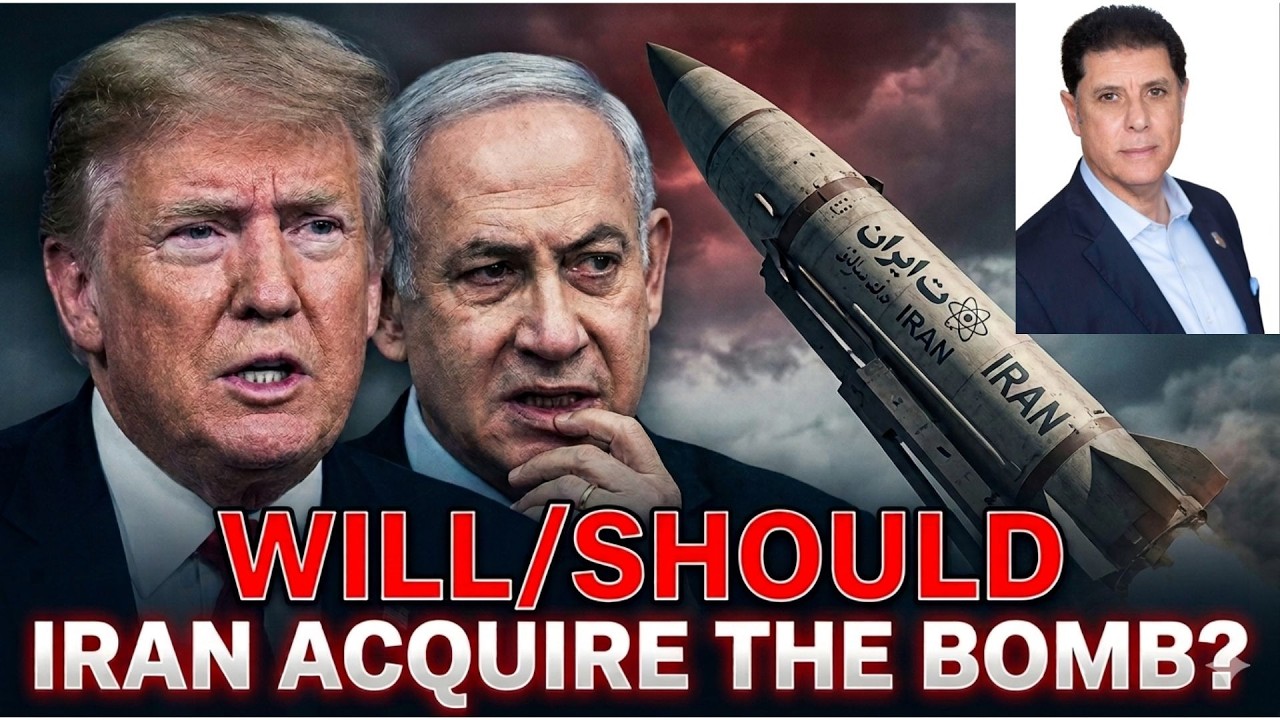
David Oualaalou examines whether Israel and Iran will go to war again, discussing nuclear deterrence, US strategy, and regional escalation risks. The conversation weighs arguments for Iran acquiring nuclear weapons against preemptive strike scenarios and explores what the next decade might look like.
Chapters
Hello everybody and welcome to Geopolitical Trends, where truth matters. Right now what we have, we have literally some world leaders are kind of celebrating the treaty, the, the peace treaty with, with Iran. I mean, in the MOU, they're thinking of it or thinking about it in terms of a peace, which it is not. But behind closed doors What do you have? You have the intelligence agencies that are already— yeah, don't be surprised— they are already bracing for a much bigger war. And this is exactly what I'm thinking about in terms of the time frame for this. That's why I always keep saying, give it about 8, 9, 10 years max, we're gonna be seeing the same scenario we're seeing today. Once this truce expires, you know, and that's when you're going to start having the countdown towards the massive regional conflicts because it will begin. So this is what happens when a country now left with nothing. What happens when a country left with nothing to lose or it's backed into a corner? So, and that's exactly what now this recent strikes between the US, Israel, and Iran. Sort of especially targeting Iran, it didn't end the conflict from the part of the Israelis and the Americans. It didn't end the conflict between US, Israel, and Iran. You know, they just changed the rules of the game, no more, no less. And that's why in this video I decided to do this. I know some, some, some will say, Dr. O, it's obvious Iran needs to get the bomb. It's not about just that. So, because what I wanted to do in this video, by providing you my own analysis, I wanted to look at why the next decade will force a deadlier confrontation that makes the recent war look like a rehearsal if Iran does not acquire the deterrence. And that deterrence is the nuclear bomb. So And this is why I wanted to address this with you. I know someone already said, well, they can't be, Dr. O. They already, uh, they sort of lost the opportunity. No, it's never too late. Iran still can do it. And this becomes now the question of, uh, with the ongoing tit-for-tat between Iran and US and Israel, you know, is it time for Iran to acquire the bomb and end this once for all? Legitimate questions we're going to ask for. And what I wanted to do in this live stream is providing you the pros and cons, those who agree for, uh, uh, uh, the Iran acquisition of nuclear weapon and those who disagree with Iran's acquisition of nuclear power. So let's start first with the— because this debate, uh, to, to where you look at it, there is no, uh, if you ask If you ask either defense analyst or geopolitical analyst from around the world, not just in the US, not just in the UK, not just in Iran, everywhere, if you do a global survey, what you're going to find is that there is no definitive consensus that exists, whether exist on whether Iran acquiring a nuclear weapon will benefit, uh, Tehran. As the strategic outcome remains highly contested among geopolitical analysts and defense experts. This is where it stands as of today, and I wanted to address this issue, lay out for you the arguments for and against, and of course you reach your own conclusion. Just make sure you stay with me till the end because I have some very interesting clips, uh, pertain some of it to what we are talking about today that will make more sense, uh, uh, to you. So, so let's start first with the argument for Iran's nuclear acquisition, which by the way, I happen to be in this camp. I am for, because I believe Iran made the strategic mistake back then and it will be paying for it moving forward if it does not make a decision. Even though, and I do believe I'm going to have Professor Morandi here and we're going to talk about the decision that is now, or the talking that exists right now within Iran regarding the movement towards acquiring the bomb. But let's go with the argument for Iran's nuclear acquisition. What it's going to do, it's going to establish a mutual deterrence, which what I've been calling for, because the proponents of this view argue, and I'm one of those, that a nuclear armed will create a balance of if you can use a power balance of whatever term you want to use. The only difference is going to be, is going to be similar to the Cold War. And that is why making a direct military conflict between the US, Iran, and Israel too costly, too risky for the other parties. So, so second thing, by acquiring the bomb, Iran will secure its own government structure. Per se. Some call it regime survival, some call it whatever. The government, the structure of the government will persist or exist. So, and this is where analyst points to historical precedent. Once again, I've argued this by providing the example of North Korea, suggesting that possessing a nuclear deterrent effectively prevents a foreign-enforced regime change. Which we are notorious for. Ask any country around the world and they'll tell you. And the third, the third element of this is ending the conventional escalation. That's why I use the term once for all at the beginning. If Iran acquires this, it will end this tit-for-tat once for all. How do you end the conventional escalations? And this is where you have some strategic Theorists argue that explicit nuclear boundaries would establish a clear red lines, like again what we've seen with North Korea, for example, with Pakistan, with India, uh, to a degree, halting the unpredictable cycle of conventional and proxy tit-for-tat strikes, which is exactly what the US and Israel are doing to Iran. And I'm only gonna share a few ideas here because I have more, uh, uh, other questions that it's worth, uh, uh, asking and providing you the answers to. If we look at the argument against, uh, Iran's nuclear acquisition, what is the first thing that does, uh, that camp argues is that the saying is gonna trigger regional proliferation. Well, wait a minute, you know, how come you gonna let only few countries control that aspect?. And this is where the critics warn that if Iran— if an Iranian bomb will force neighboring countries, rivals like Saudi Arabia and Turkey, to acquire their own nuclear weapons, which is a logical argument. When I wrote the Saudi book, I addressed this particular point, and I did mention, should Iran decide to acquire the bomb now, my— I mean, be, be on the lookout for the Saudis pushing for their own nuclear weapon somehow, even though the Saudis have one already in an escrow account. But Turkey also will ask for one, even though we do have nuclear weapons on the Turkish soil, but it's under US control at Incirlik base. That's— so it's logical arguments. The second thing, it will be risking a preemptive strike, accelerating towards a weapon could provide an immediate large-scale military intervention by Israel and the US to destroy nuclear facilities before the bomb is finalized. Which again, I find it not, not conven— uh, convincing. Why? Because that's exactly what Donald Trump's been saying. We obliterated Iran's nuclear facilities, we destroyed all this equipment, whatever, when in reality it's not. Bushehr nuclear power still stands. The one in Natanz, the one in Isfahan, and some other locations, they're still standing. So, but again, we're just providing the arguments here. So the third element of this argument is that it will increase economic isolation. Achieving nuclear status will likely trigger permanent severe global sanctions and that in itself will severely cripple Iran's long-term economic stability and domestic security. Once again, I find myself pushing back against, uh, this argument because Iran has been under sanctions for 38 years, almost 4 decades, and they're still standing. And this is again where, uh, the argument comes in by saying, well, if this is not enough, then you're going to think about emboldening the proxy warfare. What do I mean by this? Those, the opponents of this fear and criticize that if Iran acquired the bomb, that nuclear umbrella might encourage Iran to launch more aggressive conventional or proxy attacks, which I do not believe so. Because what to them, their argument is that because they believe that Iran's nuclear shields shield it from a direct retaliation. I, I don't buy that argument because Iran is not one of those countries that just want to hit and want to bomb countries for the heck of it. They won't. And I've made that argument way back, that as long as the Gulf States, which as you all remember yesterday I talked to Larry about it, and as long as there is a presence of US military on their soils, they're going to become— they're going to be a target, simple as that. But once the US military forces are out, I don't see any justification for Iran to attack any country in the Gulf, and they won't do it. I know this for a fact, they will not do that. So, and this leads us to talk about, should Iran decide to move this direction, which model is going to be provided? Is going to be, be, uh, pursuing, uh, or follow or imitate or what have you. So, and I'm going to share an excerpt from my Iran book to put it in perspective. And the first question I ask with this is, if Iran decide to go this route, will Iran pursue North Korea's path to acquire nuclear bomb? What do you guys think? Just in the chat box, yes or no. If, if you think that should Iran made the decision will it pursue North Korea's path to acquiring a nuclear bomb? So of course there are those who saying Iran is highly unlikely to successfully replicate North Korea's exact path to acquiring, uh, a nuclear bomb because as its geopolitical reality, for strategic environments, military risk differ fundamentally from Tehran to that of Pyongyang, even though I don't— I don't know, I don't see the argument for that. It will be unlikely successful in achieving that. So some hardline factions within— even within, uh, they call them hardline factions because they are in favor now of going this route within the IRGC. Because they favor the path of North Korea. And that is basically where Iran is right now. Iran is at a crossroads because this, uh, stance will sort of, uh, harden, uh, against the international pressure, because that is exactly what the US and Israel are doing, is pressure. IAEA is being used for that. Of course, they are the back door. Like I always say. So, and this is where Iran might, might, might face some difficulties. I'm not denying this. For example, you think about the preemptive war. So, because you have to think in terms— should Iran go that route, what will the US and Israel do? So, unlike in North Korea, where the US ruled out a preemptive military option decades ago Why? Due to immediate catastrophic artillery threats posed to Seoul.
Why?
Because North Korea has its sights on the 30,000 or 35,000 troops stationed in South Korea, and Pyongyang is only a few miles from across to hit South Korea. That is one of the strategic difference regarding this aspect here. So, and both, when you think about it, Washington and Tel Aviv have consistently maintained some sort of an active, credible military option against Iran. That is where the slight difference is. The second thing will be the demonstrated force. What do I mean by this? When you think about the extensive military operations and airstrikes targeting Iran Of course, it will be just an expo— exposure of force, because even with American force, we weren't able to defeat Iran. I mean, as it stands right now, we didn't defeat Iran. Iran came as a winner in this conflict so far. But we have to consider this, this, this possibility. So that means the US and Israel will continue attacking Iran consistently. So even they are saying— they mean in Washington and Tel Aviv— saying, oh, we have severely degraded Iran's infrastructure. I don't buy that. And we all know the media is going to have— especially here in the West— we're going to have to provide a different narrative for domestic consumption. And when I have Professor Marandi here, we're going to talk in great detail about these aspects of it. So the other aspect that I think of, it has to do with the diplomatic aspect, and that diplomatic has to do with the diplomatic constraint and the NPT. Because in this case, if we look at the— which I post the link for you last time, uh, I did the live stream, uh, not the one with Larry, but before that, I did put a link for the Islamabad MOU And why is that important? Because there was a clause there that almost indicates that Iran remains bound as a member of the Nuclear Non-Proliferation, the NPT Treaty, under the freshly signed, the Islamabad MOU. So, and that is why Tehran has reaffirmed its commitments towards a pledge not to pursue nuclear weapons in exchange for a fragile ceasefire and potential economic relief. But this is not going to end there. I am saying it again and again, Iran is making a strategic mistake. That's why I thought of the term of max of 10 years. We will be seeing the same scenario we are seeing today. And that will enter with the role of the IAEA, the verification trap, because that's all it is. IAEA is not objective, we all know this, and I'm not going to beat that horse over that. But this verification trap, because the IAEA, uh, director Rafael Grossi, he is, he's like already demanding, yeah, demanding a very strong system of verification. Well, wait a minute, if you are a watchdog under the UN and the UN Security Council orders, what would you be demanding if there is no resolution has been presented towards that end? And second, you have no authority of making that kind of calls because that calls will have to come from the authorities above him. So, and that is again Because Grossi was pushing for this before allowing the temporary ceasefire to hold. That tells you something right there. I never trusted the guy when he took over. I was aware of his dealings behind the scenes without detailing some— the latest one being in Japan. So, so walking away from all these talks to pursue, uh, this weapon, this is why it could automatically collapse the truce. And this is again where the camp that's saying Iran shouldn't have or acquire the nuclear weapon, but Iran has other options. It can't. And this is what I'm going to share with you, what I argued in my Iran book. To those who have a copy of the book, you might want to go to page 144 through 146. That's what exactly Uh, I'm going to share this, uh, excerpt if you allow me. Here, here is what I wrote back then. To simply— to simplify the issue, rather, we shall consider Iran's nuclear dossier under three models of behavior, namely the North Korean model, the Libyan model, and the Japanese model. Before going further, one must briefly shed light on the three models Iran may have pursued in the event negotiations with the P5+1 failed. The first model is that of the DPRK, the Democratic People's Republic of Korea. Exercising its right to withdraw from the NPT on March 12th, 1993, North Korea embarked on a policy of defiance by declaring its intentions to enrich uranium at a military-grade level. In support of this claim, North Korea declared both its intentions to produce a nuclear bomb and its capability of doing so. What is unclear, however, is whether Western intelligence agencies can account accurately for how many nuclear bombs the DPRK possesses. The ignorance is attributed to two main factors. First, the, the international community cannot infiltrate the DPRK to get firsthand knowledge of what the DPRK has. Second, the DPRK leadership's tight control over the population prevents any contact with the outside world that may illuminate what sorts of control are available. Yet articles within the treaty may have contributed to the DPRK's justification for the withdrawal. George Bond and John Ryan argue Article 5, or Article— I think Article— don't quote me, this because I remember— Article, yeah, 5 of the NPT provides the right to withdraw from the treaty if the withdrawing party decides that extraordinary events related to the subject matter of this treaty have jeopardized the supreme interest of its country. It also requires that a withdrawing state party gives 3 months' notice. And so I'm convinced that Iran would have followed the North Korean model if negotiations with the P5+1 had failed. Yet I argue the failure of the negotiations was not an option for not only Iran but also China and Russia, the main beneficiary of Iran's Nuclear, uh, uh, agreement. That is what's interesting about, uh, uh, about this aspect here. So, and this is what I need you to understand why I have to address the North Korea, uh, model, because Iran has that option if it wanted to withdraw from the NPT. Why they still holding to that, I don't know. This is one of the questions I'm going to ask, uh, Professor Morandi when he is here. And that leads me to address, for example, the idea of why is this important. We talked about the nuclear— the, uh, North Korea's model. I'm gonna give you a brief, brief excerpt from, uh, uh, my book again about the Libyan model. And the Libyan model is also very important to understand. The second model is that of Libya. Security analysts argue that Libya's decision to give up its quest for nuclear armaments was in the works during Bill Clinton's second term in office. It is a false assumption that President George W. Bush's policy to spread democracy in the Middle East and invade Iraq made it possible for Libya to abandon its nuclear program. Historians will have to judge whether there was even a link between the invasion of Iraq and Libya's relinquishing its nuclear aspiration. That's what I wrote back then. I was in the middle of knowing about the talks with the Libyans back then. I was still in Washington. As a matter of fact, one of my office was in, in a part of those negotiations. And we all knew where this is leading to. We all knew it back then. But again, it wasn't— at least for me, it wasn't my position to get involved in that. But I was aware of what's going on. And that's why I said, for, for Iran, if they ever enter into negotiations with the West— that's the point of why I wrote The Libyan Model— it's not going to end up well, which is exactly what's happening. Remember, Iran signed the JCPOA, and look what Donald Trump single-handedly did in 2018. And that gives you an idea right there that the US cannot be trusted. And the Europeans and the other members of the P5, uh, especially the European part, England and France, stayed mum. China and Russia objected, of course, to what the, the Americans have done. So, and the other, uh, uh, uh, question that I ought to ask, which is a crucial one, is— and I repeat this one here because I, I feel I have to keep repeating this to make sense to the global audience, to understand. Maybe some someone in Iran might be watching this video. And the question is, is Iran making a strategic mistake if it does not acquire the bomb? That is one of the arguments I've made. So let me play this clip so quick, and I'm gonna answer that question. If the truth matters to you, hit like, subscribe, and tap that bell. No spin, no agenda. Just the stories they don't want you to know. Don't watch from the sideline. Be part of the movement. Your support keeps the truth alive.
Thank you.
Indeed, uh, the assessments for this particular question— there are many, many, many think tanks around the world that is saying, oh, this assessment is making that Iran is making a strategic mistake by not acquiring a bomb is highly debated. But largely inaccurate.
Why?
Why is it inaccurate? Because they don't want to show that this is for a long term. They don't want sort of bring light to the issue of long-term, uh, consequences if Iran does not go that route. And they're arguing that because they have to evaluate against the the technical, the military, and the diplomatic realities. And what do they mean by this? Because when you look at some, uh, for example, as you know, in foreign policy, uh, in when you study political science, there are two schools of thoughts: the realism and liberalism, of course. But when you think about what some realist foreign policy analysts argue, that a weapon is Iran's only true defense against foreign intervention. This is a reality. So, so I, I'm, I'm, I'm, I think in terms of, of reality myself, that's why I've been saying Iran is making a strategic mistake long term if they don't embark on this, embark on this immediately. And the overwhelming consensus among defense experts is that attempting to acquire the bomb right now will be catastrophic strategic miscalculation. And I don't see why their argument— because this strategic mistake centers around, for example, Iran doesn't have the technical knowledge or reality or infrastructure because the Americans and the Israelis stated that the infrastructure is decimated. No, it is not. You still have And I, I, I got you guys picture from inside, inside the, the, the facilities. You know, just, just look at this and tell me if it is decimated. But again, that's what the, the Americans are saying. This is what the Israelis are saying. And that is the whole idea of why, uh, in, in the case of the the, uh, nuclear facilities. Yeah, they've been damaged from the outside, not from the inside. Everything's still intact, which means Iran has the capability to do so. And that's, again, it's gonna be, uh, uh, uh, of course we are not gonna rule out the possibility that, uh, the US and Israel could embark in a joint another operations. But we already saw that in June 2025 and in February 2026, both those countries, the US and Israel, won't be— they weren't able to defeat Iran. And as a matter of fact, Israel is holding by a thin thread, if I may say, if it weren't for the US support. You know, like Larry Johnson said yesterday, one-on-one, Iran and Israel, Israel will be wiped out. Of course, they might resolve to reusing the nukes, but Pakistan already warned this, the Chinese, the Russians, and all this. So when you have this, uh, you have, for example, some Western think tanks saying the centrifuges have been destroyed, the top nuclear scientists saying that there is nothing left, it's a lie. It is a lie. If Iran decide to go forward with it, they're gonna do it. So, so where I see personally, and again, my personal opinion from a military perspective, I see the military reality, the what I call the window of vulnerabilities. That's the one I saw. So it's because some of the arguments from those analysts, there is a flaw in it. And the flaw is, is the timeline of this, because here is the thing, and this is a reality for all: a country is most vulnerable to a total destruction while it is trying to build its first bomb, not before. And I have to be realistic. As I said, I am a realistic guy, especially when it comes down to, to global affairs, how I see things. And it's something I can overlook in clear conscience. I have to include that into the analysis or the conversation to make a point, because I can guarantee you there will be preemptive strikes like we saw, uh, on, on February 28th, except that this time around Iran is prepared also, because the assumption in Washington and Tel Aviv that Iran is weak. Iran is not weak. Iran still have massive amount of missiles, including the hypersonic, which, by the way, if it comes to that, that the US and, and, and, and Israel attack Iran again, Iran has nothing left to lose. They're gonna just launch whatever they have. And we already saw what the Iron Dome of Israel was not able to withstand, uh, missiles from Iran. Uh, it's like, for example, the Khorramshahr. Or can you imagine when Iran launches the hypersonics? And that's again my point. I see the argument for the military reality, this window of vulnerabilities, but I also have the, have the, the, the idea that Iran already has a plan in place should the decision is made to move forward. And I think with the new leadership in Iran, with Mojtaba Khamenei, who is different from his late father Ali Khamenei, he's going with it. And as a matter of fact, uh, I think tomorrow, tomorrow if I'm not mistaken, uh, please correct me for those who know, there will be the major funeral for Ali Khamenei uh, in Iraq, I think, also somewhere something's going on in Iraq pertaining to the, uh, uh, funeral of Ali Khamenei. And Iran already warned the US and Israel if they ever attempt to disrupt the funeral and so forth. So, so, and this is again, you have to think in terms of where this is going. So if I am to think about, uh, to put a, a comparison, if I may, and I'm going to do it for you quickly here,, to highlight, for example, we have on one camp the pro-bomb analyst view, and we have the strategic reality. On the pro, uh, the pro-bomb, uh, analyst view camp, you have a bomb will have deterred the US and Israel from launching the '25 or '26, uh, wars. Uh, and I couldn't agree more. You have also the fa— from the strategic reality, true in hindsight but irrelevant now. Tehran can go longer safely across the finish line. Can no longer. That's the argument. Second point will be failing to build a weapon leaves Iran permanently exposed to future regime change operations. That is what I was talking about the next 10 years. The other camp is saying overtly building one guarantees immediate war. The process itself invites the very invasion they want to avoid. And the last point in this comparison, uh, compar— comparative, rather, analysis is when you think about the nuclear status provides leverage to demand the total removal of global sanctions, the other camp, they're arguing the exact opposite is true. Revisiting the bomb would permanently cement Iran as a global pariah destroying the fragile, uh, economic relief offered by the Islamabad Imran. And this is once again when I go back to the book, and I, I detailed this stuff ahead of time.
Why?
Because I was thinking, what if this JCPOA doesn't hold? What if? And I lifted the window open just in case, because I know how Washington operates. And even with this there is the signature, there's the, the signing ceremonies and so forth, the P5 and all that. And I was left with the big question mark behind, left— something was telling me it might not go through forever. And here we are. And that's exactly what I argued in the another excerpt. Here is what I wrote: the third model is that of Japan. Many argue that Japan model represented the one Iran will be likeliest to pursue. However, there was no inclination in Tehran towards that end, at least during the phases of the nuclear negotiations. Like other security analysts, I argue that the Japan model proved that signatory countries in the NPT indeed could balance the application of a nuclear civilian technology with that of their requirements for nonproliferation. Simply stated, an NPT signatory country could pursue civilian nuclear technology as long as it guarantees that there will, uh, never be transfer from a civilian technology to a military application. This is what I argued back then. But here is the reason why I argue that one is because in the case of Japan, Japan was under the thumb of the US. Iran is not. And even with that, I wanted to make the argument because that's usually what I do academically speaking. You cannot just be sided on one end. You have to provide both sides of the argument towards a particular theme or topics or what have you. And that is why Japan is under the US thumb. Iran is not. And that is where the difference. And this one leads me to the next question. And that's in fact the last question here. And the question is, will we see the same tensions between the US, Israel, and Iran repeated a decade from now? And, and, and I, I— it's like déjà vu for me. When I was doing the research back then for my Iran book, I thought of the next 10 years after the JCPOA was signed. Now I am thinking 10 years from now where the conflict is still on what's going to happen in 10 years if Iran does not make a decision to move forward. So to do this, I'm going to play a clip for you, okay? And I want you to listen carefully. Uh, this is from Tucker Carlson, uh, but what's important is who's going to be talking. He's going to be talking the idiot, uh, Bill Graham, Lindsey Graham from, uh, South Carolina. An idiot. And I don't understand why the voters in South Carolina keep voting for an idiot like that. Because he is a pro-Israel. By the way, he's the one pushing for the war, has been pushing for the war against both Iran, okay, and even China through Taiwan, using Taiwan for that. It's Lindsey Graham. The three stooges: Lindsey Graham, Marco Rubio, and Ted Cruz from the state of Texas, which by the way, he doesn't represent me. I, I don't consider him representative of me in Congress. So let's take a listen, and, and, and I'll let you judge for yourself. This, I think, is going to fail. What happens next? I spent 4.5 hours with President Trump Friday. Here's what I think will happen next. If this deal fails, President Trump is going to take the Strait of Hormuz over by force. The United States will control the Strait of Hormuz, will charge a fee for all those who go through to pay for the operation, and we're going to expand the Abraham Accords in calendar year 2026. We're going to get Saudi Arabia to join the Abraham Accords, and, uh, which is the biggest change in 5,000 years in the Mideast. And if Iran contests control of the Strait of Hormuz by the United States, we'll obliterate them. So to all the people listening, if this diplomatic, uh, effort fails, President Trump is going to take the Strait of Hormuz.
We're going to run it.
First they told us we had to go in and open the Strait of Hormuz. That was the big emergency, right? Except it was already open before this war started. Shipping was moving, oil was flowing. Iran wasn't blockading the world until we began dropping bombs. Now after After all the tough talk and repeated claims that we've destroyed the IRGC Navy 100 times, suddenly the strait is a problem again? And if the peace talks fail, the plan is we're going to seize it by force, take it over, and charge every ship a king's ransom and fees? If Iran complains, we'll obliterate them? Lindsey Graham says this like it's some brilliant masterstroke. I'm sure after 4.5 hours in the room with Trump, he came out ready to expand the Abraham Accords while America plays global toll booth operator halfway around the the world? Let me ask the obvious question: if it was immoral and outrageous for Iran to threaten control or fees on their own doorstep, how exactly is it heroic for us to seize the strait and start taxing everyone? Who benefits from America becoming the world's most expensive naval security service for Chinese oil tankers? Our own people are still paying high gas prices while we bleed resources and credibility in another Middle East quagmire. They keep telling us we've crippled Iran's navy, yet here we are talking about physically occupying one of the most defensible choke points on earth if the Iranians don't fold in negotiations. That doesn't sound like overwhelming victory. It sounds like classic mission creep and overselling like the all-you-can-eat buffet where the bill later is always bigger than advertised.
Spot on. Spot on. Lindsey Graham is, and Ted Cruz and Marco Rubio, those three, those the one pushing for this war as we speak. Yeah, as of now. So I will say to my fellow citizens, especially those who voted for those, shame on you. But at the same time, I forgive your ignorance. If you would have educated yourself and understanding, then you will make a different choice. But again, it's their, their decision. They can live with that. Now, for the question that I asked, will we see the same tensions between the US, Israel, and Iran repeated a decade from now? As a geopolitical analyst, I am convinced 1,000% that the structural tensions between US, Israel, and Iran will persist a decade from now if Iran does not make a decision. Even if the current conflict remain frozen by the Islamabad MOU, we will see the same tensions again. So of course, the intensity of the future, uh, friction will depend on a lot of varieties in— a lot of, a lot of variables, I'm sorry, a lot of variables in, in West Asia or Middle East. That includes Iran, that includes Turkey, that includes Israel itself, and that includes the Saudis, Gulf states, and what have you. You have also to consider the technological breakthroughs. You also have to think about the several deep-seated drivers that will ensure the confrontation will remain a core feature of Middle Eastern politics through 2036. That's how I see it. That's exactly what my concern moving forward. So I, I intend to do an update of my Iran book, uh, when I finish my China book first. Then probably I will, I will address this kind of of, uh, of aspects of it. But one thing that I am convinced about is that we will see a repeat of these tensions if Iran does not make a final decision regarding the nuclear deterrence. So, and of course, you're gonna see the perpetual frictions that will— as long, uh, because Iran will always have, uh, Hezbollah will always have Ansarullah, will always have Iraqi militias to its side as a primary asymmetric defense mechanism, and the US and Israel will continue to launch counter operations to suppress them at every turn. By the way, then the sunset dilemma— this one has to do with the inevitable expiration of the Islamabad MOU. Yeah, it's not going to be holding forever. So because it's similar to past agreements, this newly signed MOU is temporary. And I told you from before, this is just a framework. It's not even an agreement. It's not an official agreement. When you have a framework, framework is subject to change, subject to cancellation. So because it's just a temporary stabilizing tool, stabilizing force, if I may use the term. Not a permanent peace treaty. So why should we think in terms of, oh, there is a peace treaty? There is no peace treaty as of today. So, and that is why I'm already starting to think in terms, you know, we're going to be entering 2027 in a few months, uh, 2030 flashpoints again. And I'm seeing this like I'm looking at you. You know, it's not I'm clairvoyant. No, I'm not. It is just I'm thinking about using history as my guide when I see the events, how they unfold, and what we have done before in similar situations. I mean, you look at just, uh, this development of how it's going, but you look at also other lessons from history, like the case of North Korea when it decided we done with the NPT, we moving forward with, with the, uh, with the constructing the bomb. And once it's done, no more threats, no more, uh, provocation from the US. Because also we know North Koreans do not bluff either. So, and that is again where you have to think in, in, into, uh, uh, uh, this, this transformations that's taking place, especially now you have a new a new leader at the helm of power in Iran. And I'm referring to Mojtaba Khamenei as a supreme leader, the religious figure. Of course, final decisions have to go through the, that structure within the, the, uh, the, uh, the political structure of Iran. And of course, when I have Professor Morandi here, we're gonna detail all this stuff, because what you have to think in terms of the post-Ali Khamenei era. So, so, because where Iran now, in my opinion, from looking from outside in, Iran is in a transition. Yeah, is in a transitional state. How that's gonna sort of evolve is anyone's guess. So So far, they are taking a firm stand, the leadership, the Mujtaba Khamenei, along with the IRGC, because they want an end to this sort of provocations by the US and Israel once for all. Mujtaba is in favor of moving forward with the nuclear deterrence. So, and that is why this new guard may reject all the past diplomatic compromises in favor of an aggressive deterrence. And sometimes you have to do what you have to do. And this in itself will take us to much bigger picture. And my reference here is to the broader Cold War dynamics.
Why?
Because you're gonna have Russia and China part of this dynamics that's gonna be taking taking place. Great power alignments, which are already seeing that because Iran is no longer isolated, by the way, despite what those Western analysts saying, oh, Iran is isolated like North Korea. No, it's not the case. In the case of Iran, Iran is no longer isolated. It is now a critical nod in a revisionist bloc alongside, of course, Russia and China, because that's how they see So, and that is where that strategic shielding comes in. That is why, again, I find myself falling back to the 10-year frame time, or time frame rather. Over the next 10 years, looking at financial, cyber, conventional military technology transfers from Moscow and Beijing will help Iran modernize its defenses and escalate the technology race against US and Israel forces. This is— and again, I found it very interesting to provide you once again in, in, in briefly here, uh, uh, a comparative analysis about the scenarios, the potentials for 2036. I'm getting ahead of myself here, but again, I don't like to leave chance, any chance, uh, uh, because I think that's how I think. I, I think far ahead. I think ahead. So, so let's think about scenarios. I'm going to mention the scenario, I'm going to mention the core driver for this scenario, and I'm going to mention, for example, the likely out— the likely outcome of the likelihood, uh, uh, uh, uh, impact of it. So first you start with the managed Cold War. That's the scenario. The core driver for that will be Islamabad OMOU holds loosely. You have a low-level cyber and proxy gray zone warfare that continues. What is the impact? Most likely constant tensions without escalating into an all-out regional war. That's the first scenario. Second scenario— and I'm only doing three scenarios here— second scenario is the Second Iran War. Iran approaches a hidden decentralized breakout capacity. Israel launches a new preemptive campaign. That's the, the, uh, that's the, the core driver for that. And the likelihood or the outcome is moderate, triggered if verification protocols break down entirely. And the last scenario you will have— of course, this is, are just scenarios— so you have a domestic transformation within Iran. And what is the core of that? The core with that economic collapse, civil unrest, force the IRGC to pivot inward, reducing external aggression. And the most outcome of that scenario will be low to moderate, highly unpredictable, but could fundamentally shift the regional dynamics. And that's exactly what I've been talking about the new geopolitical landscape in the region. By the way, be on the lookout this weekend. I'm going to release a recorded analysis for you about this particular point. I've, uh, I've been doing some writing on it for the last few days, and I just finished it, uh, and, and it will be worth your time watching that one when I release it on Saturday or Sunday. And that's exactly where you're going to see these changes that are taking place moving forward. So, oh, by the way, before I forget, I promised you last time to share with you a link about this particular, uh, topic. So I'm not gonna say it here, but all I'm gonna do is I'm gonna put a link for you in the chat box. Make sure to read this article. It will be worth your time whether you are in Canada, in Australia, or the US. It will be worth your time. So, and again, I don't hold back from what's need to be said. So here is my conclusion for you, because I'm coming to an end here, uh, uh, before I play the clips for you. The one thing I need you to get out of this analysis that I shared with you is that the era of unstable truce between the US, Israel, and Iran may be winding down. So, but the underlying drive for a total deterrence is far from over, especially, uh, from the part of the Iranians. You know, as technology advances, an old alliance morph into some new global coalition, and that is where you have West Asia or Middle East stands on the edge of a new geopolitical chapter. Once again, like I always said, I don't do random, I do things for a reason. That is why I prepared this analysis for you about the upcoming new geopolitical landscape in West Asia. And when I release the video, you can take a look at it. So, so here is question for you that I want you to share your thoughts in the comment, uh, section in the video. I will greatly appreciate it. Will the next decade bring a fragile peace through rigorous verifications, or are we simply watching the countdown to an inevitable regional nuclear race? So please share your thoughts in the comment section because I want to— I want you— I want to know, do you think deterrence will prevent the next conflict or will trigger it? So, and I'll put this in a— I'll pin the comments for you in the, uh, below the video later on. So now let me share some clips with you. Those are worth your time, so I want you to really pay attention to what I'm going to be sharing with you. There are a variety of ones that I need you to understand the role. You know, last time when I shared with you about Jared Kushner, okay, I told you I will get the link for you, and I found it because I kept it. I want you to take a listen here.
Please. Son-in-law Jared Kushner is negotiating peace with Iran while managing a $6 billion fund that receives 99% of its money from Saudi Arabia. And only we Jews understand that this is the biggest conflict of interest in history. Kushner collected more than $110 million in commissions from Saudi Arabia while serving as Trump's envoy to the Middle East. The same Saudi Crown Prince who is his biggest investor privately pressures Trump to escalate the war against Iran. He cannot be neutral when the people paying him billions want war. Saudi Arabia gave him $2 billion, Emirates and Qatar billions more. These are Iran's enemies and they are financing the man who supposedly must negotiate peace. This is legal because Kushner has no official government title and doesn't have to declare conflicts of interest. He operates as a private businessman doing foreign policy financed by foreign governments. The same week he negotiates peace, he is fundraising from people who want war. We Jews have seen this pattern for centuries. The man at the table always serves whoever finances his seat. Peace was never the goal. Positioning was. This is how wars start for the benefit of a few, not on battlefields but in offices. If you're ready to understand how money and power really work behind every headline, I have a book in my profile that teaches you exactly how to read the deals.
All right, I just want to share this with you again. It's the content that I'm interested in. I noticed that's probably AI-generated, but the content, what's, what's important to me. And speaking about the Saudis, the Qataris, and Emiratis. I'm gonna share a picture with you and show you the true reality of what's going on in Gaza. Okay, this is a picture reflecting more than 58,000 Palestinian children in Gaza have lost one or both parents, and yet the Saudis, the Qataris, the Emiratis giving billions to Jared Kushner. So where is this Muslim unity? You know, that's the pinnacle of hypocrisy. You know, that's to me, uh, religion or not, and when you say something, at least don't be a hypocrite. Take stand when they have the Palestinians like this. You know, those are kids. That could be my kid there. I mean, just think about it. Did these Muslim countries in the Gulf States stepped in and said, you know what, Instead of giving the billion dollars to Kushner, we're gonna give a billion dollars to rebuild. And they are allowing this. So where is this unity in Islam and so forth? God help us this, God help us that. You know, they're just using a religion to justify whatever. So, you know, I just wanted to share that picture with you because it was heartbreaking when I saw it first. Next one is about Elon Musk. That's another, uh, character which, which, by the way, they took down one of my posts on X because they didn't like when I said something about the scammers from India in my country, what the punishment ought to be. And they saying, oh, I'm calling for violence. I am not. I am not. So take a listen here, please. Musk is freaking out that a US official has a Lebanese flag right next to an American flag, but of course he says nothing about congressmen showing this flag right here. Interesting that he has that kind of selective outrage and double standards, isn't it? Comment below and subscribe. That's indeed— he didn't say anything about the Israeli flag near the member of Congress, and yet he commented on the one— even Elon Musk, you know, I, I, I care less for the guy I never trusted the guy anyway. So next one is about an old president. He passed away, President Nixon, you know. But what's important about it is what he said back then. So, and I found it very, very interesting given now what's going on. Take a listen, please. President Richard Nixon tried warning us about Israel back in 1969.
Let me explain something about what is called the Jewish lobby in this country. Their belief is that being for Israel first, that, that does not mean you're putting America second. An American president, however, has to approach it in a different way, in my opinion. He's got always to think first of what is best for America. An American president must make a decision that does not, in effect, give the Israelis a blank check. And one example Well, that is a decision that I made. I decided early on in our administration that we were going to seek good relations with Egypt and other— others of Israel's neighbors. Many of my Israeli friends didn't like that because they wanted a special relationship with Israel and Israel only.
Okay, I just want you to be aware of that. And the next one is about something disturbing from Donald Trump. But I counter that with the reality of what's going on in the US this month, especially for my American viewers, right? Because you are aware of— take a, take a listen here. So of course you'll laugh at the picture once you see.
Nobody knows more than housing in the history of the presidency. Nobody, nobody did well like me in housing. I made a lot of money. I made a lot of money with housing. Nobody knows more than housing in the history of the presidency. Nobody, nobody did well like me in housing.
I made a lot of money.
I made a lot of money with housing.
Disturbing, but that's Trump. But that's not the point why I wanted to bring this up. I wanted to bring up what he said. Versus the reality that's going on right now in America. Like what Tucker Carlson is saying, gas prices are up, Americans are struggling to make ends meet. Take a listen at what this lady had to say about the housing situation in America, which by the way the media does not disclose. That is why I, I search this kind of stuff for you, especially again for my American viewers to see.
40,355 homes were foreclosed on in the United States in May 2026. That is a 14% increase in home foreclosures in May 2026, higher than May 2025. There has been about 210,000 home foreclosures this year in January through May so far. People are having a problem paying their mortgage. They're having a problem paying their student loans, their auto loans, their credit cards. People are struggling. Inflation has gone from 2.9% to 4.2% and rising. Gas is at a 3-year high. Oil increased as much as 80%. Today is day 113 of the US-Iran war. No, it is not open, and we are paying $1 billion per day to $2 billion per day. That is money we will never get back. It's not going into the US economy. It's not going into infrastructure, education, any kind of social programs. It's gone.
It—
we're never getting it Buckle up, ladies and gentlemen, it's going to get much worse. I just did a post about unemployment. Check that out and see what state you are in and if you are above the average unemployment rate of 4.3%. If you found this post informative, please like, comment, follow, and share for more.
Yeah, I will share this one on, on my other platforms because it's the reality.. And this is what some of us Americans are oblivious. They have no idea what's going on because some of them voted for, for Trump. More power to you if you voted for him, if, if that's your conviction. Good luck with that. You just have to live with the consequences. But overall, where the country is headed, it's not a good one. So, and the, uh, one, two more, uh, this interesting one. What I found about this one here is I mentioned this to you guys few times, but I mentioned this, and again, I, I have it in my upcoming video that I'm going to release for you on the weekend. But I figured I just want you to listen from someone else, so you won't think it's just my own opinion. Take a listen, please.
That are going to emerge from this war and will dominate the Middle East for decades to come, maybe longer longer. One is Iran, there's no question about that, and the other is Turkey. They are not the same. They are very different people, very different states with very different histories. And I spent many years of my life visiting Israel back and forth, and I tried to tell them on more than one occasion, you're barking up the wrong tree, as we say. Your existential threat is not Iran. Iran, Persian civilization, the Persian world and Persian culture, those things aren't your enemy. You've got a real problem further north and to the east, and that's called the Turks. They're very different. This is a resolutely martial people, people of great courage who are innately inclined to fight. These are natural soldiers. I mean, I've seen them. And I had the good fortune to work with the Turks. I think the world of them militarily. They are great people.
Very interesting. And I mentioned that the way it's as clear to me as daylight, and that's why Israel now is seeing Turkey as Iran. So there is a reason why Israel is sort of repeating those statements through its media that Turkey is next to Iran and so forth. Israel stand no chance against Turkey either. So, and the last one is about the— I call him a disgraced ambassador, US ambassador to Tel Aviv. Another, another idiot. But again, how these people get these positions, I have no idea. But all right, let's take a listen here. What a disgrace, man. What a disgrace. Huckabee poses for the camera and smiles as the Israeli government gives him Palestinian land to build the US Embassy. He paid a dollar for the land for the next 99 years, but Palestinians paid with their lives and their blood. This is the fruit of Christian Zionism. Comment below and subscribe. Yeah, what a shame. What a shame on Huckabee. So anyway, uh, that's all I have for you. I'm gonna be working on some new stories for you guys., uh, for tomorrow. On Saturday, uh, for the members, uh, if you are a member on the channel here, please make sure to join me on Saturday at 1900 hours Central Standard Time for the Q&A. Those are— this is your time, not mine. It's your time, the members. I want to do something for, uh, the members. And speaking of that, I want to say thank you to Noel As always, Noel, truly appreciate your continued support, unwavering support I'll call it, and I'm very, very grateful for your support. Greetings, Dr. O, and thank you again for your valuable time. You're most welcome and much appreciate you, Noel. Uh, Army with Harmony, thank you for your membership here. And I'm gonna also give a shout out to, uh, two individuals that, uh posted, uh, or bought me coffee, uh, and tea. One of them is PayPal, by the way. It was Ramzi Abdulrahman. Thank you for your generous PayPal donation in support of the channel. I'm very, very grateful to you for that. And you wrote, and if, if I'm allowed to share this with, with the community, you wrote, and I quote, your service to our communities is most important If we don't promote you and if we don't support you, you are failing all of us. End of quote. Thank you very much, Ramzi, for your continued support. Uh, second person is American Citizen, uh, who bought me a tea in support of my upcoming Asia trip. And the next person is SLSU1999. Thank you for buying me, uh, cups of teas in support of my upcoming trip to Asia. Speaking of the trip to Asia, I want to let you know, give you an update of where we are, because the donation of those two individuals, we crossed into the 51%, uh, uh, mark right now. So, uh, it's now the up— the uphill climbing battle that's coming up now. We want to reach this target goal of $10,000 by the end of July. Gives me enough time to really sit down, get a pen and paper, and start making the plan for where I'm heading out to Asia to report to you. This is not about my own, this is about you, to report to you. But because of your support, that's why I am willing to do whatever needs to be done. I just can't do it alone, and you all know this. So I'm very, very grateful for your support for that. So here is the link for those who wanted to support the, uh, who wants to support the upcoming trip to Asia is right here, uh, should you decide to do that. Once again, we want to reach that target number, uh, by the end of July. Uh, we are crossed the 50%, and I will be very thankful to you for your support. Uh, the next one, if whoever wants to support the channel, you all know the type of information I'm providing you, and it's right here. So as always, remember, geopolitics impact your daily life in more ways than one. Till next time, bye-bye.
More from David


Beyond the Single Actor: Why the Gulf Isn't Choosing Between the US and China


Iran, Iraq's Militias, and the Houthis Are Coordinating! This Changes Everything




Who Controls the Next Decade's Resources? Latin America and Africa's Geopolitical Crossroads

The Chokepoint Trap: How Washington's Stupidity Triggered a Cascade That Now Controls the World

Trump Spooked as IRGC Unveiled dual-use SLV, Deployed Ghadir Mini-Subs & Hinted at Tactical Nukes!
