Will Trump Use Syria to Attack Iran? | Geopolitical Trends
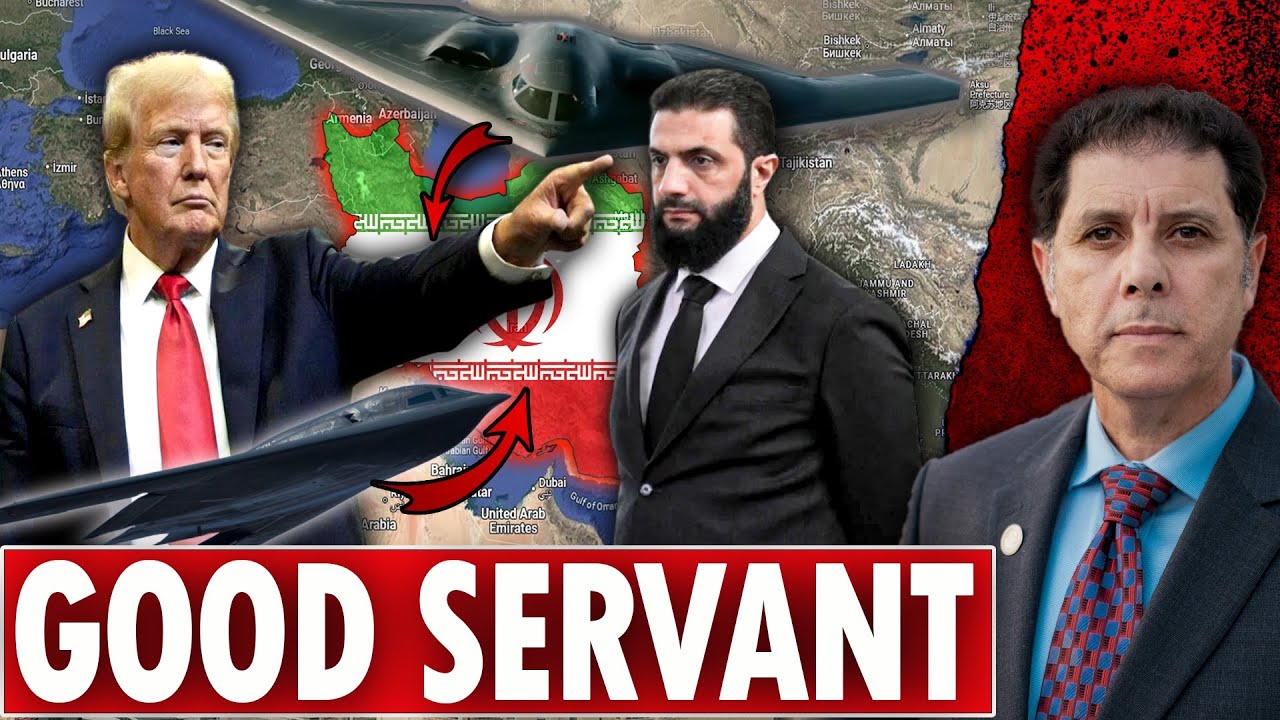
The U.S. is cultivating Syria's new HTS-led government as a potential staging ground for strikes on Iran, according to this geopolitical analysis. The host points to Washington's cancellation of a $10 million bounty on Syrian leader Zulani and its silence on Israeli airstrikes as signs of a deeper strategy that could trigger escalation with Russia and China.
Chapters
Hello everybody and welcome to Geopolitical Trends, where truth matters. Excited to be with you on this March 28th, which is— I think, I think it's the last day of Ramadan, if I'm not mistaken. I don't know, what the— does anybody know? Anyway, so excited to be with you. Got an interesting topic for you, something that is not talked much about. Even though it is my belief, and I think outside the box here, it is my belief should that attack on Iran moves forward by the U.S., the U.S. might end up using Syria as a background, where as sort of a launching pad, if I may use that term. Because we already seen what's going on with Israel attacking certain locations within Syria. And I'm just thinking outside the box here. What prompted me to decide to do this for you, and I will provide you a much bigger, uh, sort of a, uh, a wider perspective regarding this development. But first, let me say hi to our wonderful community. Please give me a thumbs up if you can hear me loud and clear, because I just saw something changed within the, the, the mic setting here, but I want to make sure. If you will be kind and just give me a thumbs up. I want to make sure. All right, let me see, uh, at the main— thumbs up. Okay, loud and clear, Doc. Thank you, Multi Tom. Thank, uh, Fighter AK-47. Thank you, Timeline Dunkley. Thank you, thank you, guys. Myta Count, good to see you. WD First Eye, thanks for becoming a YouTube member here. Appreciate you, uh, for being on and as a member on this channel here. So William Holman, as always. Francis Tango, Truth Seeker. Matt Becky, good to see you. Timeline Dunkley, as always, good to see you. Uh, another day of snowing. Oh, it's, it snows where you are, uh, Truth Seeker. Uh, Leang, good to see you. Tom Sia Wires, as always. Amanda, good to see you. Uh, Marco W, good to see you. What our wonderful community. Jerome Lazarus, good to see you here. Rample So One, good to see you. Multi Tom Tom, good to see you as always. Athene Wu, there you are. I haven't seen you for a while. So anyway, let's get into our topic here because as I said, I'm gonna be providing you my own analysis about literally why there is this ambiguity ambiguity rather regarding the US vis-à-vis the new administration in Syria. Of course, it's led by a former terrorist guy, uh, Zulani, who took over. But if you only know the background story, how all this has unfolded to where we are today, it'll make perfect sense to you. So, uh, by the way, guys, just, uh, some housekeeping items. Tomorrow, remember to join me at 12:15 for our Community Conversation. No geopolitics, but what's going to be different about it tomorrow is that Dr. Stewart is going to join me to answer some of your health questions. So if you would like to learn, or if you have a burning question, come on over and ask your question, or prepare your questions ahead of time, and tomorrow we'll be doing that. So Uh, also on the same day, which means tomorrow, I will have my conversation with Carl Zah at 7:30 PM. It was supposed to be today, but, uh, due to some, uh, issues there in, in Bali, I think some, uh, uh, uh, lack of access to internet or some, some sort of technological issues there. So anyway, it's gonna be tomorrow. And on Sunday, do not miss Sunday conversation with Professor Anna Malindog. We'll be talking about Philippines foreign policy, but mainly about what the US just did in the Philippines. I mean, talk about preparing for the next conflict using Philippines. So don't miss this conversation with Professor Anna Malindog on, uh, on Sunday morning at 8:30 AM. So, all right guys, let's get in into our conversation here. So, uh, the first thing I want to talk to you about is— how about if we do some headlines? Would you guys like want to have headlines? Why not? Let's do that. So I'm going to start with this first one because here is what I'm going to be talking about today, uh, the US ambiguity regarding the new Syrian government. So So why are we staying mum about it? There is a reason for that. So, but before I'll do this, let me, uh, share some headlines with you. This one I posted for the community, uh, post. The North Korean leader Kim Jong-un, uh, has personally supervised his country's testing new AI-equipped, uh, boat and attack, uh, uh, sort of owned, but also can be used for recon. So that is what's interesting. And this one here, uh, it seems like what Kim Jong-un is doing is prioritizing the military modernization here. So, and this is what the South Korean, uh, I'm sorry, the state-run Korean Central News Agency, or KCNA, that's— I give credit to them for that picture. Said, uh, recently, which is just yesterday, that Kim oversaw the testing of various kinds of recons and suicide drones. So that is very, very interesting. You have to understand that the logic for why, or the importance of this, because here's the thing: these new Korean drones are capable of tracking and monitoring different strategic targets and enemy troops' activities on the ground and the sea. So because this type of drone makes me just wonder, guys, this is why the US dare to even attack or challenge North Korea or whatever, because North Koreans have something they can respond with. And this leads me to one key question for you guys, you know. In your opinion, had Iran, for example, declared that it, it has a weapon or it developed a weapon, whatever the case might be, do you think we're going to be seeing what's going on right now with the US and Israel towards Iran? Just answer that one in the chat box, yes or no. In your opinion, if Iran declared its deterrence— in other words, having a nuclear capability or nuclear weapon Will the US and Israel think twice about targeting Iran? Because the way I see it with North Korea, we hardly ever do anything regarding North Korea because we know how they will respond. So, and this one of them. So, so let me see in the chat box here quickly, guys, if you answered that one. Uh, Jackana Madia, yes. Caracol, yes. Ahmed Ali say, no, I don't think US will not threaten Iran. That's correct. Carlos Delfino, you say you need to prove doing a test. Well, they can do the test underground. You know, how do you think the Pakistanis and the India conducted the stuff? There is sometimes underground. So, so sure they won't do anything, fight back. That's what you said. Michael Long, you say yes. And, and you guys got a point, and I share that point with you. To Iran, the argument has always— because it gets against the religion based on what they said, whatever. But to me, the West doesn't see it that way. So they better think, you know, I don't know who's advising the Supreme Leader Ali Khamenei, but you better think the terms. Look at the example of North Korea, you know, we dare to even challenge that because the North won't even tolerate whatever. So, but I also think the timing for the North Koreans to do this, the timing of it, given what the Secretary of Defense Pete Haack said, had just stated recently in Philippines, and I leave that for Sunday when I talk with Professor Ana Mamba. Uh, second thing is that Israel has launched now an attack on Beirut. Yes, whoever thought? So Israel has launched an attack on a Lebanese capital, Beirut, for the first time since a fragile ceasefire ended the last Israel-Hezbollah war in November. Uh, makes you just wonder what is the calculus for the Israelis and why they are escalating on so many fronts. So I'll, I'll let you reach your conclusion on that. And the third item I want to share with you before I'll dive in into my topic, it has to do with the sad news, very, very sad, what just happened in, uh, uh, uh, the earthquake, the two violent earthquakes that rocked Southeast Asia, uh, on Friday, today, that is killing at least 144 I've seen some other stats suggesting 150. I'm sure the death toll is going to climb. And this happened in Myanmar, according to the country's military ruler. At the same time, 10 people also died in Thailand's capital, Bangkok, where the high-rise building that was under construction collapsed. So it's sad. Our hearts go to the victims, to the families of victims, and so forth. Uh, it's, it's very— I think I read somewhere that the, uh, the, uh, the earthquake reached about 7.7, 7.7 on a Richter scale. That's very, very significant. So it's very, very— so we wish, uh, the, uh, and I'm sure Asian nations are going to come together to help. There is no doubt. It's, uh, I think this is what I will see. The Chinese probably will do will deploy some of their advanced, uh, uh, uh, uh, search and rescue tools that they have using the AI. The possibility of that is there. So, all right, let's get into our topic here, guys. And of course, I will be addressing today, as I mentioned to you, what are the reasons for why the United States ambiguity regarding the new Syrian government administration. So So before I move on, please make sure to subscribe to the channel if this is your first time. I would greatly appreciate it. And here is the link for you to subscribe to the channel so you can share it with other people around the world so they, like you, can hear the truth. So now the idea is that this ambiguity regarding the US vis-à-vis Syria— is kind of very odd, very, very, very odd, despite what you hear about the messages and reassurances that's coming from the new Syrian government. The interim is not even— because when you think about it, that Zulani, Zulani is not elected. That's one thing. Let's just put things straightforward. And I'm going to give you, by the way, a brief bio about the guy because you need to understand some stuff. So, so despite these messages, uh, following the fall of the, uh, Assad regime, so you have now wondering why the US didn't move forward in sort of saying, oh yeah, this guy now is the one representative. Rather, what the US did is pushed that entire file to the Europeans. This is why A week and a half ago, it was a meeting in Brussels that was attended by the foreign minister of Syria, and by which the Europeans were saying, we're gonna be donating money to the Syrians. There will be no donations. You all know that's just for show, but also because the Europeans wants to have say into the establishments of the new government. What they are so concerned because the new government is gonna go more religiously speaking into that direction. Remember the background of Zulani, you know, a hardcore terrorist guy. You know, what was the aim? Is the establishment of the Islamic State, however form you might think about it. So the US position remains some sort of vague regarding this. That's what I found very, very interesting. It's because the statements coming out of the US officials, and even though there were only few of them, have been sort of, if I am to think in terms of being characterized by lack of sort of clarity, sort of transparency, if I may use the term. So those all coming, and the reason for that is that there is the fear that this ambiguity could be a prelude or pretext to something much bigger. And you know what it could be? Two things. If I am to put on my geopolitical analyst hat, it will be two things, either to put pressure on the regional countries or, or, and put pressure on the new Syrian government to do what we want. So Because here is the thing, for the regional countries, the likes of Jordan, uh, the likes of Saudi Arabia, United Arab Emirates, Qatar, Bahrain, Kuwait, Egypt, and all of them, you have to think about the serious geopolitical position vis-à-vis its relationship with now Washington is going to be. This is why, this is why you have to understand, where did this guy make two trips to two countries in the region. That was about a month and a half or a month ago. Does anybody know which these two Arab countries or Muslim countries that Zulani made the trip to? Let me see in the chat box if you guys— and again, I want, I want you guys just get you a part, uh, get you involved in the conversation here. So if you remember, or if you are aware of it. Alistair, you mentioned Saudi Arabia. That is correct. What is the other country? Saudi Arabia and Turkey? Not Turkey, it was another country. United Arab Emirates? No, uh, not Turkey. Not Alistair. So Qatar? No. Good try, good try, guys, good try. So I always used to tell my students, it's not about being wrong, whatever, it's about thinking. That's all it's all about. You force yourself to think, oh, oh, FedEx, you got it. FedEx got it. Jordan, it was Jordan. Why is that? It's not a coincidence, guys, because those two pathetic countries are subservient to the US. So basically, when Giuliani will go to Saudi Arabia and to Jordan, that was our message to, to those countries that just do what we told you to do. So show for sort of a follow-up that you are welcoming the new interim leader and so forth. It's all for show. But also, which countries he went to? He went to the most two subservient countries in the region. So, so becomes the key question for us to ask is, what is the, what is the motive literally behind this, uh, if I may use the term, the approach of Washington towards Damascus, because this cannot be a coincidence. You know, the one thing that is key to all this, it has to do with the strategic caution, being strategic regarding aspects of how the US intends to approach Syria moving forward, because we do have some concerns about all the government. I got to share a picture with you for, of, uh, This is Barbara Leaf. She is the representative of the US that attended a meeting there inside Syria. But you're gonna notice something on the picture. And by the way, I give credit to Rourous about this. The picture is not clear, and the reason for that, because they lost electricity. Check this out. Yeah, very, very interesting. This is during the power outage, a head of the US assistant Secretary of State Barbara Lee's press conference during her visit. Uh, now is there a power outage, a coincidence, whatever? I'll let you decide on this one. And by the way, this is Barbara Lee, who used to be also a former ambassador to— if I recall, United Arab Emirates, if I'm not mistaken. So, but anyway, two faces of the same coin. My point in all this, this is what you need to understand What could it be the motives for all this one here? It's because you have to think about what was the presence of the, uh, uh, HTS. You remember HTS, the Hayat Tahrir al-Sham, which by the way it was headed by Zulani and still is to a degree, you know. Here is the important thing about this group. We designated it a terrorist organization. So makes you just wonder, how come all of a sudden we turn things upside down by asking the guy who, by the way, we had a $10 million bounty on his head, we asked him, hey man, now you need to put a suit and tie and we're gonna tell you what to do and how to do. This is what I found very intriguing into all this. And yes, of course, there is a much bigger picture, and I am going to get into it as I move forward. So now the idea is Washington wanted to see how this new Syrian administration, it's gonna move forward, meaning it's gonna move forward regarding US interests and Israel's interests. Why Israel doesn't have to wait? Because Israel doesn't have to ask permission from the Americans. As a matter of fact, it's Israel that dictates the terms to the Americans. It's pathetic, it's a sad reality, but it's the truth. Let's just be honest about it. Because what's going on with Israel? Israel is already attacking Syria right now in certain areas in Latakia. So, and I, I decided to divide this into two parts, one about Syria, one about Iran, pertaining to the conversions on, on, on Assyrians. Now what's interesting also is what Marco Rubio said in his recent, recent visit to Israel. Pay close attention, and I'm going to quote it for you. He said, and I quote, the fall of the Assad is promising and important, but Syria replacing one destabilizing force with another similar force is not a positive development, end of quote. You all read the message between all— between the lines, because that is exactly what we are aiming at. We want to remain ambiguous not dictating or telling where we stand on this. First of all, because we wanted to see where this guy is gonna be leading into, because our presence is still in Syria. You know, we're still there. You all know, and we all know about what we were doing there, stealing the oil and all that, that doesn't belong to us. You know, that ain't all right. That ain't all right. You can't steal things. You know, stealing is not a good thing anyway. So, so when you think about our presence there and in terms of what we're trying to achieve, it became clear as to what the Rubio statements was aiming at. And I'm going to repeat it once again: the fall of the— quote— the fall of Assad is promising and important, but Syria replacing One destabilizing force with another similar force is not a positive development. And, of course, well, ask Syrians inside. Of course they will be divided between those who were in support of Assad, those who were against Assad. It's no different than what happened in Iraq. When I went to Iraq, I used to go downtown and talk to the locals. I speak the language. Once again, I was lucky enough that these people treated me kindly because I wasn't coming with this arrogance of, I'm the Americans, I am the policeman of the world, whatever. No, I was coming across as another human being. Of course it helps when you speak the language. And one of the questions I will ask is, how do you feel today, literally, where things are? He said, we are worse today than we were under Saddam. You know, was Saddam Hussein brutal? Yes, he was. But on the other hand, he was some security and stability in the country back then. And what they told me was that now we are afraid to go out at night. You know, you ask the non-Muslims, meaning the Iraqi Christians, and there are many of them used to live in Iraq. They said, we can't, we are afraid to go out because they start to be targeted. By some thugs, basically. So it's saying my point, this is not where the concern in Syria, because what Zulani just did in certain locations, going on a rampage as far as decapitating, uh, people that are either Alawite or whatever the case might be, you know, why would you embark on that if you call yourself sort of you want to really unite Syria, why are you going and slaughtering people? And here is the interesting thing that you need to understand, is that both the United States and Europe, they didn't say a word about the violation against human rights. And this is where it becomes very clear as to where these things is moving forward. Now you all remember, uh, when Paris, France declared about a month ago, or even half a month ago or so, somewhere in time in, in mid-February, that's when it was. So they, uh, requested the conference on Syria, and guess who did not sign it? It was the United States who refused to sign. So when all other parties did You know, and that tells you right there about the refusal of the United States because it has still some reservations regarding the HTS, the Hayat Tahrir, because the Hayat Tahrir reached out to Russia few months— I did a video for you, I did a, a scripted video for you guys last time. He reached out to, to Russia because we were thinking about deploying our troops even more into Syria. So let me see if I can get it for you right here. And yeah, I found it here. I'm gonna put the link for you guys, uh, make sure you watch this video later on, okay? There is a link in the chat box for those who haven't seen it. Make sure— it will be worth, worth your time. It's, it's like 10 minutes or even 12, whatever that was. So just check it out when you get a chance to do so. So that is one of the arguments I make is to— the US is thinking now, how we're going to be looking approaching this. Because when you think about many, many officials inside the Trump administration kind of are hostile to what's called the political Islam. If you understand what I'm referring. This is a much more has to do with the ideology, you know. And because when you think about political Islam, one thing that comes to mind is the jihadist movements. This is what part of what political— I'm not going to get into all this because it's so complicated. Uh, I might do one video for you one day should you ever want to have that, or I'll invite a guest. I have somebody in mind who knows a great deal about this. He used to be a, a former intelligence officer, so who has a great understanding of this. So within this context, you start to think about, uh, uh, the hesitations in Washington to go forward with this, because the fear and the concern and the optics of it is that if the— if US— if Trump's administration's moves forward with the recognition of the, the Zulani, uh, where is his picture? Right here. Of Zulani as the head of— well, here he is. You're gonna be recognizing a guy that's all of a sudden— you, you were recognizing as a terrorist, uh, head of the terrorist, uh, organization. All of a sudden you are cutting a deal with him. Given our policy, we don't negotiate. So of course we say that, but we do behind the scenes. So, and here, that's where the challenge for, uh, why the US is remain, uh, ambiguous about this, because like I said, remember, Washington has canceled the $10 billion, uh, bounty on this guy's head. So, so it has, it has, uh, it announced it. It announced that it has canceled now the $10 million bounty ahead on this guy. Now I'm gonna test your knowledge with this and just type in the answer if you know. There is another guy that still exists till today. We have a $10 million on his bounty. Does anybody know where? I, I, it's, it's a long shot, but I say why not? I'll give it a try. You guys are smart, you can think. Let's see if you can type in where that is. Not in Yemen. Good try, good try, Amanda. Not in Yemen. No, no, no, not, not Putin. Not Venezuela. No, no, uh, no, thank, thank in the area of, uh India, Pakistan, some other countries there. It was another country there that we spend the— uh, Alistair Lockin, that is correct, Afghanistan. But do you know who the person is? There is a person inside Afghanistan. So I'm gonna type it for you guys. You're not gonna know this one here because it's not known. Let me type it for you. So, oh, oh, oh, you got it. I'm sorry, I'm sorry, not this one. It's, it's Anbot. You got it, you got it. Is that guy— I'm not gonna say the name, but it's that guy. So, so that's the only one that we have. So my point, my point, guys, is all of a sudden we are removing this bounty now on, on Giuliani thinking— we are thinking in terms of, okay, how can we now— since we helped the guy to get into power, we're gonna now be using the guy. Well, let me first give you a brief, a brief bio about the guy, Giuliani. You need to know a few things, you know. Uh, Giuliani, sort of— I'm gonna take you back to literally probably, uh, 2006, somewhere around that time. So first of all, he wasn't born in Syria. Let me just clear this up for you guys. A lot of people do not know, Zelensky wasn't born in Syria. He was born in Saudi Arabia. That's where he was born. So, and his father used to be some sort of a petroleum engineers. That's where he grew up. However, He did spend his youth when he was growing up into in Damascus. So here is what's important about Zulani. Zulani joined AQ, you know what I mean by AQ, Al Qaeda at the time. And right after that one, because he joined them in Iraq, not in Saudi Arabia, in Iraq. And remember how AQ came about to be, the whole establishment of AQ. If you know our history with AQ, you will know what I mean. So, but what happened? This is why Iraqi government refused for him to attend the Arab Summit in, uh, in Iraq. Why? Because he has blood on his hand in what he did to the Iraqis. Why? Because when he was in Iraq joining AQ, at the same time he joined with none other than Zarqawi. If you know Zarqawi, Zarqawi was a Jordanian guy, but he was also the lead figure of AQ in Iraq at the time. So, so shortly before 2003, uh, what happened in 2003 in Iraq? Once again, I just want you to be a part of the conversation. What happened in 2003 in Iraq? Uh, military, you got it. Invasion. Uh, bomb, you got it. You guys got it. You got it. The invasion. So before that, before the invasion, right away. And, and, and because he was there, what he end up doing, he fought against the American forces. Because he fought for about, to my knowledge, because again, I spend a lot of time, you, you have to read up on who's who, uh, at that time. So I'll find out, of course, 3 years he was in the Iraqi insurgency. Now the question becomes, was the Iraqi insurgent fighting the US because we invaded the country, which is what we did, or was he fighting just as a pretext on behalf of the AQ? That's for you to decide if you know a little bit more history about that one. So what happened, we captured him and put him in a cell in Iraq between 2006 all the way to 2011. And that is exactly— this is where the key that you need to know— his release. Anybody we have sort of captured at that time, there is no way they can be released. I mean, I mean, they still till today, some they still. But for this guy, it was for specific reason we decide to release him in 2011. Exactly. What happened in 2011? It was a major event that took place on the global stage. You guys should know what it is. I'll give you a hint, especially in the Arab and the Muslim world. Yeah, 2011, think about it. 9/11 is in— that's 2001. So that's 9/11. I'm, I'm talking about 2011. What happened in 2011? Oh, Seymour, you got it. Can you be specific? Can you be specific? Egypt. Cool, you got it. Can you be specific? There is one specific term I'm looking. Tunisia. That's correct. You guys correct. I'm looking for Zulfakar. Zulfakar got it. Where is it? Zulfakar, right there. You got it. Arab Spring. Arab Spring. That is the key. So what we end up doing? Releasing him in 2011. So, and that's why it also Arab Spring was also in Syria. And that's where the coincidence come in. It's not a coincidence, it was pre-planned. So his release coincided with the Syrian revolution against the Ba'athist Party, meaning against Assad. So, and this is where Zulani, this guy, let me get a picture of him. Zulani created a Nusra Front, and Nusra Front was the one that we provided support to. So, and that's where he became the so-called emir or the head of the, of, of the Nusra. So, and that's when he built, meaning Julani, built his stronghold still in today in Idlib. Idlib. That's so one thing, and I'm not going to get into all these details here. Suffice it for you to know that is exactly how this evolved regarding the developments of Jouleni, because it's important for you to understand. And of course, the— as he founded the HTL— HTS, I'm sorry, HTS, Hayat Tahrir Sham. So, uh, he, he kind of moved forward with this kind of approach into now we're gonna have to really figure something out if we can work with the Americans. And of course, when I say work with the Americans, you need to understand something. Even in the US government, there will always be confrontations from within the administration. The right hand doesn't know what the left hand is doing. Give you a quick example. You got, for example, the intelligence community that is at odd with the Department of Defense, that is at odd with the State Department, and each one of them wants to score political points. So even though when I say we are at war, we are at war. We support him. I'm not saying the whole entire US government. No, there were just some entities, mainly in the, uh, uh, in the intelligence community within the US. And you know what I'm referring to here. So, so that is what I need you to understand, uh, moving forward with this. And this paved the way for me to talk about the timing and the priorities. With all this dynamics that's going on right now, you all know what's going on right now. What's going on is the ongoing attacks against the, the, in Yemen with the, with the US pounding Sana'a and all stuff, you know, pounding the civilian sectors, which basically amounts to war crimes. You know, let's just be straightforward about this. What we are doing This is no military targets into all this. Uh, the same thing, the prepar— the preparation— proper, I can't speak— the preparation regarding the possible strikes on Iran also coincided with this. Why is this? Because if you notice where Syria is, and I'm pointing at it because it's written in Arabic here on the left, look at the distance, guys, between Syria and Iraq. And Iran versus if you go all the way behind to Israel. And so Syria basically could become a staging point for the US to do whatever it's planning on doing. So, and that's why I want to approach it from two— the Israel and the Iran. So I'll talk about Israel first. So why is Israel all of a sudden is attacking, uh, uh, uh, Syria right now, specifically in Latakia, or Latakia, I'm sorry, in Latakia. So that is the important aspects of all this. So let me, uh, see if I can, uh, share, uh, no, I don't have the picture here with you, with me. I was going to share a picture with, uh, with you guys, but I don't have it, so Anyway, uh, the Israelis are going and attacking Latakia here and also in southern Lebanon. Why? Because they wanted to maintain the control. And here is the thing: if you think that this new government of Zulani that says the unity of the Islam— Muslims and Syria and all that stuff— why isn't he condemning what's going on in Gaza? Not a word, not a single word. And even if we don't go with this, why, why the, the Zulani, when he was back then, never targeted Israel or US interests in the region? And it shows you right there where things are. So regarding where the Israelis are as of now, Because since the fall of the Assad regime, so what Israel was trying to do is to take advantage of the security vacuum that existed. Because what Israel objective overall is to do what? Is to weaken Syria because that's next door. They're concerned about this one. So this is why The Israelis want to sort of devoid any, any military capabilities or defensive capabilities that remain in Syria. And this is evident, in my opinion, by the number of raids that Israel has been conducting and the targeting of the ammo depots and other locations. From the first day of the fall of the Assad regime. That's, to me, uh, makes perfect sense. And the idea is Israel's doing this one also is because he wants to ensure the influential role to do what? To shape the United States possession regarding the Syrian government, which all of them will serve one particular objective, is Iran, meaning to target Iran. That is what— because the concern has always been, because Syria is a client of Iran, Iran will be able to influence. Now the dynamics have changed. Iran has lost that particular influence in Syria. Still some here and there, but it's not as it used to be. So, and this is why the Israelis wants to ensure that any American open, uh, openness to, uh, to the Syrian government does not— and all right, make sure you understand this one here— does not come sort of conflict, uh, or conflict or impact the Israeli security and strategic interests. This is why you are noticing the, the interim government trying to improve relations with the, with the US, but the US is not saying anything. So they're giving free rein to Israel to do whatever he wants. Remember the Golan Heights and all that? Forget about all this stuff right now because Israel doesn't care and the US is not responding to, it's not even acknowledging the new interim government. So this is what, where the problem is. Syrians now are finding out, maybe we changed another guy for another guy. Another word, meet the new boss as the old boss. So here is what I argued in my book regarding this aspect, and I talked about it back then. Even in terms of what if. I always used to think in terms of possibilities, especially when you consider that, uh, it was an agreement between Russia and this new interim government regarding the maintenance of Russia's assets to a degree. So, so here is what I wrote back then. I argue that Russia geopolitical strategy comes not only through Syria, assuming that Al-Assad stays in power, but also through Iran. Could this explain why, in order to bolster its presence in the region, Russia forced an alliance with Iraq, Iran, Syria, and Hezbollah? The answer is yes. Meanwhile, the United States government echoes, as usual, the empty rhetoric of how concerned our leaders are With these statements, obviously targets our more ill-informed citizens. Russia moves forward with its strategy of purging Syria's anti-government rebel while ensuring that the Assad regime remain in power. Interestingly, in all this, Turkey's participation, I wrote back then, in the air campaign against uh, uh, uh, uh, the Islamic State at that time provided an opportunity to target the Kurdish Worker Party known as PKK. Given the long violent history between the group and the Turkish government, the 2-year peace process between the Turkish government and the PKK collapsed in July 2015. Ankara now uses the war in Syria as a pretext to target PKK. That was my argument. And this leads me to one key point. If you notice now, there is a rapprochement between Turkey and Syria, the interim government of Syria. Israel is concerned about this. We are concerned about this one. And for the reason I'm mentioning all this, to understand the dynamics as to why all these moving parts when it comes down to geopolitical reading, because you need to understand these dynamics. Without them, it won't make sense to you regarding the big picture. And like I said earlier, the big picture is what? Is Iran. This is why you are noticing right now the deployments of the B— I mean, do we need to deploy a B-2 bomber? I mean, literally, do we need to do that to fight the Houthis? This is not about the Houthis. It never was about the Houthis. And by the way, I give credit to Force Index, uh, for this picture. You know, you're talking about a major bomb here. This is a 2,000-pound bomb. You know, it's to highlight to you the idea of It's not about the Houthis. It is about Iran. That is the big picture because we wanted to— I'm still, I'm looking at different angles. I am talking to some key individuals that I know and trust. Still, Trump has not made a decision on this because he start to realize How risky, how risky that is. And like I said before, and I did a video for you guys, uh, Iran is not a small matter. If you attack Iran, this is going to go beyond the region. We'll be looking at a major war, not just between the US and Iran or between the US— or between Iran and Israel. We are talking about the involvement of the Russians. I would even rule out the involvement of the Chinese and even the South Korea— the North Korean, that is. You know, the pathetic Arab and Muslim leaders, those are going to be just watching, but they're going to become a target. We don't know how it is. So what we're seeing today in Yemen, it's nothing but— it's just a sideshow. Of course, the suffering and the targeting of civilians which is against the international law that we are violating. Come on, you gotta— we're gonna be honest about this. You can't be— we can't be sugarcoating this kind of stuff. That, that's the way how I see it. So just what I want you to— and I'm gonna end this one here, guys, before I'll make my last remark. And the last remark has to do also when you think of the big, the big picture. And the big picture is not happening in the regional right now. Of course, despite all the dynamics that's taking place, the big picture has to do with the statements by Pete Hegseth in the Philippines, which what I will be addressing on Sunday. He's already mobilizing the likes of weak states like Philippines into a sort of prompting for tensions with the Chinese, basically What he wants, he wants a war with China. Well, I will say, Mr. Hicks, can you afford one? Can you take the heat if the Chinese use force? Philippines will be wiped out, will be devastated if they ever get involved, let alone allowing themselves to be used. But again, Marcos Bongbong, Marcos Jr., is, is a, is we use, we tell the guy what to do. So, and this is what I need you guys to understand, the big picture of all this, because what we wanted to do is to finalize the Middle East, then pivot the resources all the way to South China Sea. It's not going to be easy. That's not going to be easy. All right guys, that's all I have to share with you regarding this particular topic. I just didn't want you to miss the opportunity by at least understanding the dynamics and the movements as to what's going on. When you hear and see that all of a sudden, well, there is this ambiguity regarding the US— well, no, no, no, no, no, no. There are some other calculations regarding all this, whether we want to use Syria as a launching pad into all this. Because what Julian is going to do, say no? He can't, because we're the one who prompt him have for it. We will be able to, to take him out if we decide to. He's like a dead man walking, basically. That's, that's how I see it. So, all right guys, just as a reminder, remember to join me tomorrow if, if, if your time permits and so forth. And please don't forget to support the channel and subscribe and give it a thumbs up, uh, uh, if I would greatly appreciate it. Uh, this is the link if you want to support the, the, uh, oh no, sorry, that was the other channel. Uh, here is the one for Geopolitical Trends. So just for you, this is for my books, not this one right here. There are too many. So if you want to support, uh, the channel, I would be greatly appreciated. And if you want to support my upcoming Asia trip, uh, I will greatly, greatly appreciate that. So, uh, so far, uh, if I recall, I did share uh, with you where we are regarding the funding for it. Let me show it to you one more time here. That's where we are. We crossed the first $1,000, so we have about $10,000 to go. So I would greatly appreciate if you can support my upcoming Asia trip. So, and again, this is not about tourism, it's about bringing you information that you're not gonna hear anywhere else. So, so Once again, remember to join me tomorrow for my, uh, conversation, uh, with Dr. Stewart and also my conversation with Carl Zapp. As always, remember, geopolitics impact your daily life in more ways than one. Till next time, guys. Bye-bye.
More from David


Beyond the Single Actor: Why the Gulf Isn't Choosing Between the US and China


Iran, Iraq's Militias, and the Houthis Are Coordinating! This Changes Everything




Who Controls the Next Decade's Resources? Latin America and Africa's Geopolitical Crossroads

The Chokepoint Trap: How Washington's Stupidity Triggered a Cascade That Now Controls the World

Trump Spooked as IRGC Unveiled dual-use SLV, Deployed Ghadir Mini-Subs & Hinted at Tactical Nukes!
