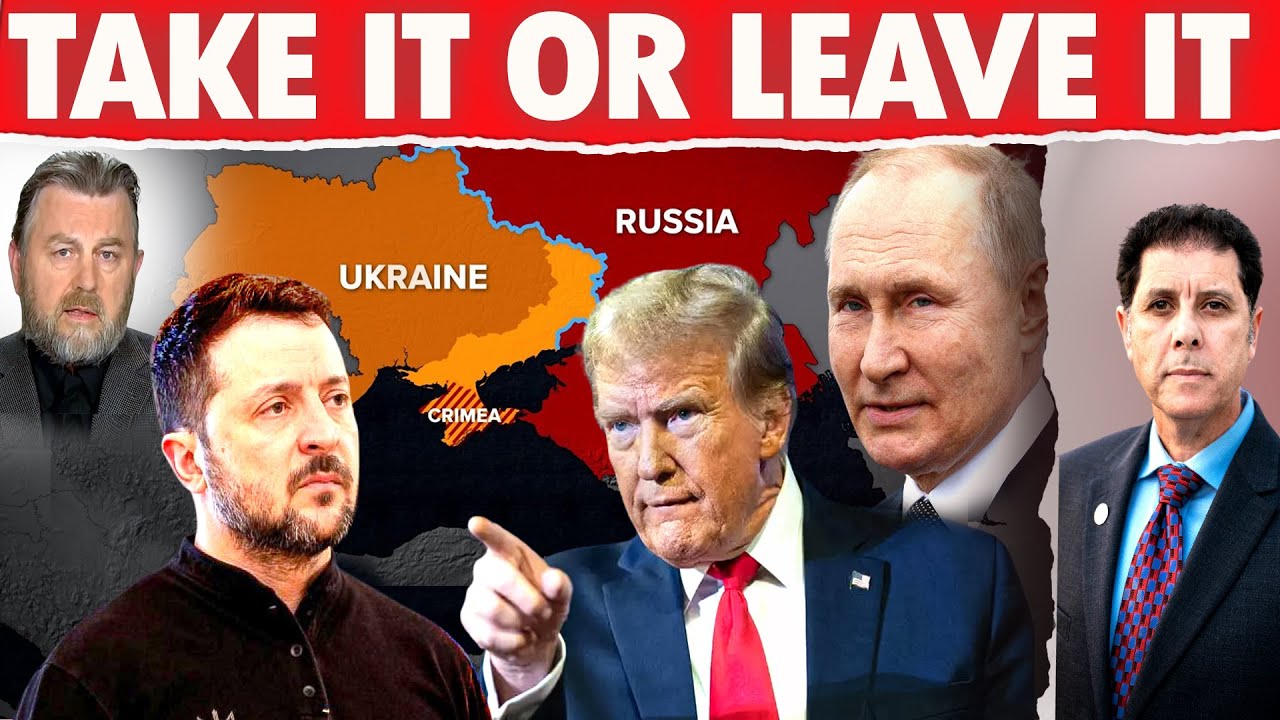
Former CIA officer Larry C. Johnson discusses whether Trump's proposed peace plan can work, covering the Russia-Ukraine war, alleged corruption in Ukraine aid, and tensions across Europe and Asia.
Chapters
Hello everybody and welcome to Geopolitical Trends, where truth matters. Excited to be with you as always. I'm even more excited because I have my dear friend Larry Johnson is here. Hi Larry.
Hey David, thanks man.
Good to have you here and we're very, very glad, uh, you carve out time for us here. To those who do not know who Larry is, which is a— you're supposed to know by now, Larry is a former CIA officer, and he was also the Deputy Director of the US State Department's Office of Counterterrorism. He is also the host of Counter Current. By the way, I'm gonna— for the community, I'm gonna put the link in the chat box. Make sure to go check it out and listen to what Larry has. The analysis he provides there is very, very insightful. So Larry, I wanna— we're gonna dive into this right away. I'd like to get your overall assessment about the Ukraine-Russia conflict, where it is as of now, before we delve into the peace proposals and so forth.
Ukraine is losing the war, losing badly, and it scared the hell out of the West. That's the headline. Let me turn it around. If Ukraine was actually winning the war, yeah, do you think there'd be anybody lining up to encourage a negotiated settlement, a peace process? I mean, if Ukraine really was beating Russia, oh no way, man. They'd want to crush Russia. They don't want to let Russia out from under, you know, if they've got them in the corner and they're beaten, you want to take them down. But that's not what's going on. What's going on right now is Russia, over the course, you know, starting in September of 2022 when Russia mobilized 320,000 reservists and then began a recruitment campaign in which they were signing up contract soldiers as well as conscripting draftees. Russia began the process of building its forces up to confront, to take on Ukraine militarily. Ukraine at the outset of the special military operation had around 280,000 active duty ground forces, Air Force and Navy. They don't have much of a Navy, so most of it was ground force, Air Force, but they had 900,000 reservists, which they then called up immediately. And so they were— they started the war off with about 1.1 million men under arms. And, uh, going up against Russia, which had, um, Russia's total ground forces were about 550,000. So at a minimum, Russia right off the bat was outnumbered in terms of ground forces. But over the course of the next, you know, 46 months, um, you know, these people would be— they come in, put on their uniforms, they get trained, they'd spend 3 to 6 months in training And every year Russia was gradually building up its strength. So by the start of this year, Russia finally was at about 700,000 ground forces deployed into, uh, the, the eastern half of Ukraine, with another 700,000 in uniform under arms in different parts of Russia. So they basically tripled the size of their army over the last 3 years. And that's why this year now we're seeing offensive operations accelerate dramatically. The Russians are attacking along 8 different axes. Previously they were, you know, able to do 1 or maybe 2 a year. In 2023 it was in Bakhmut, 2024 it was Avdiivka, but now they're up and down the line. You know, they just finished finishing off the agglomeration at Pokrovsk and Mirnograd. They're moving into Dnipropetrovsk. They're advancing forward in Zaporizhzhia. They're on the attack up in Kharkiv and in Sumy. And Ukraine doesn't have an answer. So it's in the face of this that the West hit the panic button, said, oh, we got to have a peace process, new, new peace plan. Uh, this is They're using the same old playbook. In January 2015, when the militias of the Donbas, of Donetsk and Luhansk, had the Ukrainian army surrounded at a town called Debaltseve. Debaltseve was sort of a Custer's Last Stand for the Ukrainian army, and Chancellor, German Chancellor Merkel, hopped on a plane, flew to Moscow, pleaded with, uh, Vladimir Putin. And Putin's, well, in my view, sort of stupidly agreed to sign on to what was known as Minsk II. Minsk II was, uh, was a ploy hatched by the West with U.S. support to save the Ukrainian army so that they could buy time, get time to re-equip, refit, train, and recruit, which is exactly what happened. It happened, yeah, then leading up to the events in February of 2022. So this latest maneuver with this, you know, Trump peace plan, whatever is in it— we've got some— there's so many different versions floating around, uh, it's not really clear what is, what is or is not in the plan exactly. Yeah, but I think this confusion is partly by design. And the Russians now, just, uh, you know, I was watching it 10 minutes ago on the television, uh, the Russians are saying we still have not received a formal plan, that, uh, the working document, we, we still don't know what the actual agreement is. So despite all these reports in the West, oh, there's movement, all the— they've agreed this, they've agreed to that, there's no agreement at all.
So, well, thank you for that, Larry, because there are a lot of people have been saying, at least in within my own community, some individuals been, uh, sort of expressing their opinions that why is taking the Russians so long? And my answer has always been, you know what, there is sometimes gradual movements for a reason. Those are strategic movements that the Russians are probably I do not know the answer. Probably, uh, right, they have a specific reason. And recently I saw the recent— the latest attack of the Russians on the Ukrainians. He went all the way to Kyiv.
Yeah.
And that gives me an idea right there. This is what the Russians were planning all along, is to really drain the resources for the Ukrainians gradually. And that's where we are right now.
So I'm glad you provided that insights, at least the overall Yeah, well, look, the reason they went slow— I've been— I should have seen this earlier. Yeah. And so I admit I failed in my job as an analyst. It was simply a manpower issue.
Yeah.
Russia did not mobilize for war. War mobilization would have meant a minimum of 3 to 5 million former soldiers would have been activated, put into the ranks. Russia didn't do that. They only mobilized 300,000, 320,000 September of '22. And even if you mobilize some new reservists, they still got to go through a training regimen, you know. So you're going to spend, you know, usually a minimum of a month or two with reservists, and maybe up to 3 months with new recruits, you know, minimum of 6 months. And so when you go back lay out, you know, remember this line of contact is over 1,000 miles long. That's the distance from Washington, D.C. to Miami, or, you know, the distance from Washington, D.C. to Chicago. So grab, you know, Russia initially went in with 125,000 to 160,000 troops on February 2022. Mm-hmm. Line those guys up fingertip to fingertip. They won't reach all that way. So you— so when you've got limited number of ground forces, you cannot attack at multiple locations because it's not just the attacking force that's involved. It's as well, you got to have the support for the logistics lines of communications, as you well know. Yeah. So that's why Russia was not moving rapidly in 2023. They were under— look, they're under no urgency. It's not like this is, you know, the last 2 minutes of the Super Bowl or the World, uh, World, uh, World Cup in soccer, that, oh my God, you only got 90 seconds, you got to get a goal. No, they didn't have to score a touchdown. Uh, they, they were— because their goal, as they said at the outset, only 2 goals. Demilitarize and denazify. Now here's the really interesting thing. When you look at some— one of these proposals that's been floated, they're saying, oh, they want Russia to agree that Ukraine can have an 800,000-man army. Do you realize that if they have an 800,000-man army Ukraine then is the largest army in NATO, larger than the United States, larger than Germany, France, and England combined. Combined. And when you go back and look at what the size of the Ukrainian army was in 2022 at the start of the special military operation, yeah, 290,000, uh, ground forces, or actually total forces, and another 900,000 in reserve. So basically, they're talking about only shrinking what was the total size of the activated Ukrainian army as of the summer of 2022 by just about 100,000. Russia is not going to agree to that. That's not demilitarization. Russia and Ukraine actually had agreed in March of 2022 in Istanbul to limit the Ukrainian military to 85,000. So that's demilitarization. And so there is nothing in this proposed U.S. plan that actually demilitarizes Ukraine. So from Russia's standpoint, that's a non-starter. That means this negotiation will be dead if that is in fact what's in this proposal. The second element is the denazification, which means The current government of Zelensky must be disbanded. Those who are aligned with the right sector and Azov battalions, they've got to be removed from government, and there have to be new elections where the Banderites are not involved. Russia's insisting on that too. That's not, that's not a negotiable part. It's not, well, well, maybe we can compromise. No, they can't compromise on that. And third and last is the territory that Russia now occupies in terms of Crimea and even its presence in Zaporizhzhia, Kherson, as well as Donetsk and Luhansk. Those are legally, constitutionally part of the Russian Federation. Okay, so they— Vladimir Putin does not have the legal authority nor the power to negotiate those away and say, okay, yeah, well, we'll stop the conflict here in Kherson and in Zaporizhzhia, we'll let Ukraine have that other part. Not going to happen. And yet you got all these, you know, nuts commentators in the West thinking that that's a viable proposition. It is not.
Well, I'm glad you brought this up, Larry, because that was, uh, what I was gonna get next into regarding— and, and since you mentioned all this, which makes a makes perfect sense. How significant then the question about this proposal by the US?
Yeah, it's—
there's nothing there.
It's, it's, uh, cotton candy, you know, appears to have some substance to it, but once you dig into it, not. I mean, you know, one of the, one of the, one of the leaked documents— and again, we don't know which, which version actually is the Trump plan— said telling the Russians, oh, you sign on to this plan, we're going to let you back into the G7. We'll make it the G8 again. How about that, huh? And I've, uh, I was doing a radio interview with folks in Milwaukee, uh, Wisconsin, you know, land of the Green Bay Packers. And I said, that's like, that's like going to the Green Bay Packers after they've won the Super Bowl and said, hey, We got you sign on to this deal, we're going to let you join the Canadian Football League. How about that? The hell you talking about? You know what, that would be a step down. Yeah, that's exactly how Russia views the G7. BRICS nations right now have more GDP, have higher economic growth, service of more people in the world. Than the G7. Indeed. G7's a dying organization. Russia's made it clear they don't want to be part of that. And yet the Trump plan said, oh boy, we're going to let you be part of the G7. That's like saying, hey man, I'm going to give you a chance to have a colonoscopy. No thanks.
Thanks.
Not interested. Yeah.
Well, at this point you brought up, uh, Larry, it's on I think clause number 12. I read the 28 points, so the one you're referring to is in clause 12. By the way, just for the community, I'm going to put the link for you for the 28, uh, plan here. You can read up on it later on should you decide to do so. Now, the next one regarding this aspect, Larry, would become to me is the idea of, of course, the Russians not going to accept whatever the Americans are saying. But my argument is that the idea that is the United States doing this because he wants to avoid being perceived as the loser, because basically the US lost, NATO lost, Ukraine is done for. Is this a way for the Americans to save face?
Trying to, yeah. I mean, this is, this is a, this is a Hail Mary pass. This is a last-ditch effort. But, but, but the problem is, you know, to extend the football metaphor, yeah, uh, the, the, the score is Russia's got 47 points, uh, the West has 6. 6. And there's 2 minutes left to go in the game.
There is no way. There's no way, no matter what.
Even if, even if they scored a touchdown every 30 seconds, they still don't have enough time to win at all. Um, and so this is, uh, this is Trump's effort You know, they had an initial agreement apparently in Anchorage, Alaska, or at least the Russians felt that they had some acknowledgement, acceptance on the part of Trump what the Russian position was. But then, you know, this whole European bloc along with Zelensky and all the corrupt Republican legislators, Republican and Democrat legislators who've been getting money under the table from Zelensky. I mean, they've been paid Millions, millions of dollars. One, one Republican senator from the South is— I'm telling you, he received $16 million. Uh, one Democrat senator from the Northeast, uh, prominent, uh, got $23 million. And it's all money that was taxed, U.S. taxpayer money that got diverted to, uh, Ukraine and then was taken out of Ukraine, laundered through banks in the Baltics, particularly Estonia and Latvia. And then lo and behold, winds up in bank accounts of members of Congress and certain corporations. You know, this, this is a corrupt scheme.
And actually, yeah, go ahead, Larry.
No, I was just going to say, and that's, that's why we saw this initial leak that, oh, about the $100 million that had been stolen. I mean, that's just, that's chicken feed.
That's nothing.
Yeah, we're talking tens of billions of dollars.
Yeah, actually, I have it on good authority, Larry, that the total amount of money that was pumped into Ukraine since 2022 reached about— and I know the sources will not just disclose whatever— reached about $360 billion.
Yeah, I have heard that as well.
Yeah, I got it on good authority, and you know what I mean by good authority.
Yeah, yeah.
So, and that the corruption amounted to about between 15 to 30% of the total aid. And here is exactly what you just stated about members of Congress getting this. Here is what it means. It means that $54 to about $108 billion was lining the pockets of the corrupt. Yeah, yeah, that includes members. So you are absolutely correct about your assertion regarding the corruption there.
So yeah, the, uh, and, and My, my business partner has been involved with filing a whistleblower complaint with the US government on this issue because he had, he had whistleblowers come out of Ukraine.
Yeah.
And he had identified, I think the documents they provided identified like $48 billion. But I don't at all dispute that the number is probably much higher. He was just able to show what he actually had documented evidence for.
Yeah.
So this is, you know, and so that's one of the reasons the corruption charges sort of appeared in the press. Yeah, it's a way to try to pressure Zelensky to make, you know, they've got to make some accommodations with the Russians. But remember, the ultimate goal here is to destroy Russia. This isn't about getting an actual fair, just settlement. This is about the destruction of Russia. The West is not backing off of that.
No, no. If we are to think about this, just to go back to the proposal aspect, which I know is not going to amount to anything. One thing that caught my attention about it, Larry, was that the Europeans have been sidelined. What kind of message is that sending, in your opinion, geopolitically speaking?
They're irrelevant. I mean, wow. Why? Why talk to the Europeans? What do they have to bring to the table? You know, do you remember, do you remember that, uh, the movie with Mel Gibson? It was called Payback.
Payback, yes.
Yeah. And he was, you know, he was, uh, set up. They did a robbery and one of his partners in the robbery betrayed him along with his girlfriend at the time. And, uh, um, you know, they, they tried to kill him. And so he comes back from that and he starts, you know, seeking revenge on those who set him up. And he finally gets this partner of his and, you know, catches him in the act of trying to kill his new love interest. And Gibson's got him down on the floor with a gun pointed at him. And Mel Gibson says, hey, can you do this thing for me, X, Y, and Z? And the guy says, well, no. And then Gibson goes, well, what good are you? And shoots him. That's Europe, okay? That is Europe. Europe's the guy on the ground that says, eh, you know, I'd like to help, but I can't do anything. What do they have to offer? They don't have natural resources. They don't have unlimited piles of cash. They don't have a massive industrial base. They've got nothing except money that's in banks that they control. They exercise some leverage over that, uh, back out of the City of London. But, uh, and it is, you know, they're acting like they're a bunch of tough guys, and they're not. They, as I pointed out, the combined armies of Germany, France, and the UK don't even match up with, with what Russia has by, by a far stretch. That's why they want to, that's why they want to build up the Ukrainian army to 800,000. Not that Ukraine's got that many people around, but, uh, you know, this is, um, so, uh, you know, I, I've seen another meme on, on social media, uh, is this. I, I've got, I've got Rottweilers. I love Rottweilers. And so there's this big old Rottweiler sitting there trying to sleep, and this little Chihuahua, you know, yapping at him. Yeah, the Chihuahua, yeah, yapping away. And, and finally, so the dog, the Rottie, wakes up, looks at him, goes over, picks the Chihuahua up by the nape of the neck, carries it over. He's standing next to a swimming pool, flips his head, Chihuahua goes flying in the air and lands in the pool. Okay. Yeah. That's what Europe is. Europe is an annoying chihuahua.
It is a good analogy. Literally, it is a good analogy because I didn't understand, first of all, what are the Europeans trying to achieve to begin with? And this argument and this narrative that they push in the narrative regarding, well, we're going to have to fight the Russians. They will stand no chance whatsoever. I mean, I just don't get it. I don't get it.
Well, I say, hey, I want to buy a massive piece of real estate. I'm going to need to come up with, uh, with a billion dollars.
Yeah.
So I'm gonna get— I'm gonna get into negotiations with you. I said, well, David, how much money do you have? Yeah. Oh, well, I actually— I'm bankrupt. I don't have any money. Okay. Do you know the owners of the property? No, no, no. Then why am I talking to you? You got nothing to offer. Yeah. You know, it'd be one thing if you had piles of cash or if you were in a good relationship with the owner and could actually get me a backdoor deal. Fine. But you have nothing. And that's why I think Europe has nothing but threats. Oh boy. Yeah. We're going to, we're going to rebuild our military. Oh, good luck. Good luck with that. You know, they can, uh, I've never seen a situation. I don't think historically we've had something since, in, in, uh, you know, for 400, 500 years where there was such a disconnect between the political leadership and the actual people that the political leadership is pretending to govern. I asked that question of a Norwegian friend of mine that has a podcast, Hakon Bergmark, and he said, yeah, he said he, he thinks it goes back to like, you know, the 15th century, maybe. Wow, that's been that long. And so, because whether you're talking Friedrich Merz and Emmanuel Macron, Keir Starmer, none of them are popular at all. They got zero popularity. And, uh, the people aren't lining up saying, oh my, what great leaders these are. And actually, you're seeing a similar phenomenon starting to develop with Donald Trump. Trump is losing his political support. Yeah, I did see a story the other day suggesting that, uh, he's considering getting rid of Pam Bondi and Suzy Wiles. Yeah, that would not surprise me. That would tell me that his sons Don Jr. and Eric had finally gotten to him and said, Dad, these, uh, these ladies are killing you. They're not doing— you know, Bondi hasn't done what was what we were supposed to deliver on the promises about going after the deep staters. And Suzy Wiles has made serving Israel a priority, and Trump has lost the support of the America First people. And so when you get people like Tucker Carlson and Candace Owens and Theo Vaughn, you know, there's a whole list of major podcasters that are, you know, no longer providing any positive spin for Trump. Trump's in trouble. That tells you a story right there.
So what's next now for Ukraine, uh, Larry, in your opinion?
Uh, more, more death and destruction on the part of the soldiers. You know, right now, over the course of 2025, let's just follow the numbers. Yeah, Russia is killing and wounding 40,000 Ukrainian soldiers a month. Uh, there are— so by the end of December, Ukraine will have sustained about 500,000 killed and wounded. On top of that, Ukraine is losing to desertion 20,000. That number comes from the Atlantic Council, not exactly a pro-Russian outlet. Or 40,000 a month according to the Institute for the Study of War. Again, another uber, uh, pro-Ukrainian outlet with the Kagans and then, you know, Victoria Nuland supporting it. Oh, General Jack Keane. Um, so when you add those numbers together, at a minimum we're talking losses of 60,000 a month. Well, how many are they recruiting per month? Again, this is from Ukrainian sources— 17,000. Well, you know, that's— let's put it in financial terms. If you're getting $17,000 of income a month but you're spending $60,000, how long before you go bankrupt? That is exactly where Ukraine is, on the road to bankruptcy. So, you know, in theory, the war could end in 5 or 6 weeks, or it could, it could drag on until early next spring. It's all really a function of how fast Russia decides to push the front. And the West always assumes that they're on some sort of timeline, and Russia isn't. They're not, and they're not facing— there is not domestic political pressure saying, stop the war, stop the war, Mr. Putin. No, just the opposite. There's strong support for And Russia has not gone on a war footing. That's the thing the West still refuses to understand. Russia is in a special military operation. It's only a very, very partial mobilization, and the wartime economy is not dedicating the entire economy to supporting the war effort. The rest of the economy is going along. They had to, they had to take steps to slow it down because inflation was, uh, headed towards, uh, you know, double digits last year. But, but they've accomplished that now. They're— the Nabiullina, the central banker, she's brought it down. So, um, you know, Putin, if anything, Putin would be pressured— he would face possible removal from office if, uh, he bailed out of the war tour. Yeah. Is that you getting the noise or me?
No, no, it's me. It's outside.
Oh, yeah.
No, no, you're fine.
You're fine. No.
And by the way, just for the community, uh, what Larry was talking about, also you can find it in his, uh, you need to subscribe to his Substack. I'm gonna put the link for you in the chat box should you decide to do this. And, and trust me, I read his stuff. It's, it's very insightful. So, uh, and this is not about promoting Larry, whatever. You know, Larry and I, we, we know it's not that kind of stuff. It's what's substantive, and I want the community to learn something. This is the reason why I am mentioning what I'm mentioning. I want to shift, uh, you're welcome, Larry. I want to— I truly enjoy reading your stuff, and I keep an eye from a distance reading because it's very, very, uh, informative and, and also based on facts. Yeah, I remember when you did the detail, when you did the detail about the casualties I read the numbers and you had the sources of the, the facts for those numbers in comparison to what was, uh, promoted here in Washington. So yeah, so I, I appreciate you doing that because I can only imagine the amount of time it takes you to research that information. And thank you for that. So I want to shift, Larry, to Venezuela. I, I can't let you go. I need to have your insights. Actually, I have two other One has to do with Asia, but I want to talk about Venezuela.
Yeah.
Where do you see this is going in light of the US naval assets deployment, but also the push behind the scenes by Marco Rubio, who wants— who is an avid anti-Venezuela? Where do you see this is going?
This, this reminds me, uh, a lot of the effort we went to to get rid of Manuel Noriega. Noriega. Yeah, so, uh, I was in the— so the, the entire plot to take down Noriega really got launched in late, oh, late 1987. Um, and, and so it consisted of the CIA conducting a variety of operations, both trying to organize officers internally to Panama who would take Noriega out as well as create a number of provocations where we, we could create a justification for U.S. intervention. Now, Panama presented a much, much easier target because we had actual military forces already based in Panama, both up in, in the area of Colón and then down in Panama City. So we already had a strong military presence there, and Panama is a small country, for God's sake. You can drive, you could drive across that, you know, if you didn't have to worry about traffic, you could get from Panama City to Cologne in an hour, hour and a half. Okay, so we're not talking a great distance at all. But here in Venezuela, and I maintain Venezuela is the Spanish word for Vietnam, okay, the country of Venezuela is twice the size of Iraq. And when you, when you look at what we had to do to try to pacify Iraq, which we never succeeded in doing, we went in with 130,000 troops and we were fighting over terrain that was largely flat, largely free of trees, heavy forests, uh, largely free of water, swamps, river crossings. Venezuela is all of that. It's just the opposite. Triple canopy forests, mountains, rivers, wetlands, a very difficult terrain to navigate in. And as far as being able to control borders where insurgent groups could move back and forth, impossible. Venezuela is bordered by Colombia, Brazil, principally. And, you know, there's no control over those borders whatsoever. So, you know, here's the United States rattling chains, trying to provoke a reaction from Maduro. Maduro so far has refused to take the bait. And then I think there's some U.S. commanders that are, you know, advising the president, we can't do it, we do not have the military power to go into Venezuela and take control of the country quickly and easily and secure, secure control of the oil platforms. I guarantee you that if, if the United States in some way takes military action and it has at least temporary control of those oil platforms, you're going to see repeated attacks on those platforms by by insurgent groups out of Venezuela, and U.S. won't be able to do a damn thing to stop it. And so we'll be bogged down in another endless war. And look, in the same way we failed to defeat the Houthis, okay, we had to abandon the Red Sea. Venezuela is a far more powerful, capable military force than, than the Houthis. They don't have the number of ballistic missiles that the Houthis did, but they certainly do have some air-launched missiles, you know, air-to-ship missiles that can certainly put a hurt on the U.S. Navy. So this is, you know, what Trump is trying to do there is, I think, ultimately secure access to the oil, to the gold, to the natural resources that are part of Venezuela. And looking for any excuse to do so. But Venezuela is getting support from Iran, from China, and from Russia. You know, they're singing Ringo Starr, I get by with a little help from my friends.
Yeah, yeah. To my knowledge, Larry, the naval assets now, all these deployments and this hoopla, whatever, amounts to only 10%. And that's not going to cut it for dealing with Maduro. Once again, I was informed that Maduro moved about 200,000, yeah, people to the, to the, to the coastlines in preparation for— and for us, I, I just don't get it as to Trump, what is he doing in Venezuela? And of course, Marco Rubio pushing the narrative behind the scenes. Yeah, yeah, it's problematic. My last thing, I know you are, uh, uh, uh, have a crunch on time and I want to be mindful of that. I want to take your, uh, I want to have your inputs about what's going on in Asia. I'm sure you're aware of what took place with the Prime Minister of Japan, uh, Sanae Takashi, uh, her provocative statements, which to me shows the lack of diplomatic maturity in, in provoking, uh, China. Now, when we see what's coming out of Japan, when we see, of course, the North— the South Korea, and we see the Philippines and so forth, are we looking at a U.S. reviving a mini NATO in Asia?
No, no. But what we are looking at is, uh, Japan crossing a line and potentially going to start a war with China that, uh, could draw the United States in. And again, would represent another major defeat for both China— I mean, for the United States and Japan. Japan. Xi Jinping made a phone call. He initiated a phone call with Trump a day after this prime minister made these crazy comments.
Yeah.
And the Chinese readout from it made it clear the bulk of that conversation was Xi Jinping telling Trump, uh, if, if, if you're— if your buddies in Japan keep this up, we're going to attack them. And if you get drawn in, you— we will attack you. So be aware, you're crossing into war territory. You agreed with us 52 years ago that Taiwan is part of China. You, the United States, agreed to that. Now you're claiming that you want to back out of that? Well, if you back out of that, then you're going to have a problem with us. She delivered the message and Trump got a hold— he got a hold of that message and his next phone call was to this crazy lady in Japan. And basically telling her, shut the hell up and, you know, keep your mouth shut. Stop this. We'll see if it works.
Yeah, because it's, it's really, it was unusual. As, as you know, Larry, every former Japanese prime minister never crossed that line.
Yeah.
This is the first time that I, I was kind of surprised.
So yeah, no, I agree with you.
Anyway, I want to give you a last word, Larry, before I let you go. We go back to Ukraine and this proposal and so forth. How do you see it moving forward between now and the end of the year? What do you expect or anticipate?
Russia will be well on its way to the Dnieper River, and the panic in the West is going to grow because they'll realize they cannot stop Russia militarily. This effort to try to derail Russia's military offensive with these diplomatic ploys is going to fail.
Wow. Well, Larry, I thank you. I can't thank you enough, my friend, for being here. I wish you a happy Thanksgiving, and I look forward to seeing you again.
Yeah, David, happy Thanksgiving to you and your family as well, and thank you so much for the honor of being able to talk with you.
It's always a treat to have you, my friend. You take care. Thanks.
Bye-bye.
Well, everybody, I hope you all enjoyed listening to Larry. I know he's pressed for time because He had some other commitments and I wanted to be mindful of that. So, uh, we, we were just grateful that he had enough time to carve out for us here to share with us his knowledge. So, uh, to all of you, first of all, I wanna say thank you to, uh, uh, Tara Mubarez. Thank you very much for, uh, your Super Sticker. The one and only Larry, the shirt Johnson should be a great show. Indeed. Indeed. So thank you so much for your Super Sticker, American Citizen. Truly appreciate you for that. Uh, do you foresee famine expanding or contracting in the future? Happy Thanksgiving. Uh, American Citizen, where? Uh, famine here in the US? I don't know exactly where. Before I answer, if you could just type in, in the chat box, uh, which, uh, do you foresee famine expanding or contracting where in the future? I'd like to just uh, see this one before I'll answer that question. And thank you very much for your super sticker. So, uh, John Dutchman, thank you so much. You're most welcome. And I'm glad you guys were able to join me here. For those who were able to make it, uh, to my American viewers, I'll say Happy Thanksgiving, and I look forward to seeing you next time. As always, remember, geopolitics impacts your daily life. In more ways than one. Till next time, bye-bye.
More from David


Beyond the Single Actor: Why the Gulf Isn't Choosing Between the US and China


Iran, Iraq's Militias, and the Houthis Are Coordinating! This Changes Everything




Who Controls the Next Decade's Resources? Latin America and Africa's Geopolitical Crossroads

The Chokepoint Trap: How Washington's Stupidity Triggered a Cascade That Now Controls the World

Trump Spooked as IRGC Unveiled dual-use SLV, Deployed Ghadir Mini-Subs & Hinted at Tactical Nukes!
