Yemen's Militia Just Forced a U.S. Supercarrier to Flee — What Comes Next?
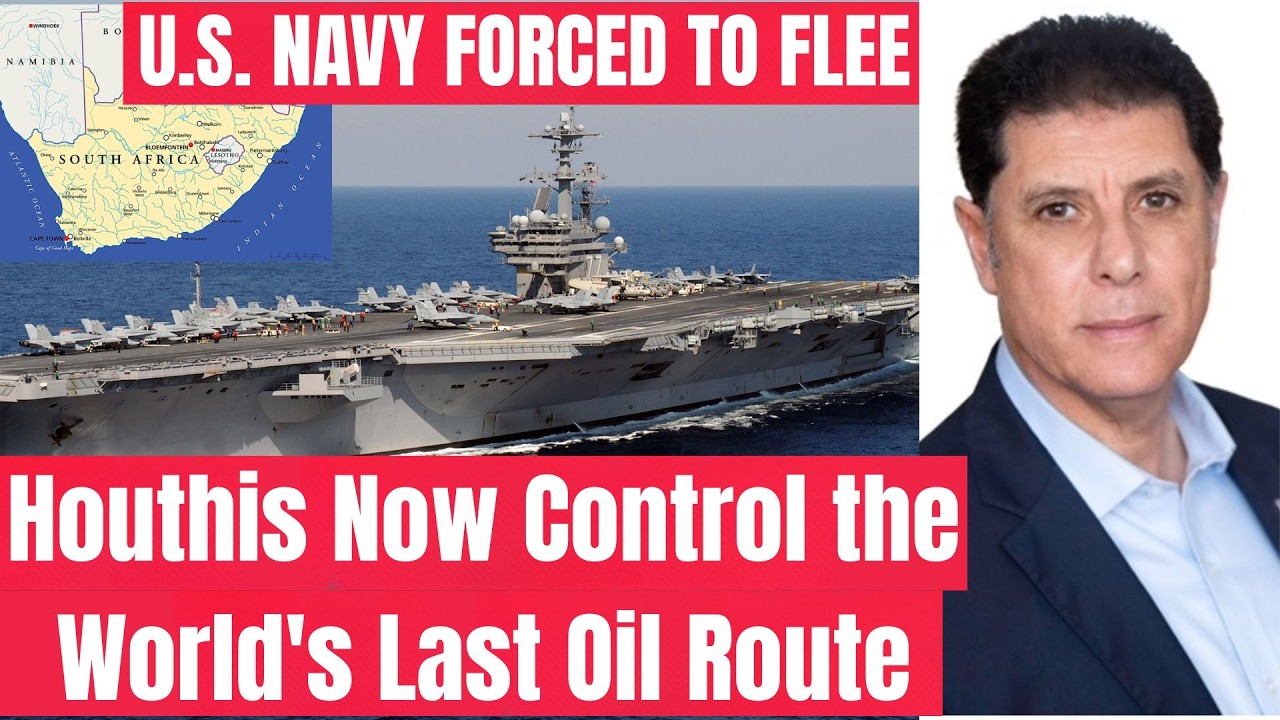
David Oualaalou breaks down what happened when Yemeni militia forced a U.S. supercarrier to retreat, and what the military and geopolitical fallout could look like next.
Chapters
Hello everybody and welcome to Geopolitical Trends, where truth matters. Two narrow strips of water, one controlled by Iran and the other one is controlled by Yemeni Houthis, or Ansarullah. Together they hold about 30 to 31% of the world oil sort of under their control right now. And right now both are being shutdown at the same time. Surprising, huh? This has never happened in modern history, to my knowledge. What you are about to hear in this livestream here, which I'm going to be providing you my own analysis about this development, should concern not just you but everyone on this earth. Why? Because this isn't just about oil. It is about food. It is about medicine. It is about global economy, which is grinding to a halt. And the clock is already ticking, given the fragile US-Iran ceasefire deadline, which, by the way, expires tomorrow. But there's already stumbling block regarding the Islamabad negotiations. So this is what's important for you to understand about this particular livestream that I'm going to be sharing with you my insights about moving forward. Now, here is the interesting thing. Still, by some estimates, some say, well, it's still US, one of the sort of strongest navy in the world. But that strongest navy has just sailed 6,000 miles around Africa. Let me just put this in a map for you because I'm going to share, I'm going to share some info with you here. And why is that? Because they wanted to avoid the Houthis. Let that sink in. What we have, we have the USS George H.W. Bush. I have a picture of it right here. A nuclear-powered supercarrier with about, give or take, 4,500 to 5,000 sailors and the most advanced weapon systems ever built. And that took a detour around an entire continent because Yemen's Houthis made a direct route too dangerous. You all know what happened last year, right? You remember when the USS Eisenhower moved out of the Red Sea because the Houthis weren't bluffing. We're talking about the— if we are to use the term— the most powerful navy. And if that doesn't tell you the seriousness of this situation, you know, has become, then nothing will, in my opinion. And this is exactly what the mainstream media isn't fully disclosing or explaining. That is what I do in this channel here. So what I'm going to do here, I'm going to provide you my own analysis. I'm going to play a clip, a clip for you, providing translation. The clip, I give credit to it to AFP, the Associated French Press, l'Agence de France-Presse. Then, then I'll do a conclusion for you, but I'm going to share some clips towards the end, very, very short. Those are like 2 minutes and so forth to put things in perspective for you. So make sure to stay with me till the end. Now here is the strategic context that I want you to understand about these developments that is taking place, especially with Bab el-Mandeb, because it's very, very crucial. We know what's going on with the Strait of Hormuz already. Now we're talking about the second choke point that Iran understand and the Houthis understand, and the US doesn't seem to get it yet. So the strategic context for this, this threat by Ansarullah Houthis doesn't exist in isolation. Because if you go back to February 28th, 2023, of this year, when the war started, or when the illegal war started by the US and Israel attacking Iran, the Strait of Hormuz has been largely blocked by Iran. And that came right after the US and Israel airstrikes on Iran and, of course, the assassination of the late Ali Khamenei. And that set the tone for what lies ahead. Okay, that single choke point— and the one I'm referring here is to the Strait of Hormuz— that single one normally handled roughly, as you know, about 20 million barrels per day of seaborne oil. And now with the Strait of Hormuz being disrupted, the world has been rerouting through the Red Sea. And that's making Bab-el-Mandeb— let me put the picture for you so you, you put it in perspective here for you. Uh, I'm sorry, not this one here, it's right here. Bab-el-Mandeb, making now Bab-el-Mandeb the last functioning major energy corridor out of West Asia or Middle East. That is what's important to understand. So why is this threat uniquely dangerous? This is different. This is not about just bluffing here. So it's because it's the last lifeline problem that exists. And with the Strait of Hormuz largely offline, you have one country, for example, Saudi Arabia, which has made the Red Sea its primary alternative for keeping the oil flowing to Europe and Asia. And that in itself has quadruple the crude loading from its Yanbu port. There is a port in, in Yanbu, it's called Yanbu. I'm gonna share the link, the picture, I'm sorry, with you right there. That's Yanbu port, and I give credit to Abdullah Al-Duwairi. That's a picture that I found, uh, credit is due to the guy. Why is this important? Because Saudi Arabia's East-West pipeline has been restored to about 7 million barrels per day of capacity, with approximately 4 to 5 million barrels per day available for export via that port, that Yanbu port terminal. But through this port, by the way. Yeah, but if this is the big if, if Bab el-Mandeb is shut down, closes completely, this escape valve disappears in its entirety. In other words, there will be no oil flowing out of the Red Sea. And this is where you have to understand the scale of the potential disruption. In normal times, Bab el-Mandeb sort of handled about 9 or 10 million barrels per day of oil and petroleum products. But if the Ansarullah Houthis follow through, which shut it down completely once they get a signal from Iran, You were talking about a total potential disruption, including the Saudi Yanbu export, other Red Sea crude flows, and of course, the Suez Canal pressure. All this is going to have happen. And this is where you have the double chokepoint scenario with Iran reimposing restrictions of the Strait of Hormuz. Of course, after the US seized an Iranian-flagged vessel, there will be no doubt of how, if there will ever be talks moving forward, which so far the talks have stumbled. Iran is not sending anybody to Islamabad. The US Vice President, as I said yesterday, wasn't going. All of a sudden, he was ordered to go. Nobody knows what's gonna happen. And the world has never simultaneously faced both the Strait of Hormuz, okay, and Bab-el-Mandeb being closed simultaneously. That is the interesting aspects of it. Then you add the Ansarullah al-Houthi threat itself because Ansarullah al-Houthis have proved that they are not some whatever. They are a force to reckon with. And the official of the Houthis, his name is Hussein al-Azzi, posted on X stating, and I quote here, if Sana'a— Sana'a, the capital of Yemen— if Sana'a makes the decision to close the Bab el-Mandeb, no force we'll be able to reopen it, end of quote. And you'll see in the clip that I'm going to share with you and translate for you, you'll see this quote there. And this in itself, the spokesperson is saying, we urge Washington to end all actions and policies that stands in the way of peace, end of quote. So in my opinion, this is not an idle blaster. This is not just hot air. This is not rhetoric. This is not bravado. The Houthis are already waiting for an Iranian signal to resume the attacks. And around— what do we have right now? You have around 30— yeah, 3-0— 30 tankers near the Saudi port city of Yanbu are currently within the Houthis' strike range. All of them can reach this in no time. And here is the interesting aspect of it. I'm gonna share with you a picture that shows the range of the Houthi missiles. Take a look. Just let that sink in. Why the Houthis are in possession, once they get the signal, to shut down the Strait of Hormuz. And that's what the Houthis, or Ansarullah, have demonstrated. Remember, between 2023 and 2025. That they can practically cut commercial traffic. And their past attacks have already halved the traffic through Bab el-Mandeb. I looked at for the stats and I'm gonna provide you the link from, I got it from an energy news beat, which deals with just the traffic of energy. What they end up doing, Houthis back then between '23 and '25, behalf the, the transport or the movement of this with oil flow dropping from a peak of 9.3 million barrels per day in 2023 to just 4.1 million barrels per day in 2024. That should gives you the, uh, uh, it should tell us the story exactly what is happening. So I'm going to put the link for that article that I, uh, research for you, and you can read it should you decide to do so. With all this happening, you have our delusional president— yeah, delusional president— it's coming and saying— here is what he says, and I quote him: I achieved a resounding victory over Iran, and I will not allow traitors to diminish it. His reference, by the way, it was to the Democrats because that is where the problem for Trump now is, the upcoming election in November, midterm elections. And that is what he's saying. But Donald Trump is delusional because that's exactly what I said yesterday, that he is achieving a resounding victory in the war of Iran. Really? I mean, just doesn't make any sense. Doesn't make any sense, but that's Trump for you. So the other aspect I want to talk to you about briefly here is the geopolitical dimension of the angle of the Houthis or Ansarullah. A senior Iranian official disclosed, and I stated word for word because he told Reuters, and you know Reuters is a US source, but you know, you still can ask for ideas from diplomats and what have you. Here is what he said, and I quote, "If this situation gets out of control, Iran's allies will also close the Bab-el-Mandeb Strait," end of quote. That's the signal. Where is the signal there? If the situation gets out of control. That means it's a signal for the Houthis to go ahead, or Ansarullah, to do what they need to do. And that in itself will signal that the Houthis' threat is coordinated with Tehran as a geopolitical bargaining chip. This is not just some group doing whatever. No, no, no, no, no, no. This is a geopolitical calculated move. And this means what? It means that Bab el-Mandeb closure isn't just a Houthi tactical move. No, no, it's part of Iran's broader pressure campaign that Iran, which is mastering very well during the ceasefire negotiations with the US. Why, you may ask? It's because the US is not honoring its commitment. This is why the Houthis will end up doing what they need to do. And here is why the Iran-Houthi or Ansarullah relations, it's not that Houthis always have to have the green light from— no, no, no, no, because it's not that type of relationship. It is a partnership. This is what the US is not getting. This is what the politicians in Washington is not getting. They're thinking about this Ansarullah and Houthis just whatever. No, no. The Iran and Ansarullah relationship is a partnership rather than a direct command structure from Iran to Ansarullah, because in this partnership, both sides asserting independence while often aligning on foreign and military objectives. Look what happened last time. We had to move the USS Eisenhower Dwight Eisenhower aircraft carrier because we were concerned. And as a matter of fact, to my knowledge, the recent trip of members of Ansarullah to Moscow, they've been provided with certain type of information to really target the movement of US naval assets in the region. And this is why, in my opinion, this kind of movements makes sort of the theater, or I'm sorry, the threat, which is threat that they can carry, harder to negotiate away from. Because there is no single lever that Iran can pull. Iran has options. This is what we are not understanding. We in Washington, we're not getting. And to make matters worse is the US seizure of the Iranian oil tanker. Has potentially now triggered a cascading escalation that threatens to simultaneously shut down the world's two most critical maritime energy choke points. Let me put a picture for you, uh, for the community here. Once again, it's the Strait of Hormuz, and the second one is Bab el-Mandeb. This is what the US doesn't think. We don't think strategically. In the long term. So the combined effect will be basically what? An oil supply shock of historical proportion. And by the way, there is no other viable short-term alternative routes. Forget about the Suez Canal and all that. It's not gonna— it's gonna happen. Why? Because any ships will have to go around the Cape of Good Hope. I have the, the, the World Atlas map for it in South Africa. That's what the US had to do with its aircraft carrier, the USS George Bush. So because when you consider this detour, it takes about 10 days additional for travel and $1 million per voyage. Think about it. It's catastrophically insufficient for companies to hold on on this because the world energy— if all Middle Eastern exports are cut off all at once, it becomes problematic because this is arguably, in my opinion, and to those who've been around for a while, you will understand that something like this is arguably, arguably one of the most consequential maritime threats to the global economy since 1973 oil embargo. I pulled out a picture from archives. Check this out. 1973 in the United States. Sorry, no gas. And that's exactly what I argued when I wrote the Saudi book. I think that's when I talked about this one. Let me, let me share just this short excerpt with you. It is what I wrote back there, back then. Saudi Arabia does not know what to do. It failed miserably when it decided to pursue a military misadventure against the Houthis, whom Iran supports. Now Saudi Arabia is convinced that the time has come for it to enter into some form of political negotiations to end the conflict. Moreover, that will certainly confirm Iran's growing regional hegemony and influence. Welcome to the new geopolitical landscape of the Middle East in which Iran captains the Middle East political game while the Saudis watch from the sideline. That's exactly what I argued back then. And remember, that was when the Saudis decided, when MBS came to power sort of in unexpected way, oh, I'm gonna just send my military to Yemen and crush the Houthis. He was stunned and surprised by what he found to the point he start begging behind closed doors through intermediaries to negotiate with the Houthis. And I tell you this for fact because I was aware of the developments that took place because we were providing the intelligence reports and targets to the Saudis. And this is at the same time when we go back to our topic about the Houthis or Ansarullah, Yemen's Iran-backed Houthis, this, that's why they are issuing a direct threat to Donald Trump in this deepening crisis because we are not on, on right. Why are we seizing the, uh, the Iranian oil tankers? Why if we are not interested in peace? Which, by the way, I'm going to share clip with you to show you that the US want to bribe Iran and Iran turned it down. I'll, I'll share it with you towards the end. So the idea that when you think about, uh, why the Houthis doing it this way Because you are talking about this global waterways that are so crucial. And when Houthis threaten to shut down Bab el-Mandeb, they ain't joking about it. And they ain't just sort of, "Oh, we're just flexing our muscle." No, no, no, no, they will do it because that move in itself could cripple international trade and energy supply routes for quite a while. So here's what I'm gonna do. I'm gonna share with you a clip here, and I'll do the translation for you. And this one from l'Agence France-Presse, which is— c'est une agence de presse— it's an international news agency headquartered in Paris, in France. And by the way, just to let you know, to those who do not know the AFP, the Agence France-Presse, its origin goes back to 1835. When it was founded as Havah. That's what was the name originally for, and that makes it one of the world's oldest news agencies. So, and in August, just some historical, uh, snip, uh, snippet here. In 1944, because I read on it, my family lives in France, so I used to go there a lot and I read their stuff. And so you have to read the history of that particular agency. In 1944, August '44, What happened in August '44? Paris was liberated, remember, from the Nazis at the time, and it was recognized in this case as the Agence France-Presse to succeed Avaar. So I just want to share this with you. Let's, uh, let's, let me, let me play this one for you. And again, not play it, but rather I'm gonna do the translation and And as I said, uh, uh, one in the— I don't know, they playing it, but I give credit to the AFP because that is the credit goes to here. So, so here is what it says here, and I'm going to do the translation quickly, then we'll move on because I have a lot to cover. And I'm going to silence this one here for you. Uh, a second global choke point is now under threat, and the warning couldn't be more dramatic. Yemen's Houthi leadership has issued a direct challenge to Donald Trump threatening to shut down Bab el-Mandeb Strait, a move that could shake global trade and escalate an already volatile standoff. In a fiery statement posted online, Yemeni Deputy Foreign Minister Hussein al-Izz— that's the one I mentioned earlier— warned that if Sana'a decides to close the Strait of Hormuz, it will be impossible to reopen, invoking even supernatural forces to emphasize the threat. The message was clear: back off or face a new front in a maritime crisis. The Houthis are widely aligned with Iran, as you know, and their latest warning appears to mirror Tehran's strategy in the Strait of Hormuz. Two choke points, one coordinated pressure campaign. Bab el-Mandeb is one of the world's most vital shipping lanes, linking the Red Sea to the Gulf of Aden.— of, or Aden, and serving as a gateway to the Suez Canal. A closure here wouldn't just disrupt oil flow, it would force ships to reroute around Africa, adding time, cost, and uncertainty to global supply chain. And the timing is no coincidence. Iran has already tightened its grip on Hormuz, forcing tankers to turn back and escalating tensions with the United States. In just the past 24 hours, which will be now 48 hours, tensions have surged again. Iran and the US both accused each other of violating the ceasefire term. Trump has reiterated that the blockade will remain in full force. And now the Houthis are stepping in, expanding the pressure beyond the Gulf. Analysts say this reflects a broader axis of resistance strategy leveraging asymmetrical tactics to disrupt global energy routes without triggering full-scale war. The Houthis have already demonstrated their capabilities targeting ships in the Red Sea with drones and missiles. But if the closure of Bab el-Mandeb will take— will take things into another level, insurance premiums will spike, shipping routes will shift, and global markets will feel the shock almost immediately. Oil prices are already reacting, showing signs of volatility as fears of a dual chokepoint disruption grow. Diplomatic efforts are ongoing. What began as a regional standoff is now stretching across multiple strategic waterways. And that is exactly what I want you to understand, the importance of this. Once again, I want just to give credit to the AFP, the Agence France-Presse. Now, the next question we had to ask is this: could this threat by the Houthis escalate into a major hot war? Yeah, it's worth asking. We cannot ignore that because that's just part of it. That's just how it works. And I'm gonna explain to you this in 3 steps, this escalation ladder, if I may use the term, 3 steps. Step 1, from threat to action. And this comes through the former US Deputy Chief of Mission in Yemen, in Sana'a, in capital, in the embassy, which I was there, I worked there, I was in Yemen for so many years back and forth. Between Washington. And here is what he told Al Jazeera. He told that the Houthis needs to do is fire at a couple of ships, okay, transiting through the strait, and this will lead to the arrest of all commercial shipping through the Red Sea. Yeah, good luck with that. And that will be a red line triggering attacks against Yemen very quickly. But we have, we tried this before and we didn't succeed. So the first shot fired at a commercial vessel wouldn't just be a provocation. It would almost certainly compel a US military response. But we all know how it turned out the last time the US engaged the Houthis. Step number 2, the US is already prepositioning. What do I mean by this? There are already US troops already on their way to the region. And there have been talks that if no agreement is reached between Iran and the US, there might be a full-scale attack on Iran. And has not yet been seen, but we all know how we are just posturing. So you know how Trump talks. This means, and if we are to go with this, uh, possibility, this means that the military infrastructure for a hot war, for a hot war with Yemen is being put in place simultaneously with the diplomatic negotiations. It's to me just posturing because that is exactly what we did to Iran for the second time. We were doing negotiations, but we were planning. And I am, I am starting to, let me finish this here. Step 3, the Houthis are coordinating with the wider axis of resistance. What do I mean by this? The Houthi officials have confirmed already that they are in joint coordination with other brothers in Iran, in Lebanon, and Iraq, saying that their move aimed to increase pressure on Israel and the US. And this means what? And I said this 3 months ago, should there be a war and the Houthis get involved, Israel and the US will be dealing with 3 fronts: Yemen, Iraq, and Iran. And this is why this means militarily that any military strike on Yemen will risk triggering responses from Hezbollah, Iraq militia, and potentially Iran simultaneously. This is a true multi-front war. What I was going to say earlier is that I am starting to sense— I could be wrong. As an analyst, I have to think in these terms. I'm starting to sense we are using these negotiations in Islamabad as a facade. We have no interest in reaching an agreement with Iran. That is what I'm starting to suspect. I hope I am wrong. I hope I'm wrong. And what happens today, which today, that means last night, overseas in the US, which by the way, I'll share the link with you where you can read it yourself. Donald Trump stated that he will not— this is what, what, uh, Donald Trump— I mean, I can't believe this guy, just pathetic, very pathetic. Here's what he's saying, is that he will not lift the US blockade of Iranian ports until an agreement is reached with Tehran. But he said that he expected a deal to be concluded relatively quickly. How delusional Mr. Trump is. Also, what's happened yesterday is that Iran has signaled that it does not intend to send any negotiators to Islamabad for another round of talk with the Americans. Why? Because Iranians have a justification that the US naval blockade of Iranian ports violates whatever agreement they've reached. Even Dr. Abbas Arakchi, the foreign minister of Iran, stated the same thing. He argued that— he told the Pakistanis, which mediating the talks between the two sides, that the US blockade constitutes a violation of the ceasefire between the two countries. And a serious obstacle to diplomacy. He's right, you can't trust us government, that is. And the last one is Israel. While all this happening, Israel continue to carry out strikes and demolish homes in Lebanon in defiance of the 10-day ceasefire with the, with Hezbollah, which by the way went into effect last Friday as the Lebanese government announced that the death toll from the Israeli attack early this March has reached 2,387. The, the Lebanese government, by the way, it's puppet. Let me just tell you this in Beirut. Don't count on them to do, uh, the right thing for whatever, uh, reason. And that is again where you have to understand where the dynamics are headed. If the truth matters to you, hit like, subscribe, and tap that bell. No spin, no agenda, just the stories they don't want you to know. So don't watch from the sideline. Be part of the movement. Your support keeps the truth alive. Thank you very much. Indeed, indeed. Here is the thing. The way I look at it is that Ansarullah are not posturing. No, this isn't just posturing. No, no, no, no, no. They have the means. They have the full capability of closure if they want to. But here is the thing. Full physical closure is unnecessary. You know why? Because perception of risk alone might do the trick. Like I always say, and you guys who've been around with me for a long time, Remember, I always say in international relations, context matters. Is the image, is the message. They don't need to close it, is the perception of it. When you think about this perception, you're going to think about missile strikes. Once again, think about what Houthis have, or Ansarullah, and those are the anti-ship ballistic missiles. And remember that the Russians have provided the Houthis with really some key intelligence information. So you think about missile strikes, you think about drone swarm, and you think about sporadic attacks on commercial vessels. All this will raise insurance premium. Then you think also about the timing and intent are very, very clear. Ansarullah involvement has remained calibrated so far during ceasefires. Even their attacks on Israel have slowed down. Because why? You have to always understand the unspoken message. And the unspoken message is this: what this suggests is that their engagement, meaning Ansarullah engagement, is closely tied to the broader regional dynamics Iranian strategic signaling. This also reinforces the viewpoint that Ansarullah functions as a flexible instrument within a wider deterrence framework. That's what you need to understand, the big picture. And what the US did, which is a mistake in my opinion, the seizure of the Iranian tanker by the US is exactly the kind of trigger that will push the dial from signaling into action. Are you with me, right? That's exactly what the unspoken message is here. And this is where you have Ali Akbar Velayati. I have— I remember reading up on him when he was a former former Iranian foreign minister. He's linking the two straits together, and he was a closer advisor to the Supreme Leader Ali Khamenei back then. And he warned when he stated, and I quote, "The unified command of the resistance front views Bab-el-Mandeb as it does Hormuz," end of quote. Very, very strategic, very powerful. In other words, Strait of Hormuz, the weight it carries on the global stage is the same Babel Mandeb does have as well. That is what's important. And he added, and I quote, that the flow of global energy and trade can be disrupted with a single move, end of quote. And with all this, you think about the nightmare scenarios, because most of military experts, most of the geopolitical analysts in the know will think in this nightmare scenarios. And there are some, there are nightmare scenarios because those one of those nightmare scenarios will be if there are restrictions on the Strait of Hormuz coincided with escalating restrictions in the Bab-el-Mandeb. This will be a massive disruption, if not crippling. Towards whom? You have mainly Europeans, would be no energy for Europeans. Which I will be talking with my guest on the 23rd, Dr. Krupa, about this aspect among other topics. So make sure you join me on the 23rd. But you also have Asia, especially South Korea, Japan, and some others that depends on the oil from there. If both choke points were shut down simultaneously, we're talking about the Strait of Hormuz and we're talking about the Bab-el-Mandeb. If they are shut down, uh, sort of, uh, simultaneously, you're talking about a quarter of the world oil energy supply will be blocked. That's not an easy thing to just overlook. You're talking about economic shock. We're talking about the pressure on Western government. Some of them might say, well, you're going to have to respond militarily., which will be enormous anyway. NATO might end up having to get involved. Gulf states might end up having to get involved, which, by the way, one of the Gulf states, and I'll tell you who that is in a second here, is already mobilizing its forces because they wanted to get involved in reopening the Strait of Hormuz. Good luck. They can't even fight a simple— look what the Saudis did in Yemen and they couldn't defeat the Houthis. And this is again, you think in terms the tripwires to watch for. What could happen? What could happen is that the warning of the Ansarullah or Houthis about the closure of Bab el-Mandeb, while it might be just a threat for now, because he could follow through that threat in one condition, and they said it. If— that's the key word— if the conflict against Iran and Lebanon escalates sharply. And you know, you and I understand that the escalation will be more towards Lebanon than it will be towards Iran. Why? Because US has no control over Israel. They also— Houthis also put the other condition, and you know what the condition is? If the Gulf Arab states join the war. One of those countries is already thinking about it. And here is the specific triggers to monitor, or you keep an eye on. One, any US or Israeli escalation against Iran beyond the current level. Two, Gulf state military participation. And this country is the United Arab Emirates, is already reported considering joining operations to reopen the Strait of Hormuz. Good luck with that. 3, a breakdown in the US-Iran ceasefire negotiations, which the tank— and which the tanker seizure by the US has already badly damaged those negotiations. And 4, Iran signal to Ansarullah or Houthi to fully activate, because reports are— intelligence reports are indicating The Houthis are awaiting exactly such a signal from Tehran if the US military action weakens Iran's control of Hormuz. And with this, we'll ask the last question before I'll do the conclusion and play the clips for you is what are the security and the geopolitical ramifications of this development? We know where the economic, economic aspects of it. Let me just start, and I'll share just few, uh, just few of these to, to put it in perspective for you. We think about the US strategic overstretch and credibility. That will be the first one to come up. Why? No American aircraft carrier has attempted now to get closer to Bab-el-Mandeb. Think about it. The US is George Bush. The Eisenhower left the region, the Red Sea, and went out. None of them is getting closer to Bab el-Mandeb because what the Houthis have, but also the information they've been provided by the Russians during the last trip of a group from Houthis into Moscow. That information wasn't circulating much. I, I came across that info through some special channels. We'll leave it at that. And this is why no American aircraft carrier has attempted now Bab el-Mandeb. You remember the transit since the, the US's Dwight Eisenhower crossed the strait in December of 2023. Well, crossed it because the fear that the Houthis might end up being provided by some advanced torpedoes by the Russians Can you imagine an aircraft, US aircraft carrier is sinking? And that demonstrating what this demonstrated even back then is that even a high capable equipped warships remain vulnerable to persistent asymmetrical harassment inside confined waters by none other than Ansarullah or Houthi. And this is, in my opinion, a serious credibility problem for the US. Because what the US now is dealing with, the US is simultaneously dealing with trying to manage, trying, I didn't say manage, I'm saying trying to manage the Hormuz Strait, the Strait of Hormuz crisis. They have an active Iran war. They are supporting Israel and now facing a second maritime front in the Red Sea. We don't have— we don't have the stamina to do— we didn't even defeat Afghan— in Afghanistan, in Iraq, Somalia, Yemen, you name it. You know the story. And this is why the Pentagon has increased its activities in a new direction. And you know what that new direction is? The Red Sea and the entrance to Bab el-Mandeb. That's why you have AFRICOM, the African Central Command, holding meetings, guess where? Somaliland. Why Somaliland? Because the only country that was recognized by Israel. You have to understand this dynamics to discuss the deployment of a base on the coast. Let me put the map here for you because geography will play a role. For you to understand. Okay, uh, my computer froze on the pictures. I can, I can scroll it up, so we just show this one here because I had a map that showed that. We're talking about Bab el-Mandeb on the left side. That's where the base AFRICOM wants to have that, especially the transfer of weapons to the US base in Djibouti. Djibouti— and I spent time in Djibouti. It's right on the Horn of Africa, right there on the corner. That's where it is. And this signals Washington is already scrambling to repossess it, which of course is an admission that the Pentagon is not going to want to accept because posturing is not sufficient. That is the problem. And this is where you get into having the Horn of Africa becoming a new great power competition zone. Why? You have more than one country that is aiming or vying for power there. You have the United States, you have China, you have France, you have Japan, you have Russia, you have Turkey. And of course, to a degree, you have India. Believe it or not, most of the first ones I don't know what India has. When I was there, I didn't see any Indian presence whatsoever. Whatever. They have military and diplomatic interests in Bab-el-Mandeb, in securing what? Energy routes. And that is why when I was in Djibouti, China, I saw, I saw the establishment of the China Naval Base in Djibouti. It was very small. Nothing like what we have. We have 8 around the world, and China has that for one reason and one reason only: to resupply the shipping, the cargo, the oil cargoes. That's the only reason it was there. That's what the Chinese establishment of the logistical support base in Djibouti overlooking the strait— and that in itself is signal the increase in strategic engagement. So you have two competing strategic visions here that I want you to get out of this, and I'll share the videos and do a conclusion for you. Two, two views that are evolving or crystallizing around the Strait. You have one strategic vision that says the status quo access. What is that? It's made up of Saudi Arabia Egypt and Turkey. Why is this important? Because they are seeking to preserve the coastal sort of state of sovereignty, if I may use the term, to protect the economic roots. Because remember, Turkey sends gas to Israel. Egypt has a deal with Israel, and Saudis have to depend so much on the, on the export of oil to survive, because without oil we won't be talking about Saudi Arabia. Okay, that's one. Then you have the other strategic vision, and what that one says, it says the recognition by deed triangle. Remember, the first one is status quo access: Saudi Arabia, Egypt, and Turkey. And the recognition by deed triangle consists of United Arab Emirates, Israel and Somaliland. This is because what the, what, what's the importance of this triangle is to reshape the regional geography through new naval bases and diplomatic recognition. Remember, Israel was the first one to recognize Somaliland. The US now wants to have a base nearby. And that is where you have the Houthi or Ansarullah threat is not just a bilateral US-Yemen problem. No, try to understand this, uh, guys. It's an accelerating scramble for influence across an entire Horn of Africa region. That is what it's about. It's not an easy thing. So think about the strategic lesson being absorbed now globally as to what we're going with, with the US and, uh, and, and Iran. Because Iran is playing a smart game. Use the term whatever you want— proxy warfare, whatever term you want to use. What is important is that the rest of the world is now seeing Iran's proxy warfare model is being validated. That is the key. That is the message. Iran views now Bab-el-Mandeb as a point of leverage in regional power projection. Geography, like I always say, most of Americans wouldn't even know where Bab-el-Mandeb is. But geography is important to understand the political decisions, the geopolitical trajectories. That is why it's important. So by enabling attacks through proxies, Tehran in this way, it can exert pressure on adversaries and project power without a direct military engagement, while at the same time maintaining sort of deniability. It's like, hey, we're not involved in that. They can decide for themselves, which is a smart move. So the strategic lesson, lesson being absorbed globally is stark. Iran has effectively weaponized two of the world's most critical waterways simultaneously using proxy forces at a fraction of what a conventional military campaign will cost. The Pentagon is lying to the American people how much we already spent in billions. Donald Trump now is asking for $30 billion to buy ammo. We don't have enough. So Iran, by doing this, is at a low cost, and in doing so, while at the same time under military attack from the world's most powerful military that it couldn't subdue Iran. And this outcome, in my opinion, validates and will— Mike, Mike, my word on it— it will incentivize other countries, especially when you think about a warfare model for every other state watching this. And I bet you, I bet you, I bet you The Chinese have learned so much from this conflict. Taiwan is watching. Philippines is watching. South Korea is watching. Japan is watching. Can we depend on the United States? We can't. Let me share the clips with you and I'll do my conclusion and I'll sign off here. The first clip I want to share with you is about Iran. And I asked you, by the way, this question, and I am so grateful to the community for answering. And the question was, is Iran still capable of building a nuclear bomb. So let me put the clip. I'll do the translation for you. It's very short, just, just clips or two, very, very, very short. And, uh, hold on, let me see. I can't play the soundtrack here, uh, but here is what it says, basically the translation. Can Iran still build a nuclear bomb despite intensive Israeli strikes? Targeting laboratories and research facilities linked to nuclear weapons development. Experts, experts believe Tehran still possesses most of the tools needed to build a nuclear bomb. It has centrifuges and a deep underground facility that could enable it to continue enriching uranium, of which it has approximately 440 kilograms, uh, at an enrichment level of up to 60%. Very close to the level required for a nuclear bomb. Iran also possesses a fortified tunnel complex known as Jebel al-Fas near the Natanz facility, which would allow it to conduct nuclear activity beyond the reach of even the most powerful American weapons. However, American and Israeli intelligence surveillance remain an obstacle, as it could detect any such operation undertaken by Tehran. Uh, I don't know about that. I, I really don't. Because why? Because Pakistan was able to conduct testing under the nose of the CIA. India was able to conduct the nuclear test under the nose of the CIA. So what makes us think that Iran won't be able to? So, and by the way, once again, thanks to the community for participating in the survey. Which by the way, 90% of you in our community said yes, Iran has the capability to build a nuclear bomb. 3% said no, and 7% say don't know, which is logical, uh, sort of come— I can understand. However, the difference that I looked when I conducted the same survey on X, on Twitter account, with my own community— I have another community there, by the way, 77.8% said yes and 22% said no. I found this very— in our community on, on YouTube, 3% said no, but on the other community, 22% said no. Very, very interesting. Next clip I want to play with you, for you, it would see, uh Yeah, I have it right here. It's in English. That just, uh, I, I came across because that's how I scour information for you, for our community, because I need the community to be aware of what's going on. This one has to do with the new prime minister of Hungary, which by the way, I will ask my guest Dr. Krupa, who is very, very knowledgeable about this particular country given the history. Here is what he says. Take a listen. The Prime Minister of Hungary says that he will arrest Netanyahu if he steps foot in Hungary. This is because Netanyahu is wanted as a war criminal by the International Criminal Court. Do you support Hungary in this decision? Comment below. Straightforward, because Orbán, you remember him, when Netanyahu went to Hungary, he failed to issue the arrest. Which is everybody lost respect for Orbán. He's gone anyway. He's gone anyway. Uh, and the last one I want to share with you, uh, is, uh, very, very short. Just bear with me here, guys, because it's very important for you to see this kind of, uh— let me share it. And again, really, really, one, one minute— no, not even a minute. Let me share a screen. And, uh, I'm gonna silence this. Basically, what you are looking at, what you're looking at, you are looking at the, uh, the commander of the IRGC Aerospace Force saying that the speed of renewing, meaning reproducing missiles and drone launch platform is higher than it was before. That is what's important. And why is this important also? It's because Israel said, oh, we have destroyed the platforms, the missile platforms. Same with the U.S. He said, we have destroyed Iran's capabilities. It's a lie. This video proves that Iran can still produce. And I have it on good authority from different sources. Not just some clips, that Iran is producing massive amount of missiles as of today. So, and the last clip I want to share with you, it has to do with what the US tried to bribe Iran, which I confirm it. Uh, there is— it's very, very— I just— the screen in itself, I'm going to translate it because it's just short. Let me see here. Oh, it says the soundtrack. What it says right there, it says, uh, it's, it's breaking. The US has presented Iran with $20 billion, okay, provided that— but Iran refused. And also, to my knowledge, with this $20 billion, the US said, if we can give you $20 billion and we can some sort of transfer the uranium. Iran said to the Americans, you got to be out of your mind. And indeed, it will be a strategic mistake if Iran ever— Iran won't do it. I can, I can guarantee you this. It won't do it. But just to highlight to you, that we still are trying some other ways by which to bribe Iran, but it's not gonna work. So here's my conclusion for you. I want to conclude all this for you, and before I sign off, what we are witnessing right now, it's not just a regional conflict playing out in some sort of distant waters far away. Most Americans couldn't even— I won't say not just Americans, let me just rephrase this. Some people from around the world might not be able to find it on the map. Bebel Mendeb is so small, they're not gonna know. But this is a fundamental. Why is fundamental? Because it's rewriting global power. Because it's also happening in real time and also is moving faster than most governments can respond to, including ours. So for the first time in modern history, in my opinion, since I start to get involved in this, in this field, a non-state actor— because Ansarullah still considered as a non-state actors, except that a non-state that is armed with missiles, drones, which has forced the world's most powerful navy to reroute around an entire continent. Let me bring back the map to show you what I'm referring to here. That's US, US George Bush, USS George Bush, and the Houthis have forced the reroute. And for the first time ever, both West Asia critical oil chokepoints are under simultaneous threats. And for the first time since 1973, oil embargo. The world now is staring down at an energy crisis or shock, whatever term you want to use, that could make everything that comes before it look minor by comparison. The Strait of Hormuz— let me put a picture right there— the Strait of Hormuz, the Bab-el-Mandeb. Where is the picture? Right here. Two narrow strips of water, but together they are the jugular vein of the global economy. And right now, hands are tightening around them from both Iran and Ansarullah. So the markets are already reacting. Just look at the stock markets, especially for the energy. The tankers are already rerouting And the super carriers are already avoiding the Red Sea. This is one thing the media doesn't want you to know. We are avoiding it. So the question is no longer if the crisis deepens. No, no, no, no, no, no. It's beyond that. It's how far it goes before someone blanks. And here is where— and here is again, If I am to use history as my guide, it is what history has taught me, and I speak for myself here about moments like this. By the time the average person fully— when I say person, I'm referring here to in my country, an American— wake up, by the time an average American wake up or even understand what is happening, the consequences are already locked in. So I leave you with this question: if the Houthis or Ansarullah follow through and close Bab el-Mandeb while Iran holds the Strait of Hormuz shut, cutting off about 30% of the world's seaborne oil, do you believe, in your opinion, the United States and its allies have the political will, the military capacity and the global coalition needed to reopen those waters by force? Or in your opinion, once again, has asymmetric warfare finally found a formula to checkmate the world's greatest superpowers? So make sure to drop me your answer. And thank you, by the way, for answering my previous question last livestream. I read all your answers. I might not respond to all of them, but I do read and thank you for answering that. So make sure you drop me an answer in the comment section below. And I, as I said, I read every single one of them. And by the way, I would greatly appreciate if this video gave you some sort of a clearer picture of what is truly at stake here. A Red Sea right now, that might end up impacting you. I would greatly appreciate if you can share it with someone who needs to see it. And also know about the truth. Because here is the— here is the fact: this story is far from over. And I just want you to know this. Uh, FYI, remember to join me on April 23rd. I might do livestream for you tomorrow, I'm not sure yet. I'm gonna follow up. Uh, it's late where I am, and, uh, first thing in the morning, as soon as I wake up, I'll, uh I'll reach out to some of my contacts to check on some good stories for you. I'll take this opportunity, I want to give shout out to— oh my gosh, what a generous— oh, Kevin Baptist! Oh my gosh, I want to share this with you. What a generous Super Sticker, Kevin! I, I, I don't know how to say it. And just FYI, guys, if you don't know, Kevin has been and he still is an avid supporter of the channel. This is not his first time, and, and, and Kevin does support the channel behind the scenes. I just want you to know. So I can't thank you enough, Kevin, for your continued support for the channel and what I do here, for the analysis that I provide you and the rest of the community. You wrote, Doc, the US attempts at diplomacy are toxic and deadly on both sides of the aisle. Folks need to ignore Trump personality and focus on his policies, which are no different than the Dems. You're absolutely correct. Thanks for illuminating these points every day on your show. You are most welcome, Kevin, and much appreciate you sharing your insights. And this is, again, guys, this is what this channel is all about. So I'm very grateful for the support, but I am also grateful for the intellectual contribution. So I can't thank you enough, Kevin. Thank you very much for this. Zamid, once again, once again, 1969. If you remember, guys, Zamid also was generous with the super sticker just last, uh, the, the previous live stream. So I can't thank you enough. So, uh, and you wrote, it's called straight diplomacy. Good one and a good message. Thank you so much, Zamid. Truly appreciate you. The next person is, uh, Arlen Chamber. Thank you so much for your super sticker. You wrote, thank you, Dr. Oualaalou, for sharing this important information. Do you think Ansarullah will succeed in closing Bab el-Mandeb? I do, I do. And the reason I am confident in saying or sharing my answer is because I know what the Russians have provided Ansarullah the type of information and intelligence that pertain to naval assets. This is why you are not seeing a US aircraft carrier close by. So if the Houthis get the signal, they will close it. No guarantees. I mean, uh, there is no, no doubt about it. And I do know that they're just waiting for the signal from Iran. So I also want to give quick shout out here to PW or P who 52, thank you so much for your generous, uh, uh, buying me coffee. Because here is what— and again, I, I don't disclose the number of cups of coffees supporters are doing. When I see generous, remember, it's in a double-digit, triple-digit sometimes. What I like the most is the statements the, the message that you sent. So I thank, uh, P, P who 52, when you wrote, thanks for keeping us informed about the situation in West Asia. You are most welcome. The other person is, uh, Dottoressa Salerano. So generous of you for buying me so many cups of coffees. And thank you so much for your message. You wrote, so grateful to have found your channel. 'Your fund of knowledge is remarkable and your intellect keen.' End of quote. I am so honored and thank you so much for your support. And the last person I give shout out to is Tim, Tim Steele. Once again, your, your kind words means a lot to me. Here's what Tim wrote and message, and I quote, 'Your analysis is always mind-blowing.' info you provide can't see anywhere else. Thanks a million times. You are most welcome, Tim, and I truly appreciate your generosity in supporting the channel. And to all of you guys, to all community, it's our community. I, I can't thank you enough for your support, and I'm very grateful. I look forward to either seeing you tomorrow or on the 23rd with my guest Dr. Krupa. As always, remember, geopolitics impacts your daily life in more ways than one. Till next time, bye-bye.
More from David


Beyond the Single Actor: Why the Gulf Isn't Choosing Between the US and China


Iran, Iraq's Militias, and the Houthis Are Coordinating! This Changes Everything




Who Controls the Next Decade's Resources? Latin America and Africa's Geopolitical Crossroads

The Chokepoint Trap: How Washington's Stupidity Triggered a Cascade That Now Controls the World

Trump Spooked as IRGC Unveiled dual-use SLV, Deployed Ghadir Mini-Subs & Hinted at Tactical Nukes!
