AI For Small Business - Phil Pallen
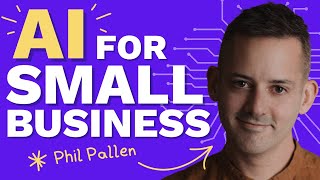
A recorded interview between David Jenyns and Phil Pallen about practical AI adoption for small businesses. Phil frames AI as an automation-first tool to free humans for higher-impact, creative work and walks through concrete department-level use cases — marketing (content, copy tools, specialized platforms), sales (lead scraping, personalization, case study of a coach reducing per-lead time and scaling lead volume), customer service (chatbots that crawl product pages, Adobe Acrobat AI Assistant for searchable docs), finance (budgeting, QuickBooks/Xero integrations, mileage/apps like MileIQ), and HR (AI-assisted early-stage interviews and candidate screening). Phil emphasizes experimentation, starting with current workflows, trusting vetted creators, and that his book (AI for Small Business) compiles personally-tested tool recommendations; he notes the book will be available January 2025.
Chapters
AI is an incredible way to automate before we jump to delegate or delegation. So automation before delegation. And if we are implementing these solutions, these tools, it's certainly a tool when integrated meaningfully, it's not going to replace the human part of the work.
Hello. AI is here and it's revolutionizing small business. I know it sounds a little bit cliche, but it really is. I don't think I've seen this amount of change in such a short space in time ever, when it comes to business and even just in the world. So I think if you're watching, you're going to see it. There's a huge amount of investment that's going into this space. It's extraordinary, really. And there are just new tools popping up every single day. And I feel like things are just getting started. It's quite hard to imagine where this is going to be in the next 12 to 24 months. So. So then the question is, as a business owner, what do you do? We know this is big, but where do you start? That's what I want to explore today. I've got the author of AI for Small Business, Phil Pallon. He's a brand strategist who's pretty much doubled down on this idea of AI testing different tools and looking for real world applications of AI. And today I want to share some of these ideas and dig into them. Think about how you can make the most of AI. So first things first. Just wanted to thank you for making some time, Phil.
It's my pleasure. We, you know, battled time zone differences pretty extreme, which I'm sure you're used to doing, but we landed on something really nice. I think it's Tuesday morning for you, it's Monday evening for me. I get to finish the day with you and I'm really excited about it because I really enjoy your podcast and.
We get to explore a topic near and dear to your heart, which is AI. I. I am curious. That's, I suppose my first question. What really got you to double down on AI and how did it capture your attention to go, ooh, I need to really focus on this?
It's funny when you say double down on this, because AI even is a big topic on its own now you say double down on, on what I enjoy. And that is specifically what you said, which is where to begin with this? That's what I find most inspiring in terms of exploring and breaking this down. For someone that doesn't even identify this as something that's right for them or they don't even know where to begin. So, so much of what I do day to day is try to make sense of this, try to understand this, try to build systems for this, not only for myself, but for my clients and for quite frankly, busy small business owners that are already wearing a lot of hats in their business. It wasn't that long ago when we were all just doing our thing in our business and all of a sudden there's this pressure to show up in real life, but also online, be it website, social media. That's been my world for 13 years. As the owner of a branding agency, my specialty has been in personal branding. But you know, I have brand and worked with people and companies from over 30 countries helping them position, build and promote their brands. I call that my adult job, my fun job. My side hustle was something I did around the time of the pandemic, right before I thought, you know what, I tell my clients to post consistently on social media. Not a big fan of writing, really love creating videos. And I thought, well, why don't I actually do it myself? Put up a video, well, at least once a week on YouTube and learn from that experience, but use the videos as a way to fuel my own curiosity and branding and marketing and social media and in technology. And so as I started to do this, branding was what I talked about in the early days. But now I've really fallen into this world of, of making sense of new and exciting platforms. Many of them AI first or AI, you know, powered. And I think I did my first brand partnership three years ago, a platform called Synthesia, very popular tool for AI avatars. I was one of their first creators and I did a custom avatar of myself and people got a kick out of that. It took off. And I've done so many cool brand deals and sponsorships and partnerships over the years and they have all, they've all been inbound and so that's actually surpassed this year. I'm doing more branded content than I am even doing client work. AI has completely changed my world and the world of many of my clients.
When you think of AI, because you mentioned a couple of tools there and it sounds like you do a lot of work with different tools. And I know coming from that sort of marketing background, I mean, there's a lot of great AI powered tools in marketing. When you think about AI, like, what is it, do you think in terms of it being a tool or, or what is it that you see AI as?
Good question. What, honestly, what do I see AI as a lot of the time right now is a distraction. O we're going to get controversial this early on, but really it is a distraction for many small business owners because it's just an overwhelming talk. It's topic, it's something brand new. Most people don't have, you know, the time that I have within my business to actually experiment with this and go, ooh, this makes sense for my business and this doesn't, you know, it's overwhelming. As I listed all of these additional, you know, hats that we wear as business owners. This is just one more how do we figure it out? And so I think it's really smart for people to find creators and systems like yours, like mine that we can trust and rely on, you know, because the most important thing is to not let AI become a distraction. What I get excited about. So you're asking me to define it. I think AI is an incredible way to automate before we jump to delegate or delegation. So automation before delegation. And if we are implementing these solutions, these tools, it's certainly a tool. It's not, when integrated meaningfully, it's not going to replace the human part of the work. And so in all the cases that we'll explore today, I can give you a few examples that I've included in the book, which are my real life clients and all the examples that I've explored where we've said, okay, this is actually successful. There are instances where business owners are able to focus on two things, what they love doing within their business and where they make the highest impact. Those, you know, any kind of combination of those two things I think are going to make for a lot of happy people.
And so it's just exciting that it's, it's alleviating some of that admin pressure on so many people.
Yeah, a lot of people are. I mean, as a small business owner, there's a certain number of tasks that you need to get done and different team members doing different things. And there are different tools that can help those team members do what they're already doing, but do it faster, cheaper and better by augmenting that human and powering them by AI. I'd love to kind of go through some of the departments and think about some of those use cases, maybe even starting off with marketing because you know, marketing really well and that's really probably where you got started with some of these tools. I'd love to know. Yeah, how you started this. I think already you kind of gave some idea on, on where to get started, which a lot of it has to do with thinking about what are you currently already doing and what tools that you're already doing and how. What do you love and what, what is going to really add value to your business? Like, yeah, I'd love to kind of just maybe through the lens of marketing first think about how I can create some wins for small business.
Let's talk about that, because I think marketing can be a really great starting point for the reasons we've already discussed. There's already a ton of pressure on us to show up on social media, show up on LinkedIn, show up on any of these platforms, and it's like marketing gets, you know, tacked on. And I actually, I do believe, I mean, yes, you can outsource your marketing, but it still should have strong influence from the leadership, from the small business owner, from the CEO. That's what's going to make it more human.
At least for small businesses. It's usually pretty obvious if you fully outsourced your social media, your marketing, and so there still needs to be something coming from you, even if you've got a team handling that. So marketing is a great place to start. There's, you know, all kinds of widely accessible tools like ChatGPT that are absolutely incredible, especially as they continue to develop. I'm also a fan of other tools that are, you know, that have a specialized purpose. So one example might be hopping into ChatGPT and using it for copywriting or copy editing. It's actually better at editing than it is at writing. In order for ChatGPT to be good at writing, you have to provide.
Examples. You have to provide examples of your tone of voice or you have to provide detailed input on who your audience is. So if you just hop over there and you start to experiment, which, by the way, everyone should. Don't let me. Don't let anyone tell you how to write the prompt. I hate that. Instead, go over there and experiment yourself with little to no stakes. Just like back in the day when we, when we opened Google for the first time, we didn't know what we were doing. And now we do through practice. So one of my big pet peeves is someone saying there's only one way to write a prompt or there's, this is the perfect way to write a prompt. That's like me saying to you, you know, the way that you speak English needs to be the same way that I speak English. Absolutely not. We both have accents from the countries we're from and we can communicate in a beautiful symbiotic way. The other pet peeve that I have is when people say it's too late to jump on the AI bandwagon or it's too, you know, if, if you don't, if you don't catch up, you're going to miss out. I hate that the Internet is full of this like stress inducing content. Shut it out of your mind, go into meditation mode and remember the most important thing in business, what you enjoy doing and where you make high impact. So to answer your question, marketing is a great place to start. My recommendation is to track your time. I track every minute that I am working on the clock in the day, including recording a podcast. And so I use a tool like Everhour which syncs with Asana Monday, any of those popular project management tools. What I love for, for busy small business owners to do is look back at the week and go, okay with a highlighter if you want. Here are the things that took up time appropriately, they're important things to do within my business. But then notice the things that took up maybe a little bit too much time. That's something you could probably automate and delegate. And Dave, that is often marketing tasks. And so there are platforms like Adobe Express is my favorite platform to create standout content. Descript Any Word. I mentioned copywriting earlier, so ChatGPT, it can be good. It's better for editing than it is for writing. One of my favorite more premium tools is called Any Word, which is a copywriting tool. It's really excellent for writing ads. Again, what I love about it is that it gives you what's called a predictive performance score. And it'll actually based on millions of copy samples, actually score the performance potential of your, of your copy, identify the audience, the demographic, a call to action. It can compute all of that. And that's like one example of a tool that is specialized and it's premium, so you have to pay a subscription. I think it's between, I don't remember, $50 to a hundred dollars a month, something like that.
But in a lot of cases these more specialized tools can definitely be worth the investment if it's enabling you to do better work.
Yeah, I think that's probably the, a really good key learning or understanding. You've got generalized tools maybe like a chatgpt which can do a bunch of things pretty well and you know, it's adding in extra capability and then you've got these specialized tools that are tailored to very specific use cases. And depending on what's going on in your business, like thinking well, what are those core tasks that your marketing department is doing? Where are you spending the time? I love that idea of tracking your time and going. It's not just for you. Also, like your team members, like, where is their time going? And then what tools might be able to shave off some time or create a, a better quality output. And you mentioned a few there, I think. Yeah, marketing's definitely got some great opportunities if we kind of shift into sales. I know you kind of went down the rabbit hole and looked at tons of use cases for all departments. So you probably started off with marketing because that's what you know, and then probably started to see what else is out there. So for sales, what popped up for you in your research?
Yeah, good question. I mentioned to you before we even hit record on this podcast that at no point do I pretend to be an expert in this topic. Let's be honest that it's only been generally available for us about, you know, for about two years. I've been trying and experimenting with AI tools for three years. That's still not a lot of time when we think about that. You know, I've had my career as a brand strategist for 13 years. So the earlier chapters in the book, by the way, the book goes through all different verticals of business and the earlier chapters like marketing, sales operations, those are the ones I was really comfortable with. Social media, content creation, I can do that stuff with my eyes closed. But as I got into the later chapters of the book, I thought, wow, this is actually more of a research project than it is a, you know, write down what Phil knows in his brain project. And so I've really enjoyed immersing myself and, and having so many different types of clients over the years. It's been fun to share their, you know, how this applies to their world. So let me give you an example for sales. In the book, I write about my client and my friend Ashley. She's a business coach. In fact, she's my business coach. I first branded her and then I went and hired her because I was so impressed with her. She was a perfect use case for sales. So before AI, she would spend, I think I estimated an hour per week researching leads. She might find about four or so leads manually through referrals. If you think about it, let's, let's tally this up quickly. Each outreach email would take what, 15 or so minutes to craft. Follow up emails would take another 15 minutes. Let's say she's tracking those leads manually in a notebook. So securing a lead would maybe take about two hours total, including answering questions, calls, those Types of things we know those add up contracts. That's I think we estimated 400 or so hours spent annually on sales before AI. Let's now take the same workflow and examine what or how we can shave that down but still have Ashley involved with the most important parts. Tools like Referral Candy is a great one or HubSpot is a popular one I often give as an example. There are many many other competitors and and and versions depending on what people are already using. These are popular tools that can automate lead generation or referral management. Personalization with emails and those kinds of tools require next to no time for the human once you've got them set up. What are some other sales hub Persona was another one to streamline outreach. There are also Google Chrome plugins that can help you scrape Data data miners 1 I can think of depending on if you're doing cold outreach. But this can reduce your response time and ideally decrease your lead time. From I think we calculated in the book it was like two hours to 35 minutes kind of go through a before AI and an after AI example and she's able to manage I think we calculated 700 qualified leads annually with AI helping her do the targeting and the personalized communication. So that's one example. That's a pretty in depth example. But if we were to break this down simply for someone.
Start by installing a plugin on your email provider that will help you draft emails. So one of my least favorite tasks is replying to emails increase for sponsored content. I'm happy they're emailing me because it's part of my job, but there are many, many, many that I get that want to do affiliate deals. Phil be on my affiliate, talk about me in a YouTube video. I could spend all day replying to those emails. Again grateful for it, but not the best use of my time. Not high impact. So I have a plugin called Ellie that enables me to single click respond to an email and I can also provide context so I could write something as simple as no purely affiliate deals.
Boom.
That will then populate the reply. Or even making use of templates in Google Mail is another handy one. Anytime you find yourself writing a response once or twice, save that as a template and save yourself time.
Oh hey, I know you're tuned in right now so I'll keep this super quick. But you like awesome YouTube videos, don't you? Well, there's not really that many YouTube channels that create great content about how to systemize your small business. So I want to make sure that you catch every video that I publish. So if you haven't already, firstly give this video the thumbs up and then go ahead and subscribe to my channel. You can even hit the bell notification to make sure that you're the first to know when I publish anything. So go ahead, do it right now, I'll wait a sec and then I'll transfer you back to the video.
When we think about Ashley's example, and it sounds like you started off going well, what are you currently doing? And you kind of mapped that out. Then the next step after that, how do you like, you've got some great visibility into a bunch of different tools because you've been researching and then it'd be obvious to you because then you can go, oh well this chunk can be done by this or that chunk can be done by that. I don't know if you have any thoughts on how business owners might approach this after they go, well, this is what we're doing. And you said there's probably some good places to start like one of the Chrome plugins or something that might help accelerate you with email. But I don't know if you have any other tips on how to then think about where to find AI solutions or is it just get out there and research and test and measure and see what you like and what you don't?
Yeah, it's a really good question and it's, it's interesting as I have this conversation with you and I self reflect that that's almost the niche that I found myself in, which is AI tools. You will find me talking a lot about the chips and the latest evolutions. Even I struggle with keeping up with that stuff that just keeping up with it is a full time job. So I really enjoy the fact that I get to for a living try a tool and be able to make a recommendation. You know, I am doing brand partnerships so in many cases brands are paying me but at the same time I'm still able to do a review of who I think the platform might be useful for and specific use cases. When I make a video it's not is this right for me or wrong for me. It's not really about me. It's about the person who is trying to find a solution to a problem. So yeah, best, you know, I think the best as technology continues to evolve, the best recommendation are going to come from people you know and trust. Or we could say people you know like and trust. That could be people on the Internet, newsletters you subscribe to, YouTube channels you watch, people like you, right. You know, where you've developed these really intricate, amazing systems and within that you're able to make recommendations on the best platforms and tools for the job. We all learn in different ways. So I'm not a big reader, but I love watching a video and I think that's why I gravitate more towards YouTube. In the book, I committed to only recommending tools that I have tried personally or have thoroughly researched. So if you wonder what I've been up to for the last year, that is it. So certainly, you know, people like me that, that have been able to budget the time, I think to look at this stuff and be able to make a recommendation are people that are worth paying attention to. To. I would say, yeah.
And I think moving forward, I feel like there's a role in organizations for this and I know it depends on the size of the organization and maybe the smaller businesses, it'll fall onto the shoulders of the business owners like most roles do for small business owners. But I think there's a role here for spotting AI opportunities like what are you currently doing and how and where can AI help because. And it's just such a big opportunity to, to not have someone on your team looking at this and, you know, watching the YouTube videos, reading your book, consuming like someone whose role it is to kind of think what's out there and what's possible and what are we doing and where can I go? Oh yes, well, that's going to work for us. I think that's definitely a new role.
It's like bound to become a job in itself. We have tools. There's a directory online that's popular, that's called. There's an AI for that. And that can be, I would suggest a good starting point for someone that just wants to see what's out there based on a keyword. But I completely agree with you. There's a role for this if the company is big enough. And I think a huge onus on the role is not just discovering and recommending the tools, but communicating with the other departments of the business and saying, hey, where are our major pain points? And I was going to mention this earlier, it's not about replacing humans or doing it quicker and cheaper. My true opinion on this, it's what can we do to enable our humans to do what humans do best in the business? And I think that's communication, it's storytelling. Technology will continue to evolve. We're going to talk about different social media platforms a decade from now. Different from what we talked about a Decade ago. But human connection, the way in which we continue to connect is not going to change. And truthfully, while there are things that AI can do exceptionally well, there are things it can't do well. Storytelling, you know, drawing on human experience, that's our advantage. And so I'm less worried about all the jobs that are going to disappear as a result of AI and I'm more focused on, and I have examples of this within my own business, more focused on its ability to allow me to be in my business where I'm needed most.
Yeah, yeah, one obvious one that pops up quite a bit. And I think it enables your best team members to, to really focus on the highest impact.
Tickets and things like that. When I think of customer service, that's a big, a big one because, and there's certain low level customer support, whether it's email and sometimes even voice that can just be handled by a machine because it's, it's just basic stuff and then it's, it's the higher level stuff that needs to be escalated and tailored to the unique situation that might get handled by those higher skilled team members. But in customer service, which, you know, maybe crosses over also into some operations stuff or at least around the delivery of the product or the service, I don't know what tools you're spotting in that space.
Yeah, lots of them. Lots of them. I think about customer service and then I immediately go, where do we all get frustrated or where's that pain point? And it's when we have to talk to a robot and it's made so incredibly difficult to access a human. So again, I don't think AI is going to replace the role of the human. But certainly it's a perfect example, David, of how AI can be stronger in a context of computing.
A great amount of information in a short amount of time. So when you look at like a directory or a bank of customer service responses, AI can formulate a response and even a relatively custom response much quicker than a human ever can. And so again, it's not going to replace it, but it's certainly a very, very good use and application of AI. I recommend some, some of the tools in the book, but I try to avoid getting super advanced. We get a little more advanced in later chapters, but something as simple as a chatbot. I recently talked about one on my YouTube channel called Vocal AI. This was a really neat feature geared more towards Amazon or product businesses. But I'll give an example of how they're using it for customer service on this platform. All you do is paste a URL of an existing product on your website and it will then crawl your entire website and related projects and essentially bank the information it has available it, it can access on your website. So FAQs, reviews, think about all that information. That's just a plethora of knowledge to be able to, to, to interface with customer, with customers. And that's an example of one that I've talked about and explored recently that I was really impressed with because sometimes we think about where do we begin? That all sounds great. I'd love to have a chatbot, I'd love to have a custom GPT. But like, where do I start? Yeah, well, with this, a platform like VoC, it's as simple as pasting an existing product URL into the platform and it does the heavy lifting. And I'll give one more example, people go, I would love to create a custom GPT. It's a big job, it's a big project. And don't let anyone convince you that it's, you know, a light lift on a Friday afternoon. One of my favorite, favorite, favorite essentially versions or simulations of this is the new feature in Adobe Acrobat called AI Assistant. It is an amazing way to take. It could be a whole combination of text or PDF documents, blog posts, scratch notes, transcriptions from a podcast, interview like this. You can have hundreds of pages, pop it in there, open AI Assistant, and you can ask the document questions and interact with it. Have like a conversation with the document. It will give you an answer, but everything in the answer will be cited, clickable back to where it was found in that document. No risk of hallucinations. So again, I'm trying to give people easy places to begin. I try to talk in practical terms. So if I talk about something, I'm like, here's a tool for it, go and try it. You know, I think that's just really important because it can get overwhelming quickly.
Yeah, yeah, I definitely think there's numerous options and new ones coming out every single day. So again, it always comes back to what are you currently doing in your business and where is your time being spent and how can these AI tools solve those problems and help elevate you and your team members to work on the highest value tasks in the business. So we kind of moved our way from marketing all around generating leads, sales, converting those leads, customer service, which can, you know, be a little bit of the, the sales, but also around delivery. If you think in terms of finance. I don't know if you've seen any tools in that space. And I know we might be moving more into where your research might have kicked in, but. Yeah, what use cases have you spotted there?
Yeah, in that section I give an example, I'm trying to remember. That was an example of a client of mine, custom design and construction. They do home renovations in California and I gave an example of.
Budgeting, financial forecasting. So their projects can be seasonal or dependent on weather or all different kinds of things. AI and application for finance or for budgeting, accounting. There are lots of use cases. Many of these as you said. I didn't know when I started the book, but tried to kind of sift through all my different types of clients and learn what are those pain points and how are you solving them. So we actually go through. In the book, I give an example of a, of a workflow. I give an example prompt as if I was them how I could interact even with ChatGPT to get some information on even tool recommendations. Like we sometimes forget. You don't necessarily have to go and find and try every single tool. You can also ask for recommendations and ask ChatGPT, for example, what are your best recommendations? Please rank them and please cite them. Cite what you find. Hyperlink. You know where these recommendations are coming from. I would also say for finance, we're already using a lot of tools like QuickBooks. I use Xero for my invoicing gusto for, for payroll. All of these, well, I shouldn't speak for all of them, but the majority of these have AI features that they're rolling out, whether it's for analysts and to look, you know the optics of making sure that these companies are innovating or if they're actual meaningful integrations. I was just a few weeks ago at the 0 conference, the accounting conference in Nashville and they had some really, really cool features coming out that are not just look, we've integrated Chat GPT via its API, but actual like meaningful interactions, conversations that you can have with the bot that are.
Going to save people time rather than having to ruffle through, you know, an expense report or income statements. Like you can actually communicate with the platform and it's going to find you what you need much faster. Those are a few, a few ideas and examples. Trying to think. I did a recent partnership with a brand called Mileiq and they're, they're kind of like Tinder for expenses. So you swipe right if it's a business expense by left if it's a personal expense. And that, you know, can just be kind of a neat and fun way to stay on top of your mileage for tax purposes. That's another thing, like shouldn't this be fun? I try to find like the fun in this and also I feel like, you know, the sustainable solutions are the ones where you can get really excited about the time. It's going to save you the communication, you know, conversations that are going to be had about finding these solutions and allowing the humans to be maybe more strategic than administrative. That's exciting.
Yeah, yeah. I think especially for business owners, they're often have a tight margin for error and, and I think this helps, you know, like this is a great win for them. And I think, I mean you gave another bit of a hint there around adoption. One of the first places you should be looking is in the current tools that you're using. All of them are thinking about AI. They're all trying to incorporate it into what they're doing. So I feel like continually going back to the tools that you're using and exploring well what can they do now and how can new AI get things done. So if we shift gears into hr, I think HR is ripe for AI applications and re engineering. Like what great use cases have you seen in that space?
My favorite HR examples. This is actually one of my favorite chapters in the book. Chapter. I think it was human resources and talent management. One of the earliest tools that I got to try and use was a platform to help you essentially help companies.
Automate the interview process. When we think about how much time interviews for jobs take and even then the process we're used to, is it really optimizing? Is it really giving you, I should say not even optimizing. Is it really giving you a flavor of the person that you're about to hire, how competent they are for the job? So again the speed of AI to compute data points and information, it's just pretty, pretty exciting application where all I make all different kinds of tool recommendations in the book, but some of these that all approach it differently, some of them allow you to upload a video interview, video responses to questions and that might be the first round of, of interviewing and that a really nice organized dashboard on the back end for the employer to actually look through the candidates based on that first round or that first wave of interviews where the interview is actually done by AI and not a managing director. So they're almost the human is brought into the second or the third wave of the interview. And I thought that was really interesting. Again it's like we're not trying to.
Not have humans do what they need to do. But if we can use technology to help us in the earlier stages, I think it's really, really beneficial. I got to try out one of the features recently where you go on and you do.
Essentially you had the timed questions and you had to do a video response. So it wasn't just you couldn't just turn your camera off in order to do the interview. You actually had to turn your camera on and it was timed. And then to see on the back end, I looked at it from both standpoint. I went as like someone applying for the job and then someone that had just submitted it. And it was fascinating to see it all basically broken down. You know, response time and, and all of that. Really cool.
Yeah, yeah. There's a huge amount of innovation in that space and like we touched some of the key departments and areas that I think that would impact all business. But I mean there's other parts covered in the book as well around security and R D and data analysis and lots of different things. When we think about like some real world case studies, I don't know if you've come across any. Like there's some big ones that have come out where you know, there's. Kalana is quite well known in the space for they're an E commerce business and they basically replaced a bunch of their customer service agents with bots and added a significant amount to the bottom line. And that's at one end of the spectrum when we're talking about very large scale. I don't know if you know. Yeah. Other other ones or that you've seen whether it's with clients or in your research around how the wins that small businesses or medium sized businesses are getting from applying some of these things.
Yeah, I mean there's, there's so many people know that I'm. I'm working on the book and so I have great enthusiastic friends that share those wins with me and it's been fun. Even if I can't include them in the book. I talk about it on social media because I share that enthusiasm. It's right. We have to like sift through and figure out those workflows and troubleshoot and get frustrated. But then when you have those wins, it's just so worth celebrating. I can think of a few. My friend Mike Russell, he owns a voiceover, they create ads for radio stations and podcast intros, things like that. And he told me about the first moment that really for him, I rocked his world. He was preparing for a conference and use the custom side of ChatGPT essentially the API or the playground, rather to scrape the website of the conference he was going to attend and cross reference that scrape with contacts on LinkedIn that were first, second, I think first and second connections. And then he was able to actually write custom messages for each of those people. And he was able to do his conference. His conference outreach in a single day versus it taking weeks. First instance of AI in my business where I went, oh, wow, this just saved me a lot of time and money. I had a client that had just done her personal brand photo shoots. She loved how they turned out. She hated how the red brick photographed in the background. It was the day that Generative Phil launched in Adobe Photoshop, and I thought, well, all my friends are talking about it. Let me try it out. Isolated the background through a text prompt, changed the color of the brick to white. That image is now on the homepage of her website. And it saved her from having to do a reshoot and for us to delay her project there. You know, there are so. There are so many wins that I can think about, not just with my friends, but also in my own business that I genuinely get excited about. It's like, yes, there are things that scare me about AI Deep fakes I find particularly troubling, particularly as the technology evolves. Our inability to know what's real or what fake. What's fake, that scares me. But I'm an optimist and I'm excited about things like being creative again in my work. Standing there and going, you know, text to image. What can I create to start to envision a really abstract concept that I couldn't find a stock photo for? Now I can actually create that and start and ideate from there. You know, just there's so many instances where, like, we get to be creative and storyboarding and coming up with concepts for advertising and marketing. Like, there's just so many cool applications that are democratizing creativity in ways that really excite me.
Yeah. Yeah. I think keeping an eye on your social and seeing as you celebrate some of these wins and shine a spotlight on where people are getting some great case studies is a great place to start. I'll pop a link through to your socials and also for people to check out the book as well. Like, we'll link through to it on Amazon. But AI for small business, if people want to keep an eye on where you're up to and what you're working on, what's the best place to send them?
Thank you so much. Instagram and YouTube tend to be the end LinkedIn Also any combination of those platforms. I post a video every single week on YouTube and it's generally an AI app or tool that I'm trying out and, and, and, and sharing my experience of that. Instagram tends to be where I post my day to day, I travel a lot and, and also just, you know, sharing those wins and discoveries along the way. That tends to be where I put them and my email list as well. Philpalin.co email or/list I think it is. I'm often sharing new tools that I'm trying and that I'm recommending and I have an ongoing list as well that I'll make sure you have the link to of my top top AI tools, including some of the ones that I mentioned in the book, which has been a year in the making. And finally it will be available January 2025. I'll be excited when more than just me can sit here and hold this in their hands. But it's coming. It's coming very soon.
Yeah. Awesome. Well, thank you so much for your time, Bill and we'll keep in touch.
Thank you so much. I appreciate it.
More from David






Remember me? Subscribe To My Channel For More Free Business Systems Content 📈




