Exit for Millions - Book Review
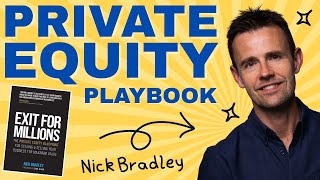
Nick Bradley explains how founders can build businesses that attract buyers. Most businesses never sell, but those with predictable revenue, low key-person risk, and clear financials command higher multiples. Private equity typically targets $5M EBITDA, and preparation takes 12-36 months before a sale.
Questions this video answers
January 12, 2026
Over $5 billion (buying and selling 27 companies; completing more than 50 acquisitions).
About 70%.
Typically 12–36 months (the sale process itself averages ~6–9 months, earliest ~6 months).
Around $5 million of EBITDA (roughly $20 million revenue estimate).
Chapters
I had this vision of businesses where it's the whole well oiled machine thing, everything just kind of works. But it's not just the processes. The processes are a core part. It's the clarity, it's the execution. It's people who are thriving in a culture which is well defined.
Most business owners, they dream of one day selling their company for life changing money. But we all know the sad reality here is 70% of businesses listed, they never end up finding a buyer. And today we're going to make sure that you're one of the rare few that ends up getting the exit they deserve. My guest here, Nick Bradley, is the author of a new book called Exit for Millions. We first connected must have been over five years ago now through a colleague of mine and it was around the time that I'd launched Systemology. Back then, Nick was deep into the private equity world and I never forgot the incredible endorsement that he gave for my work. So since then I've been just following his work and he's gone from strength to strength. He's driven over $5 billion in exits. That's billion with a B. Buying and selling 27 companies, completing more than 50 acquisitions, leading multiple successful exits. It's been an absolute pleasure to watch him just grow. And when I saw that he launched a new book, I thought, I've got to get him on the show because I'd love to explore this more. So I'm just as excited as everybody listening to this and I'd like to welcome you, Nick, to the call.
David, thank you, mate. I can't believe it's been five years. We're just saying things. Things move quickly these days.
Yeah, so much. Especially in the last few years, over the COVID years, it just felt like it really accelerated since we first connected. What's changed for you personally as far as like your work? Because you were very deep into the private equity world then, but it feels like you've shifted gears quite a bit.
Yeah, I think the transition for me is I was in private equity for over a decade and I think when we first connected I was coming out of that world but still had a foot in that world. And one of the things I did back then to make a bit of a change both personally and professionally, we started my podcast which back then was called scale up your business and we had you on. It's still around. It's now Scale up with Nick Bradley six years later. So 400 episodes later. And I suppose the vision I had was, you know, private equity, the stuff you Learn in private equity is just off the charts. It's like an mba but with real world practice. Right? Like you're out there in the trenches doing deals, expanding the value of companies. And my belief was that the way that private equity firms scale businesses is different to how lots of founders do it. And I wanted to be able to take this private equity thinking, the sort of private equity playbook, and make that accessible to founders so that they could start to do things with more precision and create more valuable companies. And the ultimate goal I think is, and I believe that on the other side of a very successful exit is freedom and financial independence. And I believe that you can't really build real wealth unless you build something that's investor grade. So since we met, I've been leaning very much into that idea of how can I help founders, usually founders of seven to eight figure revenue businesses build the right infrastructure and the right capability to create an eight to nine figure exit and have a, what we call a life changing liquidity event.
One thing you mentioned in the book, and it's early on you said that you don't build real wealth running a business. I don't know if you can expand on that because it's kind of like the next sentence.
Yeah, I'm happy to because it's kind of, it's one of those when people hear it, they can't unhear it. What I mean by that is running. The key word there is running, right? So I talk about there are three exits that are, that a founder needs to go through if they want to create that freedom and financial independence. And the first exit is exit the chaos. And usually that's the startup founders and they're in the machine all the time. They're working stupid hours. They can't get themselves out of this. Almost like a prison they've created. And the first thing they've got to do is get themselves to a point where they're working. You know the famous saying, you know, on the business versus in the business. But then you get a really interesting set of choices, right? The second exit I call exit the operation. And that's where you know, it kind of leans into your world where you've got to build a team, you know, usually a leadership team and a management team that can run the business without your involvement. Now in that situation, you're no longer really running the day to day, but you still may retain ownership. And if you build a very profitable business, you can hold that business for a long period of time and build significant amounts of wealth. Without ever selling it. So when I say you don't build real wealth running a business, you've got to get yourself out of the machine in order to be more expansive. And then of course, the final exit is when you actually exit the business, you sell your shareholding. And in my world, that's where I've seen, you know, transformational changes in people's lives. But the key, the key thing, the key thing is a business that can run without you. And that's what I think private equity does better than anybody. You know, building that level of capability within companies.
Yeah, it's definitely something that I've spent a long time focusing in on that problem because it's an age old problem that, oh yeah, every business owner goes through, especially if they start as the technician. Like the technician really is the trap because then they know how to do the work and it's too easy to slip into that when it comes to the exit. And you talked about a few different exits. If you think about the final exits, as far as selling the business and getting that payday, do you have a belief that every business owner should be get that exit?
I think my, my belief is every business owner is going to exit, yes. Without being morbid on the, on the show, you know, you ain't going to have the business forever. And if you look at some of the statistics, I think, you know, even the big businesses get disrupted. Right. There isn't too many businesses that have lasted for, you know, hundreds of years. Right. If you go into that because the world's changing, so you are going to exit. My point is really make sure you do it on your terms.
Yeah.
Now that could be selling the company, it could be different forms of succession. You might be giving it to your kids or whatever else, but you have to have a plan. And I think one of the travesties I think I see in the world is when people, they get to a point where they either have to exit their business or they think, you know, it's the right time or whatever else, but they haven't prepared in advance. And the statistic that you mentioned, the beginning, is true. Not many businesses actually sell. Most businesses get closed down. And I suppose I exist to try and change that statistic because I've seen what it takes to be able to create something that's not sellable to something that is and the impact that that can have.
Just before we hit record, we were talking about the Runway required for exit. And I know that's often the reason that a lot of business owners don't get the exit that they want. They dream up a number that they think they're worth. And when they're looking for someone who agrees, they can't find anyone. And a big part of that is not having planned correctly. When you think about the timeline and how long does it actually take, let's say at minimum to prepare a business to get a proper exit?
Yeah, I say between. And this is before we start a sales process. So remember, a sales process in its own right on average lasts about nine months. The earliest you can do it is six months. So this is before you even start that journey. I say it's 12 to 36 months on average. Sometimes it can go up to, you know, multiple years. But the key thing is this. Most business owners build from the ground up without any real understanding of where they're building towards. In private equity, we reverse engineer everything from the beginning. So from day one, when we acquire a company, we're talking about the exit of that company from the day we acquire it in the 100 day operating plan. And so, so if you came to me and said, hey, I want to sell one of my companies for 100 million, let's say in the next few years, I would reverse engineer from that number. Work out what you're currently worth today, work on what it needs to look like from both a financial and a strategic perspective and then we can assess the time. Yeah, the time is actually dependent on the outcome more so than anything else.
Yeah. When you talk about it in the book as well, this idea of, you know, a high value business and something that is investor grade, and that's really what we're thinking about building to get that highest value. So when you think about what investor grade is like, what is your definition of investor grade?
Yeah, in the book I break it down into 15 reasons. So there is quite a lot of detail and depth behind that. But it all, it all sits under the heading of what we call transferable value. And the idea is that you're building an asset that can be handed to someone else. I like the idea of it's like a baton pass in a running race. Right. Like, you know, if you want to make that a really nice clean handoff and then the person can accelerate forward to the next stage if you drop the bat. And of course, you know, not much is going to happen. You ain't going to win. Right. So. But a lot of business owners are dropping the baton when they try and sell their companies. That's the point. But the idea of a transferable Asset is, you know, it has predictability of revenue. Quite often that's seen through the lens of recurring revenue, things like subscription models or things like that. It doesn't have any key person dependent. So again, if the founder is the cog in the wheel, is responsible for marketing, sales, delivery, and as soon as that founder gets paid a lot of money and they're not as interested in that anymore, that's a risk. Right? We don't want that to happen. Clarity on the financials, what the numbers are really telling us, and all the KPIs and metrics around that. Lots of business owners, certainly when I get involved with them, are looking at dashboards with 50 to 60 metrics on it. In private equity, there's only five numbers that really matter. So there's a simplification of the business as well. And probably the thing that I get pulled into when I'm going in and doing sort of consultations is looking at the business model that the business currently operates under and working out whether that business model is predictable, repeatable, scalable and then transferable. And quite often what happens is people build a business, they make money, they focus on revenue, they focus a bit on profit, but they don't think about the scalability of what they've created. And if I'm going to come and pay a lot of money for your business, I don't really care so much about what it's done, I care about what I can do with it. So I want to make sure all the foundations are there, but I want to make sure that what you've created is going to drive predictable growth and therefore value for me in the future. So there's a lot more I can go into in terms of the detail there. But these are things that all can be fixed. But you can probably appreciate straight away that if I'm going to build a team around me, let's say I want to replace myself and have a number two in the business, I can't bring them in two months before I put the business on the market. Because if I buy your company and I know someone's just started with you, I'm not going to give you a high multiple. I'm going to say that's a risk. Whereas if someone's been in the business for a couple of years and we've proven that they've driven some value and we can talk about that through the sales process, I'm going to give you a higher multiple for your business because there's no risk there. So you've got to look at it through the idea of upside growth and risk mitigation.
Yeah, the risk element keeps popping up for me, like, all the way through the different points that you meant. Really? Because someone is going to want to pay a higher multiple if there's less risk. Like, the biggest risk they're making is, I'm going to make this investment and it looks all great and then you and key team members are going to walk out the door and. And the best clients and a lot of the revenue is going to walk out the door too. That's a risky proposition for me. So obviously I want to reduce risk. I'd love to get your take on. Like, I look through, like my lens is through systems and processes. I always look in terms of that. Where do you see the role of systems and processes in getting a great exit? Because quite a few of those items that you mentioned, my brain just goes, oh, that's. That's driven by process. But I'd love your take on that.
It's both. It's both people and process. And, you know, sometimes people say what comes first? And I think that's a really interesting debate because it kind of depends, right. Like, if you haven't got the right people in there, you know, some people say it's process first, but who creates the process? Whatever. I think even more now with technology and AI, you have to add that layer into the whole thing as well. But the key word that I have always been sort of taught in my private equity days is predictability. And anytime a process or a thing is random, you get lucky, let's say. Right. I believe luck quite often is the outcome, if you like, of a really clear process, actually, because you keep doing the same thing and you get results. But I think in your world, and certainly in my experience with private equity, the core is what we call the operational model. And that is right people, right seats, clearly defined processes across the key areas. And we go a layer deeper than most people on these things. So I'm happy to unpack that. And then intelligent use of technology to drive margin. If you haven't got those things in place, there's no point buying other companies and bolting them all together and trying to integrate them, because you want to build from strong foundations and the core has to be solid. If it's random, if it's. If we can't predict what's going to happen, if all those things are there, then why would we put more complexity onto that? So the work that you do, David, I think is core to that transferable asset.
Yeah. So there's actually quite a few pieces that you're working on there. It sounds like one of the first steps being to strip everything back to go. Well, this is the, the simplest part of the business as far as, you know, probably everything from getting leads into selling to delivering the product and service. How do we make that simple? Because that's simple is going to make it easier to scale.
Yep.
And then capturing and documenting those processes and getting the right bums on seats then to execute on that. And then I'm assuming the technology layer comes probably after the process. Like once you're clear on that, then when do you see the technology coming into it? Especially with everything we're seeing at the moment, the change with AI and how that's disrupting various roles and industries.
In fact, everybody, it starts with, I'll give you the actual playbook as we talk about it. Right. So if you ever sell your company to private equity, quite often the first question you'll get asked in the first meeting is share the vision you have for this business. Now it's a loaded question because most people can't answer it for starters, or can't answer it well. But the question behind the question is show me the thing that I'm going to buy from you so that I can see what it's going to become in the future. So the more that you can sell the growth vision of the business, the higher at that point of engagement you're going to get from a sophisticated buyer. But there's another part to that. Right. So I think about the vision. I'm very kind of precise on how I, how I instruct this. You create a vision three years out from now. Some people think it's vision is 20 years into the future. And I'm not talking about that. I'm talking about what the business looks like precisely three years from today. Which products you're selling, who you're selling them to, which countries you're in, the people in the business. The way you think about brand and marketing, the way you think about culture, like super, super detailed. Once that's clear, you can use that to hire people to, to raise investments, just to provide super clarity of what you're doing across the business. Then what we do is we break that down into the 12 month plan. The 12 month plan is, is effectively what do we need to do in the next 12 months to realize the three year vision. Right. And then we keep cascading that down right into 90 day sprints, into one monthly, monthly reviews, weekly, kind of reports and then sometimes daily. Now, why that's important is as you build out the operating machine, like, who do we need? What are we, what, what resources do we need? Where does technology come into your point? It all comes off the back of the vision and the strategy and then the operating model. And what we do in private equity is we don't, we don't have any kind of favor towards, oh, there's got to be lots of people. We look at what the result needs to be in a certain area and then we look at the most efficient way that we can drive that result, often with the least amount of people and the highest amount of technology. So AI comes in as an enabler to what the department or the strategy needs to achieve. And we just literally go through it and we go, okay, customer experience. How can we make that as efficient as possible, but at the same time maximize retention and lifetime value? And so we'll add metrics around all of it. And then I suppose the creativity comes in what you build to enable those results.
Oh, hey, I know you're tuned in right now, so I'll keep this super quick, but you like awesome YouTube videos, don't you? Well, there's not really that many YouTube channels that create great content about how to systemise your small business. So I want to make sure that you catch every video that I publish. So if you haven't already, firstly, give this video the thumbs up and then go ahead and subscribe to my channel. You can even hit the bell notification to make sure that you're the first to know when I publish anything. So go ahead, do it right now, I'll wait a sec and then I'll transfer you back to the video. Yeah. In the book, you talk about the five steps, which, which is the scale to sale and the first couple. I kind of feel like maybe that's what we touched on the clear end in mind, strengthening those foundations and then you can kind of start to move into the scale and expand the value.
Yeah, you've nailed it. You've nailed it. The first one is what we call clear endgame, which is, which is reverse engineering from an outcome. Yeah, that one exercise done. Well, I can't tell you when, when a founder has absolute clarity, they can, they're unwaveringly, like, clear on what they're doing. Unwavering. They, they, they have a different level of confidence and influence in their leadership. So that one thing, if you have, if you do one thing from listening to this, be clear on your outcome. Right. Even if you don't want to sell your business yet. Be clear on that piece. Then when we get into strength and foundations, this is usually what I call the boring bit because it's, it's often called de risking. But that's where you're auditing your business through the lens of private equity. It'd be similar to doing a due diligence process before you sell. You're literally going through the whole business and seeing where the cracks are, the chinks, and you start to affect them. In some cases, that de risking process can take 12 months, 24 months if there's lots of risks in a business. But there's no point going and doing really clever growth things if, as I said, you're just going to compound on top of that. So I advise people to not aggressively go after scale, growth and scale unless they've understood where the machine's going to break. If they do that.
Yeah, yeah. Otherwise you just end up compounding the craziness. I think you do.
You don't get any freedom from that. And you can sometimes have a business that goes backwards very quickly, which isn't good.
When I saw the five steps, again, I'm drawn to it because I see a process and that's just how my brain. I'm curious if, if you see yourself as a process person or is it. Yeah, just, just part of it or. Yeah, I suppose that's the question. Do you see yourself as a process person?
I see myself as someone who, who's obsessed with value yet which process is a part of it. But equally so is growth and expansion the way. If you got deep into my brain, I have this vision of businesses where it's the whole well oiled machine thing, everything just kind of works. But it's not just the processes. The processes are a core part. It's the clarity, it's the execution. Right. It's. It's people who are thriving in a culture which is well defined. Nothing's random. And this is the one thing I like to get across in private equity. Nothing is random. It is super, super disciplined. It's almost military level. And if you can apply, this is what we talk about, investor grade. If you can apply even half of that to what you're doing, the benefits of that to you and your business are just off the charts. So we call it operations or I was an operating partner in private equity. And what that is, to answer your question on process, is when a business is acquired by private equity, they put in a person like me to oversee the investment. But not from a Financial perspective from a leadership and strategy perspective. So my job is really twofold. To make sure that the founder can exist successfully under private equity backing and to make sure that the strategic discipline to drive value in that business is absolutely governed by my involvement. So I'm kind of a mentor to the founder. But if the founder can't perform or I don't feel that the founder can expand the value to the thesis of the private equity firm that founder is out. So an interesting role because you've got to be quite forthright and direct. But we're looking at it through that lens and process. You're 100% right is a core part of it, but it's not the only part.
Yeah. When we think about private equity, why do you think that works so well from an investment point of view? Like, it's. It's obviously a very efficient model because this is someone's money. They want to get the best return they can. So they've spent years figuring out their playbooks and how to maximize this and how to move quickly and how to spot the best opportunities and how to. To grow them. I don't know if you have any thoughts on why private equity is. Is a good option for business owners to sell and why it's such an efficient machine. Just having been in it, or is it just all you have ever known because you've worked in private equity?
I mean, I was, I was in corporate before that, so I kind of got into private equity over 10 years ago, but I was working for News International and Getty Images, and News International was obviously, you know, if you've ever seen the TV show succession, it's built on. It's built on Rupert Murdoch's empire. Getty Images was also another big media business, but that was PE backed and that was my first experience. So I kind of got to see both sides of it. I think what it comes down to, some people think that I don't like private equity and I left because it's, you know, this evil world and all that. I don't think that's true. And I certainly think it's changed fundamentally in the last sort of five to sort of seven years that I've been out of it. Because they can't just go in there and buy businesses cheap and kick the founders out. They have to partner more now to get the value. Things have changed fundamentally. But what private equity is, is it's so clear on its mandate. It's unapologetically about money. David.
Yeah, right.
There's no ambiguity. Right. Like In a private equity firm, there are different metrics that the firm is measured against, but there are two main ones. One is called multiple on invested capital and the other one is called irr, sort of internal rate of return. Now to break those down very quickly for people, because you can apply these if you own a company, you can still think about it like this. Multiple on invested capital is, let's say I buy your business for $50 million and then I've got another $50 million that I'm going to use to buy other companies and we collectively then go and buy two additional businesses. So you've got a group now, you've got your business that I've acquired, we've got two additional businesses. So we've got this kind of group forming. So we've spent, and I'll make this simple for the math, we spent about 100 million to create that. I measured on selling that group in the next three to five years for anywhere between three to five times that amount of money. So my expectation is to make 300 million to 500 million on the hundred million investment. Okay. Now there isn't an asset class in the world that gets that level of return. That's why private equity has become such a big thing. And then the other thing I measured on, which is that IRR is how quickly I do it. So I'm only interested in coming in and literally it's alchemy turning one buck into five bucks and doing that in super quick time. Most business owners don't think with that level of precision, but they could and maybe they should. Sometimes, sometimes people say to me, oh that's, that's a bit grotesque because it's just about that. Well, yeah, you know, but you don't have to, you know, take all of it in. Just understand that that's the world. And the one thing I'd say is that if private equity didn't exist, if you go back to the, say the 1970s, the only way that you ever sold your company was to sell it to a competitor. And the opportunity to create life changing wealth didn't exist in the same way as it does now. So private equity has created more millionaires and billionaires than any other entity. So you know, I often say you can hate the entity, but you, you've got to appreciate what value they've given to business owners over time.
Where that capital comes from. Because my knowledge in the space is, is not great. Is it going from an illiquid market of, you know, when you've got these smaller businesses it's small enough that it's quite illiquid. And then we. You're rolling them all up and then it may get listed or something like that. And it's. When it goes on to stock market, when that valuation jumps, is that what.
It's one of the paths. It's one of the paths, but there's a whole game that's played before. That sort of analogy of the IPO is almost like, to use an American term, getting into the Super Bowl. Yes, when I was at Getty Images, I was there for one of the main transactions and a couple of others. But that business was bought and sold through private equity a number of. Of times before it IPO'd. And when it IPO'd, I think it was worth 5 billion. It was definitely sold for over a billion dollars when I was there, from one private equity firm to another. So the key thing for a business owner to understand and forget the big numbers for a second, the reason that 7 out of 10 businesses don't ever sell, or if they do sell, they sell for a lot less money than the business owner ever expected, is that they're subscale, they're small, and they haven't opened up the marketplace. So think of it like supply and demand. Private equity tends to operate, and there are different figures here, but I'll give you what I believe. It tends to operate when you get to about $5 million of EBITDA, so effectively net profit. So in order to have 5 million, you're going to have to have a business that's probably generating close to $20 million of revenue. And then all of a sudden, when you decide to sell, you've opened up what's called the lower mid market of private equity, of which there are, I think, thousands of firms, certainly hundreds. Right. And lots and lots of money. So if you're under that, let's say you're doing 2 million of EBITDA or something like that, that might be a good business to take money out, but it's too small at that stage. Certainly if you get below a million of ebitda, it's too small for any, anyone to really buy you other than another business or something like that. And that's why there's a. There's a concept called multiples. I think some people may have heard that before. When you sell a business, it's normally a multiple of your ebitda, your profit. The multiples for a small business on average are between two and four times. So if you make, let's say 500k profit in a year. That business is maybe worth a million bucks, maybe 2 million. If someone, if you can find someone to buy it. If you can get that up to 5 million, the multiples go up quite a lot. They started about six, they can go up to 10. So all of a sudden you could have a business that's worth $50 million because you've taken your net profit from 500k to 5 million over say a three to five year period. So when I work with someone, we focus a lot on that. So I get a lot of people coming to me. They've just hit like a million of net profit and I go, okay, what's the goal? They give me a number and I say okay, well then the first, the first goal actually is let's go from 1 million to 3 million of EBITDA. Can we do that organically or should we go and buy some companies? But because they realize that the number, oh I can do that, I've already got it to a million. Now I just need to work out how I go from one to three. And then you're on the journey. Yes, that's how it kind of works. It's quite technical and quite detailed. But if you think about like it's an eight to nine figure exit and you know, forget that, just forget what the optics of the business need to look like financially and strategically. And you work on those things. That's what we do, help people with that specifically. And then all of a sudden the realization of a high value X becomes very, very clear to them.
Yeah, yeah. If someone is starting out on this journey, I'm going to suggest that they check out your book. Is there anything else that they should be thinking about as far as like the first couple of steps? Because I think you're in the day to day operations, you're running your business, you're not really thinking too much about exit. And we've just talked about the idea that you should be and planning a little bit further out. What are some of those first couple of moves that they should be thinking about?
Yeah, so I think the first one is a decision and I like to break it down. Daniel Priestley, if you've heard of him, he talks about this quite eloquently. He talks about a lifestyle business versus a performance business. And the difference is just for everyone listening, a lifestyle business obviously supports your lifestyle. So even if you're making a lot of profit, you take the money out, it supports your lifestyle. Those businesses are not very transferable because the money's coming out to support you. It's not driving growth or building a bigger entity, but you can have a lifestyle business for a long period of time and have a great life and be a millionaire and all these sort of things without ever selling. The only issue with that is there's a point, as I said, you know, a while ago, that you're going to have to exit sometime. So in a situation like that, you're either going to give that business to someone else, close it down, or transition it to a performance business. Okay. A performance business is the opposite. It's, it's the delayed gratification of something. So you're effectively not taking money out. You're putting all your profit back into growth. You're getting to that plus 5 million of EBITDA and you're, you're going to have a huge capital event one day which is going to be retirement level wealth. But you've made that decision. So what I say to a lot of people is make the decision. Like, you may want to start with, like, I just want to build a great business and then I may want to sell it, that's okay. But the quicker you can get to, hey, I'm building this business to exit. I'm building this business to give me the option if someone turns up one day to buy it for me to be able to take millions out. That decision then starts will get you thinking about the certain strategic moves or even operational moves you have to make.
Yeah, one thing that's popped up, and I've heard it numerous times over the years, you might have some insight if you feel this wave is either hitting or about to hit, is all of those baby boomers that have built an extraordinary amount of wealth and many of whom have great businesses that haven't necessarily adapted to some of the new technological changes and they're about to exit in one way or another. And that represents a huge opportunity. This is something I've been hearing, you know, from Harry S. Dent since the dawn of time. But, but I feel like we might be there now and I don't know if you have any insight to that, if this is a wave that we are about to see.
Yeah, it's been, it's been happening for a little while. And people, I think the, the idea is that, you know, most baby boomers each will, will hit retirement age fully by 2030. So I think all baby boomers will have hit 65 years or something like that. There's a statistic. The only challenge I have with it is that the marketing sometimes Overruns the reality. It's a great sort of marketing heading to say, hey, go and buy a business, no money down from a person who can't sell it and they're retiring. But most of the business owners that I speak to who are in their say 50s and 60s, sometimes 70s, they're just not going to give you their business. Right. So this idea that you have to convince them, I've done a couple of no money down deals in my career, but they've always been where the owner is distressed, like significantly distressed, they've lost a partner or they're sick themselves, you know, so those. It's not to say you can't do it, but you still have to have money and you still have to have resources to be able to go and do that. Right. Where the opportunity is big, no question in my mind is big, is when you're going into businesses that are doing sort of low level of EBITDA. Say, say that 1 to 2 million of EBITDA, you have some capital to put behind it. It doesn't have to be your money. You could have an investor backing you. Right. And you go and put two or three of those businesses together and let's say, let's say for argument's sake, they're all doing 1.5 to 2 million of EBITDA and you, and you put three together and you break through that 5 million threshold.
Yeah.
And you do the deals at like say two to three times and then you sell the whole entity for eight times. So that's called multiple arbitrage. And that, that is a real thing. So you know, you literally have spent X, you can work the sums out, you've added tens of millions to the enterprise value just by bringing these businesses together and integrating them. So I think that's an opportunity for people, particularly if you're a business owner right now and you're thinking, oh, I'm trying to drive organic growth in certain industries like professional services, home services, those sort of things like roofing, plumbing, all that. Rolling up groups of companies is just the quickest pathway to what we've been talking about because of the dynamic of baby boomers wanting to sell. And if you put a decent price in front of them, like two to four times, that's a good deal for them. And you can make it favorable in terms of how you pay so you don't have to pay it all up front. This clever ways of structuring these deals. You can, you can build a portfolio, a wealth creating portfolio very, very quickly through that strategy.
And I can imagine how you could quickly add a lot of value once you get your core processes down and you understand how to run an efficient.
Whatever it is, your thing works here brilliantly. Like so let's say so and I do this with. Let's say I've got a company, I've got one at the moment actually a construction business and it's doing over 10 million of revenue. They don't make huge margins but it's doing 1.5 million 2 million of, of profit. And we've had to. What I've guided them is mainly on people. I do a lot of stuff on leadership. The right people, right seats is probably more what I do than anything else. And they're making sure that the org chart aligns to the strategy, all those things. And we have built out a really strong senior team and the business is about to do its first acquisition. Now it couldn't. It's going to be great for what they need to do because there's so many businesses out there. But had they have not got the right people in the right seats, the founder wouldn't have had the bandwidth to go out there and look at these businesses properly. But because he's not running the day to day operation, he can do that. So that's a combination of the right people, right seats and those people having the right model, operating model, the right whatever metrics, whatever it looks like having those things in place so that the business can then be more expansive.
I love going back to something that you'd said earlier which really speaks to that is thinking about the various types of exits. Like the business owner needs to get out of the day to day to free them up to then work on this higher level work that you're talking about more strategic thinking about acquisitions which is not going to happen if you're on the tools.
No, you can't do it. And so. And when people try and do it, they fail. I think there's actually a third dimension to this. So everyone knows the kind of in the business, on the business I then sort of add above the business. Right. So there is a point like you know, and I, and I do help some people do this where we get them fully out of it. Like we make them like the chairperson of the business and their sole responsibility. They're already. They hire a CEO effectively to run their companies, right. And the board then decides on the strategy and the execution is then delegated to the CEO and the leadership team. But that founder is only really doing two things going out there and Looking for strategic partnerships, bigger, expansive ideas to drive growth or acquisitions, mergers, those sort of things. And I call that above the business because the business itself is run and you're creating these bigger group structures. So people who say to me, oh, listen, I want to build an empire, or, you know, I have a goal of creating significant nine figures of wealth or more, they have to take the journey into those types of roles to really do that effectively.
Yeah, I love exploring this with you. It's definitely a topic that a lot of business owners, at least in my world, don't think about because they're earlier in this journey. At the moment, they're just trying to make that first exit, and that's where we do all of our work. But I realized there's levels to this game. So for people who want to explore this more and your work, I'll pop a link through to the book. Where's the best place for people to tune in? Is it the podcast or where should we point them?
Yeah, there's two places the podcast scale up with Nick Bradley. As I said, we release an episode every two weeks now. 400 episodes. So, you know, obviously Spotify, Apple, podcasts, go and check that out. I think what's really interesting is over the years, I started off by telling the stories of private equity and all the. Because I was a CEO in those environments, as well as an operating partner. And more recently, there's a lot of stuff on operating playbooks and value and the way private equity thinks about it. So that's a great resource for people who are ready for that. And then the other thing is LinkedIn. I'm on LinkedIn all the time, posting content and stuff like that. So if people want to reach out and say hi or get in touch or want any help with what we've been talking about today, then they can reach me there.
Yeah, perfect. Always a pleasure to catch up. Nick, thank you so much for your generous wisdom and knowledge today.
Thank you, David. It's always a pleasure, mate. And yeah, I want to wish you all the best with what you're doing. It's certainly aligned with the stuff that I'm doing and a very important part of the whole kind of entrepreneurial journey.
More from David






Remember me? Subscribe To My Channel For More Free Business Systems Content 📈




