Hiring A Systems & AI Manager
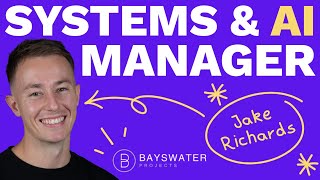
A YouTube interview where David Jenyns speaks with Jake Richards (Bayswater Projects) about Jake’s journey from project manager to full-time Quality & Systems Manager. They discuss why the role emerged, practical wins from systemizing (audits, learning management system, onboarding efficiencies), external validation with clients, and early AI use — including building an onboarding agent and using LLMs as copilots. Jake frames the systems-champion path as a career-development opportunity and recommends hiring a systems champion once product-market fit and sufficient sales exist.
Chapters
Having this system management software that went from just like a Dropbox or a SharePoint location to now like a much better system, that was a big win for us for housing, all that stuff. And I hadn't thought about all of the criteria for meeting that.
Hello and welcome.
I'm joined today by Jake Richards. He's from Bayswater Projects. They're an Australian based construction business and they do building developments, asset management, a whole bunch of things and he is their systems champion. I love chatting with systems champions just to learn a little bit about how the business has gone through building up a systems culture. What are some of the challenges, what's worked, what hasn't, those sorts of things. So hopefully can provide a little bit of inspiration for other systems champions and also business owners as well. So maybe. First things first. Just like to welcome you to the call, Jake.
Cheers, David, appreciate it. Happy to be here. As I was mentioning offline, you've made it, your work's made an impact on myself and the business, so very grateful.
Awesome. I'd love to, yeah, dive into it a little more. I'm curious because I know you didn't start out as the systems champion. I'm curious to know if you see yourself as a systems person or if you've kind of evolved into this role or if you've just naturally been, you know, you know, a checklist organized kind of guy from day one.
I think historically I've been a little bit unorganized, but in an attempt to find solutions to that and the, the troubles of that causes have become systemized over time. So it's almost like your, your deficiencies prompt a need for something and then you go out and search for solutions and then you implement them and then it ultimately leads you to upgrading benefits. So sometimes the deficiency is actually the starting point rather than you naturally being a certain way. Yeah, that's how I describe it.
You've kind of maybe tell us a little bit about how you've evolved into this role because I know, yeah, we didn't start as a systems champion, but you, you've kind of found your way into this position.
I was a project manager and it should be noted that I, I had a little bit of work with systems because I, I'd lived overseas for four years prior to being here. I built some freelancing stuff that evolved into some smaller digital type businesses and that's when I really started on my systems journey. When I came into here as a project manager with a little bit of that experience.
Was delivering as a project manager and Then as we got on our journey, the business was growing, which is awesome. But as a distribution keeps growing, it becomes harder operationally because where the director before is, has complete like oversight and touch points. With every single project you start to get to a certain size where that's not always possible. And so to maintain that, that same consistency, that same experience and being in construction, particularly where workplace health and safety is such a big element of what we do. Like you, the, the, the consequences of not being system systemized are so high. Yeah. That, that it's, it's not like you have to do it as you grow. So with my sort of previous experience, I started starting to sort of introduce bits and pieces that I think that could be helpful. I simultaneously started reading Systemology after coming across you on a podcast.
And that's when I started to, yeah, really get into this whole evolution of our business. And that's gone to like a bunch of different things that we've done, which I'm happy to talk you through. But yeah, so I went from project manager naturally started doing the system type stuff, trying to make sure that we're, you know, coherent as the business grows, running efficiently, running effectively, safe and most importantly in our industry.
And then yeah, the opportunity came up was like, we're getting to a size now where this can be a full time role and that's really. Now I'm a quality and systems manager, which is pretty cool.
Awesome. I love seeing this as a career path for someone because it gives them such a great understanding of business. Really quite unmatched compared to any other role because you get to work with the best of the best on the team. You learn what they're doing and helping to capture and codify. I'm curious, did the drive to do this come from the business owner or did you go, hey, I can see a problem here, I think we should address it. And hey, I've been reading this book. Like how did it kind of come to the forefront for the business owner to back it and say, hey, yeah, we're going to do this?
I think both sides get a bit of credit on this one. To tell you the truth, I sort of kicked it off simultaneously. There was the desire for that. There was some, you know, where we're an ISO accredited business, so we have a system for how we deliver construction. But sort of in the background there's a lot that there's a, there's a lot as well involved in that which, making sure that we're running efficiently. That's where there's a Lot of opportunities.
The construction manager here was a big champion for this as well because he wanted a more streamlined way of operating and having visibility over everything and making sure everyone knew their role, knew how to execute it highly and was being like sort of measured on how they were doing that. So there's a lot of things going right here. I sort of kicked it off a little bit with some initiatives and ideas. It was clearly a need for the business and then seeing that sort of initial spark, they backed it. So I'm fortunate in that respect.
Yeah. And for the business owner to let this evolve into a full time role as well. Like sometimes a little bit of a leap of faith for business owners, I mean they're going to have to invest time, money, resources, they have to tell the team this is what we're doing. So there is a little bit of that hesitation for some business owners. But it sounds like so did this, was it all at once or was it a dual role? And it kind of sounds like you're now doing it full time.
Look, it was a dual role a little bit start.
But to do it really convincingly for the size that we were getting to, it became necessary to have it as a full time role. I had a really, it's hard sometimes to, to make that break. I had a very distinct line in the sand because I had my first child so. So, well, my wife gave birth our first baby. So I sort of had two to three weeks off and we sort of built up to a point where I knew I was going on that I had to do a handover anyway. And then when I came back I came into that full time as the systems role. And what I will say is it's a huge competitive advantage for us now in terms of what we're able to A do internally but B show externally the clients when, when we're able to show like our complete system management software and all about we call our learning management system with all of our modules, everything like that for a small to medium sized business.
It shows a level of sophistication, creates trust.
Every single person that we've shown externally, even, even we've had project management software companies come in because obviously we run projects, they've come into our business. They've even been blown away by what we're doing internally with our systems. So around across the board it's been like it's paid dividends. It hasn't just been an internal thing, it's also been a selling point externally and a validation and a way to build trust. With clients and different people in the industry. Yeah, it's really good.
I love that. The type of wins that you've been seeing like that external validation, winning new projects. Yeah, I don't know if there are any other things where you know, someone going on leave or bottom line improvements or time saved on certain projects. Have you been able to quantify that? Because it's, it's very hard to do because it's. Systems touch everything in a business. So someone always says to me, what's the ROI on doing this? How much money am I going to make by putting this in place? And I'm like, well it's kind of just getting better at everything in your business and everything starts to rise. So how do you think about that?
One really good thing that we do is that has a direct payoff is we run with all of our site guys, we run ongoing like audits that they're implementing the systems. So it's one thing to roll the system out, do the training, but then actually having like fair accountability across the organization to like are you actually implementing the system? So very quickly we can identify trends. So you can imagine we've got a, you know, a whole different bunch of construction sites which aren't in the building where I am right now, they're not in head office. High safety demands. We're about to very quickly identify if there's a trend peaking across one specific site manager, multiple site managers and then that allows us to adapt and go, okay, there's a gap here. We either need to refresh on the existing system that exists, we need to reintroduce something, we need to get our WHCQ manager to go out there and redeliver this training. Maybe there's a gap in the current training that's not clear. That feedback loop in that respect has been massive. That's been a huge payoff. Another key win has been, and I'm still working on it now, is onboarding. So if you think about times when someone new comes on and you're trying to tell them running through exactly how we do everything because we're a very systemized business because like I said, we're ISO accredited, we're held with, that's like we've got an integrated management system, this is how we operate and we're like audited to that, which is, which is a big deal. To run someone through that top to bottom on how to deliver their role takes hours like and days for us to be able to go, hey, here's all of the modules for your Role what you're doing on a daily, weekly, ongoing as needed basis. Do these lessons. Okay? Now complete these tasks and then self go through that and then check in with us after. When you're hiring a lot of people, that saves tons of time for the person that's onboarding them, but then also a lot that all has a dollar, a dollar value associated to it, just purely in time. So it goes right across the board. There's heaps of examples, but that's two big ones that I think. Yeah, good for us.
Oh hey, I know you're tuned in right now, so I'll keep this super quick, but you like awesome YouTube videos, don't you? Well, there's not really that many YouTube channels that create great content about how to systemize your small business. So I want to make sure that you catch every video that I publish. So if you haven't already, firstly give this video the thumbs up and then go ahead and subscribe to my channel. You can even hit the bell notification to make sure that you're the first to know when I publish anything. So go ahead, do it right now, I'll wait a sec and then I'll transfer you back to the video.
Yeah, I love that.
Sounds like you've really grown into this role quite heavily. Like, you know, it starts off with some documentation and yeah, now we're talking about building systems culture and training team members and getting them to use the process. So it kind of makes sense that this really becomes a full time role. Is this, yeah. Something that was initially a career path for you or did it just happen by like we talked about before and you kind of fell into it and. Yeah. I'm just wondering for your journey and what you might say to other systems champions about this role because.
Something, some of them, a lot of them don't necessarily have the technical skills. It's not like they've been trained in Six Sigma or something like that. And I'm just curious about, you know, the journey of kind of how you got here and going through the learning process with systemology and picking up some of the ideas.
I think if you have aspirations of being an entrepreneur or you desire to be an intrapreneur and have and want to take ownership and create impact with what you're currently doing in your organization. I think it's a great career path primarily because A, you're working with all of the leadership team, B, you're working with every single person across the organization to extract that knowledge, document it, then implement it. So you're really Getting like.
It'S a job where, okay, you're helping other people learn and implement a system, but you're actually also learning about how the whole business works. So lately my focus has been hr, so we've been really updating all our hr. Prior to that it's been site safety, site management specific, which is basically operations for us. Right. So.
Now we're in this next quarter rolling out a new system for project financials. So there's so many touch points on the business. So if you're someone that's interested in business, then it's the best way to build that experience without actually being the business owner. And in some cases, depending on the size of the organization, you're going deeper on those things anyway and reporting directly to them. So yeah, I think it's a good opportunity in that respect.
Yeah, I really want to carve this out as a career path because I feel like it's the future business leaders because a lot of people when they start in business, they're trained how to do the technical work, but then they don't know how to run the business. And I feel like the systems champion path and going through this academy is it's like you're learning how to run business properly.
Correct? Yeah, correct, correct. It's a complete entrepreneurial role which either sets you up for a lot of that and leadership in the future or it perfectly prepares you for entrepreneurial pathways if you want to go down that route. Anyway.
Were there any particular things? I know you kind of gone through quite a bit of the training. It says, I'm wondering if there's any standout insights or anything that you've picked up sort of from the systemology world where you're just like, that's been such a game changer for us or the way that you think about process.
Yes. Systems management software was a big one for us that I hadn't thought about in the same way as until I read systemology. So when we already had a whole load of SOPs and things prior to that, they weren't necessarily optimized, but they were just sitting in a SharePoint somewhere and not used to their full potential, weren't implemented, weren't getting referenced.
As as much as they should have been. So having a system that actually housed all of the learning that had like there's a bunch of categories in that systemology where it was like you could assign permission levels, rich media, like so now a lot of the stuff that I do, if it's anything administrative.
And requires some sort of technology like we're doing using a project management software or something like that. It's all screen recordings with steps and talking tutorials and stuff like that. Or it'll be screenshots or whatever it might be. So having this system management software that went from just like a Dropbox or a SharePoint location to now like a much better system, that was a big win for us for housing, all that stuff. And I hadn't thought about all of the criteria for meeting that. Even the ability to say that yes, I have done this, like to tick it off, that yes, I've done it, or like I said before, permission levels, assigning them specific content relevant to their role. They were. Yeah, they were big wins.
Yeah, love it. Maybe in sort of the tail end. I'd love to think about how your thinking has changed. Like we're seeing AI roll out and start to touch and affect every single role in an organization. And particularly I saw it first on the front line with our systems champions because the ability to systemize now is easier than it has ever been and the quality at which you can do it is better than it's ever been by leveraging a lot of these tools, starting using it in your own role. But I'm also curious to know if that's leaking through to other parts of the business and you know, if you're being a champion for that and helping that spread.
Yes, we are. And I don't think you can bury your head in the sand when it comes to AI. So at a very basic level, developing all the material, having a bit of aspiring, like you've got the typical use case where you're using, you know, one of the.
Language models as like aspiring partner. A bit of a co pilot, your bouncing ideas. I'm constantly giving it context and asking it to gather questions and prompt me for questions before it recommends responses because then it's very tailored experience, feeding it inputs and that kind of thing. So that's like a basic level. Then at a different level, everyone's talking about agents and how that's going to replace people. I'm not sure whether it replaced people or not, I'm not sure. But definitely in terms of it being able to improve things that people are already doing. Like right now I'm working on building a, like an onboarding agent, so that connects. So again, as I said, I've been focused on HR recently. So there's a lot of things that go out in terms of information capture, in terms of emails, in terms of documentation. There's a big process in the lead up to someone actually coming on, on board and starting here. So much of that is just manual and just taking documents and putting in different places. The people that are doing that have got higher leverage activities that they could be doing, but they have to be doing that. So that's definitely a way that now we're starting to use. We're basically dedicating a budget and a time for myself to basically go out. It's like R D in that space, space. How can we leverage this? How can we build into the business? And definitely just speaking anecdotally, every single person I know here is exploring it and like where even I've got some stuff up on the board next to me. But trying to create a learning culture because it's one thing to give people like compliance, sops and things, but then when people actually want to learn and are going out and exploring their own learning as well, in addition to the systems, that I think that's really powerful as well. And people, people are definitely starting to do that here.
I love the work that you are doing. It's really inspiring. And the impact that you're having internally, like this is the stuff that the business owner wants to have done but never ever finds the space to do. And you're driving that cultural change from the inside. I think you are a perfect example of a great systems champion. If you had any words. If you're speaking to a business owner who is thinking about identifying their systems champion and training them up, I don't know if there's anything that you could suggest to them or having already done it and seeing from the other side the impact that it could have. Yeah, I think that might be helpful for them to hear from a systems champion for sure.
I think the first thing to assess is, okay, where are you at in your business? Do you have product market fit and are you getting sufficient sales through the door? If you're getting sufficient sales through the door, then they can greatly multiply with a solid system behind it. Not to mention avoiding the catastrophes of things going wrong. Because I think half the battle is trying to avoid the major losses. And having a solid system in place that is employed by everyone across the workforce is going to mitigate a lot of that. So that's one way of going about it. What else will I say to a business owner? I mean, all I can say is that we have consistently grown ever since this role has come in. And so it has paid itself off like multiple, multiple times in having this role.
Everyone's more organized. It's more peaceful for the business owner as well because like you said, all those things that they want to do, but they're constantly getting pulled in a lot of different directions to give you a difference. When I was a project manager, I'm getting hundreds of calls a day, emails like non stop, constantly, like operational things that I need to do in this role now there's a lot more deep work uninterrupted to actually work on needle moving activity like the other stuff is just as important. That's what drives all that revenue 100%. But this is what makes us flow better. And without those interruptions of a dedicated resource in that area, they're able to actually drive that change and implement those things where you just can't do if you're too caught up in the operations of the business.
Couldn't have said it better myself. I absolutely love it. I'm going to continue to watch if your journey as you guys develop. I'll pop a link through to Bayswater Project so people can keep an eye. And yeah, just a big thank you to you. Thank you for making the time to share and give us a little bit of inspiration. And I think for some people it'll be bit of a kick in the bum to say all right, get moving on this. Which is, you know, really what it's all about.
Yeah, you won't regret it. And like at the end of the day it'll go. You're not taking on a lot of risks by doing it. It's one person's wage. Like it's, it's not. The consequences are not, are not huge if it all went wrong, which in my experience hasn't gone wrong. So I think it's a pretty asymmetric bet to take.
I love the way also it's becoming more and more clear to me some of the best systems champions are the juniors who are hungry and who want this and comfortable with tech and work their way up. So this is not like hiring a $200,000, you know, ops manager or you know, a right hand man or woman. And this is a role that I think any business with 10 or more employees.
Correct. Yeah.
This would be a great starting point for them even before they grow into getting their right hand man or woman. And who knows, I've even seen systems champions in businesses where that person doesn't exist evolve and grow into that role also because they just learn so much through the process.
Yeah, 100%. Everyone benefits. Yeah. And there's lots of opportunity. So yeah.
Perfect. All right, thanks again for that. Appreciate it, Jake.
Cheers.
More from David






Remember me? Subscribe To My Channel For More Free Business Systems Content 📈




