How To Build A Successful Franchise Business (1-800-GOT-JUNK?)
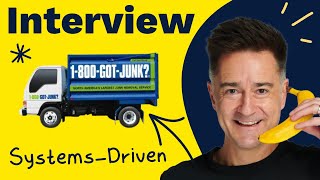
A recorded interview between David Jenyns and Brian Scudamore (founder of 1-800-GOT-JUNK) about the central role of systems in building and scaling franchise-style service businesses. Brian attributes his systems mindset to reading Michael E. Gerber's The E-Myth (around 1995) roughly six years into running 1-800-GOT-JUNK, and describes how formalizing best practices (uniforms, checklists, call-center scripts, mandatory software fields) enabled consistent customer experience, hiring/training, and growth to a large multi-brand operation. He emphasizes the founder's role as systems champion or appointing an implementer, allowing space to experiment early but systematizing once best practices are identified.
Chapters
So we've built a $600 million business just with 1-800-got junk. We could have not scaled to that level if we weren't awesome at systems.
Hey, it's Dave here. And our guest today is Brian Scudamore. He's an American born Canadian entrepreneur. He's the founder of a range of different companies, but probably most well recognized for 1-800-got-JUNK. Now, I first heard of Brian from Michael E. Gerber. Michael used to talk about this guy who went all in on the E myth and built the McDonald's of junk removal services. And a few years back I had a colleague that then suggested I read the Vivid vision by Cameron Herold. And then I found out that Cameron was the CEO of 1-800got junk. So the deeper that I've dug into Brian's world, it really is quite extraordinary what he's built and the people that he surrounded himself with. Just recently, I also finished his latest book, byob Build your own business, be your own boss. And it's very clear that he's a lover of systems and processes, which is perfect because that's what we're going to be talking about today. So firstly, Brian just wanted to welcome you to the call.
Thank you, Dave. Happy to be here. And while it's something I don't talk about as much as I would like, I love systems. I really do love systems because they make our lives easier. And let's face it, as an entrepreneur, as a leader in a business, you want to grow, you want to grow more quickly. Systems allow us, I think, to scale in a faster and better way. Massive fan.
That probably leads into my first question, which is, and you touched on some of it. But I'd love to dig a bit deeper about how you feel about business systems because I know a lot of visionary founders, they oftentimes don't see themselves as systems people. And I'm curious to find out a little bit more about how you feel about it.
I think I was probably born into some systems methodology without realizing it that I'm very ad as an entrepreneur. I see squirrels all over the place and I got to bring my focus back and so I need processes and checklists to help keep me focused. But my people, all of our people across any of our brands, like 1-800-got junk. Wow. One Day or Shack Shine, they want to know that we've got processes that tell them the best way to do anything we do. So someone in shackshine wants to know what's the Shackshine way? And there should Be one way of doing something until we get so lucky as to find the better way. So the way I really stumbled into it. Michael Gerber, author of the E. Myth. We've become friends. I think he's 85 now, and I talked to him a couple of times a year. He's phenomenal. And I'm not a big reader, but when I picked up his book, I read it cover to cover in two sitting, in one sitting, and then read it again. And I said, this book will change the course of how I do business. Because if I naturally understood that you could take a process and make it simpler, the e Myth taught me how to almost franchise my business. And it said, build your business out like a franchise, even if you don't plan on using that model. Because if everything is so cookie cutter and everyone understands what's expected, and here's how we interview, here's how we bring new employees into the business and onboard them. Here's how we price jobs, how we load the truck. Everything just became a best practice. We started to look, feel, and act so much like a franchise that I said, wow, I think this is actually the way to go. But systems thinking, inspired by first the e Myth and of course, your book Systems Tology is had us go. How do we really ingrain it in every single thing we do to make sure that we're not trying to reinvent the wheel and that everyone's doing it the best practice way?
How early in 1 800, got Junk's life. Did this happen? Was this right at the inception, or had you been running it for some years? Or when did you actually get bitten by the bug?
Yeah, good. Good way to say it. Bitten by the bug. I got that system's bug after I read the e Myth. I read the e. Myth, I think, in 1995. So six years into the business, I would have been about a half a million ish in revenue, maybe 10 employees or so. Fairly small. But we were starting to see the problems of Brian as the founder does it this way. Other people do it a different way. It needed to be uniformed. And in the same way that we literally said, here's the uniforms you wear when you're hauling junk. Here's how the trucks need to look. Here's the safety inspection checklist. And we really set out to, after reading the e. Myth, to put every single thing we do that we figured out a best practice way. I said, how do we put on one sheet of paper, almost like a manual, one sheet. What is the best practice of how to do anything. So in the call center, we take today thousands upon thousands of calls a day. But I remember when we were taking dozens, I wanted to know that it was a McDonald's like experience in the sense that every time someone called, they got the same friendly energy. They were. The rates were explained with the same consistent process. Nothing was missed. And as we started to build it out that way, the customers saw the impact and the customers we would always look at. I got this from an E Myth coach years ago was the key frustrations process. How do you look at something that's not working in the business that's causing a frustration and say, how do we nip that in the bud? How do we put a system in place to ensure that people aren't fail over and over with that process and it's changed the way we do business.
And you've done, you've started multiple businesses and other brands as well, and you've built this sort of systems. Thinking into those, I'm curious, like 1, 800 got junk. You had a small team around you. You were starting to get a little bit of momentum. Like obviously, if you've got 10 people around you, at what point when you start a new company do you start to think about systems? Is it from day one or do you try and figure things out? Or like, at what point do you start adding it into the mix?
We start thinking about it from day one for sure. But I think in the life cycle of a new business, you want some space for innovation and making mistakes. And so you don't want to systematize everything because you haven't figured out the business model. So let's take shot shine. As an example, we do windows, gutter washing, power washing. We do a lot of things to shine the home. And almost like a house detailing industry, if you will, something we added later on a couple of years in the business was Christmas lights. We make your home sparkle and glow by power washing, doing the gutters, doing the windows, the Christmas light side fit perfectly. We didn't systematize that side of the business when it came on board because we said we just, we have to understand why people want Christmas lights, what the process is, what the challenges are. And so I think you've got to give some time to understand the business and make some mistakes before you try and create a process behind again. I go back to me, a system of process is a best practice. Until you identify a best practice, there really isn't a system. Yeah, you look at an airline pilot, all they're Doing is an organized system of best practices that keep us safe. But you don't want chance to get in the way. You want to know that every single time that pilot is looking at the checklist to make sure that every single button that needs to be pressed has been pressed. Same thing in one, 800 got junk. Same thing in Shackshine. When we know that here's the best way to sell a job, to price a job, to show up and do a touch up, whatever the case might be, there's a way to do it and we want to be able to go back to our customers and depend on the fact that someone followed the system and we know it was done with a consistent way. Now that doesn't mean robotic. Right? It doesn't mean that there's no personality behind what we do. We let people personalize the experience as employees in any of our brands, but we expect them to follow a core process to ensure that it was delivered with excellence.
Yeah, it sounds like as well in that initial innovation stage, and you mentioned something just before I hit record is that you see yourself as like the systems champion in the business and you're helping to drive it and capture some of those early systems. I'm curious to know your thoughts on that. I think is that part of the role of the business owner is to figure out some of these best practices and then turn them into process or how do you think about that?
Yeah, you would have dealt with so many more businesses than I and different business owners. So I'd be curious on your perspective as well. But mine would be that the business owner, if they're not a systems person, they need to find someone to play that role. So a visionary like myself, we've got Eric, who's our president, who's our implementer. I'm the visionary. We work really well together. Like Cameron Herold and I did, where I'm the visionary. I'm setting these big bold ideas. Where do we want to go? But Eric's team will make sure that there are processes in place to ensure that things are done with excellence. You have to have someone in the business. While I'm the champion of systems, in our company, I think I'm the champion of. Here's the need for them, the spirit behind them. The old E myth. People don't fail, systems do. When we make a mistake, we say, okay, what did we learn here? It wasn't really that someone failed. We didn't have the right system in place to ensure that someone knew step by step, the procedures to follow to make sure that this was done right now, someone might go, hey, Brian, it's junk removal. Do you really need all the systems? Yeah, our profitability depends on systems. Why not save time and be more efficient by doing it the right way every single time rather than trying to reinvent how we do things. That's why someone buys a franchise. They go, brian, listen, when we buy a franchise with any of your O2E brands, we want to know that you figured out all the challenges. We want to know that if you, if this happens, what do I do? And again, doesn't mean they don't get creativity and that they don't make the business better with their ideas, but it really is going, what is that best way? And how can I ensure from a customer perspective, from a brand growth perspective, that we've nailed how to do it?
I love hearing the way that you describe and explain this because just the language that you're using just shows me how deeply this system's DNA is just embedded into your makeup. And it speaks to something that I remember Michael Gerber had said to me. And you're, oh, I'd love to get your perspective, Dave. I remember Michael. I'd sent him a copy of the systemology book. And in the book I give the business owner a little bit of an out by saying, hey, you can get the team to help do this. And we try and take the business owner out as soon as possible. And Michael's words were, dave, don't let the business owner off the hook. Because. And I always. That stuck with me because the business owner still needs to lead it. Maybe they're not the person who is getting in there and writing out the process and crossing the T's and dotting the I's, but they need to have it in their language and be up front and tell the team that this is how we do things here. And they need to not be above the law and above the rules. And that's such an important piece for that visionary founder to play.
Yeah. And the visionary founder has to tell the stories of why things are important in our business, why we do things the way we do them. And so even if they don't create the systems as you said, or write them all out, they need to be someone that believes in, here's why we do this. It's like the movie the Founder with, with all about McDonald's and not one pickle, two pickles. They had a system. And those two pickles were there for whatever reason Ray Kroc believed in. But that Was their way. Don't do one pickle. Don't do three. The flavor of that burger, the consistency of what you expect, it's two pickles. And still to this day, it's two pickles. So I think, as the owner, you need to decide what is important to you. And then how do you make sure that you've got the system in place to ensure it happens every single time?
Definitely feels business ends up being a reflection of the business owner. You can look at someone's business and you can tell a lot about the individual behind it based on how the business is run. I'm curious to know how you've then built up the systems culture in the organization. Obviously, you talking about it and being upfront and talking to the team and making it important. But what are some of the ways that you kept systems front and center?
Yeah. So we've built a $600 million business just with 1-800-got junk. We could have not scaled to that level if we weren't awesome at systems. When I go to any city in North America or if I'm in Australia and I see our trucks there, they look the same. The uniforms are the same, the people smile the same. Like, they've got this energy and enthusiasm. So how did we get there? It goes back to five years into the business. Around the time I read the e Myth, I actually fired my entire team. They say one bad apple spoils the whole bunch. I had nine bad apples of 11. I didn't know what to do with the remaining two, so I just wiped out the whole company. But I said, I let you down. I started with two words. I said, I'm sorry. As your leader, I didn't give you the love and support you needed, the guidance, the direction. You don't believe in me. I didn't believe in you. And I'm sorry this hasn't worked out, but I need to start again. So around that time and with reading the e Myth, what I realized is I wasn't the right leader, but I wasn't leading with giving people the systems to be successful. So we did everything from. We started with systems to find the right people, systems to train the right people, systems to keep them. Great. So every single thing we did was calculated, was organized, had a result that we expected. We didn't always hire the right people, but because we were so intentional about the type of person we were looking for and how to train them, we got organized and it allowed us to scale again. It's no coincidence when we have our big gathering of franchise partners every year and you get about 700 to 1,000 people in a room. Birds of a feather flock together like they're attracted by this entrepreneurial energy and the systems organization behind what we do and the consistency. Because as the champion of systems, it's something I've pushed and maybe last thing I'll say about this, Dave, is I've really leaned on Michael Gerber's philosophy. If people don't fail, systems do. So when someone makes a mistake, it's really easy for someone to go, oh, what a jerk. How did this guy do this? He just doesn't care. Hold on. Let's look at why there's lots of people failing with that same practice. How can we change it? How can we fix it? How can we put something in place? I can give you a very simple example that this was a real frustration is we had our software where we do all our booking and dispatch and way back in the day it was called junk. Net. And I said as the owner, it's really important to me to understand every person that calls into the call center. How did you hear about us? How did you learn about 1, 800 got junk. So I get people to. There was a field where that they had to fill out what the answer was. People would forget. I'd remind them we'd put post it notes up around their computer. Don't forget to click that box. Don't forget. I realized everybody, including myself sometimes would be busy on a call and you just forget to ask the question, how did you hear about us? So we made that field mandatory. We realized that you couldn't actually complete the order without making that field have a choice in it. And once we changed that, we went from 50% success to 100% success. Everybody completed it because you couldn't go further.
More from David






Remember me? Subscribe To My Channel For More Free Business Systems Content 📈




