How To Scale A Recruitment Business
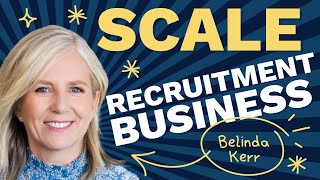
Conversation between David Jenyns (host) and Belinda Kerr (founder, Recruitment Garage) about how recruitment agency owners can scale. Key takeaways: focus on a niche and work with clients who value recruitment; target clients typically in small–mid businesses (roughly 50–500 employees, sweet spot ~100–200); expect AI to displace high-volume, low-skilled recruiting and adapt services (e.g., recruitment-as-a-service, embedding AI into clients’ processes). Practical guidance covers marketing (brand-building, LinkedIn, content, follow-up, referrals), qualification and onboarding practices, payment models, and client-nurture to win repeat work.
Questions this video answers
July 1, 2025.
Approximately 100–500 employees (sweet spot ~100–200).
High-volume, low-skilled recruitment.
One-third upfront, one-third on shortlist, one-third on placement.
A $2,000 sign-on fee (refundable if two suitable candidates aren't provided).
Chapters
If you've got a LinkedIn strategy, you want to go all in and consistent and really optimize your skill in that area. If you're doing word of mouth and you're doing networking, learn it really well. Go out and be consistent and be all in on it.
Hello and welcome. If you run a recruitment agency, then I know you're going to love this session. I'm joined by Belinda Kerr. She's the founder of Recruitment Garage. They're a coaching company for recruitment agencies. So having launched, grown and sold two of her own agencies, she now helps other agency owners do the same. I couldn't think of anyone better to work with to help identify best practice for agency owners. And we're going to dive into the critical client flow and I want to uncover what are the critical systems that recruitment agency owners need to get in place to run a thriving business. So maybe first things first. Just like to welcome you to the call, Belinda. Yeah, thanks.
Thanks for having me, David.
Awesome. Well, maybe just to start because I'm going to jump straight into the critical client flow. The first thing we talk about is the primary target audience. So if we put ourselves in the shoes of an agency owner, like a recruitment agency owner, and we think about, you know, of the many clients that they could be dealing with if we just pick one that maybe is a, a dream client, refers friends and family, pays advertised prices, is a pleasure to deal with and an agency owner might like hundreds more clients like that. Yeah. Perhaps if we start there, if you could tell me a little bit about with the different coaching clients, you've got ones that you go, oh, you know what, this is a great target audience for someone to focus in on.
Yeah, sure. Well, I think, well, the first thing is that most agencies, well, all the agencies that I deal with are working in specific niches or niches if there's Americans listening. Because now that's the critical first point is not to try and be all things to all people. We know that just doesn't work as well. So that would be the first thing. The second thing is, is that we all want clients who understand the value of recruitment and want to work as a partner, not just as a sort of a vendor supplier because that's where people can get unstuck. You get this mismatch of, you know, recruiters who are always really hell bent on doing great delivery and giving 110%. And then if you've got a client that just doesn't respect that, it just doesn't work. That would be the second thing That I would say and you know, we live in a really rapidly changing world as we were just talking about before we came on and AI is really changing things. So I think recruiters need to be very careful now about the sorts of market that they go after. So we know that high volume, low skilled recruitment is going to be the first one that's gobbled up by AI. So we need to be looking at opportunities to be working with clients that have more nuanced requirements, typically more senior, more hard to find type people and nuanced because we know AI is very good at just, you know, ticking boxes. But how good as is it at really understanding from a cultural.
Like specific experience set, like how good is, is it at pulling all that out and defining it? So they need to be, you know, I certainly wouldn't be launching a low skilled temp agency these days. I would be looking more at going for your more nuanced skills, senior level type, full time recruitment across lots of different industries. And of course the other thing to look at is the clients that you've, the clients that the recruiters have, are they quite vulnerable to AI. So if they've got repeatable skill sets, if you start to think about industries like manufacturing or even, even some of the, you know, what's perceived as high level skills like legal services, a lot of that's being impacted by AI. So I think recruiters now need to look really carefully at how AI is potentially going to disrupt the industries that they're targeting and perhaps look at different areas where it's not so much the case in generally.
Again you probably can work with a variety of different sizes and types of businesses. I think going after a particular niche makes perfect sense. Is there a sweet spot for the size of organization like I'm imagining many, you know, thousands of employees in a company would mean they probably have their own recruitment team. So yeah, generally what's kind of like that sweet spot from a business size?
Yeah, that's, it's such a good question. So, so a lot of the guys I work with, all the guys I work with are smaller businesses and it's very hard for them now to compete with, you know, Hayes or the, the really bigger companies that have got preferred supplier agreements with these, you know, big, let's just call it news limited. Those sorts of people, like the bigger companies, the corporates, the big banks, those sorts of people have all got PSAs and also internal teams. And of course again with, with AI, that's all changing at the moment. And these things are really hard they take a long time to get onto and usually they're trying to screw you down on rate. So I always find for the, for the smaller agencies it's, it's better to sort of match like with like so go for the smaller businesses and you know, the smallest you would go at would be that somebody that can at least give you, you know, they're going to be able to give you some work and up from there. And I'd probably cap it, you know, well, before you get into that corporate zone. And I find that, you know, most of the people that I work with find that sweet spot where they might have a talent acquisition person or they might not have a talent acquisition person but there's enough there, there's enough going on but they just haven't really solved that problem. Like they haven't built in a big talent team yet. So you're absolutely right. So small to mid sized businesses is perfect. But of course if you are a bigger agency, if you have got, you know, if you're an agency with hundreds of staff then you can absolutely go and you know, work with the banks and the bigger guy, the, you know, the bigger mining companies and all those sorts of people who want these bigger corporate partnerships.
If we were to put some ballpark numbers in here, when we say small to medium, if you think of like headcount, what, what do you think of as a small or medium sized business?
Yeah, well, I would say anyone up to, in terms of recruiting for them, let's just call it up to about 500 people. But the sweet spot's probably going to be one or 200.
Yeah. So anywhere let's say 100 to up to about 500. Yeah. Great.
And also, sorry David, just to clarify too, but also coming way down from that, I mean I remember one of our clients had about, one of, we got about 80. I know this is wrong having 80% of your business from one client, but it happened to us one year when I was, when I had my agency and they only had about six people. So you can find small companies that are growing. If you've got a small company that's growing, you know, there's lots of guys that I work with that are working with startups and you know, they've only got a few people to start with but they perhaps just got some funding through and all of a sudden they need five or 10 people. So they, they can be just tiny as well.
I know sometimes there are some, some outliers and things like that. If you had to sort of Pick I. I'll go maybe that range then 50 to 500. Because again, I know you'll find. Are they more the. The really small ones you're talking about that would recruit a consistent amount? Are they more the exception or the rule? Like, if we had to kind of.
I think it depends what the recruiters set up to do. So there's recruiters who purely just go at it. Could be IT startups, for example, and.
There'S a lot of people working in that space because a lot of startups. So I wouldn't necessarily call them the outliers. I'd say it's more around what that recruiter themselves is going for.
Yeah, perfect. Now, I think each recruiter watching this is going to have a different industry. But just for this exercise, if we were to pick an industry, is there an industry where you have seen recruiters have good success in it, or you've done, or anyone that jumps out? I mean, you mentioned a couple like mining and a few things like that for some of the bigger ones. But are there any industries where you're just like, oh, yeah, I've seen it work in this space.
Well, it traditionally has been a cash cow, but of course, the last couple of years they've been really hammered. I think it's starting to come back now. But then it depends, like within it, like that's such a big market. There's, there's, you know, hundreds of specialisms within it. What I think is kind of counter to what you've just said there. Like, I can speak to people who are in the same market, one of them's doing really well and one isn't. And the only difference is the person. So I think sometimes it's actually down to the recruitment founder and how they're running their business, not so much the market.
All right, I'll leave it then, even we'll just leave it as a general industry there. I think the takeaway here is that the agency owner needs to pick a space, an industry that they'll become an expert in. And then as far as when we think about the product and the service that they offer, it's the recruitment of staff.
So I don't know if there's anything else to add or any nuance on that, or that's just basically placing a staff.
Yeah. Although it is changing too, because again, with AI, we're starting to see some of the function of recruitment can be taken over by AI. So people are now thinking about what are the services and how else can they adapt what we traditionally do as recruiters to better serve their clients. So what I'm talking about there is things like, you know, one of the guys in my program at the moment, he's just putting together a recruitment as a service model to go and work with some of the smaller business. He's, he's in the.
The. It's not the, he's in the, let's call it the automation. The machinery automation space. I was trying to think of the right word for it. And so he's got clients who are.
Want, like wanting more.
They're still wanting to partner with him but in a different way. So he's starting to look at recruitment as a service. Recruitment outsourcing is something that's, that's bec. Stronger as well. So people, if companies are now, if some of these companies are starting to use their own AI internally, there's an option for. And it sounds a bit counterintuitive. You think, well, I'm giving up my business, but if you're going to lose it anyway to AI, then you may as well help the clients convert over. So how can you actually help your clients use AI more efficiently within their recruiting services? So there's opportunities there to build out new products where you're actually going to your client and saying we're going to help you recruit by helping you embed these AI tools and different ways of doing things in your business and we'll help you run that. So there's different ways and this is all very new. I'm not giving you a very good answer here because it's all kind of unfolding right now. I think.
A lot of the skill in recruitment traditionally, for example, like things like sourcing and your lower level admin, that can all now be done by AI. So what that may transpose into in the future is that recruiters are able to offer a lower cost price for what they do. I'm not saying suggesting they cut their prices, but they can be so much more effective. They can deliver more efficiently using AI and different tools where they would normally be using themselves or their team to lower the price of delivery. Which means that, that their product becomes a little bit more palatable for perhaps people who are trying to save costs on their recruitment.
Oh hey, I know you're tuned in right now, so I'll keep this super quick, but you like awesome YouTube videos, don't you? Well, there's not really that many YouTube channels that create great content about how to systemize your small business. So I want to make sure that you catch every video that I publish. So if you haven't already, firstly give this video the thumbs up and then go ahead and subscribe to my channel. You can even hit the bell notification to make sure that you're the first to know when I publish anything. So go ahead, do it right now. I'll wait a sec and then I'll transfer you back to the video.
Yeah, perfect. I'll leave it then. Just obviously what the deliverable is is evolving and changing. Yes, but it's. For now it's still just a recruitment service. You're basically helping to place staff but you might be using various ways to speed up and use AI to, to change which parts of that you actually do. And there might even be a component of teaching the business how they can improve what it is that they're doing. So if we think in terms of that as a target audience and the service that we're selling to them, basically small, medium sized businesses looking to recruit team members, generally these agency owners, what are some of the more effective ways for them to grab the attention or to market their services? I could imagine word of mouth because I think a lot of these, you're building up relationships. But what are some other like effective ways?
Yeah, certainly word of mouth and referrals. And again I can only sort of speak from the guys that I deal with who are the smaller founders. It's super important now for them to be building their brand. Whoever you listen to will tell you brand is important. Which is really challenging for recruitment founders because they're busy in delivery and we're all trained as recruiters to go after next month's revenue. But to win the long game now as a recruiter you absolutely need to build your brand because it's the only point of difference that you have. You know, everything else can be copied. Your brand can't, no one can copy that. We can't make another David, we can't make another Belinda. So that's number one. And we know that marketing used to be the other way around. Sales was far more in recruitment than more important than, than marketing. Now it's the other way around. Marketing is so important and recruiters find that really hard because they're not marketers or recruiters. But using so content marketing is incredibly powerful. I mean all these, there's no one thing, there's no one magic bullet. So referrals, word of mouth. Absolutely. Building your brand, leaning into digital marketing, which when done well is incredibly cost effective. I mean LinkedIn is a gold mine that's been, you know, people struggle with LinkedIn there's, there's particular strategies that work very well on LinkedIn and there's others that just will waste your time. You'll be in there all day and not getting, not getting anywhere. Another big, the guy. So I'm sort of, you know, referencing the guys that I know are doing well. They will be very heavy on follow up. We all know the fortunes, the fortunes in the follow up. So we've got these big databases, huge amounts of LinkedIn connections that aren't just being, that are not being leveraged because people are looking for the new thing all the time. What's next? What's next? Here's the next best thing. I've been on YouTube, here's something else but I absolutely nurturing that email list that they have got their LinkedIn that works incredibly well. They're probably the main things and I think also cold calling is making a bit of a resurgence. It's really funny. I've had a few people recently have some wins with cold calling and we've been sort of bagging it out for so long but it seems to have its pla. I know you've got these like these, these mavericks that can go out and we'll just do cold calling and earn millions but they're very much, you know, just a tiny fraction of the market. They're the exception. But I've had some people recently using cold calls effectively and, and I think people too are enjoying getting out and pressing the flourish the flesh a bit more. So conferences, networking.
And that's, that really covers the, the gamut of it. And I think with any of these things, and you know this David is it's about consistency. So if you're doing, you know, if you've got a LinkedIn strategy, you want to go all in and consistent and really optimize your skill in, in that area. If you're doing word of mouth and you're doing networking, learn it really well, go out and, and be consistent and be all in on it. So but yeah, but they're, they're the.
Things I'd say perfect and I think just picking one or two of these to start with, I think that's, that's great as a place to start. Like I think any one of these and other methods can be effective that consistency and focusing in. So if you spread yourself too thin sometimes you don't tend to do anything very well. Once you kind of do some of the attention getting methods how do, when someone's actually ready, how are they often sticking their hand up and saying, I'm ready. I'm imagining they're either filling out some sort of web form or they're sending some sort of DM or an email or maybe there's a phone. So there's probably a few different ways that that first inquiry comes in is that when someone says, you know that they spot one of those different channels that you're marketing on, they say, all right, yep, I'm ready now. How do those inquiries normally come in? Would that cover everything?
So that's going to depend on the channel that they come through. So obviously if it's cold calling, it's going to be on the phone. If it's LinkedIn, it could be something like a DM.
Word of mouth's probably going to be a call. I imagine conferences, it's going to be they're going to be having a chat and probably following up later by email or phone. And content marketing, you know, a lot of content marketing is going to have a call to action at the bottom. So that could be just coming through via an opt in to an email. So I don't think there's any one way that people come. Depends on the channel.
Yeah, perfect. And then generally, what's the first thing that happens after that inquiry comes in? Some sort of qualification or jump on a call or.
Yeah, what, what's that talk about what the, what the recruitment needs are going to be? Not just now, but, you know, let's just call it for the next 12 months. What's, what are the priorities for the client? Where are there? And then you'll be having it. Just a typical conversation around their, their hiring needs, who are they looking for, what are the problems, you know, what's the. Looking at what the culture's like, talking about the industry, the competitive landscape, the typical, you know, the employees that they've had, what makes a good employee for them, all those sorts of things which any good recruiter would know what to ask there.
Yep. And then after that call is what happens next? Is it usually a proposal or what?
Depends on the level of the role. But if it's a senior, you know, often if it's a senior retained role, there could be a proposal. If it's a bigger company. Yes, absolutely. You'll be needing to put in proposals, but sometimes it'll just be a conversation and, you know, I'm looking for a sales account manager and then boom, in you'll go to the, you know, taking the brief and starting to work on the role.
Yeah, perfect. And then like you mentioned, there's probably a big piece here around the follow up. Not only kind of mining some of your attention getting methods but once you're kind of down here as well, I suppose you want to strike while the iron's hot. Once you've had a chat with them and sent out the proposal. And then generally is there any money usually taken up front or is it usually on completion?
Well that depends. Again everybody's different. So it's interesting it's changed. When I first started in recruitment it was, it was sort of like contingent basically you got the money paid after and it was potentially out to you know, other agencies as well. It might just be out to you, it might be exclusive or it was retained. So that we do was a third upfront, then a third on short list and a third on, on placement. But now it's different. Now you've got people taking all sorts of different payments. So it might just be.
It could just be a sign on fee of $2,000 or something like that and then everything in between. When I had my agency we were in a market that was very contingent based. It was very hard to get retainers out and we introduced a new product where we took, I think it was a two thousand dollar sign on fee. And then our thing was if we don't come up with two candidates that are absolutely spot on to the role then we'll give you that back. But they had to pay it even if they didn't hire the people and that worked out really well. So and that it was kind of a step way back from retain but it gave us the commitment from the client which is often what recruiters face. They just, the recruiter, if, if the client doesn't understand recruitment well they don't give that.
That commitment and what that gave us was commitment. So sign on fees are things, things like that are becoming a little bit more common than they used to be and I think they're a good thing.
Yeah, perfect. And then once the client's done sign on and they're ready to go. I'm imagining there's some sort of onboarding that would have already probably collected some of the data up on that earlier sales call. But there might be other things that you collect. How does the onboarding usually work? What, what before they actually get into the recruiting itself?
Yeah, it's funny, I did a training on this the other day actually. There's, it's interesting because you, what can happen is it's like yes, we've got a job, here's our terms of business. Let's go and then you're into filling the role. But, and that's great. But what we're looking for, if we're looking for clients that want to use us long term, we want to stand out in the beginning. So often the onboarding will have things like, you know, introducing the, to the team, because normally the recruiter, if they get the job on, even if they've got other resources behind them, the client doesn't usually meet them. So it could be introducing to the, the team, letting them know what each of you doing, walking them through the process of how you're going to find people. Because I think sometimes there's a bit of a, an assumption by clients that we just have this big pile of candidates that we can just choose from and ship them over. And I think. And sometimes then they don't understand why the fee is the fee, particularly if they're, you know, they haven't hired a lot of people. So I think part of the onboarding for people who do it well is actually taking people through the process of what you do and how you do it and some of the tools that you use, the, the people and, and their responsibility within the team, what they're doing to actually.
To actually give credibility to what you're doing and help, you know, help the client understand, I guess, build your credibility with the client in what, in what you were doing. And then of course, ultimately, I know it's sort of like business by Zoom these days, but if you, the more you can get out and meet people, I just think that whole face to face connection is important as well. So a lot of people, you know, I think again are sort of switching back to getting out and doing more face to face. But of course, the other side of that is now that we've got Zoom, we can, I can be sitting here on the sunny coast and I could be recruiting someone in San Francisco. So yeah, that kind of rules out the face to face.
Yeah, yeah. And then you kind of move into the doing of the work which was. Would be the recruitment itself, which I'm imagining there's going to be a lot of moving pieces here. And I just capture it in one box first, very high level. But obviously there's going to be a range of different milestones and sourcing and filtering and getting your candidates on board and interviewing and before you even endorse candidates for them to interview. So there's probably those high level steps. So I won't go into those because I feel like that's a lot of the recruiters.
That'S probably their strongest area because that's their jam.
And then when we finish up, I suppose afterwards, you know, we're looking at doing some sort of handover or something. And.
That once you kind of find the candidate, you really want to try and win some ongoing work. So I don't know if there's any, any. Yeah. Any additional points or that you want to speak to both underneath the recruitment, like the doing of the work or the handover once you have found someone.
Oh, you mean the handover being placing the person.
Yeah, placing it and saying, all right, we're successful here now and how might we continue to work together?
Yeah, exactly. Well, I guess there's two parts. So there's that particular role itself and then there's ongoing business. So if you take the role itself, then often like we will stay in touch with the person over time and work with the client and be back in touch with the candidate to make sure that they're, you know, enjoying themselves, they're feeling welcome, they're feeling onboarded, they're not shoved in a corner somewhere. They're being given the tools. And you know, the big thing that recruiters are obviously worried about is typically they'll give, let's just call it a three month guarantee. They're wanting to make sure that that person. Yes, they go past their guarantee, but I mean, it's not just about that. We want to make sure that they're going to stay there for longer as well. And I think because you've built that relationship with the candidate already, quite often you're in a nice place to kind of just really make, stay close to them and understand how they're really feeling in that new role. And then of course, on the other side of it is with the ongoing business. And I think sometimes we can forget to nurture and keep in touch and keep giving value to our clients when they're not working with us. You know, we know that most of the time they're not recruiting typically and how do we keep in touch with them until that next role comes along? And so I think, you know, we work a lot with nurturing people and giving them value and staying in touch because if you're not staying in touch with them, guess what, your competitors are. And so you don't want to miss that next job. And I've had it happen, happened when I was recruiting. You know, you'd have a great relationship with a client. You'd, you'd think that they were going to come back to you and give you the next job and then you find out in six months they've placed somebody else. You go, oh yeah, so and so just rang me and they had somebody and we took them in. So I think in terms of getting future work, you've absolutely got to have strategies in place to be able to, to keep nurturing them, keep in touch with them with different touch points along the way so you don't miss out.
Yeah, perfect. And then that kind of almost feeds back up to what we were saying up underneath the word of mouth and it kind of keeps cycling around. So if we have a look at that as far as like the pain points and if you think about some of the coaching clients that you've got, what are the most common pain points that come up in the critical client flow or areas where recruiters are weakest?
Yeah. So getting clients is becoming increasingly challenging because, because it's become more of a marketing play now and recruiters are recruiters and there's so much out there. They're not, they're confused about what strategy they should take to get that consistency. It's usually not a shortage of leads. I mean, you can do a search on LinkedIn and you can come up with a whole page of leads, but how do you convert those leads into clients? That's quite a challenge. And the other thing is with the guys that I'm coaching, their founders running small businesses, so they're still, they've still got the technical side of recruiting, they're still running a desk and then they're trying to grow their business as well. And they've come out of agencies where they were sitting running a desk and there was a whole operations team behind them. Well, now they're that operations team as well as the recruiter. So time becomes a really big challenge. And then being able to manage that operating machine, everything from, you know, payroll to picking it to, you know, think and thinking about marketing strategies and nurturing and all those sorts of things that they didn't have to think about as a recruiter. So that's another big challenge for them and understanding how they can keep, as we sort of touched on before, that whole nurturing play in place, that automation piece behind the business that keeps it, that the automation engine that sort of is behind the placements that they're making. They find that piece challenging and second guessing what they need to do there. And I, and I think the other thing at play now is there's a lot on people's minds about AI and where that's going to go. That's not, that's not so much a specific.
Like bottleneck they have in their business as such, but it's something that's definitely playing on their mind.
Yeah, I think.
As someone sort of transitions, you know, it's the classic thing. Michael Gerber used to talk about that idea that you might be a great technician, but then you quickly find out it's very different running a business that delivers the technical work. So just because you're a great recruiter doesn't mean you can run a great recruitment agency because you need to make sure that consistently you're moving leads into the business and that consistently you're doing the work. And as you start to change all of these hats to do those things consistently, because you're wearing so many different hats now, you spread yourself very, very thin. So I definitely, definitely think, you know, leaning into some of those areas. You know, we always talk about systems and process and really dialing into those and go, well, what are the systems and the processes for each of those two hop areas, you know, particularly under attention and maybe deliverable. And then that, that also sometimes becomes the stepping stone for you to get an admin assistant or get someone who can kind of help move those things along. So as a request recruiter, you can do probably what you do best, which is probably a lot more of the personal stuff. It sounds like the personal side of things is huge inside the recruitment industry.
Yeah. And one of the things that particularly recruitment founders find so hard is delegating and that is that, that's where it all starts, is working out what's outside your skill set and below your pay grade and start thinking about what you can delegate, like you said, to admin and quite. And increasingly. So it's different tools. You know, we've got, we've still got BAs, but you know, a lot of what the VAs are doing, other tech tools are sort of increasingly taking over and doing for them. So it's keeping across that and understanding what they're so you can free up your time and work on what you are good at, which is going out, seeing clients, building a strategy, thinking about where you want to take your business. But so often, and like in all small businesses, it's so easy to get caught up in the, you know, the doing and in the weeds and not be able to sort of get into that quadrant where you're working on the non. In the non, sorry, the non urgent but important activity that is where the, the profit sits.
Yeah, yeah, love that. Look, I, I feel like we've covered some really good ground. I'll pop a link through to Recruitment Garage, so that way, if people want to explore a little bit more about your work, they can. Is there anywhere else that's great for people to keep an eye on your work?
Yeah, probably just LinkedIn. Just. Yeah, LinkedIn's the obvious thing. I've started. I'm starting now, actually doing a lot more. Starting to do a lot more content on YouTube to try and know. It's tough times for recruiters out there for everybody. It's kind of. We're in a weird place in the world right now, so I'm trying to just put more content up there that I think can would be useful and interesting and, you know, motivational. Not motivational as in rah rah, but just help people keep inspired and across what's going on. So if they want to follow my YouTube, they can as well. It's. But bear in mind it's early days.
Yeah, well, perfect. Thank you so much, Belinda, for your insights and, yeah, looking forward to keeping an eye on. On your work and keeping in touch.
Yeah, lovely to have. Lovely to be here. Thanks, dav.
More from David






Remember me? Subscribe To My Channel For More Free Business Systems Content 📈




