How To Scale An Agency - Case Study
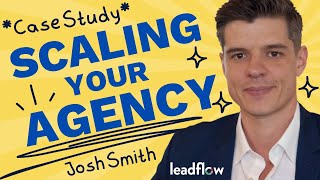
Josh Smith of Leadflow Marketing built a quiz-based agency using the Speed method, a sequential delivery system that lets him handle multiple clients at once. He documents everything in Slack, hired a COO to tighten internal processes, and credits small teams with running and improving those systems.
Chapters
For me, a bigger one is probably team. I think if you've got the right systems in place, put the right team in, even if it's small, to help run those systems, break them and improve them.
Hey, it's Dave from Systemology and today we're shining a light on business owners and their journey to systemization. I've got Josh Smith here from leadflow Marketing. Maybe just to start, Josh, if you can introduce yourself, tell us a little bit about your company and the work that you guys do.
Yeah, great. Thanks, Dave. I always love our chats, so it's nice to do this in a forum where we get to record it and hopefully one of us or both of us will say something smart that people like. I'm sure you will. I'll do my best over here. I'm confident you will. So, yeah, so basically we. So I've been in lead gen for virtually my whole career and I've done every form of it from live events to stuff standard basic funnels that everyone's run and in recent years particularly Covid Driven drove it. Actually we niche down into quizzes or scorecards or assessment type tools and from that we've been able to build a really robust agency leveraging the SaaS product of scoreApp, scoreApp.com, really fantastic platform for allowing you to build quizzes in all sorts of different formats. What we identified early on was that as great as the platform is, a lot of people at enterprise level especially, they're going to struggle with creating these tools in a way that are really streamlined from the concepts through to actual point of being a sales asset. So we came in and built the platform to assist the users of Score app to do quizzes at the level that they could be done from a real sort of base where it will plug into an infrastructure that can work really successfully. Yeah, and so we've been doing that for about two and a half years now.
It makes me wonder if you see yourself as a systems brain because what you described there, I'm imagining you effectively have to map out the linear journey that a prospect would go through and think, okay, what happens next? What happens next? What happens next? Which is almost like a system. So do you see yourself as a systems thinker? Is that something that you just go, oh, I'm not though.
I have, I have probably periods where I feel like I can think and perform quite well from a systems perspective and then other periods where I feel like it overwhelms me quite, quite a lot. I think as well, like my natural Position hasn't been like systems oriented over the years, but like in the decade and a bit that I've been doing this kind of stuff, it's certainly been an area that I've like forced the growth in and sometimes like so, and sometimes I don't. But you are right in what you've said in that the way that our projects come together for our clients, they are actually really systemized. I hadn't thought about it like that before actually. So much so that we've built a methodology around our work. It's called the Speed method and it allows us to take, I guess, same as a business, it allows us to take a really complicated project with which a lot of these quiz builds are and then break them down into like sequential chunks. That allows us to do the work, us to get strategic like input from the client as we go without bombarding them with requests and so on, which is never really a good experience from an agency perspective. And then get to an end result where we've been able to stay on track. The client has given us periodic green lights along the way. And then you know, we get to a point at the end where it looks great, feels great and it works, which is really important. And you know, that wouldn't work as well if we hadn't built our Speed method, which like I said, is a system for delivering the work that we do.
The team members that you've got, are they receptive to this? Because also being effectively in a creative digital agency like marketing, there's a lot of creativity there. I'm curious to know if that's something then that the team accepts or if you've had a challenge. As you started introducing systems and process and this methodology into the work, was there any resistance?
Any resistance? I don't think there's been resistance, but it's a great question because recently with the COO that we've come on, which has been fantastic addition to our company, she's been able to challenge me in really good ways around the ways that I thought our Speed method made sense and how we sort of created documentation around that and not so much how we deliver it client facing, but how we manage it internally, which is really important because especially, well, not any business, but in any creative business, if you want to break up roles into different chunks, for instance, you have to make sure everyone's on that same page. Otherwise it's quite hard to hand over a design role and a copywriting role and a tech role if there is one, and then maybe an advertising perspective if that's in the project too. So, yeah, so she's been really good at pushing back on the internal sides of that system because externally it works great, but internally there has to be a team that's not just me, for instance, that can follow it without necessarily needing my input constantly. And I think that that's probably the part of systems that I would struggle on the most. I think very good at doing, very good at creating something that I can work with, but not necessarily having the right experience in my own head to make sure, like an internal team can sort of take some of those nuanced bits. And I find there's. In our kind of work, whether it's like, scientific and creative, there tends to be a lot of nuances that I still don't always have the answer to when it comes to explaining how to systemize some of that internally with the coo.
And it's always fun to watch them do their work, especially if they bring some systems or some new perspective in. Is there anything that you're picking up from them of around how they're able to build a systems culture? Like, is this. Do you keep the systems front and center or do you talk about it, or is it a team collaboration to build them? I'm just curious to know how you kind of get the team involved.
Yeah, great question. So as it stands, when she came on, we had a portal that we built, which was my interpretation off the back of reading Systemology. And the one thing that like, I probably grappled with a lot has been project management versus, like. What's the right word? Yes, yes. Systems documentation hub or something like that.
Systems hub, yep.
Yes. And so what I did and what I needed to, for us to be a bit of a catalyst to be able to expand my thinking outwards to other members of the team was kind of document it in a way that felt right for my. The way my head seems to work, which might not be the right way sometimes. And somehow I decided to do that using Slack, which I think apparently is quite a unique way of doing it. I haven't heard of other people doing it that way. And what I did was essentially built out the. Our business through sections and channels within Slack, from onboarding, through our speed method. And it was really good in theory and it looks quite impressive if you jump in and see how things turn to threads and everything sequential and we have different files for reference throughout. And it kind of worked really good from that perspective. But it's actually quite clunky from a perspective of trying to Work through it. If you were going client to client, unless you really knew what you were doing all the time, you didn't have to constantly check back in. So I hadn't thought about it from that perspective until Chris was in there and looking at it and going, this is really great. But actually it doesn't work that well when we work through it where it seems like we're going to be able to build everything from our systems documented documentation out to workflow to project management and in such a way that should be client and internal facing. And I definitely wouldn't have gotten there without her support and her insight from her experiences, which. Which is really fantastic.
So yeah, with other insights that you picked out from the book because it's funny, sometimes you'll read something and you picked up that distinction that was in the Systemology book and now it's kind of like, ah, that's making more sense now I'm wondering if there's any other things that stood out for you when reading the book that's kind of shaped your thinking about systems.
Yeah, probably the other biggest thing. So like, you're right. So I often read a book a couple of times. That's why I don't have like a. That's why I haven't read like a thousand books. I've read maybe like 100 books five times because I feel like that's how I need to do things. And so I've listened to Systemology, I believe three times over the last couple of years and the systems documentation bit was like a real light bulb for me. Even though for you might be like, oh, it's like one of those basic concepts but it's like what my brain needed to get over some of the roadblocks that I have in the process of doing it all. The other thing was about you not necessarily needing to be the right person to do it. So having your systems champion, I believe is the right name for it. Having someone else that can sort of take what you've done and just put it somewhere better so that it can then turn into something a bit more free flowing and workable. And that's probably been the other distinction too that I feel that we're now starting to get into quite well with, with Grizzly, who's my CEO and who's working with us on improving what we have and how we can sort of scale our sort of workflows, which always been a bottleneck for me.
Yes. Yeah. If, I mean you're a little bit, you've started on the journey and sounds like it's still in play and a big part of it is kind of building it out. Now that you've started. I don't know if you've had any wins or anything because I know the first system or two you put into place. Sometimes you don't notice the impact, like small savings of time here and there and a couple little errors, but might be fixed or avoided. But oftentimes systems have a real compounding effect, which means you don't notice them straight away. But I am curious where you're at if you've had any wins, where you're just like, wow, like I'm on the right track here.
Yeah, definitely. For us, the main thing that probably comes to my mind is the way that we had structured our projects and the way they work through our Speed method means that we can take on a lot more clients than what our team would actually suggest that we should. And it's because, well, one, we set expectations really well, which I think few agencies do well, especially anything that's in like a development space that tell you it's a month and it's full. So we set expectations really clearly, which is a part of our systems in the early beginning and then from that. The way that we break these projects down to our Speed method mean that we can handle different chunks of the project at different points and, and essentially juggle a lot of different clients at any one time because they're all at different timestamps if you want network flow. And we're sort of managing them accordingly. If we didn't have that in place and if we tackled these like we did our initial early test builds like two and a half years ago, where it was like I understood the business we were working with or I was working with because at the start it was just me. And then I could just get into it and, you know, eight, 10, 15 hours later come out with a really good product that doesn't work when you're trying to work with 10 different businesses. One is a pet food supplier, one's a lawyer, one's an engineer and one's a business consultant, et cetera, and list all the rest. Because we work with all these different spaces because our Niche is the SaaS product of Score app, not like the actual business itself. Like, we wouldn't be able to juggle that kind of client load without being able to break down our projects the way that we have because of the Speed method system. So that's, yeah, definitely been a revelation. And now we're just kind of like testing how far we can push that without needing more people and so on.
Yeah, I definitely know a lot of people when they grow an agency and they start to get some new clients on board, they think I'll just throw more staff at it and it'll solve my problem. But oftentimes it just means that you have now a larger inefficient business and sometimes going to work on the systems first makes infinitely more sense before adding those extra people in. So I love that. Is there anything you might be able to say with the benefit of hindsight and what you know now and picking up about systems, if you went back in time and spoke to either a younger Josh or another business owner that you might say to them around systems and process and it's important in business.
Yeah, I think for me a bigger one is probably team. I think if you've got the right systems in place, put the right team in, even if it's small, to help run those systems, break them and improve them. Because, like, as I'm recently finding, the more and more leverage I get, like I was saying before we were recording, like, it feels like a superpower and it feels like a freedom that I, you know, really had because I always carried so much. So. Yeah, so advice to myself would be, you know, trust the process a bit more and you don't need a lot of people. Sometimes you just need an extra 1 or 2 to kind of pull the load. And if you've got good systems in place, like, you can punch a lot heavier than your weight because, you know, like I said, you might break a project down into pieces that are easier to deliver on than trying to conceptualize the whole thing and do it start to end. So, yeah, young old me now would have said the older to younger me, you know, get people in sooner, even just one, two key people and then, you know, focus your systems around. Around that and, and building with them with that in mind. Yeah, that makes sense.
I think one thing you mentioned earlier, this idea of the COO as well, I find particularly for founders and those visionary creatives, getting that person who understands systems and running operation is a game changer for many. So I think, yeah, that that key hire sometimes can, can really transform the business.
Yeah, agree, agree, agree. Like, you know, you shouldn't just be looking for button presses. You should, you know, be looking for people that asking you why they're pushing those buttons and if they can do it in a way that's a bit better. I mean, you know, there is a time and place for people that can just press buttons, but usually that comes a lot later. At first, you need the people that will query why those are the buttons to get pressed, and then off you go. So, yeah. So yeah. Been amazing to have that for us.
Yeah.
Very cool.
And I appreciate you. Yeah. Sharing a little bit about your journey. I'm sure many business owners will listen to this and then pick up something that you've said which hopefully will inspire them to take that next step. If people want to find out a little bit more about what you do, we'll send them over to Lead Flow Marketing. And yeah, just a big thanks, Josh, for all the work that you do and sharing today.
Cool. No worries. Thanks for having me.
More from David






Remember me? Subscribe To My Channel For More Free Business Systems Content 📈




