How To Systemize A Cleaning Business - Case Study
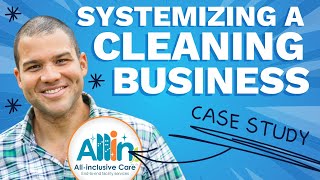
Jose built All Inclusive Care from a solo cleaning operation in Sydney to a four-car team by documenting systems, hiring a virtual assistant, and training staff. He took a 10-day break to the Maldives while the business ran without him, and credits Systemology and business coaching for the shift from hands-on work to delegation.
Questions this video answers
October 2015.
Since 2015.
About a year-and-a-half before this interview (guest-stated).
Four cars on the road.
About two months.
Chapters
If you are a business that is already making millions, you do not need to be everywhere at the same time for systemizing. I think you should make it a priority. So you also as a business owner, so you also understand the importance of it because if you just delegate it from the start, it's not as deeply rooted in your business values as it should be because you are not giving it the time it deserves.
Hello, it's Dave from Systemology and I'm here to shine a light on different business owner stories. We've got Jose from All Inclusive Care and yeah, perhaps just to start, Jose, love it. If you could tell us a little bit about the business and what you guys do and a little bit about your story.
Right, okay. Well thank you for having us, David. Appreciate it, appreciate your time as well. Well, All Inclusive Care is business and we provide facility services, end to end facility services. You can think of us as your comprehensive solution for bin management, gardening, cleaning services, high pressure cleaning, window cleaning. And we focus mainly on a strata buildings, but we also cover a bit of commercial work and residential work as well in the Sydney metropolitan area.
Yeah, perfect. How long have you been in business for?
Since 2015. So basically a bit of a backstory. My wife and I, we arrived in Australia in 2015, October 2015, on student visas and doing the whole process. So this was basically the first job that I was able to find. Like not many people know, but on a student visa it's a bit difficult. Originally I'm an engineer, so I came here trying to go all in for the engineering office job. And I soon realized that I didn't really want to do that anymore as soon as I began working outdoors. So one thing led to another when I finally swapped from the student visa to permanent residency that I was able to actually go out and find work. I balanced the two options and I said, well yeah, maybe that's not what I want to continue doing. So 2015 all the way now began as a sole trader. We began an official company about a year and a half ago and ever since then it's just growth, growth, growth. I'm just working really hard for it. So yeah, very excited.
Yeah. Did you always see yourself or did you have a thought that you would be a business owner? Like it sounds like you're going into engine and then you've gone in a completely different field.
So actually, actually no, it's like my first. I've always, I've always had to invoice in order to make money since I was probably about 17 years old.
Yeah.
I've only lived off for nightly wages for two years of my life. When I was back in. In. In originally from Venezuela, when I was back in Venezuela, like two years I lived off wages and I still had to invoice, but just, you know, a little bit because it wasn't as involved into it. So I. I've always been a business owner. Never to this extent, though. Obviously, Venezuela is a bit more. It's a bit more complicated, but to the extent we're doing it now, it's. It's something that I can go on 12 days in, 12 hours in a day, and it just doesn't feel like I'm working. So I do consider myself, but I've always been, yeah, business owner. I absolutely love it.
Yeah. And you still on the tools or. I know you've sort of started to get some team members, perhaps. Tell us a little bit about where you're at at the moment with business.
That is. That is very exciting. I'm only at the tools while I'm documenting the jobs in order to be able to systemize the jobs. So that's when I'm on the tools. After that, I pass it on to one of the team. It wasn't always like this, obviously. So since 2015, it was just get work, get work, get work, do it myself to the point that I had to do very, very, very long days in order to be able to hand some of it over to somebody else, but still make a bit of money for myself and for the business. Because otherwise, what's the point? Then when that happened, it was just rinse and repeat. So make myself busy again so I can hire somebody else. There was a point in which I realized that I didn't have to do it like that anymore because numbers were just working. So now most of like today's Tuesday. Right. So I don't. I don't. I don't have to leave the house. My. My plan for today's admin work, office work, things that only myself can do. But I've got four cars on the road right now with people that. They know what to do and they've got the backup of the systems of what they need to do. So, sure. Answer is no. I'm not in the tools that much right now. Just when I just when I need to be on tools.
Yeah. Congratulations. That is a huge step. A lot of people never actually get to make that step through. And it sounds like you've sort of on the path for that. Was there a particular turning point for you or Something that happened that kind of really drove you to make that step or were you on that path and you knew it was going to happen? Like was. I'm just wondering because a lot of business owners, they get stuck on the tools and then they build up the habits of just being the main person. Whereas it sounds like you've sort of managed to grow through that. And I was wondering if there was a. A catalyst or something that happened that made you think I need to change.
So one word. Education. So that's the num. So with. So two main things happen with me that allow me to see things a bit differently. Right. So number one, I enrolled into a business coaching program. So I was a sole trader, like I don't know, since 2015 up until a year and a half ago. And when I made the swap to a company, I also decided to. I want you to do this right from the beginning.
Yeah.
I joined a business coaching program through the same business coaching program. I met Systemology. Right. Yeah. It's been. And a whole bunch of books. It's just educating yourself will allow you to gain that extra understanding on what it is that you need to do. So that's number one. Number two, losing. Losing the fear. I remember clearly not long ago saying, I will never be able to not do this one because it's very important. Like not do this job because it is really important. It's an important client, an important job or, you know, whatever. I will have to do this one. So I will have to get around doing this one in particular while also making the hours of my day work. Yeah. I did that for an extent of time until I, until I couldn't anymore. So I was like, okay, so I have to let it go. I have to let it go, period. So I created the system around was seamless. Like it was. It was seamless.
Yes.
Who don't care who's doing the job.
Yeah.
As long as they, the client gets the perception that it's being done to the standard that it was done before or that they expected to be done. So training your staff and creating the system for them to follow allowed us to. To do just that. Now I basically lost that fear. And the one thing that I think about now is how quickly can I push this to somebody else so we can continue scaling.
Yeah. Do you see yourself as a systems person? Is it something that came natural for you or was there a level of resistance for you or. Yeah. How do you think about it? Yeah.
So I didn't know the concept as systems. Right. So I, I've always been very organized and I've always had my, you know, my tutorials and my prior and an order to do things, but I didn't have a team to do it with. So I only had my systems for myself in life, in my work. Then I understood it as the concept of systems probably about two years ago. And it involved the other people I was working around with.
Yes.
In, in that moment I realized, oh, hold on. Well, this is very in line with what I do and with what, with how I just basically lead my life. But now it involves other people, which is great because I can just, you know, let them know what it is that I'm thinking so they don't have to just read my mind. And we put it on paper. It was, it came easy for me because, yeah, it's what I had always done. Now it's just a bit more techy, it's a bit more organized, it's a lot more people involved. Yeah, it is the same concept with a different name.
Yes. And when you went through Systemology, was there any particular ideas that stood out for you? Or when you read it, you thought, ah, like, were there any breakthroughs for.
You on every page? Like, I've got, I've got the book right here. I literally had to add probably about 10 blank pages at the end of the book.
Yeah.
I didn't have enough space on the book to write what I needed to write. So I went to the back and I just wrote down all my ideas and the book leaves on my desk every single day. And I, and I look at it and it's just like, okay, this is what I need to do. This is what I need to do. So on every page, on every chapter, there are new ideas that keep coming up because again, going back to education, this is not something that it comes naturally if you consider yourself a business owner. But it's not ideas that you think out of thin air. You need a catalyst to help you think the way that you need to think to be able to come up with the ideas that will actually make a difference. So the book helps you find the answers that you already know.
Yeah.
But you did not connect the wires in your brain that way before, so it helps you make those connections so the new ideas based on these new learning can actually be created. And then you go, oh, well, that's a very good idea. Let's write that down. And then you go and implement it. And there you go. It was a great idea.
I love it. I think because you'd Sent me a note beforehand. It sounds like you've started to get some of the team involved as well, have you? I think you've identified your systems champion. Can you tell us a little bit about that person?
Right, yeah. Okay. So, okay, so yeah, the systems champion for a long time it was obviously me.
Yeah, yeah.
But then applying, applying one more of the concepts, you have a person who is called a virtual assistant. Right. So any job that can be done remotely should be done by a virtual assistant anywhere in the world. It's just, it's just a, it's just a fantastic and brilliant win, win scenario. So I've got, I'm again from Venezuela. So what did I do? I hired someone from Venezuela. I looked at, I looked at Philippines, I looked at South Africa. But my main issue was I, I needed someone who was both fluent in, in English and Spanish. The main issue with hiring someone from Venezuela is obviously the time difference. But like she likes working into the night so that's fine. Obviously English and Spanish is just not a problem. And she knows technical stuff. She's very organized and, and we, she's been working with us for about two months now and I'm beginning to see, I'm beginning to see her become more independent, which is the cherry on top. Like things happened and you only get to know that things happen after they were done. Yeah, you don't, you don't, you don't need to be there saying 1, 2, 3 for today and 1, 2, 3 for tomorrow and what you have to do that for the first month because you know, training and getting to understand her and you know, finding your rhythm for everyone in the team. But once all of the systems are in place, one, once your team knows the tools you use, they, they will get to know what they are ex. What is expected of them. So reaching to that point and we will have a catch up after, after this, today actually after this meeting and I'm just going to see a whole bunch of stuff that she did that I, that, that came out of one conversation that we had and she just exponentially. Okay, so that means this, that means that, that means this, that means that. And I'm just great.
Yeah.
So she's awesome. Very happy. She's my assistant's champion now. She's in the process of working and reaching to each one of the team members without having to go, having to go through me. So before it was me asking the question to the team member and then getting that information to extract the information that I needed and then organize it or give it to her now. Now I'm just removing myself.
Yeah. Wow.
Through. Through our own system management software, they can talk to each other.
Yep.
She will be able to see who's doing whichever job and then she will be able to talk with this person. I need this, I need that, I need this, I need that. The person will get back to her. She will do it. And then I come in for the last 10%. You verify, make sure everything's in order, add bits and pieces, publish another one. Done and dusted. Yes. So very excited. Very excited.
That's good. I can see in your head the picture's very clear. Even the way that you articulate the pieces together and how they work sort of shows me that. Ah, yes, your. The picture is very clear. The. The next bit, once the picture's clear, it's then transferring that picture so that your team can see the picture and then they can go to work on it. I'm curious if there have been any challenges or how you've overcome some of the challenges as you're trying to get your team to get it or to see what it is that you see. Is there anything that you know either challenges that you've been able to overcome or any insights or ideas now that you've been doing it for a little bit?
Okay, so the main. The main issue that we had was a bit of resistance while we transition through the different tech tools. Right. So my mistake was not doing it like this from the start. Yeah. Because you hear about the concept, but while you read it, while you understand it, while you come up with the ideas, you need to do it, some you need to do it, you need to make it happen. Yeah, right. While it was making it happen, while I was also learning this, we had to do it in a different way. So when the way we did it before was very manual, not heaps of reporting, not heaps of communication. So I didn't know everything that I needed to know on time. Then I would get complaints rather than requests, and I wouldn't know everything that was going on just because we didn't have that platform. Right. So once we introduce the new, like, they are like three or four pieces of different tech that all interlinked together. When I need to know something, I just go to the tech that I need to go and I will have the information there. So once we rolled out each one of those little pieces, obviously there was a bit of confusion. There was a bit of, you know, how do I use it? Or I don't know how to use it. Or that'll take too long, or I don't want to take photos or a whole bunch of resistance. And for me, the best way to make it all, you know, it's just. That's not important. Let's do it this way. Is to focus the attention on their own benefit. So it's not. It's not I need it to make sure that you're doing your job. It's. I need it to make sure that I can protect the job you're doing against what might happen after you've done. After you've done it, after you've finished. It's. It's telling them, you know, this is the way you are able to take longer holidays, or this is the way you're able to. To manage your. Your time better, or this is the way you're able to. To find yourself with a. Oh, that's my dog. I'm sorry.
No, no, no.
So this is. This is the way you're able to understand that not everything depends on you, and that if something happens and you need some time off, you will be able to take it. No issues, because we will know exactly what we need to do, even if you need some time for yourself. And the most important thing is that if that. Not if, because it's a matter of when. When that happens, we want to be able to place anyone in the same job. And on the eyes of the client, it's seamless, the same person. Because what will happen is step number one, step number two, number three, step number 50, whatever it is, in the same order, in the same time distribution, with the same expected results without having to go through you. So that is very exciting. So, yeah, to avoid resistance is just basically focusing the outcomes on their own benefits.
Yes. Yeah. One thing I remember, because I was lucky to do some work with Michael Gerber, and when I first wrote the book, I almost made it sound like all of this could magically happen without the business owner. And I remember when Michael read the book, he said something that always stuck in my head. He said, don't let the business owner off the hook. As in, they still need to lead it. And I think that's what I love seeing. Even the way that you explain it and the way that you're talking about the tools and overcoming the resistance and how to introduce it to the team, like you understand it at a deep enough level that you can lead it. That doesn't mean that you have to do every single bit of documentation or that doesn't mean that you need to be doing Every single job. But as the leader, you know enough to go, this is important. This is how we do things here. And I just love hearing that sort of articulation of the way that you, you see this coming together and just watching your business grow.
Yeah. On that note, what I would, what I would suggest other businesses, it depends. Okay. So here's my perspective. It depends on how big you are. So in my case, because this whole thing began as myself as a sole trader, so I've been able to be a part of each different segment of the business.
Yes.
The point that right now I know everything that is going on and I'm able to just explain it and then just oversee it and just push people forward, motivate them, enable them, give it. Yeah. But if you, or the way I see it, if you are a business that is already making millions, you do not need to be everywhere at the same time for systemizing. I think you should make it a priority. So you also, as a business owner, so you also understand the importance of it. Because if you just delegate it from the start, it's not as deeply rooted in your business values as it should be because you are not giving it the time it deserves. So it's something new for an established business, for the business owner, for the operation managers, for the CEO or whatever. Make it one of your important priorities. So people that are, you know, your systems champion or your knowledgeable, knowledgeable person, they, they know that it is also important because they see you, they're doing it with them, at least for some time.
Yes.
Yeah.
And I think the bit that's sometimes missed when people read systemology, I actually think the skill of systems development is the master skill of the entrepreneur, of the business owner. Because it's the idea of taking the picture that you have in your head of the way that something should be done. And that's part of the magic of a business owner. They can see the problems that their target audience has and then they know how to craft the solution that delivers the great result. Now if they can develop the system that then delivers that result without them, that's actually their master skill and to make it happen without them. I think as you get to the final stages of systemology and you move into that optimization phase, because initially systemology is about capture what you're currently doing, not what you would like to be doing. But when you get to optimize, you do start to re engineer the systems. And that's actually once you create enough space for the business owner, that's where they do their best work because then they can look at a problem and then they look for the system solution and they might recraft that system and optimize it. And it's, it's that final bit which, it actually sounds like you're getting closer to that stage. Because what needs to happen is you have to get the basics down. You have to get those minimum viable systems into place. The business kind of needs to operate. You then give yourself enough space to then be able to, as Michael talked about, work on it rather than in it. And then it's giving yourself the space to be able to work on it. So it's this journey that you go through. And I think you're right. If you, if you recognize the importance of systems and then you build it into the DNA by doing it yourself, it's much easier. Like everybody looks to the leader and the business owner for how should we be doing things and how do we, how do we conduct ourselves in that culture? And the leader sets that tone. So I, I'm biased. It's funny though, because I see some people who don't see themselves as systems people and I kind of, it's almost like I kind of trick them into just getting started and I'm hoping by doing a little bit then they'll get a bit of a win and before they know it, they'll realize, I am a systems person, there might be parts that I enjoy more than other parts. And maybe I can get a documenter, maybe I can get a systems champion. But I think the way, just hearing your story is like the perfect illustration of the implementation of this.
It's very exciting. I do not see an end to it. It's like in the optimization stage, things can always be better. We are not in the optimizing stage yet, so it's okay. So the type of business that we have means that we have to make. We have to have a lot of clients to be able to be profitable. Because some, some, some stops might be 10 minutes, other stops might be a full day. So I have guys going to two jobs in one day. I have guys going to 11 or 15 different addresses in, in the same day. So it depends on, on the day plan. Just because of that, it is the importance of this. Because as we scale, obviously no one can be in two places at once. So it needs to be well documented. So if something happens, you are three steps ahead of the issue. So this has helped me see what possible issues we might have in the future. And just think ahead. If you know, something happens with the car, something happens with the phone, something happens with themselves, something, whatever. What, what can we do? What season do we have in place to make sure we still get it done while we solve this other thing? So the combination of all the tech tools are really important. Right now we are pretty much extracting. So we, we finished a whole bunch of different job addresses and they are sitting there pretty nicely integrated with, with our job management system. While we're still extracting, you know, and organizing and documenting and creating the videos for the other ones that are still pending, obviously we get some out like done while we continue doing other documents and other systems for particular job procedures and we are still getting some new work. So it's a, it's an, it's an endless, it's an endless queue which is, which is basically what we want. That's, that's a good thing. So pretty much at some point most likely we will need another systems champion to help to help us with other parts of the business. That again, just Systemology helped me to see a bit better. I'm creating systems around training, I'm creating systems around marketing and creating systems around basically every department in the company. Right now the main focus is systems around service delivery. Right. So that's our goal once we are 90 with that. So we will begin with all the other parts of the business. And it takes time, but that really doesn't matter because you're, you're moving forward and the good thing is that you see the benefits straight away. Yeah.
In the tail end, is there anything that you could say to a business owner if the. Still not quite sure if systems are the right way to go or if this is going to be the right fit for them or really anything. I don't know if there's any final thoughts you have like you've got the benefit of you're a little bit further down the road than someone who is yet to start. And I'm wondering if there's anything that you might be able to, you know, suggest to them.
Okay, so I'm going to share two wins that come, that come to my mind. Wing Wing number one from March this year. March is my wife and I wed anniversary and we were, we were blessed to go to the Maldives in March. March. What was it like? Yeah, the first ten days of March. The book I was reading while I was in the Maldives of just picture I was sitting in a little island right next to the beach reading Systemology while having applied a portion of Systemology until that moment and it allowed me to Just forget about everything for about 10 days while I was just continue learning what, what to keep doing so that could be repeated more often. So those 10 days I didn't disappear, but pretty much it was like a half an hour a day on, you know, let me check my text, let me check if I have, you know, an important email that needs my attention. Everything all right? Just goodbye. Let's keep going. So 10 days of a vacation, that felt like, like a vacation. Yeah. And when I came back, everything was done. I still needed to invoice for the same 10 days that I wasn't here. It was, it was, it was perfect. So that was, that was a very exciting win. Out of that comes my second win, which was recent because. Okay, so again, this important job that I had been doing myself for quite some time, the last time that I did it, about six weeks ago or so, I said, okay, okay, so it's time. Let's document this one because there might come a time that I won't be able to do it myself and it will just need to be done. Well, sure enough, that happened last week. Six weeks ago, I took a whole bunch of little videos of the job that I needed to do to document the instruction and a bit of what needed to be done. And then the next step, and then the next step. It ended up being about 15 little videos and a full video again. I had 15 little videos on my phone. Right. So that's a long way ahead from what you deliver to your, to your staff. What happened there? I put all that into a Google Docs folder and I told my va, va, please just do this. And then out of nowhere, like magic, the next day had a full video edited with the logo with a, with a, with the subtitles, with little. Everything done. Last week I needed to do the job. I wasn't able to do the job. And I asked one of the guys who is great at what they do, but he never, he had never been on that particular job before. So I put it into his roster and he. Through the job management system, he was like, okay, I've never been here before. What do I do? And I said, okay, don't worry, Just have a look at this video. The week after I, I literally forgot that it had, that that job had to be done until the end of that particular day that I'm checking the report of today. I'm like, oh, wow, okay. I wonder what happened. I went to see it. He did absolutely everything from going to the shops and buying exactly what he needed to going there to everything. Everything. To everything. All the way up to reporting. So I just, I was able to just see. Okay, yeah, it got done. It looks great. Let's move on. Fantastic. Yes, yes. Just fantastic. Just fantastic. Out of this day. Yeah, out of this year. So the next, the next important thing is that in March 2024. So March 2023 was about 10 days. March 2024, it'll be a month. It'll be from the 1st of March to the 30th of March that we're going to Europe. So there is a whole bunch of work that needs to happen until then. Yeah. But I'm sure, I'm sure we will get there and it'll be a month of peace and quiet and everything will just continue moving forward. So if you are having second thoughts about implementing systemology or systemizing procedures and your own duties, just don't just do it. You just eliminate all of those negative thoughts and just, and just do it.
I think we might have to have a part two after your next holiday next year. I know if anybody's watching this and they're based in Sydney and they're looking for end to end cleaning services that are systems driven, they can definitely look up all inclusive care. I'll make sure I include a link to that. But a huge shout out to you, Jose. I just wanted to say I appreciate you being a shining light and an example for this because that's really. I think when people see other people able to do it, it's just so much easier for them to then imagine, hey, I can do this for myself too. So thank you very much.
Thank you for your time. It is completely doable. Just, just don't give up. Just don't give up. And don't keep putting things on top of it. Right. Just, just allocate a portion, little at first and then just keep going. Once you start seeing the benefits, you won't want to stop. Like you won't want to stop.
Perfect.
Well, thank you, David. Happy to help.
More from David






Remember me? Subscribe To My Channel For More Free Business Systems Content 📈




