Interview With A Systems Champion
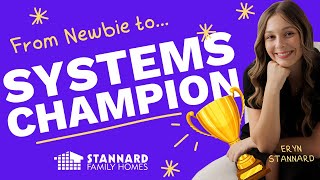
Erin Stannard moved into systems work at her family's home-building company after a staffing shift, then expanded the role as the team grew from 7 to 15 people. She uses Asana, Loom, and ChatGPT to document processes, and says the job needs someone who listens well, stays curious, and can take feedback without getting defensive.
Questions this video answers
July 10, 2024.
17.
About 7 when she started; about 15 at interview time.
System Hub, Asana, Loom, and ChatGPT.
About six months.
Chapters
Be able to see into the nitty gritties behind all the way from the marketing all the way to the sales. Then it goes to pre con selections, the whole big picture. And I, I think that's important as well with the systems is to make sure that they do impact the whole big picture.
I love interviewing systems champions. I feel like arguably they're probably one of the most valuable positions in a business and very commonly overlooked. And recently I interviewed Ryan Stannard from Stannard Homes where he shared his story about being a high school dropout and building a $15 million building business out of Adelaide, Australia, home building. And he mentioned that they are a systems driven company and his secret weapon was actually his daughter Erin, who's taken over the role of systems champion. So today I wanted to shine a little bit of light on her story and provide some inspiration for some systems champions and business owners out there. So first things first. Just like to welcome you to the call.
Erin, thank you so much for having me.
Perfect. So my first question for you is, do you consider yourself a systems person? Like are you naturally organized? Does it come easily to you?
Yeah, I do consider myself as a systems person. I'm very structured, love organization and I love to have clear expectations as well of exactly what's expected. So I really feel like I thrive amongst systems and processes.
Yes. And when you came into the family business, what was kind of your first role? How did you kind of get started?
Yeah, so I come into the family business with interior design as a passion and I thought that that was going to be my career to start new interior design and that would be great. And then which was good. It was the systems and processes were there. But then I asked a few too many questions too quickly and scared the architect. Architect, interior designer at the time away within the first two weeks. So by my week four, she had left and it was all up to me now.
So yeah, the deep end.
Yeah.
Was that something like part of your dad's idea when you first got started to start with the systems and reviewing what they did have in place? Or is it, did it kind of just naturally evolve as you started?
So I was introduced to the systems from the start, but not to edit or change them, just to read them, follow it through and understand the process. And then yeah, once she left, it was, oh my God, I'm gonna have to do this now. How am I gonna do it? And because she had other qualifications that I just didn't have, she was very well experienced in architecture and I was just an 18 year old I think I was actually 17 at the time that had left school. So that's all the qualifications that I had. And I had these clients relying on me that needed their selections done so their slab could go into the ground at the time. So, yeah, I just jumped straight into it and rewrote the systems and procedures, probably over six months of exactly how it needed to go, how I wanted it to go, what I expected of the suppliers as well.
But yeah, and your dad, it sounds like you'd already built a bit of a systems culture in the organization, because if there were already some processes there, is that something that was across the entire organization or specific for this role?
It's across the entire organization when I come in. We're just still improving it now.
Yeah, yeah. And as that role changed, so you then stepped up into the interior design role and started to work the systems there. I know your position has changed now and you've kind of started to expand into some of the other areas. How did that happen? Is that something that just was obvious to you and your dad, or did you stick your hand up? What kind of triggered it?
Well, I think once I started in the selections phase, I started to understand there's a lot more to a building company. I come in and I had a rough idea that, you know, there's a lot to a building company, but I didn't understand the flow and effect of the whole process. So when I started in selections, it's very close to pre construction, so understanding that interests me. And then when I got into it a little bit more, the. And I got comfortable, just as I got comfortable and made it my own. The accounts lady left at the time and it was all right, well, I'll jump into that. And there was a few systems and procedures, and I squeezed as much as I could out of her before she left. But then I jumped straight into accounts, which is a very different challenge and a very different role to what I was in before. So, yeah, I. That's just evolved. And. And I always showed passion in HR and accounts, and HR aligned pretty well. So I was systemizing hr, which was new to the business, because when I started, we had seven staff. Now we've got 15. So it's completely different ballgame in terms of HR and accounts and things like that now.
Yep. And when you sort of started doing some of the documentation, how did you approach it? Did you just look at, well, here's what we've already got in place, and having an idea of what a good standard is and what you felt you needed and you just kind of figured it out as you went.
Yeah, yeah. So I work side along alongside the association of Professional Builders. So I jumped in on a few calls and action plans with them, which I still do weekly at the moment to maintain the systems and procedures, especially in regards to hr because it's working with personalities and different people is just a whole huge thing that we need to get down pat in terms of system and procedures and expectations. So yeah, that was something that was well documented, but it worked for seven. Now it's getting it there for 15.
Yeah, I know. It ends up being quite a gift to give someone this particular role because it's quite common for someone when they learn a particular trade, they become the technician, they know how to do the thing. You become the interior designer and you know how to do that particular role. But then as a business owner, you start to realize it's a completely different skill set to run a business that does the thing and there's a variety of different things. So I'm assuming, like Ed and Ryan had mentioned, your visibility and understanding as the business as a whole is one of the strongest in the team now because you've been able to see into different roles and how they interconnect. Is that something that is obvious to you now?
Yeah, yeah, it is obvious to me now and I think I'm, I'm very grateful and, and privileged as well to be able to see into the nitty gritties behind all the way from the marketing all the way to the sales. Then it goes to pre con selections, the whole big picture. And I, I think that's important as well with the systems is to make sure that they do impact the whole big picture. But in regards to. Yeah, my experience, I, looking back it, I was just watching the puzzle pieces just get put together. It's like, well, that's why I've got to do that and that's why that works like that.
So.
Yeah.
Oh, hey, I know you're tuned in right now, so I'll keep this super quick. But you like awesome YouTube videos, don't you? Well, there's not really that many YouTube channels that create great content about how to systemize your small business. So I want to make sure that you catch every video that I publish. So if you haven't already, firstly give this video the thumbs up and then go ahead and subscribe to my channel. You can even hit the bell notification to make sure that you're the first to know when I publish anything. So go ahead, do it right now. I'll wait a sec and then I'll transfer you back to the video. Definitely a challenge a lot of business owners face and they oftentimes don't get systems and processes down. And it's great that your dad had the trust and belief in you and gave you free rein to really step into this role. Sometimes business owners, and maybe it was easier for him being that you're his daughter. Sometimes it's, it's hard to, as a business owner to do that. I don't know if you had any, any thoughts on what a business owner who might be looking to this can think about as they're, they're thinking about, well, who is my systems champion and how do I empower them and give them the space to do this work? I don't, Yeah, I don't know if anything comes to mind on that.
I'm giving them the space to do it. Yeah, it's a lot to let go of. Even when I just have someone just edit a system or update it, I'm like, okay, what's that going to impact? But yeah, it's, it's a big thing. But finding the right person to do it too because it's very easy to just think about, you know, your role, what, perfecting that. But the flow and effect of that is usually pretty big, especially within the industry that, that I'm in.
You mentioned about the, you know, thinking about the role and maybe even if we think about the qualities of a systems champion and maybe that's just thinking about yourself. Are there any particular skills? I know we touched on some organization and a few things like that. Are there any other skills that are obvious to you where you're just like, well, to be a good systems champion.
You'Ve got to, yeah, I think be a good listener. Like you really do just have to listen. I'm a little bit, I'm very grateful to have an open planned office. So I'm, I'm just a little bit of a fly on the wall to figure out what I do need to improve and, and, and, and, and it is able to take criticism. I feel like you really have to be able to take criticism that your idea just doesn't work because of this and, and there's usually a reason why it doesn't work and sometimes it doesn't work. And, and I think accepting that that's the case and taking the criticism on it as well.
Yeah, yeah. I definitely think because you're dealing with such a variety of different personalities, you need to be able to move to Meet the other person at a level that they're comfortable with and as you said, be a great listener and curious enough to know well, how does that work and why do you do it that way and how does that now connect with this piece and then starting to create this puzzle in your mind of the business.
Yeah. And I think as well is that I come in pretty strong. At the start when I was in selections, I was interrogating like very much just an interrogator. Why does it happen and why, why would you do that? Like just very much like, are you sure? And it's defin the approach you have on that as well. When I'm not. The approach at the start was very curious, but now, now I know that that approach isn't really going to get me anywhere but make someone put their guard up.
Yeah. What are some of the challenging aspects? Like obviously meeting people at different levels and understanding how to get them comfortable to share. Here's what I'm doing. Yeah. What, what do you think are some of the challenging aspects of the role?
I think sometimes a challenging aspect of the role is that when, when you present to someone, hey, we're going to update all of this, all of these systems here and that there might be 70 in the pre construction phase. We're going to update them all, they just freak out and, and really just taking on as bite sized chunks. Everything's just one step at a time, one day at a time, one hour at a time. If we get to, we're going to do it all, we're going to do it all now it doesn't really work very well and people can just shut down and be like, no, we're not.
Yeah. And, and how do you work with them in that one bite at a time. Like do you literally sit down with them and ask them questions? Do you record, do you do screen recordings out in the field? Yeah. How do you capture.
Yeah. So we do loom videos and how we do things. The last time that we did this is probably six months ago. So we're due to do it again. And the way that I'm going to tackle it now is my plan is to just book a time in everyone's calendar where we're all doing it at the same time and run it almost like a classroom environment to make sure that we can hold everyone accountable and discuss the things that do need to be discussed as well.
Yes. Yeah. So you'll then start that capture process and just a matter of working through it and doing some looms and then Are you using any other tools? Like, I know there's things like ChatGPT and you can get things transcribed and feed it in. Are you using those sorts of tools?
Yeah, I'm using Chat GPT. We also utilize Asana as well. So Asana is a big program that we use, which is great for me because I'm big. I'm able to go in and go. We haven't systemized that or that all that. So these are my next tasks. But yeah, we definitely utilize Asana Loom and Chat GPT. I love chat in the sense that it. I'll ask it, I'll put in the system I've wrote and then I'll ask it to provide us with a summary of it. And it just takes a little bit of the workload out of it for me in that sense, but it summarizes it really clear and concise much better than what I could.
And then you, you're saving those, I think your dad mentioned into System Hub. And then you, you're basically loading it into Asana. So that way as tasks are getting assigned, it's easy for people to find.
Yes.
Yeah, yeah, perfect. And what do you enjoy most about this role? Is there anything that you just, again, I can just feel it like you're naturally wired to this. And I think finding these people, Systems champions, like it should be really high on the business owner's priority. Yeah. I'm curious to know what it is that you like about the role.
I really like the problem solving aspect.
Yeah.
When something goes wrong, going back and going, why did that go wrong? Or even after unsuccessful hire, why? What on my onboarding system or, or code of conduct within the systems didn't work or really, I think that, I think that's what I like about it is that I've got documents there to go back and see what I did and why I did it and, and should I have done that differently? And it's almost like, yeah, just the challenge of the. Solving the problems, thinking outside the box as well. Yeah. That's what I love about. Love about it.
I can see as well, for Systems Champions, there really is a great career path opportunity for this. I don't know if it's something that you've noticed. You can obviously come in as almost like a junior apprentice with regards to not knowing how the business runs. And then over time you learn and you connect with the leadership team and really knowledgeable workers and you're finding out, well, how do you do this, how do you do that? And you're Piecing together this picture in your brain and that does make you very valuable to the business because not only have you been able to document it, but now you also have an understanding of different things. Is that like, is this starting to present itself? I kind of feel like you've moved on from the interior design selection role and you're kind of working your way up. And I don't know if you caught it in the interview with your dad, but I think you could almost be groomed into that general manager role.
Yeah, yeah, yeah, it does it, yeah, it's, it excites me. And yeah, I think that I'm just a curious person that really wants to learn and learn everything I can and continuously improve. And I think that there definitely is a huge career path and opportunities there for lots of different people, especially the younger people that don't know what they want to do. It's just a great, a great way to find a passion in something even if, if it's not the particular industry that you're after. It's a great way to just lear why things happen and then figure out which parts of that that you love to take onto the next industry or the next thing. But yeah, no, I think that I, I'll stay with standard family homes for as long as I can.
And is there any advice that you might give to a systems champion or, you know, a younger version of yourself? If you could go back in time and give yourself some advice, Is there anything that you might be able to say that could help them just to.
Stay open minded and embrace the challenges? Sometimes it's, sometimes there's like a lot of documentation or a lot of doing the same thing over and over again. But you do learn a lot from that.
Yes. Yeah. And finally, is there any advice for business owners who either haven't decided yet that they need a systems champion or they haven't found one, or just anything that really comes to mind that you think from a business owner's perspective, any advice that you could give them to make sure they create the space for the systems champion to really do great work?
Yeah. Oh, gosh, yeah, I think to allow them to have lots of time on it and it's not something that should be rushed. And yeah, there's definitely so much value and for the business owner to be able to step away from their business and go on holidays and enjoy their family as well. So, so there's so many benefits and to just start small and it will definitely build up and be a great thing that they will never regret. It.
Yeah, perfect. Well, thank you so much for sharing your story. I'll pop a link again through to the interview with your dad and also across to Stanard Home so people can check out the work that you do. And I think we need to check back in in another five years and see what position you'll be sitting in at that point in time.
Thank you so much for your.
More from David






Remember me? Subscribe To My Channel For More Free Business Systems Content 📈




