Is ‘Inbox Done’ Better Than ‘Inbox Zero’?
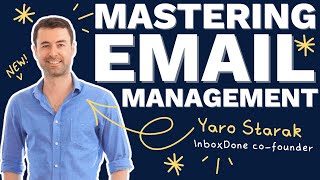
A conversation between David Jenyns and Yarrow Starak about Inbox Done, an email-management company and its Handover system. They describe how to recruit and train human email managers, the phased handover (learn → draft → send), use of templates and tools, and practical considerations for trusting assistants and scaling inbox delegation.
Chapters
The single best decision I think you can make when you're at that level. Obviously if you don't have the cash flow to hire someone, you're not really that busy. We have a few people who just, they seem to get a kick out of really organizing their email. I don't think they're ever going to hand it over because it's just part of their life. But for most people, that's not the answer. Yeah, it's something you can break free from.
Okay, today I'm joined by Yarrow Starak. He's the co founder of Inbox. Done. And that's an email management company with a team of over 45 serving clients in loads of different industries. I've known Yarrow for many years. In fact close to about 15 years. And I got to know him when he was the author of entrepreneursjourney.com since then he's grown, sold, invested in, consulted in some pretty amazing companies. And most recently we've reconnected and I started digging a bit deeper into inboxdone.com and I think that's probably where I've been most impressed because not only does it solve a really serious problem for business owners, they're drowning in email. But he's also developed a system to be able to grow and scale this business beyond himself. So today we're going to dig into one of his primary systems from inboxdone and it's the Handover system, which is all about how do you get email managers to integrate with your company so they can learn to reply to your emails? And, and it's a system I think every business owner and business needs to master because it is possible, and that's speaking from personal experience, to gradually pull yourself away from living in your Inbox to a point where you're comfortable having someone handle your emails. And that really does save you probably more time and energy than you actually realize. So with that, I want to welcome my good friend to the call, Yarrow, and let him take us from here.
Thank you, David, I appreciate it. I can understand with your interest in systems, how my current business is so more interesting than what we used to talk about back in the blogging and those boring subjects and boring businesses. But yeah, I want to clarify first, just to start with, because it's becoming a more common question around, am I talking about having software reply to your emails or having AI reply to your emails first? Because I think that is a default reaction. It's. Oh, you mean you got some kind of tool to speed up my email Replies. And the answer to that is no and not a strict no. We do have human beings who reply to your emails. They use software tools and that can include AI, but it really is about beginning a process of handing over to the point where you actually trust other human beings to be the person opening up your inbox and writing a reply to a message. Where previously you thought maybe that was something that, that was impossible to do because whatever reason, you're the only one who can do your email. So I want to clarify that. To start with, just we're on the same page to begin with.
I think that is a common problem just across the whole landscape of systemization. When we talk to business owners, they immediately jump to, oh, can we do zapier? And can we plug in this automated thing that does it all for us? And we always go back and say, but before you even automate anything or even let any robots in, you gotta first do it manually and figure out what is the process before you even consider which chunks can be handled by the machine. So it's definitely across any system's development at our end.
Yeah, spot on. Yeah, it is. It's a manual process and human beings are a bit more dynamic, variable, emotional than software is, but they're also amazing at doing tasks, especially when it's something like email, where a creative flair and emotional empathy, a certain type of attention to detail and context is required. And software can help with some of that. But you wouldn't want it to just take over and do everything for you without some kind of quality control review process with human beings. So I can dive in and just talk about how we go through a handover process because I'm sure the listener is thinking, I still don't understand how I can come to trust other human beings to do my email. I know, I felt that when I first thought about doing this process myself. I'm sure you had some reservations around other people seeing your email. What if they make a mistake? What if they lose a client because they write the wrong email? Or they're going to have access to my personal information, maybe my payment information, my credit cards, all these really big questions that people have around that I definitely think.
And the reason I was so keen to talk about this with you is because email is repeatable. It happens every single day. It's essential. It's oftentimes at the center of work and things that are getting done and it is delegatable. So I feel like this is probably one of the first areas that business owners should focus on and it is very much possible. So yeah, let's dive in and see how you make it possible. Because you've been able to do it at scale because it's one thing to do it for one person or yourself because maybe you happen to find a unicorn and they're amazing at looking after your emails but you've managed to create the system that makes this possible for everybody.
Yeah, and you're so right about it. Should be one of the one first or second things you delegate. I believe web tech design, building your website along with delegating your email. Those two things I think should not be the founder's core job. And email can be a to do list as well. A lot of people open up their email and that's how they decide what to do. The day is look at my email and answer some questions. But yeah, let's dive in a little context from my own background. I've been an entrepreneur since I was 19 years old growing up in Brisbane, Australia. And despite having a Canadian accent, I was born in Australia. Just to clarify that and way back in the early 2000s I had a little company, it was an essay editing agency and we did a lot of proofreading and editing for university students and some businesses. And that was the first time where I actually felt that I was trapped in my inbox essentially. So I actually remember the breakthrough moment or the maybe the tragic moment was I would went down to Sydney for a conference and instead of enjoying the conference and Sydney itself, I was in and out of Internet cafes just to date me here, how long ago this was because I had to go and look at emails and see is there a job I'm missing? Has the editor got the work back to the client? Has the money come into my bank account? All these typical sort of business questions and some of it was deadline driven. So I had to make sure probably three or four times a day I was actually checking that email and not missing something. So I came home from that trip and said I've got to outsource this because whoever wants freedom. The four hour work week before that concept was even phrased. This is about six or seven years before Tim Ferriss wrote that book. But I was looking for that sort of business runs without me. And back then it was the E Myth was actually. I know you're very familiar with the E Myth. That was the. Yeah, the first book that made me go, yeah, this is what I want. A business that's a system that can run without me and I can travel if I want to. I can do other things. I like to have a function in the business, something creative that I can do, but maybe a couple hours a day. And that's when I went and said, is it possible that I could hand over the entire email function of my company to another person? And it was an experiment. I had all those fears. I actually hired, I wouldn't recommend starting this way today, but I hired my friend who was at university and about to have her first baby and she was looking for a stay at home job and just was a case of luck and timing. So we went through a process and in some ways this is the origin of the system we still run today where I handed over my email to her and to me it seemed okay. This is really. There's two phases here. There's a learning phase where my email assistant is going to just study what I do and what my business is and most importantly, what's in my sent folder in my inbox. So what do I write? How do I write it? What's my tone? What's my style? Who are the people I interact with frequently? What are the most common situations? Just get a lay of the land of day to day operations of the inbox. And then the second phase is actually learning how to write those replies for me. Now there's a whole bunch of other steps that I'd love to go into, but big picture concept, that was it. Learn and then do and then me being okay with that. So it took a few months. We went through a handover process but then on, I think it was a Monday. I remember rolling out of bed, turning on my computer and the inbox was empty. My knee jerk reaction was my website must be down or something must be broken. But in fact my assistant had actually woken up and answered all the emails and cleared the inbox before I'd woken up up. And I was like, whoa, this is amazing. It was confronting. I was like, what do I do with the rest of my day now? But it was a wonderful feeling. So that's where it started in the back of my mind over the years after that I always thought this is something other entrepreneurs would need. And I never had the time to actually build a business or expand on that process. But no matter what I did, I always had my own email assistance as you and I connected around, I don't know, 2000, late 2008, 9, 10. I'm not sure when it was, but as I was running a blog and a podcast and doing a lot of teaching around that time and I actually had up to three email assistants who were maybe customer service reps, but they're more than that. They were anything hitting the inbox, as well as all the systems and processes that are triggered by emails hitting the inbox they would complete. So sending welcome video to a new buyer of my course, entering Dada into a CRM, issuing a refund or an upgrade or a change of plan, and of course every single question that came into the inbox, where do I download that? Should I buy this thing or this other thing? All those everyday questions. So I had three people, three inbox managers. I wanted basically 24 hours sort of coverage. So I had one in Australia, two in America and we just had that coverage. It was around about 2016. So more recently where I was winding down being a blog teacher coach, wanting to not make that my future, that I finally said, I think I'd like to give it a shot now and see if there is a business around email management for other entrepreneurs. And that's when it came down to, okay, we need to build systems for other people's businesses. So let's first of all test this. We've done it for my business and again, I would say luck, but this is more than luck. One of my email managers, her name is Claire, she was very talented and good at her job, but she also showed certain leadership qualities. So I went to her and said, I've always wanted to do this new business idea. No idea if it's going to work, but you're the perfect co founder because A, you're an inbox manager, you know how to do the job, B, I can see you be a good founder of a company so we could transition together and of course I can bring the the clients, be the marketing side. We did a very behind the scenes experiment where I just sent an email to my newsletter and said I have a team that runs my email and we're looking to support some other entrepreneurs. Would you like the same team that runs my email to run your email? Went to my whole newsletter, about five people wrote back, three did calls and two became our first ever test clients. And what was really interesting about it was their topics were so different. Like one was in dissociative disorder, so sometimes known multiple personality disorder. And they had support services for people going through that. Completely different business, completely different sets of emails. And the other client was a libertarian podcast. So completely different. And it was a big question, can what we do for me and email work for other people in the same system? We rolled out that system to them. Obviously that was like beta 1.0 version for other people. And it worked and it was the start of the business. And I won't go through the next six years, but over the next six years of running this business we've obviously further developed this system and this handover process. I can explain maybe more now and make that practical but I want to throw back to you David. Have I raised the question there even?
And maybe we'll go super high level on maybe even the way that you think about and recruit the inbox managers. Are there any sort of like high level things that you think about when recruiting those people and then maybe we could roll into the handover one as well.
Yeah, for sure. When we started the company our initial decision was to hire North American based assistants. Not that you can't get amazing people as David from the Philippines, from India, I work with Ukrainian developers. But for this, for some reason attention to detail, native English speakers, the sort of context and even an element of trust. I think maybe people, maybe it's not warranted or maybe it is warranted, did not feel comfortable handing over email to someone over in the Philippines where their English doesn't sound good, but they felt more comfortable with an executive assistant based in the United States or Canada and so forth. Today we have people in other countries but we're still mostly North American based. And what we look for is and we have a 10 step hiring process now it's the obvious things we're doing reference checking multiple times we're going, we're doing interviews or. But we go a little bit more specific in the sense that one of the first things I do when they apply is here's some emails situations. We want you to actually write emails in these situations and also write back to us as if we're the client. So we can see how do you deal with a dynamic email situation? How do you interact with what would be the client? So very two very important skills because it's the email writing ability but it's also client management like us entrepreneur is going to be difficult to work with. So you need patience, you need to be a clear communicator. So we test those things through the hiring process as well multiple times. And then as they get towards the end of the hiring process we actually graduate them to a course that my co founder Claire built which is 10 hours of really training further on email templates, systems like folders, redirects, reminders and then also interpersonal skills like what you're going to be dealing with when communicating with the clients. So we Just try to get them ready to go out into the wild and actually work with some clients. We also, and this is something we initiated a little later on, we always give clients to inbox managers from the beginning and we pair them up so that there's some very obvious benefits. Maybe it shouldn't be obvious, it's obvious now and not in hindsight, but virtual staff. As our listeners are probably aware, sometimes you can hire someone, you train them and then they disappear or maybe they just don't do the job or they get sick or something like that. So by having two, we have always a backup so they both learn. And the whole handover process, they clone you as we call it. And if someone needs a holiday sick leave, the other one fills the gap. If one needs to retire, career change, we can replace them and they just step right in from our team. So we try to not disrupt the client. But it also works great in, because they work in tandem, so they hand over to each other. If there's a difficult situation, they can bounce back and forth potentially without again having to go back to the client. There's a lot of benefits and often we'll pair a senior inbox manager with a junior one too. So you've got that sort of peer mentor relationship within the little two person team there. So we do that. But at the end of the day, the real work comes when they get assigned a client and they go through this handover process. Everything is about the handover process really. I think, David, I love the idea as well.
I remember Michael Gerber and you mentioned the E myth earlier, but he had mentioned that every business is a school. And the way that you articulated and described your recruitment and onboarding system, it sounds like a school. They go through that first interview process, but then they go through the training and that training is the course material to bring them up to standard. And then there's a more senior inbox manager that mentors them. They're like the teacher. So I love seeing that metaphor and that kind of built into. Yeah, the way that you're building the business. Because I, I mean that speaks volumes to the way that you look at systems.
And I should give credit to my co founder. She built all that. I'm. She's the real systems head. I'm more of the marketing head. But I'd love to just regardless of whether I want to pitch my company, just for anyone who wants to delegate their email, this is. Doesn't have to be us. You could go through this yourself. So I'd love to Just break down the handover in a bit more detail. I already touched on it, but the way it starts is we call it a matching process. I guess everything we just talked about with hiring and matching is us picking the right two assistance from our team to assign to a client. All of that, obviously we do, that's what our company does. But if you're doing this yourself, that would be up to you to basically hire and test and vet the right person. And that's huge. It's almost like you pass or fail based on the person you bring in to do this job. And maybe you probably can't afford to bring in two people, you're probably going to bring in one. I'm not going to go into a full hiring class, but that's really what you need to do. Let's go forward and assume you have a person you believe will be good at doing this job. The, the process I would take and we do this, but we do this after training people. So it's going to be a little bit more difficult if you're doing it yourself because they're not coming into it trained on this. So you're the one caveat I would have to say is expect to spend more time than what I'm probably going to say we do because we have background training, we have support systems. You're going to have to be that person, you're going to have to answer more questions, you're going to have to fix more problem just because they're learning more on the job. But if you're up for that, once you have your person, the first thing is essentially an education for them. So as I said before, phase one, I recommend the easier things are. Here's what we have in place already. Do you have any systems in place now you're listening to David, so I hope you have some in place. But whatever it is, either sops, what do you sell? What's your website? What's your sales process? What's your lead nurturing process? What's your onboarding process? Who are the people in your team that might, they might need to work with? We love to integrate with companies where we don't have to go to the founder, the client, we can go to everyone else they work with so that we're taking that person out of the loop. So if we know bookkeeping can go to the bookkeeper, a social media stuff and go to the social media manager and we can just go direct the team members then do that. So same with you. Train your person to go to other People before needing to ask you any other resources, but ultimately they will get the most knowledge from your inbox and your send folder. That send folder is a gold mine. And the great thing about it is you've got your entire history of how you've ever written an email to respond to any question ever in the past. Now you want to ask yourself first though, is what they're going to find in the sent folder, the version of a reply you want them to make. Because maybe, and this is unfortunate, but a lot of entrepreneurs are short on time and their responses and emails are like one sentence and probably they needed to write a little bit more. It's a good starting point for them. But you might say, hey, when you do this job, we need to add more to this and maybe it should be a template and maybe it should be as far as even an sop. So what we do is we give them, we have our assistants spend at least two weeks just learning everything. Part of that will be either adding to, augmenting or rebuilding from scratch any kind of email management system you have in place. So that could be third party software if you're using a front, if you're using a superhuman. I mentioned these are email tools. We use yesware frequently for template creations, a plugin for Gmail. Excuse me. So whatever software tools you have, then there's a learning process there, but also simple things. Do you have any redirects and why do you have any reminders set up and why do you have any templates? When they use their SOP is related to what comes in the inbox. All of those things they study, they learn, they improve, they maybe reduce the number of folders. A lot of our clients will have 10,000 emails in their inbox they haven't addressed. And 50 folders where they've just pushed emails in and never look at them again, thinking that's some kind of organization and system. So more often than not, we're going to come in and just get rid of the 50 folders, bring it down to the five that you'll actually use or we will use and go through the archive of emails, find what's important in there. But most of the time it's just you archive them, they're always available in the archives and then that gets you down to inbox zero. Clean folders, clean systems, and then they can start actually doing the work of potentially replying to emails. So once that you feel they've learned enough, you switch to the fun part. And I always say this to our potential clients. And say, there's one point where we need your attention the most. We're going to start essentially writing replies to your email, but we don't want to do that without some kind of careful process to make sure you're comfortable and make sure we're comfortable. So we have all of our team write drafts and we ask the client to review the drafts, give any feedback, changes, additions, subtractions, and then they send the drafts. And then we keep doing that to the point where the client says, your drafts are great. You can send these emails now without me needing to review the drafts. However, if maybe the. I don't know why I'm losing my voice here. If you are comfortable with the drafts of the simple admin email, you can say yes to them day two. But maybe there's certain emails where there's a complex sales process or a relationship in place that you want to double check an email. You might say, you know what, let's keep doing drafts. But this type of email for another two or three weeks, even a month or two, just so I can be comfortable with how you're dealing with those more complex situations. And you can stagger this as much as you want. So maybe you do 50% of the emails, you're happy with them replying without drafts. 20% you want to see drafts per week. The other 30%, you always want to be involved somehow. It's up to you. Some of our clients never want to be in the inbox again. So our goal is to get every email off their plate. But you might still want to be involved with 5 or 10%. It depends on the complexity of your business. We've got lawyers, we've got doctors. There's always going to be certain emails that we simply can't answer. But if we can take away 90, 95% of the messages, then you know, you're good to go. So if you're doing for yourself, you just have to ask yourself this question. It's good to see people write replies to simple emails because you get some basic confidence. Oh, yeah, they could answer that email that said, where do I download the handout? Or which product should I purchase? This one or this one? And they answer it. And then they answer it in more depth than you ever did because they have the time to do that. You start to trust the person, then you can work your way up. I will say from personal experience, maybe you do this too. David, I. Even though I said yes, your drafts are great. You can start writing the emails. And I let them do that. I Still, for at least a month or two, went into the send folder and I was like reading how they were replying to my messages because I don't know if it's a trust thing. It's definitely a control thing with being the person who wants to see every email that's going out. And part of it was just worrying that they were not doing a good enough job with maybe a sales email that could bring in a client. And I didn't want to, don't want to lose clients. But once I spent two or three months spying on how they were writing emails, I started to really see that, wow, I trust this person. Now. The good thing about doing that is you will also learn if you've hired the wrong or the right person, because if they can never take over what you thought would be more simple emails, they're never going to take over the more complex emails. So unfortunately, if you've hired the wrong person, no matter how many drafts they write, they just can't write the way you want them to or grasp all the context they need to know how to answer a question. So as I said, the hiring is such an important step here, but you will, it'll come out in the wash. The draft process will certainly prove to you whether you've got the right person or not. So we usually do drafts for one or two weeks and then as needed as months go by, that usually works out to be about four weeks, five weeks of actual handing over. After that there's more that can be done. Usually we take over a calendar scheduling at the same time. For companies where there's maybe more than one person who wants help, we usually will onboard the leadership team. So it could be two or three people or two or three inboxes. And this doesn't have to be a business inbox too. It can be your personal inbox. A lot of people have busy personal lives and if you like the idea of having someone in there scheduling the family events, or it's an executive assistant so they can be the one who gets an email that says you've got to buy a gift for this person's birthday, they go and do that for you as well. So they can close that personal loop. We also do social media. So if you're doing a lot of direct messaging in LinkedIn, Twitter or Instagram, or just interacting on social Facebook comments, Instagram comments. If you're running ads and you're getting a lot of replies, any place where you need a person with a high level of English who could understand your company and answer those questions, answer those direct messages, deal with the trolls, either very patiently respond to that troll and show them this is how good the company is or whatever it might be needed. So all those kind of things, and you can take that as far as you want if you hire the right person. They're an executive assistant with strong English, so they can do a lot of communication type work. But in a nutshell is the overview. I'm sure there's questions in there, though.
Yeah, a couple bubbled up for me. I can see you recruit the right person, you get them on board, there's a period where you can train them up, and then there's a cleanup phase where they'll go through and organize what you've already got. Just with the cleanup phase, do you have any suggestions on folder structure or tags or the way that the inbox is organized, or does that depend very much on the individual?
It does depend on the individual. Everyone's different. I don't know about you, David, but I still have a Yarrow folder, despite the fact that my team is answering almost all the emails. That Yarrow folder, sometimes it's just I say, oh, I want these newsletters put in there, or maybe there's a podcast guest invite, and at the end of the day, I'm the one who's going to make the call. But I don't have to do it until the end of the month, at the end of the week. So it goes in there. Some people don't want that. And it depends on your business, too. For example, the doctors and the lawyers and sometimes financial information accountants. We have to create certain structures where medical information doesn't get exposed to us. It only goes to the doctor. That could be a separate email account. It could be some kind of redirect. Maybe it's just an extra set of eyes on something. So, yeah, the financial information needs to go to another team member and then put into a folder, but that's very bespoke to that client. So I can say as a general rule, less is more. We bring it down to as few folders as possible because most people use folders as secondary inboxes, which they don't go into as well. And it feels good to push it in there, but it never gets seen. One of the things I really recommend, too, is there's something about going into your inbox that it's like a time suck. You go in there and even if you're just reading through newsletters, you're like, you think you're doing work. I'M staying up to date with my industry by reading my newsletters. I actually like it when you batch process tasks and maybe not do it in the inbox. For example, newsletters, any kind of content you want to stay up to date with. You tell your assistants, can you just collate that into a Google Doc or something and just give it to me in Slack once a week or once every two weeks whenever enough is built up in there. Then I can just sit there, open the document and read all those emails. And I'm not doing it in the inbox. It's. I don't know, some reason that feels more efficient. It's definitely batch processing because you're hitting them all at once. Rather than open one email, read it, stop, there's another email hit the inbox. There's all the distractions going on. So I like segregating your consumption of information like that. And the less you can do in the inbox, the better. Beyond that, less is more. Definitely templates. I am like we have for my other my coaching business, the one that we originally connected on. I probably had five templates when I was a person in charge and by the end the team building more. There's 150 templates for all the different situations. And that's not from day one. Some of those get built month three, month four, month five as situations arise. But it makes people so much quicker to deal with situations. And they're not copy, paste, send those templates like a robot. They're dynamically editing it to kind of address the person individually that they're emailing. But 80% of the email doesn't need to be written. And I think as I were getting asked a lot about AI, can it do your email for you? We see AI as just an amazing template writer. That's ultimately what it is. So we treat it the same way. You need to massage and adjust and review that template before you send it. And if the AI through prompting as well can speed up the process of doing that, you still need the human. It's like with chess player plus AI. Chess player makes for a better overall chess player. One without the other is not as good as the two together. So that's the way we're treating AI as well. And I think as time goes by, that's what's going to happen. We're just going to get faster and able to do more thanks to those sort of tools that speed up template writing. But that's it. They're just smart template writers at the moment.
Yes. Yeah. So that that phase when you hand over and then they start drafting things up and it sounds like templates play a huge role in that. Do you also create some sort of writing style guide or like a set of rules or anything that the email manager runs by or thinks about again as needed.
Like sometimes writing style tone, just even length, is it short, is it long? How do you want us to communicate? And some people want a super over the top friendly tone in the way they write, even though they don't personally write that way. That's what they want their assistance to write. So we'll get some feedback during the initial handover if I honestly think it'd be quite rare, but if there's a need because it's not something that can just be easily adopted, then yes, a style guide would be created for more likely for certain situations that it's more like filling out a survey or filling in the blanks rather than the way the email was written. Just to make sure no information is missed. And I would actually see that's probably in one of our SOPs more than anything else. You've got to write this email, include this information, update the CRM, inform the bookkeeper, all those tasks are triggered. And that's just one of the things. Just make sure the email is written with this style, with this information. But it's so dynamic. What I'm saying to you now about my business was we didn't need a style guide. I just said be friendly, simple. For our first ever client, the dissociative disorder was a very different onboarding experience in terms of introducing the assistant to their audience because it's a very sensitive thing. They needed to tell their audience that, listen, I'm still here, but we, I brought on an assistant back then we was just one. They're going to be enabling me to write reply more frequently, stay on top, help you more than I already am. And they're a really nice person. I personally vetted them, I trust them. And that was the way to introduce them carefully because it was like they. One of the nightmare scenarios for them was someone opened up their heart about this mental condition they have and then they got a reply from a totally different person than they thought they were emailing, which would have been a bit of a shock. So there had to be a careful introduction to their audience, our services, and that's because of the topic. I doubt accountants on the other hand need anything like that. It's just we roll out. There's not usually much more than just do good customer service. And away you go, I'm curious to know.
And it sounds like it's going to vary from client to client if people typically with their inbox assistant, get them to reply as themselves. So it's I'm Jenny replying on behalf of Yarrow or something like that. Is that typically how that's handled or is it sometimes like if it's drafted up and then the person's hopping in there and editing it, then they might send it out with their signature. Is there a way that's handled?
So again, it's different. But I will say the majority of clients, what happens is our team will use the password sharing tool like a bitward in our last pass to enter the shared inbox. A Gmail or an Outlook are the most common. And then they may have an alias created, so it'll be John and Jane at your company domain name. And they have their own signature, the assistant, the email manager, the executive assistant, whatever you want to call it. And they reply as themselves. Working for your company. And usually that's the best situation because A, your company is growing, B, you're expanding your team. It's all positive things. And it also creates a clear delineation of responsibilities. People are used to the fact that there's assistants, there's receptionists, there's people that help the leader in a company. There have been, as a caveat to that, certain clients for some situations need us to pretend to be them. We don't like that for obvious reasons. Essentially someone else is writing as if they're you and if something is causing the problem, you didn't write the email. So it's a, there's more risk there and we don't want that responsibility either. But there's been a few situations where we do it and it's not necessarily high risk, it's just necessary for that situation. I do tell this story early days, we don't do this anymore. But we had a client who was basically carrying on multiple dating relationships with people through their email and wanted us to pretend to be them and maintain the dialogue with these three women at the same time, just so that the dates would keep happening. It was like, that's not what our service is. Early on it was like, okay, maybe we can do that.
Yeah, I can only imagine the stories you'd collect in inbox. The other one. And you mentioned earlier about AI and the changes that having. And that's definitely something that we've talked about, this idea that the AI is going to just make your best performers perform even better because it's just a tool and I think as long as they know how to write the prompt and ask the right question and then they can analyze what actually comes back to determine is that good or not and if not ask the right question to adjust it further. So I could see very much how that would work in email. And like you mentioned a couple of things like that where you also talked about templates and at Systemology we always think in terms of systems, the 80% solution and then there's usually a final 20% customization that happens in the moment based on the situation. And it's important to give the team that flexibility. Otherwise if it's so rigid that they're following the system to the letter, then they can't handle the exceptions. So I feel like that you've got that built in just with the way that you're doing things. Yeah, I see. This system and process is something that all business owners need to explore. Starts off with themselves first and might expand to other key team members that their time is better spent on high value tasks rather than grooming their inbox or something like that in the tail end. I don't know if there are any other points you wanted to cover off on. I'm definitely going to point people over to inboxdone.com if they want to find out a little bit more about the service. But I think even whether they use the service or not, I'm hoping that this conversation is enough for someone to go this is a problem. This is time consuming. This is something that's solvable and definitely worthy of a business owner investing in.
Yeah, yeah. I encourage everyone to especially entrepreneurs for obvious reasons. Do a just a basic calculation of how much time you spent in the inbox each day. You can use software to do that or just open up your phone and click open the timer while you're in there. And in tandem with that, look at what you're doing in the inbox as well. Because you're probably like a lot of busy people you've got before you start work. You're at home with the family. You're probably trying to squeeze in a bit of inbox time while the kids are getting ready for school. Then you get to work and first thing you do, open up the inbox and see okay, what was I working on yesterday? All right, I need to get back to this person and complete this. And that's your to do list like I said earlier. And then that happens maybe throughout the day. We have some clients who are notoriously fast at responding to an inbox email. Like, they just sit there, they hear the ding and they're like, run off, break whatever they were just doing, answer their email. And we actually have to train them to not do that and then retrain the expectations of the people that email. You're not going to get a reply within 10 minutes going forward because David, who was doing that, is now too busy. He's getting too many emails, he's getting no work done. We're stepping in to help and you're going to get a reply within 24 hours max, probably within three or four hours, because we're going to clear your inbox twice a day. But that's okay. You're going to be. That's still going to make things work. And then usually there's unfortunately, after work, before you go to bed, another session of opening the inbox. What I find just form of insanity. You get to inbox zero, but then there's more emails later on. It's like the dishes. You always have to do them again and again for the rest of your life because it never, there's never an end point to this. So I think the best thing you can do for productivity, for mental clarity, for stress relief, for so many things, whether it's you want to get to the gym again, you want to go on holiday without worrying about your business, you want to write a book, you want to just do some growth activities in your company, you want to. Anything in your company you want to expand on. All these things can be done when you lock up, unlock that one or two or three hours that you're spending an email. Again, not necessarily with our help. Just look at your day now and ask yourself, if someone else was in this inbox replying to these emails, how many of them could they probably handle? That's an important question. Probably more than you think. And then how much time would you free up? The single best decision I think you can make when you're at that level. Obviously if you don't have the cash flow to hire someone, you're not really that busy. We have a few people who just, they seem to get a kick out of really organizing their email. I don't think they're ever going to hand it over because it's just part of their life. For most people, that's not the answer. Yeah. It's something you can break free from.
Yeah, perfect. I appreciate you sharing the system and opening everyone's eyes that it's possible. And if they want to find out a bit more Inboxdone.com is the place to go. So thanks for your time. Yarrow.
Thanks, David, I appreciate it. And good luck, everyone. Breaking free from your email.
More from David






Remember me? Subscribe To My Channel For More Free Business Systems Content 📈




