Junior Business Process Manager - Case Study
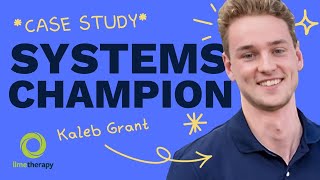
Caleb, an occupational therapist at Lime Therapy, became a systems champion using Systemology's book and Catalyst program. He captured workflows through forms and interviews, automated admin and onboarding processes, and got high team buy-in by focusing on the 80/20 rule and avoiding perfectionism.
Chapters
I think for us, where it's a little bit different would be, I guess, focusing on our clients. So having having these systems set up for us really increases our timely work and making sure it's the highest quality it can be, obviously meeting with the people who do it the best.
Hey, it's David Jennings from Systemology. Today I'm here with Caleb from Lime Therapy. Now, if you've been following along, I recently posted an interview with Renee Kelly, who is the owner owner of Lime Therapy. And I'm super excited because I don't get to chat with enough systems champions. And we've got Caleb, who is the systems champion from Lyme Therapy. So maybe just first up, Caleb, if you can just introduce yourself and maybe tell us a little bit about the business. I know Renee did, but that might just be a good way to kind of set some context for what you guys do.
Absolutely. So, yeah, as Dave said, my name is Caleb. I work as an occupational therapist at Lyme Therapy in Woodjara. Essentially the business, we work as a multidisciplinary team. So we've got a lot of different professions, OTs, physios, EPs, a lot of different sort of people working in the one business. And we, I guess, sort of service the local community with allied health needs. And I've been working with Dave and as you said, Renee, as a business owner, sort of the last few months or so around systems and trying to get them all, I guess, up and running and wrapping the head around the process. And it's been an awesome experience so far.
Yeah. How many years into being an occupational therapist are you? Like, you've obviously gone through some traditional training and now you're starting. You kind of just getting started or have you been doing it for a while?
Yeah, so about two years I've been working at Lyme. So, yeah, graduated about two years ago. And yeah, been at Lime for two years.
A big thing that I find especially it's not just isolated to occupational therapists. I mean, it's. It's really this idea of the business owner that's the technician that knows how to do the thing, but they don't necessarily know how to run a business that does that thing. So it's, it's the, you know, it's the mechanic who says, right, I'm going to start a mechanic shop. And then they realize, oh, wow, there's a whole bunch of other skills that are required to run a business. And I always feel like the gift of being a systems champion, especially early in someone's career really helps them to understand how the business works. And I don't know if you can speak to a little bit about that, like how it's been for you personally to be able to kind of work with the skilled team members to figure out what they're doing.
Yeah, absolutely. I think that, that that point you've just made there is, is really why I've found systemology so beneficial, I think particularly for our business. There is such a breadth of knowledge and understanding around what we do and particularly the areas that we need to know to be able to do our job well and service our clients in the best possible way we can. I think being in that position of being relatively new and coming in, you know, to a business where there is such a big understanding and learning curve to it, I think really shows the benefit for me in terms of what systems can bring just from being. Having that lived experience and being in that position, I can really see the benefit of having those systems having the processes and I guess step by step ways of doing things. Because it can be quite daunting coming into a business like this just with how much there is to learn and know. So that's, I think, why I've found this process so beneficial. And as you said, working with the knowledgeable workers in our business who have been doing it for a long time and have great knowledge to be able to work with them and get a bit of a deeper understanding into the business side of things as well. But then also to help with my role and what I do. Yeah, has been, yeah, pretty awesome experience so far.
It's funny, you might not even realize it now, but fast forward 10 years down the track and you'll realize what a gift they've actually given you. Because it's really common for the technician just to do the thing and not learn all of the other pieces. And I think you'll get some tremendous insight. I'm curious how they selected you for the role or if you selected yourself or how did the idea come up?
Yeah, so Renee and Matt, obviously, who you've spoken to in the past, sort of got onto the course and I guess just myself. I like things organized and I like, you know, my lists and I know what I know, I like to know what to do essentially. So I think just having that mindset made me a decent candidate to be a systems champion, which is a big honor, I think, in our business. And I'm very, very lucky to have Matt and Renee who sort of have the confidence in me to do this. And they've Given me a lot of flexibility and freedom to be able to take this on and the time to do it as well, which has been really important as, you know, again, particularly with our business and the scale of what it is to have that time and freedom to be able to do it to the best of my abilities. Yeah, been really awesome.
A lot of business owners, they struggle to find a systems champion or they don't know what to look for. Not focusing in specifically on your industry, but more about like some of your qualities. Is there anything that you go, right, if you were looking for a systems champion, you want to look for these things like you mentioned, organized. I feel like that's a good natural one. Are there any other skills that you go, oh, this has served me really.
Well in this role, I think attention to detail maybe and just detail orientation, particularly with doing the extraction side of things and documenting. And again, you're doing it with someone who knows it very well, but just being able to sort of ask the right questions and really if you understand it, then other people are going to understand it as well. And particularly for these type of things where I maybe haven't done those tasks before to then ask the right questions and really start from scratch, I think a pretty good skill to have as being a systems champion. Yeah, I think just. Yeah. Attention to detail and organization are probably the two that stand out to me.
Yeah. And as you sort of started. How have you learned this stuff as far as, like, you didn't have a background in systems or processes. Like you've kind of just picked this up with the work going through Systemology. What. Yeah, what. What parts of learning have you gone through that have really helped or which pieces. Did you read the Systemology book?
Yes, got that actually right here in. Right here in front of me. Yeah. So I think in combination with the book, what Renee and Matt have have sort of guided me with, and I had a lot of meetings with them sort of early on and still do now, sort of around how to tackle it. And then the Catalyst program as well with James and that sort of introduction to it all and working still closely with him to this day as well, really sort of set me up well and allowed me to sort of ask questions and really get to understand it. And then obviously feedback as we've gone through as well. But I think just. Yeah, starting from. Yeah, obviously Renee, Matt and then the Catalyst program as well have probably been the two big ones.
Yeah. And how's it been with the team? Like, how have you, like, are they receptive? Have There been challenges or resistance or. Yeah. What's it been like going through that?
Yeah, again, pretty lucky with. We've got an amazing team here and I think everyone has really jumped on board and got behind this and I think the real desire and not sure what the right word is here but it's. The feelers are definitely out for systemology and we haven't necessarily rolled it out from what I've been doing just yet but obviously through our team video and getting people on board has been a really smooth process. We haven't really had much or any resistance thus far which has been really good. And even now people are coming up to me sort of with ideas for systems and how about we do this or different ways to sort of do it. Which I think really shows that that buy in from the team and it's a credit to the people we work with here to get this up and running because without them, you know, we wouldn't be able to do it as successfully as we have so far.
Is there anything that you've been able to do to keep systems front and center for the team? Like is this something that you talk about on team meetings or do you share processes that you're documenting or have you got other ideas that you've come up with to kind of make systems and processes fun and keep it front and center?
Yeah, I think just sort of constant contact with the team. Like we've got an all team chat throughout sort of messaging service that we use. So I think just giving them updates around what I'm working on, what's next and I think giving them the chance as well to contribute to upcoming systems and any ideas they have around what they think could be really valuable again for new people coming into the business or for someone stepping into a new task. Having these things set up will be very beneficial and as I said, someone coming in from that, that sort of space in the past but I think just getting them involved as much as possible really helps with that buy in and that continued buy in as well. So that's sort of what we've been trying to do.
And what sort of tools are you mentioning you mentioned or use rather you mentioned the messaging app. Are there other tools like do you have any sort of project management software where tasks are assigned or do individual team members manage themselves and how are you kind of managing that piece?
So the teams app is sort of what we use for sort of all our, I guess, internal communication. We're in the process of working through a project management software and that's again with James, who we've been working with is a technologist so nothing like that at the moment but that's something that we're certainly looking at implementing. But yeah, teams are sort of the one we use for all our internal chat. So we just set up, you know, the all team chat through that. Yeah, that's where it's sort of all the communication sort of lies internally.
Yeah. And how, what is your process for the way that you capture systems? Like firstly there's probably a little bit of identification of what you're going to capture. Then there's figuring out who knows how to do it. Then there's figuring out like I'd love it if you could kind of just walk me through a little bit of your thinking about how you capture some of these projects.
Process definitely. So I think it starts with working with Matt and Renee, so the business owners as well as sort of the senior members of the team and that's where we sort of start our CCFs and we get them sort of identified because again with the breadth of the business that we have here it's really important to narrow the focus down and try and be quite specific because it's very easy to go off on tangents and focus on other things. So I think first and foremost is identifying the CCF and getting that sort of set up with the different departments, identifying who the knowledgeable workers are, the best method for extraction and then sort of meeting with that person. And again I'm very lucky to have the time booked out sort of each week to be able to do that. So then I meet with the person or get them to do the pre extraction form first with support obviously. So then that way when I meet with them they've got a fair understanding of what we're going to run through and then it's sort of a smooth process from there has been so far. But I think yeah, the CCFs are really important particularly for our business because it's easy to sort of I think get lost sometimes. Yeah. And go off on things that aren't as important or not as narrow focus. So I think starting there and then working your way through that and just sort of taking it step by step that way has been the way we've been doing it so far and it's working which is being positive.
Definitely. See you're quite fortunate that you've got business owners that are allocating time and resources to this. It's a big thing that I see a lot of people go wrong on. Firstly, the business owner might try and do it themselves. And then that might not work because they're obviously busy and they go, oh, yes, I'll get to this someday. And then they don't. And then the next thing is to actually realize that you've got to allocate some resources to this and give someone the space to do it. Because if you just give it to one of your best team members, they're busy anyway. And I mean, you're. You're seeing clients and doing work as well, so you kind of have to juggle that. I don't know if there's anything that you can speak to a little bit about the importance of creating some space for you to do this work, because if you don't have the space, it's not going to get done.
And, yeah, I think that's spot on. And as I said, I'm very fortunate with Matt and Ren, who have been able to give that to me and they've got the confidence in me to be able to do it. Well, I think just having that time blocked out where I don't see any clients or that space is sort of protected, and that time's protected is invaluable because without that, you're trying to do it in between seeing people or trying to make time for it outside when people might not be available. So having that time sort of set up each week where I know people are available, I've got the space where I can do it. It's, yeah, vital. So I'm very lucky in that sense to be able to have access to that.
Yeah, yeah. With some of the extractions, I don't know if any comes to mind as a story or a win or something where you're like a. We identified this as a problem and then we thought, great, let's create a process of it. And whether or not you even saw some impact from that already, I don't know if you've got any stories like that that come to mind.
Yeah, probably with. More recently, I've been doing a lot of work with our admin team here.
Yeah.
Because there's been a few changes there recently. So I think, I guess in terms of a winner, it's been nice to sort of get that, I guess, up and running in a way. So then when new people come in, it's sort of that first point of contact. And even with, you know, new. New. New workers to the business or students on placement or orientation, having that sort of set up for them when they come, it's sort of. You can sort of direct them to the systems instead of I guess having that focus on that key person that's got all the information because obviously they're, they're busy enough but having that, that first point of call in Systems Hub to be able to direct that person too. And I think yeah, that's probably the win I guess so far in a way and I guess probably hasn't been implemented just yet but will certainly be. So I think yeah, that's probably the one for that.
Yeah, I reckon definitely that onboarding process and Systemology is a bit of a journey. You start off with the critical client flow and then you move to this idea of minimum viable systems which then starts to take think about the different departments in the business and once you kind of get that in place, really narrowing into an onboarding sequence and thinking about well, how does a new team member come on board, what do they learn, how do they get introduced to the way of business? I think that's, that's key. I, it's funny, when I first wrote the book like Systemology was originally written for the business owner so I, I, I really thought about where they were at, what they were looking to do and now, now I've really started to realize that the systems champion is probably one of the biggest leverage points and one of the most important roles in making this happen. So the business owner needs to first get it and then they need to lead and show to the team, hey, this is really, really important. So a lot of the work that I've been doing currently is thinking about systems champions and what is it that they need to succeed and where were there maybe areas in the book that there might be confusion or things that systems champions have picked up as they've gone that I can then use that to kind of teach future systems champions what to look out for. So one of the insights I had was I talked about this idea of the four stages of business systemization and the final stage in that is actually building. I talk about getting to saleable. Now saleable doesn't necessarily mean that you're going to sell the business but rather it operates in a way that's key person, independent that which is an essential bit for being a salable business. And it's really, you've got most of the documentation into place and I try and clarify that with some of my systems champions. It's not necessarily that the business owner is looking to sell, but they're looking to build a business that is saleable. I'm wondering if there's any other things on your journey that either you've spotted in the book and you've kind of learned something, or if there's something that you wish you knew before you started this journey or anything that you've picked up, that you might be able to give advice to other systems champions as they're kind of on the journey.
Yeah, that's a really good question. I think from the systems champion perspective in the book, I think you nailed it really well. I guess some of the things that I've picked up and again these are reiterated in the book as well. But not aiming for probably perfection when you're doing particularly the early stages, because you can really get caught up in that. And that's if you're a bit of a perfectionist. It can be hard to step away from that, I guess. And I guess just getting things down with how they're being done at the moment and then going back later when you meet with that person again, I think is a really key point and something I really liked from the book as well as focusing on the 80, probably the 8020 rule in terms of again, for this business in particular, there can be so much so just I guess capturing and documenting what's done 80% of the time so you sort of narrow get that key part of the system or whatever you're doing down and then going back again later when you meet with that person to really nut it out a bit further. So I think they're probably the two biggest ones. But again in the book I think it's covered quite well for the systems champion point of view. And again for probably our business, when you mentioned the salable aspect, I think for us where it's a little bit different would be, I guess focusing on our clients. So having these systems set up for us really increases our timely work and making sure it's the highest quality it can be obviously meeting with the people who do it the best really then leads when we come to do it, say for the first time or someone new steps in that we're really delivering the highest quality work in a timely manner that we can for these people. And it really empowers us I think as team members as well, to know that we're following step by step guides from the people that do it the best. And again, just eliminating that key person dependency and seeking out those people who know it because often they're busy and they've got other things going on. So having it there out of their heads. Yeah, really increases those outcomes for our clients, which is sort of what we're about.
It's great to hear you talk about systems the way that you do and explain it because a lot of business owners have this preconception that systems and processes are boring. And you know, when people talk about it, sometimes the eyes glaze over and it's not typically, you know, a fun topic. Oh, great, we're going to follow process. But I feel a different sort of energy in the way that you explain it and I don't know what it is that makes you see that or if that's just how you've always been or. I don't know if there's anything that we can reassure, if a business owner is watching this, that your team will adopt this and they don't have to be boring and stale. I don't know if you've got any ideas on that.
I think, and I was talking about this with Renee the other day, I think we're both very excited about where this is going and we see how well it's going to be implemented say in 12 months time. And it's really hard not to look that far ahead and try and focus on what we're doing now. But I think again, just being in that position of coming into a business for the first time and being that new person and not having these in place to then seeing even where we are now what we've got done, but then just, you know, that time down the track where we hopefully will have most of the business up and running with it being systemized, I think is just really exciting. And I think that's what I was chatting to Renee about. And yeah, for us it's such an exciting adventure and process that we're in. So I think for business owners it's just that, yeah. Oh, I don't know, I don't know how to say it properly. But yeah, for us it's, it's, it's just, yeah, an exciting venture that we're on.
I think sometimes it's weird because it's the, it's in the business owner's head and then they project it onto staff and team thinking, oh, I'm not a systems person. Or, you know, maybe they've been doing it so long that systems doesn't benefit them. So it's very easy for them to then project that and just think that that's the way that other people think. But it's good to kind of hear you mention, well, as a new team member, it's actually really helpful to know what to do and how to do it and have a starting point.
Absolutely. And I think that's where that empowerment comes in. And if you feel empowered as a team member, you feel much more confident in what you're doing. So I think that's, yeah, a huge, again, especially for us, but a huge part of, of what this is going.
To bring for us in the tail end. I'd love to just finish off thinking a little bit about the systems champions themselves. Like, if there's a systems champion that's watching this, if there's anything either advice or tips, like, I would love to make the idea of a systems champion and maybe even evolving into a system ologist as a career path for people because I think they're just so needed in businesses and I think you're a prime example of what a, a great systems champion is. I, I actually think the junior person who has maybe gone to uni, done that bit, wants to become that person, is then hungry and curious to learn and discover the business and all of those aspects. And then this, what a great opportunity to make yourself known to the knowledgeable workers like you. You get a chance to work really closely with some of the best people on the team, which then almost shines a spotlight on you and then you help to solve a problem that the business owner oftentimes has struggled with for years and hasn't been able to solve. So it's this magic little mix of you getting a huge win, the business getting a huge win, and, you know, who knows where this takes your career many years down the path. But is there anything that we could speak to potential systems champions about, you know, if this opportunity presents themselves or even to put this forward as an idea to a business owner?
I think, yeah, again, very, very good question. I think just being open to it, because as you said, sometimes when you think of processes, it might be a bit of an eye roll, but I think just being open to this because it is so different and I think the benefit is there for a lot of businesses and probably all businesses. So I think just being willing to take it on and give it a shot because I think once you get rolling with it, it's, as I said, very exciting. And it's, yeah, it's been an awesome, awesome journey for me so far and I'm very excited to see where it can take us in the next 12 months from clinician point of view, but then also from a business aspect as well and just making it run as efficiently and smoothly as possible. So I guess, yeah, my advice would be to take it on and be willing to interact with those people who have that knowledge and just dive into it because it's really, really exciting stuff.
Yeah, perfect. Well, we'll wrap it up there. A huge thank you, Caleb, for your shares and insights and hopefully inspiring some business owners and some systems champions out there to just get down to it. So thank you for that.
Thanks for having me.
More from David






Remember me? Subscribe To My Channel For More Free Business Systems Content 📈




