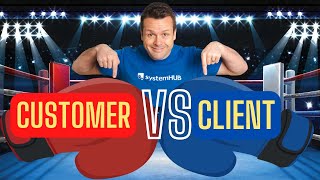
A short talk by David Jenyns distinguishing 'customers' (transactional, price/volume-focused) from 'clients' (long-term, advisory relationships). He contrasts supermarkets (customers) with doctors (clients) and explains Systemology's approach of treating those who engage with the business as clients — trusted advisors investing in long-term outcomes and referrals rather than single transactions.
Chapters
Okay, so I would love to talk a little bit about this idea of customers versus clients and then that kind of helps us to think about how we think about the people that engage with systemology. So I'm going to jump over to my iPad just here and once this loads, I'll just make sure that everybody can see that. Okay, Is that popped up for you guys? Perfect. So I just want to go through this idea of what a customer is versus a client. So when we think about a customer, A customer. You go into a supermarket and you're a customer. You pick things up off the shelf, you walk up to the front register. There's no real engagement with the checkout person. Who knows, maybe it's even one of those self service ones where they're just selling you the product and there's no real thought, there's no advice, there's no direction around your product selections and if you've made the right decisions, it's just great. Here's what you selected off the shelf, here's the price. Can I have your credit card details? So a supermarket deals in customers and they really focus on really they're just transactional. There's no real long term investment in the person getting the outcome. They're just thinking about a volume game. And oftentimes for customers it really just comes down to price. You know, if you're thinking about a supermarket, why you choose to shop at one supermarket versus another supermarket? Well, this supermarket's got the right range that I'm after and the quality and the price is the best. So. And some people are going to be more influenced than others around quality versus price and things like that. But it is, there's not really adding much value oftentimes when you think about it, when you're thinking in terms of just a customer, it can be quite short term focused because you're really just thinking about the sale right now. You're not thinking oftentimes about the sale six months down the track. The supermarket when you're at the checkout isn't oftentimes thinking as much about, hey, I need to sign you up and get you on the newsletter and make sure you come back and continue to purchase. For me, they're thinking about, hey, can I just make this sale right now? And they're really just selling products now. If we compare that against thinking about clients and what clients are. So when you go to a doctor, a doctor doesn't call you a customer, you're not a customer of a doctor. Oftentimes you might be a client or you might be a patient. And the relationship that you have with a doctor is very different from the relationship that you have with a supermarket. When you go to a doctor, the doctor is seen as the trusted advisor. They have an area of knowledge and that they have like this specialized knowledge that they can then apply to your unique set of circumstances. They'll have a discussion with you, find out your pain points and where you need help and what problems you've got. They'll listen to all of your symptoms and then they'll prescribe a solution after that and they'll say, oh, you have all, all of these symptoms, you need to take this drug or you need to go for this walk and you need to be looking at these exercises. So it's a very different relationship when we think about clients or patients because they're taking this body of knowledge and they're invested in the client getting a fantastic result or making the right choice. And they're thinking long term because usually when, when you're seeing a doctor, you might have that doctor for life, that might be the family doctor and you keep going back to them and they know they're going to see you next week or next month when you come into your checkup. So they've really invested in the long term success of you and you getting that long term result. They're invested in you getting in that long term result. So when we think about the difference between customers, which is a very transactional thing, versus client, which is, you know, I'm invested in that long term result, I want to make sure that you achieve your goal, you solve the particular problems that you've got. This is a great frame to think about when you think about how Systemology engages with their clients. Because at Systemology we have cloud clients versus customers. We don't really have customers. We have clients where we're here to really support and serve the business owner and the rest of their team in getting an outcome. We work with clients over a long period of time and even if we don't have a product or service to sell them, that's okay, we'll still point them in the right direction. Even if our product or service isn't the right fit for them right now, or it might not be the right fit, that's okay. We're not just going for the transaction. We're here to serve and be a trusted advisor and we'll point them in the right direction. Because you never know what's going to happen down the line. They might circle back around in 12 months time and say, great, I'm ready now. Or they might have a friend or an associate that they can refer to us because they say, you, you know what? Systemology is a great company. They're invested in you doing better and your company doing better. So I can feel trusted that I can point people to this business and they're going to get a great result. You don't worry about a doctor. When you go see a doctor. You don't think in your head, oh, this doctor is just trying to sell me this drug, because maybe he's making a commission on the back end of this drug and he's got a vested interest in me taking this drug. Drug. You think the doctor is making the recommendation based on what is best for me, and that's the way that we do things here at Systemology. So that was just. Yeah, just a little thing I wanted to run across. I don't know either if anyone. If anything stood out for anyone for what I had just gone through there, or if anyone goes, oh, yep, that. That reinforced something that I knew. I don't know if anybody wants to chime in on anything that stood out from what I just covered, then who wants to jump in? Either, I think Christian or Amy or Ivan. There we go. Ivan. Yeah.
I think that that resonated quite well with. With what Maggie and I and. And Joyce were discussing in the breakout room, which was that we're there for the long haul. It's. It's one thing to. To get the sale. It's one thing to get the. The customer to agree to use our service in the first place, but that's not what we're about. We're about supporting them through that long journey and to ensure that the customer's able to thrive and survive in an ongoing basis. And that's the difference between a customer and a client. Because they are our client. They become part of our family, and that's how we look at it, and that's the support that we want to provide them.