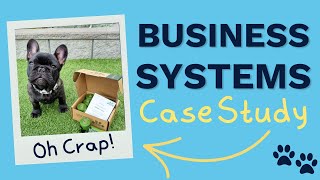
David Jenyns tells how Oh Crap, a compostable dog poo bag company, went from a garage operation to supplying over a million bags to the RSPCA. The breakthrough came when Henry and a VA pushed for documented processes and systems, which freed up capacity to take the massive order that made them Australia's major supplier.
Chapters
I remember one of our clients, they have a company called oh, Crap, which is a fun name. They make compostable dog poo bags. They came up with this idea. They were out walking one day, and the business owner, Bruce, saw people, you know, picking up their dog crap and putting it in a little bag and then realizing all of that just ends up in landfill and never breaks down. And it's, you know, it's dog poo. It should break down. And here it is sitting in a plastic bag. So they came up with this idea of, well, let's create bags that can be compostable. And it started off in their garage. They came up with the idea. They sourced, you know, a manufacturer out of China. It was real humble beginnings, like home business. When the shipments would come from China, they'd be stacked pretty much from floor to ceiling of all of the bags in all of the different rooms around the house. And initially it was just Bruce. That's the older guy there. Bruce's. It was his brainchild, his business. And anytime he wanted to go on holidays, the business would stop. And they figured out they were getting some ads, working on Google AdWords, and they were getting good lead flow. But every time that Bruce wanted to go away on holidays, they'd have to pause the ads. No work would happen, and everything would kind of grind to a halt. They'd stop fulfilling and all that sort of thing. So it wasn't really a business. It was kind of just Bruce doing his hobby thing on the side. And then they thought, oh, there's a huge opportunity here, and we want to continue to grow it. So they end up bringing Henry on. That's the younger guy there. And. And Henry was more of the marketing brain. So they had figured if they could get their orders right from China and they could get a truckload of these bags and they could get their marketing right, they could just see how they could scale it really well because there wasn't too much to the business. Not really that many moving parts. People buy bags, they ship them out. Done story. So Henry started to really dial in the marketing. Ends up hiring a VA out of the Philippines who ends up becoming their systems champion. They went through the systemology program. Basically, Henry said to this VA in the Philippines, this is now your job. I want you to be the systems person. I want you to be meeting with team members constantly reminding everybody to follow process. If I send you a recording, I want you to do the documentation. And here's our system for creating systems. Here's what a system should look like, here's where they should be stored. Then they started integrating it in with their project management platform. And what ended up happening is they opened up the capacity of the business because initially with Bruce, when he goes away on holiday and everything grinds to a halt, if they got a huge opportunity or a huge order that would fall in their lap, they would just miss that opportunity. They weren't ready for a big order. But as you start to systemize, you start to open up capacity and you start to create space for opportunity. So what ended up happening is the RSPCA came across the work that they were doing and they said, this is awesome. We would love to endorse your bag and get it listed on our sites and push it all through to our locations. And in their first order, they ordered like a million bags. And Bruce and Henry were both like, if we hadn't systemized and got the business ready to be able to handle that capacity, if the RSPCA had knocked on our door 12 months earlier, we wouldn't have been able to service them because the lead times were too long and all of the different challenges that they had because they weren't ready for that scale. So you want to, as you start to systemise and build your business, you're just constantly stepping closer and closer and closer to running this systemized business that enables you to scale. And then when the opportunity does happen, because you can't always manufacture an opportunity, sometimes opportunities just happen. You talk to someone and they talk to someone and they refer you work. Maybe you're on site and there's a big project and someone says, you did great work, you should go here. If you don't have the opportunity or the capacity to take that, you miss that huge opportunity and you don't know when the opportunity is going to be. So you want to constantly be moving your business closer to be able to handle bigger capacity. And. And then you'll actually find you spot the opportunity and you've got space to chase it and you go, ooh, yep, I'm gonna now double down on that. And that's a big part of what a business owner should be doing. That's part of the magic that they can bring to be able to spot those opportunities and bring them in when they're slightly outside of what's front and center. And yeah, it was huge. Like, I mean, as far as, oh, crap is concerned, they've gone on. They sell an absolute truckload of dog poo bags. They work with the rspca, they're the biggest in Australia. Of their particular type. And Henry had said to me, we're able to do almost like what big companies can do, even though we're only a small company. They've got a team of like, 12, and they've just got really solid systems, and that makes them so much more efficient and scalable. So, again, this is that whole idea of what opportunities have you left on the table that you might not have even realized whether it's. You haven't been following up with the leads. There might be a truckload of work there. You just didn't have a system for it. So you don't actually know what it is that you've been missing out on.