Stop Systemising Everything! Follow This One-Page Blueprint
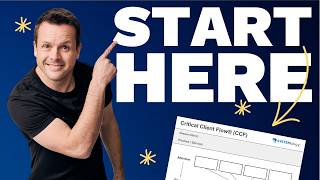
David Jenyns shows a one-page tool to map your business flow and find which process to systemize first. Map seven steps from attention to handover, identify your biggest bottleneck, and start there. A daycare case study revealed onboarding was killing their growth.
Chapters
Most business owners, they're systemizing the wrong things. They're documenting everything from their social media workflows to HR policies, accounting procedures and hundreds of other different processes. And they're trying to do it all at once. After analyzing a few hundred businesses, I've discovered the real secret to successful systemization. The businesses that make it work. They're not trying to start with a truckload of systems, they start with a handful. The most important, the most critical systems. Now, if we haven't met, my name is David Jennings. I'm the best selling author of the book Systemology. I've also got a new book called Systems Champion. And I've helped thousands of business owners get off the tools out of operations and build a business that gives them true freedom. And in this video, I want to show you the exact exercise that I do with my top tier clients to answer the question, what are those first few systems that you should build? Now, by the end of the video, you're going to have a one page blueprint that shows you exactly what, what to systemize first and in what order to kind of follow on from that. I'll show you the critical client flow. We'll walk through creating yours and then we're going to identify the biggest bottleneck in your business. Where is it hiding so you know where you need to get to work? Let's get started.
Now, most business owners, they try to systemize everything at once or they end up systemizing the wrong things that have very low impact and that no one actually ends up using. I made the same mistake when I got started. I probably spent countless hours and who knows how much cash trying to figure this out. But the good news is I invented a tool that makes this so much easier for you. It's called the critical client flow, or CCF for short. It's a simple one page map that shows how your business attracts, converts and delivers your core product or service. I want you to think of it like a blueprint for your business. It's simple, it's high level, it's all on one page and it shows how you do what it is that you do. I think that's what makes it different from every other business planning tool out there. This is not about what you should be doing. This is about identifying what you're actually doing right now. It's like holding a mirror up that shows you what's working in your business and what's not. So here's how to build yours. First thing I want you to do is we're going to get you to download the template, you'll find it in the description beneath this video. Just pause for a moment so you can go download it. I'm happy to wait. I'll just wait. Have you got it? All right, now, in the top left hand corner of this template, I want you to write down one specific client. We call that the dream client. It's the person who pays your advertised prices, refers, friends and family is a pleasure to deal with. They keep coming back and you'd like a truckload more of them. That's your dream client. Write that down in the template in the top left hand corner. Next, I want you to write down the one product or service that you sell them. Now you might sell a range of things, but just pick one. Pick maybe the first product or service that they buy from you. We're just going to use that to really focus on getting this critical client flow down. Now, one of my clients, they ran a daycare center for dogs called Diggy Doggy Daycare. And their dream client was busy working professionals without kids who treat their furry friends like a human or a kid. They now their service was to provide the daycare for those dogs. So you want to make it as simple and clear as that. Write down one dream client and one primary product and service. Now we're going to map out how that customer goes from having never heard about you through to buying from you and then coming back for more. There are going to be a couple of rules I want to give you up front though, before we start mapping this out. Firstly, I want you to only capture what you're currently doing, not what you would like to be doing. And secondly, I want to keep this really high level, very simple. Not more than three or four words to describe each step. Some of those details and things like that will come out later. For now, we just want to capture this high level. So let's map it out together. Step number one, attention. How did this dream client find out about you? Were they referred? Did they search you on Google? Did they use chatgpt or social media? Just write it down into the appropriate box. Next, step two, the inquiry. How did they reach out to you when they were ready to find out more? Did they fill out an email or pick up the phone and call you? Or maybe they entered some details into a form on your website? Whatever it is, just write it into the box. Step three. Well, think about the sales. What does your sales process look like? How did you convert them from an inquiry into a paying client? Did you have a discovery call? Was there a meeting in person? Were there questions that you asked them? How did you figure out what products and services would be a good fit for them? Just high level. Write down one or two of those steps in that process. Step number four, when they were ready to go, how did you collect the money? How did they pay? Did you get a deposit? Did you invoice them? Did you shoot over a PayPal invoice? Whatever it is, capture that high level. Then we'll move on to step number five, onboarding. What happens after they paid? How do you set them up for success? How do you get them into your system? You might even just want to call it very high level onboarding. That might be enough. Again, the details can come out later. I just want you to think about the distinct steps. Step number six is delivery. How did you actually fulfill the work? Now, no doubt there's going to be a whole range of different steps and milestones and things that may need to be completed to deliver that product or service. I just want you to capture it high level. You might even just call it do the work. And then lastly, step number seven, how do you hand over that completed work to the client and get them to come back? Or maybe refer friends and family in each one of those boxes? Just use a few words to describe each step. No complex jargon, no fancy workflows, just the basic path from I've never heard of you through to, hey, I'm a client and I love working with you and I'd like to keep coming back. Let me show you how this works with a real world example. You know that client I mentioned a little bit earlier, that diggy doggy daycare? Well, when they came to me, they were drowning. Every morning their phone is ringing and clients are asking the same questions and they're spending a good few hours every single day just answering the questions that should have been handled by the system. We started off mapping out their critical client flow. Took less than 30 minutes to get a rock solid, clear picture, all on one page, of how their business works. We shared it around with some different team members, had some discussion, and almost immediately it was obvious the pain point was within the onboarding. These new clients were coming in with their dogs and they had no idea what to do or what to expect or how things worked. That's why they were asking the same questions as these new people were coming in the door. So we looked at the critical client flow, we identified where the pain was, and then that ended up being our first step. Within six weeks, we Ended up getting the phone to stop ringing like it was. We reduced those basic questions down to the exceptions. So the team stopped getting interrupt and then it freed up a good 15 to 20 hours per week just on that one activity. That's the power of knowing where to start to start in the right place. Now look at your critical client flow and ask yourself, where is the pain? Where are things breaking down? Where are you the bottleneck? And when I've done this with loads of clients, almost immediately the answer jumps out at them. It's obvious. They look at the map and then they say, this is where things start falling apart. That's going to be your starting point, not the 57 other million things that you could be documenting or creating systems around just that one step. When you systemize the biggest bottleneck, everything gets easier. Your team has more clarity, you get more breathing room. And the next system actually becomes obvious. You don't need 100 systems, you need 10 of the right systems. And the critical client flow shows you which 10 matter the most, which are the systems that are you money. And then you can narrow in on the pain to figure out where you start. If you focus on the systems that are going to move the needle in your business, it's a real game changer. So here's what I want you to do right now. It'll take less than 10 minutes if you haven't already. Download the template, don't bookmark it, don't save this for later. Download it now. Step number two, write down one dream client, one primary product or service, Set a timer and then map out your critical client flow. Step three, I want you to identify your bottleneck. Just circle it. What's causing you the most pain? Then just drop a comment below, tell me what your business does and where the bottleneck is, and I'll personally review all of the comments and help to point you in the right direction. I don't want you to overthink this. I just want you to take action. The businesses that succeed are the ones that take action. The ones that fail are the ones that watch videos and do nothing with it. So which one are you going to be? And now that you know what to systemize first, the next thing that we need to talk about, the elephant in the room, is how the heck are you going to get it documented? I think a lot of business owners, they end up doing this the hard way, spending six hours writing one procedure. Or worse, they end up creating these 15 page documents that nobody ends up reading anyway. The good news is there's a faster way. And I'm going to show you in my next video how you can create bulletproof SOPs in under a few minutes just using AI. No more documentation marathons. No more procedures that sit in folders gathering dust. I'm talking about systems that your team members will actually use. So click on the video on the screen right now, because the faster that you can document these systems, the faster you can get your life back.
It.
More from David






Remember me? Subscribe To My Channel For More Free Business Systems Content 📈




