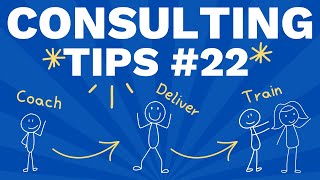
David Jenyns walks through a hybrid consulting model where you train a client's internal person (called a Systems Champion) while doing some of the work yourself, then shift to coaching. He uses Portavac and Kane as an example. This approach sells better and creates lasting change without keeping clients dependent on you.
Chapters
One of my early clients, we got him through an EO group, Dave Porter, and he runs a company called Portavac. They basically clean roofing gutters. And he tried to systemize in the past and failed. And a big part of it was the person he was working with prior. There's a couple of things. One they were trying to do ISO, which is a whole nother story in itself, which is just systemizing for systemizing sake. But a lot of what they were doing, it came back to relying on him. And he had this real sense of feeling like he needed to be the one that had to create the systems and it meant that it just didn't get done. So when we started as a Systemology consultant, first thing that we did is I identified, we called him Systems Champion Kane. You can see him on the screen just there. I told David that Dave Porter, that I could come in and I could train one of their internal team members as I was doing the work for him. So instantly Dave's imagining, well, Kane is going to learn what to do. Like he might go, well, I don't have to sign up to a two year commitment to work with Dave at Systemology because he's going to teach and train Cain, guide him through. We're going to develop this skill internally and then we're going to be able to run with it. That is a fantastic way to sell because it shows the client you're more invested in them getting the result and having a positive impact than locking yourself in. Now, what invariably ends up happening is you start working with the client, you get them a great result and they want to continue working with you anyway because you've developed that great result. We ended up moving into. It's almost like after we did the first bit of work where I worked with Cain and we captured a lot of their systems and it was a hybrid approach. I did some of the work, Kane did some of the work, and then we delivered it to the client at the end. At the end, they ended up going great. We want to have you come in a slightly different capacity beyond that, where I ended up becoming almost like the accountability partner for Cain. And I was coaching Cain and I started then meeting Cain every month just to kind of make sure that he was developing this inside, which I actually believe is the right way to do consulting. A lot of consultants and business owners know this. They worried that you're going to come in, you're going to do your work and as soon as you walk out the door, if no one's there to Drive it. All of the good work that you've done is going to sit in a Google Drive folder somewhere that's not touched because no one really knew how to do it except for you, because you were the consultant who came in and did it. That's always the risk that the business owner thinks that everything's working while the consultant's in, but then as soon as the consultant's out, it doesn't. It's a really powerful selling position to come from it. I want you to develop this skill or to be able to continually solve this problem yourself. So again, try and take some of these ideas and think a little bit about it as you start to develop your own Trojan horse method. I think that the hybrid approach of some coaching and consulting with shared delivery. I've got another friend who was a consultant in the digital space and he similarly found he was in the. He was consulting to E commerce businesses offering a hybrid approach where you offer a little bit of delivery in addition to your training, like your training or your coaching, that changes the game for the client because they see forward momentum whether or not they're doing something. And it enables you to get really good at it as well. And that's how you can start to grow and scale your consulting business. You know, you, you get an administrative assistant in who can help with a little bit of the delivery. You just rock up and do your thing, which is the coaching and the consulting. But then, you know, maybe you have an admin assistant who helps with some of the other doing of the work that then the client feels great about. And if, you know, for extra points, if you can make some of this happen without the business owner, I'm assuming a lot of you are coaching and consulting into business owners. If you can get them a win without the business owner, that's like magic for them because the business owner is used to feeling like they're involved in everything as opposed to not having to micromanage and the team moving things forward. And if you're able to come in and look after the team and manage them and get them a result, they end up feeling really, really great about.