What is Lean Marketing?
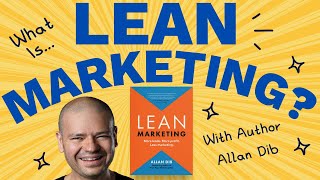
Alan Dibb explains how Lean Marketing differs from his earlier One Page Marketing Plan: it focuses on execution and process instead of strategy alone. The core idea is doing fewer, higher-leverage activities for bigger impact, and spreading marketing across product, engineering, sales, and support rather than keeping it siloed.
Chapters
Another way that people get wealthy is through compound interest. The magic of compound interest. Now, compound interest absolutely applies to marketing as well. So if I can do a process and it's something that can really help me compound my time, money, energy and effort, that's something that I want to invest in.
Today I am joined by Alan Dibb, author of the OnePage marketing plan and Lean Marketing. He's a good friend of mine. He, he's started, grown and exited multiple businesses, one of which was named in the top 100 fastest growing companies in Australia. Now, his original book, the One Page Marketing Plan, really did start a movement. Huffington Post said it was one of the 10 best marketing books. It's been translated into over 30 different languages. What I love most about Alan's work though, is his approach to marketing is very systematic. He looks for what works and, and really makes it repeatable. Today, very keen to dive into some of his latest thinking from his book, Lean Marketing. So perhaps Alan. Yeah, if we just jump straight into it, I'd love to get your insights on. After the OnePage marketing plan came out and as you've seen it been picked up and applied all around the world, what sort of new insights have you sort of made seeing it roll out?
Yeah. So the, the one page marketing plan, as you said, it's been, it's had a lot of success, which has been nice. And a lot of what I wanted to do with that is strategy. So help people with strategy. Because I saw so many people were like just throwing tactics against the wall, random acts of marketing. You know, let's do a little bit of SEO, let's do a little bit of Google Ads, let's do a little bit of podcast, whatever. And people didn't kind of have a strategy. So the whole point of the One Page Marketing Plan was let's put together a strategy. And when I say strategy, I want to define that. So, for example, if you want to win the war, you might put together a military strategy. You might say, hey, we want to drive the enemy back to its borders. Right. So that it's kind of in broad terms, what do we want to do? And so the One Page Marketing Plan, it's in broad terms, where do we want to allocate our finite resources? So where do we want to spend our time, money and energy? And it's about putting together that. On a, on a plan that you can easily share with your team and all of those things. Now, once you've got your plan together, that's awesome. And so that we want to Implement that, that plan. And so the second book is much more tactical. It's about how do we actually execute a plan, how do we actually do this stuff? So using that military example again, it might be, hey, we're going to cut off their supply lines. Hey, we're going to bomb their tanks. So what in specific terms are you actually going do to implement your strategy?
The, the roots of the book, which talks, I mean, it's in the name Lean Marketing. And you also lend from Six Sigma and some of these process method methodologies. I'd love to get your thinking around that and how you feel that plays a part in marketing.
Yeah. So a couple of years ago, I was speaking, I was the keynote speaker at a big conference in the automotive industry. It was in Mexic, and I kept hearing the word lean. You know, one guy introduced himself, said, I do Lean Six Sigma. Another guy was talking about lean this and that, Lean manufacturing, Lean thinking and all this. And I'm like, what the hell is all this lean thing that everybody's talking about? And so I looked into it and I'm like, wow, how did I not. How have I been in business for all this time and I haven't really known it? And it's, it's really a methodology for, in a systematic, structured way, knowing how to get a more consistent, a better result by doing less stuff. And it was interesting. One of the guys I was speaking to, I'd launched my, my book in Spanish and he said, hey, I read your book. I really loved it. And I think of your book as Lean Marketing. And that's the first time I'd ever heard that term. And I'm, you know, at the time, it didn't, the penny didn't really drop. I thought, yeah, thanks very much. And we kept in touch. He became a client down the track and all of that. But that really got me thinking that a lot of what I do is figuring out how to do more with less. How do we have a bigger impact by doing less marketing? And that's really what Lean Marketing is all about. Because whenever I look at all the best marketers in the world, yourself included, they do. They don't do a lot of stuff they're not to do. List is way bigger than their to do list. So the stuff that they're doing, they double down on the stuff that's really working, the stuff that's having a large impact and, and they're not bothered with the hundred other things that everyone says that they should be doing. You know, being Omnipresent on social media, TikToks, all of that sort of stuff, not that any of that stuff is bad, but they're having an outsized impact. They're doing less stuff, but getting a much bigger result. And so that's really what I wanted to do, is help small business owners really double down on stuff that can really work for them and them having an outsized impact by actually doing less stuff.
When we think about the marketing department, what do you see is its core function? Like what, what is it there to do for the business?
Like, yeah, so one of the, one of the ideas that I've got in the new book is that while there might be a marketing department, I've got a few. I've got, I've got nine principles of lean marketing that are outlined in the book. But one of the core ones is that marketing should not operate in a silo. So one of the biggest mistakes is, you know, we've got the product development team, they design, come up with a, with a product idea or whatever. The engineering team decides how to put it together, how to manufacture it, all of that sort of stuff. Then the sales team tries to sell it. And so you've got all these departments working in a silo, you've got the support team who supports it, and then it kind of falls to the marketing team. Hey, we're not really getting our numbers. Can you guys do your magic and sell this product or get this product out to more people, generate demand. And so everybody operating in a silo creates a huge amount of waste because sales team's not talking to the product development team or the support team. Everyone's working in their own silo. So I believe for marketing to be effective, it's gotta be throughout the entire customer lifecycle, from product development through to engineering through to sales. And when you look at lean, which originates in Japan, that's exactly the, the way that they create that efficiency. So you would think that operating in separate teams who have specialized tasks would be the most efficient way. And that's really a mass manufacturing concept. It was sort of pioneered by Henry Ford. But Japan, after the Second World War, they, their industries were completely devastated. They just couldn't afford the mass manufacturing approach, which is heaps of inventory, separate departments, specialized tasks, specialized machines. And so they created a methodology called lean. And in Lean, you have a functional team. So if we're manufacturing a product, we've got a whole team that works together. We've got the engineer, works with the marketer, works with the sales team. We're all on board with how that product should be positioned, how it should be functioning, what it should do, how it should be supported. And I think that's the way that marketing is going to work in an effective way if everybody is integrated, having an integrated approach to marketing. So yes, while you might have a marketing department, I think you should think of it as a marketing function that's spread across all of your departments. Because here's the thing, like if your support team knew how to upsell a product, like they're talking to a customer, they've resolved a problem and they saw an opportunity to upsell, wouldn't that increase your customer lifetime value? And if people loved speaking to your sales team rather than being afraid of speaking to your sales team, wouldn't that increase your conversions? And if your product developed team didn't waste a lot of time creating stuff that nobody wanted, again, wouldn't that increase your conversions and your customer lifetime value? So I think of marketing now as a function that's kind of spread throughout the entire organization and that's a way that you're going to be way more efficient, way more effective and be able to do much more with less and.
Being spread across the entire organization. What, what is the job then of marketing as far as is it there to advocate for the client? Is it there? Or is it dependent on the different tasks that they're working on? Really it's just coming to it from a marketing perspective, thinking about, well, how are we going to get this in front of our target audience?
So the whole goal of marketing, and I think really the whole goal of an organization is how do we get best fit clients to know us like us and trust us enough to buy from us and buy from us on an ongoing basis and then to love us so that they'll refer, so that they'll buy in more volume, in more frequency, in more quality, in more quantity, all of those sorts of things. So we want to figure out how do we get more and more of best fit customers to really know that we exist, buy from us and then recommend us in every way. And I think again, that's, that's not just a marketing function. Often, ah, marketing thought of as an afterthought. It's often just lipstick on a pig. It's like no one really wants this stuff. We have actually totally missed the mark with our positioning, our pricing and everything like that. And now we've got to figure out who to flog this stuff to. So that's.
More from David






Remember me? Subscribe To My Channel For More Free Business Systems Content 📈




