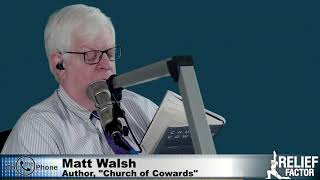
In this interview on the Dennis Prager Show, Matt Walsh discusses his book Church of Cowards: A Wake‑Up Call to Complacent Christians. He defines a "complacent Christian" as someone who lives a comfortable, culturally‑driven life, avoiding the sacrifices and doctrines of true faith, especially when contrasted with persecuted believers abroad. Walsh points to statistics showing a decline in self‑identified Christians in the United States and argues that many who still claim the label no longer believe core doctrines, discarding obligations of obedience, morality, and reverence. He frames this decline as rooted in cowardice, describing it as the opposite of courage and the source of “false virtues” such as superficial welcoming, acceptance, and tolerance, which mask a fear of judgment. Walsh urges listeners to conduct a personal inventory: first, honestly assess whether they truly believe the extraordinary claims of Christianity; second, let that belief permeate every aspect of life rather than compartmentalizing faith. He identifies the modern Catholic Church as a primary arena where these problems manifest, though his critique applies to Christianity broadly. Throughout, Walsh rejects simplistic step‑by‑step solutions, emphasizing that genuine change requires courage to confront uncomfortable truths and live sacrificially. The conversation also includes a brief promotion of the book and a reminder of where to purchase it.
Chapters
Matt, welcome to the Dennis Prager Show.
Hey Dennis, thanks for having me on.
What's the— what is a complacent Christian?
Probably describes Christians and probably religious people in general in the West, that we live such comfortable lives. We're sort of floating on the tide of the culture and going wherever the culture takes us. And when you compare that especially to Christians over, over overseas and the very real persecution that goes on there, We have sort of the exact opposite problem of our ability to avoid suffering and to live such comfortable lives, I think, has led us into decline.
And how does that decline manifest itself?
Well, I think it manifests itself in many ways. You could look at just what the statistics, and they'll tell you that whatever it is, 80% of the United States claims to be Christian, and that number is going down. For religious people in general, we know the number's going down, and the number of secular people and atheists going up. But I think the numbers are a lot worse than what they tell you, because if you were to actually talk to some of those supposed religious people and ask them what they really believe, and ask them about the doctrines of their faith, you're going to find that a startling number of them don't actually buy into many of those doctrines. And so that's what's happening, is that people are— are— even those who still claim the faith are, are beginning to get rid of bits and pieces here that they don't like, especially the ones that call them to sacrifice and the ones that deal with obedience and morality and reverence. We don't like any of that, we throw that aside, and we start constructing a faith for ourselves that is all about making our lives in the here and now more comfortable, which is really the exact opposite of what faith is supposed to be doing.
Well, you got an amen from me. Uh, you know, of course, I'm sure I know, I know you know I'm Jewish and I'm a religious Jew, and the Indianapolis Jewish Federation for the Jewish holiday of Purim, put out a flyer that people should celebrate with them at a drag queen reading hour for the Jewish holiday of Purim. This is put out, I have a copy of the flyer, by the Indianapolis Jewish Federation, and that is happening in, if you will, mainstream Judaism, mainstream Protestantism, and mainstream, well, that particular one wouldn't be in the mainstream of Catholicism, but they have other left-wing positions. So I'm simply echoing what you're saying. So what do you propose in your book?
I think I propose, first of all, at the beginning stage here, and I think with an issue like this, when you're talking about something like the decline of faith, people always want the 1, 2, 3, 4, 5 step plan, you know, do this, do that, do that, and we'll solve the problem. I don't think that there is quite a plan like that. Anybody peddling a plan that simple, probably, I don't know if we should listen to them. So I think it's got to be more sort of broader and more abstract, but I think it begins with very basic. If you're a religious person, you're a person of faith, ask yourself, do you actually believe all of the claims that you make? We do make some rather startling and extraordinary claims about the nature of reality, the nature of the world. Do you really believe those things? If you don't, if you can say to yourself, you know what, I don't actually buy this, I don't know if I believe it, then okay, then go and try to live your life without that belief. Try to live your life, you know, without a deeper meaning to anything, and then see how that feels. Uh, try to walk in those shoes, and maybe you'll discover some of the problems there. But if you really do believe it, then the next step is to look at our lives and realize that that belief should infiltrate every single aspect of our lives. Everything we do should be affected by that faith that we claim. And I think what we'll find— I know that what I often find when I do this inventory is that there's so many aspects of my life that I've sort of put aside. I'm stashing in a box in the side of the room and saying that, "Well, no, that's exempt from faith. Faith has nothing to do with that." But of course, it can't be that way. Everything we do has implications to our faith, and so we should try to live that way.
You have a chapter— I'm speaking to Matt Walsh— of The Daily Wire, Church of Cowards: A Wake-Up Call to Complacent Christians. Before I get to this chapter on what you call virtues, why do you use the word cowards? Is that the— do you think that's the animating principle of the decline of seriousness in Christendom today? Cowardice, or ideology, or both?
I think it's sort of all of the above. I think it was— I believe it was C.S. Lewis, paraphrasing, who said that courage is the substance of every virtue at its testing point. I might have butchered that. So, so that's what courage is. And then what you find with cowardice is sort of the lack of all virtue, kind of the opposite of that. And I think that's what we see, what we see in the culture. So it is cowardice. I also put complacency in there in the subtitle. I think all of these things are wrapped together. We're afraid of sacrifice. We're afraid of trying to live our lives according to some greater truth beyond ourselves. So there is, I think, fear and cowardice in that.
You have this as a variant, the false virtues. So you list, for example, welcoming, acceptance, and tolerance, and then under judgment you say that's the one they most fear. I mean, this is so up my alley, I can't endorse this highly enough. Matt Walsh's book, Church of Cowards: A Wake-up Call to Complacent Christians. So what type of church do you attend?
I'm Catholic, so I go to Catholic Church, and I write this book not just about Catholicism, about Christianity generally, but these problems I'm talking about are certainly very much manifested in the modern Catholic Church.
Yeah, well, I want to— good. So let me— I want to talk to you about that, what's happening in the Catholic Church, and then we're going to resume the talk of our daily affairs. But this is important. The book is up at DennisPrager.com, Church of Cowards. Dennis Prager back in a moment. The Dennis Prager Show, live from the Relief Factor Pain-Free Studio.