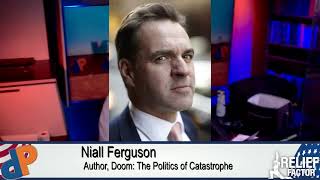
In a lengthy interview with Dennis Prager, historian Niall Ferguson compares COVID‑19 to past respiratory pandemics, arguing that the 1957‑58 flu is a more apt benchmark than the 1918‑19 Spanish flu. He criticises epidemiologist Neil Ferguson’s early pandemic modelling that predicted millions of U.S. deaths and defended lockdowns, calling those forecasts wrong and the resulting policies overkill. Ferguson contends that school closures for an entire year were a criminal act that will exacerbate educational inequality, blaming teachers’ unions for refusing to prioritize reopening while private schools managed distance learning. He likens the political power of American teachers’ unions to the British miners’ unions of the 1970s, suggesting they must be confronted. Ferguson also denounces “wokeism,” describing it as an illiberal ideology that has infected more people than COVID‑19 and threatens American values. He notes that COVID‑19 mortality was heavily age‑skewed—about 80% of deaths were among those over 65—yet lockdowns targeted the young, reinforcing his view of policy missteps. While praising doctors for their effort, he places the bulk of his criticism on public health officials and the influence of unions.
Chapters
Most of the big respiratory pandemics were really 2-year affairs. That was true of 1918-19, '57-'58, and it will be true of COVID which will be remembered as the pandemic of 2020-21. And when you do that comparison, it kind of works out pretty clearly. 1918-19 was far, far worse, covered a similar time frame, like our pandemic pandemic, it came in waves, but the, the total death numbers were far, far higher. I mean, if you look at the global mortality in 1918-19, it was nearly 40 million, which would translate into 160 million in our time, whereas we're currently looking at death toll of over 3 million. And if you look at '57-'58, the death global death toll was somewhere between 2 and 4 million if you scale to our population. So I think it's the much better point of comparison. And the problem was that a great many people last year, including someone with a very similar name to me, an epidemiologist called Neil Ferguson at Imperial College London—
we're well aware, I felt bad for you—
it was good that my parents gave me the Gaelic spelling, N-I-A-L-L, or I'd have got even more hate mail than usual. But the other Neil Ferguson basically talked last March like we we were facing 1918-19. He said 2 million Americans, 2.2 million Americans would die if we didn't lock down. And I think that was wrong. And I said it was wrong at the time. I said, I don't think it's that bad. I don't think the virus is that deadly. And I think this is overkill. And it's interesting that the other day, that same Neil Ferguson, N-E-I-L Ferguson, said in an interview that he was glad that the Chinese had done a drastic lockdown because that kind of gave Western countries permission to do the So we were kind of unwittingly copying what the Chinese Communist Party was doing. I think that was a huge blunder. We should have been copying Taiwan, which got this right. But Taiwan was basically being ignored by the World Health Organization at that time. Taiwan, as far as they were concerned, didn't exist because they were so in hock to their friends in Beijing. So I do think the comparisons are valid. I think when we do the comparisons, we can see that we weren't facing a 1919 pandemic. Scenario. We were looking at something much closer to '57-'58. And as older listeners will recall, in 1957-'58, there were no lockdowns, no school closures, minimal increases in public spending, and the economy barely felt the pandemic.
So I will offer you some of my theories, and I would like you to say what you think about them. As I always tell my guests, I am completely comfortable with the guest disagreeing. I think that the closing of schools for as long as we have has been criminal. Your reaction?
I agree, and incidentally, so does a great liberal journalist Nicholas Kristof, who wrote this in his New York Times column not so long ago. We will, we will see that a generation of kids in public schools have, have been deprived of a year of education with, with lasting consequences. And I think it was a shocking abdication of responsibility by the teachers union not to prioritize schools reopening. Private schools reopened. It was very possible to reopen a school. And they were the ones who didn't really need to because the kids had laptops and iPads and could do distance learning. So we know it was possible to reopen schools. And I think it was indeed criminal and will have terrible consequences, not least for inequality in America, because it's— our education system was doing a pretty poor job for poor kids already. But shutting them out of school for a year, oh, this is going to have very, very negative consequences. So on that, we agree.
Well, I'm glad, even though it's very painful, that subject. When you say we'll have consequences, I fully agree. Unfortunately, we will not have just consequences, as in justice. The teachers unions and the teachers will pay no price.
That's right. And indeed, they will continue to enjoy disproportionate power in American politics, not least in California. I'm beginning to think, Dennis, that the American Teachers Union is kind of where the National Union of Mine Workers were in Britain in the 1970s, an overmighty and malignant force that ultimately will have to be confronted, as Margaret Thatcher confronted the British trade unions. And until that happens, this country is going to have a kind of ball and chain around its leg, because how can we flourish as a nation if if education is increasingly dysfunctional, if it's happening at all. And we haven't even spoken about the plague of wokeism. I mean, we, we didn't have just one plague in 2020 to '21. We had a plague of the mind as well, which is this lunatic ideology that masquerades under, uh, under slogans like anti-racism, an ideology which is in fact deeply illiberal and hostile to American values. That plague has actually infected more people than COVID-19, and may well end up doing even more damage.
Well, I didn't know you'd say that, but it's exactly, uh, what I have been saying. Back to the epidemic or pandemic. Overwhelmingly— I have followed this avidly and very seriously— overwhelmingly, those who died of it were people who were within a year or two of death in any event. I know that sounds callous, but that's— society has to make decisions based on who is being hurt. Children were not being hurt.
That's right. 80% of people who died were people over the age of 65, and the further up you go the age ladder, the higher the mortality. The percentage of people who were— who died of COVID in the the younger age groups was tiny, right?
And yet we, we locked down young people. It's, it's, that's part of this criminality that we're both, we're both referring to. So in that case, it's the teachers unions and their disproportionate malevolent influence. What about the, the medical profession? Did it distinguish itself?
Well, you were beating up on doctors a moment ago, and I, I wouldn't want to do that. My Dad was a doctor, and I know many doctors have been doing their utmost to do a good job in this incredibly difficult time. And it's been an exhausting time for people in hospitals, particularly at the peak back in the spring and then again over Thanksgiving and the holidays. I have much more of a bone to pick with public health officials.
Yes, okay. Their doctors. We'll be back in a moment. Neil Ferguson's important book, Doom: The Politics of Catastrophe, is up at DennisPrager.com.