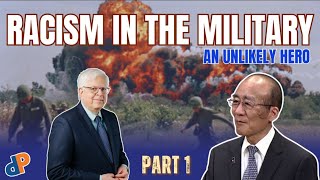
In this YouTube interview, Dennis Prager sits down with retired Major General James Mukoyama, author of the memoir Faith, Family, and Flag: Memoirs of an Unlikely American Samurai Crusader. The conversation begins with a brief promotion of the book and its foreword by Jocko Willink, then moves into General Mukoyama’s personal and military background: two combat tours (Korea DMZ and Vietnam), service as an airborne lifer, transition to the Army Reserve, and command of the 70th Infantry Division (a reserve unit mobilized for Desert Storm). He notes that he was among the first Asian‑American generals and the first to command an Army division, though not a combat unit. The core of the interview addresses the claim that America is xenophobic and racist. General Mukoyama asserts that throughout his career he “forgot the race” of his soldiers, seeing everyone as “olive green,” and recounts his mother’s experience during World II, stating she never felt racism despite being a Nisei. Prager reinforces this view with a personal anecdote about his father’s WWII service and a story of a Polish boxer denying racism. Both hosts frame the United States as the least racist, least xenophobic nation, using the General’s experiences as evidence. The interview concludes with a reminder that the book is available on DennisPrager.com.
Chapters
So I have a veteran, very high-ranking veteran I might add, a Major General James Mukoyama, U.S. Army retired, and he wrote a book. When did it come out, General?
Actually, the official release is this week. Oh, cool.
And there's a great picture of him serving in Vietnam as a young man. And the book is Faith, Family, and Flag. Is it up at DennisPrager.com? Well done. Faith, Family, and Flag. Listen to the subtitle: Memoirs of an Unlikely American Samurai Crusader. I will find out why unlikely is appropriate. Jocko Willink, who does PragerU videos for us, wrote the foreword. He's terrific. It's one of the most popular videos, by the way. Major General James Mukayama. So, General, thank you. You have a beautiful page here largely about me, and I can't tell you how moved I am by that fact. You flew in from Chicago just to be here, is that right?
That's correct. I was given the option of doing this over the internet, And I said, no way. If my wife and I get a chance to be with Dennis and Alan, we're there.
Are you sure about Alan?
Oh, absolutely. I've, you know, I'm a big PragerU guy, so I've seen him on the Book of the Month with Michael. And, you know, he did Tale of Two Cities and he did The Intellectuals. And so, and then of course I've seen you too, because you did the first one.
Boy, you really know. No, we're very moved by that, Alan and I, just, just so you'll know. And thank you for coming. And Mrs. Mukayama, thank you for coming as well. So if I would have spoken to you when you were 15 years old and said, you know, you'll be a major general in the U.S. Army, would you have said that sounds great, or what are you talking about?
No, I would have said probably Not, not a large chance at that point. When I actually— when I joined the Army, uh, there had never been an Asian American admiral or general in the armed forces. I wasn't the first, I was like the third or fourth, but I was the first to command an Army division in the history of the Army.
And where was that?
That was the 70th Infantry Division training out of Livonia, Michigan. My career, I had 5 years of active duty, 2 combat tours, one on the DMZ in Korea, one in Vietnam, and I was a regular Army Airborne guy. I was what they called a lifer. And when I came back from Vietnam, I said, you know, I don't want to do this 24/7. Resigned my regular Army commission and I joined the Army Reserves, 'cause I was committed to serve 20 years, period. And so I actually served 32 years. But my division, the 70th, was an Army Reserve division that was mobilized for Desert Storm. So it's like I died and went to heaven. I mean, I took my division to Fort Benning, Georgia, and we took over the training of the infantry soldiers at Fort Benning.
So I want— I have no idea what the answer will be. So you were the first Asian American to command a combat unit, is that correct?
No, not combat. It was an Army division here in the States.
Okay, right. No, I know.
I didn't— training, right?
Fair enough. I thought they went to combat.
Yeah.
Whether they went with you or not. Okay. It doesn't matter. What I want to ask you is America is accused of being xenophobic and racist. Did you experience that much in the Army? Because you were a first.
No, as a matter of fact, through my Army career, I actually caught myself forgetting the race of our soldiers. It didn't make any difference to me whether they were white, black, yellow.
And it didn't make any difference to them about you.
Right, right. Everybody to me was olive green. And I love that.
I love that. My dad, may he rest in peace, was an officer on a transport ship in World War II in the Pacific for 2 and a half years, I believe. And he was a committed Jew. He would have Sabbath services on Friday night for Jews who were on board. So everybody knew he was a Jew. And the captain of the ship— my father told the story, and it meant so much to me as a child, means a lot to me now— and the captain basically told everyone on board, if he ever hears an anti-Semitic word, that, that guy is doomed. And my father said 2 and a half years, his being a Jew was not an issue. That's what you're saying.
Yes.
Whatever the color of the Navy, that was the only color that mattered. See, that, that's why it is so awful, this charging Americans with systemic racism and xenophobia. It's probably the least racist, least xenophobic country in the modern world.
Absolutely. And I, I reflect on that in my book. Because my mother, bless her soul, grew up during the Depression. Her family had lived in Montana, in Nebraska, in Wisconsin, in Oklahoma, in California until she married my dad and she moved up to Chicago. And she was interviewed by University of San Francisco researcher about the Nisei, the second-generation Japanese Americans, and it was like a 2-hour interview. And this woman kept— the researcher kept on asking my mom, well, when did you experience racism?
Oh God.
And you know what my mother said? She said, I didn't. And this woman was just, you know, she kept on probing. In fact, during World War II, we were in Chicago, and my family, my parents had assimilated into our community. We didn't have a Japantown, so to speak, right? Our neighbors, not realizing that Japanese could not become naturalized citizens of the United States until 1950. '52. Okay, they sent a telegram to our congressman vouching for the loyalty of my father as an American citizen. And that's— so we did not experience that.
The interview of your mother, that's who you're talking about? So I have— you, you'll love this. As loyal a listener as you might be, I'm not— I don't, I don't know if you would remember, I played this once on my show. A Black in Poland, born, born in Poland, and parents African, and he's a championship boxer in Poland. And the interviewer on Polish television kept asking him So you experience a lot of racism here in Poland, don't you? And the guy kept saying no. And she was so annoyed with him. So your mother's story is exactly the same thing. You're not experiencing all this anti-Asian, anti-Japanese racism in America. We'll be back in a moment. The book by the major general is up at DennisPrager.com, Faith, Family and Flag.