How a founder of an IT company can ensure rapid growth - Dmytro Rodenko and Isaac Sacolick
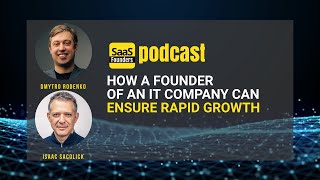
This is a YouTube video titled "How a founder of an IT company can ensure rapid growth - Dmytro Rodenko and Isaac Sacolick" recorded in April 2024. It features a conversational interview between Dmytro Rodenko, founder of SaaS Founders Community, and Isaac Sacolick, a best-selling author and CIO expert in digital transformation. They discuss topics relevant to digital entrepreneurs, including technology adoption, AI impact, productizing services, startup growth strategies, and challenges faced by small and medium businesses in the tech ecosystem. The conversation is rich with practical advice for founders on navigating market uncertainties, leveraging AI, and focusing on customer value and operational efficiency.
Hi everyone, my name is Dima Odenko, I'm the founder of SaaS Founders Community and I'm here to welcome Isaac's a colleague.
Isaac. Hi Isaac. Hi.
Isaac is the best selling author in digital transformation. He is CIO and Chief Digital Tribalizer at Star CIO. He has 10 years of experience in startups and 10 years experience in on the enterprise side. So that's why I'm really innocent to know the view, let's say the vision of the Isaac, what's really going on in the market right now? How should we handle with all this, let's say shocking economy and what future can we expect as a regional entrepreneurs? So let's start from that. What do you think? What are the reasons of the shocks that economy has has right now?
Well, I think we're on a decade plus journey right now of organizations realizing that they need technology, customer experiences, data analytics. Now AI as a strategic advantage. You know, it's running every part of our business from sales all the way down to back offices. I don't know of a single company including government, not putting out customer facing technologies. So it's ingrained in everything that we're doing. But if you look historically the companies that have really thrived in delivering technology are technology companies and large enterprise. Some industries like financial services and now every company, whether it's manufacturing, construction, government, all need to be able to build applications, all need to be able to test large language models and see what that's going to do for their organization. They're all trying to build some efficiencies in what they're doing and that's why technology is interesting. We need to find more efficient ways to enable those capabilities across a wider range of organizations, not just large enterprise. I do a lot of work with medium sized companies, with startups, we're trying to build new capabilities out and I think that's the opportunity now is like how do we enable more companies to use technology in ways that are innovative and operationally resilient for themselves?
Okay, how can we do it? So before I would say maybe three to five years ago it was like skyrocketing, so it was like a decade of high growth. So you just say okay, I'm doing new fancy technology, I utilize it in a certain vertical and people let's say throw you like shut up and take my money. So it was easy to do. Now the situation has changed and we are the digital entrepreneurs so we know how to we understand the technology, we understand the benefits of applying it to certain verticals. What should we, as a digital entrepreneurs do in this situation of, let's say, of a certain lack of financing and in the situation of uncertain demand?
Yeah, it's a great question. I mean, I do a lot of advisory with the buy side, you know, and I tell them, look, your transformation goals are going to evolve significantly every two years. Like you said, you know, 2018, we were focused on growth. In 20, we were focused on a pandemic response. In 2022, we were focused on efficiencies. And now 24, we're trying to figure out how do we actually deliver value from generative AI. And the best answer for SaaS founders is going back to basics.
Right?
You understand technology, you understand the art of the possible. The way you scale any business is understanding customer needs, understanding where they can provide value, and doing it really, really fast and doing it really, really efficient. I think what's changed a little bit, particularly over the last couple of years, is how you're meeting buyers, how you're interfacing with them, the number of people that are involved in a buying decision, particularly as you get trying to sell to larger organizations. It's not just, I'm selling to a CMO or I'm selling to a cio, you're selling to their staff and a collection of people who are interested in innovation or interested in data science or have a particular set of customer use cases or are concerned about security and compliance factors. So you have a broad set of people that you have to sell to. And, you know, the most important thing is really understanding who your buyer is, what your value proposition is. And then how do you checkbox your response to all these other folks who are involved in the buying process?
Okay, okay. So you suggest us to concentrate on value, do it fast, and understand, let's say, the right approach to the people, to the people who are decision makers. Okay, that's good. That, that sounds fair. Okay, that's good. Also, you mentioned AI. What do you think? So there are different concepts on the AI. Some people say, okay, it's the next Skynet. It will, let's say it will run. It will ruin the world that we are living right now. It's one opposite side. So that's why we should fight back with the AI. So it's dangerous. Right? Another polarity. I would say people say, no, AI will provide us with the basic income so we don't have to work. AI will. Robots will work for us. And we have to just work on like, like leisure, on different, let's say, fun experience, let's say we'll enhance our creativity and other stuff. What's your position on that? Where are you between this polarity, let's say. What do you think about that? What's the future of AI generally?
I'm a practical and pragmatist when it comes to AI and any technology. I actually studied neural network spec in the 90s in grad school. So I have a pretty deep background in how they work inside and how they operate. And you know, you're seeing a lot of experimentation right now and a lot of exploration. There's a lot of productivity it's driving, it's enabling us to code a little bit more efficiently, it's enabling marketers to develop content a lot more efficiently. But you know, I don't think it's going to take over the world. I think what we're seeing here is a continual evolution. What we understand today and types of problems that we're putting people against. We consider how technology continues to enable us to do more innovation around it and do it more efficiently. Generative AI in particular is the next level of growth in that capability. Maybe I'm not writing SQL anymore. Maybe I'm writing a natural language query to be able to do that. Maybe I'm not summarizing things like I used to. I'm using an AI to be able to do that. But you know what, if you take for example, flying an airplane, right? Most of flying an airplane is automated, right? But how many of us really want to get into cockpits that are fully automated without a human in there to handle difficult situation, to handle unknowns? We've seen in the last six months, just a good number of those. Some of them people created and some of them outside factors are created. And that's the nature of how we run things, right? There are places where we can use technology to enhance what we're doing. And there's places where we want human decisions, human ingenuity, human thinking in the loop. And I think we're going to continually see that. I think there's another couple of factors that we'll see sort of limit our growth in AI that particular entrepreneurs have to consider. One of them is power and energy. I mean, the cost of compute to run these AI models is significant. We're seeing, you know, the biggest technology companies being able to make those investments. You know, smaller companies, you talk about SaaS, we got to be able to leverage those and be careful about what we're building ourselves and what we're leveraging from other people and the byproduct of those energy factors is the underlying costs to run and leverage models are going to go up.
Right.
And you know, to be an end user of a copilot isn't going to be cheaper, free forever. And so those are things that we have to consider and that really goes back to are we applying them into real important use cases that our customers are going to value and, and ultimately invest in when they're working with us?
Okay, very good things. But how to deal with the digital inequality? Because we are the small and medium businesses. Yeah, we are the entrepreneurs. We don't have resources, we are very numerous. One where there are millions of us all over the world, right? But there are, I would say a dozen even less vendors that concentrate all AI powers and all AI decisions and all, let's say, access to the AI in their hands. And we become even more dependent. Because for example, if you utilize email, of course you can use Gmail, you can use Microsoft, you can use different tools for that, but now you more and more limited because you don't have, let's say several hundreds of providers that can provide you a certain level of the technology. With AI, I expect it to be even more strict. For example, if you want to get the results, you'll have maybe not a dozen, but maybe just a couple of providers. How can we deal with this risk? Because if we rely with our business model too much on certain vendors, breaking up with these vendors will break our business down. What do you think about that? How can we mitigate these risks, for example, if it is possible?
Actually, yeah, it's difficult. I mean, you know, if I look back to my days when I was doing startups, right. We basically had relational databases and you were choosing between four, right. Much simpler back then. Oracle, Microsoft Postgres or MySQL those were basically the choices that you had. And then you had a few other things to go after. And then we. Once you pick your flavor, then you are left with a fundamental problem. Am I going to build an abstraction layer between me and my service provider so that I could defend if I need to move off and use another platform? And am I going to use proprietary capabilities? Am I going to stay SQL 92 dialect, or am I going to use Oracle Text or some other text engine built into that? I think some of those kind of technology questions still exist for the entrepreneur today about how you're abstracting because that costs money when you build those things and it's a little easier today. But then also when does the capability of your vendor give you a Strategic advantage, where you're going to take that upfront cost, you're going to take that upfront risk, leverage it, and realize that at some point you might have to back out of that and go move off of somewhere else. So I think that's one thing that I think about. You know, I think, you know, for, you know, the companies of the sizes that you're talking about, I really do think the more important thing to consider is growth and how fast you're growing. You know, any kind of technology choices that you're doing today, number one, have to enable you to get to speed of market. I can do things faster, easier, not necessarily cheaper, okay, but faster and easier, Number two, I would say is more supportable.
Right.
I'm going to build something today. And then, you know, when you hit that sort of growth mark, which I have been through, that growth from 40 to 400 people, that growth from a million to 10 million to 100 million, whatever currency you're in, your operating model changes significantly. And what you find is you don't have the time to go fix the things from the previous generation. That's why even SaaS companies end up with tech debt. And that's why SaaS. SaaS companies end up with operational issues, is because we know they're there. We're cutting corners in our, you know, stage one, and then we hit stage two, and now we have a whole new another set of issues. But we got to go back and say, you know, like, nine out of ten SaaS companies just don't make it. So I focus on how do we make things easy for our end customers? How do we make it easier to onboard a customer into our environment? How do we make it easy for them to understand what our value proposition is, what we're actually solving for? How do we solve some of the friction points? You know, if I look at any, you know, I look at a lot of SaaS solutions and I look at them, and if I don't understand what they do from their homepage, we got a problem. If I can't download or sign up for a trail and figure out how to use the thing in a couple of hours, I know we have a problem. And, you know, these are not easy things to solve for. I mean, there's a reason why a good number of SaaS companies struggle with this. They're not easy. You know, what terminology you're using, what are you giving away for free? How do you set up the user experience so that's easy, but that those are the things I think SaaS companies need to think about if they're going to enable that growth stage later on.
Absolutely, that's absolutely true. It's like having forgetting about your old skin so you're getting older and you just forget all, let's say all your technology. You forget your technical technological depth. There is stuff, you just build it from scratch because of the new layer, because of the new capacities, etc. Very nice. Okay. In our country we have a very specific situation. I'm not talking about the war, everybody knows about that. So we don't, we don't speak about that. We have a lot of really talented, technological, technologically gifted people are well educated, well aware of the modern technologies, et cetera. And there is a certain lack of entrepreneurial background, I would say. Right. So that's why they tend to sell their hours as providers of offshore software development services because they understand this model much easier then convert their knowledge to convert the experience to the products, to the SaaS products, for example, whatever. What would you advise them? What, let's say first steps. Would you advise them? Would you sell them? How would you sell them? Situation. Guys, please transfer your hours to your products. What's your opinion on that?
Well, look, you can go through a bottom up, you know, from services to capabilities to productizing and you, you may get lucky that way. You know, you may find a product, a technology capability that ends up finding a market. In many situations those approaches don't pan out very well. The, you know, the approach needs to be, you got to learn an industry, learn a market, learn a use case. You know, I saw this a lot with my Indian service providers, right? They took, you know, technologies they were doing for nine to 29 customers and creating, you know, an abstraction, productizing it. They all of a sudden had a proprietary content management system or a proprietary CRM and they would come to me as a buyer, I was a CIO at the time and I'd look at this and say, okay, you know, how to create a workflow around a database. But that's not exactly the problem I'm trying to solve for right? Here are my problems in customer relationship management, here are my problems in managing content. And there was a mismatch, right? They didn't actually do their homework and figure out what their potential buyers were looking for, what my choices were at the time in terms of things I could either build or buy to be able to enable this. And so look, I think build hourly is a good way to understand and learn how to deliver services. I think when you start Productizing it, you're building components or capabilities of components. But at some point you need to take kind of a pullback and take a step backward and say, we're going to adopt product management disciplines, we're going to understand what customers are doing, we're going to go research what their buying options are, we're going to project what their needs are going to look like two, three, four years down the road because, you know, not everybody's going to be able to build a generative AI capability. So what does that impact? How does that impact this market? If you're in manufacturing, you know, how does sustainability and IoT impact those markets?
Right.
What does that look like? Like if you're in financial services, you know, regulations are changing every single year, right. How does that impact those markets? You got to take that sort of top down, market driven approach and saying, this is where I think customers are going to have need in the future. So let's start building those capabilities and testing them quickly.
Right?
Let's go find some customers to go test with. I think that's really the bigger problem is, you know, when you're that small, finding a customer to be able to say, yeah, I'm going to take a bet and partner with you and see how that evaluates and how that works. I think that's actually the bigger challenge when you start going down the path of productizing.
So as far as I understand, not everybody can move to that stage. So a part of people will, will be happy with delivering services hours for a lifetime and they will be in that model. But only a part of people will move to the next step, like understanding and let's say productizing or let's say making products of their services. Right.
I, I think that's like, yeah, I mean, history shows that to be true. You know, history also shows that, you know, a market driven approach, you know, in the United States, venture backed, right. You know, it's still 1 in 10, you know, end up surviving that first round. And that doesn't necessarily mean they're gonna be sustainable businesses going five to 10 years down the road. So I mean, this is the world of entrepreneurial ship. I mean you, you, you make an investment, it takes a year or two years to be able to get to a point where you have a viable product. Okay. And you know, you're always wondering to yourself, is this viable product something. I've fallen in love, love in, I have passion for, is it really going to be a sustainable way to make a living? And if it's not you know, do I pivot? Do I start over from scratch? That's the world you live in. I did it for 10 years, you know, and I, you know, Mike, you know, at the time, I said, look, if I'm going to do this again, I better move to California. I better join the Silicon Valley rush and get out of New York if I'm going to make this a business. And I pivoted. I became a cio, and now I do education programs and I write books and I do things like that. So, you know, you got to have passion in what you're doing. You have to look at it as a learning experience. But, like, I think the most universal thing is really understand who you're targeting as a customer, as a market, as a business. And, you know, if you start doing that well, some good things come out of that.
Yeah, okay.
Okay.
Yeah, I get it. Some. Some founders, they feel some fatigue during that process, so they're getting tired. They start losing their, let's say, energy. What would you suggest them to do in that case?
Look, I see that in every group I work with, I tell companies, you're always going to be transforming, right? That's the new normal, right? We're going to get a release out. And if you're a startup, maybe that releases in a week. And then if you're an enterprise, maybe it's over two months. And customer expectations don't stop with that release. You have to jump into capturing feedback and understanding what's working, what's not working, quickly address issues that you didn't anticipate, and then onto that next release. That's the world we live in, right? And those time durations, those cadences are shrinking and the customer expectations are increasing. So there's a couple things that you can do here.
All right?
First is you do have to find real points as a group and real points as individuals to come up for air and take a breath.
Right?
When are you going to celebrate with your team? If you don't celebrate with your team now, trust me, the next day business is going to come after you for something else that they want from you. So if you found some quick win, make sure you go celebrate with your team, okay? Find a period of time where people do can come up for the air, learn something new, try some experimentation. Every company has a lighter period of time where you can say, look, we're going to use this time to do certain things that we can't normally do. So advertise that, Say, look, we're using this time to go do something different. I think that's really important. I think it's, you know, what the last four or five years have taught us is don't just look at this at a company or a team level, look at this at an individual level.
Right.
Isaac is going through a difficult period for whatever reason. You know, we're working as an agile team who can help him with some of his responsibilities so that he could spend more time with family, whatever it is. So I think we have to be really cognizant of individual needs around this. I think as companies grow, you know, you mentioned my books. I wrote Digital Trailblazer for companies that recognize they need more people to step up and learn how to run transformation programs, learn how to run change management, learn how to understand voice of customer, develop a technology roadmap, partner with companies around their technology execution plans. What I didn't anticipate is, you know, there's a lot of startups going through this, right? You go from like that team, again, a 4 to 40 to 400, guess what, you need to be able to do that. You need practices, you need leadership, you need ways of scaling what you're doing. You need to continue to innovate and scale, but you're also now bringing in, you know, when do we address technical debt? When is an operational issue of fire and when is it a defect that we can fix in the next release? When do we spend some more time automating something that's taking too much time? How do we improve our data model so that we can get better data of what we're doing? I need trailblazers to come in and say, look, I'm going to make some better decisions over people's time because we're always transforming.
Yeah, absolutely. I've got an idea. If we speak about tribalization, does it mean that, please correct me if I'm wrong and maybe, maybe add something about that, that the world we are living is changing from the strict vertical structures like companies, governments, countries, let's say unions of countries, to more horizontal, I would say tribes. And that's the trend we are trying to use to transform the world. Is that correct or you have another meaning of that?
I mean, I think you could make a pretty good argument that that's the, the way the path we should be going on. There's incredible political factors and wealth factors that become detractors against those kinds of things happening. And those are things that are out of our control to really make change and drive impact with. So my quick answer to that is probably not in our lifetime. You know, why, why do you think?
So we see the Internet. Internet, it was like a vertical structure, but now it's absolutely horizontal. And more and more communities, which are tribes actually, they arise and the weight of the communities become more powerful. They are, let's say, they are transforming clients, they are transforming processes, they are transforming technologies. So I'm more optimistic regarding that. So I really see that the verticals are really strong, but the horizontals, they appear. They appear maybe 20 years or 40 years ago, and they are getting more and more and stronger. What do you think of that?
Look, it's what, 20, 24. So 30 years of the Internet's ability to democratize information, and we're nowhere near there yet. That.
Right.
It's. It's. It's possible. You know, it certainly has elevated the possibility of many countries participating, many people participating in this digital economy, whatever words you want to use. But, you know, if you take any industry.
Right.
Is there an identity standard out there?
There.
Right.
Most fundamental piece of information. Who is Isaac Soic?
Right.
Is there a fundamental piece of information out there that's universal, that says I am who I am, and yet we don't have it. We have fractions of it and we have pieces of it, and, you know, some countries ahead of others around it. But there's tremendous forces, again, between wealth and government, people who own power to slow some of those things down, because it may not be in their best interest to see that kind of value happening. In the US we have companies that try to sell identity as a service.
Right.
If you create an identity standard that's utopian across governments, not going to work for them after that.
So what do you mean on selling identities? So it means that you mean digital twin or you mean the real identity?
Real identity.
Right.
You know, so. And, you know, I Pay, you know, $100 so I can get through the airport line faster.
Right.
Okay.
That provides that service, and lots of people use it to save time and energy and make the experience go a little bit faster.
Right.
We know the technology exists between retinal scanning, between fingerprinting and. And other, you know, government could have an answer in this country with all the money that we have to simplify this for people. And yet we don't do it.
Uhhuh. And what should change? Well, it's a very good thing because it's pivotal for civilization, I would think. What should change in the world for, let's say, for this pivot?
You know, I think, you know, I think we. We challenge it by Doing small things. Okay. It's a lot of small things. I think when a software company, for example, decides to take part of what they're doing and open sources it or, or contributes to the open source community.
Right.
I think those are very positive things. Okay. I think when you, you know, there's a story this week about finding a defect in the SSH parameters that a software developer found. And you know, there's an entire economic model around that and you know, he chose not to go do that.
Right.
He shared it, he got the issue addressed, he went back to his day job to program postgres. I mean, I think that things like that bring us closer to the world that you're describing where we're, we're learning, we're, we're supporting an economic model, we're also sharing information. It's how I actually started writing my first blog posts back in 2005 were about, you know, I'm learning how to do something that's not terribly proprietary. My first blog post was how to write an application log and so that you can actually find defects in your code. And I said it's not particularly proprietary. I'm just going to put a blog post out there and say, here's how I do that. This is what I put into my log files. My blog considered continued that the blog is blogs.starcio.com it's been around since 2005. I have 500 posts on it from this notion of, you know, if I'm not, if it's not part of my commercial programming and even sometimes when it is, I'm going to offer it to the world and let people get smarter and use my information to apply it in different ways. And you know, at some point we do have to think about how to create a commercial endeavor over our efforts. But look, I think that, I think the bigger challenge right now, you know, going back to something you had said earlier, right. Who are we building our products and services for? You know, and I think there's a group of, of, of companies that offer products and services to make the, the best companies more efficient and smarter, the best talent more productive in what they're doing. And I look back and say there's an entire world of smaller and medium sized businesses that are underserved. There's a small, a whole number of developers coming out of universities today that don't have all the expertise in software development, don't have all the expertise in journalism or in marketing. And how does AI help them climb that ladder more efficiently, become more Productive to become more smarter than they ever were and contribute to society a little bit faster. I think those are the more interesting problems for us to solve for today. And that's a wide opening playing field. I don't think anybody has all the answers around that. If you talk to folks saying, you know, we're using Copilot, and I ask a lot of people around that. People using Copilot today are the experts that know how to ask a co pilot a question, get an answer and evaluate the response, and then figure out how to plug it into the code base. That's our, that those are our experts.
Right.
If I ask my son in graduate school how he's using co pilot, doesn't know how to use it yet because he doesn't know how to ask the questions yet.
Okay, so I see your recommendations to be open, prepare with the things with the community.
Right.
And to maybe to learn how to ask the right questions and to relate the answers.
I think that's a number one skill set actually, if you look at my writing around this, is that, you know, we prize people about knowing how to find the answers.
Right.
I have expertise in A, B, C and D. I'm a DevOps cloud, whatever it is, expert. And when you come to me with a problem, I could say, do it on this cloud with these services, with this integration and we process, price people with having that expert.
Right.
Expertise. And now I'm saying maybe we asked the wrong question. Okay, okay.
Right.
You know, I can ask eventually AI to give me options. You know, I asked an AI yesterday. This is interesting. I asked an AI, I said, here's a hundred of my last blog posts. If you were rewriting. Not the post, just the titles. And I said, if you're going to rebuild the information architecture of my blog, what would be the seven categories I should focus on? And if I did that by hand, it would probably take me a few days and I'd probably run it by five or 10 people and I'd come back with an answer. And AI gave it to me in 30 sec. Three seconds.
Right.
And it gave me a very plausible, not only just grouping, but actually language around the grouping. I might just go public with it because it was that good.
Right.
So knowing what the right question to ask is far more important today than ever before. And knowing how to evaluate the answer is far more important. Knowing what the answer is actually is becoming less important.
Okay, that's good. That's absolutely necessary. Fundamental things. Let's get back maybe to more practical sides. So the majority of the founders I'm facing now, they are raising, let's say, from half a million to million to two millions. What are your suggestion right now? What should they focus on, let's say right now? Let's say, what are, let's say the top five or seven steps they should focus on to keep their growth and to go faster to the next level?
Well, I'm very customer driven at this stage of the company. I mean, I think that, you know, I think the debate inside the company needs to be, you know, how do we put something out there that we can experiment with, right. That will give us indicators that we're heading down the right track. You know, what can we put in front of people? And you know, if you only raised a hundred thousand dollars, you know, that might be a prototype, it might be a PowerPoint, it might be a discussion. And if I'm raising a million to $2 million, it needs to be something functional that really shows the value proposition that maybe gets people excited, that maybe gets a partnership going with a group to say, hey, willing to hold hands with you around what you're trying to engineer over there. So, you know, I'm looking for quick ways to validate what we're doing. And look, in some industries, that's a lot harder than others, right? If you say, look, I'm focusing on financial services and I'm doing large language models and, you know, I got to work with, you know, terabytes of unstructured data. There's obviously some infrastructure that you have to have in place to be able to do this. You know, if I'm doing something in health care and, and I want to do, you know, I want to do this in the United States and I have to have, you know, you know, some regulatory approvals before I can do any experiment. I have a two or three year process before I even get to the point where I can truly experiment. So, you know, there's some relative boundaries here that we have to think, think about. But, you know, the, the sooner in that industry that I can go out and experiment and put something in front of people and see if it's working is what I'm focusing on at that million to a million dollar range.
Yeah, absolutely, absolutely. I've got an opinion from one investor. He told me, you know, Dima, that product market fit is not actually what you show. To me, product market feed is like to have 200 leads in your funnel and 20 signed contracts with a certain revenue. This is what the product market fit is. And I was shocked because oh man, I've got a bunch of Lois and people told me, yes, I'm ready to go, but I'm still on the prototype stage. Can I get this contract on?
Yeah, no, but there's a, there's an important stage before that, particularly for technology companies. And I see this early on, you know, we think about the word platform and you know, set of capabilities. You really haven't figured out product market fit yet. You've figured out a suite of capabilities that may have different products with different markets, with different buyers, different end users. And you could see it very often in the webpage of that company trying to market this, trying to like figure out knowing. Look, I got one shot to show the cases technology. So am I going to showcase its security capabilities, its analytic and data capabilities? It's like workflow or end user experience capabilities. And if you try to do all three of those on one page, you got a mess. And when I look at this and say, I have no idea what you're trying to do here and what you're really trying to do in the end is experiment and figure out, okay, I've built a platform here, where's the market around. Around it. And you know, is the security market going to scale faster than the experience of the data market? Is it going to be easier to sell to? It's not that they don't exist. It's just I need to be able to get to that 200 to 20. I got to figure out what's the easier path. And that goes back to experimenting, right? Being able to get in front of, you know, 10 people, three in each market, and say, you know, what are the barriers to sell to that person or to that group, what our offering is, what are their alternatives look like? You got to learn that very quickly. And that's the hard part today, right? If you look at the data space, for example, if you're building a database technology 30 years ago, you're competing against four in the SQL space. And then this concept of NoSQL now, you know, I get lost at looking at all the data platforms that are out there.
Okay, so as we speak about an ability to create. Good question. To create additionate. Good questions. Can you remember maybe some good questions that you've got from your clients? The last time that talked to you that impressed you, I gave you a new idea on the, let's say, on the world, what's going on and that might be useful for our, let's say, subscribers.
Wow, that's a great question. You know, the questions they're asking me is, you know, usually they're from their world, from their perspective, looking at six or 12 months out, and they're projecting, you know, trying to bring together what I said was the value that we're delivering, what the product actually is. And then they're trying to anticipate what the impact is going to be their, to their organization. So they're usually asking me, hey, Isaac, if, you know, if you bring in, you know, your coaching and your learning, learning programs around digital transformation, what's different about our world a year or two from now when we're starting to use your product and services? And so now I'm forced to live in their world. I'm forced to learn at how they're servicing this today. And I say to them, look, you probably have a lot of consultants working with you right now doing the job that your team should be doing. You're probably spending a lot of money on skills development to learn specific technologies, but you probably don't have. And you might be doing a lot of learning programs with your HR to help elevate the skill set of your leaders. And what I'm doing is bringing those three together. So when you bring those three together, right. Learning coaching capabilities program, you're probably going to have less consultants, okay. You're probably going to have more tailored learning programs, and you're probably going to have leaders who can run programs internally better than they are today. That's my value proposition. But now articulating it into what's going to be the impact in that organization, what's going to change there, okay? And that's what you have to be able to participate. And I'll give you a secret. You may get it wrong, right? Because you don't have a complete knowledge of what's running in the organization. You're going to learn through this. And they're going to say, well, we don't have consultants. You know, our CI CEO fired all those a long time ago.
Okay?
Right. So you're never going to learn that unless you throw that dart against the board and say, you know, I'm going to anticipate this from previous learning and maybe I should ask that question, say, hey, do you have a lot of consultants around working with you before I go and make that assumption? Right. So you have more time. You get to learn your audience. You can ask a question before giving them an answer. I. I think those are the things that entrepreneurs have to get good at.
Yeah.
Okay.
Yeah, yeah, yeah. That's valuable. Okay. So I see that many people Rely too much on technology, but they should also rely not on technology, but on the combination of technology, processes and people. And just as you told, as you told, just, just right now, it's not only about the technology, it's about the organizational structure almost.
It's almost never about the technology.
Never.
I mean, unless you are selling a technology for a technology buyer.
Right.
You know, you know, if you're selling another way to manage kubernetes containers or, or a, a way to do security around, you know, packet sniffing and things like that. If you're doing things like that, then it's clearly about the technology. I'm doing something more efficiently, smarter, faster, easier to use for a technology audience. They're going to benchmark me against some other technical capability. Yeah, that, that's a small a niche of.
Yeah, sure.
Places you can sell technology to than the wider audience of everybody who needs technology. Everybody. So I'm focused here.
Okay, that's nice. So we should ask the right questions to ourselves. We should ask right questions to our clients. Yeah. And help them to grow and to understand how these things evolve.
Yeah. Okay.
I think for, for me, it's absolutely awesome. I, I like the way you answer it. It Give me, you give me some insights on the things I should really focus on. Think more because I, I think that the good conversation, the result of the good conversation are certain seeds of your future insights that are already in. In mind. And I'm really, I really thank you for, for the conversation. So I think we should share the link for driving digital and Digital Tribalizer in the description of the video for our readers, for our subscribers to know more about your approaches, about the things that you are talking about. And I think they are really valuable because people we work with, they are tech professionals. They are too much even in tech. They are less in people, they are less in processes.
I know I have a technology background.
Absolutely. That's why we need to compensate. Say it, let's say to leverage it. I would say and to, to make it more efficient, to make it live and to make it more productive for, for the community, for the people, for the society, for the business as well.
Yeah. I, I would just tell your audience my second book, Digital Trailblazer will give you a, a pretty sizable flavor for that. It's, it's all stories and there's lessons learned at the end of every chapter, but it's all stories. So you're going to get, you know, what's happening in US Companies as we're trying to adopt technologies and all the friction in US Companies as we're trying to adopt technologies and all the friction pain points that are in there. And then I run a coffee hour on LinkedIn every Friday. It's at 11am Eastern time, so I'm just about to get off.
Okay, sure.
We handle lots of different topics. Today. We're talking about interviewing and being able to interview digital trailblazers. So, you know, that's a big change.
Right.
How do you interview people in the face of, you know, all this technology that's out there, different ways of operating. Next week we're going to talk about how do you speak to a board member.
Right, okay.
And I have a pretty important guest on for that one. So we challenge. We talk about some very difficult subjects that we're all trying to learn from. And I've got CIOs, I've got CEOs coming on there. It's a free on LinkedIn. It's called the Coffee with Digital Trailblazers. You can just look that up on LinkedIn or find me on LinkedIn. And it's free. And you should join and come and listen.
Absolutely. I think it's vital for us because due to technology, we are lucky to share the experience and got the knowledge from you and from people like you. So that's why I really thank you for your time and I hope that our subscribers will. Will join. Will join, let's say the conversation. We'll take a lot of benefits out of that. We'll read the books and we'll be happy with that stuff.
Isaac, there's a shaking in my house that I can only describe as an earthquake. I need to drop and figure out what this is.
Okay. Good luck. Thank you. Yeah. Have a good day. See you.
Thank you.
Yeah.
More from Dmytro










Лайфхак "Какие ошибки в лидгене убивают ваши шансы на сделку по IT разработке"