4 Steps to Changing Negative Patterns with Adele Spraggon
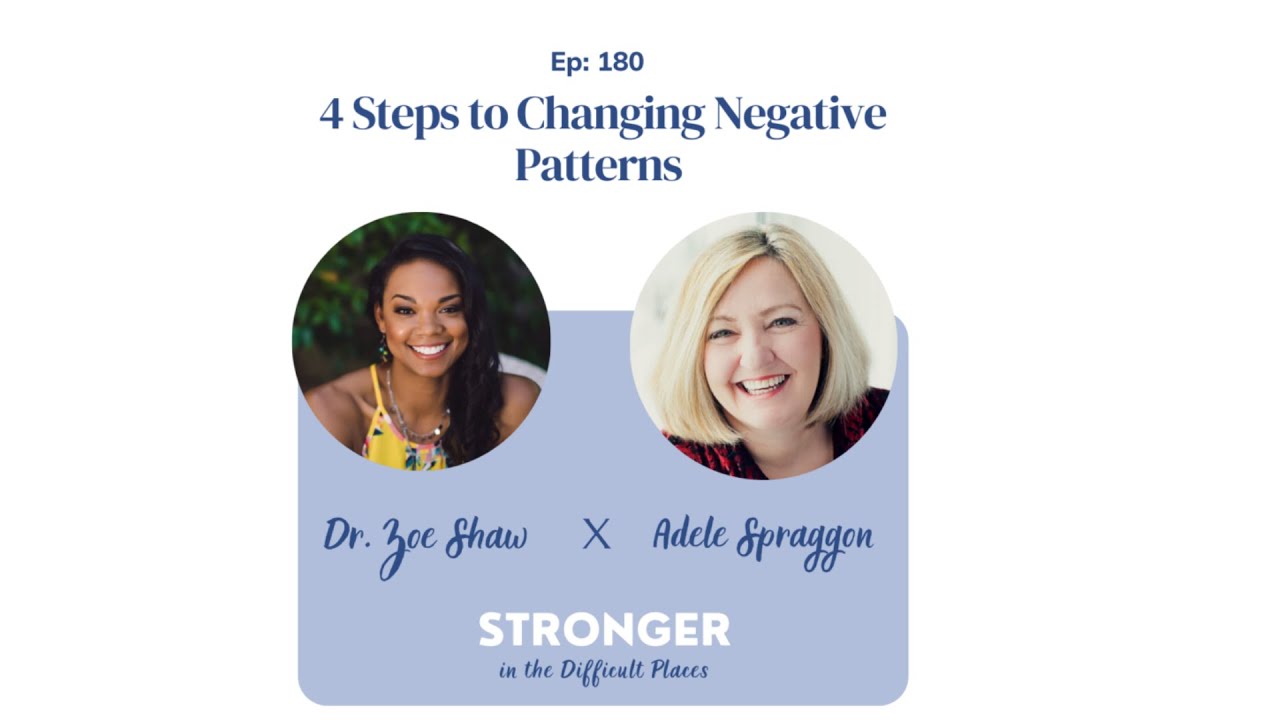
Adele Spraggon explains her four-step method from Shift for breaking negative patterns by working with the brain's subconscious rather than fighting it through willpower. The process: identify the pattern, own it as internal, deconstruct its parts, and let your brain form a new one. Recent neuroscience shows decisions happen subconsciously before you're aware of them.
Chapters
This is not a podcast about being broken, although you may have been. This is a podcast about strength for women who find themselves in difficult relationships, including that sometimes difficult one with yourself. We'll look at your relationship through a lens of psychology, faith, and a little dash of my own kind of feminism. We're not fixing them. We're fixing you. And that changes everything. Welcome to Stronger in the Difficult Places. Save yourself, heal your relationships. Listen in. Hey there, welcome to Stronger in the Difficult Places. I'm your host, Dr. Zoe, and after a couple of weeks of dealing with COVID I am back. I feel like a full human again. Thank God. I hope that you guys are doing well out there and staying healthy. So today's episode, I have a guest, Adele Spraggon. I will not take a lot of time prior to the interview. I wanted to have her on today because many of you who I work with, many of you who just listen and follow me on the podcast and maybe like what I put out on Instagram, are sometimes struggling in your relationship with yourself and others and are always looking for ways to improve and level up and how you're living your life. And so I read about Adele's Shift program, which is a unique kind of way of looking at how to make lasting change in your life. So I wanted to have her on. So listen in. It's an interesting conversation. I hope you can get some good tidbits from it. So here we go. Adele Spraggon is an award-winning author, a thought leader, an international trainer, and a fearless speaker. In 2020, she was awarded the Women of Inspiration Customer Experience Award, and in 2021, she was recognized as the Top Behavior Expert of the Year. That's impressive. In May of that year, she was also featured on the COVID of TIP Magazine, Top Industries Professional Magazine. Her book Shift, which we're going to talk about today. The 4 Steps to Personal Empowerment has won 3 awards for its powerful message of inspiration and hope, and it's sweeping the globe, transforming how people are setting and achieving their goals. And we are going to talk about Shift today. Um, and excited to do that. Adele, welcome to the podcast today. I'm so glad to have you here.
Thank you, Zoe. Happy to be here.
Thank you. So first, I always ask my guests to please share a win and a fail with my audience.
Sure. Well, as a, as a thought leader entrepreneur, I think my biggest fail recently was at the start of COVID So I did primarily before COVID I did most of my events live and I got most of my clients live.
As we all did, right?
But I put all my eggs in that basket. Do you know what I mean? Like, don't do that. Don't put all your eggs in one basket. So I was going along quite well, doing very, very well. And then COVID hit. And I remember the day that pandemic was announced because I had just done a live event. And I had 42 calls lined up, sales calls lined up from that one live event.
Wow.
And the pandemic hit, and I got 42 nos. And I went, the world has changed. There's something different going on out there. Anyway, it forced me to rethink my entire business model. So I did eventually turn it into a win, but it was a very difficult year for me and it was a big fail that I went, okay, I'm never doing that again. Not all eggs in one basket, guys. Don't do it if you own your own business. Diversify. So I, I started my membership site out of it though, and today that is back to going really strong and really exciting. So, phew, I turned a fail into a win.
You did, you did. And that's really— I mean, that is always the goal, is to figure out how to turn our fails into Thank you for sharing that. That has been an experience for many, many entrepreneurs, as you know. And I love that you learned something out of it instead of curling up in a fetal position and giving up. Right. Yes. 3 of my in-person events were canceled immediately after COVID started, and it has taken me all the way until now. I'm finally having my first in-person Um, onstage event in March, and it's been since then. So it's really been 2 years, right? And luckily, all of my, you know, the way that I make my money isn't predominantly through speaking, which is good. I am diversified, but certainly a lesson that, that is learned. And you think, I never would have thought that in-person speaking would just disappear.
I know.
How could you have thought, imagined a world where that would happen? And yet here it is. And now it's coming back. But once again, don't put all your eggs in that basket.
Yeah, exactly. And I think that many speakers— I mean, personally, I'm not willing to go back. I'm happy now. I've changed the business model. So I'm wondering if the events will ever come back to that level again, that level of speak from the stage selling model. I don't know. It may be over. We'll see. Maybe. I'm excited,
though, because I am I'm excited to go back in person, and I'm finally getting back on stage in March, and I'm excited about that. But yeah, the world has definitely shifted the way that I work for my practice. That has completely changed. I used to see predominantly people in person in my office, and now I predominantly see people on my computer, which is a shift. And I love it. I love it because there are benefits to the changes. We just have to be willing to be flexible and figure, figure it out. So thank you for sharing. Thank you for sharing your win and your fail.
Yeah. And, you know, we're heading into a world, and this kind of ties into my book, we're heading into a world where everything is getting faster and faster, and changes are getting more and more as we go. And we need to be more comfortable in not knowing what's coming down the pipe and being able to respond optimally to whatever comes at us. Because this won't be the first change, this pandemic, there's lots more coming.
It won't be. So can you tell us how you came up with this shift? Tell us about your— just how you got to this point where you were getting ready to write this book and share this with the world.
Yeah, um, well, I, I— gosh, for 30 years I've been in the field of behavioral change, so it's not new for me. Um, I was a coach for many, many years. The problem was, is, you know, one day I personally, I kept quitting business after business after business. I always was an entrepreneur at heart, but something in me, Zoe, would not follow through and complete the business to the end until it became profitable. And every time I started a business, I would just turn tail and run, right?
Mm-hmm.
And I was also at the same time coaching in one of the leading personal development programs. And so I thought to myself, after I'd done everything I could think to do, right? Every personal development approach, every coaching approach, meditation, everything I could think to do. I thought to myself, is it just me? So I started to ask the people I was coaching, hey, between you and me, how successful are you really? Right? Like, how many goals are you actually achieving? And some people, yes, about 25% were saying, oh yeah, it's great. I'm doing exactly what I set out to do. Yeah. Other people were like, no. And some people were like me, like not at all, right? So I thought, wow, 75% of us are setting goals and not achieving them. What's going on? So I decided, Zoe, that we had the wrong operating instructions. I thought to myself, okay, human beings, we must be using the wrong operating instructions to get that dismal result. So I wanted to understand how does our brain really think? How does it make decisions? So I enrolled myself in university. I got my master's in humanities because I wanted to study the human equation. And sure enough, I realized we are using the wrong operating instructions. So I created new ones and I put them in this book called Shift.
Uh-huh.
And that's what I teach. And the people who follow this technique, which is around repatterning the brain, and I'll get to what that is in a moment, they enjoy an 87% success rate. So
when you say success rate, what do you mean in terms of—
I mean that they set a goal and then they are able— 87% of them say, yes, I achieved or I surpassed that goal.
Impressive.
And I'm like, more than impressive, because when you think about it, uh, you know, some goals like dieting, that's a 4% success rate, right?
So, and we are in January right now when everyone's setting all of these goals, and we also know Through research, is it 3rd week? 3rd week in January?
Yes, it is. Yes. Or, yes. Or even the 4th. I know.
Meaning that people tend to start to fall off already.
That's right.
Yeah.
That's right. Exactly. So, you know, so there's something off with the way that we are told we should be able to control our actions. And that's the thing that I discovered. So one of the latest findings in neuroscience, which will shock everybody if you really allow this thought to just sink in, Okay. One of the latest findings in neuroscience is that every decision that we are about to make is already made in the subconscious regions of our brain seconds before we know we are going to make it.
Why does that not shock me at all? Of course, I'm in this industry. I know, but I can even feel that in myself sometimes when I'm getting ready to make a big decision. And it's not so much that I need to make the decision, it's that I need to figure out how to do it because I've already chosen it.
That's right.
I have felt felt that drive, and I've often questioned that with myself as well. You're right, our— so much of, of how we view the world, so much of the decisions we make start— are completely unconscious. And then, and, and that's also why sometimes we do things and don't understand why we've done them.
Why did— why do we keep making the same mistake over and over and over again? It's because we have a pattern in our brain that is making that choice on our behalf. And our conscious mind is just backing that up. Right? Yeah, of course I want a cookie right now, but your hand is already in the cookie jar. So if you don't have a choice on whether you're putting your hand in the cookie jar, we cannot start there to say, well, let's not eat. Like, that's just— it's just, it's just not the way the brain is designed. So it just doesn't work.
So in the moment, we are driven by our drives that are predominantly Unconscious or subconscious. Okay.
So let's simplify it a little bit more. Right? How I'd like you to think of your brain is like an iceberg. And at the top of the water are all your actions, all your behaviors, all your beliefs. Let's put conscious, subconscious, unconscious up there at the top of the water. Under the water are where brain patterns lie. So the brain works by creating patterns. It forms these neural pathways And once a neural pathway is formed, it is that neural pathway that then is responsible for the action that you're taking. Okay?
Correct. Correct.
So we're told— well, we're taught 2 things in our wrong operating instructions. Here's what you're told: change the action enough times, that will trickle down, change the behavior, change the belief. Okay? So if you want to, let's just keep on the diet path. That's not what I teach, but let's just stay down there for a minute. So you want to lose weight? Okay. Keep eating healthy over and over and over again. Eventually, that will trickle down, change your behavior. You won't have cravings for food. That will change your belief, I'm overweight. Great. You're good to go. Okay? That, that's the myth. I'm going to stress that. Okay? The other way you're taught to change is change the belief. Let's go back, find the originating incident. Let's rescript it.
Right? Correct.
Change how you feel about your childhood, how you feel about yourself. That ought to trickle up, change your behavior. So if you can believe yourself to be thin, if you can convince yourself of that enough times, that should change your behavior. That should eventually change your action. You will then lose weight. Okay. Neither one of those is that effective because it's ignoring what's under the water, which is our brain patterns.
Okay.
And it is those that are taking the action, the behavior.
Okay. So I'm, I'm super curious about this because of course I do practice from a cognitive behavioral point of view, which is addressing many of those things that you just talked about. Right. Which I do know have some effectiveness.
Right.
So they do have some effectiveness. So I'm very curious about this, about which, and, and it makes sense to me looking at the brain patterning, because we know that goes deeper and earlier, right, than we can possibly really, um, access through talk therapy. Um, so I'm curious. So keep going.
Okay. Okay, great. So yes, it does work sometimes. But the question is, why does it work?
And
here's why it works. And you know this from your cognitive behavior. The reason it works is because it's actually done enough times that it teases apart that neural pathway and snaps it into new channels. And it is then That the person feels differently, does differently, believes differently.
Right. Correct.
So that's how it's working. But we're working from a top-down approach. What if we just give up that top-down approach and work from the layer where the change is actually occurring at the level of patterning? If we had a method to remove that neural pathway that is taking that action, then the person just literally steps out of one identity into another. They just literally stop that action and just take— pick up another one, right? One that they— and it comes with such surprise and such ease that they go, wow, I didn't know that I was gonna do that, right?
Right.
Does that make sense?
It makes sense. But of course, the question is, how do you get through that gap?
Okay, awesome. So how we do it is we stop thinking that we should know the correct way to go. Okay. So that's number one.
Okay.
So here's your new operating instructions. Everybody ready? Set a goal. You need a direction. You need to tell the subconscious where you wanna go. And so setting a goal is not a problem. But your next question is not, how do I get there? Your next question is, why am I not there right now?
Great question. Uh-huh.
As you think that question, you will notice that your mind starts to bubble up a whole bunch of beliefs.
Yeah.
A whole bunch of behaviors, a whole bunch of actions that you're probably inactions that you're not taking, right? So the reason I'm not feeling like I'm at my ideal weight is because I overeat. Great action. You're gonna write that down, right?
Mm-hmm.
Um, you know, I believe myself to be overweight. Great. You're gonna write that down. And you just write down all these things that just pop into your mind about your actions, behaviors, beliefs. Now, knowing that under each one of those, there runs a pattern. Now you get my book, it's got the 4 steps in there, and you start removing each of those patterns And then let your brain do what it does brilliantly, which is create a new pattern. Now, how— what new pattern is it going to create? It's going to create a pattern that takes you in the direction of the goal that you set. Okay?
Okay.
Your subconscious has to do that, not your conscious mind. We've positioned our conscious mind as being in control. It isn't.
True.
Think about what neuroscience is saying. That action is already being taken. So we need the subconscious to come to our aid, not our conscious mind.
Very interesting. Very interesting. I love it. So I have not read your book. My interest is, as I told you, you know, before we, we started the recording, I've read the reviews of the book. I've read about the book, and I will be reading your book. And I'm very interested in seeing And delving into this more and understanding it a little more. It definitely makes a lot of sense. So for the woman who's listening and maybe thinking about some things in her life that she wants to change, some relationship issues that she wants to work on with herself or, you know, her partner, can you tell me a little bit about the divided brain? And what— like, how that applies to this idea of shift?
Yes. Okay, so another interesting, intriguing finding that's coming out in neuroscience is the difference between the brain hemispheres. So most people know that we don't have one brain, we have 2. Most people know that you have a left brain and a right brain. We use—
the sides of our brains interact with each other, right? They're connected and interact, but they are 2 separate lobes. Yes,
2 very separate lobes, but dividing them down the center is something called the corpus callosum. Which also unites them. Okay, so communication can flow through these hemispheres through that corpus callosum, and that's just a band of fiber or tissue, we'll call it. Okay. Okay. Um, this— the role of these hemispheres, though, is not what we used to think it was. So even back 20 years, we had this impression of the hemispheres that the right hemisphere is creative, the left hemisphere is logic.
Right. Yeah.
Most people have heard that, right? Okay. So neuroscience has now debunked that. Both sides of your brain are equally needed for logic. Both sides of your brain are equally needed for communication, for language, for all of that stuff. Okay? So it's not what they are doing. It is rather how they are doing it. So this is where things get really interesting. Sitting here right now, there are 2 equally needed things that your brain needs to do at exactly the same time. One thing is it needs to be aware of everything in its environment so it knows if there is any danger.
Right.
Okay? At the same time, you need to be able to concentrate on what I'm saying, and you need to be able to hone in and focus and block out all of the distractions around you. Okay? So these 2 things are— cannot be done simultaneously. Think about it. How can you be aware of everything and focus in narrowly on one thing. Well, your brain found a way to do it, or nature did. She severed it right down the middle. She said, okay, right brain, you be responsible for drinking and everything in this current moment. Left brain, you be responsible for honing in, paying attention. Right? Okay. Great. Alright. Awesome. So that means when you think about it, that your right brain is always in the now. It is always here, present in this current moment.
Okay?
And in order for you to understand every word I'm saying, you need to be using language from your past, stored knowledge that your brain has learned. Absolutely.
Right.
Okay. So the words I'm speaking are coming in through the right hemisphere. But in order for you to know what I'm saying, they need to be passed over to the left hemisphere for interpretation.
Mm-hmm. Okay.
So we could look at the left hemisphere as if it is creating what Iain McGilchrist calls a virtual map that sits on top of this space called now. So you have this space called now, which is occurring, and then you have your virtual map, which is extracting from— okay.
The now.
The now. So let's relate this back to a couple who are in conflict. Okay? Here you have You're right. The— let's just take the woman. So she's listening to her husband and he says something and it totally triggers her. Information— what his words have said have been interpreted, drank in by the right hemisphere, passed over to the left for interpretation, and the left is interpreted based on its past.
Absolutely, yes.
He might say something totally innocent, but her brain, based on past stored knowledge, now flips that into He's saying that I'm disrespected. Okay? He hasn't actually said that at all. It's just how the brain has interpreted that information based on past patterning. So what do I do? Well, I go in and I listen for, and it's not a moral judgment. It's just what is not working in terms of what this person is doing, thinking, feeling. And then when we remove that patterning, now when that information comes in through the right hemisphere. All of that information from now gets passed over to the left. The left doesn't have any past created pattern to interpret through, so now it actually has to listen to what's going on in the space of the now. It has to tap back into the right hemisphere to actually pay attention to its current environment. Is this making sense? And without that past conditioning, what gets interpreted is. It's never the same trigger. In fact, it's never a trigger at all, because mostly most people are not— you know, if he's saying something that's creating conflict, that's his pattern. It's got nothing to do with her. Right. And when she's coming from a space of now, she's just able to hear, oh yeah, there's his past pattern. Ah, whatever. In one ear, out the other. I'm just gonna ignore that and keep going. And then the conflicts just Dramatically reduced. I take couples who are on the verge of divorce to being like newlyweds again within 6 weeks. It's just remarkable when there's no personal in what people say.
Yes. So that's— I mean, that's great. That's interesting. It's also much of the work that I do too is helping people identify those triggers, understanding the foundation of them, and being able to see their relationship and their interactions Through a no longer colored lens, right?
Yeah.
What I missed and what I'm not getting, and everything you're saying sounds really interesting, is how you erase the lens. I'm calling it lens where you're calling it patterning, right? So how do you get rid of that patterning?
Yeah. So it's a 4-step process, and it's in my book, like I said. So I'll just go through the books briefly, and we can just explore each one afterwards. So the first thing you need to do is identify the pattern itself. Once you know that your action, behavior, belief is not working, Right. Then the next question is, okay, what pattern is driving that action, behavior, belief? So a pattern can be identified by it. I'll just give the definition. It's an intertwined physical sensation, Emotion, thought.
Right.
Okay? When the 3 aspects of our being come together, it results in an action or behavior. So when the person is triggered— so let's, let's go with a husband who comes in from the end of the day and he's in a foul mood and he throws his shoes on the ground and stomps in the house. Okay, now the wife will have, depending on her past patterning, will have All sorts of reactions to that. Okay? So some people might get angry. So their pattern would be one of heat rising in the body, anger. Right? And the thought might be, how dare he? I've had a rough day. Okay? That is the pattern itself. So that's step 1 is to identify the pattern. A pattern isn't logical because somebody else, if it was, everybody would react the same way. Right? Right. Somebody else, exact same situation, They may feel scared and, you know, so—
Feel like they need to protect and, right, run.
Right. So there's never any logic in patterns. The question is, does that pattern work? So step 1 is to identify the pattern. That's what we need to do. We need to flip the switch. We need, we need to understand what's happening in us, not out there. Okay? Second step, you need to own it as a pattern. So let me explain this. Because this brain of ours is locked inside this bony skull, there is no real access to the outside world. Okay, information streams in through our senses, but in the brain—
That's what I heard.
Yeah, there is no sight, there is no sound, there's no touch, there's no smell. There is nothing in there other than electrical impulses. Okay, so the brain has to interpret this sense information. And how it interprets is, of course, using that past-based patterning. That's what makes all of our reactions so different. Right?
Right.
So, okay. So the second step then is we need to stop thinking that the problem is out here in the world. The problem is in our brain's interpretation. So we're going to own this as a pattern. And how we do that is I have this little way of saying, okay, I create Mm-hmm. Right? Just reminding the brain, it's okay. It's your creation. You know, you don't have to know when it was created. Don't get me wrong. Um, but you do have to own it as, that's my pattern. That's not out here. The 3rd step is the trickiest step because we need to deconstruct that pattern. We need to tease apart that neural pathway. Okay?
Mm-hmm.
And how we're gonna do that is we're gonna put the 3 parts of the pattern back into their respective individual places. It's a physical sensation. Yes, it's an emotion. Yes, it's a thought. Yes, but those three are only become action when they intertwine. So
we're
going to put them back into their respective places as a method of observation which allows that to happen. And then the fourth step is to allow your brain to create that new pattern. Okay, so it's only then that we can start creating another pattern, but we have to be careful. It is done primarily. through trusting in the unknown and allowing the situation to drive what is required from us rather than the other way around.
Very good. Yes. Hard work. Necessary work.
Necessary work. Easy once you've got it. Like, it takes— it's just 2 minutes. It's done in the privacy of somebody's own head. It's not like, you know, so, but Initially tricky because we are overeducating our left hemisphere.
Right.
We're overrelying on our knowing and our thoughts and our intellect and what we think we know. So the right hemisphere, we're primarily cut off from it. It's communicating with the left. It's passing that information over, but the left is not checking back in with the— to the right for context. About the situation. Okay, that's what's happening. So it's looping around itself. You know, that's probably where that sign— I'm making a swirling sound, right?
With your— yeah, that kind of crazy symbol thing that we do. Yeah,
it's looping around within itself trying to interpret, and it's, it's, um, it's the source of all suffering.
Absolutely. Ruminating, without a doubt. So of course, the thing that comes up for me is, okay, so then Um, you know, when I think about women that I'm working with and trying to help them work through change and especially triggers, we're looking at things like trauma that of course is a whole nother confounding type variable, um, involved there. And then I also think about how discernment comes in when we are looking at the way that we react, right? So one of my mantras always, and for you listeners who know me, we're fixing us, we're not fixing them, and that changes everything. So we do have to always take responsibility that yes, this is about me. I am responding in this certain way, and I am experiencing this in a certain way and why. But I know what happens with women often is that then they question how they're about their perception. And ultimately, this is questioning your perception, right? Using the SHIFT method is questioning your perception. But sometimes And I guess what I'm getting at is, how do you know when, you know, he throws something across the room and you're not just responding in the moment appropriately to someone who could be potentially harming you?
Yes. So if it's physical harm, get out.
And in some ways that's easy, but then there's more manipulative gaslighting type behavior that happen in relationship that are more subtle. And if you go back to, this is just me not perceiving it correctly, then we get into kind of a— it just can get murky waters, which is why humans are complicated, right?
Yes.
Right.
So I think that's the beautiful thing about working with patterns,
right?
We don't need to know the solution. We only need to identify the problem. Okay. So let me explain What I just said. When we're little and we're first born, we're born pretty much a blank slate. Our brain has to piece together patterns very, very quickly. Right. Okay, so from the moment we're born, it's boom, boom, boom, pattern creation, pattern creation. Slows down, as you know, around the age of 6, speeds up again in adolescence, and then by the time we reach adulthood, brain thinks, ah, I've almost got all of this. I don't need a new pattern, right?
Things are pretty solidified. Yes.
Now, it's not like our brain doesn't retain the capacity to create patterns. Thank goodness it does. It's just that it prefers those neural pathways that it already has. That's what's happening.
Okay.
So knowing that, um, there's a couple of things that we can do here. First of all, you know, patterns are interesting in that they bring us to our situation, right? So we select our partner based on patterns that we created in our past.
Right.
And then we react to our partner from those same base patterns. Right. Okay. So as long as it's not physical abuse, as long as you're not in danger, in need of safety— danger, thank you— then it is worth sticking in the relationship, at least for long enough for you to use this person as your angel so that you can change those patterns. Because if you don't, those same patterns are going to take you to the next relationship where the same issues may show up. True.
Yes. Happens all the time.
So, you know, I do work with people who are in situations where they're being lied to and gaslighted and things like that. And my thing is this. What would happen if you could just have that go in one ear and out the other and be non-reactive? Would that change the way you feel about yourself and about him?
Absolutely. Okay.
So if we've removed the pattern that feels like it's gaslighted, that's what happens. Now, then what happens next? Well, his patterns are also reacting and responding to her patterns, right?
Yes.
So he gaslights, he lies, she reacts, gets angry and upset, right? He then reinforces his gaslighting. Oh, I can't share with her because, you know, she always reacts negatively when I share anyway. You know, all of that stuff. Okay. But if she's— if her pattern is different, if it's Non-reactive. Now his brain has to make a correction. It's like, hey, his brain thinks if we could get into the subconscious, what's going on here? Why? Why? What? What's happening? Because it's all new information. His brain now has to create a new pattern. So one person working by themselves on their own patterns can shift an entire family just by changing their own reactions by. Being nonreactive. But I have to say this, Zoe. If we try and do it consciously, for some reason, they figure it out.
Right?
So if we say to ourselves, oh, I'm just gonna be nonreactive, your unconscious, I like to say, screams. The conscious mind whispers. Right? Yeah. So you're sitting there thinking you're being nonreactive, but inside, the blood is boiling, and everybody around it knows, and we all know that. So, yeah.
Right. Yes, the energy seeps out. It always does. Our body speaks the truth no matter what our words say. Yes, beautiful. You know, I, I hope that, that listeners really are grasping what you are saying because that is huge. You change one part of the system, the other parts of the system have to react and will change. It doesn't mean you're gonna fix everything, right? But you will create change. And then, like you said, then you You can see from there what it is that, that you're dealing with. And if you are showing up in a healthier way, then even if you do need to exit the relationship, um, you will be showing up in new relationships healthier. Wow. Thank you. Thank you.
I always like to say, um, every single person needs to think of themselves as a center gear in a machine, and they are turning that gear in a particular way.
Mm-hmm.
Now, what might happen if you could just gently reach in and turn it in the opposite direction?
Mm.
Okay? Turn it fast enough, too quickly, not gently enough, the whole machine blows apart.
Right.
Right? But turn it ever so gently, and everybody around you has to start turning in relationship to that. And that's what happens when you work with the subconscious instead of with the conscious. You just gently turning it optimally for everybody in the family, and it has remarkable results.
Beautiful. Thank you so much for sharing. I wanted to share this with my audience because I— my curiosity was piqued, and I think you answered a number of questions which will lead me to read your book. How can everyone, uh, find you? How can they, uh, get your book?
Well, I'd love to gift everybody a So all I ask is that people pay for shipping and handling.
Oh, wow.
There's a link on my website. You can just order your free copy. I'll send you a signed copy. Okay. And, yeah. Once you've got the book, then you've got the 4 steps. You can try and apply it by yourself. But I also have a membership site. You can grab 30 days free in there.
Mhmm.
That will walk you through step-by-step process on how to identify your patterns, work with your patterns, remove those patterns. Yeah, I'm out to spread the word here, so any way I can support, I would love to do that.
Wonderful. Thank you so much for that gift. I will be putting the link to your website in the show notes. And is there any last thing that you'd like to share with my audience before we leave today?
Um, the only hint— the only tip that I can give is this: um, women take on far too much responsibility. For everybody. Let's just say this. I was gonna say for what we do, but no, we take everybody. Yes. So here's a little thing to remind yourself. You're not responsible for your actions, your behaviors, your beliefs. All you're responsible for is your patterns. Okay? And that by— what I mean by that is you are able to respond when you know it as a pattern and when you have a way to deal with those patterns. But anything that you do is always— if anybody says to you, why did you do that? Here's your answer: because my pattern made me do it. Okay? So let's take a deep, self-forgiving, gentle breath and just go, okay, I got a pattern in me that's not working. I got a pattern that is doing XYZ. Alright? All I have to do is work with that pattern. Rather than trying to change it up here.
I love it. Thank you so much for sharing, Adele.
You're welcome. Thank you for having me, Zoe.
Wow, what an interesting conversation with Adele Spraggon and how gracious of her to gift her book. So I will put the link in the show notes for you guys to be able to get her book. I'm going to be reading it. She's already sending it to me. So it is on its way. And ultimately, just remember what I say always is we're not fixing them, we're fixing you, and that changes everything. So when you point it back at yourself, there's plenty of work for you to do. There's various ways for you to do the work. And so I encourage you to check that out. Thank you for listening to Stronger in the Difficult Places. New episodes go up on Tuesdays. Please subscribe Subscribe to my email list so you can get my encouragement. And have a strong week.
More from Dr.



The Epidemic of Not Enoughness: How It Shapes Your Relationships—and How to Break Free


You Can’t Change This (And Neither Can They): The Truth About Temperament in Relationships

What Do I Do When Overwhelming Shame Is Keeping Me From Seeking The Help I Truly Need?


