Are You Doing Boundaries Wrong?
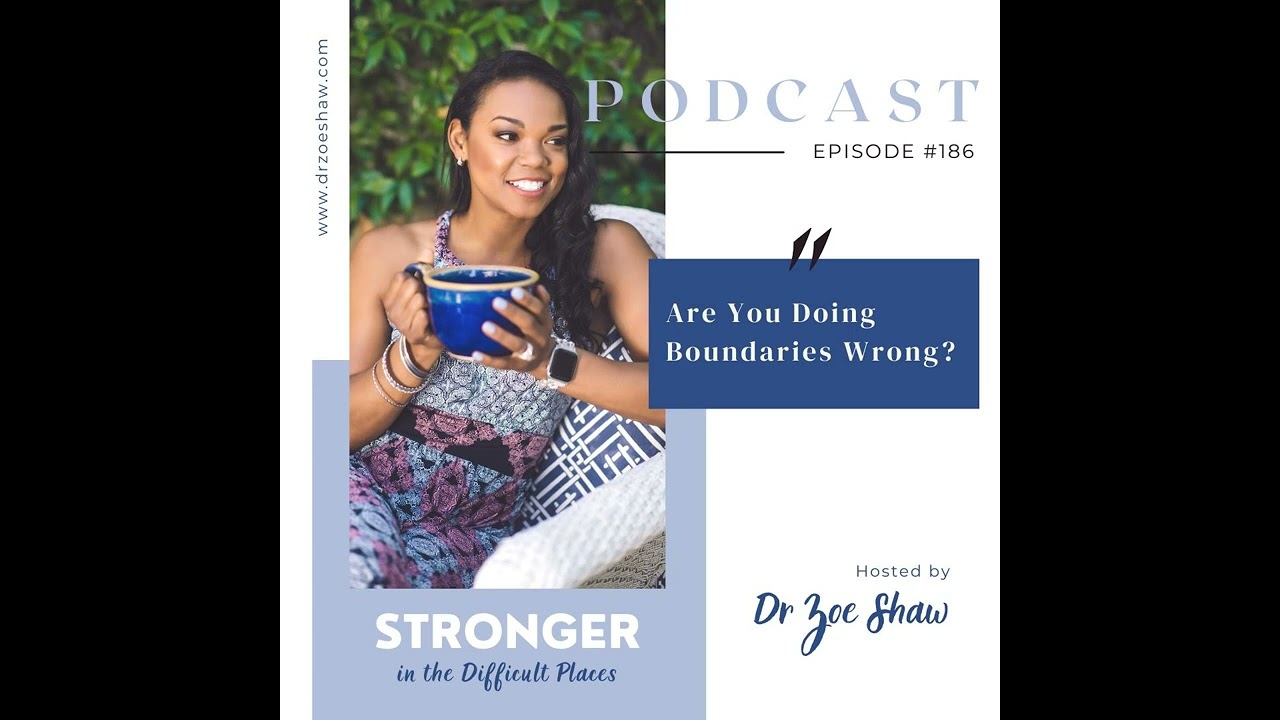
Dr. Zoe Shaw explains why boundaries fail: people set them but don't enforce them consistently, accidentally rewarding violations through sporadic follow-through. Real boundaries need clear communication, repeated enforcement, and the willingness to disengage when someone keeps crossing the line.
Chapters
This is not a podcast about being broken, although you may have been. This is a podcast about strength for women who find themselves in difficult relationships, including that sometimes difficult one with yourself. We'll look at your relationship through a lens of psychology, faith, and a little dash of my own kind of feminism. We're not fixing them. We're fixing you. And that changes everything. Welcome to Stronger in the Difficult Places. Save yourself, heal your relationships. Listen in. Hey there, welcome. I'm your host, Dr. Zoe, and I'm so glad you're here today. Today's topic is, are you doing boundaries wrong? If so, or you're not sure, then consider this a Boundaries 101. But first, my win and my fail. So my win is that I'm recording this podcast from my new office in my backyard. It's a beautiful, now beautiful, she shed, and I'm loving it. Already. I'm gonna do a video that documents the beginning from when we removed the playset to laying a foundation and having the shed come drop in here to now the beautiful structure that it is now. You know, the audio might sound a little tinny because it's still practically empty. I still need to fill it up, but when I fill it up, the audio should be pretty good. And I'm looking forward to using this space to write, to Record, to see clients, maybe just to sit in here and read for a bit and not have to worry about asking the kids to be quiet or worried that someone's going to ring a doorbell and the dogs are going to go off. I'm just really excited to have this space. So my fail, I'm leaving in 2 days with my son Sage. We're going to go to the East Coast, which I hear is pretty cold right now, so we have to make sure to bundle up. We're going to go to the East Coast and we are going to Look at colleges and decide which one he's going to spend the next 5, well, 4 years or 5 years if he decides to do a dual bachelor's-master's program. The fail, that's not the fail. That's a good thing. The fail is that I've completely not had time to book a hotel, book a car reservation. We're gonna be flying by the seat of our pants. It's just me and Sage. Obviously I've booked the airline flight there and back, which is good, and I've reserved the tours the colleges, but the rest of it, it is a fail because I probably should have done that before. I usually always get to the important stuff, but my fail is sometimes I do let those little things kind of fall to the wayside. And sometimes it's a good thing because sometimes I can fly by the seat of my pants, and sometimes it bites me. So we'll see which one it is. On to the topic. Are you doing boundaries wrong? I'm doing this episode today because I've noticed that a lot of people are realizing the importance of boundaries. They're starting to understand what boundaries are and they want to erect healthy ones in their life, but they seem to be missing the mark. Not everybody, but some people. I had this conversation with someone online and it quickly took a wrong turn. I'm sharing this because I think many of us have experiences with conversations that went wrong, whether we're on the receiving end or we are the one that is, you know, causing Somebody to be offended. And sometimes we're not aware of what's quite going on. And sometimes our boundaries are crossed or we've crossed other people's boundaries. And so I'm talking about this today because I'm sure I'm not the only one. But I had this conversation with someone, it took a wrong turn, and her response to me was, you just crossed my boundary. And the reason why was because I asked a pointed, albeit maybe rhetorical question about a message that I felt she might've been sending to our children. And she was really upset and she requested that I apologize to her. And I actually became very defensive, I noticed. I became defensive immediately. And I recognized this. And then I tried to challenge myself on my defensiveness, wanting to not be somebody who would disrespect someone's boundaries, because that was kind of a trigger for me when she's telling me I'm someone disrespecting other people's boundaries. When I really try not to do that. And so I mulled over whether I should apologize or not, and I realized, wait, wait, I'm getting caught up in groupthink, which is a sociological term that happens when emotions are high in groups of people and everyone starts to buy into a fallacy when they otherwise might not have. So this woman did have a clear boundary. And she might have had that boundary for decades, or maybe she just had that boundary for a minute. I don't know, because I only knew her for a few minutes. Just for reference, we had actually met in person as well. If she was a random person on the internet, I might not have had such a response. And so I had no reason to know what her boundaries were or to have any idea of what I could do to cross them. The fact that I crossed them angered her, but was her anger valid? And that's, I think that's a really good question because you know that I firmly believe all feelings are valid and so we should honor them. But part of honoring our own feelings is understanding ourselves well enough to discern whether our feelings are directed in the right place. So her feeling of anger and indignation was valid. Of course it was, given her unique makeup and her life experiences, but I'm not sure that it was properly directed. And I ultimately apologized for hurting her feelings, but honestly, the apology rung hollow for me, and I think that it did for her too, because I was not sorry for what I said. I was sorry that the conversation had gone so sideways and that her feelings were hurt though, but I wasn't really sorry for what I said. And that's what happens sometimes when boundaries don't align. When she has a boundary that might push up against my boundary, and neither one of us are wrong. She has to do what she has to do to take care care of herself, and for her, she felt that she needed to block me. And for me, I can be caught up in people pleasing, which we'll talk about later, or I can do what I need to do. And ultimately, I decided to apologize because I did hurt her feelings, but I'm also not choosing to no longer ask questions. And neither one of us are wrong. I've since had a number of people, clients, friends, acquaintances, mention their boundaries, and now I think it's like confirmation bias, right? I'm hearing boundaries everywhere, and I'm I'm a little more attuned to the topic, but I've heard people mention about how their boundaries are crossed. You can look on the internet and everyone's talking about people crossing my boundaries. People are realizing, some people, that they need to have firmer boundaries. I've talked about boundaries a number of times on this podcast because I talk about relationships and boundaries and relationships go together. A number of people have asked me how can they create boundaries in certain relationships. So remember, so we're gonna do just a little Boundary 101 here. Our boundaries are ours alone, not someone else's. So in close relationships, we should communicate what our boundaries are, but our boundaries are still ours. And we don't even need to disclose our boundaries to people that we're not in relationship with. So we don't have to go around telling people, you're crossing my boundary, or here's my boundary, don't cross it. So just to make it clear, someone has not disrespected your boundary if they cut in front of you in line. What they've done is they've failed to follow a social rule of politeness and consideration, but you don't need to alert someone that they've crossed your boundary in this instance. You can confront them or you can make a mental note, but that's not really boundary crossing. So people will often ask me, how do I get people to respect my boundaries? My answer is you don't. You can't expect them to first of all know what they are, or even to fully understand them when you disclose them. People might go, "What? That's a boundary?" Or, "Why do you have that boundary?" Your boundary is yours, and you teach people how to treat you by how you respond if a boundary is broken. Remember, it's not about trying to control someone else; it's about. Deciding what you will do. It's about determining your own behavior. That's why boundaries work, because you don't have to rely on or trust somebody else to keep them. It's relying and trusting on yourself to hold them and respond appropriately when they're crossed. So if someone crosses your boundary, you can see it as information that's being given to you. You're learning about that person and which boundaries you may have to implement with you, which boundaries you might have to hold stronger, but it doesn't have to be a point of contention or Not even disappointment on your part. Not yet. A boundary crossed means that you have to take action if you want to remain in a healthy relationship with them, yes, but it doesn't mean that you need to then be hurt and offended. So when a boundary is crossed, you have to take action, and that action can look like you saying, I'm not okay with that, or that won't work for me. Now, if someone then continues to cross your boundary even after you've made it clear that you're not okay with that, Then you need to remove yourself from the engagement or the situation, that particular thing that they're doing, or in that moment. If they're saying something to you, you're on the phone with them, you may need to let them know you need to go because you're not going to tolerate that behavior. If you're interacting with them, same thing, you remove yourself because you make it clear you're not going to continue to engage with them if they're crossing the boundary. Now, if you do that consistently, Their behavior will extinguish. And I know everyone's going, no, no, no, no, I've tried boundaries, it doesn't work. Yes, if you do it consistently. And that's the thing, because humans continue a behavior only because it reaps some benefit. If every time someone attempts to cross your boundary they get shut down, they will stop. That's how we teach people to treat us. If for some reason you cannot disengage yourself from situations, or maybe because the nature If the nature of your relationship doesn't allow that, meaning the confines of the relationship, then at this point they are disrespecting you by crossing your boundaries. Now it's okay to get offended. Now it's okay to have valid anger. And at this point, then you need to decide what proximity you want this person to have in your life. It still comes down to you. You can still hold the boundary, but it does get a little harder. Boundaries always work. The thing is, is that it's hard for people to implement them and hold them. See, the problem is that many people, first of all, never bother to speak up. So they become angry or resentful instead, and maybe they even become passive-aggressive when someone crosses their boundary, right? They don't say anything, but they get angry, pouty, they give the cold shoulder, or they just walk in bitterness and resentment. Now, some people will speak up, and then they'll say the words, I don't like that, but then there's no follow-through. Or even worse, there's inconsistent follow-through. Yes, inconsistent follow-through is even worse than follow-through because inconsistent follow-through, believe it or not, can actually strengthen their behavior, meaning it strengthens their behavior of breaking your boundary because of inconsistent follow-through. This goes along with the understanding that happens in Vegas. It's called intermittent reinforcement. So intermittent reinforcement, the way that that works and what scientists have found is the strongest level of reinforcement is that you don't have to reinforce a behavior every time. So when we— you go to Vegas, you're not going to win every time, right? It doesn't work that way. But maybe every 10 times you're going to win. Every 10 times you win. And so what that does is it strengthens your behavior. You want to double down to try to get what you want, right? Maybe cross somebody's boundaries or in Vegas to keep gambling because you know eventually you're going to hit. It's damaging, right? You're gonna lose more money almost every single time in Vegas, and they know this, but they understand the concept of intermittent reinforcement. So holding your boundaries intermittently is worse than not having any boundaries at all, because what you've taught them is, yeah, maybe I'll blow up, you know, every 5 times that you cross my boundary. Maybe I'll yell and scream. Maybe I'll pout and be resentful. But then The next 4 times, you'll get away with it. And your person you're in relationship has decided on one level that it's worth it. Now, a lot of these actions are not necessarily conscious actions, but it works. Just like you're not consciously thinking in Vegas, oh, I'm being intermittently reinforced. Oh yeah, maybe I'm gonna lose for 9 times, but I'm gonna win on the 10th. You don't think that, and that's why it works. And so this is where a lot of people get frustrated because they'll try to hold a boundary and they'll try to be really strong, and maybe it'll work for that moment, And then the next time they're not holding it as well and they're like, ugh. Or they might say, yeah, I'm not okay with that, and the person ignores them. And then they'll go, oh yeah, boundaries didn't work. No, you didn't keep your boundary consistent. And then some people will take another step and they'll choose to end relationships the second a boundary is crossed. So these are people that kind of tend to maybe not have a lot of relationships, or they'll have a lot of relationships and end them very quickly. They don't have a lot of long-term relationships and they're thinking, well, I just have strong boundaries, so that's why. You know, that's why I'm not able to find a mate, or that's why I don't have a lot of friends, or that's why, because I just have strong boundaries. But listen to this. This might look like firm boundaries, you ending a relationship as soon as someone crosses them, but it's actually a result of not having firm boundaries and just ending a relationship so you don't actually have to hold up your boundaries. See, healthy relationships require healthy boundaries and people in them who are willing to do the work of upholding them. So I wouldn't go so far as to end a relationship immediately when a boundary's crossed. Make your boundary clear, sit back and watch. Remember, it's information. And then over time, see what the person you're in relationship does. And yes, ultimately, if you have to, you'll need to end a relationship, but that should be one of the last resorts. And what fewer people do is erect healthy boundaries, maintain them consistently, and teach people how to treat them in a healthy way. And that's what I'm asking you to do. And is it work? Absolutely, it's work. It's more work in the beginning, especially if you're not used to having healthy boundaries, because the other thing is that the reason why you don't have healthy boundaries is because you want to please people and because you fear ending relationships. And you don't want to disappoint people, and you don't want people to get hurt, and you don't want them to think badly of you. And so this causes you to neglect yourself, thinking that you're going to save these relationships. What happens is that in neglecting yourself, you also teach other people to neglect you and break your boundaries, right? And then what happens is then you're resentful and passive-aggressive and all the things I talked about at the beginning of this episode. And so the very thing that you're trying to save in a relationship, you end up damaging it. And a slow process because ultimately resentment seeps out in unhealthy ways. So remember, there are some social norms that some people are just going to blatantly disrespect, like cutting in front of you in line or calling you a name. That's a clear offense, but that's not boundary crossing. That's just bad behavior. Your anger is a very natural response to that, and that's okay. But a boundary is more personal. It's something that might not necessarily be a social norm, but it's important for you and your mental and emotional health in a relationship. And you and those that you are in relationship with should honor your boundaries. So I want to remind you that you are capable of holding boundaries. And more than that, the feeling that you get when you hold a boundary, even in fear, when you worry, oh, when I say this, this person's going to get mad at me, or when I say this, I might lose this relationship, and you say the thing and then you don't lose the relationship, that sense of confidence and pride, you will carry it with you and it will grow and you will be able to speak up more and more and you'll find that your relationships are more fulfilling. So I just want to encourage you, you can do this. You can do hard things and it is hard and I'm not going to discount that it's hard, but The results of living in a relationship of mutual respect, when you've spoken up for yourself, it's like you're so proud. You make yourself proud by taking good care of yourself, and you make yourself feel good by taking good care of yourself, and you validate something that a little small voice says, oh, I'm not worth it, or, oh, I'm not good enough, or, oh, they're not going to like me. And when you speak up anyway— You extinguish that voice too. So I want you to think, how have I upheld a boundary today? Hit me up, send me a message, tell me how you've held your boundary today. You can do this. Thank you for listening to Stronger in the Difficult Places, which you are. New episodes go out mostly on Tuesdays. Subscribe so that you don't miss an episode and you get some encouragement That's it from me. Have a strong week. Bye.
More from Dr.



The Epidemic of Not Enoughness: How It Shapes Your Relationships—and How to Break Free


You Can’t Change This (And Neither Can They): The Truth About Temperament in Relationships

What Do I Do When Overwhelming Shame Is Keeping Me From Seeking The Help I Truly Need?


