Becoming Toxic Person Proof with Sarah K Ramsey
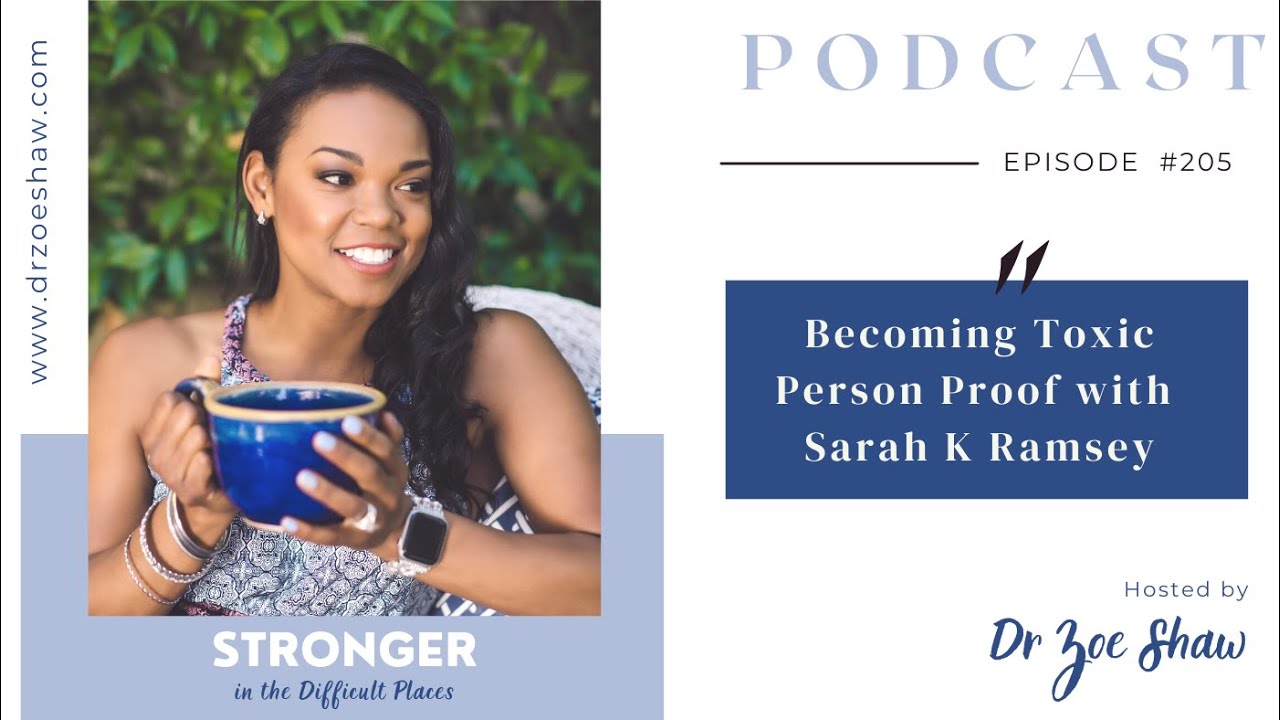
In this episode of the Stronger in the Difficult Places podcast, Dr. Zoe Shaw interviews bestselling author and life strategist Sarah K. Ramsey. Ramsey introduces her two podcasts – Toxic Person Proof and Problem Solved – and her two recent books, Becoming Toxic Person Proof and Problem Solved: Simple Habits for Complex Decisions. She defines “toxic‑person‑proof” as the ability to trust one’s nervous system and intuition, rather than relying on others’ narratives, and explains how people‑pleasing and perfectionism keep many women stuck in harmful dynamics. The conversation explores how toxic relationships function like “precancerous cells,” how gas‑lighting erodes confidence, and why many women ignore red‑flags by over‑valuing kindness and second chances. Ramsey offers concrete, actionable tools: recognizing turn‑taking (or the lack thereof), keeping a daily relationship‑rating calendar, making lists of moments when intuition was right, completing stress cycles, and using decision‑making frameworks from her Problem Solved book. She shares personal anecdotes about the arduous process of writing her books, health setbacks, and the emotional toll of confronting toxic people. The interview also covers levels of toxicity (e.g., a toxic mother‑in‑law), strategies for peripheralizing harmful relationships, and the health consequences of chronic stress (fibromyalgia, breast cancer). Finally, Ramsey provides resources for listeners – her website, Instagram, and a Facebook support group – and offers a final encouragement to trust oneself and maintain integrity.
Chapters
Hi, Dr. Zoe here. Welcome to Stronger in the Difficult Places podcast. I'm so glad to be back. I've been gone for 2 weeks. I went and participated in my mother's wedding in Maryland and then drove up north to drop my son off at college. I got a cold, some kind of virus along the way, so excuse the voice. But I am thrilled to have Sarah Kay Ramsey on the podcast today. She, I think, will be quite a treat for you. She's the bestselling author of the book Becoming Toxic Person Proof. Clear the Confusion and Learn to Trust Yourself. I'm reading the book now. Phenomenal. I highly recommend it. She's the host of the Toxic Person Proof podcast, which reaches thousands of listeners around the world, and she also has a new podcast called Problem Solved Decision Made. I haven't listened to it yet, but I know it's going to be good. It breaks down the concepts presented in her newest book, Problem Solved Simple Solutions for Complex Problems, available now September 2022. Her work has been featured in thetodayshow.com, the Solution Journal, Authority Magazine, Up Journal, Emotional Intelligence Magazine, so many more. More Elephant Journal, Your Best Self TV. She's a life strategist, relationship specialist, creative solution finder, and heart-centered problem solver. And I am honored to have her on the podcast today to share her wisdom. Listen in. We're going to be talking about, talking about becoming toxic person proof. Sarah, I am so thrilled. I say that so much, but I only bring people on my podcast that I am truly thrilled to have. And so I'm so thrilled to have you today to talk about all the things toxic, becoming toxic-proof. But also, well, first, hi.
Hi, Zoe. How are you? I'm good.
I have so many questions. You have 2 podcasts going on right now, which I read and thought, how in the world? I know how much it is to do one podcast. And I love your podcast. Is it called Toxic Person Proof or Becoming Toxic? Yes, I have been listening to it. I love it. Great stuff. I haven't checked out the other one yet. I know it's pretty new, right? Can you tell my listeners what it is?
Yeah, so it's Problem Solved. I've written 2 books, and I don't know that I will do a new podcast for every book that I write, but one, um, is, you know, about toxic relationships of all types— work, personal, family, friends, all that kind of stuff— and then rebuilding a really amazing life after that. And When I started working in this work, I had 2 types of women. They were usually perfectionists or people pleasers. Right. And so when you're a people pleaser, the way you make decisions is, how do I not upset you?
Right. Right.
If you're a perfectionist, the way you make decisions is, how do I not mess up? Neither one of those are probably going to get people the life that they want.
Correct. And some people are both.
And some people are both, right? And so this second book, Problem Solved, Simple Habits for Complex Decisions and, you know, the podcast Problem Solved Decision Made, it really kind of links those 2 ideas, right? So you have that, all my work in helping people overcome people pleasing and perfectionism and then like how— so what do we do, right? Right. If we make 35,000 decisions a day and never been taught how to make a decision and it's not how do I not make you mad or mess up, What else is there? And I'm like, oh, there's so much else. So that's, that's the new, the focus of the new stuff.
Oh, awesome. I can't wait to tune in. So before we get started, first, I'm listening to your Audible book and I love your voices. You just went the, oh, and I thought, oh, I'm listening.
I'm
going, wait, she's not an actress, but it feels like I'm really getting into this. So is it really great? Okay. So before we get started with the topic, can you share one win and one fail with my listeners?
Yes. So I told you guys a little bit about my book, Problem Solved. What I didn't tell you is that this book has tried to kill me. Oh my gosh. It has been terrible. I mean, when I say what I've been— I've been sick, my husband has been sick, you know, family stuff. I like— my eyes got swollen at one point. I don't know if from stress or so I like fell down the stairs. I lost my ice cream one time. My arm went numb, right? And so I swear that this book has tried to kill me. And so whatever you believe in, whether it be be spiritual warfare or like just darkness trying to get light, you know, preventing it from coming out in the world. This book has been my labor of love and, you know, um, and it's really breaking down the language of overwhelm. So when you think about how to explain overwhelm without being overwhelming or how to explain confusion without being confusing,
right.
Um, I personally wrote The one chapter on the book, the main chapter in the book for a year. One chapter.
Wow.
And I'd write it and give it to a beta reader and then write it and give it to a beta reader and write it and give it to a beta reader. And finally, the very last one was my high school English teacher. So I'd been rewriting this for a year and she goes, Sarah, I hate this. Your whole book is so good. I hate this chapter. And I was like, that's the main chapter. Oh my gosh, what do I do? Right? And so I just went, that's the drawing board again. So I definitely consider the success of that chapter and the feedback I'm getting the win. But it has been a brutal process trying to put it into the world. So I don't know if you call that a failure because I overcame it. But it's, it was very hard and very difficult.
Right. Well, you definitely had some trials and tribulations. And thank you for sharing. Because, you know, people usually just hear the authors like, oh, here's my book. It was so great. And it's out and it's wonderful. And they don't hear all that backstory about what it takes sometimes to put something out and how many years and tears and injuries are a part of it. So thank you for sharing that.
Another secret about me is my audiobook, because, you know, being a podcast host and stuff, the audiobooks are what feel like home to me. Yeah, you know, more so than, you know, and, um, but it was— my voice is higher in the evening than it is in the morning. So I would get up and record the audiobook at like 3 AM.
Oh my goodness.
And send it to my sound engineer in like Eastern Europe, and then they would send it back. And so I've got all these videos of me like recording. It's like 4 AM audiobook time, you know, and stuff you would never know behind the scenes. But, uh, you make like $2 off each book, you know, it's just nothing. So it's just such a labor of love and A message out there that I know will help people.
Well, it will. And so many people benefit from the audio version of the book. So, and refer it. So,
yeah.
So, okay. Your book comes out. Congratulations. People can get it everywhere, I assume. Um, can you say the name again? Problem—
I can show it to you. So excited. Oh, Problem Solved: Simple Habits for Complex Decisions. And I think about this maze at the front as being like the map that we used to think grownups had. You know, when you're a kid, you're like, oh, grownups know what to do.
They know.
And then you become
a
grownup and you're like, no one had any clue what they were doing.
Right.
So I think about this maze as, you know, being your map out.
I love it. I love it.
Into the world.
Congratulations. And for those listening, um, which is the majority of my podcast, uh, audience, I'll put the link in the show notes and you'll be able to get the book.
Thank you. Lots of wins and lots of crazy things.
Yes, exciting time. Book launch is always an exciting time. So let's dive in here, Ken. We're talking about becoming toxic person proof, which I think is such an important topic because, you know, a lot of times we're thinking about how can we, like, avoid it or, or how can we fix it? What can we do? But I love the concept of just becoming toxic person proof in general. So can you just give us a Just a definition of what that means?
Yeah, you know, I mean, it's really when people tell you who they are, believe them. That Maya Angelou quote, that's just so amazing, right? Because we then, we put our own perspective in it. Like, if I'm nice, I assume everyone's nice. If I'm guarded, I assume everyone's guarded. If I'm cruel, I assume everyone's cruel, right? You know, um, and those conversations that we really— being toxic person-proof is being able to trust your nervous system. And I think our nervous system is smarter than we are. You know, when our ancestors, when there was a rustle in the woods, our ancestors ran away. They didn't stop and say, is it a bear? Is it a lion? Is it a tiger? Is it a tribesman, the tribesman next door, right? They said, there's a rustle. I notice, I act on it, and I get away to safety.
Hmm.
Okay. And I'm a really nice person. I want to be kind. I want to be, but I don't want to be so naive That I had just assumed, well, there's a— I hear a rustle. Oh, it's probably fine. I hear a rustle. Oh, it's probably fine. I hear a rustle. It's probably fine. I need to forgive them for the 116th time, and their behavior is completely disconnected with who they are, or their behavior to me is completely disconnected to who they are. You know, I mean, all those sorts of things that really get us in a real mess. And it's just really listening to yourself and trusting yourself and believing yourself.
Mm-hmm.
It's just what I want for people. The subtitle of that book is Clear the Confusion and Learn to Trust Yourself, which is funny because I have a maze on the sec— on my second book about really trusting yourself. And this is again how to trust yourself. But I tell my clients all the time, I am not relentlessly— I— if you get a divorce or change jobs or cut off ties with your mother, all those are your decisions.
Mm-hmm.
My agenda here is for you to completely and utterly trust yourself and your decisions so that you feel good about them and you feel confident in them. That's what I'm committed to. Whatever you decide to do with that version of you, have at it.
And if you're able to do that, then you're going to be toxic person-proof.
Absolutely, absolutely, because they thrive on confusion, they thrive on gaslighting, they thrive on getting you to trust them more than you trust yourself,
right?
That's what gaslighting is.
Yeah, absolutely. You know, I have so many clients who feel like maybe they're in toxic relationships, are surely in toxic relationships, and they're often in the space of asking questions like, was it, you know, is it his fault? Or, or can I fix it? Or maybe it's me, or maybe this isn't really toxic. They're always kind of questioning and asking, right, trying to figure it out. And so can you explain— I love the way in your book how you form the definition of what is toxic, because it wasn't about label, like this, this is all the things that he does. It was really about you and how you feel. Can you explain for a woman out there who might be listening what that means?
When you feel confused, when you feel small, when you— I love the concept of that's weird, which is when you kind of— you're listening to something, you go, Huh? What? Huh? What? What did they say? It makes you stop. You stop and lean in. Okay. And Zoe, we've been talking, you know, for a while. There is no point that I was like, had to stop and lean in and like, did she really just say that? Did she, she really mean that? Did she— was that a dig? Was that, was that ugly? Was that mean? Was that right? But there's certain people That make us kind of lean in and pay— we have to work extra hard, right, in that relationship. And those are your precancerous cells. When you wait— I hate that so often when we talk about toxic relationships, we're talking about stage 4 cancer. Right. We're talking about domestic violence. We're talking about, you know, physical abuse. We're talking about, you know, Danger, right? And if we only tried to cure cancer from stage 4 places, we would be losing the battle with cancer.
Absolutely.
And the that's weird, that's the I feel small, I feel unsure of myself, I feel confused, I feel like something's wrong. Those are the precancerous cells.
I'm walking on eggshells.
Yeah, eggshells, right? That's when you can do something about it. Right before. And that's what everybody says, and that's women's intuition. Ladies, I've talked to so many women. It's not that they miss the red flags, it's that they talk themselves out of them.
Yes, I think that's, that's a huge point. And I can always go back every single time with any woman I'm ever working with, and she can tell you what she knew beforehand and ignored, what she knew beforehand and explained away, what she knew beforehand and rationalized. And she's probably still doing it today to a certain So I want to talk about that. Why is it that we don't want to believe that the people we're in relationship with could be toxic?
We all see from our own perspective, and if I'm someone who's good, kind, loving, giving, and forgiving,
I'm
going to assume other people are good, kind, loving, giving, and forgiving. Okay, and some common phrases I hear with women who've been in toxic relationships are not, "Oh, I just have such low self-esteem." "Oh, I'm codependent." "Oh, I'm such a mess." "Oh, my dad." was like this to my mom. That's not the language I hear. What I hear is, oh, I just believe in giving second chances. I believe in seeing the best of people. I believe in getting— giving the benefit of the doubt. And it's like, well, until we—
I see so much potential.
So much potential, right? But it's like, well, when does that stop and the actual, like, behavior counts? I mean, is your philosophy in life the behavior never counts? It's only my belief about the behavior, which is their potential, their future. I'm sure it's going to work out. They get kind of addicted to that hope of it being a magic fairy ending at the edge, right? You know, a lot of women I see, it's that they're— they are acting in their integrity.
Mm-hmm.
I tried to get them to change their integrity, right? So for example, my integrity used to be That I'm loyal no matter what. Okay. Now my integrity is it is not my job to help you become more selfish.
Right, right,
right. So both stages of my life, I've been acting in my integrity. I just had to change. My integrity was very damaging to my will.
The no matter what part of your loyalty was damaging to you. Right.
Yes, you know, relationships first, put others before yourself, you know, forgive, keep forgiving, believe in second chances, don't give up on people, don't be a quitter, right? All those sorts of things are great in many circumstances, not so great in a toxic relationship.
Exactly, and I think that's the point to highlight is that those— and I think what makes it so confusing is that those are actually good qualities and necessary qualities in a relationship where the other person is doing the exact same thing. Right?
Yes.
And that's what gets so confusing is you go into the relationship giving and doing all the things that a healthy relationship requires, but the other person isn't reciprocating in the same way, and the other person is wanting more, telling you it's not good enough, or, or things just get warped. And that's where you get so confused because you're doing all of the things. And so I think I love that concept of changing integrity But also recognizing that the integrity you had was good and it's still good. It just can't work with certain people.
Right. And if I'm speaking to a 3-year-old or a 30-year-old or an 83-year-old, okay, I'm probably going to use different language. I'm probably not going to speak to them in exactly the same way.
Absolutely.
Does that mean I'm a liar or I'm not authentic or something? No, of course, right? I'm just a good communicator.
You're recognizing. Yes.
Yes. My audience is a 3-year-old. You know, when I was— I'm going to be a little more laid back and say things here that I wouldn't have said in the bank presentation this morning.
Right,
right. Because it's appropriate.
Absolutely. Yeah.
So if you're in a relationship with somebody who wants to play by the same set of rules and who believes in give and take, Those qualities are appropriate to bring to that relationship. If you're in someone whose wants, needs, desires, sexual needs, relationships, hobbies, emotions, everything are always more important than yours, you've got a real problem. If you just— I'm just going to be giving, I'm just going to forgive, right? Um, it really keeps people trapped, and it's just so heartbreaking for me because it's really those good pieces that are keeping them trapped, not
The good parts of themselves, right?
Yeah, it's wonderful. It's all the things we want our daughters to be and our sons, like good, kind, loving, giving, and forgiving. These are what we're trying to teach our kids for the most part, right? Um, we just gotta teach balance.
So what would you say are the steps in becoming, um, toxic person-proof for someone out there who's listening and thinking, okay, I can see this, I can see I'm doing that, I can see I'm continuing to do this. What do I do?
So I have 2 major concepts for you, okay? One, I want you to think about how early you were taught to take turns. Probably 2 years old, 3 years old,
as early as you can remember. Yeah, stand in line, take turns. Yes,
yes. Okay, so this toxic person in your life— because I know there's a lot of questioning like, oh, are they really good? Are they really bad? Is it this? Is it that? Okay. So toxic people don't know how to take turns.
Hmm.
It's always their turn. Their wants, desires, money, emotions, anger, sex, whatever is always more important than yours.
Mm-hmm.
Okay. So if there is a 2 or 3-year-old who was taught to take turns and they're 23 or 33 or 53 and they haven't figured out how to take turns. Mm-hmm. Okay, that's where I really want to caution people to hang on in hopes that they change.
Okay, wait, say that again. So if they're—
If they have been taught to take turns since they were 2,
right
now they're 32. So for 30 years, the world has said take turns, and in their head they think, well, why should I do that? It should always be my turn,
right?
It's never your turn. It's always my turn. And then, you know, women think, oh, I just need to find the right therapist, or I need to find the right book to read, or I need to find the right article. And it's like, hey, here's the deal. And I— It's heartbreaking. I know it's heartbreaking, right? I am— this is all empathy, but I'm also wanting to protect you and say, really look at the data. 30 years or 40 years or 50 years of them thinking it's always their turn, they don't want to change.
Exactly. And that trench is dug so deep in their psyche that the concept and idea of change is likely going to be superficial. And that's the hard part, because when we're dealing with someone who is toxic, maybe a narcissist, when you threaten to leave, what happens? Everything changes, right? They go back to the honeymoon phase. It's charming. They can put on that cloak. You know, they can look the right way for a specific period of time to get what they want, but it doesn't last. And that's what gets so confusing for women because they think, oh, maybe he's changed now. And so they get sucked right back into that cycle. And it's actually very, it's very degrading to their self-esteem. And so by the time they figured out they're sucked back in, they're already just so much more beaten down.
Which is why it's always like, clear the confusion, learn to trust yourself, clear the confusion, learn to trust yourself, right? I don't think he's going to change. Oh, now he's making promises. I have to clear the confusion and regain that trust in myself. Like that is the process of becoming toxic. person-proof and I have a video called Navigating the Narcissist that addresses exactly what you're saying. I'll give it to you, put it in the show notes or whatever, because it goes through— I call it like the worst massage ever, because they find these pressure points and it's like, oh baby, I love you or no one will ever want you or you're gonna die alone or this is all your fault, right? They find all these pressure points to create that confusion.
They know what your triggers are, they know what your biggest fears and insecurities are, and they can definitely press those. Yeah.
Cruel. I mean, it's so cruel. But also, a great first step is figuring out all the times your intuition was right.
Mm-hmm. I love that.
Right? So, um, you can go back and think— I remember I knew a man who was having an affair, and I was thinking, man, this is— something's weird about this. Something's going on. Something's out. Well, it turns out he'd been sleeping with This other person for 2 years, right? And taking incidents like that, that I know, that I know, that I know every woman has.
Yes, yes.
That seems like— and then they turn out to be right. But when people say we're wrong or confuse us, it sticks a lot harder than when we were right. So we have to learn how to put those own stickers on ourselves
I love that. Yes.
So, I mean, making lists. If you're daydreaming, think— it's going to sound funny— what have I been right? Right? It's like, sometimes the things I've been right about, right? Oh, I thought that was weird. Then this happened. I thought that was weird. And then turns out he was really running a secret business. I thought this was weird. And then, right, all this certain circumstance.
Yeah.
So that the next time you get that Spidey, tingly feeling. I feel like something's wrong. I feel like something might be off. I feel like something's weird. Please, please, please think about our ancestors and the bear rustling in the woods.
Trust it.
That is the same. It's just your, your subconscious is smarter than you are.
And you don't have to know what it is because that, that's the other thing is women get that sense. And they know, no, no, deep inside. But then they need proof and then they need to figure it out and understand it. And they're spending all of that time doing that. I have a number of clients who are in that space right now. She knows her husband's cheating on her. It's super clear. Somebody else even came to her and told her, but he's denying it. And she's like, but I don't have proof. But she already knew even before the woman told her. Right. And, you know, it's just— it happens time and time again. And instead of feeling it and going, You feel it and you question.
I have a friend recently who got a divorce. Um, she wasn't married to him long and she was asking me kind of my advice. And I said, well, what I can tell you is when I talk to women, they take forever to make a decision and they always regret staying as long as they do.
True.
And she's like the only person I know. I mean, she was like out of that marriage within like a year and a half. Right. And not that I'm like, Go divorce. That's not the point.
Never the point. Right,
right. But it's like what I see over and over is exactly what you're talking about. And it's like they know what they should do, but they just stretch it out for another 6 years until it gets so bad that they feel like they're gonna fall apart, and then they make a decision. Right? And it's like, that's the— why my next book's on decision-making.
Right, right.
That's exactly why my next book is on decision-making, because It keeps you— even though it's not necessarily a book about toxic relationships, it's actually still a book about keeping you safe from toxic relationships because it's teaching you how to solve those problems and make those decisions before you hit rock bottom.
Yes,
which is a terrible place to have to make decisions from.
Absolutely beautiful. Thank you. So are there any other steps, or it's It's those 2, I think. I don't know if we got one, one and a half.
Well, yeah, I talked about the unraveling of the, you know, taking turns and they still can't figure out turns,
right?
And then really strengthening that belief system of your times you were right. Another helpful tip is to have a calendar. If you're in a toxic relationship, work, family, whatever, you can keep a calendar of And don't write, this is my toxic relationship calendar. Do not do that. Just like a blank calendar and you can kind of keep score every day. Like, okay, my general life was an 8 today, but my relationship was a 3. My general life was a 6 today, but my relationship was a 2. My— and that really gives you some data once you take a month of that inventory. Because I know a lot of people are like, oh, is it just my life? Is it really my work? Is it really my relationship? Is it really this? And when you start kind of saying life in general, And then this one toxic problem. Um, again, I don't have an agenda for that. It might be that work is really the problem. You think it's your marriage, and that will give you the data to kind of figure that out and make a decision out of your head, which is just getting out of your head and getting some like resources before you. Um, so that's why I like the list about ways to trust yourself. And now I like the calendar. Um, and I also like thinking of your life as if it was a movie.
Okay. Mm-hmm.
What type of character would you be? Would you be the heroine? Sorry for you. Would you be like, girl, stop doing— like, he's not gonna change. Like, honey, get out. Like, whatever it is. But like, as you're watching TV or thinking about a movie, what character would you be if someone had a video camera following you around?
I love in your book how you mentioned in the beginning that you were taking some type of personality test and realized that you would be the first one killed, I think, right? In the
horror
movie. Yeah,
I'm the classic, like, everybody's wonderful, everybody's great. Like, that is my default. That is what I want to believe. I want to live in a world where everyone's nice and everyone's good and everyone does the right thing. And the story of my life is figuring out that's not what people want to do.
Mm-hmm.
And it's, it's a continual lesson for me. Um, and it's very recently I had, um, a friend make decisions about her, her parenting that I felt like were really like, had her child in like physical danger. And, um, with another friend, not just like not being supervised. Like, literally, like, it was— and I just cried and I was so upset. And my husband's like, why are you so upset about this? It's not your kid. I was like, but it is a kid. Like,
yeah,
well, I'm upset about this, right? You know? And I think us, like, golden-hearted people who are sensitive and trying to make the world better, it's like, but why would you do this? You know? And we lean into those, and then we just can't. Like, we just can't I can't parent my friend's children. That's so inappropriate and so many boundaries crossing and so controlling on my end, whether or not I think it's the right thing or not. And so, you know, the lesson that I have to learn is that not everyone thinks like me, right? We all see our own perspective and just really, really truly trying to continue to recognize that. And I believe there are toxic people. I believe I know them. I believe that I believe that I believe my intuition is smarter than I am. And if I'm picking up something in my subconscious, I don't have to wait until it gets to my language brain. So you're talking about, you know, until you have proof,
right? The logic brain versus— yes.
Yes, right. Sometimes I think that can be helpful if it's like, okay, my brain does have proof because my spidey sense picked up the bear rustling in the woods, but my language brain Is newer than my— right? So all that's happened is it's stuck somewhere in this process. So it's not that I don't know, it's that I don't have the full language yet.
Yeah, technical understanding of it.
Right? But it's something— it's like, well, you do have the data. You, you absolutely have the data.
Right. Right?
It's not like people saying, oh, I want to stay in my comfort zone. Well, you're not comfortable, so don't call it a comfort zone.
It's familiar, but it doesn't mean that it's comfortable. Right?
Right.
Right.
So you do have the data. You may choose not to act on the data, and that is your decision, you know. But if you're a coaching client or something, it's like, you know, it's, you know, I don't want you to lie to yourself. Whatever decisions you want to make is completely your decisions. But if you're lying to yourself, then that's something I want to help with. Well, let's— You trust yourself.
Yeah, yeah. Let's talk about the woman who's in a relationship who she's not— she's not ready to get out of. Or maybe there's situations in other relationships, not necessarily marital or romantic, where you cannot extricate yourself. How do you— I, I assume it's about boundaries, of course, putting up boundaries, but how do you Like toxic person-proof yourself within relationships with toxic people.
Well, and you just have to decide. Like I talk about all the time, like if there's a crocodile in the water and your arm's getting bitten off, and I hear a lot of people say, how do I not let the toxic person bother me?
Exactly.
It's like, how can I not let the crocodile bother me while it's gnawing off my arm?
Hmm.
And I'm like, well, that involves drugs and alcohol. And I am— I'm dead serious. Like, you will have to numb yourself out because your nervous system is very intelligent and it is designed to keep you safe. I'm not suggesting people start drugs and alcohol, but I'm saying that's literally it. You're trying to— or your nervous system will shut down, um, you know, fight, flight, and freeze. You will be in For so long that you're numb. But if there's someone hurting you and you're saying, hey, how do I not let someone hurting me bother me for 20 years? Yeah. You know, it's just terrible strategy. And, and I say it truly, it's like numbing yourself out. And I'm not suggesting that. I'm saying, please don't. But that is the solution. Right? Because you're shutting down, you're asking, how do I shut down my alert signals in my nervous system? That is terribly dangerous.
It is. And I think that that is a very, uh, big mirror to put up for women. So I'm sure the woman listening to that probably felt that like, oh, okay, right, you're calling me out because I'm trying to figure out how to stay In relationship with someone who's hurting me and unhealthy, um, instead of figuring out what I need to do about it.
Yeah, and there's definitely strategies, you know, if you're in a situation, try to plan your rest time when they're not there. Try to plan— if you're going to clean the kitchen and they're not, clean the kitchen when they're home. Don't clean the kitchen when they're not home, right? You want to use that time when they're not home to rest, reset. Um, you know, there's certain tricks and stuff like that, but it's very much putting a Band-Aid on something that needs surgery.
True. And there's levels of toxicity as well. So let's say you have a toxic mother-in-law, right? You don't want to divorce your husband over your toxic mother-in-law. Um, but when we talk about being in relationship with somebody versus being peripheral to somebody, I think that the job then is to figure out how to create keep that relationship peripheral instead of trying to, as you mentioned in your book, trying to please her, trying to appease her, right? Trying to quiet her and, and live in relationship with her. It's really about learning how to separate yourself from her as much as possible.
Yeah. In my new book, I talk about, is this my problem to solve or your problem to solve? And so even conversations with the mother-in-law, I would say I like my mother-in-law, but you know, if I was mad at my mother-in-law, well, that's my husband's conversations with her are my husband's problem to solve, not my problem to solve, right? Just like my conversations with my parents are my problem to solve, not my husband's problem to solve, you know? And sometimes that can help really in that codependent wrapped up, like, whose problem is this? Is this a boundary issue? Is it not? So, but yes, I would not divorce a man, a good man over his mother because the chances you would find another good man with a strong mother. But, uh, but definitely going kind of lower contact, low contact. You don't have to go no contact and all the drama involved in that. But, um, what's the 7 degrees of separation from Kevin Bacon?
Absolutely.
We need a few more degrees of separation in that relationship. Yeah, you know, you could sit at the other opposite end of the room at Family events when possible.
Exactly. I like to think of them like our social circles as rungs, like the tree, the tree rings, and putting people into outer rings when you realize that they're not healthy for you to be in your inner circles.
Absolutely. And, you know, Taylor Swift had it so right when she said shake it off, because a lot— remember the bear rustling in the woods? Okay. So our nervous system picks up on it. We run away. Let's say the bear chases us or doesn't, and then we stop. So our brains say warning, run, or physical activity, run, stop, and we get the safety at the stop. That's when our body and brain go, okay, you're okay now. It's completing a stress cycle. So when it's a bad email or a bad conversation with your mother-in-law, right, there's no completed— Stress cycle, your body stress stacks. 77% of people say they're in burnout right now, 84% of millennials.
Right, right.
Let's not stress stack, right? So, you know, shaking those conversations off, you know, some— sometimes if it's a relationship like that, some strategies are surrounding the completion of the stress cycle so you don't stress stack. Rather than how do I never talk to this person again? Because that may not be feasible.
Right. Yes, absolutely.
And if you're living with this person, your nervous system's never getting a break. So just be aware of that too. So, exactly.
It's not. And, and there are significant health effects of living in toxic environments and relationships. Absolutely.
Nervous system diseases, usually.
Yeah.
Fibromyalgia is really big. Yeah.
What did you say?
Fibromyalgia and breast cancer are big indicators
of that. Interesting. Um, so how long did it take you to move from this place of being so susceptible to being toxic-proof? How long was that for you and what was that process like?
Um, Like I said recently, you know, I'm still— it's a— I feel like I'm in a video game where there's always new levels, right? Mm-hmm. And, um, so, you know, it would be, what, what does that look like now? I am a completely different version of myself year after year in the best way possible. Um, and finally just getting so mad I really made some big decisions in my life when I just got so mad that I didn't care anymore, right? So going ultimate people pleaser to like, I just don't care about you anymore. I don't care about anything other than getting away.
Mm-hmm.
I care about nothing other than getting away, really, and really going through that. But then it was more like angry but not happy, right? You know, I was just like, well, Probably I'll have fibromyalgia and breast cancer like next year, and I'll probably die and my kids will be orphans, right? You know, I mean, I was just such this terrible, terrible state of mind. And then rebuilding. And, um, you know, always joke with people. I said, I've never heard of anyone saying they studied narcissism and found happiness.
Hmm, interesting.
Right, right. So it's a great place to start to Process, please do not let it be your finish line.
I love that.
And that's really where happiness is found in that process. I don't know, there was a lot, there was a lot that happened in my life, like unexpected, that I, you know, kept getting like, again, like these video game levels. It's like, okay, I set a boundary here and then I have to set a boundary here, then I have to say, but most people it's not that way. Um, It's actually easier than what I had to do, but the— that process of really finding problems to solve that had nothing to do with the toxic person, because our brains are problem-solving machines.
Mm-hmm.
We want a problem to solve. If the problem to solve is to figure out why someone is acting like themself, right? Guess what? Here's the disclaimer: all the books on narcissism said the same thing. Are they gonna change? No, they're not. Disclaimer, I read them all. They've all been on my podcast. I know all the authors by name. Like, I could get them on the phone right now. Like, here's the disclaimer: is there hope? No, no, right? There is no hope. The, the stories that say hope are usually liars. And I, I can say I call BS when anybody says, oh, we changed our marriage and it was saved. I'm like, what's the real story? Because now I've heard so many backstories
Right.
Like, there was one story and, um, oh, they saved their marriage and it was so good. The mom had had an affair and tried to kill herself, and then the dad forgave her and all this kind of stuff. Okay, guess what? Fast forward 10, 20 years later, the mom is not allowed to go to the grocery store by herself. He picks out her shoes.
She's
not allowed to talk on the phone with her daughters without him listening.
And that's what I'm talking about. The cycle just goes back, and by the time you realize you're right back in it, you've— you're so demoralized. Yes.
Yes. And, you know, she was probably suicidal just to get out. She didn't know another way to— that she was trying to get out,
you
know. And so he was controlling then, and then he kept being controlling. It just looked different,
right?
Right. Don't change personalities They change strategies, right? And those are a world that is not the same thing. Changing personalities is being less selfish and less controlling,
right?
Changing strategies is, ooh, if I leave bruises on her arms, people will know. If I just call her a bitch, no one will notice.
Exactly, yes.
Right, so
good points, good points. Thank you so much, Sarah. What did you say?
Tricky business.
It's, uh, business. And I, you know, it's tricky business. And that's why so many people, I think, gravitate towards these kinds of conversations, because they're trying to figure it out and they want to do what's best. They want to do what's best for them. They want to do what's best for their families. And often what I end up saying to clients is, stop trying to figure it out because you're not going to. You know something's not okay. You can see that behavior and it's not working. That's all you need to know. You don't need to understand why in the childhood and the motivation and, and how he really feels like, oh, but he really loves me. Okay. None of that matters whether he loves you or he doesn't love you. What matters is what's happening. Right. And so thank you for that because, because that's what, what women need to hear. They need to hear these kinds of things.
Count.
Right.
Promises don't.
Right. Yeah.
Hard. I like, you know, put it on a tattoo on my face. I don't know. I mean, it's just like, I could care less what you promise. What do, what do your patterns say? Your actions tell me who you are, and I believe those.
Exactly. And, and women need to hear it time and time and time again. So thank you so much for coming on and sharing your wisdom. Thank you for writing your 2 books. The links will be in the podcast. How can people get a hold of you? Well, wait, before that, I just want to ask one final word. So for a woman who's sitting here and feeling a little frozen and feeling her stomach kind of turn up and realize, okay, this is me and I keep coming back here, can you just give her one final word?
Life is so much easier. Like, I mean, when I'm going through this with my book and I'm going through this, there was another lady who tried to take down my first book and like, said it was a trademark issue. It wasn't. All worked out. But just like all the things that kept hitting me, and my assistants like who are seeing this are like, oh my gosh, like how are you still standing? I was like, this is nothing compared to a toxic person problem. Like, they is the worst. We're talking about lawsuits, health issues, losing my sight, losing my arm, falling down the stairs. My husband had a skin cancer— well, he had skin cancer, not even a scare. Like, you— I mean, you talk about some crazy things that happened. Nothing compared to like the absurdity of toxic people completely degrading you, completely gaslighting you, causing you confusion in your head. Because when you have problems, it's, uh, this stinks, I wish this wasn't happening. When you have toxic people, it's, what's happening? I can't figure out what's happening, right? So you're always off balance, you can never settle, and if you can never settle, you can never have peace.
Mm-hmm.
The worst types of problems to have. That's why when I'm going into corporate and talking about problem solving, people like, well, this is great. I'm like, this is nothing compared to toxic personality, right? Those are the most complicated problems to solve. So, so just forgiving yourself, really going back to that integrity piece, because that's what, you know, I hear people say, oh, I ignored the red flags, I wasn't acting in my integrity. And I'm like, was your integrity to never give up? To not quit, to be loyal, to be a good wife, to not break up your family, right? You were acting in your integrity. Let's just get a higher identity of integrity.
So thank you for your words. How can women get a hold of you? And do you work with women one-on-one to coach them?
Yeah, I do. Yes, I do. So they can check out my website, sarahkronzy.com. Check me out on Instagram, Sarah Kay Ramsey Author. And if you're into Facebook groups, you can join my Facebook group, Finding Love and Success After a Toxic Relationship.
Beautiful, beautiful. Well, congratulations on the launch of this new book. I will be reading it and reviewing it as well. Thank you for coming on.
And Zoe, I'm excited to have you on the Toxic Person Proof podcast.
I'm excited.
Have our— have your listeners join us there as well.
Oh, definitely. Okay. Take care.
More from Dr.



The Epidemic of Not Enoughness: How It Shapes Your Relationships—and How to Break Free


You Can’t Change This (And Neither Can They): The Truth About Temperament in Relationships

What Do I Do When Overwhelming Shame Is Keeping Me From Seeking The Help I Truly Need?


