Finding Peace and Purpose in a World You Can’t Control
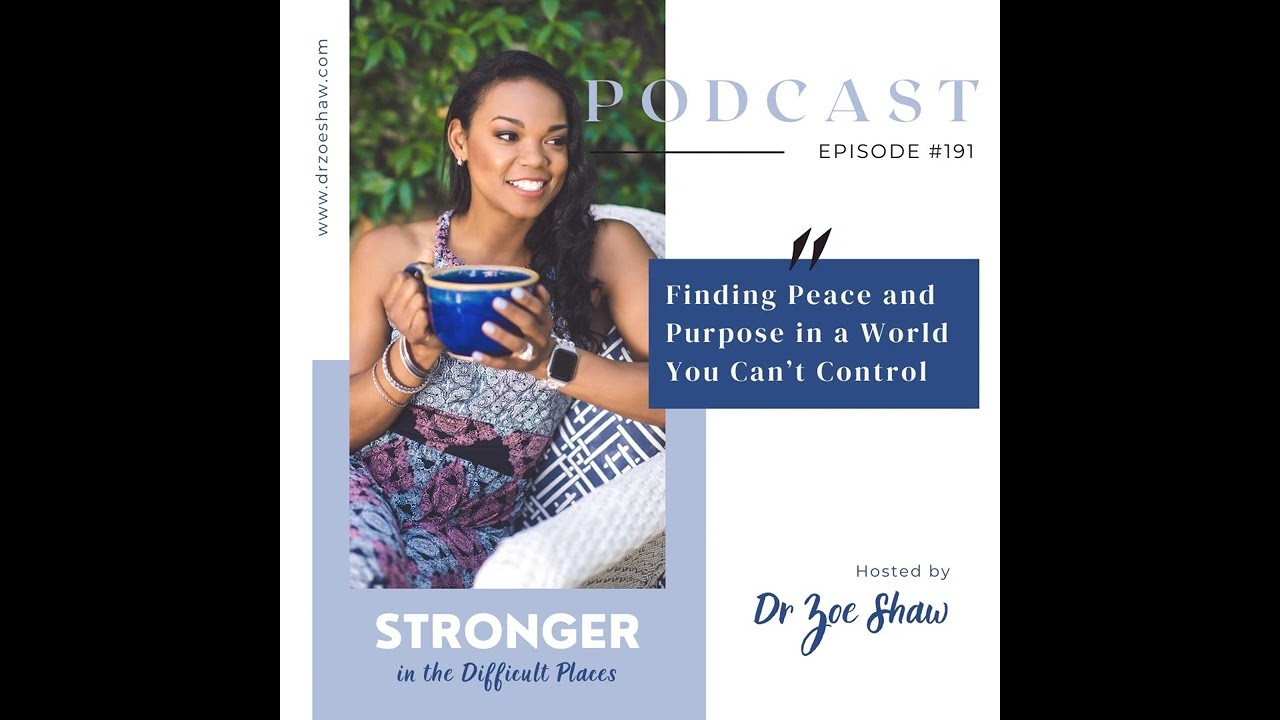
In this solo podcast episode, Dr. Zoe Shaw addresses women navigating difficult relationships, including the relationship with themselves, by blending psychology, Christian faith, and a feminist perspective. She opens with a personal "win" (returning to writing) and "fail" (forgetting proper pants for her daughter’s rafting trip) to illustrate the importance of persisting in beneficial practices despite setbacks. Shaw explains that the human brain evolved for survival, not for sustained happiness or peace, which makes it naturally attuned to negativity and threat detection. Modern media overload keeps this survival mode constantly activated, leading to chronic anxiety and desensitization to tragedies. She encourages listeners to acknowledge lack of control, then intentionally care for their brains by grounding themselves in a few core truths: belief in God, the sacrifice of Jesus, and unconditional love for their children. From this foundation, she offers concrete steps: (1) identify what you truly know for sure, (2) prioritize reading books over news, (3) avoid spreading fear, (4) focus on one actionable issue at a time, and (5) align purpose with innate talents, even if that purpose doesn’t pay the bills. Throughout, she stresses holding convictions strongly yet lightly, recognizing that many beliefs are provisional. The episode concludes with a challenge to write down one core truth and two certainties, reinforcing that purpose is personal, attainable, and a source of peace.
Chapters
This is not a podcast about being broken, although you may have been. This is a podcast about strength for women who find themselves in difficult relationships, including that sometimes difficult one with yourself. We'll look at your relationship through a lens of psychology, faith, and a little dash of my own kind of feminism. We're not fixing them. We're fixing you. And that changes everything. Welcome to Stronger in the Difficult Places. Save yourself, heal your relationships. Listen in. Hi there, welcome. I'm your host, Dr. Zoe, and I'm glad you're here today. Today we are talking about finding peace in an uncertain world, a world you can't control. And this episode was inspired by a conversation that I had on This Grit and Grace Life podcast. And I thought about it again in the light of the recent school shootings. And so I thought that I would share some of my words with you today. And just in case you are feeling a little hopeless and purposeless about that or anything else that's going on in the world or your world today, this episode is to remind you that there is still peace, hope, and purpose to be found in an uncertain world. But first up, my win and my fail. My fail is that I forgot to pack a decent pair of pants in my daughter's bag when she went Whitewater rafting on the Grand Canyon last week. I had 2 separate bags, one for the trip that she was doing separate from that, and then the other bag for the camping trip. And I did pack a pair of rain pants in my defense, because I always wanna defend myself, I guess, but not a really decent pair of pants. And her little legs got sunburned. Yes, Black people burn, not as easily as lighter-skinned people, but we do, and she did. And that was my fail. She came home with sunburned legs, but she's healing and we're good. My win is that I'm writing again. And for any writers that might be out there, I think you know what I'm talking about when I say simply, I'm writing again, because although I write daily in my life, I write my blog posts, I script even this podcast to a certain extent, it's the deeper writing, it's the book writing, it's the deeper article writing that I actually need, just like I need exercise as a physical rhythm, as a meditation, writing is good for me. And when I get out of practice, especially when I'm frustrated with my writing and where my writing's going— this book is taking way longer than I'd hoped to sell. And so it's hard sometimes to get back into writing. It's easy to just drop the writing because there's so much frustration involved in it. So my, my win, my win is that I'm writing again, and I'm really excited about what I'm writing. And it feels really good to be back in the saddle and moving mentally the way that, that I know is good for me. And if you have any type of practice and you find that things in your life either sabotage the practice or keep you in some way from, from doing it. I just want to encourage you to get back in it. Keep going. Sometimes things are frustrating, and certainly our self-talk can get the best of us. And I, I know that as a self-talk expert and as a human being. And I just want to encourage you to get up and try again. Get up and get back in the practice, because even if the practice doesn't yield whatever your fantasies may want it to, the practice of it is healthy for you. So keep going. So there's my win. Now on to the topic, finding peace and purpose in an uncertain world. When you're feeling overwhelmed by a world you can't control, acknowledge it. I can't control this. We often fight it instead, and we try to control everything, and that's part of what creates our sense of disease and anxiety. You are the only person that can control you. But first, understand how your brain works. Your human brain was not meant for pursuit of happiness. It wasn't made for the pursuit of peace, prosperity, or success. It was made for survival. Once your brain has survival down, then it can start focusing on bigger issues. But part of the problem is that when we have worries and anxiety, we are telling our brain that we are not safe. And so our brain kicks straight into survival mode instead of working on, on other issues like peace, prosperity, success. And so we are constantly fighting a brain that's, that's made for survival when we're trying to do so much more than that. In order to survive, our brains are hardwired to focus on the negative. This aids in our survival when it all goes well. Focusing on the negative is super important when we need it, but it can also sabotage our happiness in the moment. So our brains are continually imagining things that could happen that could keep us from being able to meet our survival needs, right? To be able to stay alive. And that need to focus on negativity is in conflict of our need to have peace and seek purpose. So if we understand that our mind is hardwired for survival, and it's hardwired to focus on the negative, then the fact that you feel crazy, sad, anxious, worried, it makes total sense. There's nothing wrong with you. And when things happen in the world that confound us, that make us go, why and how and what can we do? It just ups the ante in feeling out of control. And the biggest problem now is that that fight and flight response that is hardwired into us was so good and protective when, you know, there might be a bear or a lion or something that could happen in the moment to jeopardize our lives. But we were able to heighten all of our responses, shoot cortisol and adrenaline in our body, get ourselves safe, and then get back to a normal, low level of stress and anxiety type of life. The beauty, of course, is that then there was no news, no newspaper, no social media, no constant awareness of all that could have and has gone wrong in the world. Now, we see a tiger and a lion every 30 seconds, and we are frazzled with the brain in constant survival mode. And that is why when this last shooting happened, some of you might have just gone on about your day. We are so desensitized now to hearing about things like mass murder, and that's a way that our brain protects us. It doesn't mean that you're callous. It just means that your brain is working to protect you. And thank God for the ability to become desensitized. It is a defense mechanism. But what we also know about defense mechanisms is that they are Band-Aids. They are not long-term solutions. And you may not feel in the moment the effect that these negative things have on you, but they are accumulating. And that's why we do have a society of pretty anxious people. Part of the problem is that people feel that they should be worried, that worrying is a good thing and it's a productive thing to do. And then you log into Twitter and Facebook and you see your friends and others doing the same thing, and it reinforces that message. Yes, you should be worried. And if you're not, what's wrong with you? But constant worrying will not save the day, and fear prescribed daily won't do it either. So now that you know that you're normal, your job is to be intentional about bringing your mind and your body back to a state of believing that it's danger-free so that you can experience calm, peace, and the mental space To seek out your purpose, I'm not asking you to lie to yourself because we know yes there are real dangers out there. I'm asking you to care for your brain in such a way that it can actually function for you and not sabotage your very existence, so that you can have the space to begin to contemplate greater things like purpose. Our bodies notice all the anxiety and the stress that. Yeah. We're experiencing even on a lower level. And when we're telling our bodies that we're in danger, but yet we're going about with life, we create this kind of cognitive dissonance because we're acting like everything's okay, but yet on another level, we're telling ourselves that we're in danger. And so what our body wants to do then is distract us from it. So we zone out on entertainment, we zone out on food, on pleasure, on seeking to not think about the things that we're telling ourselves are threats and dangers. Focus goes out the window, and instead we're just on an exhausted autopilot. Does that sound familiar to anybody out there? So let me give you some tips on how to not sabotage yourself. One, ask yourself, what do I know for sure? When I was in my 20s, this list would have been super long because I knew so much. I knew how to parent perfectly. I knew all the things in the world. I knew all the solutions. I just knew it. But the process of living on this earth for decades has given me wisdom about my knowledge. And my knowledge list has dwindled down to almost nothing. Being a writer, I have a front row seat to the evolution of my own thinking, which is one of the gifts I love about writing is that I can write something down. And in the writing, I learn what I think. And what I used to know for sure, I don't know anymore. I understand as a psychotherapist that all behavior makes sense in its context. And I know that for most things, I'm completely blind to the context. I'm completely blind to everybody else's context. And Sometimes I'm even completely blind to my own if I don't pay attention. So for me, this is freeing because knowing things for sure can cause angst when the rest of the world doesn't follow suit with the things that you know. We get so caught up in trying to find truth and we get polarized in our nonessential beliefs that it rips families apart and it rips relationships apart and it rips society apart. What I have learned, and this is for me, is that there's only one truth in the world and there are only 2 things that I know for sure. You need to come up with your own list. The one truth I know is that there is a God in heaven who created me for a purpose. The 2 things I know for sure is that he sent his Son to die for me and that I will love my children without fail until I take my last breath. That's a pretty short list. Now, I have a lot of opinions and I have a lot of beliefs and I have a lot of convictions. None of them Other than the ones I just stated, do I know for sure? And I'm okay saying that now. It doesn't mean that I'm not going to walk out my convictions. It doesn't mean that I'm not going to keep weekly on this podcast telling you things that I believe deeply. But only 3 things do I know: one truth and 2 things I know for sure. And so I believe that we need to walk strongly in our convictions but hold them lightly, because plenty of my convictions are based on the lens through which I've seen this world, which is based on teachings that I've been given, things things that I've read, and some may be true, and I'm okay to admit that some may be false, but I will hold them strongly until someone has convinced me otherwise. So you need to figure out what are your truths that you know for sure. You need to walk strongly in those convictions, but hold them lightly. Next, read books, not news. So here's the reason: when you read a book, you're consuming something that someone took years to research and solidify. On top of that, it's been vetted and it's been fact-checked by somebody at least. When you read the news, or even worse, social media, someone wrote it last minute on a deadline. Its purpose is likely to sway you or their perspective or to elicit fear. Not that books' purposes aren't to sway you, of course they are too, but the purpose also of news is to elicit an emotion so that you keep watching, and you gain very little from the process. So just consider, read more books than you consume news. And next, don't spread fear either. Decide that you won't be a fear spreader. Your focus on fear ramps you up just as much as it ramps up the person you're inoculating. Awareness is super important, it is, but we are bombarded with way too much information these days. Don't spread more information. And I have to admit, you know, this is something I'm talking to myself and I have to kind of chastise myself about because I can do that as well. Instead, take action. Sow love, sow kindness, sow acceptance. I don't remember Jesus ever warning anyone about anything in the Bible. He got angry and he turned over some tables, but he was not the preacher raining down fire and brimstone and judgment. He just loved. So if that's how he showed up in the world, and then he got 12 people who knew him the best to spout his message, which has spread across the globe over thousands of years better than any viral media post, isn't that what we should be doing? So next time you want to respond or put out that Facebook post, and I've been guilty of it myself, think, how can I show love instead? There's enough noise. Better yet, let me get off Facebook and live my life. Next, create a list of all the things that overwhelm you and threaten your peace and pick one, just one that you'll take action on, because you don't have to be, you can't be all things to the whole world. God created a lot of us, and you're deluding yourself if you think that you have to take action on all things. And this is one of the things that overwhelms us. This is one of the things that robs our peace and our joy, is trying to figure out all the things and take in everyone's emotions and problems. When something big in the world happens surrounding that one thing that you've already decided will be your platform, if we want to use that word, Then take action. If something big happens and it's not your thing, don't allow yourself to be persuaded. You have phenomenal talents. You have a unique personality and abilities, and you need to focus those on your passions and your talents. When you're able to do that, you will understand your purpose, and our purpose is always in line with our talents. God gives them to us for a reason. Now, sometimes our purpose doesn't pay the bills. Sometimes our purpose is not going to support us, but our purpose always aligns with our talents. So if you're wondering, where is mine? Start looking at your talents. What are you good at? What comes easier to you than it does to someone else? And if you focus on that, instead of looking at the lane beside you, instead of thinking about all the things that are, are shinier and seem more pressing in this world, You will have more peace. If you recognize that there are enough people that God put on this earth to deal with those things, then you won't feel like you have to do them all, or that the weight of the world is on you. Remember, there are only a couple of things that I know in this world for sure. And so that actually makes my life a lot easier. I don't need to judge, I can understand, I have my opinions, I have my beliefs. And maybe they're right. I will continue on. Assuming they are until I figure out differently. And I think that that is growth, and I think that that is wisdom. But like I said, I still don't lose my convictions. And I used to be in a place where I wished that I was something that I wasn't. I wished that I was this academic or this phenomenal fiction writer. I am not, and that is okay, because what I do know now, what I've been able to figure out, are where my talents lie. And the beautiful thing is it is the thing that I love to do. And in following that and allowing myself to naturally gravitate there, I have found my purpose and I am walking in it. And it does feel like peace. It does feel like home. And when things come up, I can quickly see, oh, that's not my lane. I'm going to let her take that. Good for her. Let me cheer her on. Maybe if I have space and time, I can support her. When something comes up and it is my lane, I'm like, there it is. I got it. I got it. So I hope that this episode has been able to just identify a little bit for you, a couple of steps that you can take if you are feeling pretty lost, if you aren't clear about your purpose. Purpose is a difficult thing, and sometimes it's a journey to figure it out. But I really think the journey is accepting what's already there instead of devaluing it. Because it doesn't seem big enough. Your purpose doesn't have to be saving the world, and it still matters. And you, you alone, are the most qualified to do that thing. So I'm just going to challenge you to write down what is your truth? What is your one truth that you know in this world? And what are your 2 things that you know for sure? Focus on those. You've got this. Thank you for listening to Stronger in the Difficult Places. New episodes go out on Tuesdays. Subscribe to my newsletter so that you can get some encouragement from me, and have a strong week.
More from Dr.



The Epidemic of Not Enoughness: How It Shapes Your Relationships—and How to Break Free


You Can’t Change This (And Neither Can They): The Truth About Temperament in Relationships

What Do I Do When Overwhelming Shame Is Keeping Me From Seeking The Help I Truly Need?


