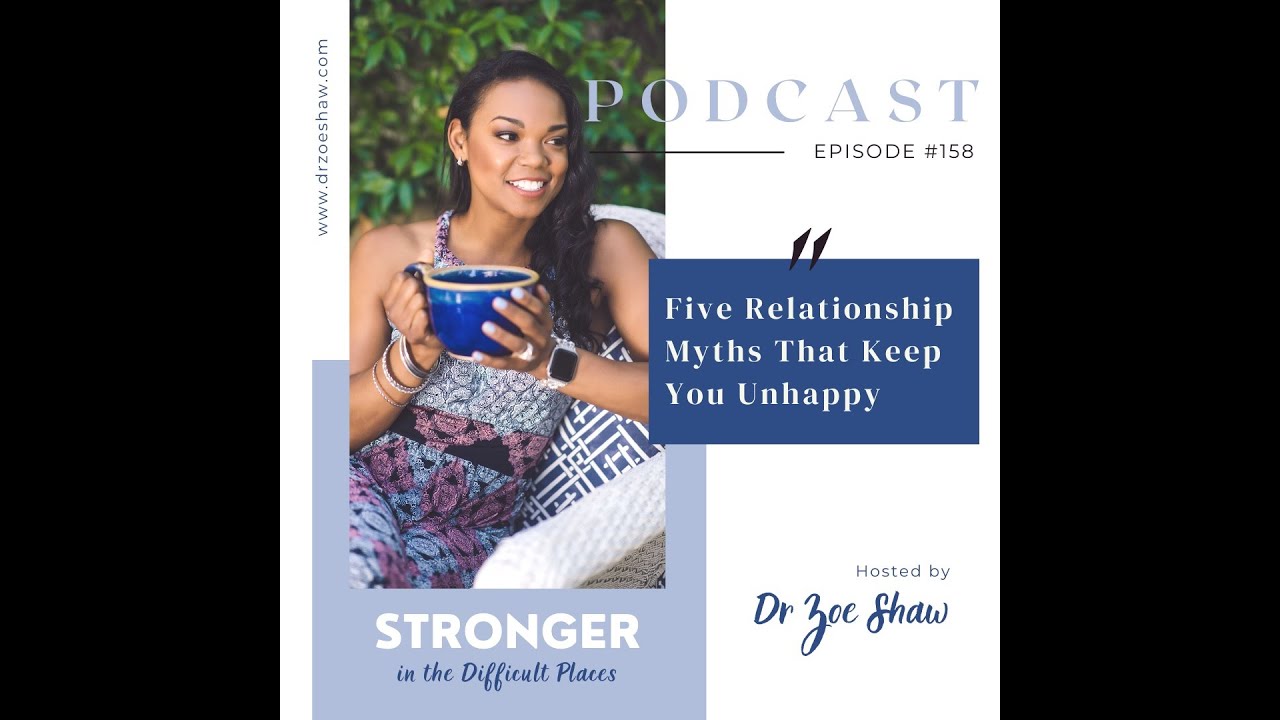
In this episode of Stronger in the Difficult Places, Dr. Zoe Shaw identifies and deconstructs five common relationship myths that undermine long‑term happiness. Drawing on her clinical experience and personal anecdotes, she explains why (1) love must be expressed without being asked, (2) conflict is unhealthy, (3) love alone can sustain a partnership, (4) seeking therapy signals a relationship is beyond repair, and (5) a partner must change for the relationship to work. For each myth she reveals the underlying family‑of‑origin beliefs, illustrates how the myth manifests in couples, and offers practical guidance—such as communicating needs explicitly, embracing healthy conflict, recognizing love as a choice rather than a glue, normalizing therapy as maintenance, and focusing on personal change rather than blaming the partner. The episode concludes by urging listeners to examine their own assumptions, take responsibility for their role in relational dynamics, and view relationship work as self‑growth, thereby turning “fixing you” into lasting relational ease.
Chapters
Hey y'all, it's Dr. Zoe. Welcome to Stronger in the Difficult Places. We are fixing you, not them, and that changes everything. Today's topic is 5 relationship myths that keep you unhappy. And I chose to do this episode because in working with my clients, I realized that a lot of them are coming to a relationship with these preconceived notions. I did it myself early My marriage, with this idea of what's right, what's wrong, behaviors that are okay or not okay. And many of this comes from our family of origin. But what's happening is that these myths, these ideas about how relationships should be, aren't always right and aren't always functional. So I'm going to just talk about 5 myths, and maybe that can help you think about things that might be going on in your relationship that are causing some issues. Relationship myth number 1: If I tell him what I want him to do to show me love, then it's not genuine if he does it. I often have this conversation with my clients and I'll ask them, what are your needs? Or, what do you want from him? And usually she has no problem telling me what that is, and then I ask, have you laid all that out for him? Does he even know? The answer is often no, and usually I get an answer back that confirms a dysfunctional thought pattern that says, he should know what I need, and if I have to ask him for it, then it doesn't count or it's not authentic if he gives it to me. This couldn't be further from the truth. If you ask and he gives it to you, it's his expression of love that he's motivated to do the things that make you feel loved to begin with. I had a client who got downright angry with me when we had this conversation and she said, so you're telling me that I have to ask my husband to love me? That is not what I said, but of course that's how she perceived it. The interesting reality is that he never completely fulfilled your needs in the beginning. You might have perceived that he was fulfilling your needs because Because your mind was filled with limerence. You were in that lusty kind of quasi-love stage, and your mind was drenched in dopamine and norepinephrine, which colored the way that you saw him, and it filled in the gaps with assumptions of good intentions because you saw him through that lens. And the irony is that when you're both in that place, you actually act better towards each other. But those chemicals do their job, and they don't stay forever, which is a good thing because you do need your brain back to do life. So when the chemical dust settles, you're left with what's really going on in your marriage. And now you see him through a different lens that's colored with real life and maybe little and sometimes big hurts. And so all that goodwill falls to the wayside. And now instead of filling the gaps with good intentions, it's filled with the assumption of bad intention. And this is where the maintenance comes in that's necessary in a long-term healthy relationship. This is the place where the man who never had to show how to love you becomes the guy that you need to be really specific with about how to love you, and you need to find out the answers to his questions too. What does he need to be loved by you? And none of this is a bad thing. It's just part of the beautiful cycle of the way that life and relationships work. So think about this. If you found out that your partner loves back rubs, and you may have figured this out when you guys were dating, and you give him a back rub, is that not an authentic back rub from the heart? Because if I find out that you like back rubs, my response might be like, oh cool, I like back rubs too! But I'm not giving you a back rub because I don't love you, and that would be weird. But when your partner gives you the things that you've told him make you feel loved, it's simply an authentic expression of his love for you. No, he can't and he shouldn't read your mind. So if you don't tell him, then you need to point the finger right back at yourself for why you don't feel loved. Relationship myth number two: Conflict is not healthy in relationships. I think you guys know this one, but it's amazing to me how many people know this on a cognitive level, but they still feel very much on an emotional level that conflict is bad and it should be avoided at any cost. Some of this might come from your family of origin and unspoken messages that you received about conflict. Maybe you got in trouble for confronting someone in your family, or maybe conflict just. Spiraled out of control in your family of origin and it was scary and dysfunctional. The truth though is that conflict exists in all relationships, even when you don't acknowledge it. It just becomes internal conflict that seeps out in unhealthy ways in your relationship. When you believe that conflict is bad, then you're going to tend to avoid conflict at all costs. You'll adjust your behavior to avoid a conflict and so you might lie, sometimes to yourself in the form of denial. You'll omit and placate to keep conflict at bay, and all of these actions just create more conflict and bigger blowups when it does happen. And if you manage to maintain a relationship with absolutely no conflict, and I have seen those relationships, then it's also devoid of a deep intimacy that comes with knowing someone and accepting all of them, including all of their flaws and all of their conflicting parts. So what does healthy conflict look like? It's an honest, I don't agree with you. I need you to hear me out, followed up with a, but I also want to understand your point of view too. The goal in conflict resolution is never for the other person to agree with you, but rather to be heard and respected in the relationship, to have your point of view examined and considered. Relationship myth number 3: Love should be enough to get us through anything. It's not. Love is not even enough to bring back your wayward kid. Love is not enough to keep your friendship intact. Love is not enough to keep Your marriage together. Love is a starting point, and it's a benefit, and it feels good, and it's important, but it is not the glue that holds a relationship together. What holds a relationship together? Trust, respect, open communication, mutual consideration. Love makes you want to strive for those other behaviors, but it is not the glue. I say love is no good reason to get married, and a lack of love is no good reason to get divorced. Love is ultimately a choice, and you should not use it as a litmus test or place too high a burden of it in your relationship. Now, if that feels completely devoid of emotion or unromantic, it is not. I hope that it sets you free from a mandate attached to an unattainable requirement. See, when you determine that love is the glue and a requirement, then you can easily get stuck in a place of trying to find and create a feeling in order to move forward in the relationship. And I've had women say to me, I can't move forward Until I can get this feeling of love back. And I'm saying that's not quite how it works. Now, I'm not saying that all relationships should stay together forever no matter what. I don't actually believe that, not even marriages. I feel that there are plenty of reasons why people should end relationships. And we do ourselves a disservice when our marriage becomes an idol in our lives. But I also feel that we toss away way too many marriages because of the whole, I just fell out of love, thing. See, often what happens is you fall out of love, you leave the marriage, you go find somebody else who looks different but is pretty much exactly like the guy you just had, and you start having all of these same issues all over again. So you should sidestep that and avoid it by working on yourself first. Relationship myth number 4: If a relationship needs therapy, it's too late. There are 900,000 divorces a year, and fewer than 10% of them ever talk to a therapist. And most couples sit on a therapy-worthy issue for 7 years before they get help. Needing help or maintenance is not a sign of dysfunction. Staying in your dysfunction because you're too scared of what it means to get help and get maintenance, that's the unhealthy choice. No one thinks their car is done for if they have to take it into Jiffy Lube for a Oil change or maintenance, and the same is true for your marriage. Relationship myth number 5: In order for the relationship to be successful or healthy, my partner has to change. Now, you know what I'm gonna say here because the opposite is the premise of my entire channel. It is so very easy to blame your partner. Even when your partner is to blame, it's light-lifting if you choose not to look at yourself and your part in this relationship. It doesn't matter how horrible your partner is. You have had a part in this dynamic, and it's super critical that you figure out what that part is. And the more adamant that you may feel right now that you had nothing to do in it, the deeper you have to dig in order to save yourself, even if what I'm saying makes you angry. Because it is not a coincidence that you ended up in your relationship. It is not a fluke that you married your husband. You chose him for a reason that makes a lot of sense if you look hard enough and you're willing to acknowledge it. All behavior makes sense in its context, and you show up the way that you do in the relationship for a very good reason, even if they are dysfunctional ones. So because that's the case, when you change, your relationship changes as well, because anytime you change a system, the whole system has to change and adjust. Being an Olympic-level blame artist just prevents you from doing the real work of changing yourself, which has to Remember, you are not making changes so that he will change. You're making changes so that you can show up healthier in the relationship. So why did I want to cover relationship myths today? Because they are sabotaging your relationships. You may have a few of the ones that I just talked about today, or maybe you can identify a few of your own that I haven't mentioned. These myths are shortcuts to procrastination and complacency in your relationship, and they can make us doubt ourselves and the health of our relationship. All relationships are hard in some way, and walking through and doing the hard things actually creates the ease long-term that you desire in your relationship. Remember, we're not fixing them, we're fixing you, and that changes everything. You've got this. Thank you for listening to Stronger in the Difficult Places. Check me out next Tuesday. Subscribe and follow so that you don't miss an episode. Have a strong week. Bye.