Forgiving In A Way That Honors You with Deb Curtis
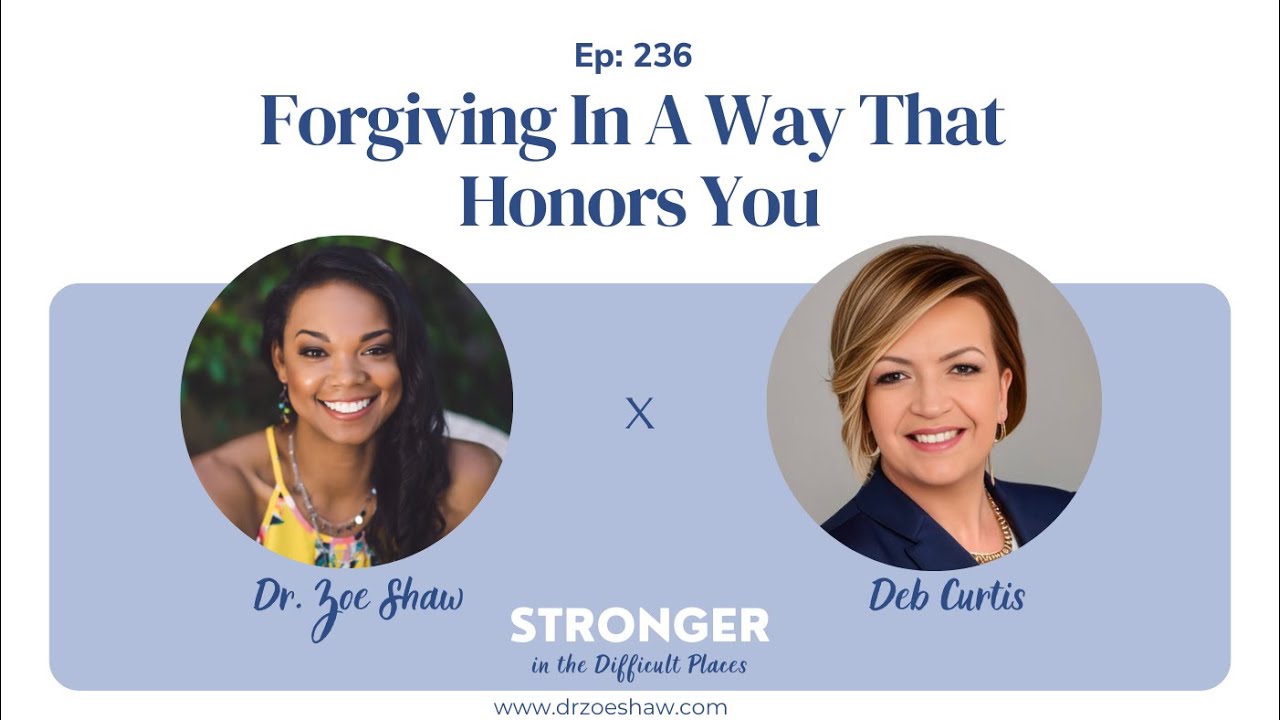
In this episode of Stronger in the Difficult Places, host Dr. Zoe Shaw interviews Deb Curtis, a survivor of childhood trauma, maternal abandonment, and an abusive first marriage. Deb recounts her early life in rural Wisconsin, the chaotic environment created by her mother’s drug use, the loss of custody to her mother, and later being rescued by her father. She describes how people‑pleasing and codependency developed from complex shame, a concept Dr. Shaw explains as the internalization of rejection and self‑blame. Deb credits a self‑help book, Codependent No More, and her Christian faith for helping her break free from an abusive relationship after three attempts, eventually finding a healthy 30‑year marriage and a blended family. She shares the transformative power of forgiveness, describing it as a blessing that allows one to let go of a “better past” and rest easy. Practical advice includes taking action, seeking professional help, and speaking openly about pain. The conversation concludes with Deb’s current work helping people acquire established small businesses using SBA‑backed financing, and provides her website (debcurtis.com) for listeners.
Chapters
Hey there, welcome to Stronger in the Difficult Places. I'm your host, Dr. Zoe, and I'm so glad to be here with you today. Today we're talking to my guest, Deb Curtis. She is a remarkable woman who's overcome many obstacles in her professional and personal life, and we're going to talk today about overcoming obstacles and how to positively change the narrative in your life. So I'm looking forward to having Deb Curtis on today. Listen in. Deb, I am so thrilled to have you on today. And I have to say, I love like all of your background. It is speaking to me right now. It is speaking to me. Thank you for coming on today.
Well, thank you, Dr. Zoe. Uh, the compliment of my background, that's been a work in progress. You know, we keep seeing everyone else have their backgrounds. It's like, oh, I gotta try to make it like me. So there you go. Wow,
that's beautiful. So can you share with my listeners a little bit about your story and how you came to be where you are today?
Oh, yes. I will compact it for your listeners and start— yeah, I'll start with my childhood. I grew up as a baby born in Milwaukee, Wisconsin, and my parents were married. I was the youngest of 3. And at about age 4, my dad decided to move the family out to a rural neighborhood just to get away from the city and raise the family in a more country-like setting. He was born and raised in the city, so he just wanted to raise the family rural, thinking life would be better and there'd be less crime, less drugs, and all of the above. So when we moved to the rural area, area. We were still intact for a couple of years as a family. However, my mom, who was adopted back in her early days, she was given up because she was born with polio and her biological parents thought she would just be a nightmare to take care of. So they dropped her off on a fire station step, just like you see in the movies, right? Right. I didn't really know that story, side note, until later on in life. But What happened when we lived in this rural neighborhood, as I grew older with my parents and my 2 oldest sisters were moving out of the house because they were, they were about 6 to 7 years older than me. My mom was a stay-home mom in this rural, safe neighborhood that my dad was imagining was happening and that we would be safe, but she ended up getting involved with the stay-home moms in the neighborhood in the rural country who were, I guess you could say, bored because they weren't working. And, you know, they liked to gossip and then they liked to drink and then they got involved in drugs and it just got out of hand. And as the fathers in that subdivision were working full-time to raise the kids, the single moms back in the '70s, you know, they were known to stay home with the kids. Well, they were actually partying and having fun in the little ranch.
Man.
A married mom? Yeah, a married mom on Valium and, you know, just doing things in front of us kids like this is nothing, but threatened us not to say anything to our dads or we're grounded. So, right, strict rules back then. Well, my dad caught wind of it because there, there were parties she was having at the home when I was in school, when he was at work, and she, you know, just got involved with the wrong people, had affairs. And became addicted to her habits. So he left, and the judge granted custody, full custody, back in the '70s, which was very normal, to the mom, the mother. Even though she did have this background, my dad brought up to the judge, it didn't matter. You know, she had an attorney that pretty much told the judge, no, that's not right. So custody was given to my mom. Well, she went down the path even greater and had more threats on me being the only child living at home. And over time, there were so many parties, the home turned into a drug house. But I still went to school, Dr. Zoe. I still— what, at that point was 9 years old— would walk to the middle school. I'd still visit my friends, do my homework on my own. And my oldest sister was in the military and she would come home at random over, I guess, like a year and a half period of time. And every time she came home, the fridge was more moldy with no food. The house was more of a wreck and run down. She knew something was right. So she told my father. They contacted the authorities immediately. He was granted custody of me temporary until this court hearing started. So the court hearing started as far as who's going to win custody, because now he's battling to get me back full-time. And after 2 years, the only way my dad would win back then was if I testified at age 12 as to what my mom had done. Hmm. So they granted my dad custody. So that was part chapter 1 of Deb's life of being broken and not feeling loved by her mom. And at that point, I never saw my mom again for 40 years of my life until March of 2020 when COVID hit. So there's a story there that I'll finish. So then my dad remarried. The second wife did not want anything to do with me because his love was shared with me and she didn't like that. So he divorced her right away. It was like a rebound marriage. And then I went to high school. My dad worked 2 jobs. I volunteered for everything because I was people pleasing my way to get kids to like me, right?
Right.
That's kind of what we do today on social media. We want people to like us. So I was just people pleasing my way. And we, we still did not have a lot of money, my dad and I. He worked 2 jobs and, um, budget was tight. And I couldn't— um, I shouldn't say I couldn't. I did not have the means to go to a university. My dad didn't have the money to send me, and he wasn't going to co-sign sign on a loan. So I went immediately into the workforce when I graduated high school and started dating guys, was brokenhearted, people-pleased my way, trying to find love in all the wrong places. Finally met this man, my first marriage, married him, and 6 months later I realized he's a severe alcoholic and he's into drugs and stealing and domestic abuse. I people-pleased that marriage and didn't want my dad to know, didn't want my friends to know, didn't want my work to know anything what was going on in my life because I wanted my life, Dr. Zoe, to look perfect.
I have to, I have to interrupt you here because what you are describing unfortunately is so classic and it is It's a perfect description of a term that I've developed called complex shame. And you gave an exact description of how complex shame develops over the course of childhood. And I will, you know, later give all of the delineation regarding what that is. But, you know, part of what happens when we are rejected, when we are told that whether verbally or, or through someone's behaviors, or the way that they treat us, that we are unwanted, that we are bad, that we are not good enough, right? Some people do something called internalizing. Some people externalize. So when we talk about internalizing, externalizing, you know, people can have a very similar experience and turn out very differently, right? And part of that is due to our temperament and our, our personality. And I won't get into how all of that develops. But for people who internalize, we take the things that are said to us, we take the messages that are said to us, and we take them inside and we attach ourselves to them and we believe them about ourselves, which then created that people pleaser. So people who externalize tend to develop personality disorders like narcissism or borderline. And what they do is they externalize. They— it's everybody else's fault. They are perfect and everyone else is the one with the problem, right? What you did instead is you said, I am bad.
Yeah.
And I therefore need to Try to do things and pretend to be something and not let people know and hide my shame so that people will like me and accept me. And the issue with people with complex shame is that they are the perfect victim for someone who is going to prey on that. So maybe for a narcissist or for an addict, even because of the codependency that goes along with it. Mm-hmm. So you just perfectly explained through your story How complex shame develops.
Thank you for sharing that. That's very helpful for—I've never heard of it that way, so thank you. One word you did mention was the codependency, and what saved me from that marriage was one book somebody recommended to me. I don't know who; I can't remember. But because of my experiences in that book Changing Me. I recommend it to everybody that's in a domestic abuse situation. Um, Codependency No More.
I knew you were gonna say that. That's great. Codependent No More. Yes,
that's the one. Thank you. Uh, I was close. Melody Beatty, I think, is the author.
I know it's Melody. I don't remember the last name. Yes, Codependent No More.
It's still on Amazon with a revised version That's a couple years recent, but that book opened up my eyes to what was happening in my life.
Right.
So, um, I, I, uh, left him. My dad, who was the hero of taking me away from my mom, was the hero to take me away from this first marriage. It took 3 attempts though, Dr. Zoe. I, I left and went home twice, was almost killed, bailed him out of jail. And my dad, I went back. I'm like, "It's going to be okay," and he just was patient with me, but said, "I don't think so." And then the third time, he had to bring my big old Uncle Joe, who's like six and a half feet tall, to come rescue me with the police. And he passed away, my ex-husband. But the beautiful prize out of it all, my oldest daughter is. from him and, uh, and I and my current husband of 30 years adopted her when she was 6 years of age. So there is glory through all of the pain.
Absolutely. Yes. And did you know it takes an average woman 6 times to get out of a very unhealthy, toxic relationship? So you— it was 3. It might feel like it was forever for you, but you actually did it faster than the average woman. So So thank you so much for sharing that story and the redemption that now you are in a marriage of 30 years and your husband has adopted your daughter, which is just such a beautiful story. Can you give some insight for a woman who may be stuck in a difficult relationship, or maybe, you know, I can certainly talk about, about complex shame, but, but you're here and you're our guest today. And so I'm wondering how. you got from a place of being so broken, of experiencing codependency, and now finding what I assume is a healthy marriage and relationship, which also means you probably have a healthy relationship with yourself.
Thank you. Um, yes, I'm blessed with a 30-year marriage of a husband, um, And my father did not want me to rebound fast because he was so worried I would get attached to the same kind of a husband personality, somebody that needed me, right? And my husband of today, we used to work together like 30 years ago, but on separate teams. And he divorced a gal, and then I divorced my husband. And he kept pursuing me and I kept passing him down because I didn't want to date anybody through work. But finally I said yes. The saving grace would be God. And I'm going to explain. Just like I mentioned earlier, being that little girl that was abandoned. Mm-hmm. I was— went to Catholic church on Sundays and CCD classes too. I'll never forget them. But my mom was a Catholic, the adopted mom. I knew there was a God, but I did not know much about him because when we went to church, it was all foreign to me at 7, 8 years old. And she always wanted to sit in the front pew, and if we didn't sit in that front pew, Dr. Zoe was going to be a bad Sunday. It was going to be if we missed it. But anyways, I knew there was a God then. So I used to think to myself, especially when my dad left us and packed up his bags, I saw him in the master bedroom, told me he was leaving and moving out. I ran away with a bag of potato chips. And a 2-liter of Coke and talk to who I thought was God at that young age, saying, I just want a family. I just want a normal family.
Wow.
And then fast forward to the first husband and the domestic abuse and the horrific nights of not being able to get out of my apartment because he wouldn't let me out and being beat up. I'd be crying in the bedroom on my bed, and at this point I know there's a God. So I would pray to God, Dr. Zoe, if you're there, help me. I you know I I know I'm not supposed to leave a marriage for better or for worse. So that was something a burden that was on my heart. You know, it's a code of show me the way. I know you're right. Thank you for bringing that up for for me to remind me and for your listeners. But um. He— nothing was shown yet. And again, Dr. Zoe, I was praying for my own family. My own family still wasn't happening. So then this second husband, who I've been married to now for 30 years, I knew him before as a coworker, but the only way he would consider even dating me was if I believed in God and had faith. And we had several conversations about it. He was further along in his faith than I was. And that's what connected us. And I prayed to God before I knew we were going to get married, like, is this what it's— is this who you sent me? You know, is this what you want me to do? And I felt the nod that yes, because he, my husband, didn't want anything to do with me unless I was a Christian. So that got us together. And the family that I prayed for was finally on its way later in my life. 3 beautiful daughters. I have 4 new grandchildren. I'm a new grandma.
Congratulations.
And if you remember, I mentioned my mom adopted and she abandoned me and missed 40 years, I would say close to 50 years of my life, everything. She just pushed me out of her life for good. March of 2020, she called me at 76 years of age, living in a rundown one-bedroom efficiency in a drug house, crying about this pandemic that's happening. I, I don't see her. I, I mean, I— all I know is she's got a lot of issues. She's bipolar. From what I understand, she's not doing drugs or drinking at 76, which she wasn't. We had to move her in with us During the pandemic for about six months because she was frightened about her health and the pandemic, I had to learn all over how to build up a relationship with my mom after abandoning me. And you know what I had to learn, Dr. Zoe? Forgiveness. And so we have a relationship today, and I thank God that He sent her back into my life because. All that baggage, and a lot of your listeners probably have that baggage in their heart of a lot of hurt of what has been done to them in the past, because I'm one of them. I carried that anger and unforgiveness for 50 years of my life. Now I forgive her, and I feel free, free, and I'm able to share my story. To help others. So that, that's a long answer to your one question. Um, you just have to find your faith and, and speak to people that are professional like Dr. Zoe and community and, and keep listening to what people have to say that you trust, because sometimes God will work through other people to speak to you.
Without a doubt. So, you know, forgiveness, I love and understand deeply the necessity of it in relationships, both for ourselves and for other people. It's such a simple word, and we all kind of understand what it means on one level. But I think on another level, it feels for some people so unattainable.
Mm-hmm.
I'm looking to see, I had a A quote about what forgiveness is. Oh, I see it. Somebody, Jerry Jampolsky, said that forgiveness is giving up all hope of a better past. And I love that definition because it doesn't talk about anybody specifically. It doesn't talk about anything, you know, it doesn't say that you have to now absolve someone of anything. What it says is you're giving up All hope of a better past. And when you do that, I think that you're able to release people who were part of that past. But can you tell me what forgiveness means for you?
Wow. Um, I just was listening to the quote and to your words afterwards. What does forgiveness mean to me? It's a blessing. You know why? That what you just quoted, it gives us hope for a better past. I can look at my past now in a better way, Dr. Zoe.
Mm-hmm.
Yes, my husband, my first one that was an alcoholic and battered me and tried to kill me, he had past. He had a past that hurt him. Yes, my mom, the same story. But my ex-husband, who is now deceased, he blessed me with this oldest daughter of mine, who blessed me with 2 granddaughters that are babies. Wow. And now my mom, who abandoned me at a young tender age of 9, 10 years old, living with her was horrific. But today She's blessed and she tells me that because I gave her a second chance. And now we are mending our past to create a better future. So when she's called home or I'm called home, we can rest easy.
Mm-hmm.
And I, you know, I even say that today. I tell her, if I didn't have a chance to forgive her, I don't know. I think of the people that don't forgive when they lose somebody then and wish they would have or could have or should have. Don't carry those would've, should've, could'ves. Just forgive today because it is a blessing, like Dr. Zoe's quote that she referenced, to make hope of a better past. That's really cool. I love that.
Yeah, well, it's really giving up hope of a better past, but it's really giving you a better future, right? You're accepting that the past is what it is. You're giving up hope that it could have changed because a lot of our forgiveness is stuck behind us. It's if we could have, and that's really the grieving process. It's the bargaining process of grief where we look behind and we think if they never had and what my life would have been like if, if, if, and all the should-haves and could-haves. And we hold onto that and we attach people onto that. And I love what you said, which was that essentially when you give up the hope of the better past, you can now rest easy. Yeah. And resting easy, I think, is, is really the goal of forgiveness, right? Because when we are not in forgiveness, when we are holding on to very negative things, we cannot rest easy. And we bring that into our future. So, wow, I love that concept of rest easy. And it's not easy to do, is it? I mean, you know, forgiveness—
No.
Can— it is such a journey. And I hate to use that word simply or easily, because I always want to recognize for anyone, there's so many reasons why Our bodies and our minds want to hold on to things that have hurt us. And sometimes we feel so entrenched and so validated, you know, that we should be here in this place. Anger is a motivator. And I think if we can use it for motivation for good, it's excellent. When we use it to keep us sabotaged, you know, in a, in a negative place, then we're hurting ourselves. So yeah, yeah. Yeah.
Yeah, that's wasted energy. Spend it elsewhere. That's forgive.
Thank you for for sharing that story. Do you have? Yeah. Um, do you have a word or a last word maybe for a woman who is sitting here and and thinking I feel I see some some some threads of my life and her life and. I, I'm listening to what Deb is saying. I'm listening to what Dr. Zoe's saying, but I don't even know how to begin to forgive. What would be a first step?
Boy, you have to take action. You can't just sit still in anger, and forgiveness is anger, like you were just talking about. And whether the person is still around today that you have to forgive, take that action. And even if they're not here today, talk to someone. And, and, and there are ways to still forgive even if they're not here. If there's anything that I would share over all the years of the hurt that I've been through and all the hiding Don't do what I did and hide for that long. I hid too long, and what it did was just make life harder for me and more bitter. So it's taken me longer to heal because I hurt for so long. So I know it's easier said than done, but just do it. Because waiting— because I always thought, oh, I'll forgive her at this point in time in my life, you know, or, you know what, or I'll forgive this. It never happens. You just have to do it and let it go. That would be my advice. And seek advice. Seek professional advice. You know, we all can tell you what to do, um, in, in, in Terrible times like domestic abuse. I think of the police department. There was a lady police officer that came out to my apartment with my first husband. With all the domestic abuse, people constantly called the police. After three times, the third time she came up to me in the kitchen and she said, "There's probably going to be a next time that when we come, you're gone because he killed you."
Yeah.
And, and, and that woke me up. So you, that's another sign that you have to listen to what the professionals are telling you.
That's beautiful. You know, I love what you said when you said, don't keep hiding, I think, or you said something like that. Stop hiding. And that hiding is what our shame tells us to do. And so as you talked about talking to somebody, when I think about complex shame, we hide because we believe we are bad. We are not good enough. We won't be accepted. We can't Have those things that we want. We have to pretend and not let people know. And when you talk, you are being brave. It is taking a lot of courage, and you are exposing the very shame that you have. That is a step. It's not the ultimate step in healing complex shame, in my opinion. Mm-hmm. But vulnerability is a step. So I'm glad that you said the first step, because when you start to talk, when you start to open up, One thing that does happen is that you realize you're not alone, and you realize that your situation is not as unique as you think it is, which also means that there are solutions because other people have found them. And so I'm so glad that you said stop hiding, stop covering your shame, start talking. Beautiful.
Thank you, Dr. Zoe. And I have a little secret to tell you.
Yes,
just talking with you is a I it's a form of me getting better and healing because your words of what you reply back to me just sink in my heart and they're golden. So, and the good news is I can go back to this episode and and listen and learn again because Lord knows I'll need it on those days that I'm I'm doubting myself because they will come because it's still in me after all those years and I'm learning how. to create new habits. So thank you.
You're welcome. And that is maintenance for all of us, because that, that what you just said applies to every single one of us. And once we get to there, wherever there is, our job is then to continue to maintain. So thank you. Thank you so much for sharing your story and your wisdom. I know you've been a blessing for so many women. How can people find you? And what type of work are you doing out there in the world to help people?
Oh, sure. I am a woman business owner and I help individuals that are interested in acquiring established small businesses that are already working and making money and you want to transition in as the new owner. So I help individuals obtain the bank financing that are— that's backed by the government, the SBA. Mm-hmm. And sometimes, you know, you might want to take a different turn in life and maybe exit corporate and acquire these established businesses. And to answer how you can reach me, my first name is Deb, D-E-B, last name Curtis, C-U-R-T-I-S, dot com. That's as easy as it gets.
Excellent. And we will put all of that in the show notes. Thank you for your excellent work, Deb.
Thank you, Dr. Zoe.
More from Dr.



The Epidemic of Not Enoughness: How It Shapes Your Relationships—and How to Break Free


You Can’t Change This (And Neither Can They): The Truth About Temperament in Relationships

What Do I Do When Overwhelming Shame Is Keeping Me From Seeking The Help I Truly Need?


