Healing Abusive Brain Chatter with Jacquie Elliott
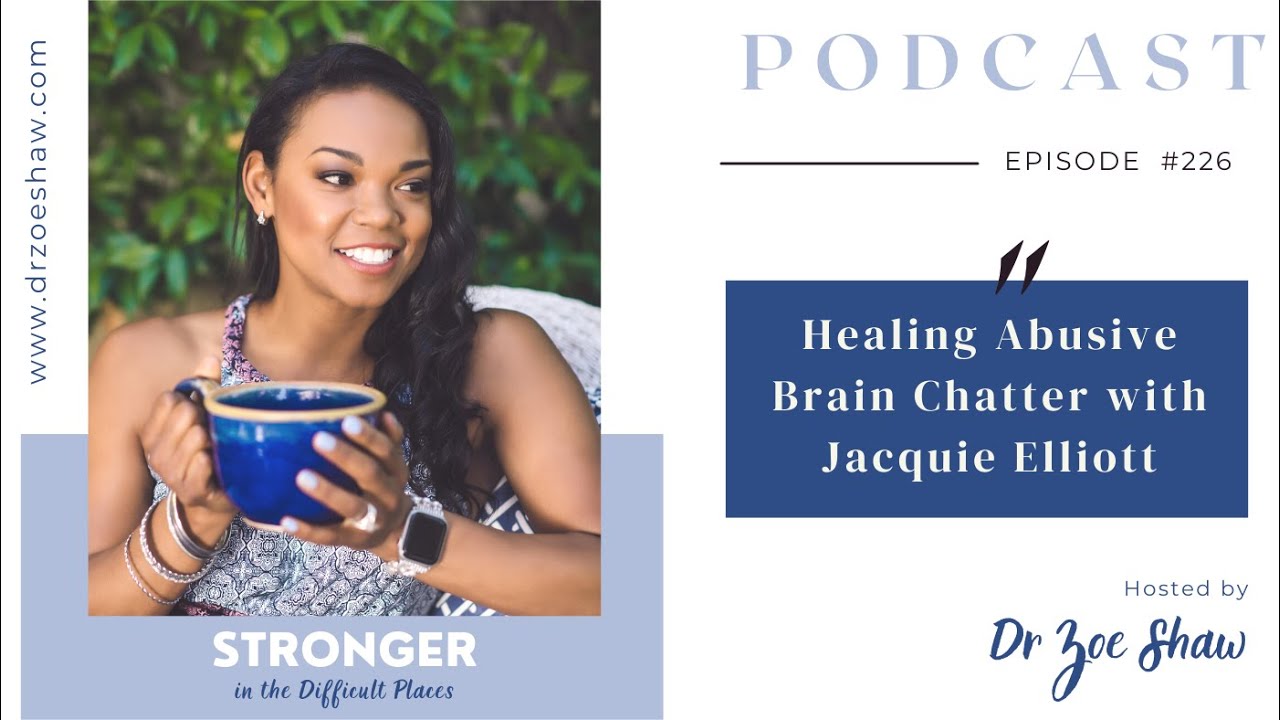
Jacquie Elliott describes abusive brain chatter as extreme self-talk rooted in childhood beliefs about worthlessness. She spent 42 years struggling with it through a toxic marriage, binge-eating, and substance use before finding recovery through Voice Dialogue and her ABCs framework: Awareness, Believe, Challenge. Daily journaling, affirmations, and spiritual grounding can rewire these patterns.
Chapters
Hi, Jackie. So nice to meet you and welcome to Stronger in the Difficult Places.
Oh, well, thank you for having me. It's a pleasure.
Wonderful. So I, I heard this thing called abusive brain chatter, and that definitely piqued my interest. And so I wanted to have you come on the show and talk to us about what that is, what's going on, and how do we get rid of it if it's something that needs to happen. So can you just, for my audience, give us a definition? What is abusive brain chatter?
So abusive brain chatter is that chatter in our head that tells us we're not good, tells us we can't do it. It's the chatter that holds us back. We all have it. We've all heard, you know, we all hear our, our, our head saying, oh, don't do that or whatever. But abusive brain chatter is that chatter on steroids. So it's the reason I think it's important. And people talk about chatter.
Right.
Um, but abusive brain chatter, what I— the distinction I want to make is that it's really emotional abuse. So the signs of emotional abuse are bullying, belittling, isolating, commenting on your looks, um, gaslighting. So that's what abusive brain chatter is, only you're your own emotional abuser. And I think when you make that connection, suddenly it becomes clear that it's not something that you want to do, that it's not normal. You know, normal thoughts are, oh, I, you know, I shouldn't have pushed that printer button. I made a mistake. Oh, you know, gee, what an idiot, blah, blah, blah. But abusive brain chatter goes further and says, you're so stupid. You push that button, the wrong button. You're going to get in trouble now. And, you know, you're never going to get a good job. Look, you can't even handle a printer. I mean, it's those thoughts on steroids.
Got it. Okay, so it's what I always talk about and what clinicians talk about, our negative self-talk, right? Making sure we're aware of our negative self-talk. But I love that you couch it in that concept of self-abuse. Hadn't necessarily thought about it that way. And I mean, we'll probably get into this later, About abuse and voices and where they come from and everything like that. But okay, that's a great definition. So it's what I would call negative self-talk on steroids to the point that it now has changed into this realm of self-abuse.
Yes.
Yeah. Okay.
No, go ahead.
Well, I was going to ask if you could share your own journey of how you've overcome abusive brain chatter, but it sounds like you're going to say something first.
Well, that's basically— that's what I
was talking
about. Good. Okay. How I came up with this. And, you know, yes, I had a journey of 42 years of talking to myself negatively and telling myself not to try, not to go, that I was a weakling, that my sisters were smarter and better than me. My sister had special DNA that made her probably, you know, successful that I just didn't have it. And my abusive brain chatter held me back. It put me in a bad marriage because it told me that that's all I was worthy of or that I was lucky to have a man. That was the chatter. Oh, don't get rid of this man because you're lucky to have him. So you better hold on to him despite the fact that he was lying and cheating and, you know, emotionally abusing me, right? I felt that I was lucky to have anyone because my abusive brain chatter was so loud. And, and so the way I dealt with abusive brain chatter was to stuff myself with food, to binge.
Right.
And of course, that only makes it worse. Addictions only make it worse, but addictions quiet it. I, I, I, I believe, and I've seen with my clients, That people with addictions have abusive brain chatter and that they use those addictions to— they use whatever their substance is,
right,
to quiet it. But then what happens is it grows because then you have the shame and the consequences.
Yes,
exactly. And you're shameful and you just don't get it. And so it's a pattern that I One day when I was 42 years old, I just was in my bed, um, vegging out, eating a box of cereal. I, I just, to this day, I remember the box of Frosted Mini-Wheats. And I was watching, binge-watching TV, another way to check out.
Mm-hmm.
And my brain chatter was just going crazy. You know, I was trying to get myself to get up and get out of bed and My brain chatter was saying, you know, oh, sit back. You're never going to be anything. And, you know, just eat more. Eat more cereal. Quiet your chatter. And the irony is, is that the Frosted Mini-Wheats, when you crunch into them, they make a really loud noise. You can't hear your thoughts. So I was crunching them just like I'd put one in my mouth and I'd crunch it and I'd put one in my mouth. So I was doing everything I could to quiet that chatter.
Wow.
It was like I just—it—it just—it just hit me suddenly. I became struck with awareness, and I said, "Wow, this is this is I can't do this anymore. I cannot do this anymore. I need help." And you know, for me, that led me on a spiritual journey, a twelve-step journey that led me on a journey to figure out how to stop. my abusive brain chatter. And, you know, literally I got down on my knees and I said, uh, you know, I need to— I, I can't, I can't listen to my brain anymore, and I don't know where to find a good brain. So I felt like the Scarecrow, if I only had a brain. Or was it the Tin Man? One of them anyway.
Yeah.
You know, I, I, I felt like that, that I, that I just, I couldn't— my brain was, was just going to lead me down this very lonely and desperate path.
Mm-hmm.
And that's when I got help. And the process has been, you know, 20, 28 years of, um, just, you know, moving through this and understanding it and staying aware. And the more aware I became of how I was talking to myself, the more I was able to accept it and take charge of it. And so, you know, as a life coach, when I became a life coach, I started helping people. I started hearing their chatter. And then I went, ah, okay, there's something to this. It's not just chatter. It's just not brain chatter. This is abusive. The things that I would have to listen to as a life coach were abusive, were horrible, were awful, were bullying, were, you're fat, you're ugly, you're disgusting, you're never going to amount to anything. And it was like, Whoa, I got to help these people. I got to figure out a way to help them the same way I help myself. And so that's how I came up with the ABCs of abusive brain chatter. It's just kind of a process that I came to. And, you know, I mean, we all have it. We all have it. So, you know, well, we do.
We all have self-talk. We don't all have abusive brain chatter, but we all have self-talk. And the goal then is to move from abusive brain chatter to regular self-talk, which is, you know, Sometimes negative, sometimes positive. The other goal, of course, is to keep our self-talk as positive as possible.
Yeah.
So let's talk a little bit about how people come to abusive brain chatter. How does it develop?
Well, it develops, you know, I think as children we are molded. We're told how to believe. How to behave? We're fed information that maybe doesn't match with our soul. You know, that's why I became a spiritual coach as well, because I felt that that was the key. Understanding who I was and who my soul is will keep me from allowing it to be abused, and that means I have to measure every thought against it. And in my case, my abusive brain chatter, you know, I had a mother who was. bipolar. She was suicidal, attempted suicide many times. Her beliefs were that it was important to have a man and it was important to be beautiful so that you could get a man. Of course. So, so that's kind of the, you know, abusive brain chatter comes from these core beliefs. It's our core beliefs that really drive our abusive brain chatter. So if I believe that I— getting a man is the most important thing in my life, then my abusive brain chatter is just going to chat at me when I don't have a man or to try to get a man. You know, I'm just using that as an example. Right. If I'm told as a child— I had asthma, so I was told that I was weak and my mother coddled me. And again, these are not— I'm not saying they're— your parents deliberately do this. But this is what happens.
Messages that get sent to you.
Exactly. So the message that I grew up with, the core belief is I am weak. So consequently, whenever I would try to get outside of my comfort zone, if I ever wanted to work out, if I ever wanted to achieve anything, my abusive brain chatter wanted to keep me safe. And so it would say, oh, no, you can't do that. You're too weak. You're too weak. You're just better off staying here in bed. You can't exercise. You can't do that. And so it's our core beliefs where I believe the chatter gets all of its ammunition.
Right.
And so I think it's really important to understand our core beliefs in a really loving way. Again, for part of my life, I was so angry at my mother. I was so angry at her for all of those messages. But I realized she gave me some really Great messages, too. These were just messages that were handed down to her. You know, when life is tough, you check out. I mean, her aunt was suicidal. You know, that was a message I learned. When life is tough, you check out. So I wasn't going to kill myself, but I certainly needed to check out with my substance.
Absolutely. You know, when I think about what we're talking about, abusive brain chatter or very negative self-talk, In terms of its origins, when, you know, we are foundationally formed, right, we do get those messages. Sometimes they're very overt, and sometimes they are subtle. Regardless, they still dive very deep. The words never actually have to be said to us for us to get those messages very clearly. But often what happens is when we leave people who have either been abusive to us or have given us negative messages for some reason, we imagine we're leaving that. And we aren't. What we often do is we kind of pack up all of the words that they told us, and we may leave them, we may leave their house, we may leave their city, but we take those words with us and we continue that relationship in our mind, and we just continue to replay them over and over. And so I like to help my clients with a process of actually leaving those words. Of first figuring out where did they come from, because the words did not create themselves in a vacuum, right? So figuring out who told you that, when did you learn that thing that you're saying to yourself, and where did it come from? Who told you? When did you learn it? And how can we begin to separate ourselves from that? How have you carried that along with you, hefted it in your mental backpack every single place you've traveled? And how can we uncouple that? Now, you mentioned survival, I think, or safety or protection. Mm-hmm. You know, our brain is certainly wired for protection. No doubt about it. It's wired for protection and safety above all other things, because that's the thing that keeps us alive. I don't know that our abusive brain chatter is protective. I think that what we know, it's abusive, right? And I think that it is a habit. That we get into, and we're not— we don't pay attention to it. We don't recognize the damage that it's doing to us, right? And so we have to learn to kind of get out of that habit. Maybe our parents saying it to us was a protective mechanism. Oh, well, we want to make sure that they have a good life. We want to make sure that we protect them. So we've got to tell them they can't be fat, or they can't be— they have to be pretty, or they have to be these things. Maybe the message came from a protective place that was also very dysfunctional. Let's not forget that. But I don't know that the message that we're telling ourselves is really protective. I think it's just a habit that we've gotten into, and we become desensitized to it, and we don't realize the damage that it's doing to ourselves. So
absolutely. That's why I like to say it's abuse, so people get in touch with that. And I will say that there's a process that I use called Voice Dialogue Process.
Oh,
let's hear about it. Oh, yeah. It's a wonderful process. It's a book by Hal and Sidra Stone. And it was a process. I think they wrote it in the '60s or '70s. And it's kind of like the shadow work. But the idea is that you have 2 parts. When I work with a client and they tell me, oh, I really want to go out and change jobs and succeed. And so then we kind of get into what's blocking them. Then we have 2 parts of them. They have the part that wants to succeed. and the part that wants to hold them back.
Mhmm.
And so what I do is I give them the space to talk, each side to have a voice. And usually what I find is the, the part that wants to succeed has been held back by fear or whatever, whatever the, the other part is doing. And the other part is afraid, is holding the person back because they're afraid they're not gonna be heard. You know, they're not gonna listen to me. They're gonna take a risk and they're gonna, they're gonna fail. You know, for example, I, you know, I'm trying to do a TED Talk and, and of course, you know, my, What will happen is the chatter will start coming up, and I'll start saying, you know, well, maybe you're not gonna. It's not. You're not gonna be a success, or blah blah blah. And I have to say that I have to pause, and I have to give that other side of my myself the attention and say, okay, what's going on here? Well, fear. You're afraid. Fear doesn't want me to look stupid on the stage. You know, I just don't want you going up there and looking like a fool. Well, you know what? Guess what? I really got this. I know my stuff. I've been doing this for many years. I've really got this. So if you quiet down, maybe we can work together and get through this. So in that respect, that's kind of how I see abuse, a way to work with abusive brain chatter, not just shut it up like a child who's screaming at you, but actually work with it and figure out what the heck is it that you want.
Right. And in that respect, that negative self-talk is maybe attempting to protect, but it's actually sabotaging, right, instead. So let's talk about these ABCs. What are the ABCs of abusive brain chatter? If someone's listening to this and they're realizing, oh, maybe I have crossed the line into abusive brain chatter, maybe it's not just negative self-talk, maybe it's that. What's the process of overcoming it?
Okay, so the ABCs are just a shortcut once you've done the work. I don't want to give anybody the impression it's Oh, the ABCs, and now you're done with it. There's a lot of work that goes into changing how you talk to yourself. I think you said it beautifully. You have to let go of those old agreements that you had to believe what you believe. So there's a lot of work that goes into it. But once you do the work, there's a shortcut to remind yourself. So the first is awareness.
When you say there's a lot of work that goes into it, what do you mean?
Well, for example, um, I, you know, once I, once I had awareness, I had to continue. I had to do the probing. Like you say, you have to do the probing. What are my core beliefs? So the ABCs are aware, believe, and challenge your core beliefs.
Okay.
So within those, there's work to be done. But once you kind of do the work and you practice, you know, I use it as my quick shortcut. If I turn on Zoom and I'm going, oh, I look so ugly, or whatever it is, I just go, ah, awareness. There it is. Believe that. So it's awareness. Aware what you're saying to yourself. And you can even write it down or whatever you need to do. Just be neutral. Completely neutrality. Like you're an explorer. Oh, wow. I'm telling myself I'm ugly. I'm telling myself I'm fat. Those are signs of emotional abuse. I have a list of what's emotional abuse on my wall. You know, and am I belittling myself? Yeah. Am I gaslighting myself? Yeah. Am I commenting on the way I look? Yeah. Those are things that I don't— that I've chosen not to do anymore. So be aware of what you're saying to yourself and be aware of what abuse is. Okay? That's the first step.
I love that. Let's stop there for a second because I have a lot of my clients, when we start to really dive deep into their self-talk, is to keep a journal for at least a week. And to write down all of the things that they notice that they're saying to themselves in various times, like when they're anxious, sad, scared, frustrated, you know, just going throughout their day to keep a week-long journal of the things that they say to themselves. And that helps you. It does 2 things. Number one, we can become aware of what those words are and we can start tackling them. But then number 2, it starts to prime you to become aware, right? So if you say to yourself, oh, you know, blue Volkswagen or whatever, it's that confirmation bias. Yeah. really, or just, just being aware, all of a sudden you're going to start to see it because you've primed your brain. Blue Volkswagen. When before your brain wasn't paying attention to it, it's desensitized to all the cars that were driving by. All of a sudden you're going to see more than you've ever seen before. And so doing that journal work, which it can just be quick, putting it in your phone, texting yourself, just create a list, a week-long list of all the things that you say to yourself so that you can start to really know what it is you're saying. And You know, and the effect that it has on you. Okay, so go on. So that, that's just for you guys out there listening.
No, you know, you, you said it. You listen. That was beautiful. That's exactly— I love that. That, uh, and I love that, you know, you do it for a week, and I love that blue Volkswagen metaphor. So exactly, you know, pay attention. Start, start, start hearing that chatter. And, and I, I think your advice of writing it down and, you know, so that you have it is, is really great advice. I used to do it from the other direction when I was married to, uh, my ex-husband, and I And I couldn't remember. I would forget how abusive his chatter was to me. I would have to write it down in my journal so that I would remember it because I would forget. He would do something nice. I would forget. So I started a journal so that I could go back and remember and go, oh, no, this isn't the way I want to be treated. So anyway, I just wanted to pivot to that. But the second part is believe. And this is where the spiritual piece comes in. And when I say spiritual, I don't mean religious and I don't mean God and I don't try to push anything on anyone. What I mean to say is that I know that I could not use my own brain to get out of my brain. I had to find a higher self. I had to find a higher power. I had to go inward and believe and start to believe in a voice that said, well, Jackie, you are beautiful. You are— here's who you are. Here's what you are. Here's who your soul is. So I could challenge so that I could go to the next step of challenging it, and I couldn't do that unless I had some other reference point. And the reference point to me is spiritual, and that can come in the form of God. It can come in the form of you know my spiritual clients believe from anything from God to Gaia to Buddha. I have clients who I had a client who believed in Glinda the. The Witch of the West, you know, who, who listened to that voice. It doesn't, it doesn't have to be the old man with the beard on the hill. It has to be that loving, quiet voice. So when we talk about work, that's work to be done. We have to go there. We have to find that.
For me, that's who God tells me I am. Yes. And for me, it's God. And I I do have to meditate on, but wait, who does God say I am? Because the world often will tell us other things about us. Our abusive chatter will often tell us other things about us. And you're right, we have to ground ourselves and ask ourselves and remind us, but wait, who does God say we are? Because that is the truth. Yeah.
Yes. And I do a spiritual exercise where I take people to find— it's just a way, a method. It's just tools to find Find their soul. Go back. When did you lose it? When did it get covered up? And then bring it back. And now it's yours. And so everything that I say to myself, I measure up against that soul. And I say, is that going to feed my soul or is that going to kill my soul? Is that going to nourish my soul or is that going to starve my soul? And that's an easy way now for me to get to that ABC. It's like, oh, I've got this beautiful little soul. I was a sweet little girl. I was happy. I was joyous. I sang. I picked flowers. I made perfume. And I love that little girl. And I want her to know that she's loved. So when I say to myself, oh, you look terrible, or when I think, oh, you look like your grandmother in the mirror, am I feeding my soul or am I shrinking it? And I want to continue to feed that soul. So that's how I measure everything against that belief. And then the C part of it is challenging your core beliefs, like we talked about before, which you said so eloquently. Like, okay, let's unpack this. Let's go back. Who's saying that? When did they say that? Is that true? Is that an agreement you want to have? You know, like for me, I had to do it even after my mother died. You know, one agreement I made with her was that I couldn't breathe. I, I would have to be perfect and invisible or she would kill herself. So there was that agreement, you know. I— so it, it's no wonder I had severe asthma most of my life.
Of course.
Because I had to make myself really small and not breathe. Um, and, and when my mother would rage or when she would— whatever would happen, or she would be depressed, I would just have to just not breathe. Well, you know, after she died, I realized I was still holding that. I was still holding that in my chest. And I had to make an agreement with my mother, like, Mom, you know, I can't hold you up anymore. If you want to die, you know, you, you, you, it's your life. You get your choice. You do you. I'm gonna do me, and I'm gonna breathe, and I'm gonna let go. And I had to make that agreement so that, you know, when I start to get little, um, I say to myself, oh wait, challenge yourself. Challenge that. You're getting little. You're not speaking up for yourself. You're people pleasing. Which is a big form of manipulation. And I always wanted to be the good girl, so why would I want to manipulate people? So it's that— it's, it's unpacking all of that, Dr.
Zoe, right?
As you know.
Yes, because you, you need— you feel like you need to manipulate people in order to love you. You don't have this sense of I as I am, as the way God made me, is enough, right? I'm not enough, and so I have to do these things to manipulate people to love me because Otherwise, I'm not lovable. Beautiful. So, so yes. So the next step then is to identify all of those beliefs, right? And when you mentioned, okay, so you lay them all out. My, my, you know, the next question is, okay, well, what do I do with them? Because they can feel very overwhelming when you actually become very aware of all the horrible things. Okay. And so what I think is important is that we identify that because we can get so very overwhelmed by those words that we're saying to ourselves, and then we begin to refute them, right? So I love to have my clients create an opposite list that directly refutes each and every one of those statements that they notice they're making to themselves regularly, so that we're really creating a very specialized, unique affirmation list, right? Because, you know, when we're saying these things to ourselves so much, our brain believes it. And so we have to say the opposite 10 times more than we're saying that negative in order for our brain to start to make those shifts. It's really like trying to just pull, you know, this heavy weight or, or a rope, you know, this way, and you need to exert more force. And so that's what I love to do when we start to really try to heal those words once we've understood where they come from and what they are. is to refute each phrase, each thing that we say to ourselves, and say something directly opposite that is true and encouraging to ourselves. Is that what you do with your clients?
Yeah, that, that is, um, that's exactly it. We, you know, we, we also release. We do a releasing exercise because it's important, um, to also release those, those things and not Hold them. So, you know, we might put them in a balloon, you know, like, okay, so I release you and I set you free. And it's a prayer that I learned from my— at my coaching school, Life Purpose Institute, was I release you, I set you free. And I, you know, it's basically I let go and I give it to God. And, you know, all is good so that it's done in a sense, in a place of joy, of release. Oh, I'm releasing it. And I love what you say. Now I'm embracing that I'm a strong person.
That I can breathe freely.
Yeah, exactly. And the other thing that I personally did is I started to take each thing that I believed and challenged it. So, for example, I'll use the example of how I felt like I was too weak to exercise. What I did when I turned 50 was I joined a triathlon. Now, that for somebody who's not in terrific shape was an endeavor. And I will tell you, I came in dead last.
But you finished.
But I dragged myself through that finish line. And I said to myself, I will never think that I can't do it. Now, I will ask myself, not, you know, what, can I do it? But how can I do it? And that's, that's the, the, the great learning lesson for me. Before, it was like, oh, I can't do that. Oh, you can't do that. Oh, you can't make more money. Oh, you know, I used to think I was lucky if I got minimum wage. Well, you know, I had to challenge that belief. Well, who told you that? Why do you think that? How much do you want to make? You know, how are you going to get there?
Mm-hmm.
How? And so I start setting up the steps so that I can Actually blow that belief out of the water. And for me, I ended up opening my own business, successful business, selling it. And I was able to change a lot of these old beliefs that, wow, the first 42 years of my life are like a dream. Like, was I really that person? Because this half of my life is all about going for it. I love that. I go for it.
Yes. You know, those ceremonies can be so very powerful. And I certainly encourage everyone on their healing journey, whatever it is you might be healing yourself from, to have a ceremony. I think it's also important that we don't do it too early because the ceremony isn't what creates the change. The ceremony is celebrating the change that you've already created, right? It's celebrating and kind of closing, a metaphorical closing of that chapter. And I think it's so powerful. Powerful and so important to honor the work that you've done. But you got to do the work first.
Exactly. That was how I— at the beginning, I said it's not as simple as ABC. It's the work. And then once you do the work, like you're saying, beautifully put, once you do the work, then these little, oh, aware, believe, and challenge your core beliefs can lead you to serenity, lead you back to your back to who you are. But, you know, you— but it takes the work. It takes the work. Thank you for that reminder. That's, that's exactly what needs to be done.
You're welcome. And those are, you know, are the steps of the work is the— is becoming aware. And I hope, as you know, a listener, if you're— as you're listening to this episode, that you're becoming aware and really trying to pay attention to your, your own self-talk and figure out really how unhealthy it is on that whole spectrum. And regardless whether it's just negative self-talk or whether it's abusive chatter, All of it's bad. Some is more toxic than the other, but all of it's bad. So you can still apply all of these, these skills that we're talking about today to even just your negative self-talk. Thank you so much, Jackie. Is there, is there one last thing that you'd like to share with a listener who may be in that space of going, yep, I see it, my negative self-talk might be slipping into abusive chatter, I'm definitely there? And is there anything you can share, share for her? To her?
Yeah, no, I would definitely say you don't have to live like that. You don't have to live like that. And the chatter will send you in places that you don't want to go. It'll make decisions for you. So just have the courage to honor yourself. Find that little baby soul of yours. Find that baby picture. I have a picture of me when I'm 4, and it's up on my wall. So that I can see her and I can realize, yeah, I'm going to honor that little warrior child that I was. So I would just say that to everybody. Grab those pictures and find who you are.
I love that. Thank you for sharing that. How can people get a hold of you? You offer coaching?
I don't do a lot of coaching. I do spiritual coaching, and I only take on very few clients. Um, but I do a free Monday motivation the first Monday of the month on Zoom, um, where you— we come, we set goals, small little goals. Um, and I do retreats periodically. I do spiritual retreats and I do spiritual coaching. But, um, they can find me on healingabc.com. And, um, yeah, I'm just— I'm open if you have any questions about it, you know, just feel free Check in with me. That's what I'm about, giving, giving back to— giving back what I so freely received.
Beautiful. Thank you so much for coming on the podcast, Jackie, and thank you for sharing your wisdom.
Thank you too, Dr. Zoe.
More from Dr.



The Epidemic of Not Enoughness: How It Shapes Your Relationships—and How to Break Free


You Can’t Change This (And Neither Can They): The Truth About Temperament in Relationships

What Do I Do When Overwhelming Shame Is Keeping Me From Seeking The Help I Truly Need?


