How to Grow Deeper, Instead of Bitter, Through Hard Times with Jodi Rosser
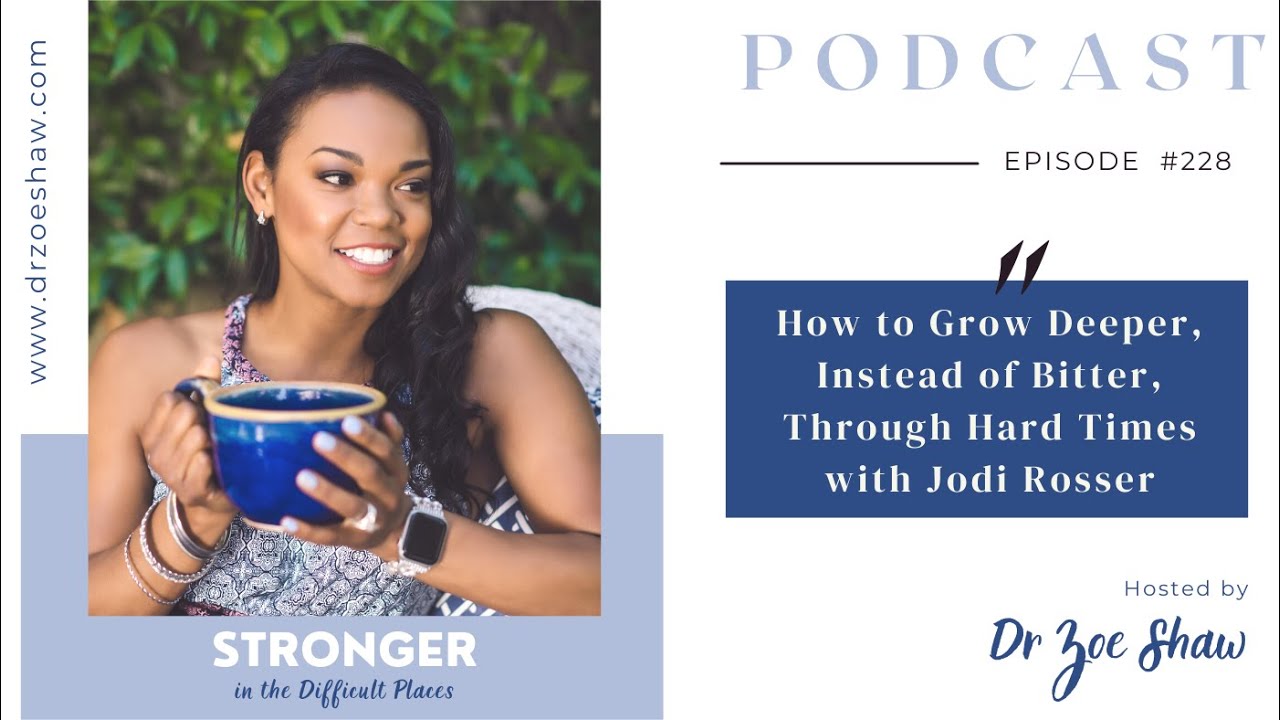
In this interview, Dr. Zoe Shaw talks with author and podcaster Jodi Rosser about transforming personal heartbreak into spiritual strength. Jodi recounts three major crises—a miscarriage, a divorce, and the death of a close friend from cancer—and how each deepened her faith. She introduces the concept of "depth" using tree metaphors (oak, Angel Oak, bamboo, sequoia) to illustrate the need for deep, unseen roots before visible growth. Jodi outlines her STRENGTH acrostic framework (Seek God, Tearfully grieve, Replace finite view, Embrace character development, Never lose sight of grace, Trust God, Honesty in sharing) and explains each step with practical tools: journaling, anger processing, counseling, reading specific Christian books, and intentional prayer/praise. The conversation contrasts outward blame (bitterness) with inward responsibility (growth), emphasizes the healing power of sharing one’s story, and highlights how personal pain can become ministry. Jodi shares resources—her website, podcast "Depth," book "Depth: Growing Through Heartbreak to Strength," and social media—inviting listeners to connect for encouragement.
Chapters
for coming on, Jodi. I'm so glad to have you here today.
Oh, it's wonderful to be here, Zoe. It was so fun to meet you at the Hope Writers Conference. Just, gosh, that was in November. So it's fun to see you again and through Zoom.
Yes, I was just gonna say, we met there and it was so wonderful to meet you. And I fell in love with the name of your podcast. I fell in love with some of the work that you were talking to me about, but I actually have not done my own deep dive. And so I'm really excited to hear for the first time with my listeners, your story and how you got to this place and everything that you have to offer.
Well, thank you so much for having me. I'm excited to share. So you want me to start a little bit about me?
Yes, please. So, so what I'd like to hear, because we're going to talk today really about moving from heartbreak to strength, right, and how you can use your heartbreak to really become your greatest strength, which is kind of what I've done in my life and what I've done through my writing and the work that— I mean, that's why I have this podcast. So can you share a little bit about your story? What have been your heartbreaks?
Yeah, well, I love the name of your podcast, Stronger in the Difficult Places, because I think we get stronger in our faith when we go through hard times. I mean, as much as we would love to say we're growing stronger all the time, I think when we hit a point in our lives where it's not what we hoped or expected, then we have like these moments where we have to really evaluate our faith and it deepens, it gets stronger. And so for me, that happened multiple times in my life. My very first heartbreak was my miscarriage. I had had my son and we were expecting again. I was so excited and it was the second trimester. So I think, you know, you kind of maybe expect there could be a complication at the beginning. And we'd gotten to that 12-week ultrasound and everything looked strong. And then it was like a month later and it was like, God, I don't understand. Like, we thought we were through the hard part. You know, we thought we had this. So I remember that just knocked me off my feet. It was the very first time life did not go as I hoped or planned. And it was a really hard summer. And And so that was my very first heartbreak that I think just rocked my world. But God taught me so many lessons through that one. But then the greatest heartbreak I would say I walked through was my divorce. That was 8 years after the miscarriage. And again, it wasn't something I wanted for my family. And here I am in a season now as a single mom. I had 2 boys. They were really young, 6 and 10.
Oh, man.
And I just thought, wow, God, this is not what I had planned for my life. And I think that one was the one where God taught me so many lessons. And that's when my writing and that's when my whole ministry began, which I think is interesting that a lot of our hard times become these places where God uses it to help others. I know, I know that's true for you, and that's been true in my life. And so that was where it was birthed. But again, it was just, oh, such a hard season in my life. And then 2 years after that, I kind of thought, okay, God, I've had 2 hard heartbreaks. Like, I feel like I've had enough. That's enough, right? Right? Enough, God. And then my dear friend sadly calls me, and she says that she had a cancer diagnosis from her doctor. We didn't know what kind. We find out a couple weeks later it was pancreatic cancer, which is really a tough one. And 4 months later, she passed away. And I think that one is where I had a lot of doubts and questions for God of just like, I don't understand what's going on. But through all of that, my roots grew deeper in my faith. And my podcast and my book are both titled Depth. And I want us to think about that, that deep-rooted faith. Really, the times that that happens is during these unexpected storms that enter our life out of nowhere. And we're in a place where we have to decide, are we going to run to God? with the pain, or are we going to turn away from our faith? And so I just asked God to enter in. It was just simple, like, help me, God, I'm struggling, give me strength today to help my kids. It was nothing monumental, but I just had this intimacy and depth in my faith with God during those times greater than I ever had before. And that kind of birthed this— what if your greatest heartbreak catapults you to your greatest growth? And I just— is what happened for me, and I think that's what happens for a lot of people. Now, it's a choice Right. You don't just automatically get there. You have to choose it. But I do believe it can happen. And so I love to encourage people in the middle of hard times that, yes, grief— you have to feel the emotions. I'm not asking you to go through grief quickly. I still want you to take the time to grieve. But if you could just keep that perspective in your head of what if this is going to catapult you to a growth in your faith that you couldn't have gotten to if you didn't walk through it. And so it kind of gives a little purpose to the pain, which I think helps. When we're walking through these hard heartbreaks.
Right. I, you know, I think that is so helpful. And I'm glad that you made the point that not everybody grows from hard times. It's something that has to be intentional. But I do believe that everybody can grow from heartbreak.
Yes.
And so we're going to deep dive into kind of those steps and the things that you did. But before we get there, I want to, to just talk about that word depth, which I love. I just love the title of your podcast and I love the concept and the metaphor of trees. I have a Tree with roots tattooed on the back of my— on my back. Because
I didn't know that.
I do. Yeah, I really connect with that. And the whole concept of the tree, the strength of a tree, right? And how the tree gets its strength by digging those roots so deeply, which is what we have to do in our lives. So let's talk a little bit about how you got there. How did you— when you had, you know, these 3 devastating things happen, how did you not turn towards bitterness? How did How did you not give up, essentially?
Such a good question. Well, I love to talk about the tree, and then I'll answer to that question kind of as a side thing. So the word depth came to me. You know, I don't know if you choose a word for the year, Zoe. Do you have the word of the year? Okay, so I started in 2015 right after my divorce, and I've been doing it ever since. So my word for 2017 was depth, and I had read this book that talked about you know, what this tree, this oak tree, and just this depth to it. And, and I just sat there and I thought, when I look at trees, I'm a big nature person. I always just captivated by the gorgeousness of the, the branches. And I thought, the part that's the most important part of the tree, we can't see. Yeah. You know, really what makes a tree strong is their deep roots. It's not anything else. And so I just became obsessed with the study of what's happening underneath. You know, so much of what our growth is, is the part that we can't see, that deep-rooted growth. And so I got to go to, in, in 2019 to South Carolina. And they have this tree there called the Angel Oak Tree, and it's 400 years old. Zoe, if you ever can get there, you will be captivated by this tree. It is beautiful. And when I stood next to this tree, I mean, it was magnificent, the, the size. But what got me most jazzed is what I couldn't see. I just pictured that equal amount of growth underneath, because to really make that tree survive 400 years, to survive the storms that it went through in its life, wasn't How high the branches reached. It was how deep those roots went down.
Right.
And so to really think about it, they need to be equal. So I like to think about like it's a mirror. So if you have like your tree, imagine that tree flipped, and that's the amount of growth you need below. And so I just decided when I had heard that word depth, it just ignited in me this desire for this deep-rooted growth. Well, how do we get that? Well, it started when I realize now it started by me reading tons of books. Well, why was I reading so many books? Well, I was reading so many books cuz I was in the middle of a crisis. Right. And I needed encouragement and hope, and I needed truth spoken to me because I was drowning. I felt like I would barely keep my head above water. Another wave of grief would hit. So I was reading stories of other people, and they were Christian books that were speaking to my soul of God is with you in the middle of the heartbreak. God is with you. And, and if, if they could do it, if God could do it for that person, then I thought, well, God could do it for me. And so these books sparked hope. They ignited hope in me. And at the same time I was healing from my heartbreaks, from reading these books, I didn't even realize I was growing.
Right.
My roots were growing deeper, and I just didn't even know. Like, you can't see that growth. But it all of a sudden occurred to me as I had this word depth come to my head, like, oh my goodness, this is happening in my life. And so I'm realizing that this can— this, this deep-rooted growth can happen for others as well. And so this is what I want to encourage women. I want to encourage them to grow deeper through their— in, in through the storms in their life. And, and doesn't mean that you like the storm. So let me just clarify that, because people are probably like, oh, this lady's so excited about the storms. I'm like, no, no, no, they were horrible. They rocked me. I wish them on no one, even my worst enemy. I would not want anyone to walk through what I walked through. But what happened was the God of the universe met me in a way I never had been met in my pain. And I didn't want to become bitter. I didn't want to have these things change me to where I became— you know, I've met people that the storms of life have caused them bitterness, and They're not fun to be around, and I don't want that. I, I realized I want God to use this to grow me. And I remember just the next morning, or a couple mornings after my greatest heartbreak, when I knew our family was splitting apart, I remember just writing in my journal, God, use this to grow me. I, I don't even think I knew what I was writing, Zoe, when I wrote those words. Mm-hmm. But I just knew I don't want this to make me bitter. I want this to make me better. And so I started searching for answers by reading, reading my Bible more than I'd ever read before. Reading Christian books that would lead to things in the Bible. And all I realized at that moment is those were growing deeper and I didn't even know it. So I love this illustration of a tree because you, you don't know when that storm's gonna come. That tree has no idea when a windstorm's gonna come. It has to be prepared. So that deep-rooted growth needs to happen also just in preparation for the storms of life. It could happen anytime where we're hit with these unexpected things— death of a loved one, cancer diagnosis, No, those are going to happen. And so I love to encourage women to grow their deep roots in there.
I love that. And, you know, as you were talking, I was thinking, okay, so what's the difference? What's the— what makes one woman become bitter and one woman become better? And I'm listening to your story and I'm thinking about my story and I'm thinking about stories of my clients. And what it is, is turning inward. Because when we turn outward, When we blame, when we try to, you know, figure out how to change other people, right? We become bitter because we recognize there's no control. We, we're telling ourselves that we have no locus of control, and it makes us feel hopeless and bitter. When we turn inward and we go, okay, what do I need to learn? What do I need to do to change? Number one, we are being productive, and that tells our brain that there's something that can be done about it. Right? Which gives us hope. And then number 2, we're like you said, we're learning and we're creating depth and growth. So I love that. But for the woman out there listening, I just want to point out that difference. Turning outward, blaming other people, looking at other people and expecting them to change or wishing they would change or hoping they would change or being angry at them. And anger is a natural process. So let's not, let's not say you should not be angry. That's a natural process of grief. Yes. But when your focus is external, You're more likely to develop bitterness. When your focus is internal, you're more likely to develop growth.
I love that. And I think it's true. Like, I always tell people, experience all the emotions, right? Allow yourself to feel the anger, but just don't get stuck there. That's the key. You can't park there. Like, I know someone that's parked there and they're still in that anger phase and it's been years. And it's like, I want— every time I talk to her, I wish her that she can forgive, because it is going to keep you stuck if you can only stay in the anger. But you have to let yourself feel the anger, and you have to journal. Yeah. Oh, I was a big journaler. That's a hard word to say, journaler, but I journaled all the good, the bad. Like, I don't want anyone reading these journals, Zoe, someday, because they shared it all, because there was so much hurt and feelings of disappointment and devastation. And anger is that secondary emotion, and usually what's right below it is hurt and disappointment. And the old me would jump right to anger, and I didn't even know that it was secondary, that there was these Other emotions that my counselor helped me see. This is what really— what feeling— this is what's causing you to feel the grief. But if you stop and go underneath the anger, what it was like an umbrella, like picture the anger as an umbrella. Disappointment, fear, worry, all of those are what's under it. And if you can really park there and let yourself really grieve, like you can't heal until you feel. So you gotta feel those feelings and allow yourself to feel. And then ask God to help you move through them and move past them, but not ever, never that you have them. Like, that's not going to help you grow. Actually, in my book, I have an acrostic for the word strength, and my first T is tearfully allow yourself time to grieve and process the emotions. You have to. You're going to get stuck if you don't let yourself feel it, but that's not where you stay. So you— so the S is seek God and invite him into your pain, which I feel like is what we just talked about. That T is to let yourself grieve, like tearfully allow yourself time and take time. It's not a quick thing. Grief is slow. It is. And everyone's gonna try to rush you. I always tell people, like, it's like you're underwater. They're trying to move you to the surface. But as a scuba diver, we— when I used to scuba dive, you have to take little safety stops along the way up. So what if you had someone that was willing to sit underwater with you and sit there until you were ready to move to the next stop? That's what grief should look like. You want to take that time. But the R in grief—
Well, let's stop there. I wanna stop right there real quickly with the T.
Okay.
Because when I think of, of all those feelings and especially the anger, I just want to create a vision of a woman walking through that anger. And like you said, it's so important to feel it because if you don't, you're still feeling it, you're pushing it down and you're creating something really unhealthy and dysfunctional. And so I like to visualize, you know, kind of just like a, a long, maybe like What are the runway? And maybe there's fire on the runway, right? And you're walking through. But as you walk through the anger, you're purging, you're purging, you're purging, and everyone's going to purge in different ways. And purge, of course, just means to get out. So you are making sure that as you're walking through, the way you don't stay stuck in that anger is to purge and keep moving forward, purge and keep moving forward, purge and keep moving forward, and you will get through that space. Okay, let's get to the next one.
No, I think that's so good. And I, I just think that you have to tell someone. You can't keep it inside. So I had a Christian counselor, and she was phenomenal. I'd share with her, or I had these friends. There was the 3 of them, 4 of them that I would just call and rotate through. Like, I gotta tell you this. You have to get it out. And I love that purge and move forward. So lament, purge, whatever word you wanna use. But yes, get it out with someone you trust, not all over social media. Let's, like, let's be clear. We're not purging to the world. Purging with someone trusted. And I think that's really good. Okay. So my R is replace your finite view with God's infinite perspective. Because I think a lot of times we look at this and we see it's like a puzzle piece of the puzzle, and we're like, we don't want this piece. Like, God, I don't want to be divorced, or God, I don't wanna have a miscarriage, or God, I don't want my friend to have died to cancer, or God, I don't want whatever it is.
Right.
I don't want infertility or suicide or whatever it is that you have in your, your story. Or someone in your family's story. But what if you were to ask for God's eyes to see what's the bigger puzzle? Because that piece, if I didn't have those things, Zoe, I would never have had my ministries begin. I— that doesn't mean that God didn't have other plans for me, but I now can help others in their pain because I've walked through pain.
Mhmm.
I can help someone that's going through something hard because I have walked through something hard. You, you can't enter into that empathy until you've experienced. And so even though I don't want to have walked those things, Now I can use them. And so that's that bigger perspective of God, help me see. Maybe we don't know why are we in a season of waiting? Well, I, I don't know why you're in a season of waiting, but I know for me, God was developing me. And that's my E, embrace God's character development in the midst of the chaos. Oh, you guys, there was so much I didn't know about myself that came to light as I went to counseling and learned like, oh, that's, that's what they have to live with, right? Like, this is who I am. And these are things I didn't want. I wanted to learn and I wanted to grow and I wanted to become the better version of me. And I read a book in 2011. So I actually read these books before I actually got divorced. But change is slow. So I just want to let people know it takes time. And so it didn't quite happen right away, but these were some steps I was working through. But the first book was How We Love Our Kids by Mylyn and Kay Yurkovich. And it is a phenomenal book about parenting. But instead of looking at the kid, you look at yourself. Because so much of things that happen to us in our childhood affects our parenting and triggers us. And they have these different love styles. I'm telling you, Zoe, it is a phenomenal book. They have a marriage one called How We Love. They live here in California. I actually went to their counseling center. They have a counseling center here. They go to my church, Saddleback Church. But they are a phenomenal couple. Focus on the Family's had them on. Their book is a life— one of my people go, what's your life-changing book? How We Love Our Kids. It was the first time I had self-awareness and I realized, wow, I read this chapter on the vacillator and it was like, this is me. But I'm like, what's a vacillator? I don't even know what that means. And so we vacillate through these times where we connect with our loved ones to these extremes of like, now I have these, um, high expectations of them and they're not met, and what do I do with the disappointment? We've— and so we go to these extremes. Yeah. And I— yeah. And there's— and for me, it was reactivity. So when I— things happened that were a struggle, I would react. Some people withdraw. But it was just this first time I could kind of get this little picture of, wow, this is something I had to dive deep and go back into my childhood and identify things and just go, where, where are these struggles happening? And I have a chapter in my book called Embrace the Chisel where I encourage people to do this because you're not gonna change and you're not gonna grow if you have— if you don't go deep and start looking at yourself. You can't change anyone else in your life. Don't look at the other person that hurt you. You gotta focus on you. And so that was the first book that opened my eyes to, wow, I got some growth work to do. The second book was Unglued by Lysa TerKeurst.
Oh.
And I read that the following summer in 2012, and I realized, oh, I'm a reactor. And so why do I react? And Why do I react to my loved ones? And I just had to ask these harder questions. And this word self-awareness became one of my favorite words. I'd say to people, self-awareness is the key to change. It's not— this doesn't cause the change. It's the key to change. The change is hard work. The change is time. It's the first step, though, to you seeing, hey, this is something I need to work on in myself. And so I read Lisa TerKeur's book, Forgiving What You Can't Forget, just last year. But she has this section called— it's all about dots. Okay, let me see if I can say it right. Like, identify the dots. Correct the Dots. I'm not— but I'm butchering it. But if you read about it, basically, it's kind of what I did. Identify your struggles, right? Go through the growth steps, and then what do you need to repair? Where are there things that you need to do to repair those things? And so it was just really cool to see years later as I read her book, like, I did some of this hard work. There's always work to do. You never arrive, y'all. So do you know what? There's another thing that happened in my life recently, and I had to start doing it all again. But those original ones kind of started this path, and You know what? I, I introduced this term in my home. My response is my responsibility. Up before that, Zoe, I was a blamer. You— something would happen and I blame you, you, you. None of it was ever my fault. Well, guess what? That is not true. If I react and I get angry, that's my fault. I can control my emotions even if I'm triggered. But I used to blame. If you hadn't done that or said that, I wouldn't be yelling at you. It's like, that is so not okay. That is disrespectful and that is not true. I am responsible for what comes out of my mouth. That takes responsibility. That person did not Yeah, they didn't make me get angry, right? And so we started to say this around our house. Well, then my kids, I'd say to them, your response is your responsibility. I have to tell you, Zoe, about a year into it, I had a, you know, we all are growth works in progress, right? So I had a moment, a little setback, let's say that, where I got angry again. And my kids say to me, Mom, your response is your responsibility. And it was one of those moments where I was proud and angry all at once because I was so proud that they were reminding me the truth. But I was so angry, like, oh, that's so true. And I just wanna be angry right now. So I had to back up and go and repair the rupture and say, I'm sorry. I, I, you're right. My response, my response. But it was this life-changing time. And you know what? I wouldn't have developed those character traits if I had gone through life with everything going well. Like, these things happen and God grows us. I think of Joseph. He's my favorite character in the Bible, Zoe. And I think about God gave him this purpose in life. Me too. But he started as this unself-aware boy bragging to his brothers about his dreams. I, I laugh cuz I think of myself was— I was unself-aware for so many years. So I kind of relate to Joseph. I want to, like, be like, buddy, I get it. Like, we don't know what we don't know. And I didn't know that we were, you know, unself-aware. But then what did God use to grow him? Detours. He ends up in the pit, and then he ends up at Potiphar's house.
Heartbreak.
All those—
Loss.
Heartbreak. All these losses, grief, all of that were things he didn't want to walk through. But those are the very catalysts that grew him. So when the time came for The Pharaoh to bring him up and interpret the dream. He was ready. God had developed him. God's not gonna take you to that new height until he's developed you first. And so I always talk about deep roots. It's not only so you can endure the storms, it's also because God's gonna wanna take you higher. And if your tree's gonna get taller and higher, it has to have deeper roots first.
I love that.
Yeah. And I like to talk about bamboo because think about bamboo, it's gonna be 100 feet tall, but guess what? The first 5 years of the life of bamboo, No growth external. You would look and think this, this has died. You'd planted seeds of bamboo and you would think there's no growth. This, this plant has died. But for 5 years, all the bamboo's growth is happening downward. Deep, deep roots, because it's gonna grow 100 feet tall. In order to be able to go to that height, it has to have the depth first. And so maybe in your life right now, you're growing your deep roots because God has big plans for you. Yes, these heartbreaks have been hard and they've grown you, but maybe there's more. And God's gonna, who knows, like you and me, start a podcast, write a book. We don't know. I'm not gonna put that on you. you. God has a purpose for you. Maybe it's just to help another hurting heart by sharing your story, but those deep roots, he's not going to waste them. And so maybe it is to grow you to new heights, but I get so excited about it. You can tell. But I—
I hear it, and you're ministering to me. I love it.
Yeah, but that character development— listen, no one wants to be chiseled. It's like no one wants to go in the refiner's fire and have us be worked on, but that's such an important part of it. And so that's my E, embrace God's character development. And I think That is a hard one. That's where a lot of people want to turn their backs and go, now I want to be bitter. Why are you putting me through this? But again, if we can have that perspective, maybe there's something bigger going on here, and in a couple years we'll see it. We can't see it right now, but we just ask God to grow us through it.
And then my end is— I was just having that conversation with a client right now, and, and nobody wants to hear that. Like you said, when you're in the midst of it, you know, maybe you can't hold on to that, or maybe you can just hear it and let a little bit trickle in and know that It will get better. That the beautiful thing about life is that it never stays the same. And so although you're feeling so dark and deep and you can't see any hope and you can't see any purpose for this horrible thing that might be going on right now in your life, yes, it's there and it doesn't matter right now. You don't need to focus on that. You just need to focus on walking through.
Yes. And you know what? I think it's nice to just keep it in the back of your mind that there could be more. It's kind of like that song, The Waymaker. Even though I can't see it, he's working. Even though I can't feel it, he's working. You don't see it, you don't feel it. And so in your mind, you're like, he's not working. But he never is not working, you guys. He's always working. You just aren't gonna see it. You might not see it for 4 years, 5 years, 10 years. You might not ever see it. Like, I almost wanna say that to someone right now, 'cause things— okay, well, I'm just gonna wait till I can see. You might never see how God uses the pain that you went through.
Mm-hmm.
But he is gonna use it, and he's gonna either use it to grow you or to help someone else or to start a ministry, or— there's so many ways. But in the middle of it, you can't see it. But to try to just remember that he is still working and just keep that, especially on those really hard days. Like, God, I can't see it, but I'm just praying that you're still working and I'm trusting. That's my second T in strength, the trust that God is working. But it's really hard when you can't feel it, right? So I'm glad you said that because those people out there right now listening going, I think that's great. She feels it right now. But I didn't. But I didn't for many years. If you— I wish I could go back in time and tell the 2014-year-old Jodi or 2014-year Jodi when the whole world just turned upside down and I'm going through a divorce. you are gonna have a ministry that is birthed from this. I wouldn't even believe it if I was probably told, right? But God wasn't gonna waste it. And you're gonna write a book and you're gonna help others. I'd be like, what? Like, but I love that he has a bigger plan than we could even understand, right? And so—
Beautiful.
Just that hope. There's just that hope. Like, if he did it for someone else, he could possibly do it for me. And I think that's what ignited me as I read the books. So the N is never lose sight of God's grace. And I think this is so important because there are some heartbreaks that have a shame attached to them. So for me, divorce had shame attached to it. I didn't wanna be divorced. I was a strong Christian. I was embarrassed that others were gonna find out that I was going through a divorce. That's not how I felt when I had my miscarriage. There wasn't a shame attached to it. Right. It was outta my control, right? But sometimes there is a shame attached to addiction. There's different things. And so there's a whole section where I talk about this, that, that God can take whatever you're going through and use it. It doesn't mean because you've walked through something that's shameful that God still is like, oh, you're disqualified. If anything, he qualifies you even more to talk to that other person that's feeling that shame. Because now you can feel like you know what they're feeling and you can enter in and help them. And I remember there was this divine appointment that happened as I listened to a woman speak. And I remember God saying in my head, like, you may have a broken heart, but you're not a broken vessel. I could still use you.
Mm-hmm.
And maybe somebody needs to hear that today. You may have a broken heart, but you are not a broken vessel. God can still use you, and he probably is gonna use you through that very brokenness that you're walking through. And it's maybe not what you would want, but he is— you're gonna be able to reach people way more in your, in your, um, struggles than you can in your success. No one wants to hear from you when you've got it all together. Trust me, they want to hear when you're vulnerable and this is what I'm going through, and you're going to be able to enter into someone's pain and help them in a beautiful way. And so I just want to say that—
go ahead.
Yeah, go ahead. No, go ahead. I just wanted to tell someone that that might be feeling shame right now.
Yeah, I'm so glad that you mentioned that because sometimes we think that those self-inflicted wounds, those self-inflicted things that are going on in our life don't count because we did them to ourselves. So God can't use that, or, you know, there isn't any hope for that because I've done this to myself. And that's really part of what shame is, is this idea that I myself, right, am bad. I myself, um, am not good enough or not worthy. And yes, I mean, we can think of so many examples where even self-inflicted harm wounds can be used. I'd say even especially, right?
Especially. Yeah, the The very thing you think you— that has disqualified you is the very thing God wants to use. The very thing that you think, he can't use this. No, he can. You are not shackled to that shame. God has grace, and he wants to let you know you are free, and he's going to take your story. And because that has happened, you have a story to share that's going to reach someone else that maybe we couldn't reach, someone else can't reach because they haven't walked that storyline. Who better to help someone that's walked through divorce than someone that's walked through divorce? Who better to help someone that's gone through an addiction than someone that's walked Through an addiction, right? Like, these are the very places we minister to others in the very place we don't want maybe others to know about. And so I just think it's important for someone to hear that because sometimes I know for me, I almost got stuck there and I almost wasn't able to get past it. And, and, and I have a chapter called A Divine Appointment and I'll, I'll, I'll let people read about it, but it's a moment in time where I can't even imagine what would have happened if I didn't hear that message because I needed, I was stuck in my shame and Satan was trying to keep me there. And I was like, I am not. I, once I got free of it, I was like, oh, you almost had me. But now I'm gonna tell everyone. So this is me telling y'all. Um, the G is give praise to God even as your heart breaks. And there's something powerful about being able to be thankful and offer praise in the middle of your pain. It's very hard to do.
That's a hard one. Yeah.
Because you're like, how can I praise God? But there's a song that really helped me, Praise You in This Storm by Casting Crowns. And I would just put it on a loop, like, and pray. And by the end, I was lifting my hands and praising God and singing because there is something powerful about it. He is meeting you in the middle of it, and you can praise him for that. You're not praising him for the circumstances or the hard thing. You're praising him for him showing up in the middle of it, because he is not leaving you alone in your pain to walk by yourself. He's saying, I'm here. The Lord is close to the brokenhearted. Psalms 34:18. It's my favorite verse because he actually is closer than if things are going as they're supposed to. So know you're not alone, and you can praise God even if it's hard. I have a chapter in there called The Gift of a Day, and I had a time with my friend A special day right before she passed that I didn't expect to have it happen. I was gonna take the kids and leave and go to a jumpy place because she needed some time alone to be quiet. It was loud, but she was having a hard time getting out of bed, and she's like, can you come here with the kids? And I got this gift of time with her. And I don't praise God for the fact that she was ill and sick. I praise him for that gift of extra time with her. So sometimes it's the gift of an encouraging word from a friend. You can praise God for something small. It doesn't have to be something epic in the middle of your storms.
Yes.
The T is trust God is good when your mind is doubting and you don't understand. And you guys, this is second T. There's 2 Ts in strength. And a lot of times people want you to trust right away, and sometimes the trust is hard. So just know it's a process. The, the tearfully allow yourself time to grieve comes first, and then as you're in there and you're asking God to help you, then you can start working on that trusting him. I, I feel like it, it's a process, and we can— and I— and there were many times I said, God, I want to trust you through this. I wasn't always there yet, but I always said, I, I know you're still good. I just don't feel it right now, but I trust that you're gonna somehow use this for good. So even sometimes just claiming what you know to be true, even if you don't feel it, is Really big, and then last is my favorite one: H. Honestly share your story and help another hurting heart. It's not going to be able to be used if you keep it to yourself. You have to tell others. And this is where I get excited about a tree, Zoe. I'm going to tell you this tree story because I was fascinated. So we live in California, so I don't know if you've been up to the Sequoia National Park. Have you been there? Okay. So these are the biggest, tallest trees in the world. And so I kept thinking to myself, oh, their roots must go so deep because they're like hundreds and hundreds of feet tall. Well, I get there and they're like, no, they don't have deep roots at all. And I'm like, whoa, whoa, whoa, you're totally messing with my entire message. But then they said this, they said they don't go down deep, they go out wide. Right. And they interlock with the tree roots next to them. And they're more powerful in community than they are by themselves. And they're powerful because they've interlocked tree roots with another tree. And so I thought there, sat there and I thought, wait a minute, this is a beautiful picture of how we are. So yes, we need that deep-rooted faith, that time with God that's gonna grow our roots deep, but that's not where we're supposed to stay. We're supposed to then share it with someone else and interlock truths with them and say, I can help you because I've walked this too, and I'm going to walk it with you, and I'm going to give you encouragement. And maybe it's just sharing what you walk through. It's not like you have to have the answers because there really aren't answers. It's just the gift of presence and the gift of—
Action.
I understand. Me too. Connection, right? And I'm going to pray for you, and I'm going to walk through, and you can call me when you're going through something hard. And, and you interlock this beautiful truth, and that tree is now stronger because they're connected to another tree. And I sat there and I thought, that's the honestly share your story. If you keep it to yourself, you're missing a big part of what God wants to do through you. And each one of my heartbreaks— I'm not telling you, it was crazy— a year later, each one, another person would call me. I have a friend that's going through this, and it was the exact heartbreak, and I was able to help them. And I didn't really even know when I reached out to that person how it was going to bring my healing full circle. But it did. It was powerful. And you can't get there if you just keep it to yourself. And you're like, but I don't want to tell someone. This is embarrassing. I know. I don't want to be known for the person that walked through a divorce. But you know what? I can't help someone unless I share that.
Right.
And I don't want to have whatever it is. It's okay. And it doesn't mean you blast it to the whole world, but you can honestly tell one person if you know that would encourage and help them. And so that's the last H, or that's the last part of strength, the H. So that's the cross-stick in the book that kind of traces how I went from heartbreak to strength.
I, I absolutely love it. And especially that last part, because sharing your story, connecting with others doesn't just heal them, it also heals you. And a lot of times we're thinking, well, why am I going this— going through this for somebody else? But no, actually, you walking through that process is a healing process for you too. And it's important to recognize that.
Yeah, and it does give purpose to your pain. And that doesn't mean the pain is better. It's still hard. It's still all those hard things you got to go through. But to know that there's a purpose sometimes gives us a little light at the end of the tunnel, you know?
Can we talk for a minute about being angry at God? Because, yeah, as you were talking, as you were walking through this, I was thinking, oh yeah, but let's not forget that that's okay too. Yeah, we need to recognize there's a bigger story here, but We are humans and God gave us a human mind, right? And our mind, part of grief is anger. And it's okay to actually express that to God. I think so many people get scared to do that as if somehow that's sacrilegious or that, you know, that's not showing faith. No, it's actually having a real relationship with God. I think we can be angry at God because we don't know why he's doing it. I agree. We don't understand. And sometimes it feels very unfair.
Yeah. You know what? I think we have to be honest with God. And sometimes the honesty is, I don't understand why. Why am I here? Why is this happening, and I'm angry that I'm walking through this. When I say run to God in your pain, it doesn't mean you run like, oh, everything's wonderful. You run to God, and sometimes you run to him angry and doubting.
Yeah,
it just— don't turn your back. There's a quote by John Ortberg that says if you ask people the number one reason why they walk away from the faith, their faith, the answer is suffering. But if you ask someone else the number one reason that your faith grew the deepest, the answer will be suffering. So suffering is just the catalyst, you guys. It's what you do with So running away from God means you, you don't— you could be angry and run to God. Let me just say it that way. You don't have to only run to him when you have all the answers. Actually, it's actually meant— you're meant to run to him and ask him for help with the answers. Like, I don't understand, why am I this? I'm angry. I'm angry that this is now the situation for my kids. They're now in a broken home. Or I'm angry that now this mom of my friend who died, her kids don't have a mom. Like, God, why? Why would you do that? Like, get it all out. I'm not going to tell you right away you're going to have answers to your questions, right? But you running to God, you're wrestling with God, he's gonna show up in ways. Just the intimacy with God, that depth. It doesn't mean every answer gets— and actually, I don't think even if we got answers that we would feel like they were good enough, you know?
Um, yeah.
Or understand them, right? Because what if God was to say to you, well, this is— you'd be like, no, that's not good enough. So I, I do think though it's okay To say everything you feel to him. The doubts, the anger, all of it. Run to him with it, though. Don't turn your back and say, I give up on my faith, because that's the other option. And you know what? Then you're alone, and you're already feeling alone in your grief. You don't want to walk through it alone. God wants to walk with it through you, walk with you through it. So don't just go with all the anger. And I have a chapter called Why God? And it was interesting because it was right when my friend— I just couldn't get my hand wrapped around it. Like, God, you could heal her, and everyone knows she's a Christian. It will all bring you so much glory. Like, why are you not doing that? And that wasn't his plan. And I still to this day don't always understand, but I had to kind of like Jesus knelt in the garden and said, yet not my will, but yours be done. Like, I had to release it and say, whatever you decide, I'm still going to believe that you are a good God, even though I don't understand it, even though I don't want this to be the way you end the story. Like, I want you to rewrite it for a different way.
Right.
But even if this is what the path you choose, I am going to still believe that you have a good plan. And so, but it's that wrestling, that deep wrestling, I think, is really where this intimacy of the depth happens. Mm-hmm. Because it's not like you— and I think David models this so well in the Psalms. If you read what he says, he tells all his feelings. I feel this, I— but this is what happens when you're writing in your journal. Don't stay stuck in there. End it with something that you believe, even if you don't believe it for that day. I know God. said that you have a plan even though I don't see it. Or, God, I know you are close to me in my brokenness because it says in the Bible you're close to the brokenhearted. Maybe you just write a scripture even though maybe you can't fully grasp it, but you know that to be true. So journal it all out, get all the hard feelings out, but don't end it with the I'm angry, because that's okay to say, I'm angry, God, but I know—
Yeah, but not
with emotion. With something, some truth statement, because God, that's what David did so well to God, you know, but I know you are my strength and my my hope and my, my refuge in the middle of this storm. And he would end it with these statements that gave some hope to him. But definitely get all the hard feelings out, and anger is one of them. Anger towards others and anger towards God is, is definitely going to come out.
Beautiful, Jodi. I feel like you have shared so much already and, and really just, I, I hope, ministered to me for sure and, and to some other women or, um, listeners. Do you have— well, first, I always ask that question, but let me go back to— I'm going to read your book. I love the title, and I love everything that you're talking about right now. So I'm really excited to read your book. Usually I read them before, but time just didn't happen.
I understand. As a fellow podcaster, I totally get it.
So thank you so much for sharing your wisdom. And I know that your pain is helping other women. So do you have one thing, although you shared so much, but just encouragement to a woman who might be out there feeling really brokenhearted right now.
Well, I want to share with you that in the middle of my brokenness, I read a book called The Mended Heart by Susie Eller, and she talked about this woman who gave her testimony by holding up a cracked clay pot. The image was so powerful that that weekend I went and got a pot and I went into the backyard and I broke it. I took it and I slammed it against the edge of the planter until it just crumbled into pieces. pieces. And then I took those pieces and I glued them back together with a hot glue gun, and I put a candle inside of it. And there is light that comes out the top, but the light that came out the cracks was just beautiful. And I thought to myself, I always wanted to be a perfect clay pot. I didn't want— I'm— I struggle with perfectionism. That's one of my struggles. And I never wanted anyone to know about my cracks, let alone see them. Then God showed me this illustration with this cracked pot with this light streaming now. And it was like, but Jodi, you're much more of a light when you allow that light to come out the cracks instead of pretending those cracks aren't there. Because listen, everyone has cracks. If they tell you they don't, they're lying. They're— everyone's going through something hard, or they've walked through something hard before. No one has a life without hardship and heartbreak. But if we could take that and use it to be a better witness to others and say, this is what I'm going through, this is hard, and you don't have to have the answer, But just say, this is where I'm at. I'm this broken pot. God's going to use you in such a beautiful way. And so I would say, I used to want to be that pot with no cracks, but now that I see the cracks and the way God's using them, I want to show others and say, listen, God's going to use it. I don't know how, but God is not wasting your pain. Yeah. This is the truth I learned after my miscarriage, that nothing is ever wasted. Not one tear, not one heartbreak, not one broken piece. If you will lay those at his feet and say, God, I don't know what you can do with this pain I'm in, but I'm gonna hand it back to you and say, I give you permission to use it. Oh, the way he's gonna use it's gonna blow your mind. And maybe you don't see it for a couple years, but it will happen. And so don't underestimate what God can do with your tears. Your greatest heartbreak is gonna become your greatest ministry. The hardest time in your life is become the most growing time in your faith. These are all true statements that you can cling to. in the middle of your storm.
Jodi, thank you so much. That is so beautiful and, and gives so much hope. How can, how can people get a hold of you?
Well, I have a website called jodirosser.com. My name is spelled J-O-D-I and then Rossers, R-O-S-S-E-R. And that's where everything's located. You can get a link there to my podcast, which is called Depth. And again, I have authors on that come and share stories just again really exciting. Some of my life-changing books, those people have come on. I've got to thank them for how their books made an impact on me. Current authors, I do Heartbreak to Strength stories as well where people just come on and share where their heartbreak and how it's made them stronger. But I encourage women to grow deeper in their faith and stronger in their relationships. So there's a link to my podcast there. I have a blog called Heartbreak to Strength, and I also have a book link there too for my book Depth: Growing Through Heartbreak to Strength. And that's also found on Amazon, but they can find all the places there. So that's the best way to find me. But I am on Instagram and Facebook. I've even tried TikTok and some of those other places, but mostly Instagram and Facebook. That's probably the best place. And I'm Jodi.Rosser on those. And if they want to come and send me a message, I love to encourage people. That's— I feel like I'm along the journey a little bit farther that now I could come back and help. But I have to tell you guys, it never ends. I'm in the middle of another heartbreak. My mom has dementia, and it's another phase. And I got— so I get my book out sometimes and read myself some truth to myself. yourself. It's fun when you get to speak the truth back to yourself.
Right.
But I wish I could say, I'm done, I've done my 3, I'm out. But that's not how it works. And, and so you are constantly going to be in a season of either in the middle of a storm or just coming out of a storm, or there's one on the horizon. You're in one of those 3 places. And so maybe you're not in the middle, but maybe one's on the horizon. So I, I just know— I just want to let people know I understand and I'm there to encourage them. So definitely have them, if they want to message me or Or join my email list and then email me, whatever they want to do. I'd love to connect with them and encourage them in the middle of their, their heartbreak.
Thank you, Jodi. I know that people can feel your heart. So thank you so much for coming on today.
Thank you for having me. It's been great. Thanks, Zoe.
More from Dr.



The Epidemic of Not Enoughness: How It Shapes Your Relationships—and How to Break Free


You Can’t Change This (And Neither Can They): The Truth About Temperament in Relationships

What Do I Do When Overwhelming Shame Is Keeping Me From Seeking The Help I Truly Need?


