How To Have Difficult Conversations And Come Out Better with Kimberly Beams Holmes
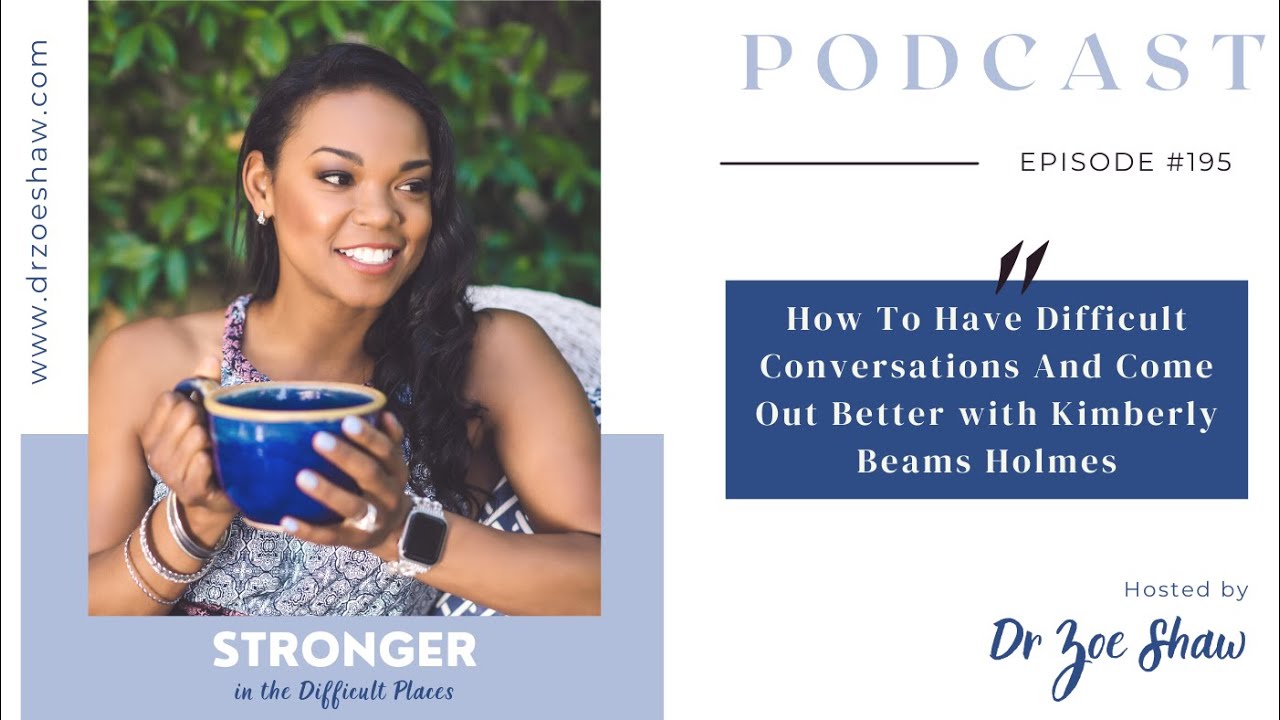
In this YouTube interview hosted by Dr. Zoe Shaw, Kimberly Beams Holmes—CEO of Marriage Helper, mother, wife, and host of two top‑ranked relationship podcasts—shares personal stories, the origins of her passion for marriage work, and practical guidance for navigating difficult conversations in relationships. She opens with a personal win (recovering from a severe foot injury) and a fail (struggling to be fully present with her husband after work). Holmes recounts her parents' tumultuous marriage, divorce, and eventual reconciliation, highlighting how their journey shaped her commitment to helping couples. The conversation then delves into common barriers to tough talks (sex, past negative experiences, personality mismatches) and introduces the conflict‑pursuer versus conflict‑avoider framework, referencing DISC and other personality models. Holmes offers concrete strategies for each style: for pursuers, avoiding emotional outbursts, using specific need‑focused language, and framing requests; for avoiders, allowing processing time, self‑reassurance, and setting clear timeframes for follow‑up. They discuss the importance of recognizing differing communication styles, avoiding assumptions, and cultivating curiosity about a partner’s temperament. Holmes emphasizes coaching each other, building trust, and the principle that personal growth precedes expecting change in a partner. The interview concludes with actionable resources—MarriageHelper.com, a free mini‑course, and Holmes’s podcasts (Relationship Radio and It Starts with Attraction)—and a brief teaser about her “PIES of attraction” framework. Throughout, the dialogue blends personal anecdotes, research‑based insights, and practical tools aimed at helping listeners improve communication and sustain healthier marriages.
Chapters
Welcome. I'm your host, Dr. Zoe. I don't often do the intros on video here on YouTube. If you want to make sure you hear the intro when I'm having a guest on, you can head on over to any place you listen to podcasts, Apple Podcasts, Stitcher, Google Play, all the, all the places. My full intros are on those always. But today I had a few minutes, so I wanted to make sure I popped in before my guest does. And today my guest is Kimberly Holmes. She is the CEO of Marriage Helper. She She is a mama and a wife. And she also is a podcast host of 2 top 1% relationship podcasts. One is called It Starts with Attraction. The other is called Relationship Radio. We're going to talk today about how to deal and like how to have difficult conversations with your partner and come out good on the other side. So I'm looking forward to our conversation. She'll be sharing her wins and her fails today. I might on the audio version of the, of this podcast, share my win and my fail, but listen in. Kimberly, I am so thrilled to have you on today. Thank you for coming.
Thank you so much for having me, Zoe. I'm excited to have this conversation.
Me too. So before we get started talking about difficult conversations, can you share a win and a fail with my audience?
Yes. Okay. So I've been thinking about this. Do you have other guests that when they get on, they're like, gosh, the win was hard to think of, right? Like, I don't— we're not primed naturally to think in that kind of way. But I will say a big one that I've had is I broke my foot on my birthday this past—
Okay, that doesn't sound like a win.
Well, that part's not— that was— and it also wasn't my recent fail. But that, that was— it took— and it took 4 months to heal. And, but here's the win. So yeah. And I thought, I honestly thought I was never going to run again. So I broke it while running and endured level 4 sprains on a midfoot, on my midfoot, underneath my foot and up my ankle.
Did you fall?
Uh, no, no.
It was stress, a stress fracture?
Um, no, it wasn't even a stress fracture. It was some, like, I just kind of hit a bump in the road wrong, but I kept running. And ended up having 4 bones on the top of my foot broke and then had the sprain underneath and on the side. Like it was the craziest combination from just a normal birthday run.
Right.
And I honestly thought, I'm never, I'm never going to run again. Like this is never going to heal. And yesterday I ran for the longest that I've run since that happened on my birthday. Even in the middle of the hot Nashville heat, I just had Some days I just have to go out for a run to clear my mind. So I did like 2.5 miles and I was— that's a huge win.
Congratulations. That's awesome. Yeah. I'm, I'm a runner, so I can definitely relate with that. I've had one big injury where I had to swim for months and it was, it felt so great getting back on ground and running. Yeah.
Yes.
Therapy, right?
It really, really is. Yeah, it really is. Now for my biggest fail. So this was just yesterday as well. I really try and do a good job, especially in the line of work I do, with cutting off work at the end of the day and then transitioning into mom mode, into wife mode, and being fully present. And, uh, so we had gotten our kids. I had texted my husband last night and, um, And said, hey, like, can we just hang out earlier? We typically start hanging out at 8 o'clock together at night. But I said, can we just start doing it earlier? It was about 7 o'clock. And so he comes in, he's situated sitting down on the couch starting to talk to me. And I start like, I'm half reading a book that I'm supposed to be reading for work and half talking to him. And I saw the look on his face. He goes, are you reading right now? This was like 10 minutes into our conversation, and I said, uh, and I couldn't say no because clearly I was. And he said, I'm just gonna go shower, and when I get back, be done. And I thought, man, I failed at that right then. Like, I shouldn't have even had the book open to begin with. I should have just been focusing on my husband.
How many of us can relate to that? Yes, thank you for sharing that fail. It's real, especially when we work from home, and so many of us do now. It's so hard to make that separation. And entrepreneurs too. It's even harder. So yeah, thank you for sharing that, Phil. Did you guys get back together afterwards and hang out? Good.
Yes. Yes. That's a win. That's a win. You're right. That's a win.
It's a win. Okay, so let's dive in here. I love your story. So if you don't mind, can you share how you became— well, not necessarily how you became CEO of Marriage Helpers, but can you share your Marriage Helpers journey with us?
Yeah, absolutely. So I think I know the story you're talking about. It's the kind of the origin story. I'm surprised.
Kind of your origin story, right?
Yeah. That's perfect. Yes. So back in the 1980s, my, my parents, they actually this year, they just celebrated 53 years of their, of the first time that they had gotten married. So they got married in 1969. And in the 1980s, my dad had become a very successful speaker in the industry that he was in. His speaking schedule was booked out for 6 years in advance.
Oh.
And I had 2 older sisters at that time who were 12 and 7. And, and, and my mom, of course. And it was at that time that my dad decided that he didn't know that he wanted to be in the marriage anymore. And in fact, he thought that he could be happier with someone else. And so he divorced my mom, left my 2 sisters, and ended up going and living this life that he thought was going to give him everything that he ever wanted. And what he actually found was that he went from being that super successful person to being bankrupt, living out of his car, wow, an alcoholic, a drug addict, and actually almost dying from blood alcohol poisoning at At its worst. Everything he thought he was going to have was not the way he thought it was going to be.
Mm-hmm.
And he realized in that time, I am not the person that I was, and I don't like the person that I've become. I want to get my family back. And so he called my mom after 3 years of being divorced. And she had already started dating someone else. And apparently that relationship was going pretty good. But he said to her, I want to try and fix this. I want to make this work. Will you marry me again? And she said, do you love me? And he said, I can figure out how to fall in love with you again, if you can figure out how to fall in love with me. And she said, give me—
What an interesting proposal. Right?
Right.
Yeah.
She said, give me 2 weeks to think about it. And so she asked everyone in her life, her family, her friends, every single person said, Do not do it.
Right.
But she said, I knew in my heart that he was a good person who had done a lot of bad things. But I believed the right thing to do was to try and make it work, especially for the 2 girls. And so they did. They were not madly in love with each other when they remarried the second time, but they figured out how to fall back in love with each other, and how to have a great marriage the second time around, more committed, more loving, all of the things than it even was the first time. And as a celebration of that second marriage, they had me, their celebration child, as they would call it. And I always love it when my dad tells the story. He goes, we had our celebration child, forgetting that celebrations are really only fun in the moment. I'm just sitting there rolling my eyes like, thanks. Yeah. So much. So that is how I came to be. And I mean, even more than that, there was even more crazy things. Um, like in my mom's pregnancy, there actually in her uterus, tumors started growing around me as I was growing. And it was the same hormones that were feeding me,
right,
that were feeding the tumors. And so, and this was in the 1980s, and the doctor said, we're gonna have to take all of it. We're gonna have to take the baby, the, the uterus, a total hysterectomy. And my parents said, no, we're not doing it. And so they prayed about it, the tumor stopped growing, and I was born, and the tumor started growing again. And they were able to take everything from my mom and, and I was fine.
Wow.
And I lived through the whole thing. So just crazy. Like, I have a crazy birth story and how I came to be. But one of the reasons that I'm so passionate about marriages is because I wouldn't be here if it weren't for my parents figuring out how to save their marriage, even when they were literally in the middle of all hopelessness. They had been divorced. It was over. My mom had moved on. But they, to this day, have a marriage that has given me a role of what I want my marriage to look like. And their marriage has, because of the work that my parents now do with Marriage Helper and them founding the company I'm now the CEO of, literally has saved tens of thousands of more marriages just from the hope that, that came from their own. So that is, that's the story.
Thank you so much for sharing that story. You know, I heard you on a podcast. And I realized who your father was, because I had heard him tell that story, maybe a year or years ago through his lens. And so it was, it's just so interesting hearing it through his lens, and then hearing you tell it. And I was Like, that must be her dad. So it's just beautiful, really beautiful. And I think, you know, I know as a therapist, I would probably advise your mother the same thing that all the people who advised her, like, no, you know.
Yeah.
Don't go back. Don't go back to that when you've already ended it. But sometimes we do have to trust and honor our own knowledge deeper than what other people tell us. And additionally, your mom said something that was really important. She knew that he was a good guy. She knew his character and she knew his heart deep down despite what he had done, right? And that makes a difference. It wasn't just that, oh, it wasn't a codependency. Oh, I'm just so in love and he wants me back and so I'll go back. It really came from a place of wisdom and strength. And that makes all the difference.
And you know, another thing, and I believe you and your listeners will appreciate this, the more I've talked to my mom throughout the years about what hap— what, like, what was her life like during those 3 years of being a single mom and co-parenting with my dad, but he only had my sisters every other weekend, and he lived in a different state. So they really didn't have much of a relationship. But she said, Kimberly, I stopped being the victim and I turned into the victor. She said, I began working on myself because that was the only thing that I could do. I, I could have stayed in the pity party and all of that stuff, but it wasn't good for anyone and I had 2 girls to provide for. And so that's— she had never worked before the divorce. Wow. began working, became a salesperson at a, like, a gas stove and furnace place, became the number one salesperson in that place. So she was killing it, right? Like, she was doing all of those things. And so when he came back and said that to her, you're right, it wasn't from this like, oh, finally he's back and this is what I needed. She knew who she was and she was fine without
him. Right.
And I believe that made their second marriage so much healthier. And that's all I've seen. All I've seen is the healthy marriage of the two of them. And, you know, I see them, uh, we're going to be talking about difficult conversations. I've seen my parents fight. I started seeing that when I was, I mean, as young as I could remember, but I saw them figure it out. I saw them either compromise or respectfully disagree and come back in and have those great repair attempts like we hear about in John Gottman's work. Right. So that was modeled for me. And I believe that, that, that difficult conversations become so much healthier in a relationship when both people aren't dependent on each other, but are interdependent. They can be fine separate, but they choose to want to be together.
I think that's one of my favorite words, interdependence.
Yes.
So let's get into that, then let's talk about those difficult conversations. Because, you know, so many of my clients and, and people who write in to me talk to me about how much they dread having a conversation that they know they need to have. And I'm talking sometimes years people will go holding things in and not having the conversation because of all of the emotion that gets brought up, because they don't trust themselves, they don't trust their partner. What do you find are the biggest issues that people don't really want to talk about in marriage? Or in relationships?
Yeah, that's a great one. Sex is going to be on the top of the list for several different reasons, which we can get into later. And then I also believe that there's not a— I can't think of a pretty word to sum all this up, but past experience. So if I bring something up to my spouse, and in the past, that conversation hasn't gone well, then that has taught me, I don't want to bring that up again. And that could fall under a lot of different things. So it could fall under finances or parenting styles or you know, issues with the kids or, you know, in-law issues, right? Because if there was just a negative outcome of that conversation, whatever it was, it's less likely I want to approach it again. But then there's also things that, that we fight about, or that there's these continual annoyances or grievances that continue that are because of just personality differences. And so the way I see things— oh, my husband and I are the case study of this, right? Like, I am the more emotionally led of the two of us. And he's the one who's incredibly logical. And so if I don't, if I don't approach it from a lens that he can see it, if I just jump into a conversation, like cannonball into the emotions, and bring all of that with me, it's not going to end well, because he can't understand what I'm trying to say to him in that moment.
Get his mind around all of it. Yeah. Yeah.
Like, abort mission. I'm done. I don't know what you want from me right now. Where's the data that I can go off of this on. But it's those negative experiences that couples have to where overall what they're, what they're believing in those negative experiences is, I can't trust my partner to listen to me. I can't trust myself to bring this up in a way that's not going to lead to a fight. So I'm just going to avoid it. So there's some kind of pain or hurt that we're wanting to avoid experiencing by avoiding these conversations. But the truth of the matter is, the longer you delay, the harder the conversation becomes. It never gets better with time. It just always gets harder.
It always does. And whenever we try to press it down, and we think— because in the moment, it's easier. It is easier in the moment. The easiest thing to do is to just be silent and trudge forward. And we tell ourselves that we're trying to just keep the peace.
Right.
But what we don't understand is we're just creating volcanoes for the future.
Yes.
Yeah. So I agree with you because I know that, that clients have told, well, 2 things. People will sometimes create difficulty around conversations as a blockade, right? To make sure that you don't come next time and have that conversation. And so we both have that experience of trying to have a conversation. It doesn't go well. And we're getting trained to not have it, or we actually train our partners to not have the conversations. Both. So how do you work within Marriage Helper? What are your steps for people who are, you know, dreading having those difficult conversations?
Yeah, the first, the first thing that I would do if I was working with a couple, or even just, even just one spouse, is I would start to get an understanding of what you just said. Who is the conflict avoider? And who is the conflict pursuer? Or are both of you the same?
Yeah,
I am for sure a conflict pursuer. So I— yes, of course there's even— right, like we— people like you and I were like, we have to have the conversation because I've got to get it off my chest and get to a resolution. And we're wired that way. A lot of that has to do with personality temperaments or personality styles. At Marriage Helper, we use the DISC profile. But even if you look at other things like Myers-Briggs or Enneagram, you can identify who are the people that are more likely to charge into the conflict headfirst.
Right.
But then there's those peacemakers or the conflict avoiders who are like, I just want to keep the peace. I don't want to rock the apple cart. Well, this is why it's helpful to identify where you are and where your spouse is. So if I'm a conflict pursuer and my husband is a conflict avoider, then I need to understand that the way that I approach him my startup, as the research would call it, is going to really determine whether that conversation is going to go well or not go well.
Right.
So what can I do to start the conversation the best way possible for the best possible outcome? It's not just going in the heat of the moment. This is what we have to talk to our clients about all the time. There's times where we get emotionally charged, pissed off, and we want to just react, especially those people who are conflict pursuers. Just, here's a word vomit of everything I feel towards you right now. And that is typically the most harmful thing you can do because you're going to say a lot of things that you regret in that moment. It's not going to turn out well. So if I understand that that's what I am, that's what my husband is, right? That's good. Do it that way. But if I'm a conflict avoider, then that's going to help me see, okay, my natural tendency is going to be to push this down, to avoid it, but it's not going to be what's helpful. So I do the flip side. What do I need to do to get the confidence to approach this conversation and still do it in the best way possible to get to, to the best outcome that we can? But if I keep pushing it down, or I keep avoiding when they try to talk to me, that's not what's best for the relationship either. So in both of these situations, it's helpful to reframe it and thinking— Right. I'm not just trying to do what's best for me in the moment, I'm trying to do what's best for the future of the relationship.
I love that you think of the future, because I think that's always the issue is we're trying to do what's best in the present for us or, you know, for the relationship instead of looking at the future. Okay, so let's go back to that. I love that you— and if you're listening out there, I want you to identify where am I? Am I a conflict avoider? Or am I a conflict pursuer? So me, I'm the pursuer. And I, in my history, have gone the pendulum swing. So either I'll just jump right in, right? And I have all these things I need to talk about, we need to get off our chest, we need to address, and my husband feels like he's been jumped on and dumped on. Or then I go, okay, we need to talk. And then my husband feels trepidation, and he's already coming to the conversation in defense mode because I've already prepped him. Right. We're going to have this conversation. So what would you say is a better way to approach for someone who is a pursuer?
Great question. So there's a couple of different ways. I'm going to talk about what I've tried because I know what a lot of the research says, and I'll get to that in a minute. Yeah, I have tried a lot of different things. I've tried the what you just said of, hey Rob, that's my husband's name. Hey Rob, we need to talk. But as you've said, those words are conditioned. Right, there's— Right. There's an emotional reaction to those words. So other times I've tried going to him and saying, hey, let's— like, I need your help with something. Would you be willing to work with me on figuring out how this can be done better? And so I love— I was just reading some research a couple of weeks ago that talked about, you know, we hear about all the time about these I statements. I feel this, I feel that. And while those are helpful, It's also really easy to slip in little jabs in the I statements, right? Like, I feel like you don't listen and therefore you're a jerk, or I feel like you never, ever, ever help with anything around the house. It's like, okay, we're not just talking about my feelings anymore. I'm starting to use that to attack the character. Right. So what instead could it look like to simply say the positive thing I need? Hey, what I need from you right now is a way to help me feel less overwhelmed. That's it. So we also know from research that 69%-ish of issues that we fight about are never going to be resolved. They're going to be what's called perpetual disagreements, right? And that in my house has to do with the chores. It all— it just does. It's our perpetual argument. And I, whenever I bring it up with my husband, his response is, you don't see everything I do, which I think is a valid answer. But my answer back to him is, but I am doing more than I should be doing. And we just, it ends up the way where we just fight about this all the time. So instead, we've reframed it now to where it's okay, I'm not fighting about what you're doing, what I'm doing. I'm just telling you, here's what I need overall. What can you do to help me achieve that? And what can I do to help you achieve what you want? And so you come to the table with compromise, figuring out how can you get on each other's page, understand where each other is coming from, but talk about the positive thing you need, not just the thing you want them to stop doing.
I like that. It's being very specific too about the behavior, not I want you to make me feel or you're making me feel, but being very specific about how he or she can help.
Yes.
Okay. Now what about for the conflict avoider? Because I know that the conflict avoider feels flooded, feels attacked, feels fearful that this is gonna blow up. And 2 things that I've also seen with the— or one thing I've seen with the conflict avoider is that once a conversation gets started with a conflict avoider, if it's like, okay, we're gonna go there now, they will tend to bring up everything and the kitchen sink because now we're doing it, let's get it all over now because I don't want to have to—
Yes.
Yes. What tips could you do— could you give to the conflict avoider on how to kind of hone that in and, and sit really with the issue?
Yes. And so specifically, and I can talk about both, but when a conflict avoider needs to approach, or when the conflict avoider is being approached—
Is being approached, because the conflict avoider is usually not going to approach, although maybe we should talk about ways that That they can, or, or yeah, can develop that courage to do so.
Yeah, that's good. Yes. Okay, so when you're being approached, so let's talk about if the person who's approaching you, let's say your spouse is doing all the things we're talking about and, and it's going well, great. So some of the things to remember is, okay, we're both on the same team. My spouse is on my team. They're for me. They're not against me. But we are— we just need to sit with some discomfort or some tension right now to work through it. But there's a greater end goal that we're not just going to stay here. So just some self-reassurance, some positive self-talk in your mind of why this is happening and what, what the greater good of it is for. But then as you talked about, like, yeah, the conflict avoider could be quick to be defensive and bring up everything and the kitchen sink. But is that what's helpful Right now. So maybe— and, and another part that I'll add in here is it's totally fine if that conflict avoider is typically also someone who's more of a processor. So it's totally fine for that person to say back to their spouse, hey, I hear you and I want to answer this. Will you give me some time to process? And then put a time frame on it. Give me—
That's right.
20 minutes. Give me 2 hours, or let's come back tomorrow. I would say no more than 24 hours, because the other person needs to trust you're gonna come back to it. Because that's the conflict pursuer's biggest fear. You're never going to come back to this, right? It's going to keep being an issue.
Yes.
So ask for what you need in that moment, but honor the trust in the, in the relation, or honor the process of building trust in the relationship by agreeing to come back, and then actually come back. And kind of coach your spouse through how to handle you. Hey, you need to let me have this time to process, please. And so when I come back, I may have more questions. But here's what I would like for you to do. Allow me that time and space to ask the questions and to continue to process. And, and just coach each other. I think that's what we need to do more of overall in our relationships is coach each other of how we want to be communicated with and how we want— and how the other person— listen for how the other person wants to be communicated to. That, that is the magic sauce right there.
Absolutely. We teach— we have to, in relationship, teach our partners what we need and be very specific about what that is. I love that. So in Marriage Helpers, What would you say is the biggest issue or reason when it comes to communication that marriages fall apart?
Hmm. A lack of it. And let me preface that part by saying, I think we too often assume that our spouse communicates the way we do.
Yeah.
And we are blind to the way that they actually receive communication best and give communication best. And so, so for an example, before I really understood that my husband was more of the logical, analytical thinker, it was easy for me to just think he can be a complete jerk. Right? Like, he, he just shuts off. He wants to know the facts, and, and he becomes cold, and maybe he can seem distant in, in different communication or conversation. And I thought, like, gosh, there's something wrong with him. He could have easily looked at me and been like, she can cry, like, at the drop of a dime. She is off her rocker, emotionally unstable, right? That's how we can look at our— look at each other when they're so different from us.
And then we create meaning about it. So they're different, that means this, and then we get offended and have feelings based on a meaning that we created in our head.
Oh my gosh, that's so true. Yeah. Another way that I like to say that is we create a story in our head about it.
Yeah,
right. So we start writing these negative stories about our husbands or about our wives, just based on assumptions that we're making about them. But when you really understand that we're all made differently, wired differently, and that is the strength of each of us, then, then once I really become curious about my husband and his temperament and his personality and just the way he was designed, and when I seek to understand that about him, then I realize he's not crazy. He's not a jerk. He realizes I'm not emotionally unstable, right? We just have to see we're wired differently, and then we can respect each other in those spaces. And so then I know when I approach him— and shoot, we've been married 12 years, and I'm still learning this and perfecting this— but I know now more today than I did 12 years ago that it helps for me to go with it to him with the facts. Rob, this is exactly what I need. This is why. And this is when I need it done by. Can you do that for me? That would not work. That same style would not work with different to other people, right? Because there's going to be differences. And so he knows to come to me, he does not need to have that approach. He needs to have the approach of, hey, this is how I've been feeling lately. And I'm like, oh, I can connect with you there. Like, just tell me. Yes, tell me how you feel. And I will change whatever I need to change about it. So we've learned that about each other. What was your initial question? I feel like I may have gone off on something we weren't—
What was my question? Well, I was asking about what— yeah, what are the issues that tend to break down relationships? And I think you're answering when it comes to communication. And I think you're answering my question. You know, a tool that I give people sometimes who are in this place of that disconnect and that stance of I'm right, and this is the meaning I'm applying, is I ask them— and this is so hard, I will admit it's hard, especially when feelings are heightened— is I ask them to say to themselves individually, They're right. How can I understand how they're right? You have to bend, right? Because of course what you feel is they're wrong. But if you start with the stance of they're right, then your, your, your mind, your brain kind of opens up to trying to figure out and understand. And if both of you come from that place, it does get a little bit easier to communicate.
Yes. I love the reminder of being curious about our spouse.
Yes.
In the, in the exciting things. What did you do today? What are the hobbies you have? What are your dreams for the future? But also in the difficult places. Why did that frustrate you? What about how I said that turned you off? Why did that make you so angry? Because that helps us to understand what we can do to be better spouses for them and what we can do to support them. In in their future, knowing where their tender spots are, where the hurts from their past are, so that we don't inadvertently push those buttons again in the future. So, and that's a that's a quid pro quo. It's a back and forth. But I also know, and I love again, as I've said, I love the way that you approach working with your clients and encouraging them to start working on themselves. What I've also noticed with marriage is so many people, when they realize their marriage needs. to be worked on, their first thought is, but it's my spouse that needs to change.
Let's fix them. Yes.
Fix them. It's like, yeah, we don't have the pill for that yet, but when Zoe and I figure it out, we will make billions of dollars selling that pill. But the pill is you start by working on you.
Yeah.
And that's what changes. That's what can, can begin to change the cycle, if anything will. That's where it has to start.
I like to see it as a win-win. When you start working on you, you become healthier, and if the relationship works out and benefits, then you've both won, right?
Exactly.
But if you've come to a place of health and the relationship can't be worked out, you've still won because you have up-leveled yourself. You've gotten to a healthier place. Um, so many people fear changing themselves Because number one, they feel like the problem's the other, of course, and they feel like it's a waste of time because, well, what if that doesn't work and I've done all of these things? But if you're working on yourself, then you have— you're gonna win either way.
Absolutely. I could not agree with you more. You are 100% correct.
Yeah. So we know these, these conversations are hard and we know that they are scary. What would you say is one last piece of advice or encouragement you can give to a woman who really does feel kind of frozen, who maybe feels like, I feel like all of my conversations are hard conversations? What's one last piece of advice you could give to her?
Hmm. That is, that is a hard place to be putting myself in those shoes and thinking of the hard conversations I've had even outside of my marriage. There's been a lot of different friend conversations I've had to have this year that have just been difficult. And the fear is, for me, the fear on the other side of that has been, I'm gonna lose someone important to me.
Yes. Right.
And so my encouragement to these beautiful women is to first of all ground yourself in knowing You are worth it. You are worthy. You are beautiful. You are, you are doing what you can to become a great friend, a great wife, a great girlfriend, a great sister, a great daughter, whatever that role is for you. And, and so take that belief of you and believing that you are wanting to do what's best for the relationship. And hopefully that can help to just reframe the way that you enter it and maybe take some of that pressure off that it's not just about you and them judging you in that moment. It's how can you connect with them to do what's best for the future of the relationship. And sometimes there's the difficult conversations with family members or friends or things where you have to set those difficult boundaries, or you have to sometimes cut toxic relationships out of your life. types of conversations in your life. But when it comes from that grounding of you are worth it, and there is hope for a better relationship, and you, you don't have to come with all the answers, you simply need to be the one brave enough to come up, to come with, with the, with the longing for something to be better. And hopefully that can help.
That's beautiful. That is so beautiful. I know that's going to be encouraging. As you say that, What I think of also is, really, because like you said, you are worth it, which means the words you speak matter, whether they're received in the way that you want them to be, whether the result is exactly what you want. And so it's important to just say the things and release the expectation, right, for the outcome, because the saying of it is what really matters.
Absolutely.
Beautiful. Thank you so much for coming and sharing your wisdom on the podcast. How can people get ahold of you and can you tell them a little bit more about Marriage Helpers?
Absolutely. So people can find Marriage Helper. What we do is we work with that one spouse who wants to save the marriage or the couple who's wanting to save the marriage. But, but we really, that is where we thrive when there's been affairs, when there's been control issues, when it feels like all hope is lost. When you don't know what else to do because you feel like you're at your wit's end, that's when Marriage Helper comes in and can see and can teach you what to do to turn that situation around. And everything we do is based in research-based principles. We've been around doing this for over 23 years at this point and have worked with thousands of people. So you can find out more about what we do. Go to marriagehelper.com. We have a free mini course for how to get your spouse back. It's less than 30 minutes, you can sign up, get it emailed to you. And you can find us on YouTube and podcasts. So we have ones on marriage, one called Relationship Radio, and then I have one called It Starts with Attraction, which really focuses on the things that we personally can do to become more attractive in our relationships as well. So those are the different ways that you can find me and find Marriage Helper.
Awesome. I think I might have to have you come back to talk about that attraction. What do you call it? The 4
Yeah, it's the PIES of attraction. It's the 4 steps, or the 4 parts of attraction, but then there is also the 4 steps of falling in love, which we call the love path.
Okay. Yeah, I think we're gonna have to do that. Well, thank you so much. Have a fantastic day and happy running.
Thank you, Zoe.
Bye.
More from Dr.



The Epidemic of Not Enoughness: How It Shapes Your Relationships—and How to Break Free


You Can’t Change This (And Neither Can They): The Truth About Temperament in Relationships

What Do I Do When Overwhelming Shame Is Keeping Me From Seeking The Help I Truly Need?


