How to Rebuild Your Self Confidence After Divorce with Leah Marie Mazur
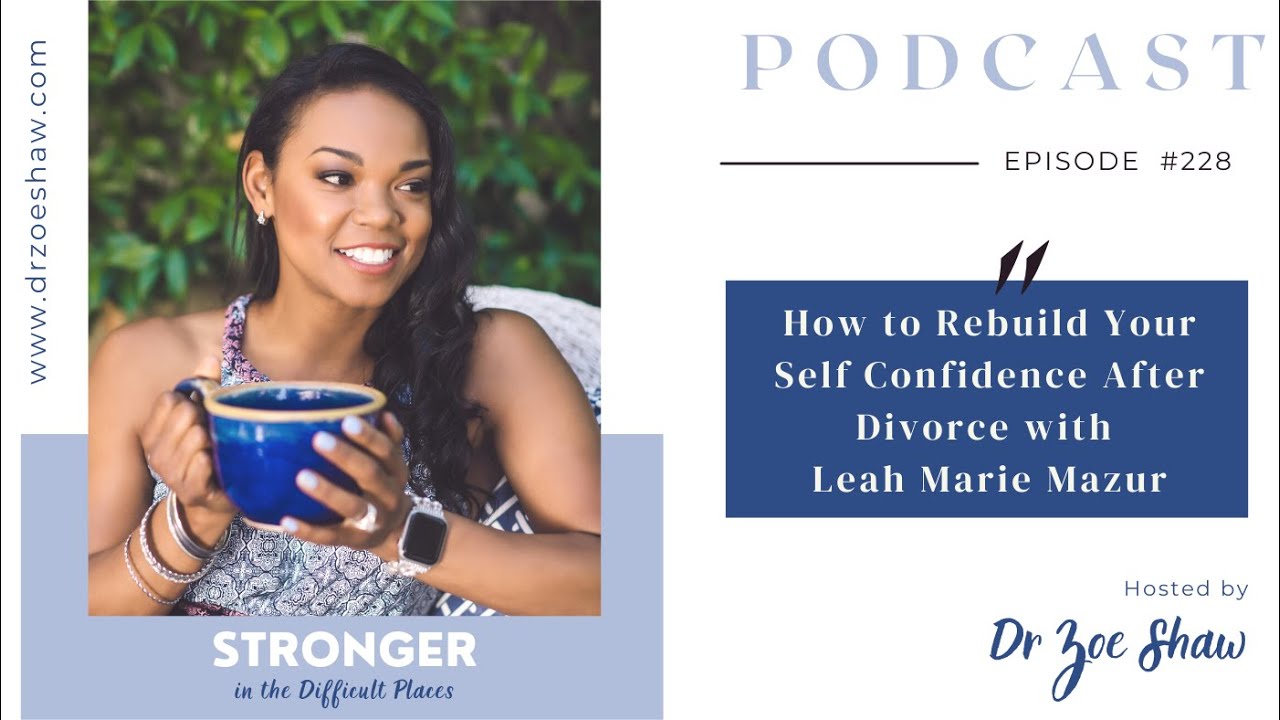
Leah Marie Mazur, a divorce-recovery coach, talks about rebuilding confidence after divorce. She lost both parents by 21 and went through two divorces herself, driven by fear of abandonment. Her framework: silence your inner critic, practice self-forgiveness, do strength training, nurture friendships, and become your own cheerleader.
Chapters
Hi there. Welcome to Stronger in the Difficult Places. I'm Dr. Zoe, your host. Today we're going to be talking about how to rebuild your confidence after divorce. We're talking to a certified divorce recovery coach. Her name is Leah Mazur. I hope I'm pronouncing her name correctly, and I'm excited to dive into this topic. Listen in. Leah, I am so glad to have you on the podcast today. I messed up in the intro your name, so I'm going to correct it for everybody to hear. It's Leah Mazur, correct?
Yes, you got it. Yeah, I'm stoked to be here. Thanks for having me.
Great. So let's dive into this. We're going to talk about how to rebuild your self-confidence after divorce. Can you share with my audience about— I assume you probably have a journey regarding that?
Oh, yeah.
Yeah.
Oh, yeah. Yeah. My journey, my journey of 2 divorces, the tale of 2 divorces. I can take you back a little bit just to give you a backstory. So when I was 16 years old, I actually witnessed my mom have an asthma attack in our home and die. Oh my goodness. As you can imagine, that was extremely traumatic. And then 5 years later, my dad died of pancreatic cancer, and I'm an only child. So by 21 years old, it was just like, okay, Leah, here's the world. Go figure it out. Right? And so as a coping mechanism, I didn't realize this till years later, essentially, from that abandonment, that fear of abandonment, the fear of being alone, I became a serial monogamist. I just kind of hopped from one long-term relationship to the next because that was like my buoy to keep me afloat. That was like, if I wasn't in a relationship, who am I? What am I doing here? Right? And so after my second divorce, that's when I realized, okay, obviously there's some stuff going on I need to figure out. Why am I finding myself in these situations over and over? Why am I choosing the partners I'm choosing?
Right.
And I realized it was that just fear of being alone. And so I faced it head on, and I did a lot of the internal work, the therapy, journaling, meditation, podcasts, books, all the things to get myself to a place where I could stand on my own 2 feet, feel fulfilled, feel confident, and not feel like I needed a relationship. And so then I basically just took all of the best tools and the most effective methods and everything from my own journey and created a framework for other women so that they don't have to go through that trial and error kind of like I did. I help them heal faster. that they can move forward with confidence and avoid making some of those big critical mistakes that would keep them stuck.
That's beautiful. Isn't that what so many healers do? Right? They go through their own healing, and then they reach down and they help other people as they work on their healing journey. And thank God for that, because if we didn't have all that foundation, everybody would be out there just kind of flailing and trying to figure it out. But thank God for the people who are able to take what they've learned and consolidate it and really Recycle it back in a way that other people can utilize it. So,
well, absolutely. Yeah. Showing us there's light at the end of the tunnel. Right?
Right. So why would you say do so many women have such a self-confidence hit after a divorce?
I think it's a lot of things. A lot of it comes from that guilt and shame, right? Feeling of failure, feeling like they failed or They weren't worthy of someone changing or being who they wanted them to be. You know, if somebody left them or had an affair, they make that about them and their worth. There's also, unfortunately, still a stigma. You know, you'd think that there wouldn't be, but there is. Even though it's so common, society gives us a hard time. And there are people who still believe that no matter what, marriage is forever. You should just suck it up and deal with it and figure it out. And so I think it's a lot of that. It's that internal dialogue, right? Like, what are you saying to yourself about yourself? Are you, are you making your divorce mean something more than it really is? Are you defining yourself by that one thing? Or are you able to kind of find the lessons in it, right? Grow, take that wisdom and bring it with you into the next chapter.
Yeah. You know, I think we really have to walk that fine line between I'm a failure, and let me see what part I played in this so that I don't have to be here again. And it is a fine line. It is. And you got to kind of walk that and try to build up your confidence, right, as a result of that.
Absolutely. I mean, that is a huge part in finding acceptance. A lot of my clients struggle with just letting go and really accepting the divorce or what happened. But self-reflection, looking back and saying, okay, well, what role did I play? Because it's really easy to point fingers, right? You can say, oh yeah, he did all these— he did 100 things, and that's why our marriage ended up dissolving. But, but what role did you play? Where were you mentally and emotionally when you started that relationship? What red flags did you ignore? What boundaries did you not set? Right?
Mm-hmm.
There's always a role. It's not about the blame game. When you can do that, it empowers you to make better choices in the future that are more aligned with who you are, what results you want.
Right. What would you say then are the biggest mistakes that women make after divorce or during the divorce process?
So one of the most common, and I was guilty of this, is hopping into a relationship too soon. And it makes perfect sense. I mean, there's tons of reasons why someone might want to do that. It helps pass the time. It helps combat loneliness. If you need a self-esteem boost, you may be getting that positive attention from somebody. But those aren't good foundations to start a relationship on, right? Because that's essentially just filling those voids that you have within yourself with that external source that is another person or a relationship. And so, and I did— that's how I wound up with divorce number 2. After my first divorce, I did all the things you're not supposed to do, right? I didn't self-reflect. I didn't heal. I didn't take the time. I didn't learn how to stand on my own 2 feet. None of it. I just— I knew I didn't want to be alone, so I hopped right back into another relationship. And then I— you choose the wrong partners because you're not coming from a place of abundance. You're not coming from a place where you feel whole, happy, fulfilled enough all by yourself, right? That's the place you want to get to before you decide who you want to be with. Your standards are going to be higher, your deal breakers are going to be stronger, and you're gonna make better choices. So that's a huge mistake, one of the most common mistakes that I see people make after divorce, for sure.
Yeah, I will concur that 200%. That desire is real and that, that want, that need for validation is real. But if you're jumping right in, it's almost always going to be an unhealthy relationship. And, you know, sometimes I'll tell women, you need to kind of be by yourself until you get to a point Where you actually feel really good by yourself, where you feel like you don't need a relationship. And that's the time that you're actually ripe for having something healthy. But it's, it's hard and it takes time. It is. And you have to walk through the pain of loneliness, the pain of having to deal with everything that happened, because a relationship can be a phenomenal distractor and it feels so good in the present, but you're setting yourself up for something Not so great, right? And, and, and the future. And so it's really about— and always, not just in this situation, but I think we always need to be working towards how can I take care of my future self? Because often we're focusing on how can I take care of myself now? What feels good right now? And what feels good right now is not always taking care of your future self. And if you're always thinking about your future self, then you're always going to be in a great place because you've taken care of her. before, and you're going to be taking care of her moving forward. And so you're reaping the benefits of that.
Absolutely. I think a lot of that, too, is just what we were taught growing up. Right. We were given that message of, like, you grow up, you graduate, you go to college, you get a job, you get married. That's the goal. That's what you try to do. That's your accomplishment in life. And that's just a bad message to be sending. You can live a very happy, fulfilling, amazing life Not in a relationship. Like, you can fulfill your own needs. You can meet all of those. And when you are doing that, that is the best place for you to find your ideal partner because you don't need them. A relationship is meant to add value to your life. Right? It's just kind of like the icing on the cake. And so when you have that mentality, it completely changes the way you view relationships, and it changes the, the partners that you choose.
Right. Absolutely. Absolutely. I know it's hard, but it's the healthy journey to walk.
Yeah.
So how do you walk women through this journey of divorce? When do women come to you and what's the journey that you take them through?
So I have women come to me through all the stages, some who are on the precipice of divorce and kind of need their feelings validated, some who are knee deep and just don't know where to start, and then women who are in recovery, like the recovery process. And so for me, It's just helping them. More often than not, it comes down to their inner dialogue, that self-talk, because that is what keeps people stuck and can keep them stuck for years. It's what they're telling themselves and the beliefs that they have about themselves. And being alone is a huge fear for a lot of people, a lot of women, a lot of my clients, especially even moms. They think, well, who's going to want me now? Now I have kids and I'm divorced and I have all this baggage. I'm only getting older. Right? And so they have— it's that inner dialogue that they're having with themselves. So it's really about helping them change that inner critic, right? So that they have more positive self-talk so they can build their self-esteem and build their confidence and then how to find themselves again. So one of the best things you could do when you're going through a divorce, you're going through this huge transition, number one is making sure that you're nurturing relationships you already have. Just because you're not in a marriage anymore, it does not mean you're just walking around this planet all by yourself. You have people, right? And that's gonna help you feel less isolated. Find ways to stay more connected. And I know, like, everyone's busy, everyone's got stuff to do, but we live in a digital world. You could do FaceTime coffee catch-ups, right? You could do things like on your phone or on Zoom or whatever, just so that you can feel more connected and less isolated. And another huge thing is to make sure that you're getting some kind of creative outlet, right? Or hobby. Because that is not only going to pass the time, not only give you fulfillment, but it's going to build your self-confidence and it's going to help you learn more about you. Like, who are you? What do you want? What do you like to do? So that is the time. That's the time to, like, explore, experiment, discover, do all the things, try all the things to find what you like and what you feel is aligned with you. Maybe, you know, go pick up that camera and go take those pictures or join that dance class, right? Join that hiking group. Like, what is What do you like? What do you want? And that can really bring you so much more fulfillment and confidence. It's huge. And then prioritizing self-care. Even when you're going through a divorce or if you're recovering from one, it's so important that you're taking care of yourself. A divorce is one of the hardest things that a human can experience. It's like right under death of a loved one if you Google what's the hardest things, right? So are you getting quality sleep? Are you drinking enough water? Right? Are you eating foods that nourish you? Are you doing things that help ground yourself and, like, to counter all of that stress and all that overwhelm? What are you doing? Even if it's 10 minutes in the morning, you could sit and do some deep breathing or some guided meditations. Right? What are you doing? Get outside. Get in nature. Get moving. Exercise is huge too because it gives you all those feel-good chemicals in your brain. Right? It helps boost your mood and lower depression and lower anxiety and make you feel better. So practicing self-care and doing all of those things will make a huge difference in how you get through that battlefield, essentially.
Right. You're literally training, right? Training for the rest of your life. When we talk about exercise, a lot of women will either gain weight after divorce because they're depressed, or they'll lose a lot of weight because they're trying to be attractive. But I encourage women to lift heavy things. Because when you lift heavy things, you're not just feeling physically strong and building that physical, um, confidence, but it actually— research has shown that it transforms to emotional confidence and psychological confidence in your daily walk. So lifting heavy things is one of the best things that you can do physically for yourself to help increase confidence.
Love that. Yeah, that's Yeah, I, I, that makes sense to me. Yeah. And just challenging yourself too, right? When you're, when you challenge yourself in different ways and you push yourself outside of your comfort zone, that's when you surprise yourself. And that's when confidence builds. When you're doing things that you maybe didn't think that you could do.
You're developing that mastery. When you're talking about finding a new passion or hobby, you're developing mastery over some something. And it also tran— it, it transfers to all other aspects of your life. Beautiful. So what would you say are the biggest obstacles that women experience when they're attempting to rebuild their self-confidence after a divorce?
Well, that inner critic is a big one. And fear of being alone and that unworthiness. Right. Like, they kind of get into that place where they feel like, I'm not good enough, or this is not going to work out for me. And so that's huge. And that's where people get stuck. And so one of the things that I encourage them to do is start with journaling and using positive affirmations, because whether they realize it or not, they're already using affirmations. They're just ones that make them feel bad.
Amen.
And so it's about switching that to, I am healing more every day. I deserve happiness. I am worthy of respect. I forgive myself for my mistakes. I let go of perfection. All of those things, like, a lot of it also is about forgiving yourself. It's not even about What, you know, so-and-so did.
Mhmm.
It's about making sure you're forgiving yourself for your mistakes or for tolerating that behavior or for not leaving sooner or for ignoring those red flags or all of those things. It's finding that place where you can accept your mistakes, learn from them, and not criticize yourself for them. Right? Meet yourself with the same compassion you would with somebody you love. You know, we can be our own worst critics and so judgmental. And so it's about changing that relationship and that conversation that you have with you that makes all the difference with how you feel and then how you show up in the world and the choices you make and then the results that you get.
I think that concept of self-forgiveness can't be talked about too much. When we feel like we've been hurt or harmed, It's really easy to focus on that. We've been hurt, we've been harmed, that person has done us wrong. And we get certainly into that victim mentality, right? But growth doesn't come out of that. Sitting in anger, sadness, bitterness, you know, grieving, even growth doesn't come out of that when we're focused on what the other has done to us. But when we're focused on what did I do, and how can I forgive myself for whether it was just putting up with it or whatever my, my part in it was, then all All of a sudden there's action to be taken. There's no action to be taken when we're just mad at somebody else for what they did to us other than revenge, which is also a whole nother dysfunctional, toxic thing. But when we can instead focus on ourselves, then we have action to take. We can be productive. We can actually make healthy changes in ourselves, which is going to reverberate to all of our world and all of our future relationships. So I know that self-forgiveness is the key, and sometimes that's so very hard for women. To think about, number one, focusing on what I could have done or should have done or what I did, because that hurts. And the grief process, when we look at divorce, it is like a death, like you said. And so we have to grieve. And that grief process, we know it starts with denial, of course. And then we move to anger, which is a very natural feeling. And then we move to that bargaining. And I think that bargaining and the anger place is where we can get very stuck. And the bargaining— Either can look like blaming the other person, kind of trying to rewrite it in that way, blaming ourselves. But if we can take that bargaining period and really use it to figure out how we can be productive and make changes in our life, then we can move to those next stages. The next one is sadness, depression, because we're gonna feel sad once we have to acknowledge the reality of what we could have done or didn't do. But then we can move into acceptance. And it's a cycle, but it's definitely doable if we're willing to sit in that bargaining period.
Yeah. And also making sure that you are letting go of the things that you can't control.
Oh, that's—
people try so hard to control things, or they're still mad because they're not showing up the way they should. They're not parenting the way that they should. They're not responding to me the way that I feel like they should. Right. We have these expectations. Of other people, I had I had learned a while ago from a coach that everyone walks around with these kind of invisible handbooks of how they think everyone else should act, right? And when there's problems in a relationship, it's because those people aren't just following; they're not following the rules. They're not following my handbook of how I think that they should show up or react or behave, right? And so we almost have to lower our expectations and stop expecting other people to show up the way we would, right? We are all very different. We all wear different prescription glasses to see the world. We process things differently, and so. So when you can meet people for exactly where they're at and not try to change them or project your own beliefs onto them, that gets you into that space of, like, freedom, right? That gets you in that space where you can find indifference. You don't, you don't have to be angry. You don't have to forgive. You can find that middle ground where you can just accept for how they are and then focus on what is within your control so you can change your experience. Yeah.
That is so true. I always talk to my clients and say that the biggest issues that we have in relationships is that we expect people to be who they aren't, and then they continue to show up as they are, and we get upset and we expect them to be who they aren't. And when we divorce somebody, we still sometimes do that. We expect them to still toe this line when they're going to show up exactly as they are, and that's how we should expect them to show up. And like you said, Accepting that instead of making a narrative about what that means. Because if I were to do that, it would mean something. It might mean the narrative that I have, but if somebody else does it, it doesn't necessarily mean that narrative. So we've got to be able to let, let that narrative go. And it's hard, but it gives you freedom. It gives you freedom when you're not caught up in trying to make other people be the way that you want them to be. And I would say that is a huge obstacle. That I see, especially soon after divorce when you're navigating this transition and you want it to be a certain way and they're not showing up that way. It's hard. It's hard to let that go.
Yeah. Why can't they understand? Why can't they see what they're doing? Right. And it's all perspective. Everyone kind of sees this world through a different lens. And so accepting that really helps you move forward and let go.
Yeah. So I want to go back to what we were talking about earlier about the loneliness. And, you know, the biggest mistake that women get is getting into new relationships. And the reason why that happens partly is loneliness and wanting for validation. So I want to kind of just double down on talking to a woman who really does feel that pull. And, and let's talk about ways that she can I don't know, fulfill that, or ways that she can fill herself up in terms of social connection that doesn't involve getting into a romantic relationship?
Yeah, well, a lot of it is just meeting your own needs, right? So you have to understand your intention. So what is— if you want to get into a relationship, let's dive into that why, right? What is your intention? And when, when it is something like, well, I'm lonely, or I need that self- esteem boost, or I'm bored, or I need this companion, or not being in a relationship means I'm not worthy of one, then you can dive in there and meet your own needs. So essentially, you need to unearth what your needs are and then find ways to meet them, because you can meet all of your needs, right? Take yourself out to dinner. Buy yourself that, you know, nice dress or some flowers. You know, you can please yourself sexually. You can please yourself in any way. Whatever it is that you feel like you need somebody else in order to accomplish, figure out how to meet those needs yourself. You have to essentially learn how to be your own lover, best friend, cheerleader, teacher, parent, right? You do all of those things for you so that you're not dependent on anyone else, so that you can then, if you decide you want to date, You're not attached to the outcome. You can date and take it day by day and stay more in the, in the present. And then if it works out, great bonus. If it doesn't, I'm good. I'm good on my own. I can meet all my own needs.
Yeah. Yeah. And I want to— I love what you just said, but I want to also honor that we are social beings. And so that desire and need for connection with someone else is natural and it's healthy. When it's healthy.
Yeah.
And so I want to honor that as well. And in addition to you meeting your own needs, it's also good and important for you to seek out social connection because we are social beings. It just doesn't have to necessarily be romantic connection yet as you're working on your healing.
Totally. Yeah. And so that's why it's important, like I said, nurturing relationships you already have and joining support groups. There's support groups that you can join. There's local things that you can connect, free things that are happening in your town or in your area. You can connect with people. And when you are diving into those new hobbies or those creative outlets, those things can also present opportunities to connect with like-minded people and to make new relationships when you're kind of putting yourself out there, but in a way where you're following the things that make you happy.
Right. And when you're intentional about it, you'll find— I have a client I'm working with right now. And when we start talking about being open to connecting with people, being open to developing new relationships, when you have that mindset, all of a sudden, They'll present themselves to you. All of a sudden there's someone that's there, and, you know, maybe you share some kind of, you know, commonality, and let's go out for coffee. And so it is being intentional about it and being willing to assert yourself and risking the scary rejection. But the reality is most people are also looking for connection, and we assume that, you know, well, everyone's already got their friends, especially, you know, as adults. It's different than when we were in school, and we make that assumption everybody's got their friends, they've already got their thing. I don't want to— but actually, you need to do that. You need to speak up, not just with new people, but also with your current people. Because the reality is, is that you will be engaging with your current social circles differently. And a lot of people, after they get divorced, they kind of begin to isolate themselves and they kind of feel like, I don't want to be that third wheel, or, you know, maybe I'm not really invited here anymore. And, and, or they want their friends to step up and, and, and invite them. But it's important to remember that your friends are kind of going on with their own life and they might not be aware of what's going on in your mind. And so you do have to speak up and invite yourself to things and ask to be invited and, and be intentional about pushing in a healthy way yourself in there, at least just letting it be known that that's what you want.
Yeah. Yeah. Well said.
Yeah. So for a woman out there who might be contemplating divorce or in that divorce space, is there one last word of advice that you'd like to give her regarding rebuilding her self-confidence? Maybe she's been married for years, or, or, or, or maybe not, but she definitely is feeling at an all-time low in terms of her self-confidence.
Yeah, I mean, I would definitely say you're not alone. I know divorce is— it can be so isolating because It's uncommon for someone to be going through a divorce and then know someone close to them who's also going through it at the same time, right? It's like having your friend be pregnant at the same time. Like, it can happen, but it's not common, right? So you feel really isolated. You may feel like people don't understand. So you're not alone. And so make sure that you are connecting with people. I have a private support group. It's called Divorced and Empowered on Facebook. You're more than welcome to come there. It's an amazing judgment-free community of women. So making sure That you're also giving yourself that time and space to heal, to, to hold yourself accountable, understand your role, let yourself grieve, let yourself process all of those thoughts and feelings, do the journaling, use those affirmations, do whatever you can to make sure that you're creating that space to heal and not rushing through that.
Mhmm.
And doing the things that make you feel good. When you're prioritizing your own self-care and you're showing yourself that love and respect, it's gonna change the way that you feel.
Beautiful, beautiful. And life never stays the same, right? It all completely changes time and time again. And that can be a scary thing, but it's also a beautiful thing. And so sometimes when you're in a dark space, you just have to remind yourself it won't always be this way.
Yes, this too shall pass. That's one of my favorite things. It's so true. We're all on this journey. It's never ending.
Absolutely. Thank you so much, Leah, for sharing your advice How can people get a hold of you?
So go to my website. It's mindfullyready.com. That's mindfullyready.com. I have a free empowerment guide and training video to help you gain acceptance, build your self-esteem, and gain clarity on what you want next. You can also join my private support group, and then you can also book a consultation with me if you want some tools and recommendations. And there's an online course. There's private coaching. There's group coaching. There's all kinds of things depending on where you're at and what you need.
Awesome. Thank you so much for joining us today.
Thanks for having me.
More from Dr.



The Epidemic of Not Enoughness: How It Shapes Your Relationships—and How to Break Free


You Can’t Change This (And Neither Can They): The Truth About Temperament in Relationships

What Do I Do When Overwhelming Shame Is Keeping Me From Seeking The Help I Truly Need?


