It’s Not Normal, It’s Toxic - Recognizing A Toxic Relationship And What To Do About It with...
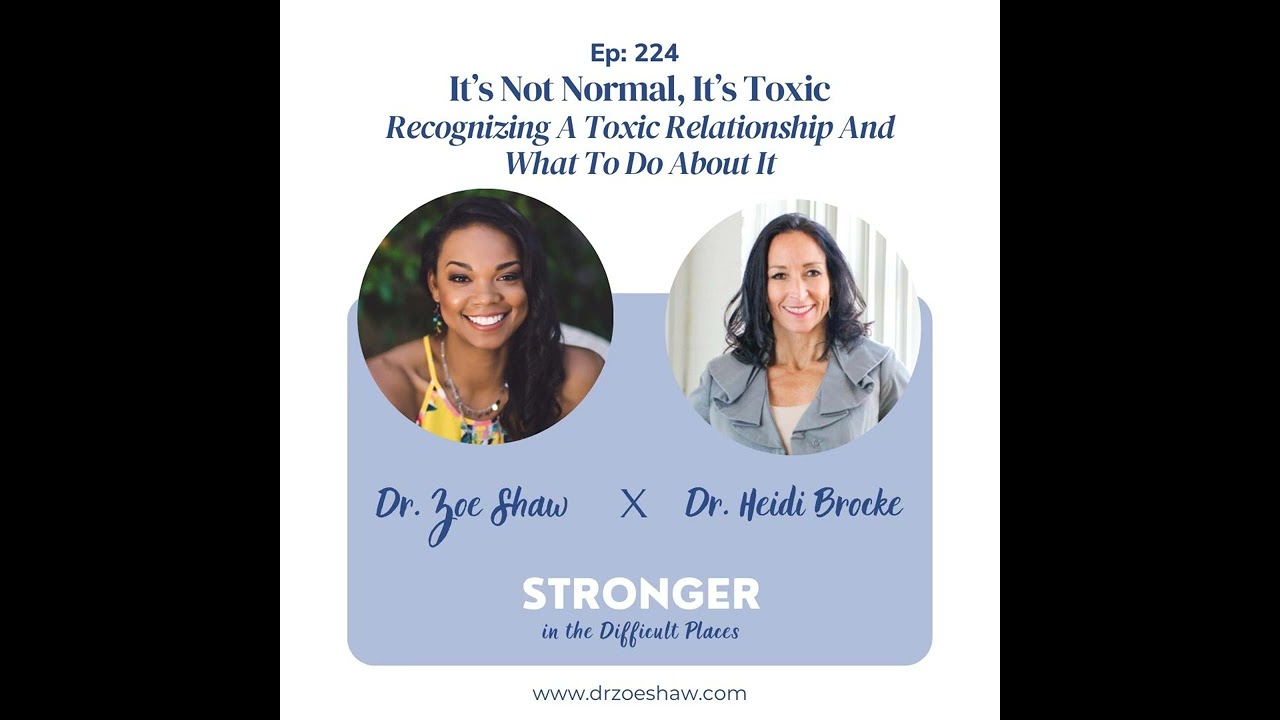
Dr. Heidi Brockie, who left her emotionally abusive marriage six times before divorcing, explains why toxic partners seek control and how caring, conflict-avoidant people get trapped in trauma bonds. She offers tools to recognize patterns and set boundaries.
Chapters
This is not a podcast about being broken, although you may have been. This is a podcast about strength for women who find themselves in difficult relationships, including that sometimes difficult one with yourself. We'll look at your relationship through a lens of psychology, faith, and a little dash of my own kind of feminism. We're not fixing them. We're fixing you. And that changes everything. Welcome to Stronger in the Difficult Places. Save yourself, heal your relationships. Listen in. Welcome to Stronger in the Difficult Places. I'm your host, Dr. Zoe, and I'm so glad you're here today. Today's topic is It's Not Normal, It's Toxic: Recognizing a Toxic Relationship and What to Do About It. I believe this will be my last in the Loving a Narcissist series. Dr. Heidi is a toxic relationship healing and awareness specialist. She's the host of the podcast, It's Not Normal, It's Toxic. That's the name for today's episode. She helped people get out, heal, and recover from toxic relationship and emotional abuse. So we're gonna be talking all about that today. But first up, my win and my fail. Have you ever prayed over a spreadsheet? I think that's my win for the week. I prayed over a spreadsheet. You guys have heard and been along for this book journey of mine. And I think I talked last week about publisher's interest. I have been humbled with a keen sense of responsibility as I have received offers from publishers this week. And so I made a spreadsheet. I made a spreadsheet as I attempted to make up my mind about what publisher I'm going to go with. And I prayed over this spreadsheet. I think I prayed over the spreadsheet because it was a tangible decision that I could hold in my hand. And I just prayed, Lord, let me choose the right team to help me bring forth these words. My prayer is just that I'm even in the right place to do this. I think that's a win because I think we're always winning when we choose prayer over cognition, when we choose prayer over logic. I know God gives us these logical brains and he gives us our cognition and we need to use it. And in addition, we also need to use our intuition, which I think is part spiritual. And so— When you have a big decision to make, Make a spreadsheet and pray over that darn thing. So my fail, my fail is that I am behind on every single possible thing you can imagine in both my personal and my professional life because my mind has been filled with newness, a new position I've taken at Hope Media I'm excited about, and I'll talk to you guys about that later. This book that I must write and changes that are happening in my life. And yes, I'm behind on every single thing, but sometimes there has to be a moment of pause in our lives where we have to let balls drop. Now I'm not letting the necessary balls drop, those are still— I'm still juggling those, but all unnecessary balls have officially dropped. And maybe it's a fail because things are dropping, but it's a win because the most important things are still in the air and I'm embracing change as I move forward. I hope that wasn't too cryptic, but you Yeah, that's where I am right now in my life, my win and my fail. Oh, and I just wanted to thank someone who gave a review. Thank you, T.E. Banfield. You said you've learned so much. You've learned so much about yourself, toxic relationships, and more importantly, how to deal with them. I'm so very grateful that this podcast is available. Dr. Zoe is spot on, and I appreciate her wisdom, and I appreciate you. Thank you so much. And for you listeners out there, if you haven't already, please rate and review the show so that other people can find it. So on to the topic, It's Not Normal, It's Toxic, with Dr. Heidi Brockie. Listen in. Dr. Heidi, I am so excited to have you here. I say it all the time, but this is a really, really important conversation that we're going to have because toxic relationships are real and they hurt. And thank you. Thank you for coming on today.
Well, thank you for having me. I've been excited.
Yeah. So you call yourself— or I've heard you been referred to as an emotional abuse graduate. Can you tell us a little bit about what that means and what your journey has been?
Well, I just picked that terminology because I have worked so hard to overcome the things that I've had to overcome. I don't want to be called a survivor anymore. I don't want to be called a warrior anymore. I don't want to be called all of those things. And even though those are different stages, I just wanted to come up with something that made me feel like, oh, okay, good. In the past.
It's really empowering. It's really empowering because it also indicates that you've learned a lot.
Yes. And when I say I've learned a lot, I have learned a lot. But to those people who have also felt like they learned a lot and then still feel like you get, you know, you go down the rabbit hole and you trip and fall on your face.
Yeah,
I still do that too. So,
oops, I just hit the microphone, but me too. Yeah.
Um, so a little bit about that. First thing, I always make sure people know, if this is the first time you've heard me, I am— I go by Dr. Heidi. I am not a mental health professional. I'm a chiropractor acupuncturist by trade, um, and I am an emotional abuse graduate. I spent 14 years in a relationship that, of course, when I was in it, it was normal. It was daily life. It was— I would have never ever pinpointed it as abusive. I didn't understand what emotional abuse was. 14 years in that relationship, and I ended up running away from that relationship to be able to get out of it. When I ran away, I was already divorced for 2 years.
My goodness.
So
he stayed in the house even though you were divorced for 2 years?
Nope. We were divorced for 2 years, but we had different houses. But we had a business together. Our daughters were in a sport that was very much in the spotlight, so all the finances went to that. So I saw him every day, even though there was 2 separate households.
So then that was what we call the post-separation abuse as well going on.
Yes. And I do a ton with my clients with post-separation abuse. And when I have to look back, On my story, I used to think, oh my gosh! You should have figured this out and and not spent the next two years there. But everything that I have had to go through, somebody that I have worked with has gone through it too. So I know that everything I went through was purposely for a lesson because people have needed it. When I did leave, I I signed everything over. I gave him the practice. I gave him basically the property. I left my kids to begin with, which he kept from. from me for almost 5 years. No communication with 2 teenage daughters for almost 5 years. So I had to move. And not even knowing what this was, I'm trying to recover. I'm trying to start over. I'm trying to build a new life. Meanwhile, I'm a mom that just— her kids just disappeared. And through that, I didn't talk about it when I was in it. Then when I moved, I couldn't talk about it because how am I supposed to even explain that? People don't understand it if they haven't been through it.
Absolutely.
And then I I started doing women's retreats. Everybody gets burned out in their career. And I always poke fun at this. I could adjust people in the dark with my eyes shut. And I thought, as soon as I feel that in my work, I know I have to change something.
Right.
So I started doing women's retreats, and I was doing them on making yourself a priority because I have never been the priority in my life, ever. I get up in the morning and I make sure everybody in my world is going to be okay today. And it wasn't very long before I realized I was all of a sudden just using examples of things from my former life. And the people that were coming to the retreats for making themselves a priority were all coming out of or were presently in relationships where they felt like they were not the priority. Mhm. And as soon as I realized that, it was just like, The universe just absolutely dumped this mission on me. I always joke I did not choose this. When people hear what I do, they're like, you want to do that and talk about that every day? I love it. It is the best job. I am so thankful that I went through what I went through because I couldn't ask for a better job. But in doing so, my Coaching with Dr. Heidi programs developed, and I was able to retire from healthcare in 2020 after 24 years. So I actually do toxic relationship recovery and healing full-time now. And
I love it. That's amazing. That's amazing. You know, it really is true that our purpose is born from our pain. It would be nice if it weren't true, but there is so much truth from that or truth in that. Okay. So I'm sure everyone who's listening right now is wondering, first of all, how long has it been since you left your husband?
Okay, so I have been out of that relationship for exactly as long as I've been in it now.
14 years.
And I will tell everyone, I am— I have been remarried for 10 and a half years.
Wow.
And I'm married to the best man on the planet for me. I call him my hot husband. He's programmed in my phone as my hot husband. Um, but, but I don't think he's— he knows he's not perfect. I know he's not perfect, but he knew What I had come out of. And even though he still to this day does not fully understand it, he really put the time in to support me through my healing. And that's kind of what has motivated me to turn around and be able to do that same thing because, because I understand it. I know exactly where my clients are. I always take the time to go, okay, this is, this is where Susan is. Take yourself back to when you were there. How did you feel? Mm-hmm. What were your struggles? What were you thinking? And that has really, I think, helped my clients because of the emotional abuse aspect that people don't understand.
I think that's phenomenal and such a gift that so many women do need. I've heard different stats on how long it takes a woman to get out of an abusive relationship. What I know is it's 1 year, 10 years, too many, whatever. Yeah, too many. And also that it's multiple tries. It's not often just the first try the second try or the third try?
I left 6 times.
6. Wow. Yes. And I think that's probably, unfortunately, in the average.
It is. It is. And that right there is what I've dedicated my life to. The reason that I kept going back is because when you are in situations like I was in, logically, I could look at the relationship and go, there's something wrong here. I can't put my finger on it. I don't know what it is, but, but something logically, I don't think this relationship is healthy for me. But I am very emotionally wired. I would not be a chiropractor or be doing what I was doing if, if I wasn't fulfilled by helping other people.
Right.
So, so my emotion goes into everything. So logically, I can go, yeah, this relationship isn't healthy for me. But as soon as my emotions get involved, It clouds my logic because I think of things like, yeah, but I've invested so much and I've got a business with him and we've got 2 kids. And, and then, oh, it's not so bad. I can— I'll, I'll deal with it.
I can do it, or I can wait. Yes.
And, and the, the reason people stay in it, the reason people go back to it, is because, because they don't understand it. Another thing, when you're in it, you, you don't— you don't have time To understand the situation because you're living in it. And, and I'm jumping the gun here, but I'm going to finish the statement. We have to pay such close attention to what they're saying and what they're doing that we never, ever have time to even think about what motivates it. You know, we become very adaptive. We become very reactive. We go into survival mode for if they say this, I'm going to do this. And if he does this, I'm going to do this. And if this doesn't happen, the kids have to go to— Absolutely. Be really quiet. And so we're constantly trying to stay one step ahead of them. And when we're doing that, we're watching how they breathe, we're hearing how they walk, we listen to how they shut the door, so that we know exactly how we are going to have to keep ourselves safe, going to have to keep ourselves out of trouble. We're going to have to avoid conflict, avoid criticism. And so you never really have time to stop and go, oh, well, what is this really?
And that's— go ahead.
And that's what I teach. You have to see it from a different perspective in order to go, Oh my gosh, I get it. And then and only then are you able to make the decision that's best for you.
I think that's excellent. And I see that so much in my client work is that we get focused on the story. What happened this week and how did I respond that week? And instead of looking at the bigger picture, like, what are my choices? What am I doing? Because it's the same story week after week, just a different event, essentially. But you do keep so caught up in trying to just stay on top of the emotional abuse. So what I'd like to do today is to help a woman understand, okay, what is going on? Because you mentioned that part of the problem is you're not really seeing what's going on. But first, can you tell us about your relationship with your daughters today?
So my relationship with my daughters today, I left them when they were 11 and 13. And there's a little bit more that plays into that. They were pro rodeoing at a very high level. So they had horses and they had trailers and they had— so for me, me leaving with no income and of course debt that I didn't know I had accrued, which I found out later, I was never going to be able to support that. I did not anticipate, however, that he would cut them off from me, uh, completely. Um, so now they, uh, they spent 5 years there after me. And my kids are tough. My kids are problem solvers. They're tough. They had been in it just as long as I had. Right. They knew the exact the exact way to keep themselves safe. We had safety plans. They had, you know, extra car keys. They had all that kind of stuff. But one of the things that I— 2 of the things that I— that put me at ease when I left was I looked at myself and the relationship that I had tried to raise them in. This was the only example of a relationship that they had.
Mm-hmm.
You know, we were very isolated. They weren't really allowed to have friends. I wasn't allowed to have friends. I wasn't really allowed to go see my family. So our marriage was the only thing they'd seen, which was completely not normal. Right. I was not the example of a mother that I would have ever wanted my kids. Right. There was nothing really for me to— for them to look up to. I tried to protect them, but I couldn't when I was there. And the biggest thing that has paid off is I knew that if I kept protecting them, And making excuses for his behavior and covering up and continually telling them how much he loved them. I knew that if they didn't see his true colors, they would be stuck in the same cycle that I was stuck in with him. And so I, I kind of put it out there that I needed them to be safe, to be careful, to protect themselves. But I wanted when they were 18 that they could choose the relationship. That they had with him, and my oldest sees him about once every couple months because she still rodeos, and she sees him. My youngest has not spoken to him in five years. So they were able to decide for themselves how they were safe in having or not having a relationship. My relationship with them is fantastic. They have they have struggles just like me. We go through ups and downs. There's a lot of. You know, a lot of support, a lot of learning as we go. But yes, it is. It is very good.
Thank you. Thank you for sharing such a difficult, radical decision. And I'm just so glad that you were able to get out. And thank you for sharing that.
It was the hardest. It was the hardest 5 years of my life, for sure.
I can only imagine. Yeah. Yeah. So let's talk to that woman who's thinking, I think I'm in a toxic relationship. We're going to talk about that word narcissist. And, and how, how does she decipher? Can you define what is toxic and what is— I know narcissist is that buzzword that everybody likes to throw around and nobody really knows what it means.
So, so I chose the word toxic 7 years ago when I started, when I decided I was going to start this. And that was long before it was all over social media. The reason I chose it is toxic is not a diagnosis,
right?
It is an adjective that is used to describe any relationship in the status that it's in that is unhealthy for you. mentally, physically, or emotionally.
Mm-hmm.
And the thing that I teach people to realize is we don't have to label somebody as toxic. They're toxic, or she's toxic, or my mom's toxic. You actually get to decide who in your life is healthy for you and who is not. And it, it doesn't matter how they interact with other people. So in order, in order to make that decision, you really have to understand the toxic personality. Now, again, it's just a blanket phrase. A toxic personality can be anything from the bully on the playground all the way up to the person that your listeners are living with, to the man I ran away from, to the things that you're seeing on Netflix.
Right.
But, but what motivates the toxic personality is, is the same across the board. And once you can see things from that perspective, then your relationships becomes very, very understandable. Um, we talk about the word narcissist. Why? Because everybody talks about the word narcissist right now. Um, and because I'm not a mental health professional, I'm not going to diagnose if somebody is that or not. Narcissistic personality disorder is a diagnosis.
It is.
Um, when I was practicing in the '90s, everybody had fibromyalgia, right?
I remember.
Although there was plenty that did. Okay, then we go into 2000s. Everybody was gluten intolerant, right? And there certainly was some people, but all the buzzwords are all of a sudden, you know, there's always a century buzzword.
Of course.
And right now, because I think because of social media, people are starting to come out and talk about their stories. This word has, has not, not been given the respect as a diagnosis as it should,
right?
And, and I know there's narcissistic behaviors that are not necessarily a narcissistic personality disorder, but from my point of view, I don't speak in diagnoses because, from my opinion, if, if I'm trying to decide who's toxic for me or not, it doesn't matter to me if they have a diagnosis.
Amen. So, so you listeners, I want you to, number one, be, you know, I just want to confirm for you that what you're experiencing is real and you don't have to have a diagnosis in order for it to be real in your life. So instead of trying to figure out, can I get him a diagnosis? Can I take him to a therapist that will diagnose him? As if somehow that diagnosis is going to do anything. It won't.
Yes. And I do believe that what people are seeking in finding a diagnosis is validating that it is something. Right. Because when I was in it, I knew it was something. And a lot of times I had thought, I think he's got a diagnosis, but I didn't care. He was who he was. And it's about accepting them for who they are, not who we want them to be, and then being able to make that decision. Now, again, How I I said earlier, logically, a lot of you that are listening can can go. I don't think this relationship is good for me. I don't think it's a good spot for my kids. But as soon as emotions get involved, it clouds your logic. Now, the thing about your toxic personality is they are attracted to the emotionally wired personality. So the listeners that are are really listening really hard right now, if I was going to describe their personalities, they're. The kind, caring, loving, giving, the fixers, the supporters, the conflict avoiders, the peacekeepers.
Right. Which have also been described as pathologically kind. And I just want to point out, it also doesn't mean weak. Unfortunately, I think many of these women are extremely strong, which allows them to stay in a relationship that's very tough and unhealthy for them.
Yes. And, and the other thing I follow you up with, Yes, they are very strong. And yes, our personality is wired to be nice, to support, to be the person that's there when nobody else is there. Our biggest problem is we are not picky enough with the people that we distribute our good personality to. Because I say this all the time, I used to invite everybody in my inner circle. Yeah, come in. I'll fix it. I'll support it. Yes, I'll bring brownies. Yes, I'll cook them in the middle of the night. Yeah, whatever you need. Right. I spent the last 14 years kicking everyone out.
Boundaries. Boundaries.
Because, because, because just because they want in doesn't mean I have to let them in. And I, I am very, very picky and not mean. You know, people don't even know where they are on my, on my list because I put them at a level and I'm just as nice and caring and loving as I can be with them on that level. For me to be safe.
Right.
Because when we talk about the toxic personality, they are after certain things. They are after the emotionally wired person because they like the feeling of control. And the emotionally wired person doesn't really care about that. Right. And they like the feeling of power. They like the attention, the admiration, the affirmations. We change ourselves through this relationship to become what we feel like They want, because the emotionally wired person very much wants to be approved of.
Right.
We want to be accepted.
They're looking for love, acceptance, validation. Yes.
So if you want me to dress like this, that's easy. I can change that. You want me to— 3 weeks after I married my former, he told me he was really disappointed in himself because he was always going to marry a blonde. Okay, clearly I am not blonde, right? By the time I looked in the mirror, And finally left for the last time, I almost had blonde hair because I kept trying to reach that level of, okay, now I'm good enough. But every time I would change whatever was insisted on being changed, he would move the goalposts. He would change the rules. And what does that do? We just said one of their needs is attention. And when you're trying to fix and you're trying to be better and you're trying to get approval, where is your attention? Yeah.
All on them.
All on them. And it's that control and power and attention that makes them feel secure in themselves. They need people in their lives to make them feel secure. So if you're in the life of somebody who is toxic, that wants control and power and is, is the attention admiration person, if you're in their life, you're supplying them with those things. Because if you weren't, you wouldn't be in their life at any significant level.
Hmm. And, you know, that statement right there that you just made, I know, can be very scary for women because the first question I imagine a woman is thinking is, okay, so I'm in this marriage, I'm in this relationship. I'm not wanting or trying to get out right now. I just want to understand what's going on and know how can I be the healthiest in this? What can I do for myself? And that is very scary what you said, because that's exactly what's keeping women stuck is this concept of if I'm not giving him what he needs, Then will I be discarded?
Yeah.
And so can you speak to a woman in that situation who's trying to figure out how can I, how can I be healthy in this or as healthy as I can in this? And what about that fear that if I get to that point, he's going to discard me?
Okay. Fear is one of the tactics that a toxic person will use to keep you where they need you. It's not always fear for your physical safety, which is why I'm sure some of the listeners are, are you know, sloughing off the abuse-type relationship. Well, I'm not being hit. It's not that bad. I'm not being locked in closets. So, so when we, when we talk about the emotional abuse thing, we really feel like if we can just make them happy, things are going to go better, right? We know how we view the world. We, we, we are the, the caretakers. Right. How many times in your relationship have you not looked at them and thought, How come you can't just act normal? How come you can't just be nice? The reason we think they're not being normal and nice is because we are emotionally wired. We would never say the things they say. We would never do the things they would do. We would never need control. We would never manipulate for power. You know, we aren't going to steal somebody's attention. We just don't operate that way
right
now. That being said, everybody has toxic traits. Everybody has the capability of criticizing and It's when it's in a repetitive, cyclic type of scenario and it's being used to supply somebody with something they need in order to feel secure.
Right.
So for the people who are thinking about leaving, when you look at them and you think, how come you can't just act normal? It's because you can only see the situation through your emotionally wired eyes. So what do we do? We think, well, if I can just talk to him about it, if I can just If I can just word it different so that they understand what my needs are and how they hurt my feelings, and if I just wear the right color and I pick the right day, and when they're in a good mood and it's not raining and Mercury's not in retrograde or whatever, we really feel like if we can just express to them, we will get it through to them and they're going to wake up some morning and act like us.
But that's not going to happen.
It's not going to happen because when we look at them and say, how come you can't just be normal? For their personality type, they are acting 100% normal.
Right.
They don't know what it's like to operate with as much emotion as you do.
All right.
So when I work with people privately, and I'm just getting ready to launch a community because my schedule is full, so I'm going to start a community where I'm going to start teaching all of this. You have to be able to see every situation from their perspective.
Let's talk about that. So what does that look like for the woman who maybe is thinking about leaving, but also for the woman who doesn't feel like that's an option for her, isn't in a place where she's thinking about leaving right now?
The woman who is thinking, who is not in a place or thinking about leaving, has already thought about leaving.
Good point.
But they've already thought about the fact that what if this happens and what if this happens? And 90% of the time, what keeps us there Besides children, right, is we do not know how they are going to react because the toxic personality is very unpredictable and they're very inconsistent. Why do they do that? Where is your attention when you're involved with somebody who's unpredictable and inconsistent? Our attention always has to be on them.
Mm-hmm.
So when we think about leaving, we don't know if they're going to be nice. We don't know if they're going to be mean. We don't know if they're going to go nuts. We don't know if they're going to take all the money. We don't. And, and when we think about all those what-ifs, because we don't know how they're going to react, we— all we see is a huge mountain that we do not even know how to tackle. So what we do is we go, that's okay, I figured out how to stay here. It is always easier to stay in what's familiar than to step into something you don't know, no matter how bad it is.
True.
And when I went back 6 times, It was because I could not control his reactions, and some of them were horrible, and I didn't know what the future held. So I just thought, you know what, it's way safer for me to be in the house with him so I can predict his behavior than try and be out of the house and not have a single clue what's happening. And, and you probably know that's part of the trauma bond. We feel safer When we're closer because
we feel like we have a sense of control. Yeah,
we have a sense of control and we, we know we have to be that close in order to predict how we are going to survive.
So what can we say to a woman who's like, okay, I see I'm in that, that's everything is going on. You hit the nail on the head, but what am I to do? What can— what's my first step? What do I do with this information?
So I'm not one to— I'm not one to throw statistics out and I'm not one to really keep track of statistics. But I started tracking some stuff in 2021 and I have people from all stages. I work with people from all stages, all the way up to the end of co-parenting, all the way up to rebuilding yourself and identity rediscovery. But during 2021, I had 9 of the women that I worked with had come to me with a goal of, I don't have a goal. My kids are teenagers. Can you just teach me enough that I can get to where they're 18 and they're out of the house, and then I can deal with it? And I said, yes, of course, because, because if you have a toxic personality in your life, you need to understand them whether you're in the relationship or whether you're out of the relationship.
Right.
So, so I taught these women the same thing as I taught everybody else, as the people who were already exiting, the people I was working with through divorce, the co-parenting people. Every single one of those 9 women who wasn't going to leave till their kids were 18 filed for divorce within 6 months. Of learning what I taught them.
Wow. And what did you teach them?
In a small nutshell, what I taught them is how to take every situation and look at it through the eyes of the toxic person. Think like they do, and you understand why you're in their life. And, and I remember when I, when I finally figured it out, I remember going, you have got to be kidding me. This is so easy. And I remember waking up one morning going, I am not doing this one more day of my life. And every single one of those women, they said, we call it half past quarter till I don't give a crap. There's a time—
Say that again.
You're just going to wake up and it's half past quarter till I don't give a crap. And it's at that time when you understand the toxic personality so well that you realize the reason you are in a relationship with them Is completely different than why you're in a relationship. Emotionally wired people step into relationships for companionship and partnership and building a life together and intimacy and emotional support.
Right.
And in the beginning, the toxic person leads you to believe that that's their goals.
Mm-hmm.
And they want you to buy in and invest in the relationship, and they want you to believe that they're trustworthy.
Mm-hmm.
And and. You will almost always feel a shift if your relationship is toxic. It will go from this where they admire you and they accept you and they love everything about you to all of a sudden one day something feels different,
right?
And when something feels different, they have learned what your securities and insecurities are, what your strengths and weaknesses are, what your secrets are, that they feel like you've invested enough and you trust them to then Use you for what they need you for. And, and, and at the end of the day, what the toxic personality needs— they need people in their life to supply them with the things they need to feel secure. You and I know it's what we put into our own lives that make us feel secure,
right?
It's, it's when our career is going well and we have a good group of friends and we're in the gym 3 times a week and we're eating well, we feel secure in ourselves, right? Toxic personality does not have the ability to do that. It doesn't matter how many friends, what physique they have; they have to put people in their life to supply them with those things. So, and that's that's why I say as soon as you understand that, the relationship goals are are completely different. But because they told you in the beginning, that's exactly what I want. We keep hanging on those words of well, that's what they said. And we spend the whole relationship just wanting the person from the beginning to come back.
Exactly right. And that person from the beginning was not the person that you're actually with. That was—
Now, you might, you might see that person pop up every now and then if you try to leave. I saw that person pop up every time I left. Oh, there was the kind, caring, loving one that was going to take me on vacations and be a better husband. And, and yeah, but as soon as I bought into it and stepped back in, it went right back to the way it was.
Absolutely. Absolutely. Dr. Heidi, thank you so much for, for sharing your wisdom today. Is there one last word that you could give to a woman who is feeling stuck in a toxic relationship, feeling like, I'm here and I don't know exactly what I can do to care for myself best, but maybe I've gained a little bit of information today, maybe I can see a little bit better? Can you just give one last word of encouragement for her?
I, I think, um, when we feel stuck— and I felt stuck for a very long time— I felt like I was, I was in a prison. And people around you will tell you to leave. And if it's so bad, why don't you just leave? And, and I remember thinking, oh, that's a great idea. Like, I haven't thought about that every day for 15 years.
Right.
The reason we feel stuck is because of the emotional abuse. Our emotions and how we feel completely depends on how that person is feeling or how that person is treating us. And so we don't really own our own feelings. And in doing that, we don't feel like there is an option to leave. We feel like, you know, there's spiritual things that keep us there. There's marriage vows that keep us there. There's kids that keep us there. And, and when we have that feeling of we don't feel like there's an option and we feel like we're stuck, we just continue to change ourselves To be in it. What what I try to present to my clients is let's teach you what you need to know so you're looking at this relationship from a completely different perspective. Because as soon as you start doing that, you will be able to see one that there are options, and two that there is a way that you can take care of yourself either in this relationship or out of this relationship. When people work. When people work with me, I support them whether they're in it. I support them whether they're out of it. I support them whether they get out of it and go back into it because they need somebody that understands it. And until, until you fully understand it, you're going to revert back to the ways that the emotionally abusive person has trained you to think and feel.
An
example— this will be good for your listeners if you have 2 more seconds— an example of if you're being Emotionally manipulated, or if somebody else is controlling your emotions. It's Tuesday morning. You're in the kitchen. The I'm assuming this is a marriage, and I I don't mean to be aiming it at men, but that was my situation. So it always just seems to revert to that. You hear him get up. He's in a good mood. Talks to the kids. Pets the dog. Comes in the kitchen. Takes his cup of coffee. Pats you on the back. Gives you a kiss. Says have a good day and leaves for work. What kind of day do you have that day?
A good day.
A good day. Wednesday morning, you get up, same scenario. You can hear that he's walking heavier. You can hear the dog yelp. Comes in the kitchen, takes his coffee, walks out without saying a single thing. What kind of day do you have that day?
A horrible day, right? You're worried, you're anxious, you don't know what's going on, right?
Exactly. That, that is an example That you are dependent on somebody else for how you're feeling. You're waiting to see how they feel and how they treat you to decide how you're feeling. So when somebody tries to leave, a spouse will say, I can't believe you're breaking up the family.
Right.
Okay. The emotion they're trying to control there is guilt. It got me 4 times when I left. Oh, you're right. I never took the time to go, this is not a family. This is completely dysfunctional. But the minute He would say something that made me feel guilty because we don't like to feel guilty. What is the word? What is the fastest way to get rid of the feeling of guilt?
Stay.
Do what they want,
right?
Because that feeling of guilt goes away. So the emotional abuser says and does things to get you to feel certain ways so they can get what they want. And when we feel stuck, a lot of times it's because we are not in control of our emotions at all. And, and we don't realize it because over the years it's such a slow drip that all of a sudden we don't realize we're not feeling.
Yes, right. We don't even realize how far we've drifted from where we were before.
I was just gonna say, for those of you who have listened to this and are thinking, oh my gosh, it sounds like she's talking about my relationship, there is something on my website called the Toxicity Profile Analysis, and it's a quiz. It's lengthy. Um, but I use it for when— before I talk to clients. Each one of those questions correlates to one of the 21 character traits. So the results I get, I can see what type of personality people are dealing with.
Mm-hmm.
But for somebody like some of the listeners who are just now questioning, just reading some of the statements and reading some of the questions may prompt them into thinking, because being in a toxic relationship is like Is like walking into a room that stinks.
Right.
The longer you stay in the room, the smell goes away, right? It doesn't mean the room doesn't stink. So a lot of the behaviors they're seeing on a day-to-day basis are normal. I'll never forget me talking to somebody and telling this person what happened on a day-to-day basis in our house and them going, what?
Right.
And I heard my daughter, she was probably 7, she goes, oh yeah, it happens all the time. It happens every day.
Yeah.
And, and that was one of the things when I realized, I'm like, oh my gosh, this is completely abnormal. But we have gotten so used to seeing it and hearing it and accommodating to it that we don't realize the room is stinky.
Exactly. Exactly. So thank you. You know, I think that at the very least, this offers some hope, hope for a woman that things can change, that she can change herself. No, she's not going to change him, but she can make some changes within herself that are going to change her life.
Yes. And I think, I think the pressure of us having to change ourselves is overwhelming too. It's, it's more about, um, we know that they're not going to change, but what we have control of is we have control of the way their behavior affects us.
Beautiful.
And, and having the understanding of that is huge. For the people who know that they're not in a situation where they can reach out to me or reach out to some other professional about this, I have, I have a podcast that I do a lot of education on, and you can listen to that in secret if you need to. It's called It's Not Normal, It's Toxic.
Excellent podcast. I highly recommend it. Yes. Thank you so much, Dr. Heidi. And how can people get a hold of you so they can check out It's Not Normal, It's Toxic? They can check out your website, which is—
the website is Coaching with Dr. Heidi.
Great. And they can take that quiz there as well.
Yep. They can take that quiz there. I have an Instagram profile. You can get a hold of me. I also run a support group on Facebook. And if you're in a spot where you don't have a support system, just having people that, that know exactly what you're going through and you don't have to explain it. It's called Strength Within on Facebook. There is more than one strength within. So the COVID photo is a white flower growing out of a gray rock. But it's a community. Not all your questions are answered in there, but at least, you know, these people know exactly, exactly what I'm going through.
Beautiful. Thank you so much for coming on today, Dr. Hyatt.
Yes, you're welcome. Thanks for having me.
Thank you for listening to Stronger in the Difficult Places. New episodes go out on Tuesdays. Subscribe to my email list so that you don't miss an episode and you get some regular encouragement from me. Have a strong week. Bye.
More from Dr.



The Epidemic of Not Enoughness: How It Shapes Your Relationships—and How to Break Free


You Can’t Change This (And Neither Can They): The Truth About Temperament in Relationships

What Do I Do When Overwhelming Shame Is Keeping Me From Seeking The Help I Truly Need?


