Making a Truce With Your Body with Anne Poirier
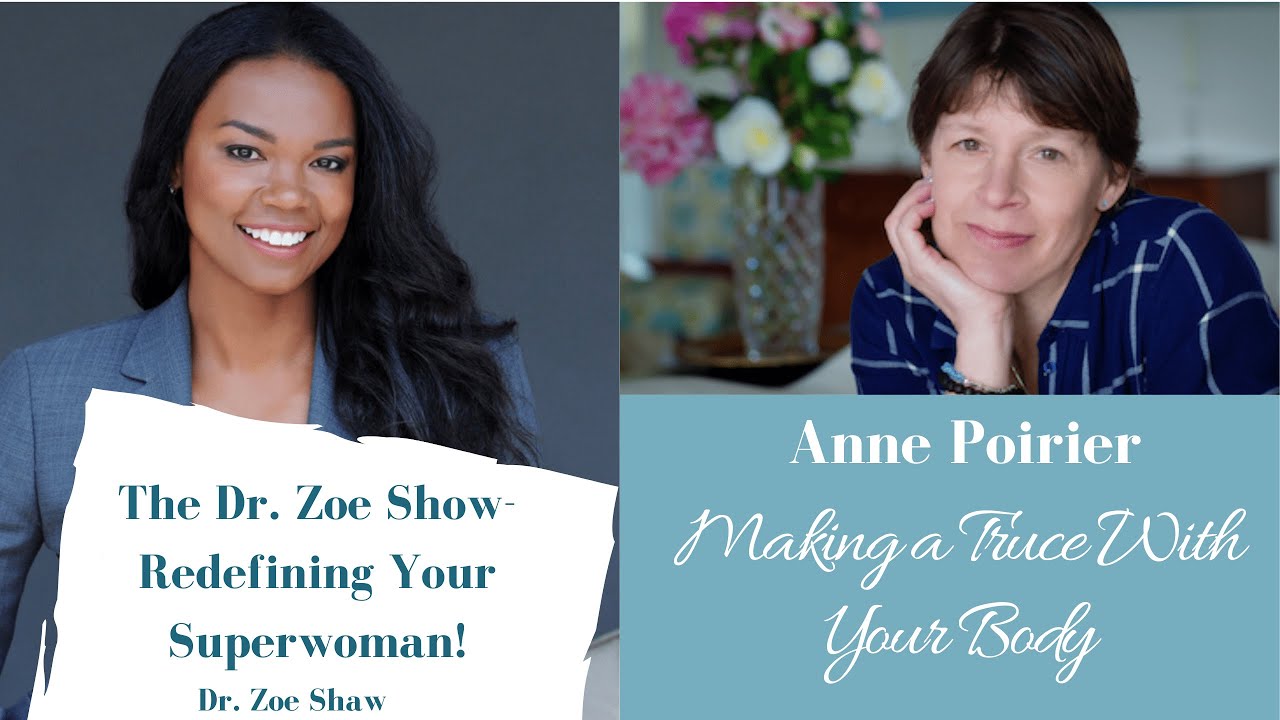
Anne Poirier, an eating-disorder specialist, talks about her recovery from anorexia and how she learned why diets fail: metabolic slowdown and hormone shifts. She shares practical tools like writing letters to your body and the Petals of Worth exercise to build a truce with yourself instead of fighting it.
Chapters
Hey there, I'm your host, Dr. Zoe, and welcome to Redefining Your Superwoman. Today our guest is Anne Porrier. She's an eating disorder specialist, a lifestyle strategist, and an author, and we'll talk about her new book. I wanted to have her on today because we women struggle with our bodies, getting them to look like we want, feel like we want, keeping them healthy, all of the things. And I want to talk about how we can have a truce With our body image. Anne is gonna share with us her story from anorexia to peace and acceptance regarding her body and give us a few tips and some encouragement on how you can have that too, the peace and acceptance part. I love Anne's calming presence, so stay tuned for our conversation. Hi there, I'm Dr. Zoe. I'm glad you're here. This is the place for developing your strength as a woman and helping you navigate difficult relationships in your life, including that sometimes difficult relationship with yourself. Being a strong woman is not about what other people can see, and it's not about how loud you are about it. It's a quiet knowing. This isn't therapy, but you may feel like you've been to therapy after one of my episodes. Here, we also explore the intersection of psychology and faith, all with the purpose of creating a new kind of strong. Welcome to Redefining Your Superwoman. Welcome, Anne. I'm so glad that you are joining us today, and as I mentioned already in the introduction, intuitive eating coach, an eating disorder specialist, lifestyle strategist, and now an author.
Yes, very exciting. And I'm excited to be here to, to share with you and talk to your audience and, and just spread different messages in the world.
Yes. And we are looking forward to hearing them. So the reason why I wanted you to come on to my, uh, podcast today is because I have never ever met a woman or spoken to a woman who has said to me, "I have always loved and accepted my body since before I could remember," including myself. I've never met a woman who's in that place, and that's you know when I think about that, I think wow, that is really it hurts me really just to think about it because you know we grow up and we watch our mothers struggle with their body image. We watch you know them try to kind of change and. And we grow into a body that we've already learned to hate. Yeah. And so I want to talk about that today because it's not getting any better. Social media is just compounding all of it. And so I want to find out, how can we take a first step to make a truce with our body?
So yeah, go ahead. It's so, it's so interesting because really the biggest first step is to decide.
Oh yeah, I thought you were gonna do it.
You know, that I don't have to buy in. I don't have to buy into society, into culture, into the diet industry, into all of the things that we've been told, right? You know, such deep beliefs that, as you said, started when we were kids.
Yeah,
that our bodies weren't good enough, right? And it just, it snowballs. And the more you think that, the more you see that and the more you find proof of it. Right. So,
oh yes.
Well, we're
going to talk about that, about that whole confirmation bias thing. But before we get started, and I love what you said, the first step is to just decide. So we're going to talk today really about how do we get to that first step of deciding that I'm going to let this stuff go. Um, but before we get into it, can you please share your Superwoman win and your Superwoman fail? With my audience?
Sure. Um, my Superwoman win is I just started a community on Facebook, a free one, um, called the Body Joyful Revolution. And I'm so excited about it because it's for women who just want to come in and be confident and comfortable in their bodies, no matter what size, shape, or weight they are. Oh, that's so good. Just, you know, let's, let's find a new place to gather rather than the coffee shop with All the diet talk, right? A different place to gather. And so that's going to be my win because it seems to be some really great conversations and people share are sharing their stories in there. You know, there's a vulnerability and a connection that's already started. So that's my win. Really big win.
Congratulations! Fantastic win. So people can find it at the Body Joyful
Body Joyful Revolution, and it's right on Facebook. It's a private community.
Great. Body Joyful Revolution. Thank you for sharing that.
Yeah.
And so your fail.
Um, we were just, just talking about— I have quite a few of them, but they all— and they always help me learn, right?
Yes, absolutely.
You know, I, I really want to say my biggest fail was when, um, I got through— I went through a divorce and I Didn't take ownership of my part of it.
Yeah.
And it was really being able to own my part of the dysfunction and then to own my part of not being the best mom I could be and to actually have conversations with my daughters about, you know, apologizing and, I'm sorry, I am here to do better.
Yes.
I am learning from my mistakes. Um, but I think it was, it, it just changed everything for my relationship with my daughters who are, you know, they're adults, 27. So being able to say, hey, I was doing the best I could, but I, I didn't know any better. And, uh, now I do. So here I am. You
know what? That is the most, that is so beautiful. Really brings tears to my eyes as you say that. I've certainly been in that position of apologizing to my children. I think I was writing a blog about that, but That is really— I can tell you, I've been doing therapy for I think almost 20 years now, maybe more, and I think all of my clients need to hear that. Every single one of them is in the office with me because there's somebody who hasn't been able to say that to them. And those words are so simple, but they do mean so much. And just like you said, they're reparative. Mm-hmm. They honor their experience and say, So thank you. Thank you for sharing that deep fail, which has really turned into an amazing win.
Exactly.
Yeah. Yeah. I think so many, so many women need to hear that. So thank you. And I'm glad that you had that reparative experience. So can you tell us a little bit about how you got from a place? Cause I just said, I don't know any woman out there who has always loved her body. So how you got from a place of not loving your body to a place where you are right now. And I have to say, I love your energy. It just— something just exudes through the screen where we, you know, we aren't in the same room together, guys. I'm just— I just love your energy. So I can see, you know, a lot of the deep healing that's been done. Um, so can you share with my audience just your story?
Sure. You know, I hated my body for forever. It's like You know, any women?
Yeah.
And that's just, that's what we learned. It was kind of a learned response that we're supposed to look different. We're supposed to. And if we do look different, then we'll be happy and then we'll be successful and then people will like us. And, you know, all of those delusions that we have. So I had some experiences as a child, right, that really kind of planted the seed. I call it the, you know, planted the seed that I was fat. I wasn't— I wasn't— I didn't look like the other girls. I had really short hair, kind of tomboyish, and, um, stocky, as my mother would call me. Your mother would. Right?
Yeah.
And the chubby little baby that I was when, you know, I was adopted. And so when they brought me home, I was this chubby little baby, and I just, okay, you know, didn't quite look— didn't look like my brother at all. He was tall and thin and blonde. And so You know, very different genetics.
Yes.
And, um, he, he and his friends, I just wanted to be part of their little group, you know, the boys.
Right.
They had a little nickname for me, and I laugh at it now because I can, but I didn't at the time. Um, and they, they called me Annie Fanny Farmer.
Oh my goodness.
And it was just, you know, I mean, yeah, now I can look and say that's kind of cute or whatever, but at the time It hit me as a— all I could hear was Fanny. Yeah, all I could hear was that.
Right.
So that kind of started this, this thought that I'm not good enough, that I don't fit in, that my body isn't like the other girls. And within another year, going into, you know, you have your 11th— it was my 11th year physical at the doctor's office. Weigh you. The doctor pulls my mom over and says, you got to watch what she's eating because she's at the top of the chart. So there's another, like, proof— doctor, I call it doctor-approved. Yep. Got to be fat now.
Right.
And not being able to fit into the clothes that the other kids were wearing. So all of those little things just made me realize that I, I have to lose weight. So I'm 11 years old, going into 7th grade, 11 to 12, right in that age group.
And such a difficult age. Yeah.
Yeah. And I go on my first diet. I'm gonna I'm going to lose weight and I'm going to, you know, people are going to notice me and everything's going to be great, right? And that's my first diet was an extreme success in the fact that I lost weight and ended up in the hospital with anorexia nervosa.
Wow.
Right out of the gate at 11, 12 years old, I basically disappeared in front of my parents lying about what I ate. And in this I'm going to age myself a little bit here, but this was in the '70s. So it wasn't— people didn't know what anorexia nervosa was at the time.
Mm-hmm.
And so my mother basically saved my life because she was relentless to try to figure out what was wrong, got me help, and I could go to therapy and, and basically kind of recovered, kind of recovered from the eating disorder. Yet the seed was still there.
Sure.
And my whole, you know, I went into fitness as my career because I figured if I was teaching exercise, then I'd have to stay fit. So my whole life has been trying to fit in to society's thin ideal, basically. Always on a diet, always worried about what people were thinking. I say 95% of my headspace was worried about what I was eating, what I wasn't eating, the calories, what I was working, you know, how hard did I work out, work out? What do I have to do tomorrow? Why did I eat that? Such self-criticism and judgment and shame carrying around. Right. Um, and then of course, can't always diet. So I'd go to the flip side. And so I, then I would eat and on a diet, off a diet, binge. So it was, it just was this roller coaster of being stuck basically.
Right. So the disordered eating and then, and the eating disorder never went away. It just morphed and changed and showed up in different ways. And there are plenty of people that, that binge through exercise. Um, I'm also, you know, I've been a part of the, the, you know, health and fitness world. And so I totally understand that although there's a lot of health involved, there's also a lot of dishealth when it comes to eating disorders? And yeah.
Yeah. So definitely when, when life happens, that's when I reversed kind of back into my disordered behaviors,
you
know, and, and it happened twice, once in college and then once going through a divorce and that everything came, came rushing back in. And that's, that was kind of in that, in that space where My body started to break down because of all the pounding, pounding, pounding, running. You know, then I was getting addicted to running. And so it was— it was— was I in a smaller body? Yes. Was I healthy? No. Right. So I was not healthy at all. It was probably my least healthy. And I was actually getting ready to go into surgery so that they could Break my leg so that I could continue to pound on my leg. It was a surgery that my knee was bad, so that there was a surgery there where they could break a bone and line up your leg so that you could continue to run on it. And when the doctor came in and says, you know, I don't know if I'm gonna be able to do this. It might, you know, if your knee's too bad, it's not gonna help. And I knew, I I knew as soon as he said that. They're not gonna be able to do it. I just, I knew it.
You knew it. You felt that. Yeah.
I felt that. And that, I call that the tipping point of where, what am I doing? You know, do I want to live like this for the rest of my life? Do I want to be pounding myself? It was almost like I got permission to rest.
To stop. Yeah.
Stop. Just stop beating your body into the ground and stop beating yourself up and start enjoying food and start like, you have a choice here.
Right. So you didn't get the surgery?
Um, well, I went in for the surgery and he couldn't do it.
Wow. And then you had all that recovery afterwards.
Where you just— where there are lots of blog— lots of writing, journaling. Started a little bit of blogging, found out I wasn't the only one that felt this way. Thinking you're the only one, right, that's always worried about this. So, um, I mean, I did get a knee replacement The next year, and it's great. And I'm, you know, I can dance now and do the things that I love, but I don't exercise like I used to. I move my body in ways that feel good. So I've flipped everything.
So for you, that turning point was really a forced stop, almost, that you're not going to be able to do this anymore. And so you've got to figure something else out. Okay. Okay. And so what did you do? How did— how— what did you deal— like, how did you deal with those feelings and the fears and How did you go from a screeching halt to where you are right now?
Long journey. Lots of, lots of soul searching. Yeah. Lots of stepping in and looking at yourself and forgiving yourself and grieving, grieving the identity of my whole life, the athlete as the fitness instructor, you know, being able to and allowing myself to grieve that and to just say, what do I want? And ask those really, really hard questions that we never really ask ourselves. How do I want to live? What feels good in my body? You know, what does it, what does it look like? And so I actually ended up going back to school and to my alma mater who had an eating disorder graduate program.
Mm-hmm.
And so that's where everything changed. I just learned so much. I learned, well, no wonder I haven't— diets weren't working for me because now there's Now I'm seeing scientific evidence. There's research on all kinds of reasons why they don't work when we look at them in the way that our society looks at them. It was so eye-opening to understand. And then there was— I just continued to learn and learn and learn and understand how my own self-talk was basically keeping me stuck, beating myself up over and over and over again.
I talk about self-talk incessantly because it rules. It really controls and steers your entire life. Ultimately it does. Yeah, I don't, I don't think— and that's why I keep drilling it, guys. I know you guys might get tired of hearing me talk about it, but I don't think people really understand how important that self-talk is. It just is. So you said something earlier. You said diets don't work. So I've heard that. What do you mean by that? Diets don't work? Why? And so because, you know, there's keto, there's paleo, people are vegan, people are, you know, doing, you know, All kinds of fun, different things, and some things do appear to actually work very well. So what do you mean when you say diets don't work?
So here is my— here's my— my— there's scientific research, right, so that we know that when we are taking in less, less calories— I call it energy— less energy than our body needs, right, our metabolic rate slows down. It's a protection mechanism. It just goes, okay, there's not enough food coming in, so let's make sure that we have enough to sustain and do the things that we know that she's going to be doing. So it— the metabolism slows down a little bit, um, our cortisol level kind of spikes up a little bit, right? So, uh, the stress hormone, and that's that fight-flight-freeze.
Yep.
Um, and I think about feast and famine, so it's— it's the body's kind of holding on to some fat just to feel it's protecting it. So the body kind of is Almost playing against the weight loss game. It doesn't necessarily want you to lose weight because affecting you, and then there's this the the ghrelin and the leptin, which are the hunger and the fullness hormones. They get a little bit altered. So if I'm not taking in enough calories or enough energy, my my hormone the hormone that says that I'm hungry starts to increase,
and
the hormone that says that I'm full starts to decrease.
Decrease. Okay.
You know, so it's like when you go home thinking about when you go home. And you haven't eaten all afternoon and you're starving and—
You want to eat everything in your kitchen.
Yeah. And you say, oh, well, I can't eat that because that's not good. So you just kind of do this little— I call it the eat around and we eat this and then we eat this and we eat this and then we eat this and then all of a sudden we've eaten all of these things. And part of it is physiological because the leptin has been kind of shut down for the day. So it's like, I'm not sure when she's going to eat again. Let's make sure—
let's fill her up.
Let's fill her up. Let's make sure she has enough. Right.
Yeah.
But I think that there's a real important piece of diet that the on and off part. If I go on something, my brain is going to— it knows it's going off. Right. I always say if there's, if there's a way of eating that makes your body feel good and that you're choosing to eat because it makes your body feel good and you enjoy it, and it's something you can do for your life. Absolutely. It's when we, it's when we—
Do something temporarily.
Yeah. Or take foods out of our diet in order to lose weight. That becomes a diet.
So lifestyle, changing your lifestyle is important and good. Changing, putting yourself on a diet is the thing that doesn't work. And so what it really means is that people need to have some patience, right? So if you want to change your weight, if you want to change your body, if you want to get healthier, I guess is what I should really say, then what you have to do is start a healthy lifestyle and be patient because it's going to take a while.
Exactly. Exactly. It's really putting— because it usually is about weight loss. It's usually putting weight loss on the back burner and saying, let's, let's just focus on the habits.
Right. On healthy habits.
On healthy habits. Let's focus on what feels good in your body. What foods do you like versus not like? And how can we work with your body as opposed to against it? We are always working against our body. No, I'm not hungry. I shouldn't eat. Oh, I should eat all of this because my mother told me to finish my plate. Oh, I, oh, I deserve to have, right? Oh, I'm hungry. What do I want to eat? You want something crunchy? Do I want something warm? Do I want something cold?
So I want to talk a little bit more about this whole eating diet thing. And then I really want to get into body image because when you say, when I hear intuitive eating coach, my first thought, and I'm going to be honest with you, I was raised by a mom who I would say has disordered eating style issues, eating issues. And I don't know that— my question is, how do you eat intuitively when your intuition barometer is broken?
Such a good question. Yeah, good question. Because that's— it takes patience. And it takes listening and it takes tuning in. We don't tune into our bodies. They are completely broken. And so that's why it's a learned process. What does my body feel like when I'm hungry? What does it feel like when I'm full? What, what, when do I, you know, when should I eat when I'm getting hungry? Do I wait till this time? Do I, You know,
I love that you say that because I think that is what I've learned over the years is to ask myself, how does this food make me feel? And then also, and then as I'm doing that and over time I've been able to go, I don't want to eat that because I know what I'm going to feel like afterwards. It gives me a fuzzy head. It gives me a little headache or I just don't feel well or I have joint pain, whatever it is. But it is really, it has been for me that journey of paying attention into my body and honoring it, and then also caring about it enough to take care of it for the future, right? For tomorrow or for 10 minutes from now or for 10 years. Yeah.
Absolutely. That's exactly what intuitive eating is. It's really tuning in. How was this before, during, and after with food, really? And then, you know, what's your bigger goal? How do you want to live your life? What does it look like? You know, I don't want to give up. I don't want to never have chocolate chip cookies again because they're my favorite thing, right? But I don't need to eat a whole bag of them. I can eat one and enjoy it and love it and taste it and then be fine, right? And, and that's scary for people. It's scary for people.
Well, it is because like I said, for a lot of us, our— that barometer is just completely demolished. And so for those women out there listening who go, I can't intuitively eat because I will intuitively eat every single thing, That's what my intuition tells me to do. Um, so yes, I do, I do love that you just pointed that out, that it's really about learning, taking the time to learn your body. So you're not immediately going to be able to trust that it's going to make the right decisions. But if over time you start to pay attention and you learn, and then you choose to act on what now you've learned— and that's really what intuition is, right? Intuition isn't some kind of You know, magical, you know, sense. It's really a combo of what I say, like a deep knowing and then wisdom that you learn over time. You learn things that you don't even necessarily realize, but if you pay attention to them, yeah, then you can start applying. So, okay, that was really helpful for me. Thank you. Yeah. So now I want to get back to the whole, to the body image part. Because, you know, some of us are dealing with weight issues, some of us aren't, but I think everybody, um, is dealing with figuring out how to be comfortable with this skin that we're in, especially when we look out and it seems like, you know, there are all these other women that have it better.
Right. And I think that's the biggest falsehood, right?
Sure.
Everyone— oh, she's got it all figured out. She's, she's got it all figured out. And we never know anybody else's story. And I think that that's part of, part of all of this is to say, I have a unique genetic blueprint. It's mine.
I love that. Right,
right. Um, I have different color hair. I have different eye, eye shape, eye color, foot size. Our bodies are different,
right?
And they were meant to be different. And we just are so focused on what our bodies can't do or what our bodies the parts of our bodies that we hate instead of, okay, if I look at that, that's what I'll see and it's going to get bigger and bigger and bigger versus, hey, why don't I look over here and say, hey, I really like my hair today, or, oh, I really like my smile, or can we start to actually have those kind and compassionate conversations with ourselves about our bodies? My legs are so strong. Instead of thunder thighs, or, right?
Yes.
You know, um, my stomach is such a nice soft pillow for the puppy dog or for the baby or for the, you know, like, as opposed to, we're just so harsh on our bodies and, and beating them up. And one of the exercises that I do with my clients is to actually write a, write a letter to your body and then allow your body to write back to you.
Oh, the writing. Oh, I like that part.
Yeah, and it becomes a very therapeutic exercise. Why have you treated me so poorly? Why do you yell at me all the time? Why are you pinching me all the time? Why, you know, those— our body, if our body could talk,
it wouldn't have such nice things to say about you.
I know, and like, and like you had said, we would never talk that way to our friends,
right?
No children, but we feel perfectly okay talking that way to ourselves,
saying those
things to ourselves. Yeah, yeah, yeah. One of the, one of the things too that I find really important is to— if social media continues to make you feel bad about yourself, let's step back and take a look at what you've got going on in your social media feed, because is that what social media is designed to do, to make you feel bad about yourself all the time, constantly. And if that's the— and like you said, with self-talk, if that's the messages coming in, that's what we're going to hold on to. That's what we're going to walk around this world with instead of saying—
That's so true. And, you know, I want everybody to be very clear about the fact that everybody's social media looks very different because social media learns you and whatever you're clicking on, is what social media is gonna give back to you. And so I've heard so many people, you know, talk about that and, you know, how hateful their, you know, feed is and how, you know, all these things. And I have to remind them and remind myself too, if this is something that's consistently coming through on my feed, it's because that's what I'm telling Instagram I want to see. And your social media could actually be made up of all kinds of positive, encouraging, motivating, Uh, you know, you know, images and words if that's what you click on. And so pay very careful attention to not just what you say to yourself, but what you're telling Instagram, you know, you know, you want to see. So don't click on it.
I love that. I love that. I think that that's really an important piece of the equation too. Absolutely. Yeah. Thanks for bringing that up. So,
yeah.
Yeah. And you know, you'd, you'd talked about something a little bit earlier too about this. Um, caring enough for yourself to eat the foods that you— and it's, and that's all about body image too. Caring enough about yourself to treat yourself with kindness, treat yourself with compassion, to, um, to encourage yourself, to motivate yourself, to listen to yourself, honor yourself, respect yourself. Like all of those words that we want for our children.
What would you say is a first step for a woman who says, but I don't. That's the problem. I don't really care about myself enough. I don't love myself. I hate this body. I don't, and I don't know how to care for this thing.
And then what I would say to start off with is, how's that working for you? And that's kind of hard, but it's also like, it's a self-fulfilling prophecy. If I hate my body, if I hate myself, it's a cycle. It kind of swallows you up.
I love that. How's that working for you? You can write a whole Journal entry on that, on how is that working for you? Because you're right, if it's not, and ultimately logically it does come down to that. If it's not working, then what you know is that you've got to change. And so then the next thing you need to do is take that first step to change and, you know, maybe focusing on what is one caring thing, you know, I can do for myself.
One of the intuitive eating exercises It's called the Petals of Worth. It's a beautiful exercise. It's a, it's a flower. And in the petals, you write all the, all non-physical things about who you are. If you were to ask a friend why they'd like to hang out with you, it has nothing to do with our body size.
Right.
It has to do with our personality or our sense of humor or our caring nature or our listening. So starting to see yourself as more than just This vessel that we move through the world with. Much more than that. It's not— it's really secondary, although all the eggs are put in that basket. If you don't look a certain way, you're not worthy.
Mm-hmm. Right. Externally, all the eggs are put in that basket, it seems. And so we walk that out.
Right. Right. And I always will say your weight, Your weight does not determine your worth.
It doesn't. Not at all. Not at all. I mean, it vacillates from minute to minute, it seems. And yes, absolutely has nothing to do with who you are as a person, without a doubt. So obviously, this is not something— this is a deep, deep-seated issue. And this is not something that a woman's going to fix in a podcast. But my hope is that this will just be a little bit of encouragement, just a little nudge That yes, you can make a truce with your body. You don't have to live in a place of, I don't like this. You can actually live in a place of, I love you and I'm here to care for you. And thank you for, for being the vessel, right, to walk me through this earth. So tell us a little bit about your book. You're contracted. Um, congratulations. Uh, your book is coming out next fall called Body Joyful. Hopefully it'll stay the same. I know sometimes they change those.
Well, it's, you know, as you were talking, I think about our, our body image. And this is the— the story is a memoir, but it's also kind of— it's my, it's my story. And so, uh, what I've learned about myself in the past, you know, basically only 5 or 6 years that, that I've really flipped this, flipped this switch and said, you know, I, I want to live happy and eat chocolate chip cookies. And so there you go.
That all sounds really good.
But there's, uh, there's a real disconnect between body hatred where, where a lot of people are and body love. So sometimes it seems insurmountable, like I can't even get there. And so it's, it's about moving slowly along the continuum from this hatred to this, maybe this neutral place where at least you're not hating your body.
Right.
And then at the neutral space, then you can start to treat yourself differently. You can start to feel yourself treating yourself differently and kinder and more compassionately. And then you can walk slowly up that scale and it doesn't seem quite so far away, the body, the body love. You know, it's, it's, and that's kind of how the book transports me through this place of complete hatred.
Right.
To what choices do I want to make? Right. And to own stuff like that, you know, I think that's such a big part of our own stories, to own and take responsibility for our own stuff.
That's the biggest piece is when we finally get to that point where we say yes, you know, there's that saying, I don't know exactly how it goes, but basically, you know, everything that happened to you as a child, none of it was your fault, right? You didn't create any of that, but it's 100% your responsibility to fix it as an adult. Nobody else, Can or will do that, and so that's yours for whatever reason it is. That's reality. And once you take ownership of your responsibility to take care for yourself and love yourself and heal yourself, and of course your responsibility in all the the things, the places, relationships, you know choices that you make in your life, it's really it's really transformative when nobody else is to blame anymore because then all of a sudden you get to take action. You have to because you have no other choice, right?
Right.
If you're the one. Yes.
Yeah. And I think about yes and, you know, yes, that happened. And now what?
And now what? Right.
Right.
And now what?
And now what's your choice? Do you want to, I mean, you have the choice and I, you have the choice to stay and think that way. You absolutely do. If you'd like to, you know, or you can look, you can change, you make a different choice. And it's not always a yes or a no. There's lots of Lots of choices out there
to
experiment with and try on and be curious about. And so it's kind of this journey of my, my own curiosity and then my own just wanting to learn more and understand more. And so, um, I am happily married now, um, and I— part of, part of my journey, journey was having a man that loved me for me, right?
Right.
And, um, when we Our first date, I said, my body and food are not anybody's business but mine. And that was the best thing that I could say because from there it was a much— I didn't— that wasn't his— we call it a sandbox now, but it wasn't his sandbox. It's my sandbox.
And you know what, as I hear you say that, I think that probably had nothing— I mean, that didn't have anything to do with him. That had everything to do with you and your issues and your ability to own that Out loud in the space of this relationship. And that allowed you to walk, you know, continue to walk in that one with health. So I love that. I love that.
And so that's kind of, it's, that's what the book's about. That's the story. And it's, it's all the things that, that worked for me, you know, the self-care, the self-talk, the mindset, the play and move with joy versus exercise for burning calories and eating and enjoying food. For it being fuel and tasting good. And I always thought calories in, calories out, exercise and food, like that was the only thing that mattered. And through my own healing journey, I realized how much that's really not much of the equation at all.
Mm-hmm.
It's more, it's more of the mindset, how you feel about yourself and your body and how you take care of yourself. And then once that starts to change, the food and the eating and the exercise and the movement All those things kind of just fall into place because all of a sudden you're listening to yourself and trusting yourself and being more understanding and kind. So,
well, thank you. It sounds like a wonderful journey that you take your readers on, and I look forward to reading it and gifting it. Um, we'll have to stay connected with you in case the name of the book changes. Um, so how can my readers, uh, Listeners, I hope your readers, readers too. How can you guys, uh, how can they contact you or get ahold of you?
Well, the best place is, uh, right on Facebook in the, in searching for the private community, The Body Joyful Revolution. Um, and it's right. And I also have a, uh, the business name is Shaping Perspectives, A Woman's Way to Joy. So I have a business page as well on Facebook and we're on Instagram. Um, so, but that's really the The big place because that's where I share kind of my story and other women share their stories and there's collective wisdom. And once you have collective wisdom with women who have walked some long journeys with weight, you know, 80 years old, still struggling with weight and body image, that's what I don't want for our kids.
For our kids, for our young women. We, yeah, we need to tackle this early. Well, thank you, Anne, for coming on today and sharing your wisdom. I— it was helpful for me today. I feel like I, I definitely got something from it. I hope women listening out did, and I hope they also connect with
you. Thank you so much for having me. Greatly appreciate it.
Thank you. Thank you for listening to the Dr. Zoe Show, Redefining Your Superwoman. New shows go up every Tuesday. Subscribe so you don't miss an episode and text the Text the word STRONG to 38470 to get my weekly encouragement. I look forward to connecting with you amazing women on social media throughout the week. Have a super week!
More from Dr.



The Epidemic of Not Enoughness: How It Shapes Your Relationships—and How to Break Free


You Can’t Change This (And Neither Can They): The Truth About Temperament in Relationships

What Do I Do When Overwhelming Shame Is Keeping Me From Seeking The Help I Truly Need?


