Overcoming People Pleasing Tolerate a little less
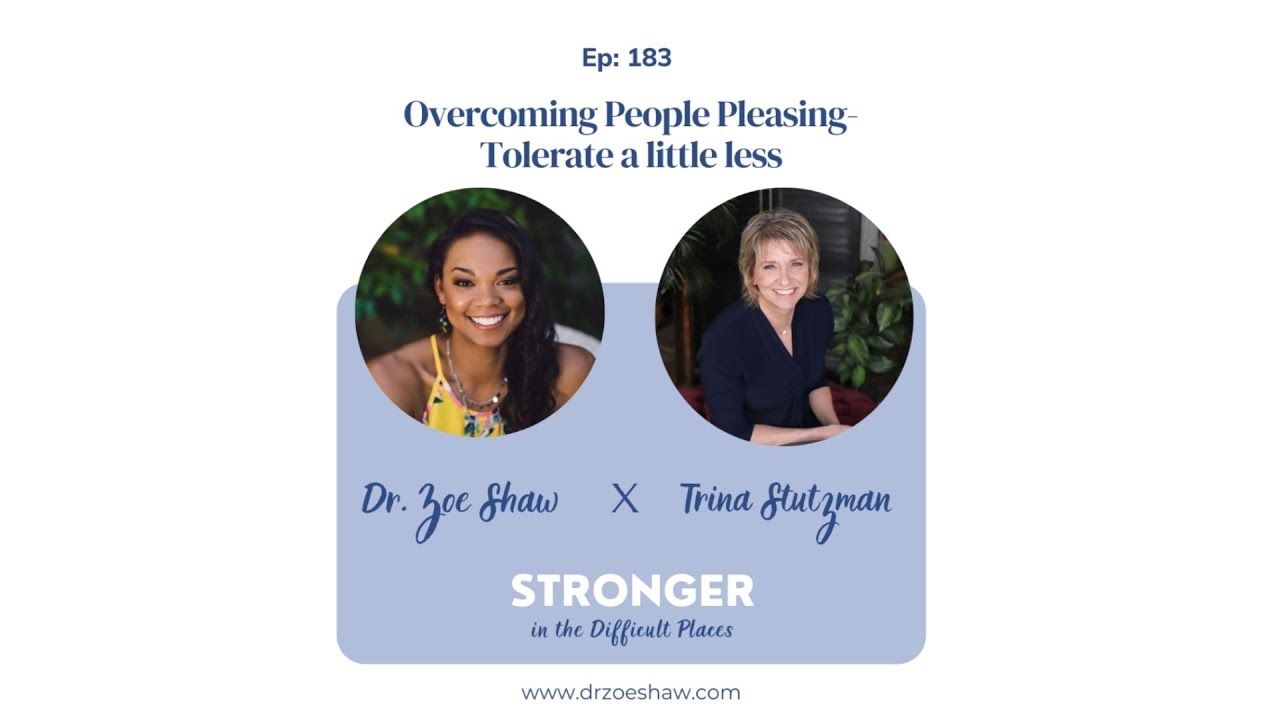
In this episode of the "Stronger in the Difficult Places" podcast, host Dr. Zoe Shaw welcomes guest Trina Saltzman, a trained lay minister, credentialed professional coach, and author of The 12 Steps to Overcome People Pleasing. The conversation opens with Dr. Shaw’s personal updates (book manuscript submission, family milestones) and a candid confession about a recent decision that challenged her own people‑pleasing tendencies. Trina shares her background growing up in a strict Mennonite community, her experience with thyroid cancer, and the breakdown of her marriage, illustrating how religious expectations and fear cultivated a lifelong habit of people‑pleasing. Together they define people‑pleasing as prioritizing others’ approval over one’s own feelings, which they describe as a form of self‑betrayal and lying. The dialogue explores the psychological roots (fear of rejection, “should” statements), early childhood examples (flushing an unwanted ice‑cream sandwich), and the emotional toll (guilt, shame, loss of intimacy). They introduce the 12‑step framework from Trina’s book, highlighting key steps such as waking up to self‑deception, noticing “shoulds,” making small choices with safe people, tolerating less, speaking truth, and “burning the box” of limiting self‑image. Practical strategies include setting boundaries, embracing uncomfortable discomfort, practicing “extraordinary mothering” toward oneself, and using community support through envisioned recovery groups like “Pleasers Anonymous.” Throughout, both hosts model vulnerability, encourage listeners to experiment with small, courageous actions, and emphasize that the journey requires messy, ongoing work but leads to greater authenticity, intimacy, and freedom.
Chapters
This is not a podcast about being broken, although you may have been. This is a podcast about strength for women who find themselves in difficult relationships, including that sometimes difficult one with yourself. We'll look at your relationship through a lens of psychology, faith, and a little dash of my own kind of feminism. We're not fixing them. We're fixing you. And that changes everything. Welcome to Stronger in the Difficult Places. Save yourself, heal your relationships. Listen in. Welcome. I'm your host, Dr. Zoe, and I'm so glad that you're here today. I've been MIA for the past couple of weeks. I did not intend to take a couple of weeks off the podcast. I knew the month of March was going to be crazy because we had so much going on, but here I am. I recorded this episode A couple of weeks ago, maybe a month ago, and I've just now listened to it again, and I'm excited to share it with you guys. I know there are a few people pleasers out there listening to my episodes, and I know that it will be helpful. I'm gonna do a quick win and fail. I usually don't before I have a guest, but it's been so long, I want to catch you guys up on all that's been going on. I have some big things going on. My book journey continues, and I so appreciate you who have been following my book journey. This memoir that I'm writing, which may become a self-help book. I'll tell you a bit about that. But my agent has submitted. I think I told you guys that we're on submission. We've got some interest from editors and are very excited. I'm very excited to be at the precipice of possibly selling this book. But I also know, as my great-grandmother would say, there's many a slip between the cup and the lip. So I'm not in a place of Feeling so excited, but I am definitely in hopeful anticipation that this book is going to become a reality, and that one day I will be sharing it with you amazing listeners who have been on this journey with me. I'm excited that you guys will get first dibs on the book. So I'm walking that journey. I'm trying to stay distracted, hoping to meet with some editors next week. And as a writer, you know, it's a frustrating place to be and exciting all at the same time. And my job is to start writing the next one. That's a win. My other win is my son has been accepted to a couple colleges, one that he really wanted to get into. The reality that he's going to be leaving in a number of months is hitting hard, just as my 16-year-old daughter is having her birthday on Monday. And we are going to the American Girl doll store for her 16th birthday. And I have to tell you, it's a little bittersweet. I love that on one level because she has special needs, you know, I get to have a little girl for longer. On the other level, I distinctly remember, you know, my other 2, my now 20-year-old and 18-year-old, and how fun the 16th birthday was because the driver's license, and we would get that and we'd get a car and all the exciting milestones that they should be hitting. It's a little bittersweet. That my 16-year-old daughter, you know, is not there and she won't be and she's fine. It's just her mama. It's just her mama. It reminds me of the poem Welcome to Holland, which my good friend just reminded me of, and I'm thankful for that, which is really a poem. I'm not going to read it. I've read it before on the episodes. The, the poem is really about learning to enjoy and see the beauty in the space where you are, even if it's not what you expected. So we've had some greats, you know, my son, we just had his Eagle Scout Court of Honor, which was a wonderful experience honoring him becoming an Eagle Scout, which has been a long journey. And as we go into this episode of people pleasing, I just want to share with you guys that I just made a really tough decision that pushes against all of my desire to people please. And I made a decision that was good for me and good for my family. But I know some people were upset with me for doing it. I had verbally committed to doing a project with a group of people coming up next weekend and quickly figured out that it was not going to work for me, that it would be not in my best interest and could possibly, you know, when I always look long-term, that it would do more harm than good for me to be in this project. And I backed out and I felt bad and I had all those nerves about backing out of a project when people are depending on me and when I verbally committed. But it was hard and I did it. And it's a win and a fail, a fail because I had to do it, a win because I did it. So I just wanted to share that with you as we walk into this people pleasing episode. Enjoy, Trina. You know, I rarely have, I don't think I've ever had a book on this podcast that I haven't read. And Trina's book just arrived on my doorstep a few days ago. Thank you, Trina. It, it got in early and I'm so excited to read it and I haven't yet, but yet I still wanna put this episode out because. Number one, I love her message. Number two, I love the title of her book. And as I look— listen back to this episode, it's so good, and she addresses a topic that is so pertinent to many women that we need to talk about it. And when I finish her book, I'll— I'm sure put it up on social and let you guys maybe even update it as a win of mine. So good to catch up with you. I'm glad things are settling down a bit with me now. Looking forward to more episodes, looking forward to connecting with you guys on Instagram. Settle in and listen to this great episode with Trina Saltzman on people pleasing. Trina, I am so, so excited to have you here today, especially because of what you just told me about your book. So I want to talk about that. Um, but first I'm going to give a bio for you guys listening. Trina Saltzman, she's a trained lay minister, a credentialed professional coach, and she helps women bridge the gap between longing for more and living a life that is fearlessly authentic and free. Love those words. And on top of that, she's just written— you probably wrote it a while ago, but it's just coming out. She is author of a new book called The 12 Steps to Overcome People Pleasing. Welcome.
Thank you so much, Dr. Zoe. It's such a privilege and honor to be on your show. And what great timing to be on here today when my book has It just arrived today. I have the package here. I haven't even opened it yet.
Ah!
It's my own personal copy to approve. And then the way the printing works now, it— we can make changes, and in 3 weeks it can be on Amazon. So I'm super excited. I called my kids, and I said, who wants to be here at 4:30 when I open this package? Because I am excited to share this labor of love with the world. And I feel so honored that I get to talk about it today.
Yeah, that is the most exciting. I was just telling you when that big box arrived on my doorstep and I opened it up and it's all my books. Wow. Yes. So exciting. So congratulations. And I'm great. I'm just grateful to be able to talk to you today.
Thank you.
So I haven't read your book, but when I saw the topic of your book, 12 Steps to Overcome People Pleasing, I'm like, I have to have her on my podcast. So I'm assuming that's your win. Can you share your fail with my audience?
Yes, my fail. It happened about a month and a half ago. And as you know, with working with the book and as a Coach, there are lots of ways that we can grow and build our businesses. And I had partnered with a person who I wanted them to take care of something for me. But after working with them, I realized it was something that only I could take care of.
And
I had entered into an agreement with them. And given them a good chunk of change. And I had to step into a hard conversation and say, you know, I just don't think this is working out. I'm not going to be able to honor the rest of our agreement. So that felt really hard and difficult. I really liked this person and, and thought that we would have a good relationship to get— working relationship, but it just didn't work out. So I had to step into a hard conversation and do what was best for me. So that was a fail and sort of a win.
Yeah, as I'm listening to it, I'm like, that sounds like a win.
It sounds like it was the money part. That was the hard part to swallow. But,
uh, yes, I've been there before. I hired someone, um, during a really busy time to write actually an article or 2 for my website. Is that what you did? Yes. And nobody can write like you, right? There are certain things that only you can do. And she was a great writer, but she— it wasn't my voice. And so I realized too, I realized then how important it is to make sure that I am only delegating things that are not my talent, that are not my, my zone of genius, right? Because nobody can do, can do what you do well. You just have to delegate all the other stuff.
Exactly.
Hard lesson, hard lesson, but still a win that you spoke up and you had the hard conversation. Maybe the people pleaser in you before
Yes,
done something different.
Would have kept the commitment because I said I thought I should, right? That word shows up a lot— should.
Oh, let's talk about should. Okay, so first, first, first, can you share with my audience what has your journey been in people pleasing?
What has my journey been? Well, I, like many people, I grew up in a strict religious community So it was strongly encouraged, you know, to live for others. So I grew up with this sense of wanting and needing to be liked and to be good, especially to be pleasing to God and to family around me.
Can I ask what religion it was?
Uh, Mennonite.
Oh, really?
I don't know if you know the Amish.
I do, I do. I grew up among some Mennonites. I, I grew up in, in Hagerstown, Maryland. Yes. Where, where did you grow up?
I'm in southeastern PA in a big Mennonite mecca in Lancaster. I didn't grow up in Lancaster. I'm 2 hours east of Lancaster, north of Philadelphia.
Oh my goodness. Wow.
Yes. So if you know anything about— well, my liberal Mennonite church now is on the other end of, you know, very conservative Amish, but we're all about community, and if we're all the same, then we're all one, and you know, we don't stray too far from the fold because that shakes things up a little bit.
Absolutely.
So that's kind of my, you know, grew up in that. And then I became a spouse of a pastor who was a pastor of a large Mennonite church. And in that journey, I, in my early 30s, I developed thyroid cancer. And that was a really pivotal time in my life because I wanted to figure out this dis-ease in my body. And obviously throat, thyroid is in your throat. And so I started looking at expressing myself more. So I've been on this recovering people-pleasing journey for a long time. And, um, the struggles in our marriage, uh, codependent relationship ended up my husband left the church. It was a very public separation.
Oh my.
And we had You know, really worked at, you know, making it work and worked on that relationship. But in the end, we were not able to, to continue that relationship. But in all of that, I became aware of, after I had cancer, this one word in the Bible that didn't seem to get a lot of attention. And that is in the 2nd commandment. It says to love God and love others as yourself.
So I just was speaking to somebody about that. Yes.
And this little word seems to get ignored. And I— and in my early struggles in my relationship, my therapist would say, you know, a friend would say, you know, anything that you do for yourself is bringing it back into balance because, you know, we hold others up so high and you're down here. Mm-hmm. So any move you make towards caring and loving yourself is just bringing it back into balance. It's loving your neighbor. as yourself. And so I really had to think that it's not selfish. And sometimes I get accused of preaching selfishness, but I'm really not preaching selfishness. I'm teaching self, you know, the self that— Yes. That God, Jesus speaks about in the greatest commandment. So it's, it's really been important for me to help people take care of themselves. And in my 20 years of coaching, I have seen, you know, the illnesses and the effects of stress and exhaustion And I've seen the lack of intimacy in relationships that people pleasers have because nobody knows us. You know, they see another version of us, but they don't really know us. You know, I had a friend that says, who are you? Like, you know, when we don't share our opinions, we don't share our needs, we really don't allow other people to see us. And so it's really been— my book is really an encouragement. I tell people, I help people stop lying, And tell the truth, because we need to tell the truth to ourselves and to others, um, the truth of where we're at and what we're, what we're feeling and who we are. So, um, being true to ourselves is, is, can help us to live rewarding and thriving lives when we're true to ourselves. So—
I have to say, Trina, I feel like you're speaking my language. All the things that you were saying, I've said so many times, the fact that when we are so concentrated on pleasing someone else, we aren't ourselves, and we're trying to get loved. And even when that person loves us, we don't even feel it because we know deep down they're not loving the real us, right?
Yes.
So we're sabotaging the very thing that we are trying to get by being people pleasing, by this codependency. So I think you've already done it, but can you just Give me a little definition of what is people pleasing.
What is people pleasing? It's when we prioritize other people's approval over our own feelings. So we prioritize other people's opinions of us, what they want of us, over our own feelings. And I— and we betray ourselves. We betray what we want to feel, right?
We want to—
I want to feel joy, but if I walk into a room feeling joy and somebody, you know, disapproves of something about me, you know, it's like I'm a balloon that gets deflated instantly.
So there's a— I love that definition, and I also loved what you said is that people pleasing essentially is lying to yourself and about who you are, right? And so stop lying to yourself.
My wake-up call was when a friend said, you're a liar.
Wow.
I'm like, yeah, you're right. I say it's okay when it's not okay, and I say yes when I mean no, and I say it's fine when it's not fine. Or I say, where do you want to go to eat? And I say wherever, and then the person chooses and I'm resentful. And it's— I'm, I'm not being honest. I'm not being real. I'm not being myself. And what is that about? And for me, it came down to Fear. Obviously, in my strict religious community, I didn't want to, you know, I didn't want God to be displeased with me. I didn't want my family to be displeased. And there was fear. I feared being judged. I feared being shamed. I wanted to belong. I mean, we had a strong need to belong. And my first people-pleasing experience happened in 2nd grade. I'd just gone to a new Christian school and I had won a coloring contest. And it should have been a really happy moment, but the prize was an ice cream sandwich.
Uh-huh.
And they sell ice cream sandwiches every day at lunch, but I didn't like ice cream sandwiches. And so instead of saying no thank you or giving it to a friend, I didn't have the agency or feel like I could do something with this prize, so I went into the bathroom and flushed it down the toilet.
Oh my goodness. Wow.
And the rest of the day I was This happy moment turned into this really afraid moment because I thought the toilet's going to overflow, people are going to find out. But why, why couldn't even at a young age I be mindful or have the wherewithal to give it back or do something else with it? But I wanted to hide that I didn't like it.
And not only—
I couldn't even say no thank you.
Right. And you couldn't even throw it in the trash. You had to try to flush it down so nobody could see it. Wow. That, that shows how deeply embedded that need to please, right? Be the perfect girl. So I'm gonna ask some difficult questions here. Okay. Um, you said, which I think is 100% accurate, that fear is really the driving factor in people pleasing. It's the fear of being rejected, the fear of not being loved, right? So you have developed strength, you have learned to honor yourself, to speak your truth. And you lost your marriage. So can you tell me, because a lot of women might be in this place of, but I don't, I don't want to speak up and lose the people that I love and lose my family, and people will leave me if I do that. Can you tell me about where you are on the other side of that, having in some ways lived out your biggest fear?
Yeah, I mean, I feel more alive than I've ever felt.
Mm-hmm.
Just because as a people pleaser, I give the analogy of like, if you've ever tried to keep a beach ball underwater, but it takes a lot of strength and energy to keep that ball under. And so as I've recovered from people pleasing, it's kind of like letting myself out, but also my feelings out. And as growing up religious, you know, in my German-Swiss background, we, you know, if you think of emotions like keys on a piano, you know, the low keys being, you know, deep, dark depression and, and the exhilaration and joy on the other end, we were kind of— had to play in the middle. Right. So we didn't feel a lot of joy, a little sadness, kind of just, you know. And so as I've worked on myself and being honest about how I'm feeling and being more real, I'm, I'm playing all the keys, but I can play all, you know, I can play the low keys and the high keys in a matter of 10 minutes. I can be crying one minute and happy the next, but it feels— I feel so much more alive, and I feel, I feel real, and I feel stepping into those hard places of fear, really trying to, you know, fear's never going to go away, but I, I'm— I've learned to, you know, recognize it as I'm doing important work, or fear would leave me alone, right?
Absolutely. Oh, thank you for sharing that. I was telling you before we started recording that I am a recovering people pleaser. And, you know, in my early marriage, there was a lot of dysfunction in my marriage, and I had that fear. And it wasn't until I could— I won't say let go, because I don't know that we ever let go of our fears. We choose to walk through them. So it wasn't until I was willing to walk through that fear that I could lose my marriage. Was— it wasn't until then that I was actually able to just feel free. And when I was able to say, okay, I accept that,
right?
I'm going to live, I'm going to speak my truth. And I'm going to accept that that can happen. Then all of a sudden, I did feel free. I didn't realize that burden of fear because fear traps us. It keeps us in very toxic, unhealthy situations.
Right.
Right. And we feel it's familiar. So okay, well, it's familiar. So I feel better here, even though it's unhealthy because I'm scared of what it looks like on the other side.
Right.
Yeah. Yeah. So I just wanted to speak to that. I wanted you to speak to that for a woman that's out here, out there in that place of fearing speaking up.
Yeah. And I think, you know, when we speak up, it gives the other person an opportunity to do something with what we say, right? It gives them a choice. And so as I started speaking up, Especially with boundaries, you know, the more that I saw somebody get upset with me when I set a boundary, the more I realized they were benefiting from my lack of boundaries.
Correct.
So I, so I kind of equated the more upset they got with the more I needed to set that boundary.
Right. And, and as you speak the truth, as you let go of people pleasing, you also find That you have deeper intimacy in your relationships.
Yes, I love, I love the— I don't know if you've heard of Matthew Kelly. He has a book called The 7 Levels of Intimacy, and he has a play on the word intimacy: into me see.
I love that.
That's so beautiful. And I've always said that our greatest need is to be known and loved. They say that's our greatest need, to be known and loved. And when we're people pleasing, We don't allow people to see into us.
Right.
And so it's really important work to start to, to show up, to show up and say, this is me, and this is what I think, and this is what I feel. And I have found that, you know, you say on the other side, you know, yes, I'm still— I still have a relationship with my former spouse. And, you know, it's all out on the table now. You know, it— I mean, it was before too, but, you know, he knows me and understands that this was for, you know, for both of us. It was for the best. It was a way that could help us both fly.
Absolutely.
You know, and we needed to be real with each other.
Yeah. Okay, so I wanna share some of those 12 steps with our audience. So people who are listening who are wondering, okay, what are these 12 steps? I'm a people pleaser. I hear your story. I hear Dr. Zoe's story. Now what? Now what do I do? You talked about wake up. Um, can you just share real quickly before we get into the steps, what does that look like, the wake-up regarding people pleasing?
I think it goes back to betraying yourself, and I kind of wanted to hit people over the head with that people pleasing is lying, you know, that we're betraying ourselves. And waking up is, is the awareness, as in all change, it begins with the first step of being aware. So aware that, yeah, you know what? I'm probably not being as honest as I could.
Yeah.
How can I be a little bit more honest? And you start to wake up and you start to— I guess that would be my first— one of my steps is paying attention to shoulds. And we talked about this.
Yes, shoulds.
The shoulds. And so many of us are guilt-ridden. And I tie the guilt back to something that we feel we should do.
Right.
And, you know, my religious background culturally as a Mennonite and in my, you know, my religious community, there's so many shoulds. As a mother, I'm a mother of 4 children, um, I have a list of shoulds. And no matter every— it just kept me stuck because I felt like there were so many things I should do. But my inner wisdom was saying, stop shoulding on yourself.
Yes.
You know, and start to pay attention. So Paying attention to the shoulds and really starting to see that you can change the should to could and start to see the choices that you have and how you respond.
So how do we do that? So there's a should, okay. I should be spending more time with my husband. I should be, you know, I shouldn't be exercising because I'm taking time away from my kids. I should be doing better at work. Like, so all those shoulds are there and you guys listening, I'm sure you can identify a ton of those for yourself. So now what? So I identified it. Okay, I'm a people pleaser. I see it. I'm actually lying to myself. I'm lying in my relationships. I'm accepting things I shouldn't. And I see those shoulds, but what do I do?
Well, I'd like to say, you know, I, I knew that it was a problem and I wanted to be a more strong, confident woman. So I started to need to make small choices with safe people.
Small choices with safe people. I like that. Uh-huh.
Small choices with safe people and practice showing up differently. Change the dance, as I say. How am I going to— you know, we're used to— you talked about comfort. Comfort isn't always healthy, you know, so we're comfortable. And so, you know, as people pleasers, how do we do it? We start to have to get comfortable being uncomfortable, and we have to test things, and we have to experiment. So small choices with safe people. Say, you know, I'm not, I'm not able to, you know, whatever. Make a choice,
right?
Make a choice.
Make a choice to go ahead and say no, even though it feels scary.
It's— and you're going to be uncomfortable. I mean, this whole journey is, is very, very uncomfortable. But, but like any worthwhile journey, you have to get comfortable being uncomfortable.
I'm so glad you said that because so many people will say, well, how do I How do I get over that fear? How do I stop being uncomfortable? And they want to get over the fear before they do the hard thing. And my answer is always, nope, doesn't work that way. You gotta feel it and you have to do it even though you're still gonna feel all those things. You're gonna feel guilt. You're gonna feel shame. You're gonna feel fear.
Right.
You have to know that on some level, they're your friend.
Yes.
They're a friend that you need to make because it's a necessity. But what you don't allow them to do is drive, right? Yeah, they're going to be your friend that sits in the back seat, right? And you're going to take them because they're a part of it until they no longer need to be, and then you can let them go. But you have to go with them. You can't leave them.
Exactly. And, and it's, it's kind of like fear always sits on the shoulder, but so does love, right? And so it's kind of that I'm going to lead with love and I'm going to trust that I have what I need in this unsafe place because back in 2nd grade, I didn't feel it was safe. And so you have to— I have to—
It wasn't.
Almost relearn how to step into these situations and trust that I'm going to be okay. I'm going to be okay. And that's where I had to go with my marriage and say that I'm gonna— you will be okay. You will be okay. It's gonna be so hard and difficult, but You know, you know, I was getting to the point where I didn't want to get sick again. You know, I didn't want to continue to carry something that was just, you know, unhealthy.
Right. You made a really great point about the fact that in 2nd grade, you didn't know how, right? And I just said that, that it wasn't healthy, really, for you to do that. And so for a woman listening, we have to honor how we got to where we are. Your people pleasing did not create itself in a vacuum. There were things in your life, there were, there were ways that you learned as a very smart person to live in your environment. And you needed to do that for some reason or another. And you developed that skill. And it was actually healthy because it was self-protective at that time. Right. But it's no longer needed. You don't need to do that anymore. You can survive and thrive without self-pleasing and it's healthy. It's healthy to do that. So thank you for saying that. So can you share, you don't have to share all 12 steps, but could you share a couple more steps with my listeners?
Yes. Um, step 11 is tolerate less.
Ooh, tell me about that.
Well, move the line of what we tolerate. People pleasers tolerate a lot. And I found myself a lot of times frustrated And I like the phrase, behind every frustration is a desire. So paying attention to those, those frustration points and looking at what it is that I desire, what it is that I want. Um, and I, I think for women as people pleasers especially, it's really difficult to admit what we want.
Even to ourselves.
Exactly, which is why we don't tell the truth.
Right. Emily P. Freeman talks about that, about how women tend to not even be willing to say what, what they want. And she, she gives you a practice of speaking what you want. I love that.
Yeah, because I think there probably was a time I spoke what I wanted, and maybe I was shamed for it or judged for it, and that didn't work, you know. And even in our relationships, you know, early on in my marriage, it was like What does that person do with what you need, you know? And if your needs are not continually being met, then it's hard to admit what you want because it's not safe, or you feel like it's not going to matter, so why bother? So, you know, it's important to see, to notice the points of frustration. And not that every frustration you need to speak it to somebody, but I think the biggest thing is really beginning to notice. Notice these things. Notice the shoulds. Notice What you're tolerating. And again, not totally give, you know, whatever it is that you're tolerating, you know, give it up tomorrow, but move the line of what you tolerate. Tolerate a little less. Pay attention to the desire behind the frustration.
I love that. Tolerate a little less. Beautiful. Thank you.
And not to judge yourself. I think early on, you know, you know, you, you know, even me saying that you're a liar, you might realize, oh my gosh, I just didn't say the truth there. I didn't say the truth there. But like, don't Judge that, you know, be— just, just notice. I had a wise spiritual teacher that said to me once, just notice, don't judge. Just notice that it's there. Don't beat yourself up on top of betraying yourself. Yes, that's beautiful.
That's, that's loving and caring for yourself and treating yourself like you would a friend.
Exactly.
Beautiful. Do you have another, another step to share with us?
I mean, Telling your truth is one of the steps. Just, you know, being honest. I had to get to really face my fears and to, you know, I did fear not wanting to be married and moving to California to be a spiritual guru. I have a son in California. I, you know, there's just being honest and naming that. I think for women, even in the church, you know, It's difficult to really express that you're struggling with fear.
Hmm. Can you, can you tell us the first time that you can remember that you told the truth when otherwise you might not have?
Oh, wow. I mean, what came to my mind was my first separation. I mean, that was a big, huge thing. And that, but that was very reactive, um, to a situation. And I just knew, I mean, I'll never forget how, how clear I was about that truth.
You mean when you asked your husband for a separation?
Yeah.
Okay. That was a big step. And
that was huge because at the time we were, you know, I've been trying to protect this perfect image of the church and in the church and You know, we, we looked like we had it all together. So, but I knew that, that I, it wasn't healthy for me to, to continue.
Thank you for sharing that. You know, it really, it has to get messy before it can get better. I talk to my clients a lot, especially the ones that are all buttoned up and everything's perfect on the outside and they are dying on the inside. And I talked to them about that closet. That, you know, the rest of your house is perfect and you've got that one closet and you have to open it. And when you open it and you start taking all the stuff out, it spills into the house and it's a mess, right? It's a big mess and you're taking all the junk out. But when you throw it all away and you go back in and you order it up, then you're not carrying that burden of that horrible, dirty, yucky closet. Exactly. It's doable, but it's got to get messy first.
Yeah, and I recently, you know, you've probably heard this, your mess is your message. You know, my mess is my message. You know, I, I, I was speaking at a church, actually my home congregation, went back to speak there, and this whole group of women, and I was talking about people pleasing, and I told them that there was a new recovery group in town, and, uh, it was called Pleasers Anonymous. And the whole group, it must have been, you know, almost 200 people raised their hand and said that they were going to be there. And I knew then that, you know, we need to be true to who God created us to be. We need to be true to ourselves, not in a, you know, as I said, a stuck-up, selfish kind of way, but just to honor and value others. We do it so naturally to other people.
We do.
You know, this, this nice idea Cheryl Richardson talks about, this extraordinary mothering to ourselves, you know, self-care is extraordinary mothering.
Mm-hmm.
We're so— many of us are so good at this extraordinary mothering to our children and to other people in our lives, but we rarely focus that extraordinary mothering on ourselves. And so, you know, continually asking myself, what do you— what do I need? You know, just like I'd say to my kids, what do you need? What can I get for you? Trying to practice that same. And that's one of the chapters in Loving Yourself Back to Life.
I love that.
Um, this idea of extraordinary mothering.
So People Pleasers Anonymous, I have not heard of that. Is that an actual thing?
That is my, that is my vision that this book will create recovery groups, 12 steps to overcome people pleasing, kind of the idea that creating little pods of, of people pleasers that really want to work at stepping into some of these hard, difficult places and doing that with the support of people around them. I had a friend who recently came to me and she said, I'm a badass mom in progress. You would be so proud of me. And that's really what I really— vision of these groups is, you know, we go, we, we have an idea, a little new dance step that we want to practice, and we, we go out and try it, and we know that we're going to come back and we're going to have a group that's going to help us process that. Because it, like I said, it can be, can be really uncomfortable.
Wow, I love that concept. I would definitely be referring some people there. Might show up once or twice myself. I love it. I love it. So thank you so much for coming on today. Is there any little nugget, any last thing you want to share with a woman who's in the space of feeling like, this is me, this sounds really scary, I don't want to totally upend my life, but I know that I need to do something because I know that I am a people pleaser. Is there one last thing you'd like to say to her?
You know, I wrote this book for the— to encourage that woman. You know, I really wanted to write a book that was relatable, um, that spoke of, of my courage to kind of burn the box, so to speak. That's one of the chapters. One of the steps is to burn the box of of being small and contained. And, um, you know, I have a prayer that I say frequently is, is, save me from all the good things that you don't want me to do.
Hmm, I love that.
There's so many good things that, that we can do for others and for our relationships with the Divine, and, and, but, but there needs to be a sense of save me from them. Because what's, what's the alternative to that is we become unhealthy, we have disconnected, disengaged relationships. I really want people to see each, each of us people pleasers. We have a lot to give, and by being another version of ourselves, we're not giving who, who we are to the world. So I really hope this book is an encouragement to, to people pleasers to show up. And to be true to who they are.
Thank you so much for sharing. That was beautiful. I'm excited to get the book. I'm going to be woohooing when it shows up on my doorstep. And I hope that listeners out there will get it as well.
Thank you so much, Dr. Zoe. It's a pleasure to be on your show.
Thank you. Thank you for listening to Stronger in the Difficult Places. New episodes New episodes go up on Tuesdays, generally. I'm not going anywhere, so keep listening in. Sign up for my email list so you can get my newsletters with encouragement, and hit me up on Instagram. I love to get a DM from you guys. Have a super strong week. Bye.
More from Dr.



The Epidemic of Not Enoughness: How It Shapes Your Relationships—and How to Break Free


You Can’t Change This (And Neither Can They): The Truth About Temperament in Relationships

What Do I Do When Overwhelming Shame Is Keeping Me From Seeking The Help I Truly Need?


